New Semester
Started
Get
50% OFF
Study Help!
--h --m --s
Claim Now
Question Answers
Textbooks
Find textbooks, questions and answers
Oops, something went wrong!
Change your search query and then try again
S
Books
FREE
Study Help
Expert Questions
Accounting
General Management
Mathematics
Finance
Organizational Behaviour
Law
Physics
Operating System
Management Leadership
Sociology
Programming
Marketing
Database
Computer Network
Economics
Textbooks Solutions
Accounting
Managerial Accounting
Management Leadership
Cost Accounting
Statistics
Business Law
Corporate Finance
Finance
Economics
Auditing
Tutors
Online Tutors
Find a Tutor
Hire a Tutor
Become a Tutor
AI Tutor
AI Study Planner
NEW
Sell Books
Search
Search
Sign In
Register
study help
sciences
college physics reasoning
College Physics Reasoning and Relationships 2nd edition Nicholas Giordano - Solutions
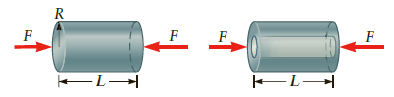
The steel cylinder in Figure P11.53A is replaced by a steel tube (Fig. P11.53B). The outer radius of the tube is R1 = 3.5 cm, and the inner radius is R2 = 1.5 cm. If the compressive force is F = 5000 N, by what amount??L is the tube compressed? Figure P11.53 A and B ? R F F F.
Two bars, one composed of aluminum and one of steel, are placed end to end as shown in Figure P11.56. The bars are both initially of length L = 25 cm, and both have a square cross section with h = 2.0 cm. If a compressive force F = 10,000 N is applied to each end, what is the change in length of
An aluminum sphere has a radius of 45 cm on the Earth. It is then taken to a distant planet where the atmospheric pressure P is much larger than on the Earth. If the sphere has a radius of 43 cm on that planet, what is P?
You want to use a steel cable to tow your car (m = 2000 kg). The cable is solid steel with a diameter of 1.0 cm and a length of 10 m. If you are pulling the car such that its acceleration is 1.5 m/s2, how much will the cable stretch?
A steel string (diameter 1.0 mm) of length 2.5 m hangs vertically. At the bottom of the string is a seat. When a child of mass m sits on the seat, she finds that the string stretches so that its new length is 1.8 mm longer than before. What is the mass of the child? Ignore the mass of the seat.
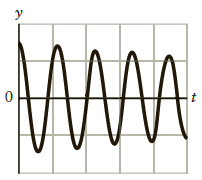
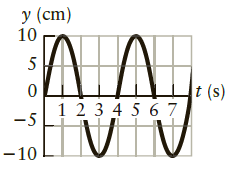
A damped harmonic oscillator is displaced from equilibrium and then released. The oscillator displacement as a function of time is shown in Figure P11.60. Is this oscillator under-damped or over damped? Figure P11.60 ? y t
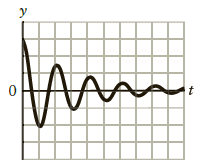
Figure P11.61 shows the displacement as a function of time for an under-damped harmonic oscillator. Estimate the fraction of the mechanical energy that is ?lost? to friction during one cycle. Figure P11.61 ? y
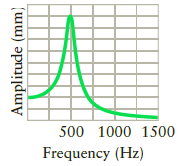
Figure P11.62 shows the amplitude as a function of frequency for a driven, damped oscillator. Estimate the resonant frequency. Figure P11.62 ? 500 1000 1500 Frequency (Hz) Amplitude (mm)
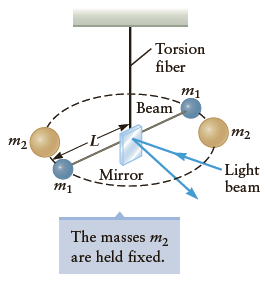
Consider a Cavendish apparatus that employs a torsion fiber with k = 1.0 × 10⁻⁸ N · m. Suppose the smallest twist angle that can be measured is θ = 2.0°. If the distance from one of the masses m1 to the torsion fiber is 10 cm (see Fig. 11.31), what is the smallest force F that can be measured?
Get new struts! A car with worn-out (under-damped) struts is observed driving over a dip in the road. The car bounces up and down a total of three times in a period of 5 seconds after hitting the dip. If an average automobile strut spring has a spring constant of 6.0 kN/m, what is the approximate
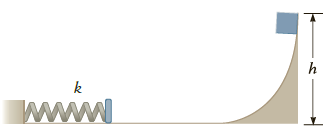
A mass of 5.0 kg slides down a friction less slope into a spring with spring constant k = 4.9 kN/m as depicted in Figure P11.65. (a) If the spring experiences a maximum compression of 20 cm, what is the height h of the initial release point? (b) What is the velocity of the mass when the
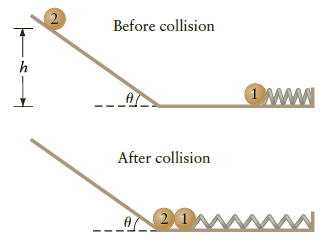
A mass of 3.5 kg is attached to a spring with spring constant k = 70 N/m. It is then compressed by 49 cm from its equilibrium position (Fig. P11.67, top) and released. At exactly the same time, an identical mass is released down a friction less slope inclined at angle θ = 40o from the horizontal,
The bumper on a car is made of flexible plastic so that it will compress on impact and “cushion” the car’s occupants during a collision. Suppose a car of mass m = 1200 kg is traveling slowly through a parking lot at 2.5 m/s when it strikes a brick wall. (a) What is the approximate value
Bobble-head. A football bobble-head figure sits on your car dashboard. The 85-g head of the figure is attached to a spring with spring constant k = 21 N/m (Fig. P11.69). You are driving along a straight road when you notice a series of hoses lying across the road, perpendicular to your motion, that
A solid rubber ball of radius 10 cm is submerged to 8.0 m beneath the surface of a lake. (a) If the bulk modulus of the rubber compound is Brubber = 4.0 × 10⁶ Pa, what is the diameter of the ball at that depth? (b) A similar ball of equal radius, but made of thin rubber inflated with
Air spring. The elasticity and bulk modulus of air can be measured using an apparatus consisting of a vertical glass tube and a ball bearing that just fits in the inner diameter of the tube. A 110-g ball bearing is dropped into the top of a 47-cm-high glass tube of diameter 3.0 cm. The ball is
Young’s modulus of granite is about 5.0 × 10¹⁰ Pa. Assuming the elastic limit of granite corresponds to a compression of 10%, estimate how tall a mountain would have to be for the granite at the bottom to just reach its elastic limit.
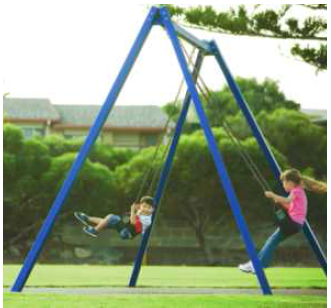
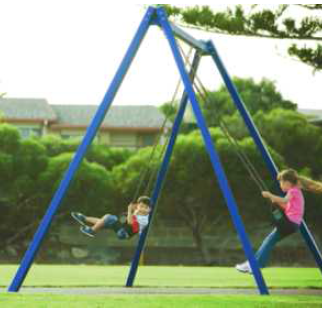
Two playground swings are side by side. The children using the swings notice that one of the swings (swing 1) has a period of exactly 4.5 s. They also find that when the first swing has completed 10 oscillations, the other swing (swing 2) has completed 11 oscillations. (a) Is swing 2 longer or
Two solid rods having the same length are made of the same material with circular cross sections. Rod 1 has radius r, and rod 2 has radius 2r. If a compressive force F is applied to both rods, their lengths are reduced by ΔL1 and ΔL2. Is the ratio ΔL1/ΔL2 (a) 4, (b) 2, (c) 1, (d) 1/2,
Consider a steel rod of diameter 5.0 mm and length 3.5 m. If a compressive force of 5000 N is applied to each end, what is the change in the length of the rod?
An aluminum bar has a length of 2.0 m and a rectangular cross section with sides of 3.5 mm and 6.9 mm. (a) What force is required to stretch the bar 1.2 mm? (b) What is the strain for this value of the stretch?
Consider one of the children in Figure P11.28. If she is swinging with a typical amplitude, what is her approximate maximum kinetic energy? Figure P11.28 ?
A mass-on-a-spring oscillator has m = 7.0 kg and k = 300 N/m and is oscillating with an amplitude of 12 cm. (a) If the value of the mass is increased by a factor of two but the amplitude is kept fixed, is the maximum potential energy the same, or is it different? (b) Find the original
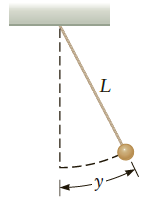
Consider a simple pendulum with L = 5.2 m and m = 3.3 kg. It is given an initial displacement y = +0.15 m (as measured along the circular arc along which it moves) and an initial velocity of +0.20 m/s. (a) What is the total mechanical energy of the oscillator? (b) What is the amplitude of
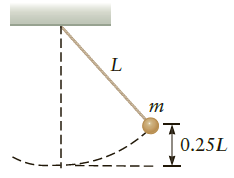
A simple pendulum has a length L and a mass m. At its highest point, the pendulum mass is 0.25L above its lowest point (Fig. P11.42). What is the speed of the mass when it is at its lowest point? Express your answer in terms of m, L, and g. Figure P11.42 ? 0.25L
Consider a simple pendulum with L = 1.2 m and m = 2.0 kg. Suppose the mass is initially at rest at the lowest point on its trajectory when it is given an impulse such that it then has a velocity of 0.10 m/s. What is the total mechanical energy of the oscillator?
Consider a simple pendulum of length 1.2 m with m 2.0 kg. If the amplitude of the oscillation is 0.15 m (as measured along the circular arc along which it moves), what is the total mechanical energy of the oscillator?
The position of a simple harmonic oscillator is given by y = A sin(2pft), with f = 400 Hz. Find a value of t at which the potential energy is one quarter of its maximum value.
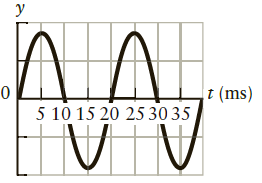
Consider a simple harmonic oscillator whose position as a function of time is given by Figure P11.38. At what times in this plot is the kinetic energy a maximum? At what time(s) is the potential energy a maximum? Figure P11.38 ? y t (ms) 5 10 15 20 25 30 35
A particle attached to a spring with k = 50 N/m is undergoing simple harmonic motion, and its position is described by the equation x = (5.7 m)cos(7.5t), with t measured in seconds. (a) What is the mass of the particle? (b) What is the period of the motion? (c) What is the maximum
The position of a mass-on-a-spring oscillator is given by y = A sin(25t), where the value of t is in seconds and A = 0.35 m. (a) What is the maximum kinetic energy of an oscillator of mass 1.7 kg? (b) Suppose the amplitude is increased so that the maximum kinetic energy is doubled. What
Discuss the difference between the Young’s modulus of a material and the strength of a material. Does a large value of Y guarantee a strong material?
Arrange these materials according to their Young’s modulus from smallest to largest: (a) Jell-O, (b) steel, (c) wood, (d) diamond.
The windshield wipers on your car are an example of periodic motion. What is the approximate period of the motion?
In Chapter 3, we learned how the apparent weight of a person in an elevator depends on the acceleration of the elevator. Consider a simple pendulum that is placed in an elevator. Does the elevator’s acceleration affect the pendulum’s period? If the pendulum is accelerating downward with
Many musicians use a metronome to help keep time when playing music. Some metronomes use a simple pendulum. If a metronome clicks 100 times per minute, what is the length of the pendulum?
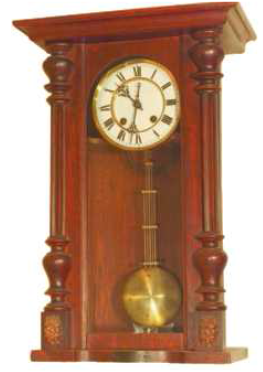
Pendulum clocks use a pendulum to keep time (Fig. Q11.15). This type of clock can be adjusted by varying the length of the pendulum. How should the length be adjusted in the following cases? Figure Q11.15 ? (a) The clock is running slow.(b) The clock is running fast.(c) The clock is running fine at
Derive the frequency of oscillation of a torsional oscillator, Equation 11.20. Consider how the restoring force depends on the twist angle and use Newton?s second law for rotational motion (? = I?). (11.20) 2T VI
Use energy considerations to derive the oscillation frequency for a mass-on-a-spring oscillator. The maximum potential energy stored in the spring must be equal to the maximum kinetic energy of the mass.
In Section 11.3, we discussed the total mechanical energy of a mass-on-a-spring oscillator. The result in Equation 11.21 shows that the total energy is proportional to the square of the amplitude. Derive the corresponding results for the total mechanical energy of a simple pendulum and for a
Make a sketch of how the position and kinetic energy of a harmonic oscillator vary with time. The period of the oscillations of KE can be determined from the separation in time of adjacent maxima in your KE sketch. Show that the frequency of the KE oscillations is equal to twice the frequency of
Two solid rods are made of the same material and have the same cross-sectional areas, and their lengths differ by a factor of two. If a compressive force F is applied to both, what is the ratio of their changes in length?(a) The longer rod changes length by more, by a factor of two.(b) The shorter
Two metal rods with the same length and cross-sectional area are both subjected to a compressive force F. If the length of rod 1 changes by more than the length of rod 2, which one has the larger Young’s modulus?
When a group of marching soldiers reach a bridge, they often “break stride” and do not walk “in step” across the bridge. Explain why.
A basketball player dribbles the ball as she moves along the court. What is a typical value for the frequency of this oscillatory motion?
A car mounted on struts is like a mass on a spring. If you ignore damping, how will the frequency of the oscillations change if passengers (or a heavy load) are added to the car? Will the frequency increase, decrease, or stay the same?
If a spring with spring constant k0 is cut in half, what is the spring constant of one of the pieces?
Consider a simple pendulum that is used as a clock. (a) What should the length of the pendulum be to make one oscillation (one “tick” of the clock) every second when it is at sea level? (b) Will this clock “speed up” or “slow down” when it is taken to the top of Mount
Design an experiment to measure the torsion constant k of a torsion fiber. The value of k is needed in the analysis of the Cavendish experiment
A mass hangs from a vertical spring and is initially at rest. A person then pulls down on the mass, stretching the spring. Does the total mechanical energy of this system (the mass plus the spring) increase, decrease, or stay the same? Explain your answer.
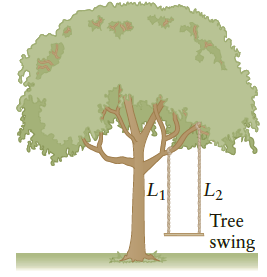
A friend of yours is asked to design a swing using two ropes attached to the branch of a tree, and he shows you the design as sketched in Figure Q11.1. Explain why this design will not work very well. That is, why it is important that both of the ropes be the same length?Figure Q11.1 L2 L1 Tree
A mass-on-a-spring system has spring constant k = 400 N/m and mass m = 0.50 kg. (a) If it is given an initial displacement of 0.25 m and then released, what is the initial potential energy of the oscillator? (b) What is the maximum kinetic energy of the oscillator?
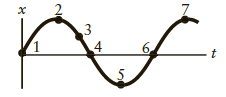
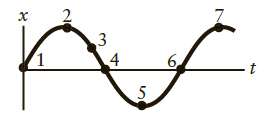
Figure P11.4 shows the position as a function of time for a mass attached to a spring. At what points are? Figure P11.4 ? (a) The magnitude of the momentum of the mass largest,? (b) The kinetic energy largest,? (c) The potential energy largest, and? (d) The total energy largest? 3 4 -t 5
The cone of a loudspeaker oscillates with an amplitude of 2.0 mm. If the frequency is 2.5 kHz, what are the maximum velocity and the maximum acceleration of the cone? Assume the speaker cone moves as a simple harmonic oscillator.
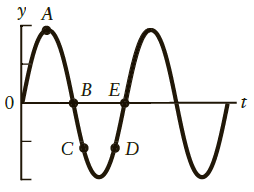
Figure P11.32 shows the displacement of a mass on a spring as a function of time.? Figure P11.32 ? (a) At what point is the acceleration positive and the velocity negative?? (b) Are there any times during the oscillation when the acceleration and the velocity are both positive and nonzero? y A BE C
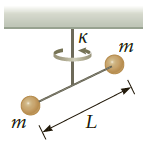
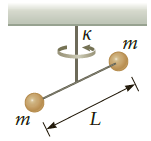
Consider a torsional oscillator like the one in Figure P11.30 and suppose it has a frequency of 0.045 Hz. If the length of the rod is increased by a factor of three, what is the new frequency of the oscillator? Figure P11.30 ? K m m L
Consider the torsional oscillator in Figure P11.30. The rotating mass consists of two small spheres, each of mass m = 2.0 kg, that are attached to the ends of a mass less rod of length L = 1.5 m. The frequency of this torsional oscillator is found to be 0.035 Hz. What is the value of the torsion
A torsional oscillator has a moment of inertia of 4.5 kg · m2 and a torsion constant k = 0.15 N · m. What is the frequency of the oscillator?
What is the approximate period of one of the swings in Figure P11.28? Figure P11.28 ?
The length of a simple pendulum is increased by a factor of three. By what factor does the frequency change?
A simple pendulum uses a steel wire as the “string.” The length of this wire is 1.5 m at room temperature. If the temperature is increased by 10°C, the length of the wire increases by 0.18 mm. What is the change in the period of the pendulum?
A simple pendulum has a period of 2.5 s on the Earth. An astronaut then takes it to the surface of the Moon. What period does the astronaut measure there?
A simple pendulum has a length of 2.5 m and is pulled a distance y = 0.25 m to one side and then released (Fig. P11.24).? Figure P11.24 ? (a) What is the speed of the pendulum when it passes through the lowest point on its trajectory?? (b) What is its acceleration in the direction along its
A simple pendulum oscillates with a period of 3.5 s. What is its length?
Consider a simple pendulum that consists of a rock of mass 3.5 kg tied to the end of a (massless) string of length 1.5 m.(a) What is the frequency of the pendulum?(b) What is the period of the pendulum?
Estimate the maximum acceleration of a bungee jumper. Is it larger or smaller than the acceleration due to gravity during free fall? Example 11.3 gives values for several quantities that may be useful. Assume the bungee cord acts as a simple spring (which is not quite realistic) and that the mass
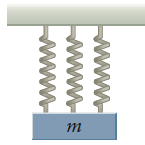
Consider the mass-on-a-spring system in Figure P11.20. Three identical springs, with the same spring constant k = 40 N/m, are used to connect the mass (m = 20 kg) to a ceiling. What is the frequency of this simple harmonic oscillator? Figure P11.20 ? m www www www
A mass-on-a-spring system has m = 50 kg and k = 200 N/m. The mass is pulled a distance 0.25 m from its equilibrium position and then released. (a) What is the maximum acceleration of the mass? (b) What is its maximum velocity?
Estimate the spring constant for a trampoline. Assume a person is standing on the trampoline and oscillating up and down without leaving the trampoline. Begin by estimating the mass of the oscillator and the period of the motion.
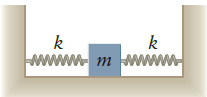
A mass m = 2.4 kg is attached to two springs as it slides along a friction less floor, while the springs are fastened to two walls as shown in Figure P11.17. The springs both have k = 400 N/m and are both in their relaxed states (un-stretched and uncompressed) when the mass is centered between the
A mass m = 4.5 kg is attached to a vertical spring with k = 200 N/m and is set into motion. (a) What is the frequency of the oscillation? (b) If the amplitude of the oscillation is 3.5 cm, what is the maximum value of the velocity? (c) How long does it take the mass to move from y =
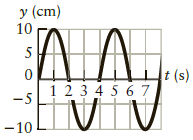
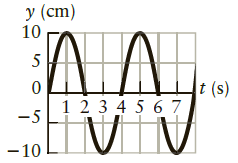
Suppose Figure P11.3 describes the displacement of a masson- a-spring harmonic oscillator.? Figure P11.3 ? (a) If the mass is m = 2.0 kg, what is the spring constant?? (b) Estimate the velocity at t 4.0 s and at 5.0 s.? (c) Estimate the acceleration at 1.5 s.? (d) Estimate the maximum acceleration.
A child plays on a bungee cord and oscillates with a certain frequency f. An adult with a mass that is five times greater than that of the child then uses the same bungee cord. What is the ratio of the frequency with the adult to the frequency with the child?
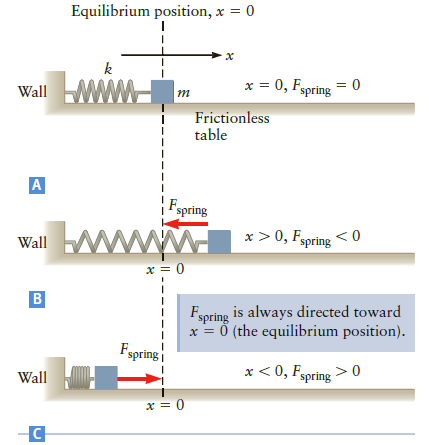
Consider the mass on a spring in Figure 11.6. If the spring constant is k = 30 N/m and the mass is m = 2.5 kg, what is the period? Figure 11.6 0 Wall x =" alt = "Consider the mass on a spring in Figure 11.6. If" alt = "Consider the mass on a spring in Figure 11.6. If" class="fr-fic fr-dii">
The period of oscillation for a mass-on-a-spring system is 0.22 s. If m = 3.5 kg, what is the spring constant of the spring?
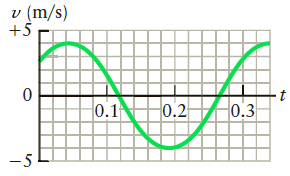
Figure P11.11 shows the velocity of a simple harmonic oscillator as a function of time.? (a) Estimate the position when v = 0.? (b) Estimate the frequency. Figure P11.11 ? v (m/s) +5 0.1 0.2 t 0.3 -5
A simple harmonic oscillator has a frequency of 300 Hz and an amplitude of 0.10 m. What is the maximum velocity of the oscillator?
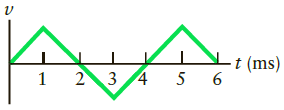
Figure P11.9 shows the velocity as a function of time for an oscillator. Is it a simple harmonic oscillator? Explain why or why not. What is its frequency? Figure P11.9 ? Li (ms) 5 6 1 234
The displacement of a harmonic oscillator is given by y = 7.1 sin(48t), where the units of y are meters and t is measured in seconds. Give three values of t at which the oscillator has (a) Its largest (and positive) displacement and (b) Its largest (and positive) velocity.
The displacement of a harmonic oscillator is given by y = 9.4 sin(15t), where the units of y are meters and t is measured in seconds. What is its maximum velocity?
The displacement of a harmonic oscillator is given by y = 3.4 sin(25t), where the units of y are meters and t is measured in seconds. Find (a) The amplitude(b) The frequency.
(a) For the simple harmonic oscillator in Figure P11.3, estimate the velocity at t = 4.0 s and at 7.0 s.? Figure P11.3 ? (b) At what time(s) does the velocity have its largest positive value? у (cm) 10 5 t (s) 1 2 3 4 5 6 7 -5 -10
Figure P11.4 shows a plot of the position as a function of time for a particle undergoing simple harmonic motion. Identify the following points on this graph:? (a) Where is the speed largest?? (b) Where is the velocity positive with its magnitude being largest?? (c) Where is the magnitude of the
Figure P11.3 shows the displacement of a simple harmonic oscillator as a function of time. (a) Find the period, frequency, and amplitude of the oscillator.? (b) At what time(s) does the acceleration have its largest positive value?? (c) When does the acceleration have its most negative
A person’s heart beats 70 times in 1 minute. What is the average frequency of this oscillation?
A simple harmonic oscillator takes 15 seconds to undergo 25 complete oscillations. (a) What is the period of the oscillator? (b) What is the frequency of the oscillator?
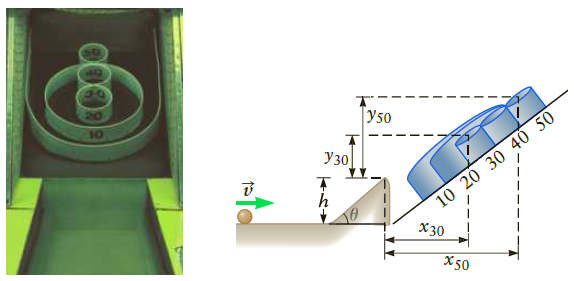
Skee Ball amusement. The popular arcade sport of Skee Ball involves bowling a wooden ball 3 in. (7.6 cm) in diameter down an alley 9 ft long, where the ball is then launched off a short ramp as shown in Figure P9.68. Highest points are awarded to those who can launch the ball such that it lands in
Halley’s comet moves about the Sun in a highly elliptical orbit. At its closest approach, it is a distance of 8.9 × 10¹⁰ m from the Sun and has a speed of 54 km/s. When it is farthest from the Sun, the two are separated by 5.3 × 10¹² m. Find the comet’s speed at that point in its orbit.
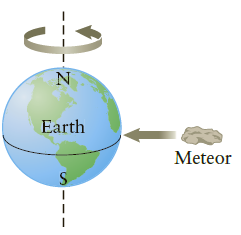
A meteor with a volume of 1.0 km3 strikes the Earth at the equator as shown in Figure P9.48, and all the fragments stick to the surface.? (a) What is the magnitude of the change in the angular momentum of the Earth?? (b) What is the change in the length of the day? Assume the average density of the
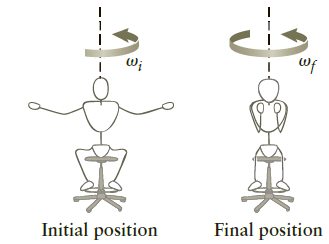
Repeat Problem 43, but now assume the person is holding a 5.0-kg mass in each hand. Data from Problem 43 Consider a person who is sitting on a friction less rotating stool as in Figure P9.43. The person initially has his arms outstretched and is rotating with an angular speed of 5.0 rad/s. He then
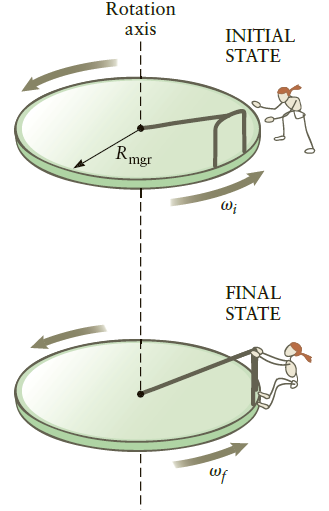
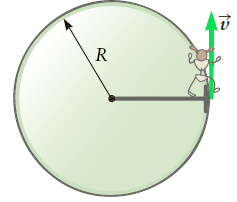
A child of mass 50 kg jumps onto the edge of a merry-go-round of mass 150 kg and radius 2.0 m that is initially at rest as sketched in Figure 9.12. While in the air (during her jump), the child?s linear velocity in the direction tangent to the edge of the merry-go-round is 10 m/s. What is the
A bug of mass 3.0 g is sitting at the edge of a CD of radius 8.0 cm. If the CD is spinning at 300 rpm, what is the angular momentum of the bug?Concerned with the magnitude of the angular momentum, not its sign.
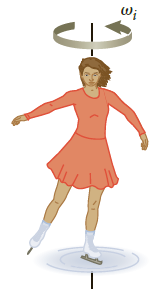
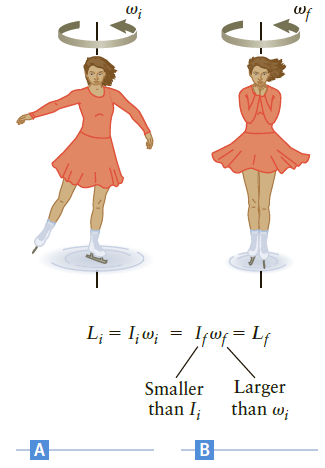
A figure skater begins a spin at an angular velocity of 200 rpm with her arms and legs out away from her body (Fig. 9.11A). She then pulls her arms and legs in close to her body, and her angular velocity increases. Estimate her final angular velocity. Concerned with the magnitude of the angular
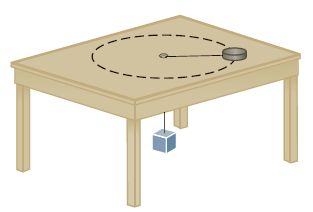
A puck (mass m1 = 0.50 kg) slides on a friction less table as shown in Figure P9.39. The puck is tied to a string that runs through a hole in the table and is attached to a mass m2 = 1.5 kg. The mass m2 is initially at height h = 1.5 m above the floor with the puck traveling in a circle of radius r
A child (m = 40 kg) is playing on a merry-go-round (m = 200 kg, R = 2.0 m) that is initially at rest. The child then jumps off in a direction tangent to the edge of the merry-go-round as shown in Figure P9.38. The child has a speed of 5.0 m/s just before she lands on the ground.? (a) Identify a
Estimate the angular momentum of a figure skater of mass 50 kg who is spinning at 300 rpm (Fig. 9.11). Assume her arms and legs are pulled in very close to her rotation axis. Concerned with the magnitude of the angular momentum, not its sign. Figure 9.11 ? Wf L¡ = I;w; !rw; = Lf Smaller Larger
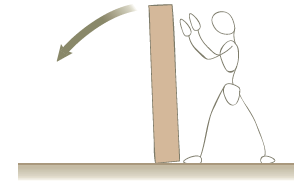
An empty bookcase (total mass 10 kg) is accidentally tipped over (Fig. P9.30). If it is given only a very gentle initial push, what is the speed of the top edge of the bookcase just before it strikes the floor? Figure P9.30
A cylinder of mass 7.0 kg and radius 0.25 m rolls without slipping along a level floor. Its center of mass has a speed of 1.5 m/s. Find (a) The kinetic energy of translation and (b) The kinetic energy of rotation.
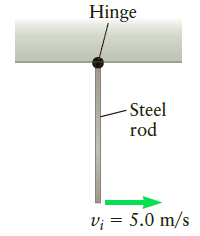
A rod of mass 4.0 kg and length 1.5 m hangs from a hinge as shown in Figure P9.28. The end of the rod is then given a ?kick? so that it is moving at a speed of 5 m/s. How high will the rod swing? Express your answer in terms of the angle the rod makes with the vertical. Figure P9.28 Hinge - Steel
Suppose the table in Figure P9.26 is extremely slippery so that there is no friction between the table and the end of the pencil. As a result, the pencil slips as it tips over. Let ?no friction denote the angular velocity of the pencil just before it hits the table, and vfriction denote the angular
Showing 3800 - 3900
of 4913
First
32
33
34
35
36
37
38
39
40
41
42
43
44
45
46
Last
Step by Step Answers

 Get 50% OFF
Claim Now
Get 50% OFF
Claim Now