New Semester
Started
Get
50% OFF
Study Help!
--h --m --s
Claim Now
Question Answers
Textbooks
Find textbooks, questions and answers
Oops, something went wrong!
Change your search query and then try again
S
Books
FREE
Study Help
Expert Questions
Accounting
General Management
Mathematics
Finance
Organizational Behaviour
Law
Physics
Operating System
Management Leadership
Sociology
Programming
Marketing
Database
Computer Network
Economics
Textbooks Solutions
Accounting
Managerial Accounting
Management Leadership
Cost Accounting
Statistics
Business Law
Corporate Finance
Finance
Economics
Auditing
Tutors
Online Tutors
Find a Tutor
Hire a Tutor
Become a Tutor
AI Tutor
AI Study Planner
NEW
Sell Books
Search
Search
Sign In
Register
study help
sciences
college physics reasoning
College Physics Reasoning and Relationships 2nd edition Nicholas Giordano - Solutions
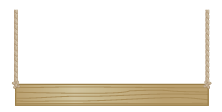
A long, non-uniform board of length 8.0 m and mass m = 12 kg is suspended by two ropes as shown in Figure P8.83. If the tensions in the ropes are mg/3 (on the left) and 2mg/3 (on the right), what is the location of the board???s center of mass? Figure P8.83 ?
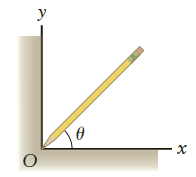
The end of a pencil of mass m and length L rests in a corner as the pencil makes an angle θ with the horizontal (x) direction (Fig. P8.82). If the pencil is released, it will rotate about point O with an acceleration α1. Suppose the length of the pencil is increased by a factor of two but its
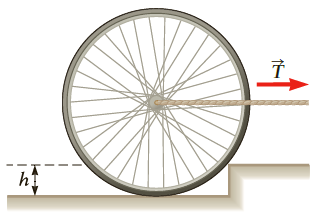
A wheel of mass 11 kg is pulled up a step by a horizontal rope as depicted in Figure P8.81. If the height of the step is equal to one-third the radius of the wheel, h = 1/3 R, what minimum tension is needed on the rope to start the wheel moving up the step? The wheel will start to move just as the
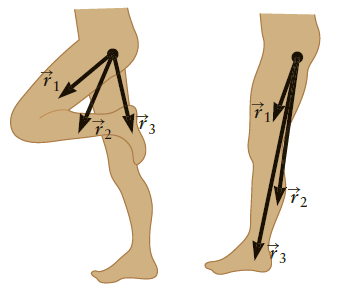
Runner???s gait. The amount of torque required by an external applied force (other than gravity) to move a leg forward is less than that required to move it backward if the leg is bent as shown in Figure P8.80. The lengths of the vectors r(vector)1, r(vector)2, and r(vector)3indicate the position
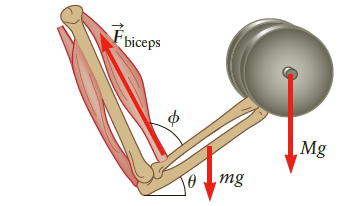
A bodybuilder is in training and performs curls with a 10-kg barbell to strengthen her biceps muscle. At the top of the stroke, her arm is configured as in Figure P8.79, with her forearm at 35° with respect to the horizontal. Approximate her forearm and hand as a uniform rod of mass 1.4 kg and
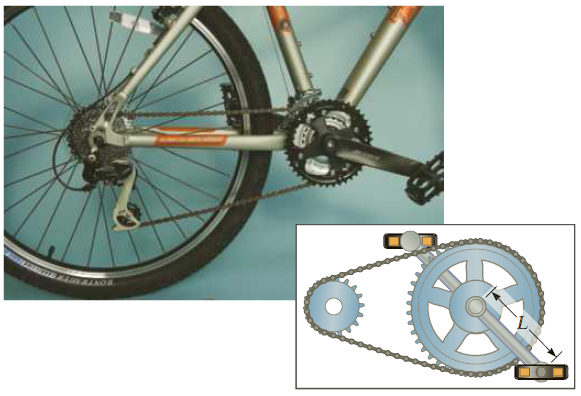
Bicycles like the one shown in the photo in Figure P8.78 typically have 24 possible gear ratios (three gears on the front and eight on the back). Suppose the diameters of the largest and smallest sprockets are 17 cm and 9.0 cm on the front cluster and 11 cm and 5.0 cm on the rear cluster. The inset
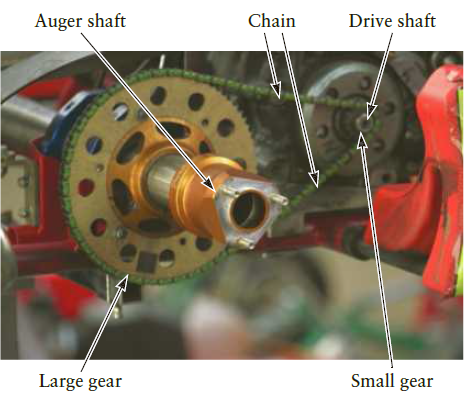
A chain drive (Fig. P8.77) transfers the rotational motion of a tractor transmission to a grain elevator. The drive shaft places a counterclockwise torque on the small sprocket of radius 2.2 cm so that it can overcome the resistance in the mechanism of the auger, which puts a clockwise torque of
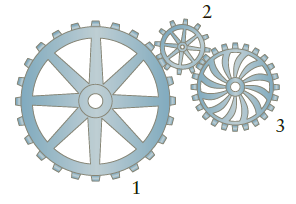
Three gears of a mechanism are meshed as shown in Figure P8.76 and are rotating with constant angular velocities. The ratio of the diameters of gears 1 through 3 is 3.5/1.0/2.0. A torque of 20 N · m is applied to gear 3. If gear 2 has a radius of 10 cm, what is the torque on gears 1 and 2? Figure
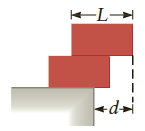
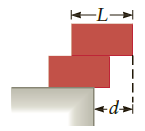
Consider again the problem of overhanging bricks in Figure P8.74. Find the maximum overhang distance d for systems of (a) three bricks and (b) four bricks. (c) How many bricks are needed for the top brick to have an overhang of d = 2L? Figure P8.74 ? -L-
Two bricks of uniform density are stacked as shown in Figure P8.74. What is the maximum overhang distance d that can be achieved? Consider how the torque on each brick???s center of mass must be in equilibrium about the balance point (the edge of the ledge). Figure P8.74 ? -L-
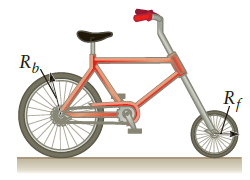
The wheels on a special bicycle have different radii Rfand Rb(Fig. P8.73). The bicycle starts from rest at t = 0 and accelerates uniformly, reaching a linear speed of 10 m/s at t = 9.0 s.? (a) What is the bicycle???s linear acceleration? (b) At t = 4.5 s, the angular speed of the back wheel is 11
A car has a top speed of 70 m/s (about 150 mi/h) and has wheels of radius 30 cm. If the car starts from rest and reaches its operating speed after 9.0 s, what is the angular acceleration of the wheels? Assume the car accelerates uniformly.
The wheel of an adult’s bicycle rolls a distance of 3.0 km. Approximately how many revolutions does the wheel make during this journey?
A truck accelerates from rest to a speed of 12 m/s in 5.0 s. If the tires have a radius of 40 cm, how many revolutions do the tires make during this time?
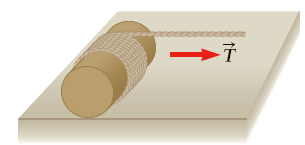
A string is rolled around a cylinder (m = 4.0 kg) as shown in Figure P8.69. A person pulls on the string, causing the cylinder to roll without slipping along the table. If there is a tension of 30 N in the string, what is the acceleration of the cylinder? Figure P8.69 ?
A cylinder rolls without slipping down an incline that makes a 30° angle with the horizontal. What is the acceleration of the cylinder?
Consider a tennis ball that is hit by a player at the baseline with a horizontal velocity of 45 m/s (about 100 mi/h). The ball travels as a projectile to the player’s opponent on the opposite baseline, 24 m away, and makes 25 complete revolutions during this time. What is the ball’s angular
A car is traveling with a speed of 20 m/s. If the tires have an angular speed of 62 rad/s, what is the radius of the tires?
A car starts from rest and then accelerates uniformly to a linear speed of 15 m/s in 40 s. If the tires have a radius of 25 cm, what are the magnitudes of (a) The average linear acceleration of a tire, (b) The angular acceleration of a tire, (c) The angular displacement of a tire
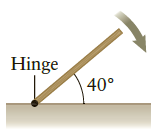
A board of length 1.5 m is attached to a floor with a hinge at one end as shown in Figure P8.64. The board is initially at rest and makes an angle of 40° with the floor. If the board is then released, what is its angular acceleration?? Figure P8.64 ? Hinge 40°
A Ferris wheel is moving at an initial angular velocity of 1.0 rev/30 s. If the operator then brings it to a stop in 3.0 min, what is the angular acceleration of the Ferris wheel? Express your answer in rad/s2. Through how many revolutions will the Ferris wheel move while coming to a stop?
You like to swim at a nearby lake. On one side of the lake is a cliff, and the top of the cliff is 6.5 m above the surface of the lake. You dive off the cliff doing somersaults with an angular speed of 2.2 rev/s. How many revolutions do you make before you hit the water? Assume your initial center
Consider again the DVD in Problem 60. As was explained in Example 8.2, the data on the DVD are encoded in a long spiral “track,” where the spacing between each turn of the track is 0.74 mm and the inner and outer radii of the program area are about 25 mm and 58 mm, respectively. Estimate the
Consider the DVD in Example 8.2. This DVD player is turned on at t - 0 and very quickly starts to play a video so that the DVD has an angular velocity of 1500 rpm just a few seconds after t - 0. The DVD then plays for 2 hours, during which time it has constant angular acceleration and a final
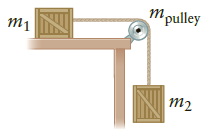
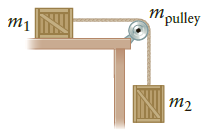
For the system in Figure P8.58, if the coefficient of friction between crate 1 and the table is µK= 0.15, what is the acceleration? Figure P.58 ? mpulley m1 m2
Two crates of mass m1= 15 kg and m2= 25 kg are connected by a cable that is strung over a pulley of mass mpulley= 20 kg as shown in Figure P8.58. There is no friction between crate 1 and the table. (a) Make a sketch showing all the forces on both crates and the pulley. (b) Express Newton???s second
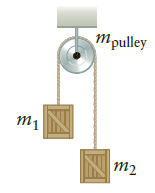
Two crates of mass 5.0 kg and 9.0 kg are connected by a rope that runs over a pulley of mass 4.0 kg as shown in Figure P8.57.? (a) Make a sketch showing all the forces on both crates and the pulley.? (b) Express Newton???s second law for the crates (transnational motion) and for the pulley
Construct a graph of the angular velocity of a car wheel as a function of time. (a) Assume the wheel starts from rest and moves with a constant (center of mass) velocity. (b) Assume the car starts from rest and accelerates uniformly. (c) Assume the car comes to a stop uniformly at a
A potter’s wheel of radius 0.20 m is turned on at t = 0 and accelerates uniformly. After 60 s, the wheel has an angular velocity of 2.0 rad/s. Find the angular acceleration and the total angular displacement of the wheel during this time.
Construct a plot of the angular displacement of a CD as a function of time. Use information from this chapter to attach quantitative labels (numbers and units) to your graph. Take t = 0 to be the time when the CD player is first turned on. End your graph when the CD player is turned off and the CD
A ceiling fan of radius 45 cm runs at 90 rev/min. How far does the tip of the fan blade travel in 1 hour?
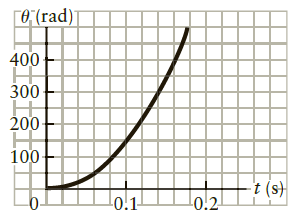
Figure P8.52 shows the angular displacement of an object as a function of time. (a) What is the approximate angular velocity of the object at t = 0? (b) What is the approximate angular velocity at t = 0.10 s?? (c) Estimate the angular acceleration at t = 0.050 s. Figure P8.52 ? [0 (rad) 400 300
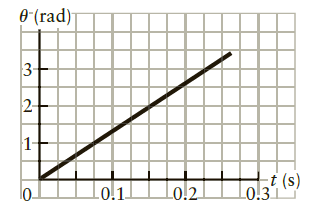
Figure P8.51 shows the angular displacement of an object as a function of time. What is the approximate angular velocity of the object? Figure P8.51 ? 0 (rad) 1- 0!2 t (s) 0.31 10- 0.1 3. 2.
Estimate the moment of inertia of a baseball bat for the following cases. (a) Assume the bat is a wooden rod of uniform diameter and take the pivot point to be (i) in the middle of the bat, (ii) at the end of the bat, and (iii) 5 cm from the end of the handle, where a batter who “chokes
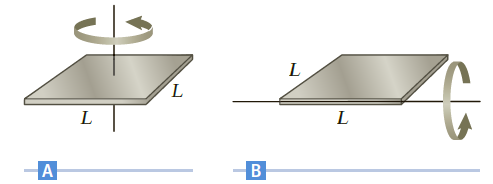
The moment of inertia for a square plate of mass M and length L that rotates about an axis perpendicular to the plane of the plate and passing through its center is ML2/6 (Fig. P8.49A). What is the moment of inertia of the same plate when it is rotated about an axis that lies along one edge of the
In our examples with CDs (such as Example 8.7), we usually ignored the hole in the center. Calculate the moment of inertia of a CD, including the effect of the hole. For a CD of radius 6.0 cm, estimate the percentage change in the moment of inertia due to a hole of radius 7 mm.
Consider two cylinders with the same density and the same length. If the ratio of their diameters is 1.5/1, what is the ratio of their moments of inertia?
If the mass of a wheel is increased by a factor of 2 and the radius is increased by a factor of 1.5, by what factor is the moment of inertia increased? Model the wheel as a solid disc.
Estimate the moment of inertia of a bicycle wheel.
Which has a larger moment of inertia, a disc of mass 20 kg or a hoop of mass 15 kg with the same radius?
Consider a merry-go-round that has the form of a disc with radius 5.0 m and mass 100 kg. If three children, each of mass 20 kg, sit on the outer edge of the merry-go-round, what is the total moment of inertia?
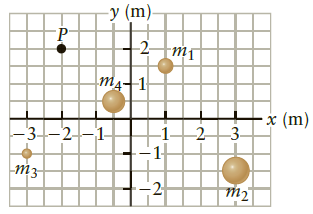
Four particles with masses m1= 15 kg, m2= 25 kg, m3= 10 kg, and m4= 20 kg sit on a very light (mass less) metal sheet and are arranged as shown in Figure P8.42. Find the moment of inertia of this system with the pivot point (a) at the origin and (b) at point P. Assume the rotation axis is parallel
Two particles of mass m1 = 15 kg and m2 = 25 kg are connected by a massless rod of length 1.2 m. Find the moment of inertia of this system for rotations about the following pivot points: (a) the center of the rod, (b) the end at m1, (c) the end at m2, and (d) the center of mass. Assume the rotation
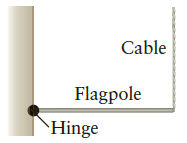
A flagpole of length 12 m and mass 30 kg is hinged at one end, where it is connected to a wall as sketched in Figure P8.40. The pole is held up by a cable attached to the other end. Find the tension in the cable. Figure P8.40 ? Cable Flagpole `Hinge
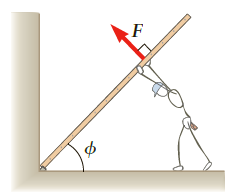
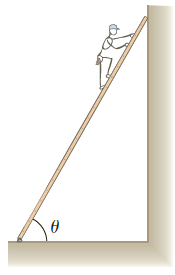
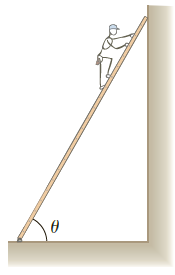
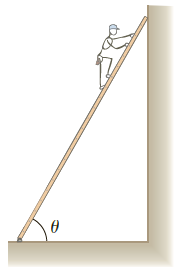
Consider again the ladder in Figure P8.38. We saw in Problem 8.38 that the force supplied by the person increases with increasing angle ?? as the ladder is initially lifted off the ground. When the ladder is sufficiently high (the angle ?? is sufficiently large), though, it becomes easier to raise
One way to put a ladder in place on a wall is to ???walk??? the ladder to the wall. One end of the ladder is held fixed (perhaps at the base of the wall), and a person slides his hands along the ladder as he walks toward the fixed end as sketched in Figure P8.38. Anyone who has raised a ladder in
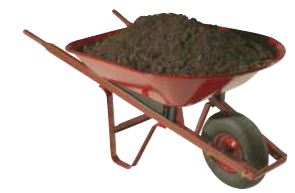
Wheelbarrows are designed so that a person can move a massive object more easily than if he simply picked it up. If the person using the wheelbarrow in Figure P8.37 is able to apply a total vertical (upward) force of 200 N on the handle, what is the approximate mass of the heaviest object he could
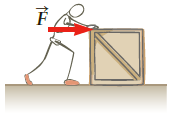
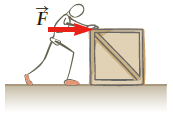
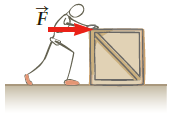
Repeat Problem 34, but assume the force F is applied at the corner of the cube and at an angle of 30° above the horizontal direction. At what value of F will the crate begin to tip? Data from Problem 34 A solid cube of mass 40 kg and edge length 0.30 m rests on a horizontal floor as shown in
Consider again the cube in Problem 34 (Fig. P8.34), but now assume the force is applied along a horizontal line that is 0.20 m above the floor. At what value of F will the crate begin to tip? Figure P8.34 ? Data from Problem? A solid cube of mass 40 kg and edge length 0.30 m rests on a horizontal
A solid cube of mass 40 kg and edge length 0.30 m rests on a horizontal floor as shown in Figure P8.34. A person then pushes on the upper edge of the cube with a horizontal force of magnitude F. At what value of F will the cube start to tip? Assume the frictional force from the floor is large
Consider the ladder in Example 8.5 and assume there is friction between the vertical wall and the ladder, with µS = 0.30. Find the angle ϕ at which the ladder just begins to slip.
Consider again the ladder in Figure P8.30 and imagine two scenarios. In both scenarios the ladder is in rotational equilibrium.? (1) There is no friction between the ladder and the floor, and there is a frictional force FW between the wall and the ladder.? (2) There is no friction between the
Consider again the ladder in Problem 30. What is the sign of the torque on the ladder due to the force from the wall? Data from Problem 30 A painter is standing on the ladder (mass 40 kg and length 2.5 m) in Figure P8.30. There is friction between the bottom of the ladder and the floor with µS =
A painter is standing on the ladder (mass 40 kg and length 2.5 m) in Figure P8.30. There is friction between the bottom of the ladder and the floor with µS= 0.30, but there is no friction between the ladder and the wall. The painter has mass 70 kg and is standing a distance of 0.60 m from the
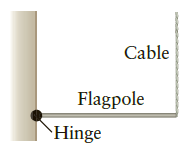
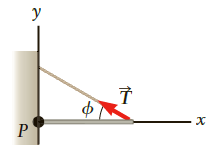
Consider the flagpole in Figure P8.29. If the flagpole has a mass of 20 kg and length 10 m and the angle the cable makes with the pole is ?? = 25°, what are the magnitude and direction of the force exerted by the hinge (at point P) on the flagpole? Assume the mass of the pole is distributed
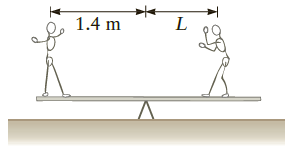
The seesaw in Figure P8.28 is 4.5 m long. Its mass of 20 kg is uniformly distributed. The child on the left end has a mass of 14 kg and is a distance of 1.4 m from the pivot point while a second child of mass 30 kg stands a distance L from the pivot point, keeping the seesaw at rest.? (a) Is the
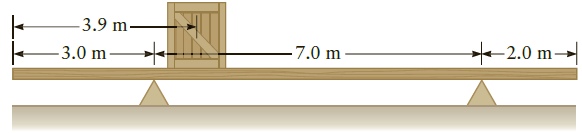
Suppose a crate of mass 7.5 kg is placed on the plank in Figure P8.27 at a distance 3.9 m from the left end. If the plank has a mass of 12 kg, find the forces exerted by the two supports on the plank. Figure P8.27 ? -3.9 m 7.0 m -2.0 m→ - 3.0 m
A uniform wooden plank of mass 12 kg rests on two supports as shown in Figure P8.26. The plank is at rest, so it is in transnational equilibrium and rotational equilibrium.? (a) Make a sketch showing all the forces on the plank. Be sure to show where the forces act.? (b) Choose the left-hand
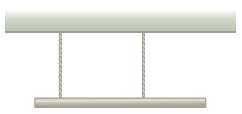
A uniform pole of length 2.0 m and mass 4.5 kg hangs horizontally from two cables as shown in Figure P8.25. What are the approximate tensions in the two cables? Figure P8.25 ?
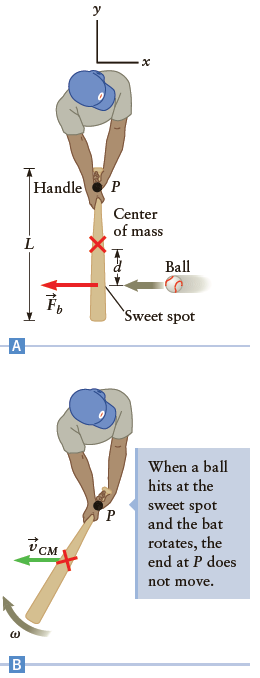
A baseball player holds a bat at the end of the handle. If the bat is held horizontally, what is the approximate torque due to the force of gravity on the bat, with a pivot point at the batter’s hands?
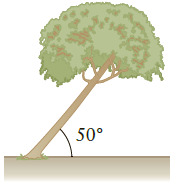
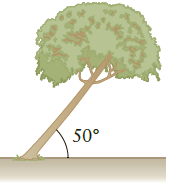
A tree grows at an angle of 50° to the ground as shown in Figure Q8.5. If the tree is 25 m from its base to its top and has a mass of 500 kg, what is the approximate magnitude of the torque on the tree due to the force of gravity? Take the base of the tree as the pivot point. (The answer reveals
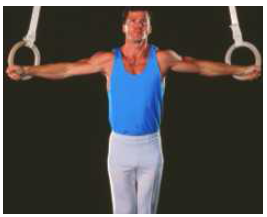
A difficult maneuver for a gymnast is the ???iron cross,??? in which he holds himself as shown in Figure P8.22. Estimate the torque on the gymnast due to gravity. Choose a rotation axis that passes through one of his hands and assume each hand must support half of his weight.? Figure P8.22 ?
If the length of the pole in Problem 20 is increased by a factor of three and its mass is increased by a factor of two, by what factor does the torque change? Data from Problem 20 A person carries a long pole of mass 12 kg and length 4.5 m as shown in Figure P8.20. Find the magnitude of the torque
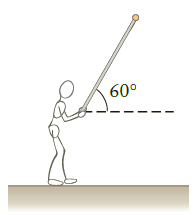
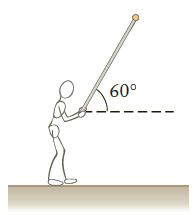
A person carries a long pole of mass 12 kg and length 4.5 m as shown in Figure P8.20. Find the magnitude of the torque on the pole due to gravity. Figure P8.20 ? 60°
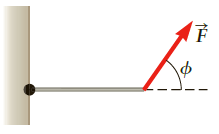
A rod of length 3.8 m is hinged at one end, and a force of magnitude F = 10 N is applied at the other (Fig. P8.19).? (a) If the magnitude of the torque associated with this force is 18 N · m, what is the angle ???? (b) What is the sign of the torque? Figure P8.19 ?
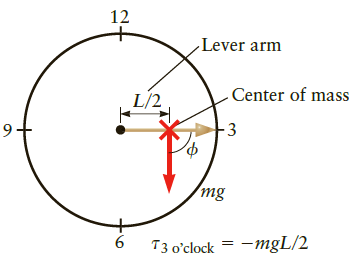
Consider the clock in Figure 8.17. Calculate the magnitude and sign of the torque due to gravity on the hour hand of the clock at 4 o???clock. Assume the hand has a mass of 15 kg, a length of 1.5 m, and the mass is uniformly distributed. Figure 8.17 ? 12 Lever arm L/2 Center of mass 9+ 3 mg 6 T3
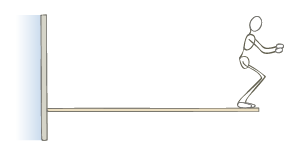
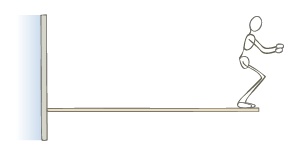
Consider again the diver in Figure P8.16. Assume the diving board now has a mass of 30 kg. Find the total torque due to gravity on the diving board. Assume the mass of the board is uniformly distributed. Figure P8.16 ? Lo
A diver stands at rest at the end of a massless diving board as shown in Figure P8.16.? (a) If the mass of the diver is 120 kg and the board is 4.0 m long, what is the torque due to gravity on the diving board with a pivot point at the fixed end of the board?? (b) According to our convention for
Consider a race car that moves with a speed of 200 mi/h. If it travels on a circular race track of circumference 2.5 mi, what is the car’s angular speed?
Construct a graph of the angular displacement of the minute hand of a clock as a function of time. The axes of your graph should include quantitative scales (i.e., numbers and units). What is the slope of the relation between θ and t?
What are the angular velocity and the period of the second hand of a clock? If the linear speed of the end of the hand is 5.0 mm/s, what is the clock’s radius?
An adult is riding on a carousel and finds that he is feeling a bit nauseated. He then decides to move from the outer edge of the carousel to a point a distance r2 from the center so that his linear speed is reduced by a factor of 2.5. If the carousel has a constant angular speed of 1.0 rad/s and a
Mercury orbits the Sun with a period of approximately 88 days. What is the angular speed of Mercury’s orbital motion?
Mercury spins about its axis with a period of approximately 58 days. What is the rotational angular speed of Mercury?
What is the angular speed with respect to the Earth’s rotation axis of a person standing (a) At the equator? (b) At a latitude of 45°?
What is the angular speed of the Earth’s center of mass as it orbits the Sun?
A car engine is initially rotating at 200 rad/s. It is then turned off and takes 3.0 s to come to a complete stop. What is the angular acceleration of the engine? Assume α is constant.
The tachometer in the author’s car has a maximum reading of 8000 rpm. (A tachometer is a gauge that shows the angular speed of a car’s engine.) Express this angular speed in rad/s.
Consider again the record in Problem 3. If it plays music for 20 min, how far does a point on the edge travel in meters?Data from Problems 3.An old-fashioned (vinyl) record rotates at a constant rate of 33 rpm. (a) What is its angular speed in rad/s? (b) If the record has a radius of 18
The angular speed of the shaft of a car’s engine is 360 rad/s. How many revolutions does it complete in 1 hour?
An old-fashioned (vinyl) record rotates at a constant rate of 33 rpm. (a) What is its angular speed in rad/s? (b) If the record has a radius of 18 cm, what is the linear speed of a point on its edge?
The shaft on an engine turns through an angle of 45 rad. (a) How many revolutions does the shaft make? (b) What is this angle in degrees?
An angle has a value of 85°. What is the angle in radians?
In Section 8.6, we found that for a uniform baseball bat, the sweet spot is a distance L/6 from the center of the bat. A real bat is not uniform; it is much thinner in the handle than in the barrel (the end of the bat farthest from point P in Fig. 8.37). Estimate how that affects the location of
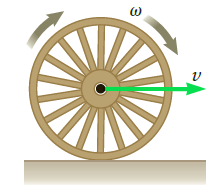
Consider a wheel that rolls without slipping such as the wheel in Figure 8.34. We have seen that slipping is prevented by the force of static friction between the wheel and the pavement. Can this force do work on the wheel?Figure 8.34
Explain why it is easier (it requires a smaller force) to open a large jar than a small one.
Bodybuilders do an exercise called “curls” in which they lift a weight by bending at the elbow. Explain why the torque on the elbow is largest when the arm is horizontal.
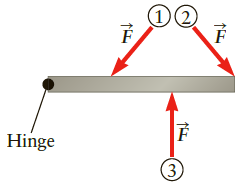
A force of magnitude F is applied to a rod at various spots and at various angles (Fig. Q8.16). In which case, (1), (2), or (3), is the magnitude of the torque largest? Smallest?Figure Q8.16 Hinge 3)
A tree has two large branches that grow out horizontally from the trunk in opposite directions. One branch has length L and diameter d, whereas the other has length L/2. If the magnitude of the torque due to gravity is the same on the two branches, what is the diameter of the shorter branch?
A tree has a large branch that grows horizontally out from the trunk. If the branch doubles in length and doubles in diameter, by what factor does the torque on the branch due to gravity increase?
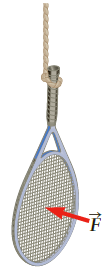
A tennis racket possesses a sweet spot in close analogy to that of a baseball bat. One might expect that rackets are designed so that the sweet spot is in the center of the strings. Somewhat surprisingly, that is not the case. The approximate location of a racket€™s sweet spot can be
In about 200 BCE, Archimedes made the statement, “Give me a lever long enough and a place to stand, and I will move the Earth.” Assume he can exert a force equal to his weight on the Earth (about 900 N). Design a lever that would enable him to give the Earth an acceleration of 1 m/s2.
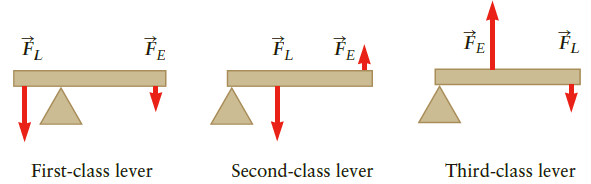
Three types of levers. Levers can be classified as first, second, or third class, depending on how the load force (F(vector)L) and effort force (F(vector)E) are configured with respect to the pivot point or fulcrum as shown in Figure Q8.11. Determine the lever classification of the following items:
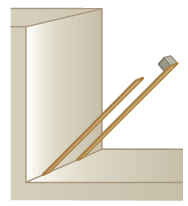
Two meter sticks, one with a weight attached to its end, are held with one of their ends in the corner formed by the floor and a wall as depicted in Figure Q8.10. If the ends of the meter sticks are let go at the same time and start with the same angle with respect to the floor, which one will hit
A snap of the wrist will usually detach a paper towel from a roll. Why does that almost always work for a full roll, yet an almost empty roll often gives much more than a single sheet?
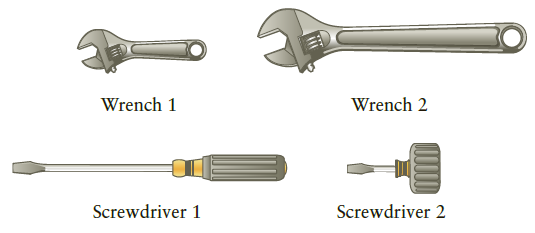
A mechanic???s toolbox contains the two wrenches and two screwdrivers shown in Figure Q8.8. While working on her vintage car, the mechanic comes across a stubborn and rusted bolt. Which wrench would be the most useful in breaking the bolt free? Why is one better than the other? She also encounters
Two golfers team up to win a golf tournament and are awarded a solid gold golf club. To divide their winnings, they balance the club on a finger and then cut the club into two pieces at the balance point with a hacksaw. Was the winning gold split evenly? Why or why not?
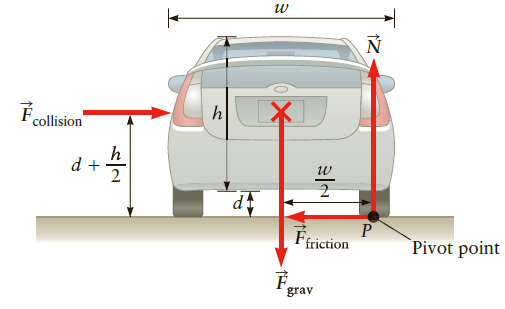
In our analysis of a rollover car accident in Example 8.6, we treated the car in a very simplified way. Develop a more realistic model of a car with special attention to the height of its center of mass and use it to compute the force required to tip over the car. (See Fig. 8.26.) Figure 8.26 ? h
The tree in Figure Q8.5 experiences a large torque due to the force of gravity, yet it is in static equilibrium. What additional torque balances the torque due to gravity?Figure Q8.5 50°
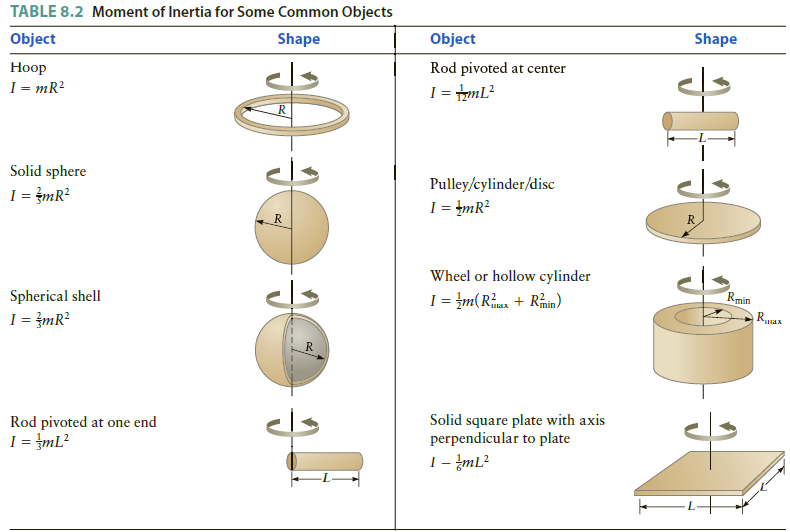
According to Table 8.2, the moment of inertia for a rod that rotates about an axis perpendicular to the rod and passing through one end is I = ML2/3; if the axis passes through the center of the rod, then I = ML2/12. Give a physical explanation for this difference in terms of the way the mass of
Showing 4100 - 4200
of 4913
First
35
36
37
38
39
40
41
42
43
44
45
46
47
48
49
Last
Step by Step Answers

 Get 50% OFF
Claim Now
Get 50% OFF
Claim Now