New Semester
Started
Get
50% OFF
Study Help!
--h --m --s
Claim Now
Question Answers
Textbooks
Find textbooks, questions and answers
Oops, something went wrong!
Change your search query and then try again
S
Books
FREE
Study Help
Expert Questions
Accounting
General Management
Mathematics
Finance
Organizational Behaviour
Law
Physics
Operating System
Management Leadership
Sociology
Programming
Marketing
Database
Computer Network
Economics
Textbooks Solutions
Accounting
Managerial Accounting
Management Leadership
Cost Accounting
Statistics
Business Law
Corporate Finance
Finance
Economics
Auditing
Tutors
Online Tutors
Find a Tutor
Hire a Tutor
Become a Tutor
AI Tutor
AI Study Planner
NEW
Sell Books
Search
Search
Sign In
Register
study help
sciences
college physics reasoning
College Physics Reasoning and Relationships 2nd edition Nicholas Giordano - Solutions
A heavy crate is pushed across a level floor at a constant velocity. What is the total work done on the crate by all forces? How does your answer change if the crate is being pushed up a hill?
A compact disc spins at 2.5 revolutions per second. An ant is walking on the CD and finds that it just begins to slide off the CD when it reaches a point 3.0 cm from the CD’s center. (a) What is the coefficient of friction between the ant and the CD? (b) Is this the coefficient of
A rock is thrown horizontally with a speed of 20 m/s from a vertical cliff of height 25 m. (a) How long does it take the rock to reach the horizontal ground below? (b) How far will it land from the base of the cliff? (c) What is the velocity (magnitude and direction) of the rock just
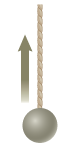
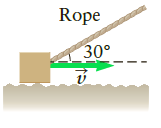
A sphere of mass 35 kg is attached to one end of a rope as shown in Figure P6.1. It is found that the rope does an amount of work W = 550 J in pulling the sphere upward through a distance 1.5 m. Find the tension in the rope.Figure P6.1
Consider an object undergoing uniform circular motion. We know from Chapter 5 that circular motion is caused by a force that is directed toward the center of the circle. What is the work done by this force during circular motion?
For the sphere in Problem 1, find the work done by the force of gravity on the sphere.Data From Problem 1A sphere of mass 35 kg is attached to one end of a rope as shown in Figure P6.1. It is found that the rope does an amount of work W 550 J in pulling the sphere upward through a distance 1.5 m.
Explain why kinetic energy can never be negative, but the potential energy can be positive, negative, or zero.
A crate of mass 50 kg is pushed across a level floor by a person. If the person exerts a force of 25 N in the horizontal direction and moves the crate a distance of 10 m, what is the work done by the person?
A hockey puck of mass 0.25 kg is sliding along a slippery frozen lake, with an initial speed of 60 m/s. The coefficient of friction between the ice and the puck is μK = 0.030. Friction eventually causes the puck to slide to a stop. Find the work done by friction.
Consider a satellite in an elliptical orbit around the Earth. What is the sign (positive or negative) of the power associated with the gravitational force of the Earth on the satellite?
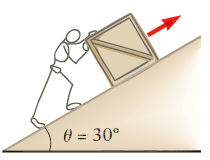
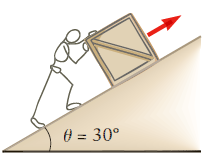
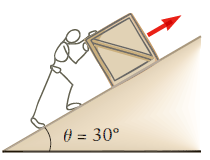
A crate of mass 24 kg is pushed up a friction less ramp by a person as shown in Figure P6.5. Calculate the work done by the person in pushing the crate a distance of 20 m as measured along the ramp. Assume the crate moves at constant velocity. Figure P6.5 ? 0 = 30°
Consider an apple that falls from a branch to the ground below. At what moment is the kinetic energy of the apple largest? At what moment is the gravitational potential energy largest?
For the bungee jumper in Example 6.9 (page 189), plot the following quantities as a function of time: (a) the gravitational potential energy of the jumper, (b) the kinetic energy of the jumper, (c) the potential energy associated with the bungee cord, and (d) the total mechanical energy.
Consider again the crate in Problem 5, but now include friction. Assume the coefficient of kinetic friction between the crate and the ramp is μK= 0.25. What is the work done by the person as he pushes the crate up the ramp? Data From Problem 5 A crate of mass 24 kg is pushed up a friction less
The work done by friction is usually negative, as in the case of an object that slides to a stop. The work done by friction does not have to be negative, however. Give an example in which the work done by friction is positive.
Find the work done by gravity on the crate in Problem 6. Data From Problem 6 Consider again the crate in Problem 5, but now include friction. Assume the coefficient of kinetic friction between the crate and the ramp is μK = 0.25. What is the work done by the person as he pushes the crate up the
Motor 1 does 20 J of work in 10 s, while motor 2 does 5 J of work in 1 s. Which motor produces the greatest power?
A car (m = 1200 kg) is traveling at an initial speed of 15 m/s. It then slows to a stop over a distance of 80 m due to a force from the brakes. How much work is done on the car? Assume the acceleration is constant.
A block of mass m = 5.0 kg is pulled along a rough horizontal surface by a rope as sketched in Figure P6.8. The tension in the rope is 40 N, and the coefficient of kinetic friction between the block and the surface is μK= 0.25.? (a) If the block travels a distance of 4.5 m along the surface, what
According to Equation 6.29, power is related to force and velocity by P = Fv. Is it possible for P to be negative? Give an example and explain what it means for P to be negative.
Give two examples in which the work done on an object by friction is negative.
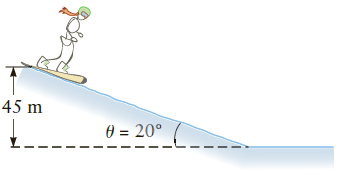
A snowboarder of mass 80 kg slides down the trail shown in Figure P6.10. The first part of the trail is a ramp that makes an angle of 20° with the horizontal, and the final portion of the trail is flat. Find the work done by gravity on the snowboarder as she travels from the beginning to the end
Give two examples in which a nonzero force acts on an object, but the work done by that force is zero.
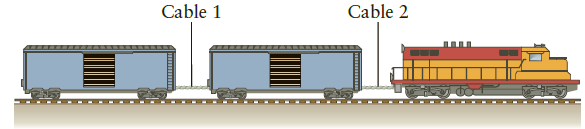
Two railroad cars, each of mass 2.0 ?? 104kg, are connected by a cable to each other, and the car in front is connected by a cable to the engine as shown in Figure P6.11. The cars start from rest and accelerate to a speed of 1.5 m/s after 1 min.? (a) Find the work done by cable 1 on the car in the
Explain how a mosquito can have a greater kinetic energy than a baseball.
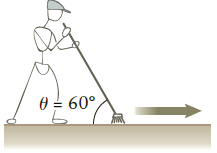
A person pushes a broom at an angle of 60° with respect to the floor (Fig. P6.12). If the person exerts a force of 30 N directed along the broom handle, what is the work done by the person on the broom as he pushes it a distance of 5.0 m? Figure P6.12 ? 0 = 60°,
A hockey puck slides along a level surface, eventually coming to rest. Is the energy of the hockey puck conserved? Is the total energy of the universe conserved? Discuss where the initial kinetic energy of the puck “goes.”
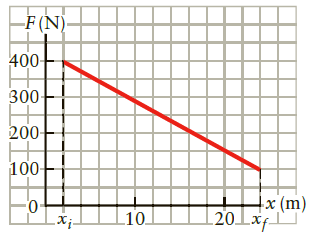
A car is pushed along a long road that is straight, horizontal, and parallel to the x direction.? (a) The horizontal force on the car varies with x as shown in Figure P6.13. What is the work done on the car by this force?? (b) What is the work done by gravity on the car? Figure P6.13 ? F (N) 400-
A spring is initially compressed. It is then released, sending an object flying off the spring. Discuss this process in terms of conservation of energy. What and “where” is the initial energy, and where is the energy found at the end?
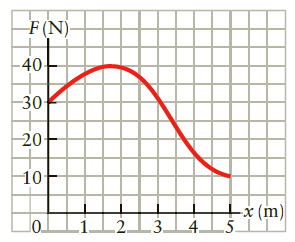
The force on an object varies with position as shown in Figure P6.14. Estimate the work done on the object as it moves from the origin to x = 5.0 m. Assume the motion is one dimensional and the force is along the x direction. Figure P6.14 ? F (N) -40 20 10- +x (m) 3.
Tarzan starts at rest near the top of a tall tree. He then swings on a vine and reaches the base of the tree, where he jumps off the vine and comes to rest on the ground. Discuss and compare Tarzan’s total energy at (a) the top of the tree, (b) just before he jumps off the vine at the bottom, and
A tomato of mass 0.22 kg is dropped from a tall bridge. If the tomato has a speed of 12 m/s just before it hits the ground, what is the kinetic energy of the tomato?
During the course of each day, you move from place to place and do work on various objects. Where does the energy for these everyday activities come from? Explain.
Two objects have the same kinetic energy. One has a speed that is 2.5 times the speed of the other. What is the ratio of their masses?
When a rubber ball is dropped onto a concrete floor, it bounces to a height that is slightly lower than its initial height. Compare the ball’s (a) Initial mechanical energy to (b) Its energy just before hitting the ground, to (c) The total energy just after bouncing off the ground,
A car of mass 1500 kg is initially traveling at a speed of 10 m/s. The driver then accelerates to a speed of 25 m/s over a distance of 200 m. Calculate the change in the kinetic energy of the car.
Construct bar charts showing the kinetic energy and potential energy of the projectile in Figure 6.16. Show these energies when the projectile has just left the ground, when it is at the highest point of its trajectory, and just before it returns to the ground. Explain how these charts illustrate
A rock of mass 0.050 kg is thrown upward with an initial speed of 25 m/s. Find the work done by gravity on the rock from the time it leaves the thrower’s hand until it reaches the highest point on its trajectory.
Construct bar charts showing the kinetic energy and potential energy for the bungee jumper in Example 6.9 at various points during his jump. Explain how these charts illustrate the principle of conservation of mechanical energy.
A horizontal force of 15 N pulls a block of mass 3.9 kg across a level floor. The coefficient of kinetic friction between the block and the floor is μK = 0.25. If the block begins with a speed of 8.0 m/s and is pulled for a distance of 12 m, what is the final speed of the block?
You are pushing a refrigerator across the floor of your kitchen. You exert a horizontal force of 300 N for 7.0 s, during which time the refrigerator moves a distance of 3.0 m at constant velocity. (a) What is the total work (by all forces) done on the refrigerator? (b) What is the work
An archer is able to fire an arrow (mass 0.020 kg) at a speed of 250 m/s. If a baseball (mass 0.14 kg) is given the same kinetic energy, what is its speed?
A baseball pitcher can throw a baseball at a speed of 50 m/s. If the mass of the ball is 0.14 kg and the pitcher has it in his hand over a distance of 2.0 m, what is the average force exerted by the pitcher on the ball?
A softball pitcher can exert a force of 100 N on a softball. If the mass of the ball is 0.19 kg and the pitcher has it in her hand over a distance of 1.5 m, what is the speed of the ball when it leaves her hand?
A truck of mass 9000 kg is traveling along a level road at an initial speed of 30 m/s. The driver then shifts into neutral so that the truck is coasting, and the truck gradually slows to a final speed of 12 m/s. (a) Find the total work done on the truck. (b) What force(s) do this work on
Consider a skydiver of mass 70 kg who jumps from an airplane flying at an altitude of 1500 m. With her parachute open, her terminal velocity is 8.0 m/s.(a) What is the work done by gravity and (b) what is the average force of air drag during the course of her jump?
You use an elevator to travel from the first floor (h = 0) to the fourth floor of a building (h = 12 m). If you start from rest and you end up at rest on the fourth floor, what is the work done by gravity on you? Assume you have a mass of 70 kg.
Consider a small car of mass 1200 kg and a large sport utility vehicle (SUV) of mass 4000 kg. The SUV is traveling at the speed limit (v = 35 m/s). The driver of the small car travels so as to have the same kinetic energy as the SUV. Find the speed of the small car.
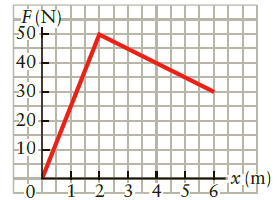
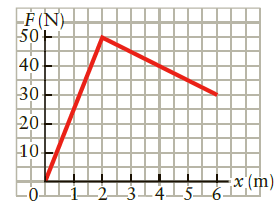
The force on an object varies with position as shown in Figure P6.29. The object begins at rest from the origin and has a speed of 5.0 m/s at x = 4.0 m. What is the mass of the object? Assume one- dimensional motion with the force along the direction of motion. Figure P6.29 ? F (N) 50'+ 40 30 20
Suppose the object in Figure P6.29 has a mass of 2.5 kg and a speed of 9.0 m/s at x = 0. What is its speed at x = 5.0 m?? Figure P6.29 ? F(N) 50'+ 40 30 20 10- x (m)
A skier of mass 110 kg travels down a friction less ski trail. (a) If the top of the trail is a height 200 m above the bottom, what is the work done by gravity on the skier? (b) Find the velocity of the skier when he reaches the bottom of the ski trail. Assume he starts from rest.
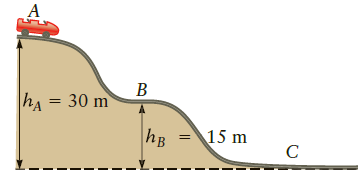
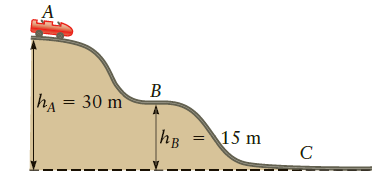
Consider a roller coaster that moves along the track shown in Figure P6.32. Assume all friction is negligible and ignore the kinetic energy of the roller coaster???s wheels.? (a) Is the mechanical energy of the roller coaster conserved?? (b) Add a coordinate system to the sketch in Figure
Suppose the ski trail in Problem 31 is not friction less. (a) Find the work done by gravity on the skier in this case. (b) If the skier has a speed of 30 m/s at the bottom of the hill, what is the work done by friction on the skier?Data From Problem 31A skier of mass 110 kg travels down a
Consider again the roller coaster in Figure P6.32, but now assume the roller coaster starts with a speed of 12 m/s at point A. Find the speed of the roller coaster when it reaches locations B and C. Again assume friction is negligible and ignore the kinetic energy of the wheels. Figure P6.32 ? A B
Mount McKinley (also called Denali) is the tallest mountain in North America, with a height of 6200 m above sea level. If a person of mass 120 kg walks from sea level to the top of Mount McKinley, how much work is done by gravity on the person?
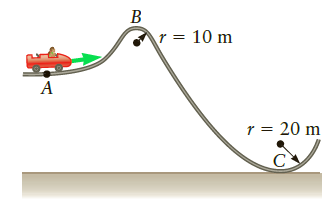
The roller coaster in Figure P6.36 starts with a velocity of 15 m/s. One of the riders is a small girl of mass 30 kg. Find her apparent weight when the roller coaster is at locations B and C. At these two locations, the track is circular, with the radii of curvature given in the figure. The heights
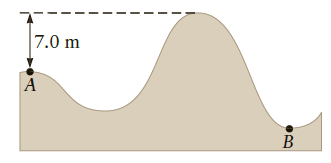
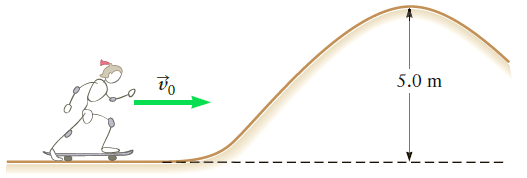
A skateboarder starts at point A on the track (Fig. P6.38) with a speed of 15 m/s. Will he reach point B? Assume friction is negligible and ignore the kinetic energy of the skateboard???s wheels. Figure P6.38 ? 7.0 m A B
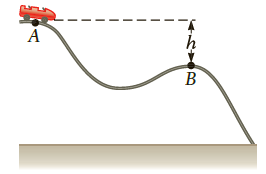
A roller coaster (Fig. P6.37) starts at the top of its track (point A) with a speed of 12 m/s. If it reaches point B traveling at 16 m/s, what is the vertical distance (h) between A and B? Assume friction is negligible and ignore the kinetic energy of the wheels. Figure P6.37 ? А B
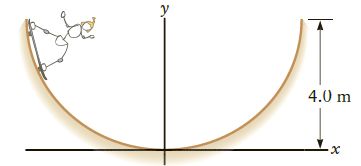
Front side air. A skateboarder is practicing on the ???half-pipe??? shown in Figure P6.39, using a special friction less skateboard. (You can also ignore the kinetic energy of the skateboard???s wheels.)? (a) If she starts from rest at the top of the half-pipe, what is her speed at the bottom?? (b)
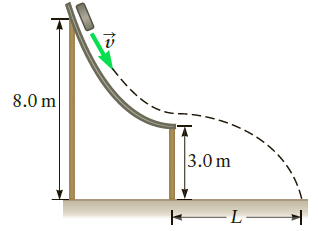
A hockey puck of mass 0.25 kg starts from rest and slides down the friction less ramp shown in Figure P6.41. The bottom end of the ramp is horizontal. After it leaves the ramp, the puck travels as a projectile and lands a distance L from the ramp. (a) Is the puck???s mechanical energy at the top of
A rock of mass 12 kg is tied to a string of length 2.4 m, with the other end of the string fastened to the ceiling of a tall room (Fig. P6.42). While hanging vertically, the rock is given an initial horizontal velocity of 2.5 m/s.? (a) Add a coordinate system to the sketch in Figure P6.42. Where is
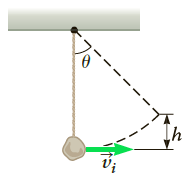
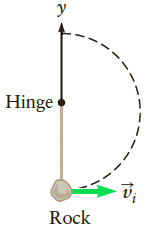
Consider the rock and string in Figure P6.43. The string is fastened to a hinge that allows it to swing completely around in a vertical circle. If the rock starts at the lowest point on this circle and is given an initial speed vi, what is the smallest value of vithat will allow the rock to travel
A rock climber (m = 90 kg with gear included) starts at the base of a cliff and climbs to the top (h = 35 m). He then walks along the plateau at the top for a distance L = 40 m. Find the work done by gravity and the change in gravitational potential energy of the rock climber.
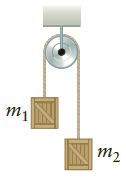
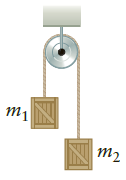
Two crates of mass m1= 40 kg and m2= 15 kg are connected by a mass less rope that passes over a mass less, friction less pulley as shown in Figure P6.45. The crates start from rest. (a) Add a coordinate system to Figure P6.45.? (b) What are the initial kinetic and potential energies of each
Consider again the crates in Problem 45, but now assume the rope has a mass of 2 kg. If the tops of the crates start at the same initial height and the rope has a length of 10 m, what is the final speed after the crates have moved a distance of 2.5 m? Data From Problem 45 Two crates of mass m1 =
Sketch how the potential energy, kinetic energy, and total mechanical energy vary with time for an apple that drops from a tree.
(a) Sketch how the potential energy, kinetic energy, and total mechanical energy vary with time for a cannon shell that is fired from a large cannon. Ignore air drag and assume the cannon is aimed straight upward. (b) Repeat part (a), but now with the cannon aimed at 458 above the horizontal
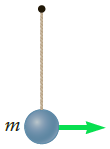
A ball of mass 1.5 kg is tied to a string of length 6.0 m as shown in Figure P6.50. The ball is initially hanging vertically and is given an initial velocity of 5.0 m/s in the horizontal direction. The ball then follows a circular arc as determined by the string. What is the speed of the ball when
Calculate the escape speed for an object on the Moon.
An engineer at NASA decides to save money on fuel by launching satellites from a very tall mountain. (a) Calculate the escape speed for a satellite launched from an altitude of 8000 m above sea level (a mountain comparable to Mount Everest). (b) Do you think this method would be a good
Calculate the velocity needed for an object starting at the Earth’s surface to just barely reach a satellite in a geosynchronous orbit. Ignore air drag and assume the object has a speed of zero when it reaches the satellite.
Sketch how the potential energy, kinetic energy, and total mechanical energy vary with position for a projectile that is fired from the Earth’s surface. Assume the projectile’s initial speed is equal to the escape speed and ignore air drag.
Consider a spacecraft that is to be launched from the Earth to the Moon. Calculate the minimum velocity needed for the spacecraft to just make it to the Moon’s surface. Ignore air drag from the Earth’s atmosphere.
space station is orbiting the Earth. It moves in a circular orbit with a radius equal to twice the Earth’s radius. A supply satellite is designed to travel to the station and dock smoothly when it arrives. If the supply satellite is fired as a simple projectile from the Earth’s surface, what is
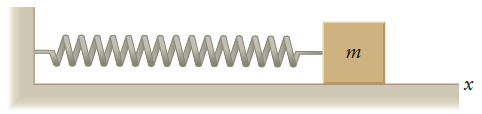
A mass and spring are arranged on a horizontal, friction less table as shown in Figure P6.58. The spring constant is k = 500 N/m, and the mass is 4.5 kg. The block is pushed against the spring so that the spring is compressed an amount 0.35 m, and then it is released. Find the velocity of the mass
A block is dropped onto a spring with k = 30 N/m. The block has a speed of 3.3 m/s just before it strikes the spring. If the spring compresses an amount 0.12 m before bringing the block to rest, what is the mass of the block?
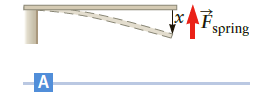
A diving board acts like a spring and obeys Hooke???s law (Fig. 6.22A). Estimate the spring constant of a diving board. Figure 6.22A ? Tx spring A
A block of mass 35 kg is sitting on a platform as shown in Figure P6.60. The platform sits on a spring with k = 2000 N/m. The mass is initially at rest.? (a) Add a coordinate system to this sketch. Where is a convenient place to choose the origin of the vertical (y) axis?? (b) If the platform is
An archer’s bow can be treated as a spring with k = 3000 N/m. If the bow is pulled back a distance 0.12 m before releasing the arrow, what is the kinetic energy of the arrow when it leaves the bow?
For the arrow in Problem 61, what is the work done on the bow as the bowstring is pulled back into position?Data From Problem 61An archer’s bow can be treated as a spring with k = 3000 N/m. If the bow is pulled back a distance 0.12 m before releasing the arrow, what is the kinetic energy of the
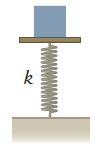
The struts on a car are fancy springs. Because one is attached to each wheel, your car is supported by four of these springs. Estimate the spring constant for one of these springs.
A tennis racket can be treated as a spring. The displacement of the spring (what we commonly call x) is the displacement of the strings at the center of the racket. Estimate the spring constant of this spring. Assume a typical tennis ball has a mass of about 57 g and a speed of 50 m/s when it
A tennis ball is a flexible, elastic object. If a person of average size stands on a tennis ball, the ball will compress to about half its original (non-compressed) diameter. What is the approximate spring constant of a tennis ball?
A tennis ball (m = 57 g) is projected vertically with an initial speed of 8.8 m/s. (a) If the ball rises to a maximum height of 3.7 m, how much kinetic energy was dissipated by the drag force of air resistance? (b) How much higher would the ball have gone in a vacuum?
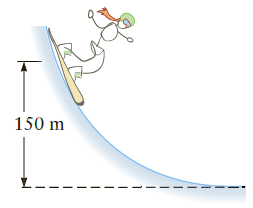
A snowboarder of mass 80 kg travels down the slope of height 150 m shown in Figure P6.68. If she starts from rest at the top and has a velocity of 12 m/s when she reaches the bottom, what is the work done on her by friction?? Figure P6.68 ? 150 m
Big bounce. A Super Ball is a toy ball made from the synthetic rubber polymer polybutadiene vulcanized with sulfur. Manufactured by Wham-O since 1965, these toys have a “super” elastic property such that they bounce to 90% of the height from which they are dropped. A Super Ball of mass 100 g is
Consider the skateboarder in Figure P6.70. If she has a mass of 55 kg, an initial velocity of 20 m/s, and a velocity of 12 m/s at the top of the ramp, what is the work done by friction on the skateboarder? Ignore the kinetic energy of the skateboard???s wheels. Figure P6.70 ? 5.0 m
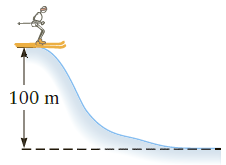
A skier of mass 100 kg starts from rest at the top of the ski slope of height 100 m shown in Figure P6.71. If the total work done by friction is -3.0 ?? 104J, what is the skier???s speed when he reaches the bottom of the slope? Figure P6.71 ? 100 m
Every year, there is a foot race to the top of the Empire State Building. The vertical distance traveled (using the stairs!) is about 440 m. The current record for this race is about 9 min 30 s. If the record holder has a mass of 60 kg, what was his average power output during the race?
An electric motor is rated to have a maximum power output of 0.75 hp. If this motor is being used to lift a crate of mass 200 kg, how fast (i.e., at what speed) can it lift the crate?
In Example 6.11, we compared the gravitational potential energy of a 20-W light bulb to the electrical energy consumed when it is turned on. Repeat that calculation, but now assume the light bulb is turned on for one day. Find the height h through which the light bulb would have to fall for the
The main frictional force on a good bicycle is the force of air drag (Eq. 3.20). Consider a bicyclist coasting at a constant velocity on a road that is sloped downward at 5.08 with respect to the horizontal. (a) Find her approximate terminal speed. (b) Approximately how much work is done
The rate of energy use in a typical house is about 2.0 kW. If the kinetic energy of a car (mass 1400 kg) is equal to the total energy used by the house in 1 min, what is the car’s speed?
A typical car has a power rating of 150 hp. Estimate the car’s maximum speed on level ground. Assume air drag is much larger than any frictional forces.
Consider a molecular motor that has an efficiency of 50%. Find the maximum force the motor can produce. Assume a step size of 4 nm. Also assume the energy consumed for each step is 5 × 10–20 J (as given for an ATP- powered motor in Section 6.8).
Suppose a molecular motor consumes 3 ATP molecules in every step. If this motor has a step size of 8.0 nm, what is the maximum force the motor could exert?
Molecular motors are often studied by attaching them to small plastic spheres. These spheres enable the motor’s motion to be observed with a microscope and are much larger than the motor. Consider a molecular motor to which a plastic sphere of radius 20 nm is attached. As the motor moves through
Consider a molecular motor that consumes the energy from 100 ATP molecules per second. What is the power output of this motor?
If the motor in Problem 81 takes a step of length 6.0 nm for each ATP molecule it consumes, what are the speed of the motor and the force it is able to produce?Data From Problem 81Consider a molecular motor that consumes the energy from 100 ATP molecules per second. What is the power output of this
In Section 6.8, we calculated the force produced by a myosin molecular motor and found that it is approximately 10 pico-newtons. Compare this force to the weight of a typical amino acid.
Showing 4300 - 4400
of 4913
First
36
37
38
39
40
41
42
43
44
45
46
47
48
49
50
Step by Step Answers

 Get 50% OFF
Claim Now
Get 50% OFF
Claim Now