New Semester
Started
Get
50% OFF
Study Help!
--h --m --s
Claim Now
Question Answers
Textbooks
Find textbooks, questions and answers
Oops, something went wrong!
Change your search query and then try again
S
Books
FREE
Study Help
Expert Questions
Accounting
General Management
Mathematics
Finance
Organizational Behaviour
Law
Physics
Operating System
Management Leadership
Sociology
Programming
Marketing
Database
Computer Network
Economics
Textbooks Solutions
Accounting
Managerial Accounting
Management Leadership
Cost Accounting
Statistics
Business Law
Corporate Finance
Finance
Economics
Auditing
Tutors
Online Tutors
Find a Tutor
Hire a Tutor
Become a Tutor
AI Tutor
AI Study Planner
NEW
Sell Books
Search
Search
Sign In
Register
study help
sciences
college physics reasoning
College Physics Reasoning and Relationships 2nd edition Nicholas Giordano - Solutions
When a fighter pilot makes a very quick turn, he experiences a centripetal acceleration. When this acceleration is greater than about 8 × g, the pilot will usually lose consciousness (“black out”). Consider a pilot flying at a speed of 900 m/s (about 2000 mi/h) who wants to make a very sharp
It is believed that much of the mass in the universe is carried by what is called dark matter, matter that does not emit enough visible light or other radiation to be detected by conventional telescopes. However, dark matter does exert a gravitational force on other objects in the universe. Explain
Reconnaissance satellites (often called spy satellites) travel in very low orbits so that their cameras can take photos of objects on the Earth’s surface with the highest possible resolution. Explain why such satellites are often launched into polar orbits; when in these orbits, satellites travel
In the days before compact discs and MP3 players (ancient history!), music was recorded in scratches in the surface of vinyl-coated disks called records. In a typical record player, the record rotated with a period of 1.8 s. Find the centripetal acceleration of a point on the edge of the record.
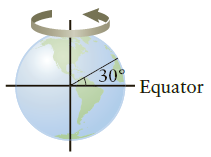
Consider points on the Earth???s surface as sketched in Figure P5.9. Because of the Earth???s rotation, these points undergo uniform circular motion. Compute the centripetal acceleration of? (a) A point at the equator,? (b) At a latitude of 30°. Figure P5.9 ? 30° Equator
Astronomers have discovered that some stars orbit around regions of space that contain large amounts of cosmic dust. This dust provides the gravitational force that causes the stars to move in a circular orbit. Suppose the density of dust is constant in a certain region and several stars orbit
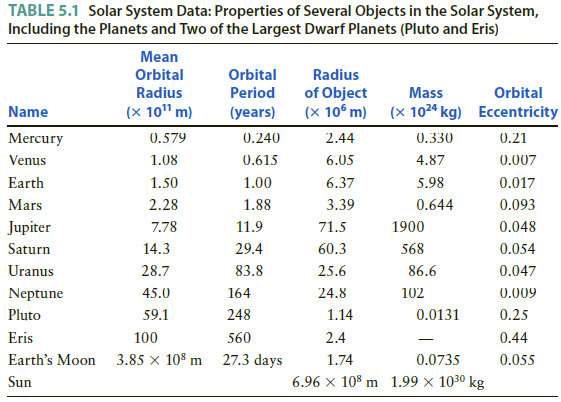
What is the acceleration of the Moon as it moves in its circular orbit around the Earth? TABLE 5.1 Solar System Data: Properties of Several Objects in the Solar System, Including the Planets and Two of the Largest Dwarf Planets (Pluto and Eris) Mean Orbital Orbital Radius Period Radius of Object (x
What force makes it possible for a car to move along a curved road? A straight, flat road?
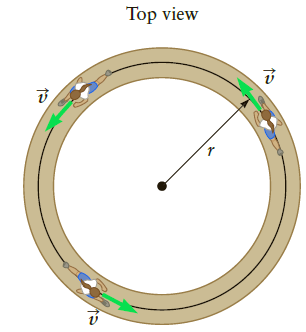
Suppose the circular track in Figure 5.1 has a radius of 100 m and the runner has a speed of 5.0 m/s. (a) What is the period of the motion? (b) If the radius of the track were reduced to 50 m and the runner maintained this speed, by what factor would the runner’s centripetal
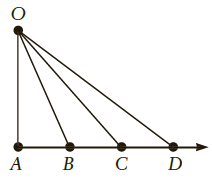
Kepler€™s second law, the statement that a planet sweeps out equal areas in equal times, can be derived by a geometrical argument. To see how one might construct such a geometrical proof, consider the simpler case of a planet moving with constant velocity as shown in Figure Q5.6. The
The hard disk in a laptop computer contains a small disk that rotates at a rate of 5000 rpm. If this disk has a radius of 2.0 cm, what is the centripetal acceleration of a point at the edge of the disk?
A jogger is running around a circular track of circumference 400 m. If the jogger has a speed of 12 km/h, what is the magnitude of the centripetal acceleration of the jogger?
Explain why a geosynchronous satellite cannot remain directly overhead for an observer in Boston.
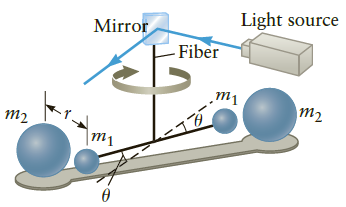
Consider the Cavendish experiment in Figure 5.22. When he designed this experiment, Cavendish had to decide how large to make the spheres. If they are made larger, they will have a larger mass, which, according to Equation 5.16, will make the gravitational attraction larger and the force therefore
In the game of baseball, a pitcher throws a curve ball with as much spin as possible. This spin makes the ball “curve” on its way to the batter. In a typical case, the ball spins at about 30 revolutions per second. What is the maximum centripetal acceleration of a point on the edge of the
In a reference listing found on the Internet, it is stated that g = 9.80665 m/s2. Discuss why it is not correct to think that the “exact” value of g can be given with this accuracy. Indeed, is there an “exact” value of g?
In Example 5.3, we considered a car traveling on a banked turn with friction. Draw free-body diagrams for the car when the speed is low and when the speed is high, and explain why they are different.
The Earth has a radius of 6.4 × 10⁶ m and completes one revolution about its axis in 24 h. (a) Find the speed of a point at the equator. (b) Find the speed of New York City.
Give an example of motion in which (a) The magnitude of the instantaneous velocity is always larger than the average velocity and (b) The instantaneous velocity is never parallel to the instantaneous acceleration.
A bicycle wheel of radius 0.30 m is spinning at a rate of 60 revolutions per minute. (a) What is the centripetal acceleration of a point on the edge of the wheel? (b) What is the period of the wheel’s motion?
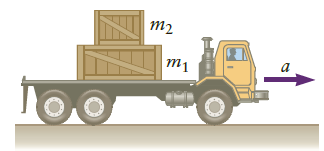
Two crates of mass m1= 35 kg and m2= 15 kg are stacked on the back of a truck (Fig. P4.54). The frictional forces are strong enough that the crates do not slide off the truck. Assume the truck is accelerating with α = 1.7 m/s2. Draw free-body diagrams for both crates and find the values of all
Estimate the terminal velocity for a golf ball.
Two forces are acting on an object. One force has a magnitude of 45 N and is directed along the +x axis. The other force has a magnitude of 30 N and is directed along the +y axis. What is the direction of the object’s acceleration? Express your answer by giving the angle between a(vector) and the
A car is traveling down a hill that makes an angle of 20° with the horizontal. The driver applies her brakes, and the wheels lock so that the car begins to skid. The coefficient of kinetic friction between the tires and the road is µK = 0.45. (a) Find the acceleration of the car. (b)
A skier is traveling at a speed of 40 m/s when she reaches the base of a friction less ski hill. This hill makes an angle of 10° with the horizontal. She then coasts up the hill as far as possible. What height (measured vertically above the base of the hill) does she reach?
An airplane of mass 25,000 kg (approximately the size of a Boeing 737) is coming in for a landing at a speed of 70 m/s. Estimate the normal force on the landing gear when the airplane lands.
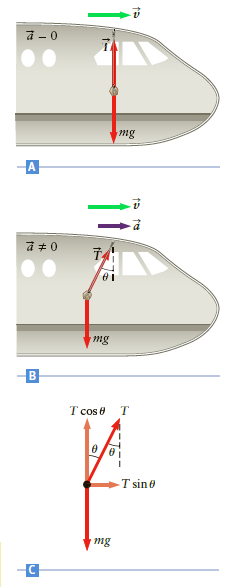
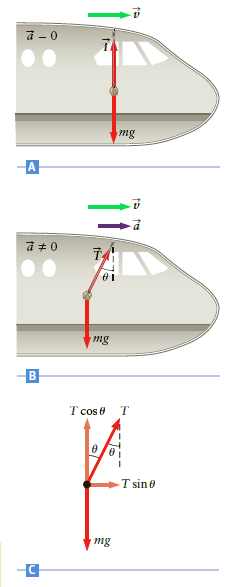
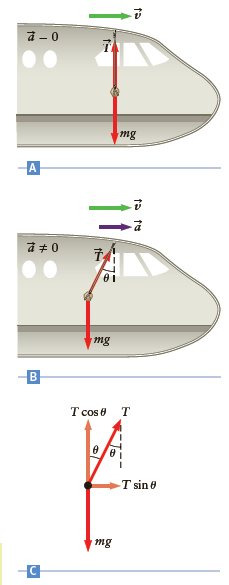
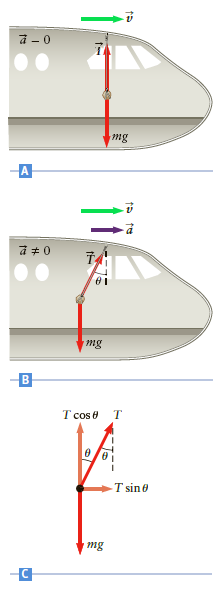
Consider the rock-on-a-string accelerometer in Figure 4.30. What is the accelerometer angle if the airplane has a horizontal acceleration of 1.5 m/s2?Figure 4.30 mg mg T cos 8 -T sin0 mg
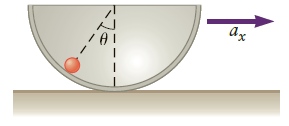
Consider the accelerometer design shown in Figure P4.57, in which a small sphere sits in a hemispherical dish. Suppose the dish has an acceleration of axalong the horizontal and a small amount of friction causes the sphere to reach a stable position relative to the dish as shown in the figure. Find
Consider a commercial passenger jet as it accelerates on the runway during takeoff. This jet has a rock-on-a-string accelerometer installed (as in Fig. 4.30). Estimate the angle of the string during takeoff.Figure 4.30 mg mg T cos 8 -T sin0 mg
A soccer ball has a diameter of about 22 cm and a mass of about 430 g. What is its terminal velocity?
A skier travels down a steep, friction less slope of angle 20° with the horizontal. Assuming she has reached her terminal velocity, estimate her speed.
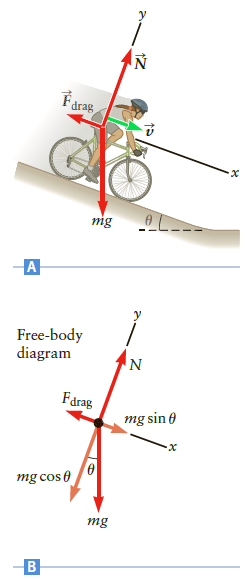
Consider the motion of a bicycle with air drag included. We saw how to deal with the motion on a hill in connection with Figure 4.33. Now assume the bicycle is coasting on level ground and is being pushed along by a tailwind of 4.5 m/s (about 10 mi/h). If the bicycle starts from rest at t = 0, what
What is the approximate magnitude of the drag force on an airplane (such as a commercial jet) traveling at 250 m/s? Consider only the drag force on the fuselage of the airplane (and not on the wings).
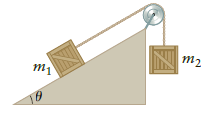
Consider the system of blocks in Figure P4.64, with m2= 5.0 kg and θ = 35°. If the coefficient of static friction between block 1 and the inclined plane is µS= 0.25, what is the largest mass m1for which the blocks will remain at rest? Figure P4.64 m2 тy
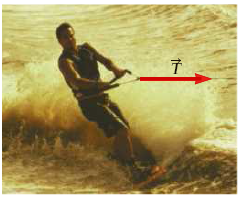
A water skier (Fig. P4.65) of mass m = 65 kg is pulled behind a boat at a constant speed of 25 mi/h. If the tension in the horizontal rope is 1000 N (approximately 225 lb), what are the magnitude and direction of the force the water exerts on the skier’s ski?Figure P4.65
An abstract sculpture is constructed by suspending a sphere of polished rock along the vertical with four cables connected to a square wooden frame 1.2 m on a side as shown in Figure P4.66. If the stone has mass m = 8.0 kg and the bottom two cables are under a tension of 25 N each, what is the
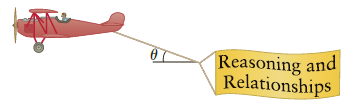
An airplane pulls a 25-kg banner on a cable as depicted in Figure P4.67. When the airplane has a constant cruising velocity, the cable makes an angle θ = 20° with the horizontal. (a) What is the drag force exerted on the banner by the air?(b) The weather changes abruptly and the pilot
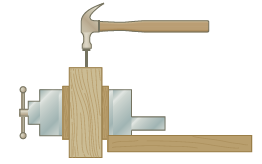
A piece of wood with mass m = 2.4 kg is held in a vise sandwiched between two wooden jaws as shown in Figure P4.68. A blow from a hammer drives a nail that exerts a force of 450 N on the wood. If the coefficient of static friction between the wood surfaces is 0.67, what minimum normal force must
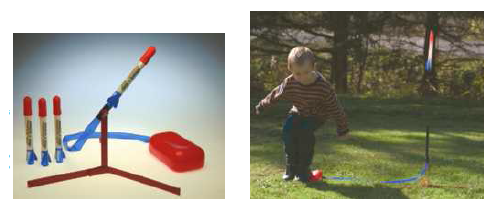
Stomp rocket. A “stomp rocket†is a toy projectile launcher illustrated in Figure P4.69 (left), which uses a blast of air to propel a dart made of plastic. The air blast is produced by jumping on a plastic bladder as shown the figure on the right. It is found that when a 190-lb father
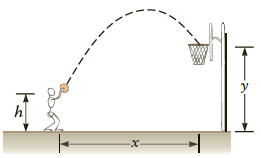
You are a serious basketball player and want to use physics to improve your free-throw shooting. Do an approximate calculation of the minimum speed the ball must have to travel from your hand to the basket in a successful free throw. You will have to estimate or find several of the quantities
Consider once again the swimmer in Example 4.7. Assume she can swim at a velocity of 0.30 m/s and the river is 15 m wide. She needs to get across the river as quickly as possible. (a) What direction should her velocity vector make relative to the water to get her across in the shortest
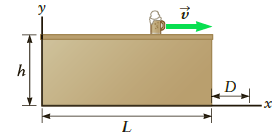
A bartender slides a mug of root beer with mass m = 2.6 kg down a bar top of length L = 2.0 m to an inattentive patron who lets the mug fall a height h = 1.1 m to the floor. The bar top (Fig. P4.72) is smooth, but it still has a coefficient of kinetic friction µK= 0.080. (a) If the
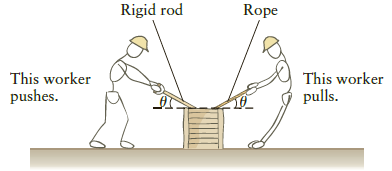
Two workers must slide a crate designed to be pushed with a rigid rod (on the left in Fig. P4.73) and at the same time pulled with a rope (on the right). The crate has mass m = 45 kg, the angle θ = 25º, and the coefficient of kinetic friction between the floor and crate is 0.56. One of the
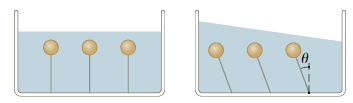
Inner ear. A student constructs a model of the utricle of the ear by attaching wooden balls (m = 0.080 kg) by strings to the bottom of a fish tank and then submerging them in water so that they float with the strings in a vertical direction. She finds that the wooden balls float with a buoyant
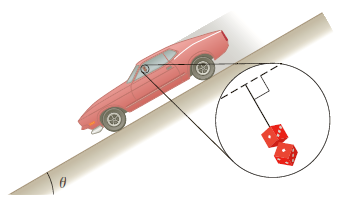
A vintage sports car accelerates down a slope of θ = 17° as depicted in Figure P4.75. The driver notices that the strings of the fuzzy dice hanging from his rear view mirror are perpendicular to the roof of the car. What is the car€™s acceleration?Figure P4.75
A spacecraft is traveling through space parallel to the x direction with an initial velocity of magnitude v0 = 3500 m/s. At t = 0, the pilot turns on the engines, producing an acceleration of magnitude α = 150 m/s2 along the y direction. Find the speed and the angle the velocity makes with the x
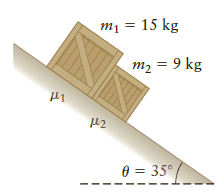
Two blocks of mass m1and m2are sliding down an inclined plane (Fig. P4.79). (a) If the plane is friction less, what is the magnitude of the contact force between the two masses? (b) If the coefficient of kinetic friction between m1 and the plane is µ1 = 0.25 and between m2 and the
A juvenile delinquent wants to break a window near the top of a tall building using a rock. The window is 30 m above ground level, and the base of the building is 20 m from his hiding spot behind a bush. Find the minimum speed the rock must have when it leaves his hand. Also find the corresponding
A cannon shell is fired from a battleship with an initial speed of 700 m/s. (a) What is the maximum range of the shell? (b) For the firing angle that gives the maximum range, what is the maximum height reached by the shell? Ignore air drag and assume the shell lands at the same height as
Daredevil stunt. Once upon a time, a stuntman named Evel Knievel boasted that he would jump across the Grand Canyon on a motorcycle. (This stunt was never attempted.) The width of the Grand Canyon varies from place to place, but suppose Mr. Knievel attempted to jump across at a point where the
Although Evel Knievel never succeeded in jumping over the Grand Canyon (see Problem 80), he was famous for jumping (with the help of his motorcycle) over, among other things, 14 large trucks. This jump covered an approximate distance of 135 ft. What was Mr. Knievel’s minimum initial velocity for
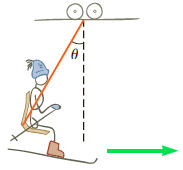
A person travels on a ski lift (Fig. P4.82). (a) If the support strut on the ski lift makes an angle θ = 15°, what is the horizontal acceleration of the person? (b) If the person plus the lift chair have a combined mass m = 120 kg, what is the tension force along the support strut?
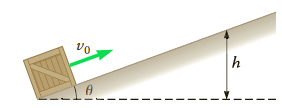
A block slides up a friction less, inclined plane with θ = 25° (Fig. P4.83). (a) If the block reaches a maximum height h = 4.5 m, what was the initial speed of the lock? (b) Now consider a second inclined plane with the same tilt angle and for which the coefficient of kinetic
A golf ball is hit with an initial velocity of magnitude 60 m/s at an angle of 65° with respect to the horizontal (x) direction. At the same time, a second golf ball is hit with an initial speed v0 at an angle 35° with respect to x. If the two balls land at the same time, what is v0?
A car travels along a level road with speed v = 25 m/s (about 50 mi/h). The coefficient of kinetic friction between the tires and the pavement is µK = 0.55. (a) If the driver applies the brakes and the tires “lock up” so that they skid along the road, how far does the car travel before it
A person riding a bicycle on level ground at a speed of 10 m/s throws a baseball forward at a speed of 15 m/s relative to the bicycle at an angle of 35° relative to the horizontal (x) direction. (a) If the ball is released from a height of 1.5 m, how far does the ball travel horizontally, as
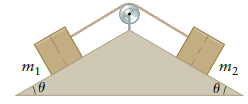
Two blocks of mass m1= 2.5 kg and m2= 3.5 kg rest on a double inclined plane with equal angles (Fig. P4.87). The blocks are connected by a string that passes over a pulley, and the blocks are in motion. Consider two different scenarios: (1) there is a coefficient of friction µKbetween m1and
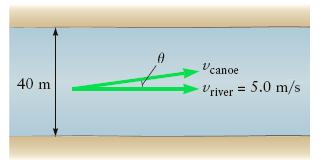
A canoe travels across a 40-m-wide river that has a current of speed 5.0 m/s. The canoe has a speed of 0.80 m/s relative to the water (Fig. P4.88). The person paddles the canoe so as to cross the river as fast as possible. (a) What is the canoe’s velocity relative to an observer on
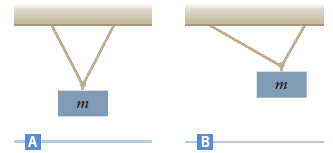
Hanging out. (a) A block of mass m = 20 kg hangs from two cables attached to a ceiling as shown in Figure P4.89A. What is the approximate tension in each cable? (b) The two cables are now rearranged so that they make different angles with the vertical direction as shown in Figure P4.89B.
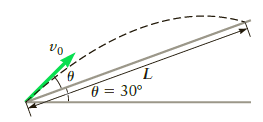
A projectile is fired uphill as sketched in Figure P4.90. If v0= 150 m/s and θ = 30°, what is L?Figure P4.90 0 = 30°
When airplanes land or take off, they always travel along a runway in the direction that is “into” the wind because the “lift force” on an airplane wing depends on the speed of the airplane relative to the air (vrel). We’ll see in Chapter 10 that the lift force is proportional to v2 rel.
Soccer on a windy day. A professional soccer player can kick a ball with a speed of about 30 m/s (about 75 mi/h). Does air drag play a significant role in the trajectory of the ball? Give a reason for your answer.
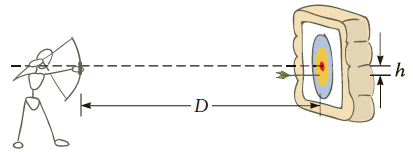
An archer lines up an arrow on the horizontal exactly dead center on a target as drawn in Figure P4.28. She releases the arrow, and it strikes the target a distance h = 7.6 cm below the center. If the target is 10 m from the archer, (a) how long was the arrow in the air before striking the
Consider a baseball player who wants to catch the fly ball in Problem 26(b). Estimate the force exerted by the ball on the player’s glove as the ball is coming to rest.
A baseball is hit with an initial speed of 45 m/s at an angle of 358 relative to the x (horizontal) axis. (a) Find the speed of the ball at t = 3.2 s. (b) What angle does v(vector) make with the x axis at this moment? (c) While the ball is in the air, at what value of t is the speed
The rock-on-a-string accelerometer in Figure 4.30 can be used to measure acceleration along a horizontal direction. Discuss how you could use it to also measure the vertical component of the acceleration.Figure 4.30 mg mg T cos 8 т T sin 8 mg
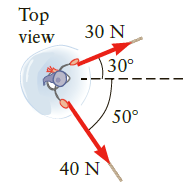
Two ropes are attached to a skater as sketched in Figure P4.1 and exert forces on her as shown. Find the magnitude and direction of the total force exerted by the ropes on the skater.Figure P4.1 Top 30 N view 30° 50° 40 N
At what angle should a ball be thrown so that it has the maximum range? Ignore air drag.
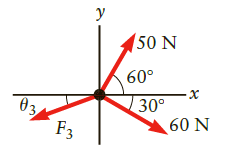
The three forces shown in Figure P4.2 act on a particle. If the particle is in transnational equilibrium, find F3(the magnitude of force 3) and the angle θ3.Figure P4.2 (50 N 60° х 30° 60 N 0з F3
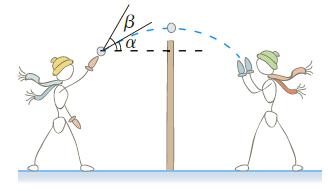
Two children are having a snowball fight, and one is trying to land a snowball on a friend who is hiding behind a wall (Fig. Q4.2). The child on the left can only throw snowballs with one value of the initial speed and finds that for one throwing angle a that is less than 458 he is able to have his
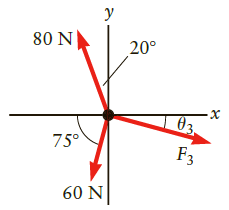
Several forces act on a particle as shown in Figure P4.3. If the particle is in transnational equilibrium, what are the values of F3(the magnitude of force 3) and θ3(the angle that force 3 makes with the x axis)?Figure P4.3 80 N 20° -X- 03. 75° F3 60 N
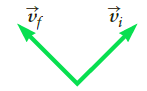
An object has an initial velocity v(vector)iand a final velocity v(vector)fas sketched in Figure Q4.3. Sketch the approximate direction of the acceleration a(vector) of the object during this time interval.Figure Q4.3
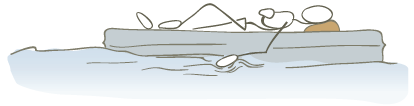
A man is lazily floating on an air mattress in a swimming pool (Fig. P4.4). (a) Draw a free-body diagram for the man and for the mattress. (b) Identify the reaction forces for all the forces in your free-body diagrams in part (a). (c) If the mass of the man is 110 kg and the mass of
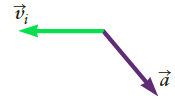
During a particular time interval, an object has an acceleration a(vector) in the direction shown in Figure Q4.4. If v(vector)iis the initial velocity of the object, draw a vector v(vector)fthat might be the velocity of the object at the end of the interval.Figure Q4.4 a.
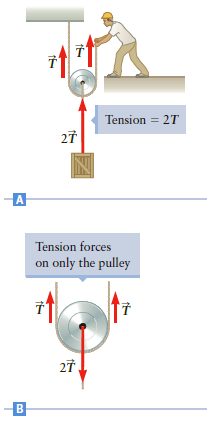
The arrangement in Example 4.2 (p. 95) makes it possible to amplify a force. (Compare this example to the block and tackle in Fig. 3.23.) Amplifying forces in this way comes at a price. To appreciate this price, imagine that the force on the car in Figure 4.4 is just barely large enough to move the
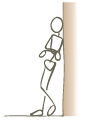
A person leans against a wall (Fig. P4.5). Draw a free-body diagram for the person. Assume there is no frictional force between the wall and the person.Figure P4.5
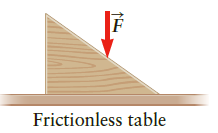
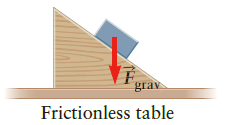
Consider a wedge that rests on a horizontal table as shown in Figure Q4.6 and assume there is no friction between the wedge and the table. A force is now applied vertically as shown in the figure. You might expect this force will cause the wedge to move to the left. Explain why the wedge does not
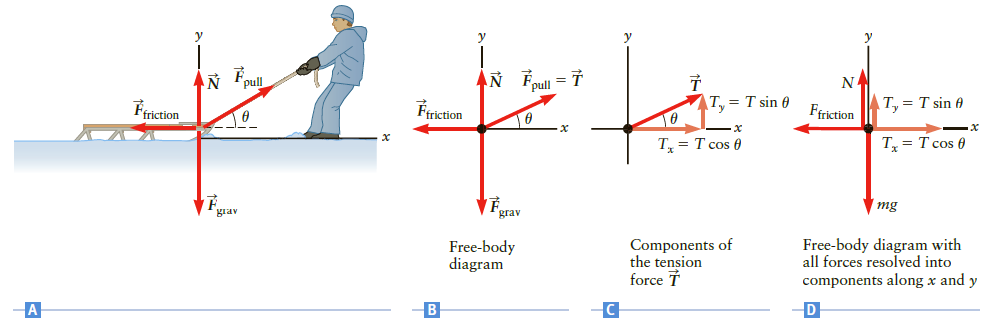
The sled in Figure 4.2 is stuck in the snow. A child pulls on the rope and finds that the sled just barely begins to move when he pulls with a force of 25 N, with the rope at an angle of 30° with respect to the horizontal.(a) Sketch the sled and all the forces acting on it. Also choose a
Consider again the wedge in Question 6, but now assume a block is placed onto it as shown in Figure Q4.7. There is again no friction between the wedge and the table, and there is also no friction between the block and the wedge. Explain why in this case the wedge will be accelerated to the left.
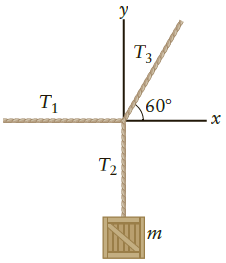
A system of cables is used to support a crate of mass m = 45 kg as shown in Figure P4.7. Find the tensions in all three cables.Figure P4.7 T3 T1 K60° х T2 т
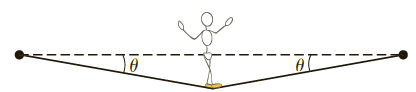
Balancing act. The tightrope walker in Figure P4.8 gets tired and decides to stop for a rest. During this rest period, she is in transnational equilibrium. She stops at middle of the rope and finds that both sides of the rope make an angle θ = 15° with the horizontal. (a)
Time of flight. Equation 4.26 gives a relation for the time at which a batted baseball lands. Use the quadratic formula to find the solutions for tlands. (See Appendix B if you don€™t remember the quadratic formula.) Since you are solving a quadratic equation, there are two solutions for
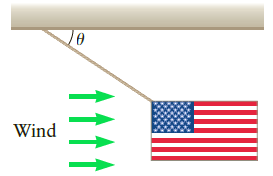
A flag of mass 2.5 kg is supported by a single rope as shown in Figure P4.9. A strong horizontal wind exerts a force of 12 N on the flag. Find the tension in the rope and the angle u the rope makes with the horizontal.Figure P4.9 Wind
Explain why the string in Figure 4.30 hangs vertically if the velocity is constant. Consider both an airplane moving horizontally and one moving with a nonzero velocity component along y.Figure 4.30 mg mg T cos 8 T sine mg
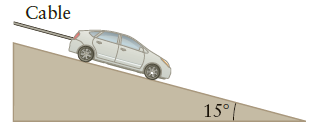
A car of mass 1400 kg is parked on a very slippery hillside (Fig. P4.10). To keep it from sliding down the hill, the owner attaches a cable. (a) Sketch all the forces on the car. Include coordinate axes in your sketch. (b) Determine the components of all the forces on the car along the
Explain why you cannot run unless there is a frictional force between your feet and the ground.
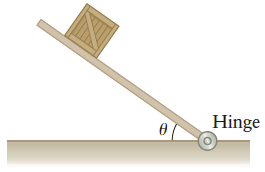
A crate is placed on an inclined board as shown in Figure P4.11. One end of the board is hinged so that the angle θ is adjustable. If the coefficient of static friction between the crate and the board is µS= 0.30, what is the value of u at which the crate just begins to
Peel out! The author has a small pickup truck. He finds that it is much easier to “burn rubber” (i.e., spin the back wheels so that they slip relative to the road surface) when the truck is empty than when it is carrying a heavy load. Explain why.
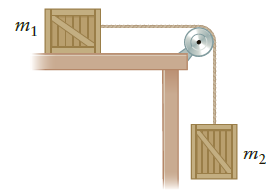
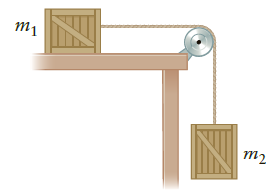
Two blocks of mass m1= 45 kg and m2= 12 kg are connected by a mass less string that passes over a pulley as shown in Figure P4.12. The coefficient of static friction between m1and the table is µS= 0.45. (a) Will this system be in static equilibrium? Assume the pulley is friction
Give an example in which the magnitude of the instantaneous velocity is always larger than the average velocity.
For the system in Problem 12 and Figure P4.12, how large can m2be made without the system starting into motion?Data From Problem 12Two blocks of mass m1 = 45 kg and m2 = 12 kg are connected by a mass less string that passes over a pulley as shown in Figure P4.12. The coefficient of static friction
Give an example in which the acceleration is perpendicular to the velocity.
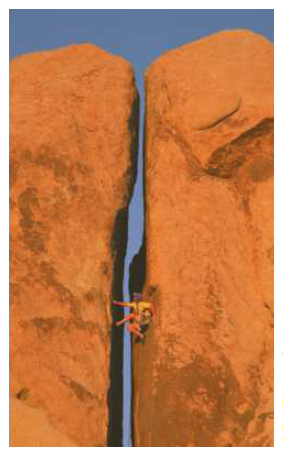
Stemming a chimney. A rock climber of mass 60 kg wants to make her way up the crack between two rocks as shown in Figure P4.14. The coefficient of friction between her shoes and the rock surface is µS= 0.90. What is the smallest normal force she can apply to both surfaces without slipping?
Give an example of motion in which the instantaneous velocity is zero but the acceleration is not zero.
A rock is thrown up in the air in such a way that its speed is zero at the top of its trajectory. Where does the rock land?
A hockey puck is given an initial velocity such that vx = 12 m/s and vy = 18 m/s, where the x–y plane is horizontal. (a) What is the initial speed of the puck? (b) What angle does the initial velocity make with the x axis? (c) What angle does the initial velocity make with the y
Give three examples in which the force of friction on an object has the same direction as the velocity of the object.
A quarterback is asked to throw a football to a receiver who is 35 m away. What is the minimum speed the football must have when it leaves the quarterback’s hand? Assume the ball is caught at the same height as it is thrown.
Ball 1 is thrown with an initial speed v0 at an angle θ relative to the horizontal (x) axis. Ball 2 is thrown at the same angle, but with an initial speed of 2v0. (a) If ball 1 is in the air for a time t1, how long is ball 2 in the air?(b) If ball 1 reaches a maximum height h1, what is the
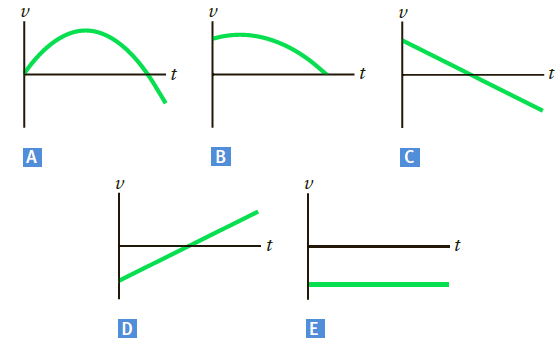
Which of the graphs in Figure P4.18 might be a plot of the vertical component of the velocity of a projectile that is thrown from the top of a building?Figure P4.18 A D
Showing 4500 - 4600
of 4913
First
36
37
38
39
40
41
42
43
44
45
46
47
48
49
50
Step by Step Answers

 Get 50% OFF
Claim Now
Get 50% OFF
Claim Now