New Semester
Started
Get
50% OFF
Study Help!
--h --m --s
Claim Now
Question Answers
Textbooks
Find textbooks, questions and answers
Oops, something went wrong!
Change your search query and then try again
S
Books
FREE
Study Help
Expert Questions
Accounting
General Management
Mathematics
Finance
Organizational Behaviour
Law
Physics
Operating System
Management Leadership
Sociology
Programming
Marketing
Database
Computer Network
Economics
Textbooks Solutions
Accounting
Managerial Accounting
Management Leadership
Cost Accounting
Statistics
Business Law
Corporate Finance
Finance
Economics
Auditing
Tutors
Online Tutors
Find a Tutor
Hire a Tutor
Become a Tutor
AI Tutor
AI Study Planner
NEW
Sell Books
Search
Search
Sign In
Register
study help
sciences
physical chemistry
Physical Chemistry 3rd edition Thomas Engel, Philip Reid - Solutions
List the energetic degrees of freedom expected to contribute to the internal energy at 298 K for a diatomic molecule. Given this list, what spectroscopic information do you need to numerically determine the internal energy?
Why is the contribution of translational motion to the internal energy 3/2RT at 298 K?
What is the relationship between ensemble energy and the thermodynamic concept of internal energy?
The effect of symmetry on the rotational partition function for H2 was evaluated by recognizing that each hydrogen is a spin 1/2 particle and is, therefore, a fermion. However, this development is not limited to fermions, but is also applicable to bosons. Consider CO2, in which rotation by 180°
Determine the total molecular partition function for gaseous H2O at 1000. K confined to a volume of 1.00 cm3. The rotational constants for water are 27.8 cm–1, 14.5 cm–1, BA = BB = and 9.95 cm–1. BC = The vibrational frequencies are 1615, 3694, and 3802 cm–1. The ground electronic state is
Determine the total molecular partition function for I2, confined to a volume of 1000 cm3 at 298 K. Other information you will find useful: B = 0.0374 cm–1, v̅ = 208 cm–1, and the ground electronic state is non degenerate.
Rhodopsin is a biological pigment that serves as the primary photoreceptor in vision (Science 266 [1994]: 422). The chromophore in rhodopsin in retinal, and the absorption spectrum of this species is centered at roughly 500 nm. Using this information, determine the value of qE for retinal. Do you
NO is a well-known example of a molecular system in which excited electronic energy levels are readily accessible at room temperature. Both the ground and excited electronic states are doubly degenerate, and separated by ~121.1cm–1.a. Evaluate the electronic partition function for this molecule
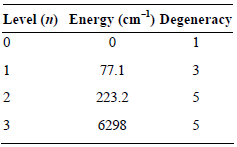
a. Evaluate the electronic partition function for atomic Si at 298 K given the following energy levels:b. At what temperature will the n = 3 energy level contribute 0.100 to the electronic partition function? Level (1) Energy (cm) Degeneracy 77.1 223.2 5 6298 5 3. 2. 3.
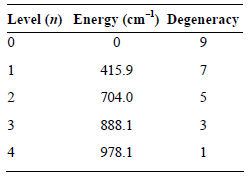
Evaluate the electronic partition function for atomic Fe at 298 K given the following energy levels. Level (1) Energy (cm) Degeneracy 415.9 704.0 888.1 3 978.1 2. 3. 4.
Imagine performing the coin-flip experiment of Problem P29.17, but instead of using a fair coin, a weighted coin is employed for which the probability of landing heads is two-fold greater than landing tails. After tossing the coin 10 times, what is the probability of observing the following
Hydrogen isocyanide, HNC, is the tautomer of hydrogen cyanide (HCN). HNC is of interest as an intermediate species in a variety of chemical processes in interstellar space (T = 2.75 K).a. For HCN the vibrational frequencies are 2041cm−1 (CN stretch), 712 cm−1 (bend, doubly degenerate), and 3669
A general expression for the classical Hamiltonian is:H = α pi2 + H€²where pi is the momentum along one dimension for particle i, α is a constant, and H€² are the remaining terms in the Hamiltonian. Substituting this into the equipartition theorem
Consider a particle free to translate in one dimension. The classical Hamiltonian is H = P2/2m.a. Determine qclassical for this system. To what quantum system should you compare it in order to determine the equivalence of the classical and quantum statistical mechanical treatments?b. Derive
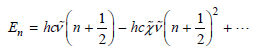
a. In this chapter, the assumption was made that the harmonic oscillator model is valid such that anharmonicity can be neglected. However, anharmonicity can be included in the expression for vibrational energies. The energy levels for an anharmonic oscillator are given byNeglecting zero-point
You have in your possession the first vibrational spectrum of a new diatomic molecule, X2, obtained at 1000. K. From the spectrum you determine that the fraction of molecules occupying a given vibrational energy state n is as follows:What are the vibrational energy spacings for X2? 3 >3 0.184 0.352
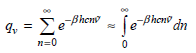
In deriving the vibrational partition function, a mathematical expression for the series expression for the partition function was employed. However, what if one performed integration instead of summation to evaluate the partition function? Evaluate the following expression for the vibrational
In using statistical mechanics to describe the thermodynamic properties of molecules, high-frequency vibrations are generally not of importance under standard thermodynamic conditions since they are not populated to a significant extent. For example, for many hydrocarbons the C―H stretch
Isotopic substitution is employed to isolate features in a vibrational spectrum. For example, the C=O stretch of individual carbonyl groups in the backbone of a polypeptide can be studied by substituting 13C18O for 12C16O.a. From quantum mechanics the vibrational frequency of a diatomic molecules
Determine the populations in n = 0 and 1 for H81Br (ν̅ = 2649 cm−1) at 298 K.
Evaluate the vibrational partition function for CFCl3 at 298 K, where the vibrational frequencies are (with degeneracy in parentheses) 1081, 847 (2), 535, 394 (2), 350., and 241(2) cm–1.
Evaluate the vibrational partition function for NH3 at 1000. K for which the vibrational frequencies are 950., 1627.5 (doubly degenerate), 3335, and 3414 cm–1 (doubly degenerate). Are there any modes that you can disregard in this calculation? Why or why not?
Evaluate the vibrational partition function for SO2 at 298 K, where the vibrational frequencies are 519, 1151, and 1361cm–1.
Evaluate the vibrational partition function for H2O at 2000 K, where the vibrational frequencies are 1615, 3694, and 3802 cm–1.
For IF (ν̅ = 610 cm–1) calculate the vibrational partition function and populations in the first three vibrational energy levels for T = 300 and 3000 K. Repeat this calculation for IBr (ν̅ = 269 cm–1). Compare the probabilities for IF and IBr. Can you explain the differences
Determine the rotational partition function for I35Cl (B = 0.114 cm−1) at 298 K.
Calculate the vibrational partition function for H35Cl (θ = 2990 cm−1) at 300 and 3000. K. What fraction of molecules will be in the ground vibrational state at these temperatures?
When 4He is cooled below 2.17 K it becomes a “superfluid” with unique properties such as a viscosity approaching zero. One way to learn about the superfluid environment is to measure the rotational–vibrational spectrum of molecules embedded in the fluid. For example, the spectrum of OCS in a
In general, the high-temperature limit for the rotational partition function is appropriate for almost all molecules at temperatures above their boiling point. Hydrogen is an exception to this generality because the moment of inertia is small due to the small mass of H. Given this, other molecules
a. Calculate the percent population of the first 10 rotational energy levels for HBr (B = 8.46 cm–1) at 298 K.b. Repeat this calculation for HF assuming that the bond length of this molecule is identical to that of HBr.
In microwave spectroscopy a traditional unit for the rotational constant is the Mc or “mega cycle” equal to 106 s−1. For 14N14N16O the rotational constant is 12,561.66 Mc.a. Convert the above value for the rotational constant from Mc to cm−1.b. Determine the value of the rotational
Calculate the rotational partition function for oxygen (B = 1.44 cm−1) at its boiling point, 90.2 K, using the high-temperature approximation and by discrete summation. Why should only odd values of J be included in this summation?
For a rotational–vibrational spectrum of H81Br (B = 8.46 cm−1) taken at 500. K, which R-branch transition do you expect to be the most intense?
What transition in the rotational spectrum of IF (B = 0.280 cm−1) is expected to be the most intense at 298 K?
a. In the rotational spectrum of H35Cl (I = 2.65 × 10–47 kg m2) the line corresponding to the J = 4 to J = 5 transition is the most intense. At what temperature was the spectrum obtained?b. At 1000. K, which rotational transition of H35Cl would you expects to demonstrate the greatest
Calculate the rotational partition function for ClNO at 500. K, where BA = 2.84 cm–1, BB = 0.187 cm–1, and BC =0.175 cm–1.
Calculate the rotational partition function for SO2 at 298 K, where BA = 2.03 cm−1, BB = 0.344 cm–1, and BC = 0.293 cm–1.
For which of the following diatomic molecules is the high-temperature expression for the rotational partition function valid at 40. K?a. DBr (B = 4.24 cm−1)b. DI (B = 3.25 cm−1)c. CsI (B = 0.0236 cm−1)d. F35Cl (B = 0.516 cm−1)
Calculate the rotational partition function for 35Cl2(B 0.244 cm-1) at 298 K.
Calculate the rotational partition function for the interhalogen compound F35Cl (B = 0.516 cm−1) at 298 K.
Consider para-H2 (B = 60.853 cm-1) for which only even J levels are available. Evaluate the rotational partition function for this species at 50. K. Perform this same calculation for HD (B = 45.655 cm−1).
Which species will have the largest rotational partition function: H2, HD, or D2? Which of these species will have the largest translational partition function assuming that volume and temperature are identical? When evaluating the rotational partition functions, you can assume that the
Determine the symmetry number for the following halogenated methanes: CCl4, CFCl3, CF2Cl2, CF3Cl.
What is the symmetry number for the following molecules?a. 35Cl37Clb. 35Cl35Clc. 16O2d. C6H6e. CH2Cl2
For N2 at 77.3 K, 1.00 atm, in a 1.00-cm3 container, calculate the translational partition function and the ratio of this partition function to the number of N2 molecules present under these conditions.
Researchers at IBM have used scanning tunneling microscopy to place atoms in nanoscale arrangements which they refer to as “quantum corrals” (Nature 363 [1993]: 6429). Imagine constructing a square corral with 4.00 nm sides. If CO is confined to move in the 2-D space defined by this corral,
Imagine gaseous Ar at 298 K confined to move in a two-dimensional plane of area 1.00 cm2. What is the value of the translational partition function?
At what temperature are there Avogadro’s number of translational states available for O2 confined to a volume of 1000. cm3?
Evaluate the translational partition function for Ar confined to a volume of 1000 cm3 at 298 K. At what temperature will the translational partition function of Ne be identical to that of Ar at 298 K confined to the same volume?
He has a normal boiling point of 4.2 K. For gaseous He at 4.2 K and 1 atm, is the high-temperature limit for translational degrees of freedom applicable?
Evaluate the translational partition function for 35Cl2 confined to a volume of 1.00 L at 298 K. How does your answer change if the gas is 37Cl2? (Can you reduce the ratio of translational partition functions to an expression involving mass only?)
Evaluate the translational partition function for H2 confined to a volume of 100 cm3 at 298 K. Perform the same calculation for N2 under identical conditions. (Do you need to reevaluate the full expression for qT?)
Why is it possible to set the energy of the ground vibrational and electronic energy level to zero?
What is qtotal, and how is it constructed using the partition functions for each energetic degree of freedom discussed in this chapter?
Why is the electronic partition function generally equal to the degeneracy of the ground electronic state?
What is the equipartition theorem? Why is this theorem inherently classical?
How does the presence of degeneracy affect the form of the total vibrational partition function?
What is the form of the total vibrational partition function for a polyatomic molecule?
Although the vibrational degrees of freedom are generally not in the high-T limit, is the vibrational partition function evaluated by discrete summation?
In constructing the vibrational partition function, we found that the definition depended on whether zero-point energy was included in the description of the energy levels. However, the expression for the probability of occupying a specific vibrational energy level was independent of zero-point
What is the high-T approximation for rotations and vibrations? For which of these two degrees of freedom do you expect this approximation to be generally valid at room temperature?
Consider the rotational partition function for a polyatomic molecule. Can you describe the origin of each term in the partition function, and why the partition function involves a product of terms?
Assuming 19F2 and 35Cl2 have the same bond length, which molecule do you expect to have the largest rotational constant?
How many rotational degrees of freedom are there for linear and nonlinear molecules?
For the translational and rotational degrees of freedom, evaluation of the partition function involved replacement of the summation by integration. Why could integration be performed? How does this relate back to the discussion of probability distributions of discrete variables treated as
For which energetic degrees of freedom are the spacing’s between energy levels small relative to kT at room temperature?
List the atomic and/or molecular energetic degrees of freedom discussed in this chapter. For each energetic degree of freedom, briefly summarize the corresponding quantum mechanical model.
What is the relationship between Q and q? How does this relationship differ if the particles of interest are distinguishable versus indistinguishable?
What is the canonical ensemble? What properties are held constant in this ensemble?
The simplest polyatomic molecular ion is H+3, which can be thought of as molecular hydrogen with an additional proton. Infrared spectroscopic studies of interstellar space have identified this species in the atmosphere of Jupiter and other interstellar bodies. The rotational–vibrational spectrum
Molecular oxygen populating the excited singlet state (1Δg) can relax to the ground triplet state (3Σ), which is the lowest energy state by emitting a 1270-nm photon.a. Construct the partition function involving the ground and excited-singlet state of molecular oxygen.b. What temperature is
The lowest two electronic energy levels of the molecule NO are illustrated in the text. Determine the probability of occupying one of the higher-energy states at 100, 500, and 2000. K.
The 13C nucleus is a spin 1/2 particle as is a proton. However, the energy splitting for a given field strength is roughly 1/4 of that for a proton. Using a 1.45-T magnet as in Example Problem 30.6, what is the ratio of populations in the excited and ground spin states for 13C at 298 K?
14N is a spin 1 particle such that the energy levels are at 0 and ±γ Bħ, where γ is the magnetogyric ratio and B is the strength of the magnetic field. In a 4.8-T field, the energy splitting between any two spin states expressed as the resonance frequency is 14.45 MHz. Determine the occupation
When determining the partition function for the harmonic oscillator, the zero-point energy of the oscillator was ignored. Show that the expression for the probability of occupying a specific energy level of the harmonic oscillator with the inclusion of zero-point energy is identical to that
The vibrational frequency of I2 is 208 cm-1. At what temperature will the population in the first excited state be half that of the ground state?
The vibrational frequency of Cl2 is 525 cm-1. Will the temperature at which the population in the first excited vibrational state is half that of the ground state be higher or lower relative to I2 (see Problem P30.18)? What is this temperature?
Determine the partition function for the vibrational degrees of freedom of 1 Cl2 (v = 525 cm-1) and calculate the probability of occupying the first excited vibrational level at 300 and 1000 k. Determine the temperature at which identical probabilities will be observed for 1 F2 (v = 917 cm-1).
Hydroxyl radicals are of interest in atmospheric processes due to their oxidative ability. Determine the partition function for the vibrational degrees of freedom for OH (v̅ = 3735 cm−1) and calculate the probability of occupying the first excited vibrational level at 260. K. Would you
Calculate the partition function at 298 K for the vibrational energetic degree of freedom for 1H2. Where ν̅ = 4401 cm−1. Perform this same calculation for D2 (or 2H2) assuming the force constant for the bond is the same as in 1H2.
A two-level system is characterized by an energy separation of 1.30 × 10⁻¹⁸ J. At what temperature will the population of the ground state be five times greater than that of the excited state?
Rhodopsin is the pigment in the retina rod cells responsible for vision, and consists of a protein and the co-factor retinal. Retinal is a π-conjugated molecule which absorbs light in the blue-green region of the visible spectrum, where photon absorption represents the first step in the visual
The emission from C can be used for wavelength calibration of instruments in the ultraviolet. This is generally performed by electron-impact initiated decomposition of a precursor (for example, CF4) resulting in the production of electronically excited C, which relaxes to the ground-electronic
Consider the molecule described in the previous problem. Imagine a collection of N molecules all at T = 300. K, and one of these molecules is selected. What is the probability that this molecule will be in the lowest-energy state? What is the probability that it will be in the higher-energy state?
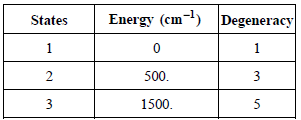
Consider a molecule having three energy levels as follows:What is the value of the partition function when T = 300, and 3000 K? Energy (cm-) Degeneracy States 1 1 500. 3 3 3 1500. 2. 1, 3.
Consider a collection of molecules where each molecule has two non-degenerate energy levels that are separated by 6000. cm−1. Measurement of the level populations demonstrates that there are exactly 8 times more molecules in the ground state than in the upper state. What is the temperature of the
For two non-degenerate energy levels separated by an amount of energy ε /k = 500.K, at what temperature will the population in the higher-energy state be 1/2 that of the lower-energy state? What temperature is required to make the populations equal?
For a set of non-degenerate levels with energy ε /k = 0,100, and 200. K, calculate the probability of occupying each state when T = 50, 500, and 5000.K. As the temperature continues to increase, the probabilities will reach a limiting value. What is this limiting value?
A set of 13 particles occupies states with energies of 0, 100, and 200 cm−1. Calculate the total energy and number of microstates for the following configurations of energy:a. a0 = 8, a1 = 5, and a2 = 0b. a0 = 9, a1 = 3, and a2 = 1c. a0 = 10, a1 = 1, and a2 = 2Do any of these configurations
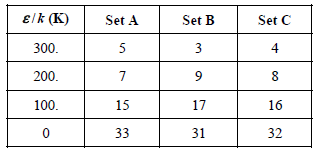
Consider the following sets of populations for four equally spaced energy levels:a. Demonstrate that the sets have the same energy.b. Determine which of the sets is the most probable.c. For the most probable set, is the distribution of energy consistent with a Boltzmann distribution? Elk (K) Set A
Consider the energy-level diagrams, modified from Problem P30.9 by the addition of another excited state with energy of 600. cm−1.a. At what temperature will the probability of occupying the second energy level be 0.15 for the states depicted in part (a) of the figure?b. Perform the corresponding
Consider the energy-level diagrams depicted in the text.a. At what temperature will the probability of occupying the second-energy level be 0.15 for the states depicted in part (a) of the figure?b. Perform the corresponding calculation for the states depicted in part (b) of the figure. Before
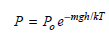
Barometric pressure can be understood using the Boltzmann distribution. The potential energy associated with being a given height above the Earth€™s surface is mgh, where m is the mass of the particle of interest, g is the acceleration due to gravity, and h is height. Using this
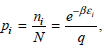
The probability of occupying a given excited state, pi, is given byWhere ni is the occupation number for the state of interest, N is the number of particles, and εi is the energy of the level of interest. Demonstrate that the preceding expression is independent of the definition of
For a two-level system, the weight of a given energy distribution can be expressed in terms of the number of systems, N, and the number of systems occupying the excited state, n1. What is the expression for the weight in terms of these quantities?
Determine the weight associated with the following card hands:a. Having any five cardsb. Having five cards of the same suit (known as a “flush”)
Consider the case of 10 oscillators and eight quanta of energy. Determine the dominant configuration of energy for this system by identifying energy configurations and calculating the corresponding weights. What is the probability of observing the dominant configuration?
a. Realizing that the most probable outcome from a series of N coin tosses is N/2 heads and N/2 tails, what is the expression for Wmaxcorresponding to this outcome?b. Given your answer for part (a), derive the following relationship between the weight for an outcome other than the most probable and
In example problem 30.1, the weights associated with observing 40 heads and 50 heads after flipping a coin 100 times were determined. Perform a similar calculation to determine the weights associated with observing 400 and 500 heads after tossing a coin 1000 times. (Stirling’s approximation will
a. What is the possible number of microstates associated with tossing a coin N times and having it come up H times heads and T times tails?b. For a series of 1000 tosses, what is the total number of microstates associated with 50% heads and 50% tails?c. How much less probable is the outcome that
Showing 2000 - 2100
of 3563
First
14
15
16
17
18
19
20
21
22
23
24
25
26
27
28
Last
Step by Step Answers

 Get 50% OFF
Claim Now
Get 50% OFF
Claim Now