New Semester
Started
Get
50% OFF
Study Help!
--h --m --s
Claim Now
Question Answers
Textbooks
Find textbooks, questions and answers
Oops, something went wrong!
Change your search query and then try again
S
Books
FREE
Study Help
Expert Questions
Accounting
General Management
Mathematics
Finance
Organizational Behaviour
Law
Physics
Operating System
Management Leadership
Sociology
Programming
Marketing
Database
Computer Network
Economics
Textbooks Solutions
Accounting
Managerial Accounting
Management Leadership
Cost Accounting
Statistics
Business Law
Corporate Finance
Finance
Economics
Auditing
Tutors
Online Tutors
Find a Tutor
Hire a Tutor
Become a Tutor
AI Tutor
AI Study Planner
NEW
Sell Books
Search
Search
Sign In
Register
study help
sciences
physical chemistry
Physical Chemistry 3rd edition Thomas Engel, Philip Reid - Solutions
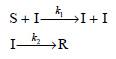
The Kermack€“McKendrick model was developed to explain the rapid rise and fall in the number of infected people during epidemics. This model involves the interaction of susceptible (S), infected (I), and recovered (R) people through the following mechanism:a. Write down the differential
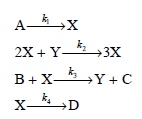
Cubic autocatalytic steps are important in a reaction mechanism referred to as the “brusselator†(named in honor of the research group in Brussels that initially discovered this mechanism):If [A] and [B] are held constant, this mechanism demonstrates interesting oscillatory behavior
Another type of autocatalytic reaction is referred to as cubic autocatalytic and corresponds to the following elementary process:A + 2B → 3B Write the rate law expression for this elementary process. What would you expect the corresponding differential rate expression in terms of ξ (the
DNA microarrays or “chips” first appeared on the market in 1996. These chips are divided into square patches, with each patch having strands of DNA of the same sequence attached to a substrate. The patches are differentiated by differences in the DNA sequence. One can introduce DNA or mRNA of
Many surface reactions require the adsorption of two or more different gases. For the case of two gases, assuming that the adsorption of a gas simply limits the number of surface sites available for adsorption, derive expressions for the fractional coverage of each gas.
Use the following data to determine the Langmuir adsorption parameters for nitrogen on mica:V ads (cm3 g–1…………………… P (Torr)0.494……………………….2.1 × 10–30.782……………………….4.60 × 10–31.16…………………………1.30 × 10⁻²
Given the limitations of the Langmuir model, many other empirical adsorption isotherms have been proposed to better reproduce observed adsorption behavior. One of these empirical isotherms is the Temkin isotherm: V adsorbed = r ln (sP), where V is the volume of gas adsorbed, P is pressure, and r
The adsorption of ethyl chloride on a sample of charcoal at 0 °C measured at several different pressures is as follows:PC1H5Cl (Torr)……………………………….V ads (mL)20………………………………………………….3.050.
Determine the expression for fractional coverage as a function of pressure for the dissociative adsorption mechanism described in the text in which adsorption is accompanied by dissociation: R,(g) + 2M(surface) 2RM(surface)
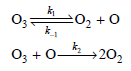
Consider the following mechanism for ozone thermal decomposition:a. Derive the rate law expression for the loss of O3(g).b. Under what conditions will the rate law expression for O3(g) decomposition be first order with respect to O3(g)? :02 +0 O3 03 +0- 202
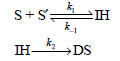
Consider the formation of double-stranded (DS) DNA from two complementary single strands (S and S€²) through the following mechanism involving an intermediate helix (IH):a. Derive the rate law expression for this reaction employing the preequilibrium approximation.b. What is the
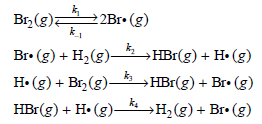
The hydrogen€“bromine reaction corresponds to the production of HBr(g) from H2(g) and Br2(g) as follows: H2(g) + Br2(g) †’ 2HBr(g). This reaction is famous for its complex rate law, determined by Bodenstein and Lind in 1906:where k and m are constants. It took 13
a. For the hydrogen€“bromine reaction presented in Problem P36.7, imagine initiating the reaction with only Br2and H2present. Demonstrate that the rate law expression at t = 0 reduces tob. The activation energies for the rate constants are as follows:Rate
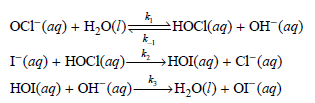
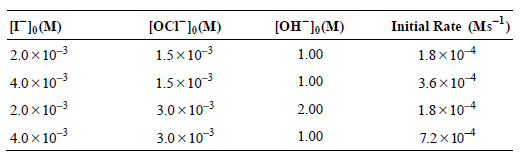
For the reaction Iˆ’(aq) + OClˆ’(aq) ‡‹ OIˆ’(aq) + Clˆ’(aq) occurring in aqueous solution, the following mechanism has been proposed:a. Derive the rate law expression for this reaction based on this mechanism.b. The initial rate of
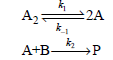
Using the preequilibrium approximation, derive the predicted rate law expression for the following mechanism: Аз A+B- →P
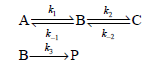
Consider the following mechanism, which results in the formation of product P:If only the species A is present at t = 0, what is the expression for the concentration of P as a function of time? You can apply the preequilibrium approximation in deriving your answer. k, ec B: A: k1 ka →P B-
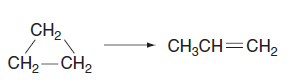
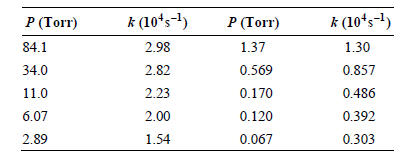
Consider the gas-phase isomerization of cyclopropane. Are the following data of the observed rate constant as a function of pressure consistent with the Lindemann mechanism? CH, CH,CH=CH2 CH,-CH2 k (10ʻs-1) 2.98 2.82 P (Torr) 84.1 к (10'5-1) P (Torr) 1.37 1.30 0.569 0.170 0.857 0.486 34.0
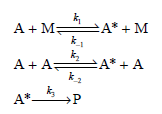
In the discussion of the Lindemann mechanism, it was assumed that the rate of activation by collision with another reactant molecule, A, was the same as collision with a nonreactant molecule, M, such as a buffer gas. What if the rates of activation for these two processes are different? In this
In the unimolecular isomerization of cyclobutane to butylene, the following values for kuni as a function of pressure were measured:Assuming that the Lindemann mechanism accurately describes this reaction, determine k1 and the ratio k€“1/k2 390 210 110 Po (Torr) 760 11.1 10.8 10.3 9.58
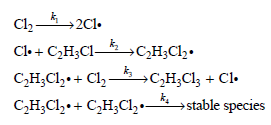
The chlorination of vinyl chloride, C2H3Cl + Cl2†’ C2H3Cl3, is believed to proceed by the following mechanism:Derive the rate law expression for the chlorination of vinyl chloride based on this mechanism. Cl2-2C1. Cl. + C2H3CI- С Н.С1,-+ Cl, — сн,C + —Сн.Cl. Cl. →stable
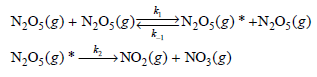
Consider the collision-induced dissociation of N2O5(g) via the following mechanism:The asterisk in the first reaction indicates that the reactant is activated through collision.Experimentally it is found that the reaction can be either first or second order in N2O5(g) depending on the concentration
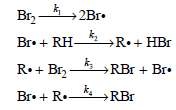
The overall reaction for the halogenation of a hydrocarbon (RH) using Br as the halogen is RH + Br2Ž¯Ž¯†’RBr + HBr. The following mechanism has been proposed for this process:Determine the rate law predicted by this mechanism. Br2 2Br. Br• + RH- →R•+ HBr
The enzyme fumarase catalyzes the hydrolysis of fumarate:Fumarate (aq) + H2O(l) → L-malate (aq)The turnover number for this enzyme is 2.5 × 10³ s–1, and the Michaelis constant is 4.2 × 10⁻⁶ M. What is the rate of fumarate conversion if the initial enzyme concentration is 1 ×
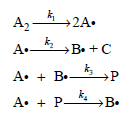
Determine the predicted rate law expression for the following radical-chain reaction: 2A• A,- 2A. A. B +C A. + B. A. + P- P →B•
The enzyme catalase catalyzes the decomposition of hydrogen peroxide. The following data are obtained regarding the rate of reaction as a function of substrate concentration:The concentration of catalase is 3.5 × 10€“9 M. Use these data to determine rate max, Km, and the
Peptide bond hydrolysis is performed by a family of enzymes known as serine proteases. The name is derived from a highly conserved serine residue in these enzymes that is critical for enzyme function. One member of this enzyme class is chymotrypsin, which preferentially cleaves proteins at residue
Protein tyrosine phosphatases (PTPases) are a general class of enzymes that are involved in a variety of disease processes, including diabetes and obesity. In a study by Z.-Y. Zhang and coworkers [J. Medicinal Chemistry 43 (2000): 146], computational techniques were used to identify potential
The rate of reaction can be determined by measuring the change in optical rotation of the sample as a function of time if a reactant or product is chiral. This technique is especially useful for kinetic studies of enzyme catalysis involving sugars. For example, the enzyme invertase catalyzes the
The enzyme glycogen synthase kinase (GSK-3β) plays a central role in Alzheimer€™s disease. The onset of Alzheimer€™s disease is accompanied by the production of highly phosphorylated forms of a protein referred to as €œÏ„ .€
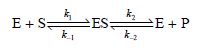
In the Michaelis€“Menten mechanism, it is assumed that the formation of product from the enzyme€“substrate complex is irreversible. However, consider the following modified version in which the product formation step is reversible:Derive the expression for the Michaelis constant
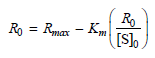
Reciprocal plots provide a relatively straightforward way to determine if an enzyme demonstrates Michaelis€“ Menten kinetics and to determine the corresponding kinetic parameters. However, the slope determined from these plots can require significant extrapolation to regions corresponding
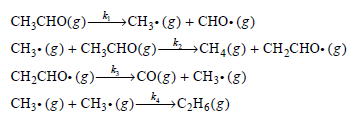
The Rice€“Herzfeld mechanism for the thermal decomposition of acetaldehyde (CH3CO(g)) isUsing the steady-state approximation, determine the rate of methane (CH4(g)) formation. CH CHO(3) — CHз- (3) + CHO- (8) CH- (g) + CH,CHо(з) — сн4(8) + сH-CнO-(3) CH2CHO- (g)– CH- (8) +
In the troposphere carbon monoxide and nitrogen dioxide undergo the following reaction:NO2(g) + CO(g) → NO(g) + CO2(g)Experimentally, the rate law for the reaction is second order in NO2(g), and NO3(g) has been identified as an intermediate in this reaction. Construct a reaction
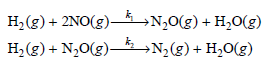
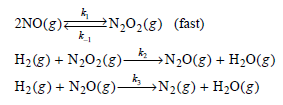
The reaction of nitric oxide (NO(g)) with molecular hydrogen (H2(g)) results in the production of molecular nitrogen and water as follows:2NO(g) + 2H2(g) †’ N2O(g) + 2H2O(g)The experimentally determined rate law expression for this reaction is first order in H2(g) and second
A proposed mechanism for the formation of N2O5(g) from NO2(g) and O3(g) isDetermine the rate law expression for the production of N2O5(g) given this mechanism. NO,(g) + O3(g)–1 →NO;(g)+O2(g) NO;(g) + NO,(g) + M(g)– »N,O5(g) + M(g)
What two factors influence the electron transfer rate constant according to Marcus theory?
What is the distance dependence for fluorescence resonance energy transfer predicted by the Förster model?
What is the expected variation in excited-state lifetime with quencher concentration in a Stern–Volmer plot?
What depopulation pathways occur from the first excited singlet state? For the first excited triplet state?
What is photochemistry? How does one calculate the energy of a photon?
What is an oscillating reaction?
What is autocatalysis?
In what ways are radical polymerization reactions similar to radical reactions in general?
What is a radical? What elementary steps are involved in a reaction mechanism involving radicals?
What are the inherent assumptions in the Langmuir model of surface adsorption?
What is the difference between a homogeneous and a heterogeneous catalyst?
How is the standard enzyme kinetic scheme modified to incorporate competitive inhibition? What plot is used to establish competitive inhibition and to determine the kinetic parameters associated with inhibition?
What is the Michaelis–Menten rate law? What is the maximum reaction rate predicated by this rate law?
What is an enzyme? What is the general mechanism describing enzyme catalysis?
How is a catalyst defined, and how does such a species increase the reaction rate?
What is the main assumption in the Lindemann mechanism for unimolecular reactions?
What is the preequilibrium approximation, and under what conditions is it considered valid?
What is a reaction intermediate? Can an intermediate be present in the rate law expression for the overall reaction?
For a reaction mechanism to be considered correct, what property must it demonstrate?
How is a simple reaction different from a complex reaction?
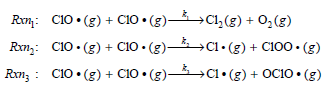
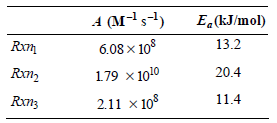
Chlorine monoxide (ClO i ) demonstrates three bimolecular self-reactions:The following table provides the Arrhenius parameters for this reaction:a. For which reaction is ΔH€¡ greatest and by how much relative to the next closest reaction?b. For which reaction is
Reactions involving hydroxyl radical (OH·) are extremely important in atmospheric chemistry. The reaction of hydroxyl radical with molecular hydrogen is as follows:OH · (g) + H2 (g) → H2O(g) + H · (g)Determine the Eyring parameters ΔH‡ and ΔS‡ for this reaction where A = 8 ×
Consider the “unimolecular” isomerization of methylcyanide, a reaction that will be discussed in detail in Chapter 36:CH3NC(g) → CH3CN(g)The Arrhenius parameters for this reaction are A = 2.5 × 10¹⁶ s–1 and Ea = 272 kJ mol–1. Determine the Eyring parameters ΔH‡ and ΔS‡
Hydrogen abstraction from hydrocarbons by atomic chlorine is a mechanism for Cl · loss in the stratosphere. Consider the reaction of Cl· with ethane: C2H6(g) + Cl· (g) †’ C2H5· (g) + HCl(g). This reaction was studied in the laboratory, and the
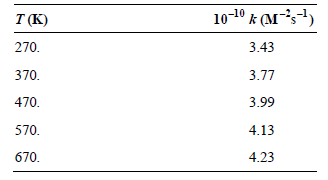
The gas-phase decomposition of ethyl bromide is a first-order reaction, occurring with a rate constant that demonstrates the following dependence on temperature:a. Determine the Arrhenius parameters for this reaction.b. Using these parameters, determine ΔH€¡ and
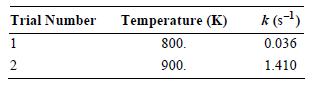
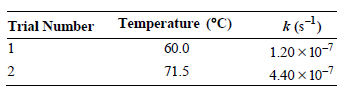
The unimolecular decomposition of urea in aqueous solution is measured at two different temperatures and the following data are observeda. Determine the Arrhenius parameters for this reaction.b. Using these parameters, determine ΔH€¡ and ΔS€¡ as
Catalase is an enzyme that promotes the conversion of hydrogen peroxide (H2O2) into water and oxygen. The diffusion constant and radius for catalase are 6.0 × 10⁻⁷ cm2 s–1 and 51.2 Å, respectively. For hydrogen peroxide the corresponding values are 1.5 × 10⁻⁵ cm2 s–1 and
Imidazole is a common molecular species in biological chemistry. For example, it constitutes the side chain of the amino acid histidine. The rate constant for the protonation reaction is 5.5 × 10¹⁰ M–1 s–1. Assuming that the reaction is diffusion controlled, estimate the diffusion coefficient
In the following chapter, enzyme catalysis reactions will be extensively reviewed. The first step in these reactions involves the binding of a reactant molecule (referred to as a substrate) to a binding site on the enzyme. If this binding is extremely efficient (that is, equilibrium strongly favors
In the limit where the diffusion coefficients and radii of two reactants are equivalent, demonstrate that the rate constant for a diffusion-controlled reaction can be written as: 8RT ka 37 %3D
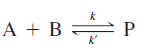
Consider the reactionA temperature-jump experiment is performed where the relaxation time constant is measured to be 310 μs, resulting in an equilibrium where K eq = 0.7with [P] eq = 0.2M. What are k and k€²? (Watch the units!) P A + B k'
The melting of double-strand DNA into two single strands can be initiated using temperature-jump methods. Derive the expression for the T-jump relaxation time for the following equilibrium involving double-strand (DS) and single-strand (SS) DNA: DS2SS k,
At 552.3 K, the rate constant for the thermal decomposition of SO2Cl2 is 1.02 × 10⁻⁶ s–1. If the activation energy is 210. kJ mol–1, calculate the Arrhenius preexponential factor and determine the rate constant at 600. K.
Consider the thermal decomposition of 1 atm of (CH3)3COOC(CH3)3 to acetone (CH3)2CO and ethane (C2H6), which occurs with a rate constant of 0.0019 s−1. After initiation of the reaction, at what time would you expect the pressure to be 1.8 atm?
The rate constant for the reaction of hydrogen with iodine is 2.45 × 10⁻⁴ M–1 s–1 at 302 °C and 0.950 M–1 s–1 at 508 °C.a. Calculate the activation energy and Arrhenius preexponential factor for this reaction.b. What is the value of the rate constant at 400. °C?
The activation energy for a reaction is 50. J mol−1. Determine the effect on the rate constant for this reaction with a change in temperature from 273 K to 298 K.
The conversion of NO2 to NO and O2 can occur through the following reaction:NO2(g) → 2NO(g) + O2(g)The activation energy for this reaction is 111 kJ mol−1 and the preexponential factor is 2.0 × 10⁻⁹ M−1 s−1; assume that these quantities are temperature independent.a. What is
Calculate the ratio of rate constants for two thermal reactions that have the same Arrhenius preexponential term, but with activation energies that differ by 1, 10, and 30 kJ/mol.
A standard “rule of thumb” for thermally activated reactions is that the reaction rate doubles for every 10 K increase in temperature. Is this statement true independent of the activation energy (assuming that the activation energy is positive and independent of temperature)?
In addition to Cl ·, other halogens can potentially contribute to stratospheric ozone loss. For example, consider the reaction of Br· with ozone:Br· (g) + O3(g) → BrO· (g) + O2(g)At 298 K the rate constant for this reaction is 1.2 × 10⁸ M−1 s−1, about a factor of 50 reduced
The reaction of atomic chlorine with ozone is the first step in the catalytic decomposition of stratospheric ozone by Cl ·.Cl · (g) + O3(g) → ClO · (g) + O2(g)At 298 K the rate constant for this reaction is 6.7 × 10⁹ M−1 s−1. Experimentally the Arrhenius preexponential factor
An experiment is performed on the branching reaction depicted in the text. Two things are determined: (1) The yield for B at a given temperature is found to be 0.3, and (2) the rate constants are described well by an Arrhenius expression with the activation to B and C formation being 27 and 34 kJ
In the stratosphere, the rate constant for the conversion of ozone to molecular oxygen by atomic chlorine isa. What is the rate of this reaction at 20 km whereb. The actual concentrations at 45 km are [Cl] = 3 × 10ˆ’15 M and [O3] = 8 × 10-11 M. What is the rate
The bimolecular reaction of chlorine monoxide can result in the formation of three different combinations of products or product channels (rate constant for each reaction is indicated):Determine the quantum yield for the three product channels. k = 2.9×10° M-'s-1 k = 4.8 x 10° M1 k = 21x 106
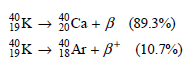
Bananas are somewhat radioactive due to the presence of substantial amounts of potassium. Potassium-40 decays by two different paths:The half-life for potassium decay is 1.3 × 10⁹ years. Determine the rate constants for the individual channels. 19к — Са + В (893%) 40 20 Ca + B 40
Bacteriorhodopsin (Br) is a protein found in Halobacterium halobium that converts light energy into a transmembrane proton gradient that is used for ATP synthesis. After light is absorbed by the protein, the following initial reaction sequence occurs:
For a type II second-order reaction, the reaction is 60% complete in 60 seconds when [A]0 = 0.1 M and [B]0 = 0.5 M.a. What is the rate constant for this reaction?b. Will the time for the reaction to reach 60% completion change if the initial reactant concentrations are decreased by a factor of two?
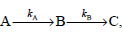
(Challenging) For the sequential reaction in Problem P35.19, plot the concentration of each species for the case where kB = kA. Can you use the analytical expression for [B] in this case?
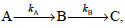
For the sequential reactionkA = 1.00 × 10⁻³ s-1 . Using a computer spreadsheet program such as Excel, plot the concentration of each species for cases where kB = 10kA, kB = 1.5kA, and kB = 0.1kA. Assume that only the reactant is present when the reaction is initiated. kaC. →B- →C,
For the sequential reactionthe rate constants are kA = 5 × 10⁶ s-1 and kB = 3 × 10⁶ s-1 . Determine the time at which [B] is at a maximum. →B- →C. A-
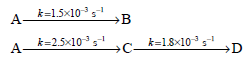
Given the following kinetic scheme and associated rate constants, determine the concentration profiles of all species using Euler€™s method. Assume that the reaction is initiated with only the reactant A present at an initial concentration of 1 M. To perform this calculation, you may want
Show that the ratio of the half-life to the three-quarter life, t1/2 /t3/4, for a reaction that is nth order (n > 1) in reactant A can be written as a function of n alone (that is, there is no concentration dependence in the ratio).
Molybdenum-99 decays to form “metastable” technetium-99 (99TC) through beta decay. This isotope has a very long lifetime (half-life of 6 hours) compared to other nuclear isomers that undergo gamma decay. The gamma rays emitted when 99Tc decays are easily detected, which makes this species ideal
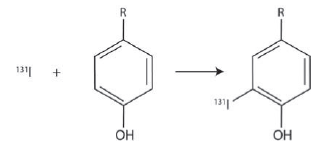
A technique for radioactively labeling proteins is electrophilic radioiodination, in which an aromatic substitution of131I onto a tyrosine residue is performed as follows:Using the activity of 131I, one can measure protein lifetimes in a variety of biological processes. 131I undergoes beta decay
The growth of a bacterial colony can be modeled as a first-order process in which the probability of cell division is linear with respect to time such thatdN/N = ζdt, where dN is the number of cells that divide in the time interval dt, and ζ is a constant.a. Use the preceding expression to show
A convenient source of gamma rays for radiation chemistry research is60Co, which undergoes the following decay process:a. What is the rate constant for the decay process?b. How long will it take for a sample of 60Co to decay to half of its original concentration? 60- 60 27 Co- o-€ 6°Co is 1.90 x
One issue confronting the use of 14C decay to date materials is that of obtaining a standard. One approach to this issue is found in the field of dendrochronology, or using tree rings to determine age. Using this approach, tree materials dating back 10,000 years have been identified. Assuming you
You are performing an experiment using 3H (half-life = 4.50 × 10³ days) labeled phenylalanine in which the five aromatic hydrogens are labeled. To perform the experiment, the initial activity cannot be lower than 10.0% of the initial activity when the sample was received. How long after receiving
The half-life of 238U is 4.5 × 10⁹ years. How many disintegrations occur in 1 minute for a 10.0-mg sample of this element?
A certain reaction is first order, and 540. s after initiation of the reaction, 32.5% of the reactant remains.a. What is the rate constant for this reaction?b. At what time after initiation of the reaction will 10% of the reactant remain?
Consider the schematic reactiona. If the reaction is one-half order with respect to [A], what is the integrated rate law expression for this reaction?b. What plot would you construct to determine the rate constant k for the reaction?c. What would be the half-life for this reaction? Will it depend
You are given the following data for the decomposition of acetaldehyde:Determine the order of the reaction and the rate constant for the reaction. Initial Concentration (M) 9.72 ×10³ 4.56x 10³ Half-Life (s) 328 685
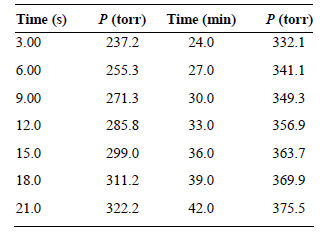
The first-order thermal decomposition of chlorocyclohexane is as follows: C6H11Cl(g) → C6H10(g) + HCl(g).For a constant volume system, the following total pressure was measured as a function of time:a. Derive the following relationship for a first-order reaction: P(t2) –
The disaccharide lactose can be decomposed into its constituent sugars galactose and glucose. This decomposition can be accomplished through acid-based hydrolysis, or by the enzyme lactase. Lactose intolerance in humans is due to the lack of lactase production by cells in the small intestine.
One loss mechanism for ozone in the atmosphere is the reaction with the HO2 radical:HO2 · (g) + O3(g) †’ OH · (g) + 2O2(g)Using the following information, determine the rate law expression for this reaction: Rate (cm-3 s-1) [HO, •](cm-³) 1.0 x 101 1.0 ×101 3.0x
Showing 1700 - 1800
of 3563
First
11
12
13
14
15
16
17
18
19
20
21
22
23
24
25
Last
Step by Step Answers

 Get 50% OFF
Claim Now
Get 50% OFF
Claim Now



![d[HBr]_ k[H2][Br,]2 тHBr] dt 1+ [Br,]](https://dsd5zvtm8ll6.cloudfront.net/si.question.images/images/question_images/1526/4/6/3/0085afbfa20b923f1526463004273.jpg)
![d[HBr] 1/2 [H,],[Br, }? ks = 2k2 t=0 dt](https://dsd5zvtm8ll6.cloudfront.net/si.question.images/images/question_images/1526/4/6/3/1535afbfab1a56331526463150069.jpg)
![k;(k[A][M] + k,[A]) K[AJ) k1[M] + k_q[A] + k_3 R =](https://dsd5zvtm8ll6.cloudfront.net/si.question.images/images/question_images/1526/4/6/3/6965afbfcd0016621526463658616.jpg)

![[H,0,], (M) 0.001 0.002 0.005 Initial Rate (M s) 1.38 x 10⁻³ 2.67 x 10⁻³ 6.00 x 10-3](https://dsd5zvtm8ll6.cloudfront.net/si.question.images/images/question_images/1526/4/6/4/1375afbfe89ca8c71526464136149.jpg)
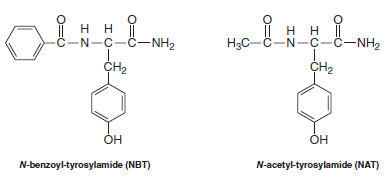
![NBT] (mM) 1.00 2.00 4.00 6.00 8.00 Rateg(mM s) 0.062 0.107 0.040 0.082 0.099](https://dsd5zvtm8ll6.cloudfront.net/si.question.images/images/question_images/1526/4/6/4/3245afbff4459dcf1526464313988.jpg)

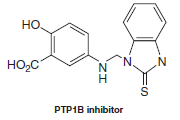
![[S] (AM) Rateo (pM s), ц - 0 Rateo (uM s), 1 % 200 иМ %3D 0.299 0.071 0.018 0.500 0.100 0.030 0.820 0.143 0.042 1.22](https://dsd5zvtm8ll6.cloudfront.net/si.question.images/images/question_images/1526/4/6/4/4865afbffe6c25b31526464482646.jpg)
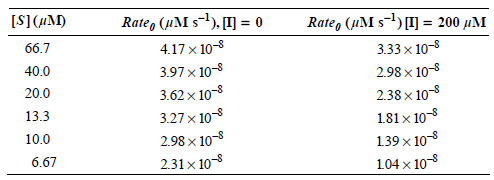
![Rmer[S]. Ro [S], + Km max <aעל .](https://dsd5zvtm8ll6.cloudfront.net/si.question.images/images/question_images/1526/4/6/5/1925afc02a8d8bd11526465189326.jpg)



![clo .+ 0, [k = (1.7×10¹⁰ M-'s-)e-260K/T ]. C1 + 03](https://dsd5zvtm8ll6.cloudfront.net/si.question.images/images/question_images/1526/4/5/6/1195afbdf373e0d41526456116305.jpg)
![[C] = 5x 10-17 M, [03] = 8x10- M, and T = 220. K?](https://dsd5zvtm8ll6.cloudfront.net/si.question.images/images/question_images/1526/4/5/6/1205afbdf38702951526456116744.jpg)





![[lactose], (M³) 0.01 [H*](M!) 0.001 Initial Rate (Ms) 0.00116 0.00232 0.02 0.001 0.01 0.00464 0.004](https://dsd5zvtm8ll6.cloudfront.net/si.question.images/images/question_images/1526/4/5/4/4425afbd8aa9207b1526454439615.jpg)
 1.0 x 101 1.0 ×101 3.0x 101 [03](cm-³) 1.0 x 10¹² 5.0 x 10¹² 1.0x 10¹² 19x 108 9.5 x](https://dsd5zvtm8ll6.cloudfront.net/si.question.images/images/question_images/1526/4/5/4/3715afbd8634b5f31526454364697.jpg)


