New Semester
Started
Get
50% OFF
Study Help!
--h --m --s
Claim Now
Question Answers
Textbooks
Find textbooks, questions and answers
Oops, something went wrong!
Change your search query and then try again
S
Books
FREE
Study Help
Expert Questions
Accounting
General Management
Mathematics
Finance
Organizational Behaviour
Law
Physics
Operating System
Management Leadership
Sociology
Programming
Marketing
Database
Computer Network
Economics
Textbooks Solutions
Accounting
Managerial Accounting
Management Leadership
Cost Accounting
Statistics
Business Law
Corporate Finance
Finance
Economics
Auditing
Tutors
Online Tutors
Find a Tutor
Hire a Tutor
Become a Tutor
AI Tutor
AI Study Planner
NEW
Sell Books
Search
Search
Sign In
Register
study help
sciences
physical chemistry
Physical Chemistry 3rd edition Thomas Engel, Philip Reid - Solutions
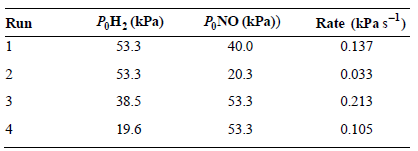
The reaction rate as a function of initial reactant pressures was investigated for the reaction 2NO(g) + 2H2(g) †’ N2(g) + 2H2O(g), and the following data were obtained:What is the rate law expression for this reaction? Rate (kPa s) 0.137 P,NO (kPa)) Р,Н: (КPa) Run 53.3 40.0
What is the overall order of the reaction corresponding to the following rate constants?a. k = 1.63 × 10⁻⁴ M−1 s−1b. k = 1.63 × 10⁻⁴ M−2 s−1c. k = 1.63 × 10⁻⁴ M−1 2 s−1
For the following rate expressions, state the order of the reaction with respect to each species, the total order of the reaction, and the units of the rate constant, k:a. Rate = k[ClO][BrO]b. Rate = k[NO]2[O2]c.
Consider the following reaction involving bromophenol blue (BPB) and OH: HBPB(aq) + OH– (aq) → BPB–(aq) H2O(l)The concentration of HBPB can be monitored by following the absorption of this species and using theBeer–Lambert Law. In this law, absorption, A, and concentration
As discussed in the text, the total system pressure can be used to monitor the progress of a chemical reaction. Consider the following reaction: SO2Cl2(g) †’ SO2(g) + Cl2(g). The reaction is initiated, and the following data are obtained:a. Is the reaction first or second
Consider the first-order decomposition of cyclobutane at 438 ° C at constant volume: C4H8(g) → 2C2H4(g).a. Express the rate of the reaction in terms of the change in total pressure as a function of time.b. The rate constant for the reaction is 2.48 × 10⁻⁴ s–1. What is the
Express the rate of reaction with respect to each species in the following reactions:a. 2NO(g) + O2(g) → N2O4(g)b. H2(g) + I2(g) → 2HI(g)c. ClO (g) + BrO (g) → ClO2 (g) + Br(g)
What is the relationship between the parameters in the Arrhenius equation and in the Eyring equation?
What is a typical rate constant for a diffusion-controlled reaction in aqueous solution?
What is meant by a diffusion-controlled reaction?
What is a transition state? How is the concept of a transition state used in activated complex theory?
In a temperature-jump experiment, why does a change in temperature result in a corresponding change in equilibrium?
What is the kinetic definition of equilibrium?
In a parallel reaction in which two products can be formed from the same reactant, what determines the extent to which one product will be formed over another?
What is the steady-state approximation, and when is this approximation employed?
What is meant by the rate-determining step in a sequential reaction?
In a sequential reaction, what is an intermediate?
What is a half-life? Is the half-life for a first-order reaction dependent on concentration?
What is the difference between a first-order reaction and a second-order reaction?
What is a rate law expression, and how is it determined?
What is the method of initial rates, and why is it used in chemical kinetics studies?
What are the fastest time scales on which chemical reactions can be investigated? Describe three experimental techniques for investigation of chemical reactions.
What is the difference between chemical and physical methods for studying chemical kinetics?
What is an elementary chemical step, and how is one used in kinetics?
What is the difference between the order of a reaction with respect to a given species and the overall order?
Why is the stoichiometry of a reaction generally not sufficient to determine reaction order?
Conductivity measurements were one of the first methods used to determine the autoionization constant of water. The autoionization constant of water is given by the following equation:where a is the activity of the species, which is equal to the actual concentration of the species divided by the
In the determination of molar conductivities, it is convenient to define the cell constant, K, as K = l/A, where l is the separation between the electrodes in the conductivity cell, and A is the area of the electrodes.a. A standard solution of KCl (conductivity or κ = 1.06296 × 10⁻⁶ S m–1 at
In the early 1990s, fusion involving hydrogen dissolved in palladium at room temperature, or cold fusion, was proposed as a new source of energy. This process relies on the diffusion of H2 into palladium. The diffusion of hydrogen gas through a 0.00500-cm-thick piece of palladium foil with a cross
For a one-dimensional random walk, determine the probability that the particle will have moved six steps in either the +x or – x direction after 10, 20, and 100 steps.
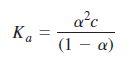
Starting with Equations (34.77) and (34.79), derive the Ostwald dilution law.Equaiton 34.77Equation 34.79 a?c Ka (1 – a) - αλη
The molar conductivity of sodium acetate, CH3COONa, is measured as a function of concentration in water at 298 K, and the following data are obtained:Concentration (M)…………………………….Λm (Sm2
The following molar conductivity data are obtained for an electrolyte:Concentration (M)…………………………………Λm (Sm0
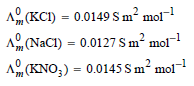
Use the following data to determine the conductance at infinite dilution for NaNO3. A, (KCI) = 0.0149 Sm² mol- A (NaCI) = 0.0127 Sm² mol ² mol- A, (KNO;) = 0.0145 S m
A current of 2.00 A is applied to a metal wire for 30.0 s. How many electrons pass through a given point in the wire during this time?
T. Svedberg measured the molecular weight of carbonyl hemoglobin (specific volume = 0.755 mL g−1, D = 7.00 × 10⁻¹¹ m2 s–1) by velocity centrifugation. In this experiment, 0.960 g of protein were dissolved in 100. mLof water at 303 K (ρ = 0.998 g cm3), and the solution was spun at 39,300
Boundary centrifugation is performed at an angular velocity of 40,000. rpm to determine the sedimentation coefficient of cytochrome c (M = 13,400 g mol−1) in water at 20°C (ρ = 0.998 g cm−3,η = 1.002 cP). The following data are obtained on the position of the boundary layer as a function of
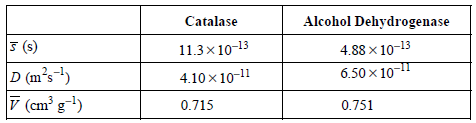
You are interested in purifying a sample containing the protein alcohol dehydrogenase obtained from horse liver; however, the sample also contains a second protein, catalase. These two proteins have the following transport properties at 298 K:a. Determine the molecular weight of catalase and
The molecular weight of bovine serum albumin (BSA) is 66,500 g mol−1 and has a specific volume of 0.717 cm3 g−1. Velocity centrifugation demonstrates that s = 4.31 × 10⁻¹³ s for this protein. Assuming a solution density of 1.00 g cm−3 and viscosity of 1.00 cP, determine the friction
Myoglobin is a protein that participates in oxygen transport. For myoglobin in water at 20°C, s = 2.04 × 10⁻¹³s, D = 1.13 × 10⁻¹⁰ m2 s−1, and V = 0.740 cm g−1. The density of water is 0.998 g cm3 and the viscosity is 1.002 cP at this temperature.a. Using the information provided,
What is the flow of blood through a small vein (diameter = 3.00 mm) that is 1.00 cm long? The drop in blood pressure over this length is 40.0 Torr, and the viscosity of blood is approximately 4.00 cP at 310. K.
Poiseuille’s Law can be used to describe the flow of blood through blood vessels. Using Poiseuille’s Law, determine the pressure drop accompanying the flow of blood through 5.00 cm of the aorta (r = 1.00 cm). The rate of blood flow through the body is 0.080 L s−1 and the viscosity of blood is
As mentioned in the text, the viscosity of liquids decreases with increasing temperature. The empirical equation η (T) = AeE/RTprovides the relationship between viscosity and temperature for a liquid. In this equation, A and E are constants, with E being referred to as the activation
a. Derive the general relationship between the thermal conductivity and viscosity.b. Given that the viscosity of Ar is 223 μ P at 293K and 1atm, what is the thermal conductivity?c. What is the thermal conductivity of Ne under these same conditions?
a. Derive the general relationship between the diffusion coefficient and viscosity for a gas.b. Given that the viscosity of Ar is 223 μ P at 293K and 1.00 atm, what is the diffusion coefficient?
How long will it take to pass 200. mL of H2 at 273 K through a 10.0-cm-long capillary tube of 0.250 mm if the gas input and output pressures are 1.05 and 1.00 atm, respectively?
An Ostwald viscometer is calibrated using water at 20°C (η = 1.0015 cP, ρ = 0.998 g mL−1).It takes 15.0 s for the fluid to fall from the upper to the lower level of the viscometer. A second liquid is then placed in the viscometer and it takes 37.0 s for the fluid to fall between the levels.
The viscosity of H2 at 273 K at 1 atm is 84.0 μ P. Determine the viscosities of D2 and HD.
The Reynolds number (Re) is defined as Re = p(vx)d/η, where ρ and η are the fluid density and viscosity, respectively; d is the diameter of the tube in which the fluid is flowing; and (vx)is the average velocity. Laminar flow occurs when Re < 2000, the limit in which the equations for gas
a. The viscosity of O2 at 293 K and 1atm is 204 μ P. What is the expected flow rate through a tube having a radius of 2.00 mm, length of 10.0 cm, input pressure of 765 Torr, output pressure of 760. Torr, with the flow measured at the output end of the tube?b. If Ar were used in the apparatus (η =
a. The viscosity of Cl2 at 293 K and 1atm is 132 μ P. Determine the collisional cross section of this molecule based on the viscosity.b. Given your answer in part (a), estimate the thermal conductivity of Cl2 under the same pressure and temperature conditions.
The thermal conductivities of acetylene (C2H2) and N2 at 273 K and 1atm are 0.01866 and 0.0240 J m−1 K−1, respectively. Based on these data, what is the ratio of the collisional cross section of acetylene relative to N2?
a. Determine the ratio of thermal conductivity for N2(σ = 0.43 nm2) at sea level (T = 300.K, P = 1 atm) versus the lower stratosphere (T = 230.K, P = 0.25 atm).b. Determine the ratio of thermal conductivity for N2 at sea level if p = 1atm, but the temperature is reduced to 100. K versus the lower
The thermal conductivity of Kr is roughly half that of Ar under identical pressure and temperature conditions. Both gases are monatomic such that CV,m = 3/2R.a. Why would one expect the thermal conductivity of Kr to be less than that of Ar?b. Determine the ratio of collisional cross sections for Ar
The thermal conductivity of N2 at 298 K and 1 atm is 0.024 J K-1s-1. What is the collisional cross section of N2 based on its thermal conductivity?
The thermal conductivity of Kr is 0.0087 J k−1 m−1 s−1 at 273 K and 1atm. Estimate the collisional cross section of Kr.
Determine the thermal conductivity of the following species at 273 K and 1.00 atm:a. Ar (σ = 0.36 nm2)b. Cl2(σ = 0.93 nm2 )c. 2SO2(σ = 0.58 nm2 , geometry: bent)You will need to determine CV,m for the species listed. You can assume that the translational and rotational degrees of freedom are in
Two parallel metal plates separated by 1 cm are held at 300 and 298 K, respectively. The space between the plates is filled with N2(σ = 0.430 nm2 and CV,m = 5/2R). Determine the heat flow between the two plates in units of W cm−2.
An advertisement for a thermopane window company touts its Kr-filled windows, and states that these windows provide ten times better insulation than conventional windows filled with Ar. Do you agree with this statement? What should the ratio of thermal conductivities be for Kr (σ = 0.52 nm2)
A thermopane window consists of two sheets of glass separated by a volume filled with air (which we will model as N2, where κ = 0.0240 J K-1 m-1 s-1). For a thermopane window that is 1 m2 in area with a separation between glass sheets of 3 cm, what is the loss of energy when:a. the exterior of the
A solution consisting of 1 g of sucrose in 10 mL of water is poured into a 1-L graduated cylinder with a radius of 2.5 cm. Then the cylinder is filled with pure water.a. The diffusion of sucrose can be considered diffusion in one dimension. Derive an expression for the average distance of
a. The diffusion coefficient of the protein lysozyme (MW = 14.1 kg/mol) is 0.104 × 10⁻⁵ cm2 s−1. How long will it take this protein to diffuse an rms distance of 1μm? Model the diffusion as a three-dimensional process.b. You are about to perform a microscopy experiment in which you will
a. The diffusion coefficient of sucrose in water at 298 K is 0.522 10−9 m2 s−1. Determine the time it will take a sucrose molecule on average to diffuse an rms distance of 1 mm.b. If the molecular diameter of sucrose is taken to be 0.8 nm, what is the time per random-walk step?
a. The diffusion coefficient for Xe at 273 K and 1 atm is 0.5 × 10⁻⁵ m s−1. What is the collisional cross section of Xe?b. The diffusion coefficient of N2 is three-fold greater than that of Xe under the same pressure and temperature conditions. What is the collisional cross section of N2?
The collisional cross section of N2 is 0.43 nm2. What is the diffusion coefficient of N2 at a pressure of 1.00 atm and a temperature of 298 K?
The diffusion coefficient for CO2 at 273 K and 1 atm is 1.00 × 10⁻⁵ m2 s−1. Estimate the collisional cross section of CO2 given this diffusion coefficient.
According to Kohlrausch’s Law, how will the molar conductivity for a strong electrolyte change with concentration?
What is the difference between a strong and weak electrolyte?
What forces are operative in particle sedimentation?
In the Stokes–Einstein equation that describes particle diffusion for a spherical particle, how does the diffusion coefficient depend on fluid viscosity and particle size?
Describe the random-walk model of diffusion. How is this model related to Brownian motion?
You are a NASA engineer faced with the task of ensuring that the material on the hull of a spacecraft can withstand puncturing by space debris. The initial cabin air pressure in the craft of 1 atm can drop to 0.7 atm before the safety of the crew is jeopardized. The volume of the cabin is 100.m3,
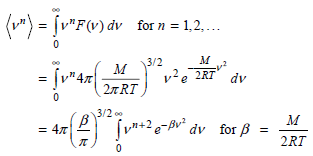
As discussed in Chapter 12, the nth moment of a distribution can be determined as follows: (xn) = ˆ« xnf (x) dx, where integration is over the entire domain of the distribution. Derive expressions for the nth moment of the gas speed distribution. (") = Jv*F(v) åv_for n = 1,2,. %3D м
Consider a collection of gas particles confined to translate in two dimensions (for example, a gas molecule on a surface). Derive the Maxwell speed distribution for such a gas.
Based on the Stokes–Einstein equation, how does the diffusion coefficient for a particle depend on the size of the particle?
What is Brownian motion?
What is the general relationship between the spatial gradient in a system property and the flux of that property?
What is the expression for the diffusion coefficient, D, in terms of gas kinetic theory parameters? How is D expected to vary with an increase in molecular mass or collisional cross section?
How does the viscosity of a gas vary with pressure?
Would you expect the diffusion coefficient of H2 to be greater or less than that of D2? By how much?
Particles are confined to a plane and then allowed to diffuse. How does the number density vary with distance away from the initial plane?
How does the root-mean-square diffusion distance vary with the diffusion coefficient? How does this quantity vary with time?
What is the expression for thermal conductivity in terms of particle parameters derived from gas kinetic theory?
Why is the thermal conductivity for an ideal gas expected to be independent of pressure? Why does the thermal conductivity for an ideal gas increase as T1/2?
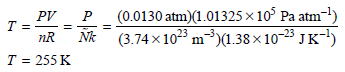
At 30 km above the Earth€™s surface (roughly in the middle of the stratosphere), the pressure is roughly 0.013 atm and the gas density is 3.74 × 10²³ molecules/m3. Assuming N2 is representative of the stratosphere, using the collisional diameter information provided in Table
In describing viscosity, what system quantity was transported? What is the expression for viscosity in terms of particle parameters derived from gas kinetic theory?
What observable is used to measure the viscosity of a gas or liquid?
A comparison of ν ave,ν mp , and ν rms for the Maxwell speed distribution reveals that these three quantities are not equal. Is the same true for the one-dimensional velocity distributions?
Consider the diagram of a molecular beam apparatus provided in the text.In the design of the apparatus, it is important to ensure that the molecular beam effusing from the oven does not collide with other particles until the beam is well past the skimmer, a device that selects molecules that are
Determine the mean free path at 500. K and 1 atm for the following:a. Neb. Krc. CH4Rather than simply calculating the mean free path for each species separately, instead develop an expression for the ratio of mean free paths for two species and use the calculated value for one species to determine
Determine the mean free path for Ar at 298 K at the following pressures:a. 0.500 atmb. 0.00500 atmc. 5.00 × 10⁻⁶ atmFor Ar, σ = 3.6 × 10⁻¹⁹ m2 (see Table 33.1) and M = 0.040 kg mol–1.
a. A standard rotary pump is capable of producing a vacuum on the order of 10−3 Torr. What is the single-particle collisional frequency and mean free path for N2 at this pressure and 298 K?b. A cryogenic pump can produce a vacuum on the order of 10–10 Torr. What is the collisional frequency and
a. Determine the total collisional frequency for CO2 at 1 atm and 298 K.b. At what temperature would the collisional frequency be 10% of the value determined in part (a)?For CO2, σ = 5.2 × 10⁻¹⁹ m2 (see Table 33.1) and M = 0.044 kg mol–1.
a. The stratosphere begins at 11 km above the Earth’s surface. At this altitude P = 22.6 kPa and T = –56.5oC. What is the mean free path of N2 at this altitude?b. The stratosphere extends to 50 km, where P = 0.085 kPa and T = 18.3oC. What is the mean free path of N2 at this altitude?
Many of the concepts developed in this chapter can be applied to understanding the atmosphere. Because atmospheric air is comprised primarily of N2 (roughly 78% by volume), approximate the atmosphere as consisting only of N2 in answering the following questions:a. What is the single-particle
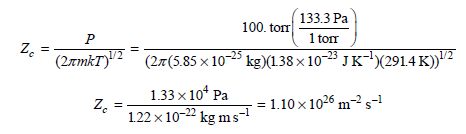
a. How many molecules strike a 1.00-cm2 surface during 1 min if the surface is exposed to O2 at 1.00 atm and 298 K?b. Ultra-high-vacuum studies typically employ pressures on the order of 10–10 Torr. How many collisions will occur at this pressure at 298 K?For O2, M = 0.0320 kg mol–1 and Zc =
Imagine designing an experiment in which the presence of a gas is determined by simply listening to the gas with your ear. The human ear can detect pressures as low as 2 × 10⁻⁵ N m–2. Assuming that the eardrum has an area of roughly 1mm2, what is the minimum collisional rate that can be
The vapor pressure of various substances can be determined using effusion. In this process, the material of interest is placed in an oven (referred to as a Knudsen cell) and the mass of material lost through effusion is determined. The mass loss (Δm) is given by Δm = ZcAm
Imagine a cubic container with sides 1 cm in length that contains 1 atm of Ar at 298 K. How many gas–wall collisions are there per second?
Using the distribution of particle translational kinetic energy provided in Problem P33.19, derive an expression for the fraction of molecules that have energy greater than some energy ε∗. The rate of many chemical reactions is dependent on the thermal energy available, kT, versus some threshold
Showing 1800 - 1900
of 3563
First
12
13
14
15
16
17
18
19
20
21
22
23
24
25
26
Last
Step by Step Answers

 Get 50% OFF
Claim Now
Get 50% OFF
Claim Now


![Rate = H10,] [H*]2](https://dsd5zvtm8ll6.cloudfront.net/si.question.images/images/question_images/1526/4/5/3/8605afbd664c0d0f1526453855130.jpg)

![[н] (он ] ад аон 1м K. 1м](https://dsd5zvtm8ll6.cloudfront.net/si.question.images/images/question_images/1526/3/6/6/6755afa81d3011be1526366669622.jpg)