New Semester
Started
Get
50% OFF
Study Help!
--h --m --s
Claim Now
Question Answers
Textbooks
Find textbooks, questions and answers
Oops, something went wrong!
Change your search query and then try again
S
Books
FREE
Study Help
Expert Questions
Accounting
General Management
Mathematics
Finance
Organizational Behaviour
Law
Physics
Operating System
Management Leadership
Sociology
Programming
Marketing
Database
Computer Network
Economics
Textbooks Solutions
Accounting
Managerial Accounting
Management Leadership
Cost Accounting
Statistics
Business Law
Corporate Finance
Finance
Economics
Auditing
Tutors
Online Tutors
Find a Tutor
Hire a Tutor
Become a Tutor
AI Tutor
AI Study Planner
NEW
Sell Books
Search
Search
Sign In
Register
study help
social science
psychology 2e
Psychology 2nd Edition Rose M. Spielman, William J. Jenkins, Marilyn D. Lovett - Solutions
Why would a clinician give someone a projective test?
How would you describe your own personality? Do you think that friends and family would describe you in much the same way? Why or why not?
How would you describe your personality in an online dating profile?
What are some of your positive and negative personality qualities? How do you think these qualities will affect your choice of career?
What are some examples of defense mechanisms that you have used yourself or have witnessed others using?
What is your birth order? Do you agree or disagree with Adler’s description of your personality based on his birth order theory, as described in the Link to Learning? Provide examples for support.
Would you describe yourself as an extrovert or an introvert? Does this vary based on the situation? Provide examples to support your points.
Select an epic story that is popular in contemporary society (such as Harry Potter or Star Wars) and explain it terms of Jung’s concept of archetypes.
Do you have an internal or an external locus of control? Provide examples to support your answer.
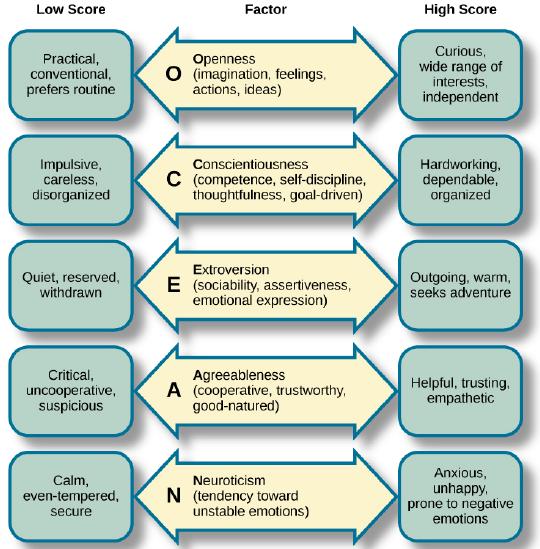
Review the Big Five personality factors shown in Figure 11.14. On which areas would you expect you’d score high? In which areas does the low score more accurately describe you? Low Score Practical, conventional, prefers routine Impulsive, careless, disorganized Quiet,
Respond to the question, “Who am I?” Based on your response, do you have a negative or a positive self concept? What are some experiences that led you to develop this particular self-concept?
Research suggests that many of our personality characteristics have a genetic component. What traits do you think you inherited from your parents? Provide examples. How might modeling (environment) influenced your characteristics as well?
According to the work of Rentfrow and colleagues, personalities are not randomly distributed. Instead they fit into distinct geographic clusters. Based on where you live, do you agree or disagree with the traits associated with yourself and the residents of your area of the country? Why or why not?
How objective do you think you can be about yourself in answering questions on self-report personality assessment measures? What implications might this have for the validity of the personality test?
As a field, social psychology focuses on ________ in predicting human behavior.a. Personality traitsb. Genetic predispositionsc. Biological forcesd. Situational factors
Making internal attributions for your successes and making external attributions for your failures is an example of ________.a. Actor-observer biasb. Fundamental attribution errorc. Self-serving biasd. Just-world hypothesis
Collectivistic cultures are to ________ as individualistic cultures are to ________.a. Dispositional; situationalb. Situational; dispositionalc. Autonomy; group harmonyd. Just-world hypothesis; self-serving bias
According to the actor-observer bias, we have more information about ________.a. Situational influences on behaviorb. Influences on our own behaviorc. Influences on others’ behaviord. Dispositional influences on behavior
A(n) ________ is a set of group expectations for appropriate thoughts and behaviors of its members.a. Social roleb. Social normc. Scriptd. Attribution
On his first day of soccer practice, Jose suits up in a t-shirt, shorts, and cleats and runs out to the field to join his teammates. Jose’s behavior is reflective of ________.a. A scriptb. Social influencec. Good athletic behaviord. Normative behavior
When it comes to buying clothes, teenagers often follow social norms; this is likely motivated by ________.a. Following parents’ rulesb. Saving moneyc. Fitting ind. Looking good
In the Stanford prison experiment, even the lead researcher succumbed to his role as a prison supervisor. This is an example of the power of ________ influencing behavior.a. Scriptsb. Social normsc. Conformityd. Social roles
Attitudes describe our ________ of people, objects, and ideas.a. Treatmentb. Evaluationsc. Cognitionsd. Knowledge
Cognitive dissonance causes discomfort because it disrupts our sense of ________.a. Dependencyb. Unpredictabilityc. Consistencyd. Power
In order for the central route to persuasion to be effective, the audience must be ________ and ________.a. Analytical; motivatedb. Attentive; happyc. Intelligent; unemotionald. Gullible; distracted
Examples of cues used in peripheral route persuasion include all of the following except ________.a. Celebrity endorsementb. Positive emotionsc. Attractive modelsd. Factual information
In the Asch experiment, participants conformed due to ________ social influence.a. Informationalb. Normativec. Inspirationald. Persuasive
Under what conditions will informational social influence be more likely?a. When individuals want to fit inb. When the answer is unclearc. When the group has expertised. Both b and c
Social loafing occurs when ________.a. Individual performance cannot be evaluatedb. The task is easyc. Both a and bd. None of the above
If group members modify their opinions to align with a perceived group consensus, then ________ has occurred.a. Group cohesionb. Social polarizationc. Groupthinkd. Social loafing
Prejudice is to ________ as discrimination is to ________.a. Feelings; behaviorb. Thoughts; feelingsc. Feelings; thoughtsd. Behavior; feelings
Which of the following is not a type of prejudice?a. Homophobiab. Racismc. Sexismd. Individualism
________ occurs when the out-group is blamed for the in-group’s frustration.a. Stereotypingb. In-group biasc. Scapegoatingd. Ageism
When we seek out information that supports our stereotypes we are engaged in ________.a. Scapegoatingb. Confirmation biasc. Self-fulfilling prophecyd. In-group bias
Typically, bullying from boys is to ________ as bullying from girls is to ________.a. Emotional harm; physical harmb. Physical harm; emotional harmc. Psychological harm; physical harmd. Social exclusion; verbal taunting
Which of the following adolescents is least likely to be targeted for bullying?a. A child with a physical disabilityb. A transgender adolescentc. An emotionally sensitive boyd. The captain of the football team
The bystander effect likely occurs due to ________.a. Desensitization to violenceb. People not noticing the emergencyc. Diffusion of responsibilityd. Emotional insensitivity
Altruism is a form of prosocial behavior that is motivated by ________.a. Feeling good about oneselfb. Selfless helping of othersc. Earning a rewardd. Showing bravery to bystanders
After moving to a new apartment building, research suggests that Sam will be most likely to become friends with ________.a. His next door neighborb. Someone who lives three floors up in the apartment buildingc. Someone from across the streetd. His new postal delivery person
What trait do both men and women tend to look for in a romantic partner?a. Sense of humorb. Social skillsc. Leadership potentiald. Physical attractiveness
According to the triangular theory of love, what type of love is defined by passion and intimacy but no commitment?a. Consummate loveb. Empty lovec. Romantic loved. Liking
According to social exchange theory, humans want to maximize the ________ and minimize the ________ in relationships.a. Intimacy; commitmentb. Benefits; costsc. Costs; benefitsd. Passion; intimacy
Compare and contrast situational influences and dispositional influences and give an example of each. Explain how situational influences and dispositional influences might explain inappropriate behavior.
Provide an example of how people from individualistic and collectivistic cultures would differ in explaining why they won an important sporting event.
Why didn’t the “good” guards in the Stanford prison experiment object to other guards’ abusive behavior? Were the student prisoners simply weak people? Why didn’t they object to being abused?
Describe how social roles, social norms, and scripts were evident in the Stanford prison experiment. How can this experiment be applied to everyday life? Are there any more recent examples where people started fulfilling a role and became abusive?
Give an example (one not used in class or your text) of cognitive dissonance and how an individual might resolve this.
Imagine that you work for an advertising agency, and you’ve been tasked with developing an advertising campaign to increase sales of Bliss Soda. How would you develop an advertisement for this product that uses a central route of persuasion? How would you develop an ad using a peripheral route of
Describe how seeking outside opinions can prevent groupthink.
Explain why the following situation is not an example of discrimination: A teacher seats students wearing short sleeves on the left half of the room and students wearing long sleeves on the right half of the room.
Some people seem more willing to openly display prejudice regarding sexual orientation than prejudice regarding race and gender. Describe why this might be.
When people blame a scapegoat, how do you think they choose evidence to support the blame?
Compare and contrast hostile and instrumental aggression.
What evidence discussed in the previous section suggests that cyberbullying is difficult to detect and prevent?
Describe what influences whether relationships will be formed.
The evolutionary theory argues that humans are motivated to perpetuate their genes and reproduce. Using an evolutionary perspective, describe traits in men and women that humans find attractive.
Provide a personal example of an experience in which your behavior was influenced by the power of the situation.
Think of an example in the media of a sports figure—player or coach—who gives a self-serving attribution for winning or losing. Examples might include accusing the referee of incorrect calls, in the case of losing, or citing their own hard work and talent, in the case of winning.
Try attending a religious service very different from your own and see how you feel and behave without knowing the appropriate script. Or, try attending an important, personal event that you have never attended before, such as a bar mitzvah (a coming-of-age ritual in Jewish culture), a quinceanera
Name and describe at least three social roles you have adopted for yourself. Why did you adopt these roles? What are some roles that are expected of you, but that you try to resist?
Cognitive dissonance often arises after making an important decision, called post-decision dissonance (or in popular terms, buyer’s remorse). Describe a recent decision you made that caused dissonance and describe how you resolved it.
Describe a time when you or someone you know used the foot-in-the-door technique to gain someone’s compliance.
Conduct a conformity study the next time you are in an elevator. After you enter the elevator, stand with your back toward the door. See if others conform to your behavior. Watch this video (https://www.youtube.com/watch?v=dDAbdMv14Is) for a candid camera demonstration of this phenomenon. Did your
Most students adamantly state that they would never have turned up the voltage in the Milligram experiment. Do you think you would have refused to shock the learner? Looking at your own past behavior, what evidence suggests that you would go along with the order to increase the voltage?
Give an example when you felt that someone was prejudiced against you. What do you think caused this attitude? Did this person display any discrimination behaviors and, if so, how?
Give an example when you felt prejudiced against someone else. How did you discriminate against them? Why do you think you did this?
What societal and management attitudes might have caused organizational psychology to develop later than industrial psychology?
Try to think of an example in which you coped with a particular stressor by using problem-focused coping. What was the stressor? What did your problem-focused efforts involve? Were they effective?
Clifford falsely believes that the police have planted secret cameras in his home to monitor his every movement. Clifford’s belief is an example of ________.a. A delusionb. A hallucinationc. Tangentialityd. A negative symptom
Which of the following correctly matches the pattern in our perception of color as we move from short wavelengths to long wavelengths?a. Red to orange to yellowb. Yellow to orange to redc. Yellow to red to oranged. Orange to yellow to red
The visible spectrum includes light that ranges from about ________.a. 400–700 nmb. 200–900 nmc. 20–20000 Hzd. 10–20 dB
The electromagnetic spectrum includes ________.a. Radio wavesb. x-raysc. Infrared lightd. All of the above
The audible range for humans is ________.a. 380–740 Hzb. 10–20 dBc. Less than 300 dBd. 20-20,000 Hz
The quality of a sound that is affected by frequency, amplitude, and timing of the sound wave is known as ________.a. Pitchb. Tonec. Electromagneticd. Timbre
The ________ is a small indentation of the retina that contains cones.a. Optic chiasmb. Optic nervec. Fovead. Iris
________ operate best under bright light conditions.a. Conesb. Rodsc. Retinal ganglion cellsd. Striate cortex
________ depth cues require the use of both eyes.a. Monocularb. Binocularc. Linear perspectived. Accommodating
If you were to stare at a green dot for a relatively long period of time and then shift your gaze to a blank white screen, you would see a ________ negative afterimage.a. Blueb. Yellowc. Blackd. Red
Hair cells located near the base of the basilar membrane respond best to ________ sounds.a. Low-frequencyb. High-frequencyc. Low-amplituded. High-amplitude
The three ossicles of the middle ear are known as ________.a. Malleus, incus, and stapesb. Hammer, anvil, and stirrupc. Pinna, cochlea, and utricled. Both a and b
Hearing aids might be effective for treating ________.a. Ménière's diseaseb. Sensorineural hearing lossc. Conductive hearing lossd. Interaural time differences
Cues that require two ears are referred to as ________ cues.a. Monocularb. Monauralc. Binoculard. Binaural
Chemical messages often sent between two members of a species to communicate something about reproductive status are called ________.a. Hormonesb. Pheromonesc. Merkel’s disksd. Meissner’s corpuscles
Which taste is associated with monosodium glutamate?a. Sweetb. Bitterc. Umamid. Sour
________ serve as sensory receptors for temperature and pain stimuli.a. Free nerve endingsb. Pacinian corpusclesc. Ruffini corpusclesd. Meissner’s corpuscles
According to the principle of ________, objects that occur close to one another tend to be grouped together.a. Similarityb. Good continuationc. Proximityd. Closure
Which of the following is involved in maintaining balance and body posture?a. Auditory nerveb. Nociceptorsc. Olfactory bulbd. Vestibular system
Our tendency to perceive things as complete objects rather than as a series of parts is known as the principle of ________.a. Closureb. Good continuationc. Proximityd. Similarity
According to the law of ________, we are more likely to perceive smoothly flowing lines rather than choppy or jagged lines.a. Closureb. Good continuationc. Proximityd. Similarity
Not everything that is sensed is perceived. Do you think there could ever be a case where something could be perceived without being sensed?
Please generate a novel example of how just noticeable difference can change as a function of stimulus intensity.
Why do you think other species have such different ranges of sensitivity for both visual and auditory stimuli compared to humans?
Why do you think humans are especially sensitive to sounds with frequencies that fall in the middle portion of the audible range?
Compare the two theories of color perception. Are they completely different?
Color is not a physical property of our environment. What function (if any) do you think color vision serves?
Given what you’ve read about sound localization, from an evolutionary perspective, how does sound localization facilitate survival?
How can temporal and place theories both be used to explain our ability to perceive the pitch of sound waves with frequencies up to 4000 Hz?
Many people experience nausea while traveling in a car, plane, or boat. How might you explain this as a function of sensory interaction?
If you heard someone say that they would do anything not to feel the pain associated with significant injury, how would you respond given what you’ve just read?
Do you think a person's sex influences the way they experience pain? Why do you think this is?
Showing 5300 - 5400
of 5790
First
44
45
46
47
48
49
50
51
52
53
54
55
56
57
58
Step by Step Answers

 Get 50% OFF
Claim Now
Get 50% OFF
Claim Now