New Semester
Started
Get
50% OFF
Study Help!
--h --m --s
Claim Now
Question Answers
Textbooks
Find textbooks, questions and answers
Oops, something went wrong!
Change your search query and then try again
S
Books
FREE
Study Help
Expert Questions
Accounting
General Management
Mathematics
Finance
Organizational Behaviour
Law
Physics
Operating System
Management Leadership
Sociology
Programming
Marketing
Database
Computer Network
Economics
Textbooks Solutions
Accounting
Managerial Accounting
Management Leadership
Cost Accounting
Statistics
Business Law
Corporate Finance
Finance
Economics
Auditing
Tutors
Online Tutors
Find a Tutor
Hire a Tutor
Become a Tutor
AI Tutor
AI Study Planner
NEW
Sell Books
Search
Search
Sign In
Register
study help
engineering
mechanical engineering
Vector Mechanics For Engineers Statics And Dynamics 8th Edition Ferdinand Beer, E. Russell Johnston, Jr., Elliot Eisenberg, William Clausen, David Mazurek, Phillip Cornwell - Solutions
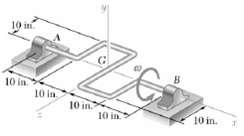
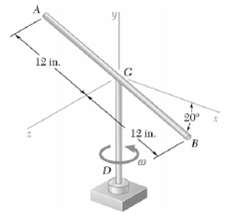
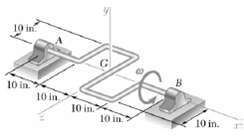
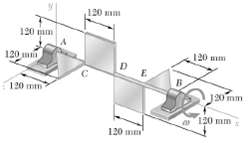
A 10-lb rod of uniform cross section is used to form the shaft shown. Knowing that the shaft rotates with a constant angular velocity ω of magnitude 12 rad/s, determine (a) The angular momentum HG of the shaft about its mass center G, (b) The angle formed by HG and the axis AB.
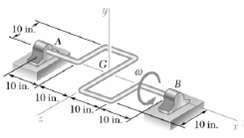
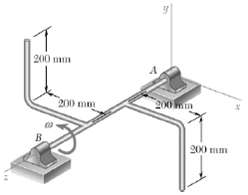
Determine the angular momentum of the shaft of Prob. 18.17 about (a) Point A, (b) Point B.
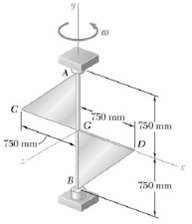
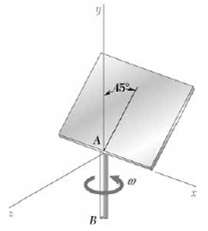
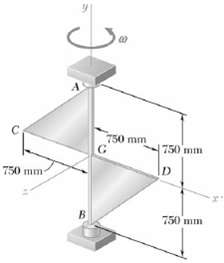
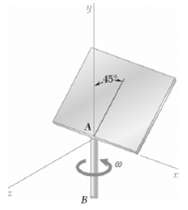
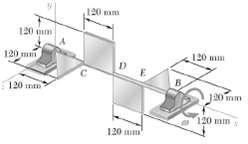
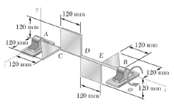
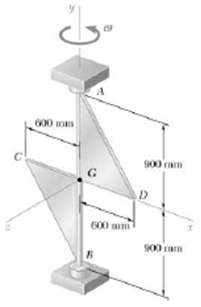
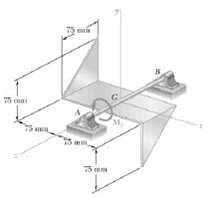
Two triangular plates, each of mass 8 kg, are welded to a vertical shaft AB. Knowing that the system rotates at the constant rate ω = 6 rad/s, determine its angular momentum about G.
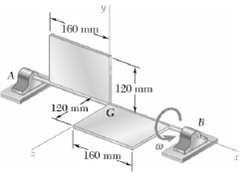
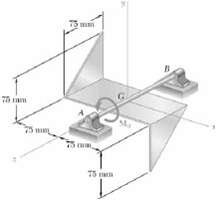
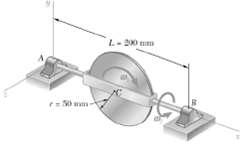
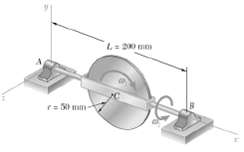
The assembly shown consists of two pieces of sheet aluminum of uniform thickness and total mass 1.6 kg welded to a light axle supported by bearings A and B. Knowing that the assembly rotates with an angular velocity of constant magnitude ω = 20 rad/s, determine the angular momentum HG of the
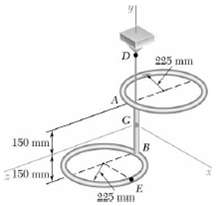
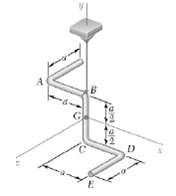
A wire of uniform cross section having a mass of 1.2 kg/m is used to form the wire figure shown, which is suspended from cord AD. Knowing that an impulse se FΔt = (5.4 N??s)j is applied to the wire figure at point E, determine (a) The velocity of the mass center G of the wire figure, (b) The
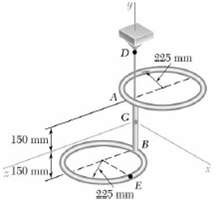
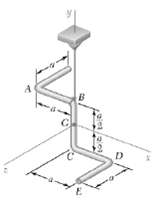
A wire of uniform cross section with a mass of 1.2 kg/m is used to form the wire figure shown, which is suspended from cord AD. Knowing that an impulse FΔt = ?? (5.4 N ?? s)i is applied to the wire figure at point E, determine (a) The velocity of the mass center G of the wire figure, (b) The
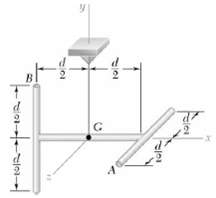
Three slender homogeneous rods, each of mass m and length d, are welded together to form the assembly shown, which hangs from a wire attached at G. The assembly is hit at A in a vertical downward direction. Denoting the corresponding impulse by FΔt, determine immediately after the impact (a) The
Solve Prob. 18.23, assuming that the assembly is hit at B in a direction opposite to that of the z axis. Problem 18.23 Three slender homogeneous rods, each of mass m and length d, are welded together to form the assembly shown, which hangs from a wire attached at G. The assembly is hit at A in a
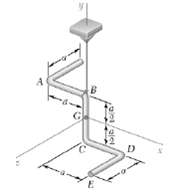
A uniform rod of mass m and length 5a is bent into the shape shown and is suspended by a wire attached at point B. Knowing that the rod is hit at point A in the negative y direction and denoting the corresponding impulse pulse by ??(FΔt)j, determine immediately after the impact (a) The velocity of
Solve Prob. 18.25, assuming that the rod is hit at point C in the negative z direction. Problem 18.25: A uniform rod of mass m and length 5a is bent into the shape shown and is suspended by a wire attached at point B. Knowing that the rod is hit at point A in the negative y direction and denoting
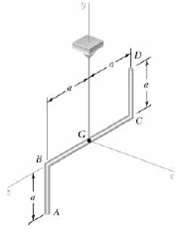
A uniform rod of mass m is bent into the shape shown and is suspended from a wire attached to its mass center G. The bent rod is hit at A in a direction perpendicular to the plane containing the rod (in the positive x direction). Denoting the corresponding impulse by FΔt, determine immediately
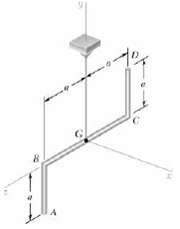
Solve Prob. 18.27 assuming that the bent rod is hit at B. Problem 18.27: A uniform rod of mass m is bent into the shape shown and is suspended from a wire attached to its mass center G. The bent rod is hit at A in a direction perpendicular to the plane containing the rod (in the positive x
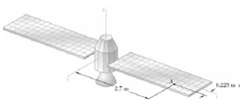
The coordinate axes shown represent the principal centroidal axes of inertia of a 1500-kg space probe whose radii of gyration are kx = 0.55 m, ky = 0.57 m, and kz = 0.50 m. The probe has no angular velocity when a 0.14-kg meteorite strikes one of its solar panels at A with a velocity v0 (720
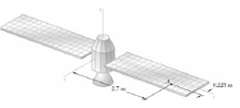
The coordinate axes shown represent the principal centroidal axes of inertia of a 1500-kg space probe whose radii of gyration are kx = 0.55 m, ky = 0.57 m, and kz = 0.50 m. The probe has no angular velocity when a 0.14-kg meteorite strikes one of its solar panels at A and emerges on the other side
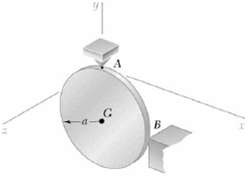
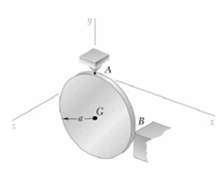
A circular plate of radius a and mass m supported by a ball-and-socket joint at point A is rotating about the y axis with a constant angular velocity ω = ω0j when an obstruction is suddenly introduced at point B in the xy plane. Assuming the impact at point B to be perfectly plastic (e = 0),
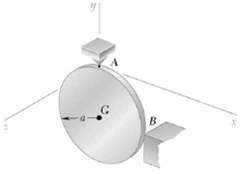
Determine the impulse exerted on the plate of Prob. 18.31 during the impact by (a) The obstruction at point B,? (b) The support at point A. Problem 18.31: A circular plate of radius a and mass m supported by a ball-and-socket joint at point A is rotating about the y axis with a constant angular
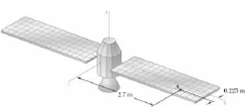
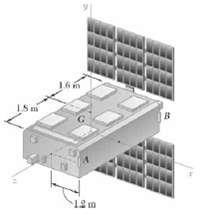
(a) The required operating time of each jet if the angular velocity of the satellite is to be reduced to zero, (b) The resulting change in the velocity of the mass center G.
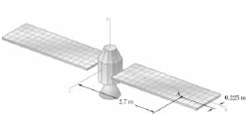
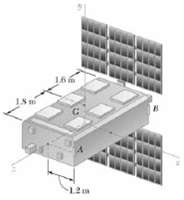
If jet A in Prob. 18.33 is inoperative, determine (a) The required operating time of jet B to reduce to zero the x component of the angular velocity of the satellite, (b) The resulting final angular velocity, (c) The resulting change in the velocity of the mass center G.
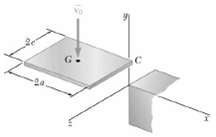
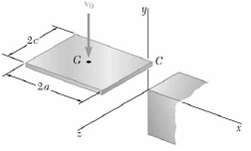
A rectangular plate of mass m is falling with a velocity v0 and no angular velocity when its corner C strikes an obstruction. Assuming the impact to be perfectly plastic (e = 0), determine the angular velocity of the plate immediately after the impact.
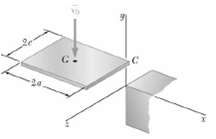
For the plate of Prob. 18.35, determine (a) The velocity of its mass center G immediately after the impact, (b) The impulse exerted on the plate by the obstruction during the impact.
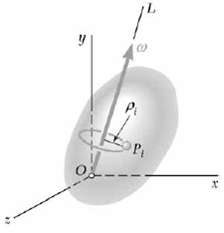
Denoting, respectively, by ω, HO, and T the angular velocity, the angular momentum, and the kinetic energy of a rigid body with a fixed point O,(a) Prove thatH0 ⋅ ω = 2T;(b) Show that the angle θ between ω and H0 will always be acute.
Show that the kinetic energy of a rigid body with a fixed point O can be expressed as T - 1/2 IOLω2 where ω is the instantaneous angular velocity of the body and IOL is its moment of inertia about the line of action OL of ω. Derive this expression (a) From Eqs. (9.46) and (18.19), (b) By
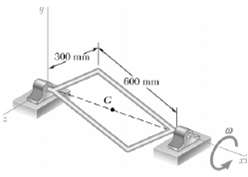
Determine the kinetic energy of the rectangular frame of Prob.18.1.
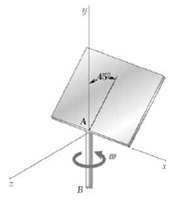
Determine the kinetic energy of the square plate of Prob.18.2.
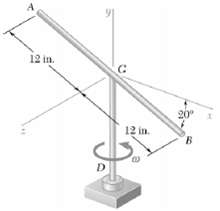
Determine the kinetic energy of rod AB of Prob.18.3.
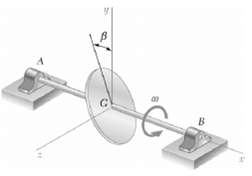
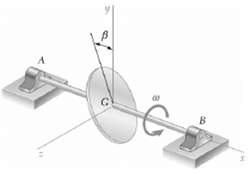
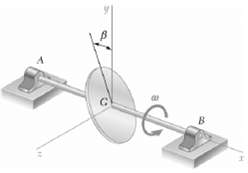
Determine the kinetic energy of the disk of Prob.18.4.
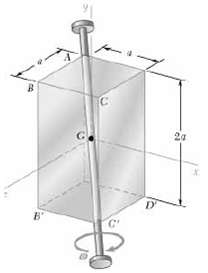
Determine the kinetic energy of the solid parallelepiped of Prob.18.5.
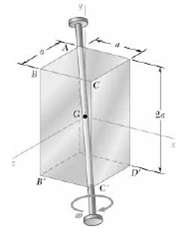
Determine the kinetic energy of the hollow parallelepiped of Prob.18.6.
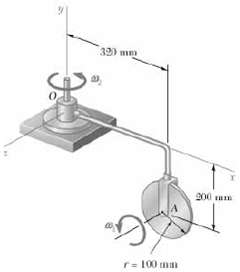
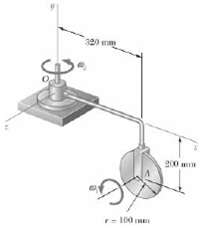
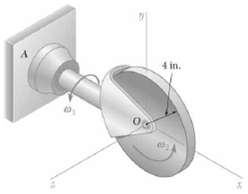
Determine the kinetic energy of the disk of Prob. 18.7. Problem 18.7: A homogeneous disk of mass m = 8 kg rotates at the constant rate ω1 = 12 rad/s with respect to arm OA, which itself rotates at the constant rate ω2 = 4 rad/s about the y axis. Determine the angular momentum HA of the disk about
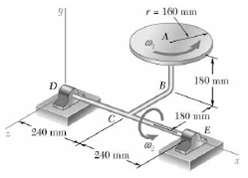
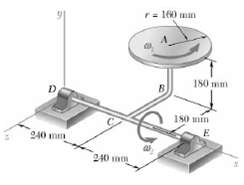
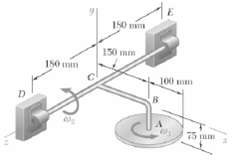
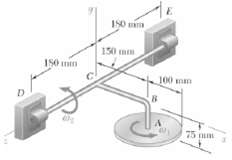
Determine the kinetic energy of the disk of Prob. 18.8. Problem 18.8: A homogeneous disk of mass m = 6 kg rotates at the constant rate ω1 = 16 rad/s with respect to arm ABC, which is welded to a shaft DCE rotating at the constant rate ω2 = 8 rad/s. Determine the angular momentum HA of the disk
Determine the kinetic energy of the assembly of Prob.18.15.
Determine the kinetic energy of the shaft of Prob.18.17.
Determine the kinetic energy of the assembly of Prob. 18.19.
Determine the kinetic energy imparted to the plate of Sample Prob. 18.1.
Determine the kinetic energy of the space probe of Prob. 18.29 in its motion about its mass center after its collision with the meteorite.
Determine the kinetic energy of the space probe of Prob. 18.30 in its motion about its mass center after its collision with the meteorite.
Determine the kinetic energy lost when the plate of Prob. 18.31 hits the obstruction at point B.
Determine the kinetic energy lost when corner C of the plate of Prob. 18.35 hits the obstruction.
Determine the rate of change HG of the angular momentum HG of the rectangular frame of Prob.18.1.
Determine the rate of change HA of the angular momentum HA of the square plate of Prob.18.2.
Determine the rate of change HG of the angular momentum HG of rod AB of Prob.18.3
Determine the rate of change HG of the angular momentum HG of the disk of Prob. 18.4 for an arbitrary value of β, knowing that its angular velocity ω remains constant.
Determine the rate of change HA of the angular momentum HA of the disk of Prob.18.7.
Determine the rate of change HA of the angular momentum HA of the disk of Prob.18.8.
Determine the rate of change HA of the angular momentum HA of the plate of Prob. 18.2, knowing that it has an angular velocity ω = ωj and an angular acceleration α = αj.
Determine the rate of change HG of the angular momentum HG of the disk of Prob. 18.4 for an arbitrary value of β, knowing that the disk has an angular velocity ω = ωi and an angular acceleration α = αi.
The assembly shown consists of pieces of sheet aluminum of uniform thickness and of total mass 1.5 kg welded to a light axle supported by bearings A and B. Knowing that the assembly rotates at the constant rate ω = 240 rpm, determine the dynamic reactions at A and B.
Solve Prob. 18.63 assuming ω = 360 rpm. Problem 18.63: The assembly shown consists of pieces of sheet aluminum of uniform thickness and of total mass 1.5 kg welded to a light axle supported by bearings A and B. Knowing that the assembly rotates at the constant rate ω = 240 rpm, determine the
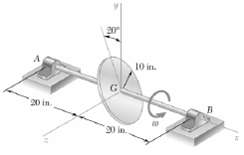
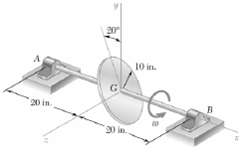
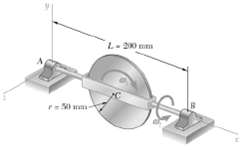
A homogeneous 8-lb disk is mounted on the horizontal shaft AB. The plane of the disk forms a 20? angle with the yz plane as shown. Knowing that the shaft rotates with a constant angular velocity ω of magnitude 10 rad/s, determine the dynamic reactions at points A and B.
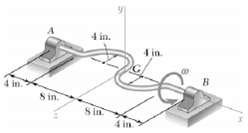
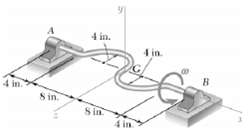
A thin homogeneous 1.6-lb rod is used to form the shaft shown. Knowing that the shaft rotates with a constant angular velocity ω of magnitude 20 rad/s, determine the dynamic reactions at points A and B.
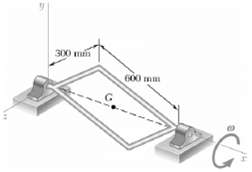
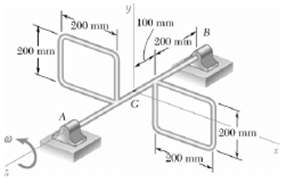
Two 2.4-kg slender rods are bent to form two square frames which are welded at the one-third points of the 600-mm shaft AB to form the assembly shown. Knowing that the assembly rotates with an angular velocity of constant magnitude ω = 20 rad/s, determine the dynamic reactions at the bearings A
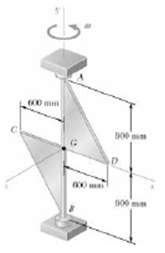
Each of the two triangular plates shown has a mass of 5 kg and is welded to a vertical shaft AB. Knowing that the assembly rotates at the constant rate ω = 8 rpm, determine the dynamic reactions at A and B.
Knowing that the assembly of Prob. 18.68 is initially at rest (ω = 0) when a couple of moment M0 = (36 N ?? m)j is applied to the shaft, determine (a) The resulting angular acceleration of the assembly, (b) The dynamic reactions at A and B immediately after the couple is applied.
The sheet-metal component shown is of uniform thickness and has a mass of 600 g. It is attached to a light axle supported by bearings at A and B located 150 mm apart. The component is at rest when it is subjected to a couple M0 as shown. If the resulting angular acceleration is α = (12 rad/s2)k,
Knowing that the assembly of Prob. 18.65 is initially at rest (w = 0) when a couple of moment M0 = (18lb ?? ft)i is applied to the shaft, determine (a) The resulting angular acceleration of the assembly, (b) The dynamic reactions at points A and B immediately after the couple has been applied.
Knowing that the shaft of Prob. 18.66 is initially at rest (w = 0), determine (a) The Magnitude of the couple M0 = M0i required to impart to the shaft an angular acceleration a = (150 rad/s2)i, (b) The dynamic reactions at points A and B immediately after the couple has been applied.
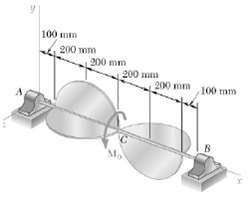
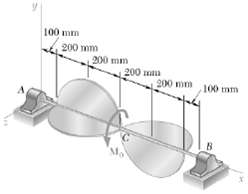
The assembly shown has a mass of 6 kg and consists of 4 thin 400-mmdiameter semicircular aluminum plates welded to a light 1-m-long shaft AB. The assembly is at rest (ω = 0) at time t = 0 when a couple M0 is applied to it as shown, causing the assembly to complete one full revolution in 2 s.
For the assembly of Prob. 18.73, determine the dynamic reactions at A and B at t = 2s.
The assembly of Prob. 18.63 is initially at rest (ω = 0) when a couple M0 is applied to axle AB. Knowing that the resulting angular acceleration of the assembly is α = (150 rad/s2)i, determine (a) The couple M0, (b) The dynamic reactions at A and B immediately after the couple is applied.
For the sheet-metal component of Prob. 18.76 determine (a) The angular velocity of the component 0.6 s after the couple M0 has been applied to it. (b) The magnitude of the dynamic reactions at A and B at that time.
Each wheel of an automobile has a weight of 48lb, a diameter of 23 in., and a radius of gyration of 9 in. The automobile travels around an unbanked curve of radius 450 ft at a speed of 65 mi/h, knowing that the transverse distance between the wheels is 4.5 ft, determine the additional normal force
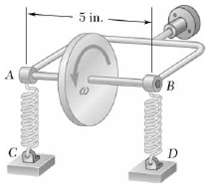
The essential structure of a certain type of aircraft turn indicator is shown. Each spring has a constant of 40 lb/ft, and the 7-oz uniform disk of 2-in. radius spins at the rate of 10 000 rpm. The springs are stretched and exert equal vertical forces on yoke AB when the airplane is traveling in a
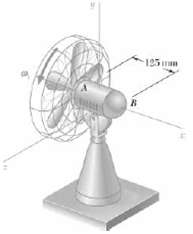
The blade of an oscillating fan and the rotor of its motor have a total mass of 300 g and a combined radius of gyration of 75 mm. They are supported by bearings at A and B, 125 mm apart, and rotate at the rate ω1 = 1800 rpm. Determine the dynamic reactions at A and B when the motor casing has an
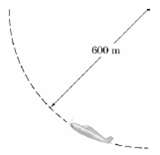
An airplane propeller has a mass of 160 kg and has a radius of gyration of 800 mm. Knowing that the propeller rotates at 1600 rpm as the airplane is traveling on a vertical circular path of 600-m radius at 540-km/h, determine the magnitude of the couple exerted by the propeller on its shaft due to
The flywheel of an automobile engine, which is rigidly attached to the crankshaft, is equivalent to a 20-diameter, 0.75-in-thick steel plate. Determine the magnitude of the couple exerted by the flywheel on the horizontal crankshaft as the automobile travels around an unbanked curve of 600-ft
The uniform thin 5-lb disk spins at a constant rate w2 = 6 rad/s about an axis held by a housing attached to a horizontal rod that rotates at the constant rate w1 = 3 rad/s. Determine the couple which represent the dynamic reaction at the support A.
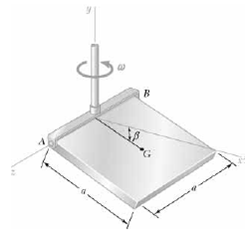
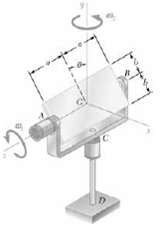
A uniform square plate of side a = 225 mm is hinged at points A and B to a clevis which rotates with a constant angular velocity ω about a vertical axis. Determine(a) The constant angle β that the plate forms with the horizontal x axis when ω = 12 rad/s,(b) The
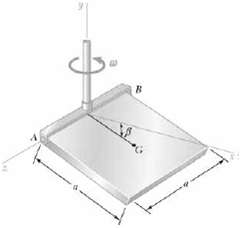
A uniform square plate of side a = 300 mm is hinged at points A and B to a clevis which rotates with a constant angular velocity ω about a vertical axis. Determine (a) The value of ω for which the plate forms a constant angle β = 60? with the horizontal x axis, (b) The largest value of ω for
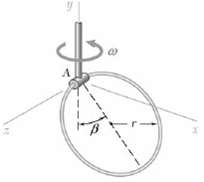
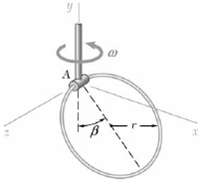
A thin ring of radius r = 8in is attached by a collar at point A to a vertical shaft which rotates with a constant angular velocity ω. Determine (a) The constant angle β that the plane of the ring forms with the vertical when ω = 10 rad/s, (b) The largest value of ω for which the ring will
A thin ring of radius r = 12 in. is attached by a collar at point A to a vertical shaft which rotates with a constant angular velocity ω. Determine (a) The value of ω for which the ring forms a constant angle β = 45? with the vertical y axis, (b) The largest value of ω for which the ring will
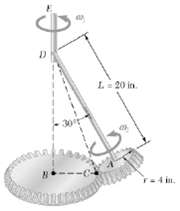
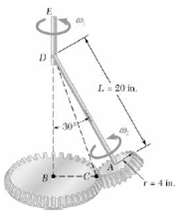
The 2-lb gear A is constrained to roll on the fixed gear B, but is free to rotate about axle AD. Axle AD, of length 20 in. and negligible weight, is connected by a clevis to the vertical shaft DE which rotates as shown with a constant angular velocity ω1. Assuming that gear A can be approximated
Determine the force F exerted by gear B on gear A of Prob. 18.87 when shaft DE rotates with the constant angular velocity w1 = 4rad/s.
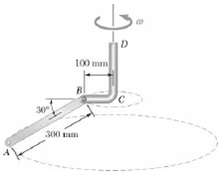
The slender rod AB is attached by a clevis to arm BCD which rotates with a constant angular velocity ω about the centerline of its vertical portion CD. Determine the magnitude of the angular velocity ω.
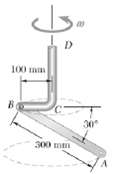
The slender rod AB is attached by a clevis to arm BCD which rotates with a constant angular velocity w about the centerline of its vertical portion CD. Determine the magnitude of the angular velocity w.
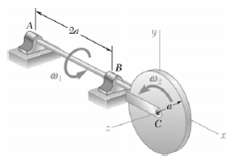
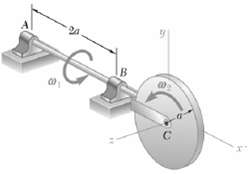
A thin homogeneous disk of mass m and radius a is held by a fork-ended horizontal rod ABC. The disk and the rod rotate with the angular velocities shown. Assuming that both ω1 and ω2 are constant, determine the dynamic reactions at A and B.
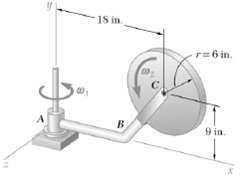
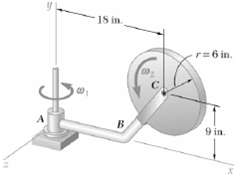
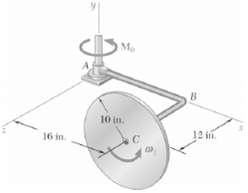
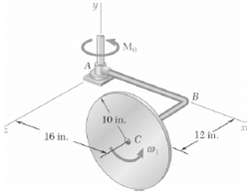
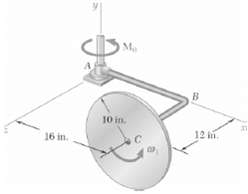
A thin disk of weight W = 10 lb rotates with an angular velocity w2 with respect to arm ABC, which itself rotates with an angular velocity w1 about the y axis. Knowing that w1 = 5 rad/s and w2 = 15 rad/s and that both are constant; determine the force-couple system representing the dynamic reaction
The 300-g disk shown spins at the rate ω1 = 750rpm, while axle AB rotates as shown with an angular velocity ω2 of 6 rad/s. Determine the dynamic reactions at A and B.
The 300-g disk shown spins at the rate ω1 = 750 rpm, while axle AB rotates as shown with an angular velocity ω2. Determine the maximum allowable magnitude of ω2 if the dynamic reactions at A and B are not to exceed 1 N each.
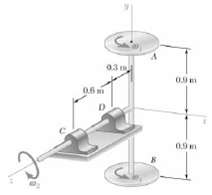
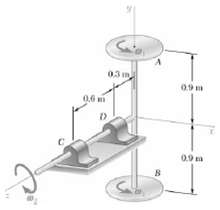
Two disks, each of mass 5 kg and radius 300 mm, spin as shown at the rate ω1 = 1200rpm about a rod AB of negligible mass which rotates about the horizontal z axis at the rate ω2 = 60 rpm. (a) Determine the dynamic reactions at points C and D. (b) Solve part a assuming that the direction of spin
Two disks, each of mass 5 kg and radius 300 mm, spin as shown at the rate ω1 = 1200 rpm about a rod AB of negligible mass which rotates about the horizontal z axis at the rate ω2. Determine the maximum allowable value of ω2 if the magnitudes of the dynamic reactions at points C and D are not to
A 100-lb advertising panel of length 2a = 7.2ft and width 2b = 4.8 ft is kept rotating at a constant rate ω1 about its horizontal axis by a small electric motor attached at A to frame ACB. This frame itself is kept rotating at a constant rate ω2 about a vertical axis by a second motor attached at
A thin disk of weight W = 10 lb rotates with an angular velocity w2 with respect to arm ABC, which itself rotates with an angular velocity w1 about the y axis. Knowing that w1 = 5 rad/s and w2 = 15 rad/s and that both are constant; determine the force-couple system representing the dynamic reaction
For the system of Prob. 18.97, show that (a) The dynamic reaction at D is independent of the length 2a of the panel, (b) The ratio M1/M2 of the magnitudes of the couples exerted by the motors at A and C, respectively, is independent of the dimensions and mass of the panel and is equal to ω2/2ω1
At the instant shown the 300-g disk of Prob. 18.93 has an angular velocity of magnitude w1 = 12 rad/s, which is decreasing at the rate of 4 rad/s2 due to friction in the bearing at C. knowing that AB rotates with a constant angular velocity w2 of 6 rad/s, determine the dynamic reactions at A and B.
An 80-lb disk of radius 10 in. spins as shown at the constant rate ω1 = 80 rad/s with respect to the bent axle ABC. The system is at rest when a couple M0 = (1.5 lb ?? ft) is applied for 5 s and then removed. Determine the force-couple system representing the dynamic reaction at the support at
(a) The couple M0, (b) The force-couple system representing the dynamic reaction at the support at point A just before the couple was removed. Assume that the bent axle ABC has a negligible mass.
A 2.5-kg homogeneous disk of radius 100 mm rotates with an angular velocity ω1 with respect to arm ABC, which is welded to a shaft DCE rotating as shown at the constant rate ω2 = 12 rad/s. Friction in the bearing at A causes ω1 to decrease at the rate of 15 rad/s2. Determine the dynamic
A 2.5-kg homogeneous disk of radius 100 mm rotates at the constant rate ω1 = 50 rad/s with respect to arm ABC, which is welded to a shaft DCE. Knowing that at the instant shown shaft DCE has an angular velocity of ω2 = (12 rad/s)k and an angular acceleration α2 = (8 rad/s2) k, determine (a) The
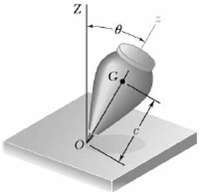
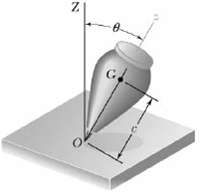
The 3-oz top shown is supported at the fixed point O. The radii of gyration of the top with respect to its axis of symmetry and with respect to a transverse axis through O are 1.05 in. and 2.25 in., respectively. Knowing that c = 1.875 in. and that the rate of spin of the top about its axis of
The top shown is supported at the fixed point O and its moments of inertia about its axis of symmetry and about a transverse axis through O are denoted, respectively, by I and I??. (a) Show that the condition for steady precession of the top is (Iωz ?? I?? φ cos θ) φ = WC where φ is the rate
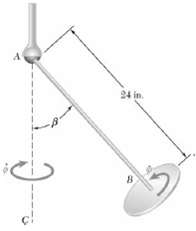
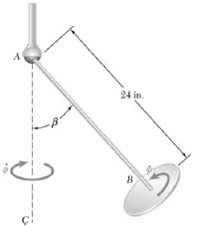
A uniform thin disk of 6-in. diameter is attached to the end of a rod AB of negligible mass which is supported by a ball-and-socket joint at point A, knowing that the disk is observed to process about the vertical axis AC at the constant rate of 36 rpm in the sense indicated and that its axis of
A uniform thin disk of 6-in. diameter is attached to the end of a rod AB of negligible mass which is supported by a ball-and-socket joint at point A. Knowing that the disk is spinning about its axis of symmetry AB at the rate of 2100 rpm in the sense indicated and that AB forms an angle β = 45?
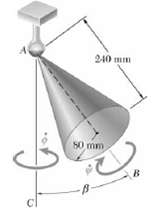
A solid cone of height 240mm with a circular base of radius 80mm is supported by a ball-and-socket joint at A. The cone spins about its axis of symmetry AB at the constant rate of 1600rpm in the sense indicated. Knowing that the cone is observed to process about the vertical axis AC at the constant
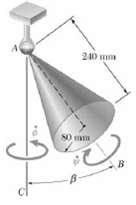
A solid cone of height 240 mm with a circular base of radius 80 mm is supported by a ball-and-socket joint at A. Knowing that the cone is observed to process about the vertical axis AC at the constant rate of 30 rpm in the sense indicated and that its axis of symmetry forms an angle β = 30? with
(a) The couple M0, (b) The force-couple system representing the dynamic reaction at the support at point A just before the couple was removed. Assume that the bent axle ABC has a negligible mass.
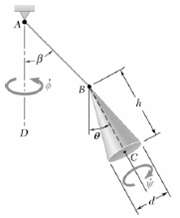
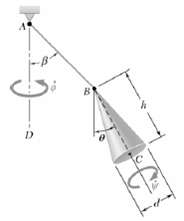
A homogeneous cone of height h and with a base of diameter d
A homogeneous cone of height h = 12 in. and with a base diameter d = 6 in. is attached as shown to a cord AB. Knowing that the angles that cord AB and the axis BC of the cone form with the vertical are, respectively, β = 45? and θ = 30?, and that the cone processes at the constant rate φ = 8
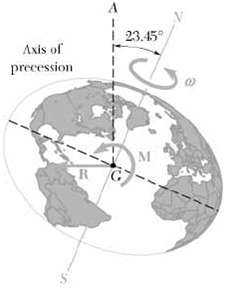
If the earth were a sphere, the gravitational attraction of the sun, moon, and planets would at all times be equivalent to a single force R acting at the mass center of the earth. However, the earth is actually an oblate spheroid and the gravitational system acting on the earth is equivalent to a
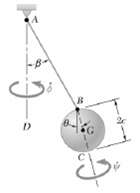
A homogeneous sphere of radius c is attached as shown to a cord AB. The cord forms an angle β with the vertical and processes at the constant rate φ, while the sphere spins at the constant rate ψ about its diameter BC. Determine the angle θ that BC forms with the vertical.
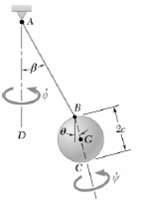
A homogeneous sphere of radius c = 40 mm is attached as shown to a cord AB. The cord forms an angle β = 30? with the vertical and is observed to process at the constant rate φ = 5 rad/s about the vertical through A. Determine the angle θ that the diameter BC forms with the vertical, knowing that
Showing 11700 - 11800
of 18200
First
111
112
113
114
115
116
117
118
119
120
121
122
123
124
125
Last
Step by Step Answers

 Get 50% OFF
Claim Now
Get 50% OFF
Claim Now