New Semester
Started
Get
50% OFF
Study Help!
--h --m --s
Claim Now
Question Answers
Textbooks
Find textbooks, questions and answers
Oops, something went wrong!
Change your search query and then try again
S
Books
FREE
Study Help
Expert Questions
Accounting
General Management
Mathematics
Finance
Organizational Behaviour
Law
Physics
Operating System
Management Leadership
Sociology
Programming
Marketing
Database
Computer Network
Economics
Textbooks Solutions
Accounting
Managerial Accounting
Management Leadership
Cost Accounting
Statistics
Business Law
Corporate Finance
Finance
Economics
Auditing
Tutors
Online Tutors
Find a Tutor
Hire a Tutor
Become a Tutor
AI Tutor
AI Study Planner
NEW
Sell Books
Search
Search
Sign In
Register
study help
engineering
mechanical engineering
Vector Mechanics For Engineers Statics And Dynamics 8th Edition Ferdinand Beer, E. Russell Johnston, Jr., Elliot Eisenberg, William Clausen, David Mazurek, Phillip Cornwell - Solutions
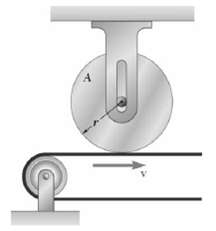
Disk A, of mass 2 kg and radius r = 60 mm, is at rest when it is placed in contact with a belt which moves at a constant speed v = 15 m/s. Knowing that μk = 0.20 between the disk and the belt, determine the time required for the disk to reach a constant angular velocity.
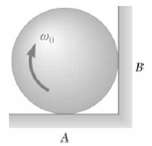
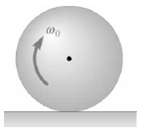
A sphere of radius r and weight W with an initial clockwise angular velocity ω0 is placed in the corner formed by the floor and a vertical wall. Denoting by μk the coefficient of kinetic friction at A and B, derive an expression for the time required for the sphere to come to rest.
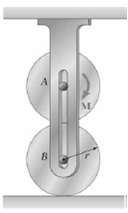
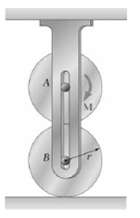
Two identical uniform cylinders of mass m and radius r are at rest at time t = 0 when a couple M of constant magnitude M
Two identical 16-lb uniform cylinders of radius r = 4 in. are at rest when a couple M of constant magnitude 4 lb ??ft is applied to cylinder A. Slipping occurs between the two cylinders and between cylinder B and the horizontal surface. Knowing that the coefficient of kinetic friction is 0.5
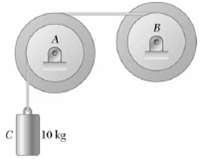
Each of the double pulleys shown has a centroidal mass moment of inertia of 0.25 kg ?? m2, an inner radius of 100 mm, and an outer radius of 150 mm. Neglecting bearing friction, determine (a) The velocity of the cylinder 3 s after the system is released from rest, (b) The tension in the cord
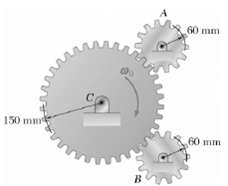
Each of the gears A and B has a mass of 675 g and has a radius of gyration of 40 mm, while gear C has a mass of 3.6 kg and has a radius of gyration of 100 mm. Assume that kinetic friction in the bearings of gears A, B, and C produces couples of constant magnitude 0.15 N ?? m, 0.15 N ?? m, and 0.3 N
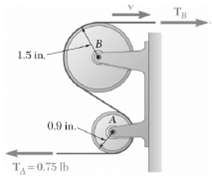
A computer tape moves over the two drums shown. Drum A weighs 1.4 lb and has a radius of gyration of 0.75 in., while drum B weighs 3.5 lb and has a radius of gyration of 1.25 in. In the lower portion of the tape the tension is constant and equal to TA = 0.75 lb. Knowing that the tape is initially
Show that the system of moment a for a rigid slab in plane motion reduces to a single vector, and express the distance from the mass center G to the line of action of this vector in terms of the centroidal radius of gyration k of the slab, the magnitude v of the velocity of G, and the angular
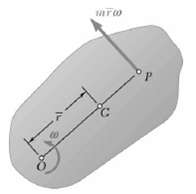
Show that, when a rigid slab rotates about a fixed axis through O perpendicular to the slab, the system of the moment a of its particles is equivalent to a single vector of magnitude mrω, perpendicular to the line OG, and applied to a point P on this line, called the center of percussion, at a
Show that the sum HA of the moments about a point A of the moment of the particles of a rigid slab in plane motion is equal to IA ω, where ω is the angular velocity of the slab at the instant considered and IA is the moment of inertia of the slab about A, if and only if one of the following
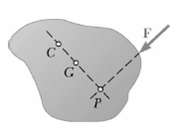
Consider a rigid slab initially at rest and subjected to an impulsive force F contained in the plane of the slab. We define the center of percussion P as the point of intersection of the line of action of F with the perpendicular drawn from G. (a) Show that the instantaneous center of rotation C of
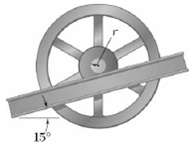
A flywheel is rigidly attached to a 38-mm-radius shaft that rolls without sliding along parallel rails. Knowing that after being released from rest the system attains a speed of 152mm/s in 30s, determine the centroidal radius of gyration of the system.
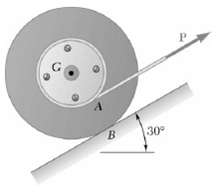
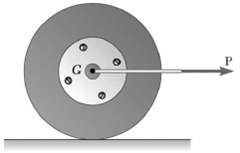
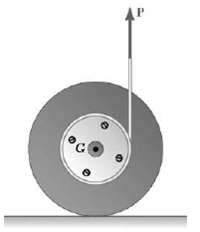
A drum of 100-mm radius is attached to a disk of 200-mm radius. The disk and drum have a combined mass of 5 kg and a combined radius of gyration of 150 mm. A cord is attached to the drum at A and pulled with a constant force P of magnitude 25 N. Knowing that the disk rolls without sliding and that
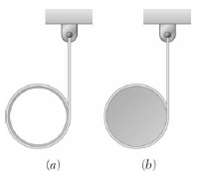
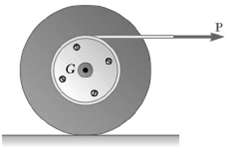
Cords are wrapped around a thin-walled pipe and a solid cylinder as shown. Knowing that the pipe and the cylinder are each released from rest at time t = 0, determine at time t the velocity of the center of? (a) The pipe, (b) The cylinder.
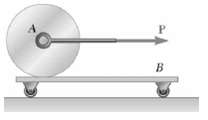
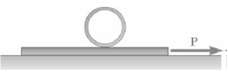
A 12-in.-radius cylinder of weight 16 lb rests on a 6-lb carriage. The system is at rest when a force P of magnitude 2.5 lb is applied as shown for 1.2 s. Knowing that the cylinder rolls without sliding on the carriage and neglecting the mass of the wheels of the carriage, determine the resulting
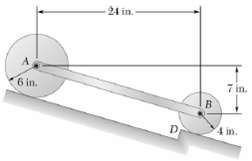
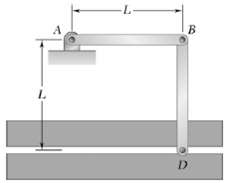
The bar AB of negligible mass is attached by pins to two disks and the system is released from rest in the position shown. Disk A has a weight of 12 lb and a radius of gyration of 3.6 in. Disk B has a weight of 6 lb and a radius of gyration of 3.2 in. Assuming that disk A does not reach the corner
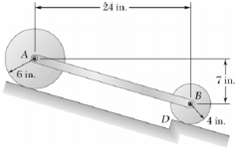
The 10-lb uniform bar AB is attached by pins to two uniform disks and the system is released from rest in the position shown. The weight of disk A is 12 lb and that of disk B is 6 lb. Assuming that disk A does not reach the corner D, determine the velocity of bar AB after 0.6s.
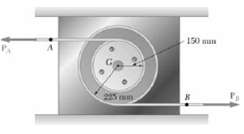
A 15-kg double pulley has a radius of gyration of 125 mm and is attached to a 10-kg slider block by a pin at point G. The system is at rest when constant forces PA and PB are applied to the cords as shown. Knowing that after 2 s the velocity of point A is 3.3 m/s to the left and the velocity of
A 160-mm-diameter pipe of mass 6 kg rests on a 1.5-kg plate. The pipe and plate are initially at rest when a force P of magnitude 25 N is applied for 0.75 s. Knowing that μs = 0.25 and μk = 0.20 between the plate and both the pipe and the floor, determine (a) Whether the pipe slides with respect
A sphere of radius r and mass m is placed on a horizontal floor with no linear velocity but with a clockwise angular velocity ω0. Denoting by k μ the coefficient of kinetic friction between the sphere and the floor, determine? (a) The time t1 at which the sphere will start rolling without
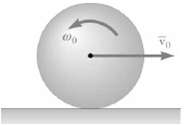
A sphere of radius r and mass m is projected along a rough horizontal surface with the initial velocities shown. If the final velocity of the sphere is to be zero, express (a) The required magnitude of ω0 in terms of v0 and r, (b) The time required for the sphere to come to rest in terms of v0 and
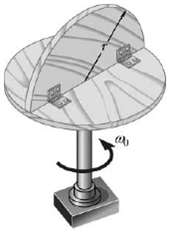
A semicircular panel of radius r is attached with hinges to a circular plate of radius r and initially held in the vertical position as shown. The plate and the panel are made of the same material and have the same thickness. Knowing that the entire assembly is rotating freely with an initial
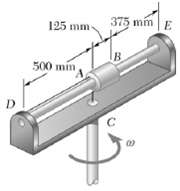
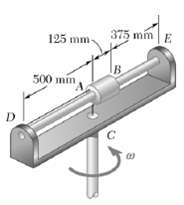
A 1.6-kg tube AB can slide freely on rod DE which in turn can rotate freely in a horizontal plane. Initially the assembly is rotating with an angular velocity ω = 5 rad/s and the tube is held in position by a cord. The moment of inertia of the rod and bracket about the vertical axis of rotation is
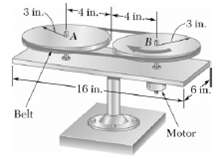
Two 10-lb disks and a small motor are mounted on a 15-lb rectangular platform which is free to rotate about a central vertical spindle. The normal operating speed of the motor is 180 rpm. If the motor is started when the system is at rest, determine the angular velocity of all elements of the
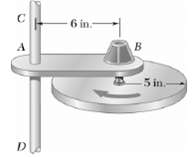
A 10-lb disk is attached to the shaft of a motor mounted on arm AB which is free to rotate about the vertical axle CD. The arm-and-motor unit has a moment of inertia of 0.032 lb ?? ft ?? s2 with respect to axle CD, and the normal operating speed of the motor is 360 rpm. Knowing that the system is
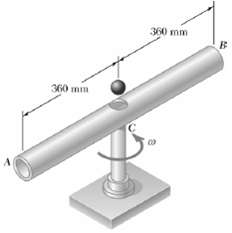
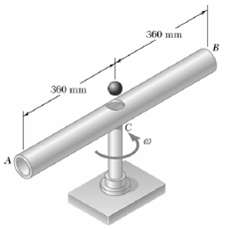
Two 0.36-kg balls are put successively into the center C of the slender 1.8-kg tube AB. Knowing that when the first ball is put into the tube the initial angular velocity of the tube is 8 rad/s and neglecting the effect of friction, determine the angular velocity of the tube just after (a) The
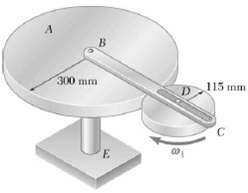
The 30-kg uniform disk A and the bar BC are at rest and the 5-kg uniform disk D has an initial angular velocity ω1 of magnitude 440 rpm when the compressed spring is released and disk D contacts disk A. The system rotates freely about the vertical spindle BE. After a period of slippage, disk D
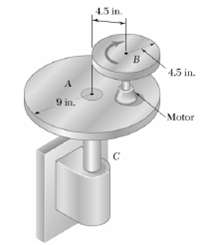
The 8-lb disk B is attached to the shaft of a motor mounted on plate A, which can rotate freely about the vertical shaft C. The motor-plate-shaft unit has a moment of inertia of 0.14 lb ?? ft ?? s2 with respect to the axis of the shaft. If the motor is started when the system is at rest, determine
A 1.2-lb slender bar B fits inside a slot cut in a horizontal triangular plate which is free to rotate about a vertical axis through point O. Initially the angular velocity of the plate is 10 rad/s clockwise and the bar is at rest relative to the plate in the position shown. After the bar is given
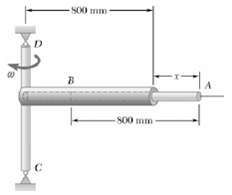
The 4-kg rod AB can slide freely inside the 6-kg tube CD. The rod was entirely within the tube (x = 0) and released with no initial velocity relative to the tube when the angular velocity of the assembly was 5 rad/s. Neglecting the effect of friction, determine the speed of the rod relative to the
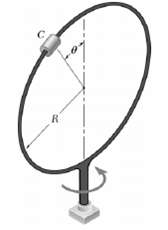
A small 3-kg collar C can slide freely on a thin ring of mass 4.5 kg and radius 325 mm. The ring is welded to a short vertical shaft, which can rotate freely in a fixed bearing. Initially the ring has an angular velocity of 35 rad/s and the collar is at the top of the ring (θ = 0) when it is given
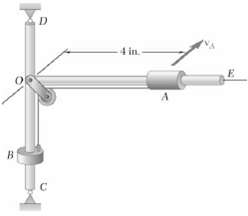
A 3.6-lb collar A and a 1.4-lb collar B can slide without friction on a frame consisting of the horizontal rod OE and the vertical rod CD, which is free to rotate about its vertical axis of symmetry. The two collars are connected by a cord running over a pulley that is attached to the frame at O.
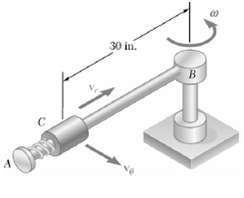
Collar C has a weight of 18 lb and can slide freely on rod AB, which in turn can rotate freely in a horizontal plane. The assembly is rotating with an angular velocity ω of 1.5 rad/s when a spring located between A and C is released, projecting the collar along the rod with an initial relative
In Prob. 17.71 determine the velocity of the tube relative to the rod as the tube strikes end E of the assembly. Problem 17.71: A 1.6-kg tube AB can slide freely on rod DE which in turn can rotate freely in a horizontal plane. Initially the assembly is rotating with an angular velocity ω = 5 rad/s
In Prob. 17.74, determine the velocity of each ball relative to the tube as it leaves the tube. Problem 17.74: Two 0.36-kg balls are put successively into the center C of the slender 1.8-kg tube AB. Knowing that when the first ball is put into the tube the initial angular velocity of the tube is 8
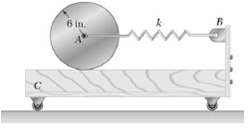
A 6-lb uniform cylinder A can roll without sliding on a 10-lb cart C and is attached to a spring AB of constant k = 7 lb/ft as shown. The system is released from rest when the spring is stretched 0.8 in. Neglecting wheel friction, determine the velocity of the cart and the angular velocity of the
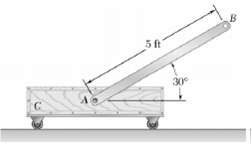
Rod AB has a weight of 6 lb and is attached to a 10-lb cart C. Knowing that the system is released from rest in the position shown and neglecting friction, determines (a) The velocity of point B as rod AB passes through a vertical position, (b) The corresponding velocity of the cart C.
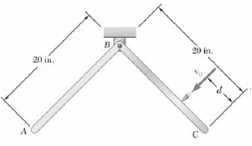
Two identical 10-lb slender rods AB and BC are welded together to form an L-shaped assembly which is suspended from a hinge at B and is at rest in a vertical plane. A 0.03-lb bullet strikes the assembly with a velocity of 1800 ft/s perpendicular to BC. Knowing that d = 0, determine the angular
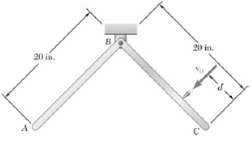
Two identical 10-lb slender rods AB and BC are welded together to form an L-shaped assembly which is suspended from a hinge at B and is at rest in a vertical plane. A 0.03-lb bullet strikes the assembly with a velocity of 1800 ft/s perpendicular to BC. Knowing that the angular velocity of the
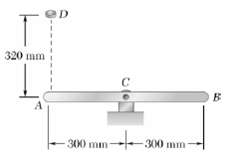
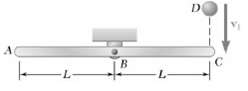
A 15-g magnet D is released from rest in the position shown, falls a distance of 320 mm, and becomes attached at A to the 200-g steel bar AB. Assuming that the impact is perfectly plastic, determine the angular velocity of the bar and the velocity of the magnet immediately after the impact.
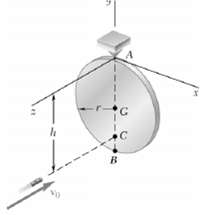
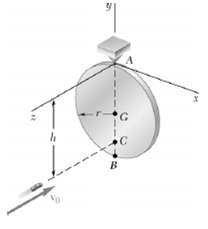
A 30-kg uniform circular plate of radius r is supported by a ball-and socket joint at point A and is at rest in the vertical xy plane when a bullet with a mass of 15 g is fired with the velocity v0 = ?? (210 m/s)k and hits the plate at point C. Knowing that r = 400 mm and h = 700 mm, determine (a)
In Prob. 17.89, determine (a) The required distance h if the impulsive reaction at point A is to be zero, (b) The corresponding velocity of the mass center G of the plate immediately after the bullet becomes embedded at C. Problem 17.89: A 30-kg uniform circular plate of radius r is supported by a
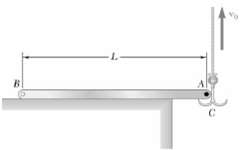
A uniform slender rod AB of mass m is at rest on a frictionless horizontal surface when hook C engages a small pin at A. Knowing that the hook is pulled upward with a constant velocity v0, determine the impulse exerted on the rod (a) At A, (b) At B. Assume that the velocity of the hook is unchanged
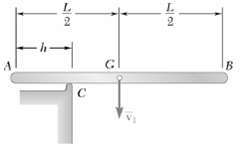
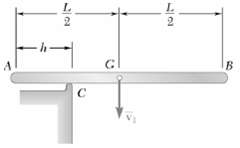
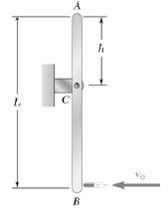
A uniform slender rod AB of mass m and length L has a vertical velocity of magnitude v1 and no angular velocity when it strikes a rigid frictionless support at point C. Knowing that h = L/4 and assuming perfectly plastic impact, determine (a) The angular velocity of the rod and the velocity of its
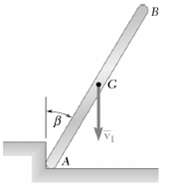
The uniform slender rod AB of mass 3 kg and length 750 mm forms an angle β = 30?with the vertical as it strikes the smooth corner shown with a vertical velocity v1 of magnitude 2.4 m/s and no angular velocity. Assuming that the impact is perfectly plastic, determine the angular velocity of the rod
A uniform slender rod AB of mass m and length L has a vertical velocity of magnitude v1 and no angular velocity when it strikes a rigid frictionless support at point C. Knowing that h = L/4 and assuming perfectly plastic impact, determine (a) The angular velocity of the rod and the velocity of its
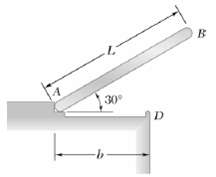
A slender rod of mass m and length L is released from rest in the position shown and hits edge D. Assuming perfectly elastic impact (e = 1) at D, determine the distance b for which the rod will rebound with no angular velocity.
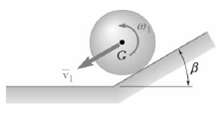
A uniform sphere of radius r rolls down the incline shown without slipping. It hits a horizontal surface and, after slipping for a while, it starts rolling again. Assuming that the sphere does not bounce as it hits the horizontal surface, determine its angular velocity and the velocity of its mass
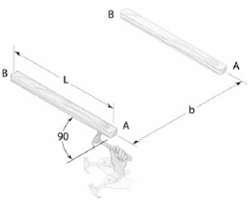
A uniform slender rod AB is at rest on a frictionless horizontal table when end A of the rod is struck by a hammer which delivers an impulse that is perpendicular to the rod. In the subsequent motion, determine the distance b through which the rod will move each time it completes a full revolution.
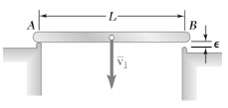
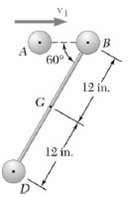
A uniform slender rod of length L is dropped onto rigid supports at A and B. Immediately before striking A the velocity of the rod is v1. Since support B is slightly lower than support A, the rod strikes A before it strikes B. Assuming perfectly elastic impact at both A and B, determine the angular
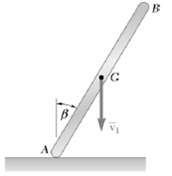
The slender rod AB of length L forms an angle β with the vertical axis as it strikes the frictionless surface shown with a vertical velocity v1 and no angular velocity. Assuming that the impact is perfectly elastic, derive an expression for the angular velocity of the rod immediately after the
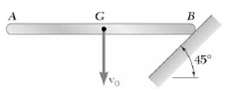
A uniform slender rod AB of mass m and length L is falling freely with a velocity v0 when end B strikes a smooth inclined surface as shown. Assuming that the impact is perfectly elastic, determine the angular velocity of the rod and the velocity of its mass center immediately after the impact.
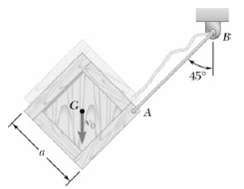
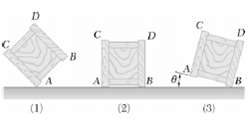
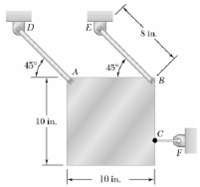
A uniformly loaded square crate is falling freely with a velocity v0 when cable AB suddenly becomes taut. Assuming that the impact is perfectly plastic, determine the angular velocity of the crate and the velocity of its mass center immediately after the cable becomes taut.
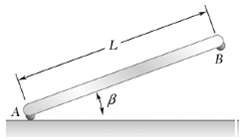
A uniform slender rod AB of mass m and length L is released from rest in the position shown. Knowing that the impact between knob B and the horizontal surface is perfectly elastic, determine (a) The angular velocity of the rod immediately after the impact, (b) The impulses exerted on the rod at
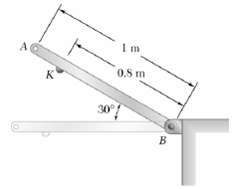
A slender 5-kg rod is released from rest in the position shown. It is observed that after the rod strikes the vertical surface it rebounds to a horizontal position. (a) Determine the coefficient of restitution between knob K and the surface. (b) Show that the same rebound can be expected for any
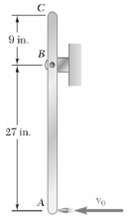
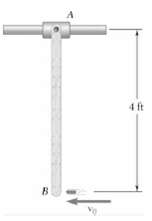
A 0.06-lb bullet is fired with a horizontal velocity into the lower end of a 45-lb slender bar which is initially at rest in a vertical plane. Knowing that the bullet becomes embedded in the bar and that the maximum angle of rotation of the bar in its subsequent motion is 45? clockwise determine
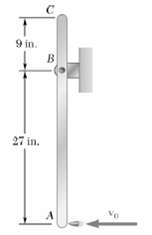
A 0.05-lb bullet is fired with a horizontal velocity of magnitude 1500ft/s into the lower end of a 40-lb slender bar which is initially at rest in a vertical plane. Knowing that the bullet becomes embedded in the bar, determine the maximum clockwise angle of rotation of the bar in its subsequent
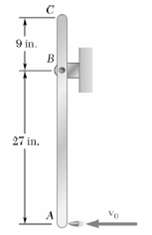
A 0.05-lb bullet is fired with a horizontal velocity of magnitude 1500ft/s into the lower end of a 40-lb slender bar which is initially at rest in a vertical plane. Knowing that the bullet becomes embedded in the bar, determine the maximum clockwise angle of rotation of the bar in its subsequent
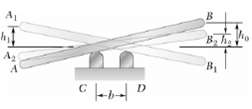
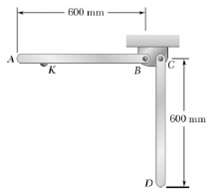
A uniform slender rod AB of length L = 600 mm is placed with its center equidistant from two supports that are located at a distance b = 100 mm from each other. End B of the rod is raised a distance h0 = 80 mm and released; the rod then rocks on the supports as shown. Assuming that the impact at
A uniformly loaded square crate is released from rest with its corner D directly above A; it rotates about A until its corner B strikes the floor, and then rotates about B. The floor is sufficiently rough to prevent slipping and the impact at B is perfectly plastic. Denoting by ω0 the angular
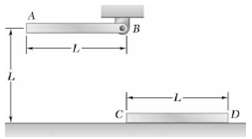
A slender rod AB is released from rest in the position shown. It swings down to a vertical position and strikes a second and identical rod CD which is resting on a friction-less surface. Assuming that the coefficient of restitution between the rods is 0.4, determine the velocity of rod CD
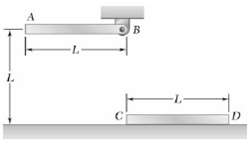
Solve Prob. 17.109 assuming that the impact between the rods is perfectly elastic. Problem 17.109: A slender rod AB is released from rest in the position shown. It swings down to a vertical position and strikes a second and identical rod CD which is resting on a frictionless surface. Assuming that
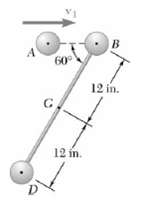
The 18-lb rigid body BD consists of two identical 2.4-in.-radius spheres and the rod which connects them and has a centroidal radius of gyration of 10 in. The body is at rest on a horizontal frictionless surface when it is struck by the 6-lb sphere A which has a radius of 2.4 in. and is moving as
Solve Prob. 17.111, assuming that the impact is perfectly elastic. Problem 17.111: The 18-lb rigid body BD consists of two identical 2.4-in.-radius spheres and the rod which connects them and has a centroidal radius of gyration of 10 in. The body is at rest on a horizontal frictionless surface when
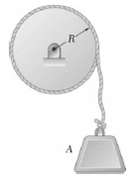
Block A of mass m is attached to a cord which is wrapped around a uniform disk of mass M. The block is released from rest and falls through a distance h before the cord becomes taut. Derive expressions for the velocity of the block and the angular velocity of the disk immediately after the impact.
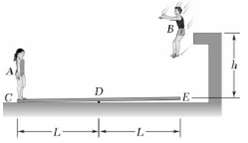
The plank CDE has a weight of 30lb and rests on a small pivot at D. The 110-lb gymnast A is standing on the plank at C when the 140-lb gymnast B jumps from a height of 7.5 ft and strikes the plank at E. Assuming perfectly plastic impact and that gymnast A is standing absolutely straight, determine
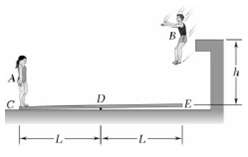
Solve Prob. 17.114 assuming that the gymnasts change places so that gymnast A jumps onto the plank while gymnast B stands at C. Problem 17.114: The plank CDE has a weight of 30 lb and rests on a small pivot at D. The 110-lb gymnast A is standing on the plank at C when the 140-lb gymnast B jumps
The 2.5-kg slender rod AB is released from rest in the position shown and swings to a vertical position where it strikes the 1.5-kg slender rod CD. Knowing that the coefficient of restitution between the knobs K attached to rod AB and rod CD is 0.8 determine the maximum angle θm through which rod
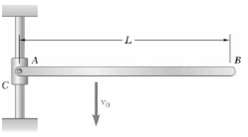
The uniform slender rod AB of mass AB m is attached by a pin to collar C of mass mc and the system is falling freely with a velocity v0 when collar C strikes a horizontal surface as shown. Denoting by e the coefficient of restitution between the collar and the surface, determine (a) The angular
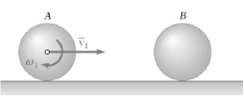
(a) The linear and angular velocities of each sphere immediately after the impact, (b) The velocity of each sphere after it has started rolling uniformly.
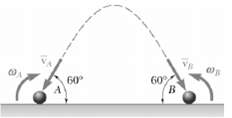
A small rubber ball of radius r is thrown against a rough floor with a velocity vA of magnitude v0 and a backspin ωA of magnitude ω0. It is observed that the ball bounced from A to B, then from B to A, then from A to B, etc. Assuming perfectly elastic impact, determine the required magnitude ω0
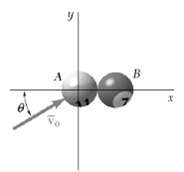
In a game of pool, ball A is rolling without slipping with a velocity v0 as it hits obliquely ball B, which is at rest. Denoting by r the radius of each ball and by μk the coefficient of kinetic friction between the balls and the table surface, and assuming perfectly elastic impact, determine (a)
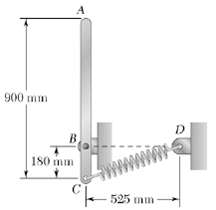
A slender 6-kg rod can rotate in a vertical plane about a pivot at B. A spring of constant k = 600 N/m and an un-stretched length of 225 mm is attached to the rod as shown. Knowing that the rod is released from rest in the position shown, determine its angular velocity after it has rotated through
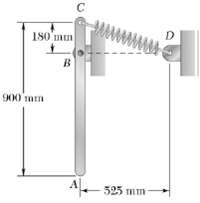
A slender 6-kg rod can rotate in a vertical plane about a pivot at B. A spring of constant k = 600 N/m and an un-stretched length of 225 mm is attached to the rod as shown. Knowing that the rod is released from rest in the position shown, determine its angular velocity after it has rotated through
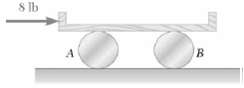
The 18-lb cradle is supported as shown by two uniform disks that roll without sliding at all surfaces of contact. The weight of each disk is W = 12 lb and the radius of each disk is r = 4 in. Knowing that the system is initially at rest, determine the velocity of the cradle after it has moved 15in.
Two uniform rods, each of mass m and length L, are connected to form the linkage shown. End D of rod BD can slide freely in the horizontal slot, while end A of rod AB is supported by a pin and bracket. If end D is moved slightly to the left and then released, determine its velocity (a) When it is
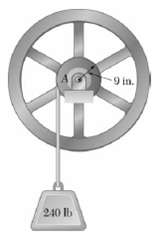
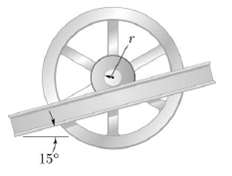
The 700-lb flywheel of a small hoisting engine has a radius of gyration of 24 in. If the power is cut off when the angular velocity of the flywheel is 100 rpm clockwise, determine the time required for the system to come to rest.
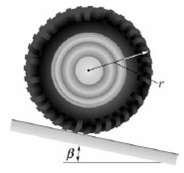
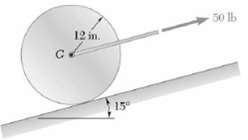
A wheel of radius r and centroidal radius of gyration k is released from rest on the incline shown at time t = 0. Assuming that the wheel rolls without sliding, determine (a) The velocity of its center at time t, (b) The coefficient of static friction required to prevent slipping.
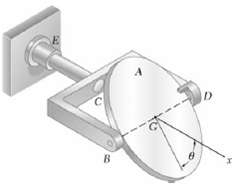
A 1.134-kg disk of radius 100 mm is attached to the yoke BCD by means of short shafts fitted in bearings at B and D. The 0.68-kg yoke has a radius of gyration of 75 mm about the x axis. Initially the assembly is rotating at 120 rpm with the disk in the plane of the yoke (θ = 0). If the disk is
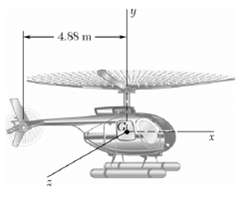
In the helicopter shown, a vertical tail rotor is used to prevent rotation of the cab as the speed of the main blades is changed. Assuming that the tail rotor is not operating, determine the final angular velocity of the cab after the speed of the main blades has been changed from 180 to 240 rpm.
A 40-g bullet is fired with a horizontal velocity of 600 m/s into the lower end of a slender 7-kg bar of length L = 600 mm. Knowing that h = 240 mm and that the bar is initially at rest, determine (a) The angular velocity of the bar immediately after the bullet becomes embedded, (b) The impulsive
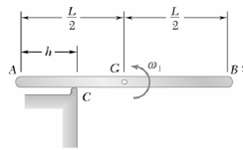
A uniform slender rod AB of mass m and length L strikes a rigid frictionless support at point C with an angular velocity of magnitude ω1 when the velocity of its mass center G is zero. Knowing that the angular velocity of the rod immediately after the impact is ω1/2, counterclockwise, and
A 1.25-oz bullet is fired with a horizontal velocity of 950 ft/s into the 18-lb wooden beam AB. The beam is suspended from a collar of negligible weight that can slide along a horizontal rod. Neglecting friction between the collar and the rod, determine the maximum angle of rotation of the beam
Member ABC has a weight of 5 lb and is attached to a pin support at B. A 1.5-lb sphere D strikes end C of member ABC with a vertical velocity v1 of 9 ft/s. Knowing g that L = 30 in. and that the coefficient of restitution between the sphere and member ABC is 0.5, determine immediately after the
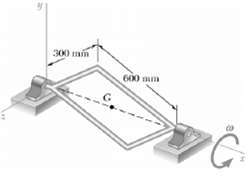
A 5.4-kg slender rod is bent to form a rectangular frame which is attached to a shaft and rotates about its diagonal as shown. Knowing that the assembly has an angular velocity of constant magnitude ω = 10 rad/s, determine the angular momentum HG of the frame about its mass center G.
A thin homogeneous square plate of mass m and side a is welded to a vertical shaft AB with which it forms an angle of 45?. Knowing that the shaft rotates with a constant angular velocity ω, determine the angular momentum HA of the plate about point A.
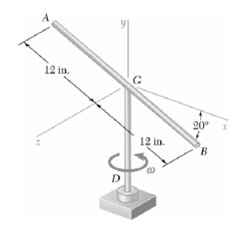
A uniform 3.6-lb rod AB is welded at its midpoint G to a vertical shaft GD. Knowing that the shaft rotates with an angular velocity of constant magnitude ω = 1200 rpm, determine the angular momentum HG of the rod about G.
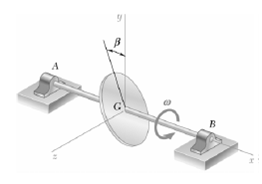
A thin homogeneous disk of mass m and radius r is mounted on the horizontal axle AB. The plane of the disk forms an angle β =20° with the vertical. Knowing that the axle rotates with an angular velocity ω, determine the angle θ formed by the axle and the
A solid rectangular parallelepiped of mass m has a square base of side a and a length 2a. Knowing that it rotates at the constant rate ω about its diagonal AC?? and that its rotation is observed from A as counterclockwise, determine (a) The magnitude of the angular momentum HG of the
Solve Prob. 18.5, assuming that the solid rectangular parallelepiped has been replaced by a hollow one consisting of six thin metal plates welded together. Problem 18.5: A solid rectangular parallelepiped of mass m has a square base of side a and a length 2a. Knowing that it rotates at the constant
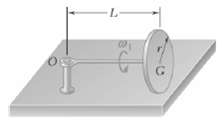
A homogeneous disk of mass m = 8 kg rotates at the constant rate ω1 = 12 rad/s with respect to arm OA, which itself rotates at the constant rate ω2 = 4 rad/s about the y axis. Determine the angular momentum HA of the disk about its center A.
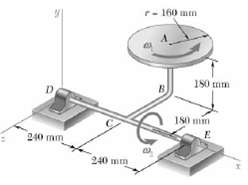
A homogeneous disk of mass m = 6 kg rotates at the constant rate ω1 = 16 rad/s with respect to arm ABC, which is welded to a shaft DCE rotating at the constant rate ω2 = 8 rad/s. Determine the angular momentum HA of the disk about its center A.
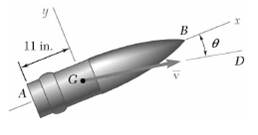
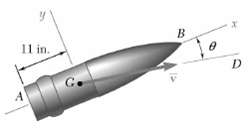
The 60-lb projectile shown has a radius of gyration of 2.4 in. about its axis of symmetry Gx and a radius of gyration of 10 in. about the transverse axis Gy. Its angular velocity ω can be resolved into two components: one component, directed along Gx, measures the rate of spin of the
Determine the angular momentum HA of the projectile of Prob. 18.9 about the center A of its base, knowing that its mass center G has a velocity v of 1950 ft/s. Give your answer in terms of components respectively parallel to the x and y axes shown and to a third axis z pointing toward you.
Determine the angular momentum HO of the disk of Sample Prob. 18.2 from the expressions obtained for its linear momentum mv and its angular momentum HG, using Eqs. (18.11). Verify that the result obtained is the same as that obtained by direct computation.
(a) Show that the angular momentum HB of a rigid body about point HB can be obtained by adding to the angular momentum HA of that body about point A the vector product of the vector rA/B drawn from B to A and the linear momentum mv of the body: HB = HA + rA/B × mv(b) Further show that when a rigid
Determine the angular momentum HO of the disk of Prob. 18.7 about the fixed point O. Problem 18.7: A homogeneous disk of mass m = 8 kg rotates at the constant rate ω1 = 12 rad/s with respect to arm OA, which itself rotates at the constant rate ω2 = 4 rad/s about the y axis. Determine the angular
Determine the angular momentum HD of the disk of Prob. 18.8 about point D. Problem 8.18: A homogeneous disk of mass m = 6 kg rotates at the constant rate ω1 = 16 rad/s with respect to arm ABC, which is welded to a shaft DCE rotating at the constant rate ω2 = 8 rad/s. Determine the angular
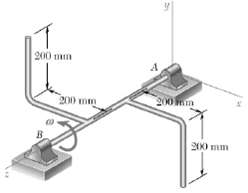
Two L-shaped arms, each of mass 5 kg, are welded at the one-third points of the 600 mm shaft AB to form the assembly shown. Knowing that the assembly rotates at the constant rate of 360 rpm, determine (a) The angular momentum HA of the assembly about point A, (b) The angle formed by HA and AB.
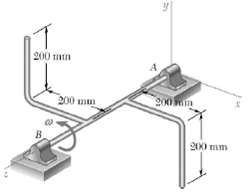
For the assembly of Prob. 18.15, determine (a) The angular momentum HB of the assembly about point B, (b) The angle formed by HB and BA. Problem 18.15: Two L-shaped arms, each of mass 5 kg, are welded at the one-third points of the 600 mm shaft AB to form the assembly shown. Knowing that the
Showing 11600 - 11700
of 18200
First
110
111
112
113
114
115
116
117
118
119
120
121
122
123
124
Last
Step by Step Answers

 Get 50% OFF
Claim Now
Get 50% OFF
Claim Now