New Semester
Started
Get
50% OFF
Study Help!
--h --m --s
Claim Now
Question Answers
Textbooks
Find textbooks, questions and answers
Oops, something went wrong!
Change your search query and then try again
S
Books
FREE
Study Help
Expert Questions
Accounting
General Management
Mathematics
Finance
Organizational Behaviour
Law
Physics
Operating System
Management Leadership
Sociology
Programming
Marketing
Database
Computer Network
Economics
Textbooks Solutions
Accounting
Managerial Accounting
Management Leadership
Cost Accounting
Statistics
Business Law
Corporate Finance
Finance
Economics
Auditing
Tutors
Online Tutors
Find a Tutor
Hire a Tutor
Become a Tutor
AI Tutor
AI Study Planner
NEW
Sell Books
Search
Search
Sign In
Register
study help
physics
electricity and magnetism
Fundamentals of Ethics for Scientists and Engineers 1st Edition Edmund G. Seebauer, Robert L. Barry - Solutions
A charge q1 = 4.0 μC is at the origin, and a charge q2 = 6.0 μC is on the x axis at x = 3.0 m.(a) Find the force on charge q2.(b) Find the force on q1.(c) How would your answers for parts (a) and (b) differ if q2 were –6.0 μC?
Three point charges are on the x axis: q1 = –6.0 μC is at x = –3.0 m, q2 = 4.0 μC is at the origin, and q3 = –6.0 μC is at x = 3.0 m. Find the force on q1.
Two equal charges of 3.0 μC are on the y axis, one at the origin and the other at y = 6 m. A third charge q3 = 2 μC is on the x axis at x = 8 m. Find the force on q3.
Three charges, each of magnitude 3 nC, are at separate corners of a square of side 5 cm. The two charges at opposite corners are positive, and the other charge is negative. Find the force exerted by these charges on a fourth charge q = +3 nC at the remaining corner.
A charge of 5 μC is on the y axis at y = 3 cm, and a second charge of –5 μC is on the y axis at y = –3 cm. Find the force on a charge of 2 μC on the x axis at x = 8 cm
A point charge of –2.5 μC is located at the origin. A second point charge of 6 μC is at x = 1 m, y = 0.5 m. Find the x and y coordinates of the position at which an electron would be in equilibrium.
A charge of –1.0 μC is located at the origin, a second charge of 2.0 μC is located at x = 0, y = 0.1 m, and a third charge of 4.0 μC is located at x = 0.2 m, y = 0. Find the forces that act on each of the three charges.
A charge of 5.0 μC is located at x = 0, y = 0 and a charge Q2 is located at x = 4.0 cm, y = 0. The force on a 2-μC charge at x = 8.0 cm, y = 0 is 19.7 N, pointing in the negative x direction. When this 2-μC charge is positioned at x = 17.75 cm, y = 0, the force on it is zero. Determine the
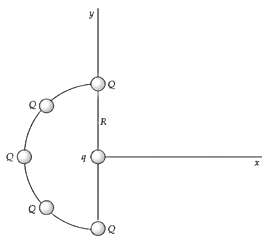
Five equal charges Q are equally spaced on a semicircle of radius R as shown in Figure. Find the force on a charge q located at the center of thesemicircle.
The configuration of the NH3 molecule is approximately that of a regular tetrahedron, with three H+ ions forming the base and an N3– ion at the apex of the tetrahedron. The length of each side is 1.64 × 10⁻¹⁰ m. Calculate the force that acts on each ion.
A charge of 4.0 μC is at the origin. What is the magnitude and direction of the electric field on the x axis at(a) x = 6 m and(b) x = -10 m?(c) Sketch the function Ex versus x for both positive and negative values of x. (Remember that Ex is negative when E points in the negative x direction.)
Two charges, each +4 μC, are on the x axis, one at the origin and the other at x = 8 m. Find the electric field on the x axis at(a) x = –2 m,(b) x = 2 m,(c) x = 6 m, and(d) x = 10 m.(e) At what point on the x axis is the electric field zero?(f) Sketch Ex versus x.
When a test charge q0 = 2 nC is placed at the origin, it experiences a force of 8.0 × 10⁻⁴ N in the positive y direction.(a) What is the electric field at the origin?(b) What would be the force on a charge of –4 nC placed at the origin?(c) If this force is due to a charge on the y axis at y =
An oil drop has a mass of 4 × 10–14 kg and a net charge of 4.8 × 10⁻¹⁹ C. An upward electric force just balances the downward force of gravity so that the oil drop is stationary. What is the direction and magnitude of the electric field?
The electric field near the surface of the earth points downward and has a magnitude of 150 N/C.(a) Compare the upward electric force on an electron with the downward gravitational force.(b) What charge should be placed on a penny of mass 3 g so that the electric force balances the weight of the
Two equal positive charges of magnitude q1 = q2 = 6.0 nC are on the y axis at y1 = +3 cm and y2 = –3 cm.(a) What is the magnitude and direction of the electric field on the x axis at x = 4 cm?(b) What is the force exerted on a third charge q0 = 2 nC when it is placed on the x axis at x = 4 cm?
A point charge of +5.0 μC is located at x = –3.0 cm, and a second point charge of –8.0 μC is located at x = +4.0 cm. Where should a third charge of +6.0 μC be placed so that the electric field at x = 0 is zero?
A point charge of –5 μC is located at x = 4 m, y = –2 m. A second point charge of 12 μC is located at x = 1 m, y = 2 m.(a) Find the magnitude and direction of the electric field at x = –1 m, y = 0.(b) Calculate the magnitude and direction of the force on an electron at x = –1 m, y = 0.
Two equal positive charges q are on the y axis, one at y = a and the other at y = –a.(a) Show that the electric field on the x axis is along the x axis with Ex = 2kqx(x2 + a2)–3/2.(b) Show that near the origin, when x is much smaller than a, Ex is
A 5-μC point charge is located at x = 1 m, y = 3 m, and a –4-μC point charge is located at x = 2 m, y = –2 m.(a) Find the magnitude and direction of the electric field at x = –3 m, y = 1 m.(b) Find the magnitude and direction of the force on a proton at x = –3 m, y = 1 m.
(a) Show that the electric field for the charge distribution in Problem 32 has its greatest magnitude at the points x = a/ √2 and x = a/ √2 by computing dEx/dx and setting the derivative equal to zero.(b) Sketch the function Ex versus x using your results for part (a) of this problem and parts
For the charge distribution in Problem 32, the electric field at the origin is zero. A test charge q0 placed at the origin will therefore be in equilibrium.(a) Discuss the stability of the equilibrium for a positive test charge by considering small displacements from equilibrium along the x axis
Two positive point charges +q are on the y axis at y = +a and y = –a as in Problem 32. A bead of mass m carrying a negative charge –q slides without friction along a thread that runs along the x axis(a) Show that for small displacements of x << a, the bead experiences a restoring force
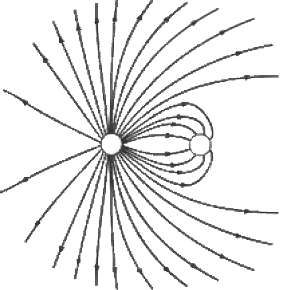
Figure shows the electric field lines for a system of two point charges. (a) What are the relative magnitudes of the charges? (b) What are the signs of the charges? (c) In what regions of space is the electric field strong? In what regions is itweak?
Two charges +4q and –3q are separated by a small distance. Draw the electric field lines for this system.
Two charges +q and –3q are separated by a small distance. Draw the electric field lines for this system.
Three equal positive point charges are situated at the corners of an equilateral triangle. Sketch the electric field lines in the plane of the triangle.
The acceleration of a particle in an electric field depends on the ratio of the charge to the mass of the particle.(a) Compute e/m for an electron.(b) What is the magnitude and direction of the acceleration of an electron in a uniform electric field with a magnitude of 100 N/C?(c) When the
(a) Compute e/m for a proton, and find its acceleration in a uniform electric field with a magnitude of 100 N/C.(b) Find the time it takes for a proton initially at rest in such a field to reach a speed of 0.01c (where c is the speed of light).
An electron has an initial velocity of 2 x 10⁶ m/s in the x direction. It enters a uniform electric field E = (400 N/C)j, which is in the y direction.(a) Find the acceleration of the electron.(b) How long does it take for the electron to travel 10 cm in the x direction in the field?(c) By how much
An electron, starting from rest, is accelerated by a uniform electric field of 8 x 10⁴ N/C that extends over a distance of 5.0 cm. Find the speed of the electron after it leaves the region of uniform electric field.
An electron moves in a circular orbit about a stationary proton. The centripetal force is provided by the electrostatic force of attraction between the proton and the electron. The electron has a kinetic energy of 2.18 x 10⁻¹⁸ J.(a) What is the speed of the electron?(b) What is the radius of the
A mass of 2 g located in a region of uniform electric field E = (300 N/C)i carries a charge Q. The mass, released from rest at x = 0, has a kinetic energy of 0.12 J at x = 0.50 m. Determine the charge Q.
A particle leaves the origin with a speed of 3 x 10⁶ m/s at 35o to the x axis. It moves in a constant electric field E = Ey. Find Ey such that the particle will cross the x axis at x = 1.5 cm if the particle is(a) An electron, and(b) A proton.
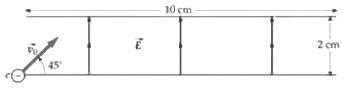
An electron starts at the position shown in figure with an initial speed v0 = 5 x 10⁶ m/s at 45o to the x?axis. The electric field is in the positive y?direction and has a magnitude of 3.5 x 10³ N/C. On which plate and at what location will the electron strike?
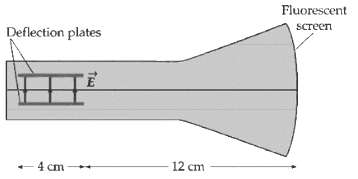
An electron with kinetic energy of 2 x 10?16 J is moving to the right along the axis of a cathode-ray tube as shown in Figure. There is an electric field E?= (2 x 10⁴ N/C)j?in the region between the deflection plates. Everywhere else, E?= 0. (a) How far is the electron from the axis of the tube
Two point charges, q1 = 2.0pC and q2 = –2.0pC, are separated by 4 μm.(a) What is the dipole moment of this pair of charges?(b) Sketch the pair, and show the direction of the dipole moment.
A dipole of moment 0.5 e∙nm is placed in a uniform electric field with a magnitude of 4.0 x 10⁴ N/C. What is the magnitude of the torque on the dipole when(a) The dipole is parallel to the electric field,(b) The dipole is perpendicular to the electric field, and(c) The dipole makes an angle of
For a dipole oriented along the x axis, the electric field falls off as 1/x3 in the x direction and 1/y3 in the y direction. Use dimensional analysis to prove that, in any direction, the field far from the dipole falls off as 1/r3.
A water molecule has its oxygen atom at the origin, one hydrogen nucleus at x = 0.077 nm, y = 0.058 nm and the other hydrogen nucleus at x = –0.077 nm, y = 0.058 nm. If the hydrogen electrons are transferred completely to the oxygen atom so that it has a charge of –2e, what is the dipole moment
An electric dipole consists of two charges +q and –q separated by a very small distance 2a. Its center is on the x axis at x = x1, and it points along the x axis in the positive x direction. The dipole is in a nonuniform electric field, which is also in the x direction, given by
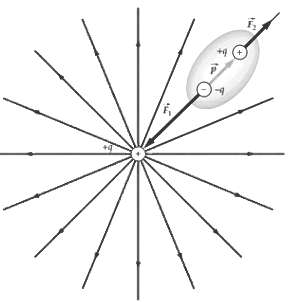
A positive point charge +Q?is at the origin, and a dipole of moment p?is a distance r?away and in the radial direction as in Figure. (a) Show that the force exerted by the electric field of the point charge on the dipole is attractive and has a magnitude of approximately 2kQp/r3 (see Problem
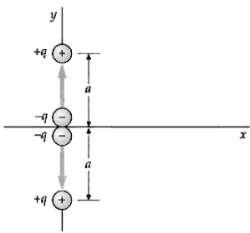
A quadrupole consists of two dipoles that are close together, as shown in Figure. The effective charge at the origin is ?2q?and the other charges on the y?axis at y?= a?and y?= ?a?are each +q. (a) Find the electric field at a point on the x?axis far away so that x?>> a.? (b) Find the electric
A molecule with electric dipole moment p is oriented so that p makes an angle θ with a uniform electric field E. The dipole is free to move in response to the force from the field. Describe the motion of the dipole. Suppose the electric field is nonuniform and is larger in the x direction. How
Two metal balls have charges +q and –q. How will the force on one of them change if?(a) The balls are placed in water, the distance between them being unchanged, and(b) A third uncharged metal ball is placed between the first two? Explain.
In interstellar space, two charged point-like objects, each of mass m and charge q, are separated by a distance d and released. They remain motionless at that separation. Find an expression for q in terms of m, G, and k.
Point charges of –5.0μC, +3.0μC, and +5.0μC are located along the x axis at x = –1.0 cm, x = 0, and x = +1.0 cm, respectively. Calculate the electric field at x = 3.0 cm and at x = 15.0 cm. Is there some point on the x axis where the magnitude of the electric field is zero? Locate that point.
For the charge distribution of Problem 67, find the electric field at x = 15.0 cm as the vector sum of the electric field due to a dipole formed by the two 5.0-μC charges and a point charge of 3.0μC, both located at the origin. Compare your result with the result obtained in Problem 67 and
In copper, about one electron per atom is free to move about. A copper penny has a mass of 3 g.(a) What percentage of the free charge would have to be removed to give the penny a charge of 15 μC?(b) What would be the force of repulsion between two pennies carrying this charge if they were 25 cm
Two charges q1 and q2 have a total charge of 6μC. When they are separated by 3 m, the force exerted by one charge on the other has a magnitude of 8mN. Find q1 and q2 if(a) Both are positive so that they repel each other, and(b) One is positive and the other is negative so that they attract each
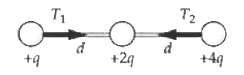
Three charges, +q, +2q, and +4q,?are connected by strings as shown in figure. Find the tensions T1 and T2.
A positive charge Q is to be divided into two positive charges q1 and q2. Show that, for a given separation D, the force exerted by one charge on the other is greatest if q1 = q2 = ½ Q.
A charge Q is located at x = 0 and a charge 4Q is at x = 12.0 cm. The force on a charge of –2μC is zero if that charge is placed at x = 4.0 cm and is 126.4 N in the positive x direction if placed at x = 8.0 cm. Determine the charge Q.
Two small spheres (point charges) separated by 0.60 m carry a total charge of 200μC.(a) If the two spheres repel each other with a force of 80 N, what are the charges on each of the two spheres?(b) If the two spheres attract each other with a force of 80 N what are the charges on the two spheres?
A ball of known charge q and unknown mass m, initially at rest, falls freely from a height h in a uniform electric field E that is directed vertically downward. The ball hits the ground at a speed v = 2√gh. Find m in terms of E, q, and g.
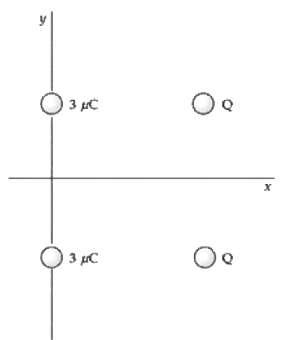
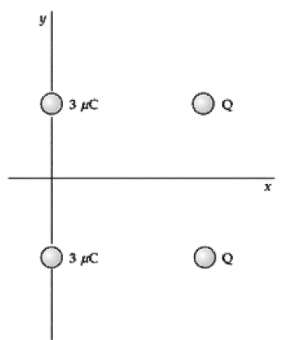
Charges of 3.0?C are located at x?= 0, y?= 2.0 m and at x?= 0, y?= ?2.0 m. Charges Q?are located at x?= 4.0 m, y?= 2.0 m and at x?= 4.0 m, y?= ?2.0 m (Figure). The electric field at x?= 0, y?= 0 is (4.0 x 10³ N/C)i. Determine Q.
Two identical small spherical conductors (point charges), separated by 0.60 m, carry a total charge of 200μC. They repel one another with a force of 120 N.(a) Find the charge on each sphere.(b) The two spheres are placed in electrical contact and then separated so that each carries 100μC.
Repeat Problem 77 if the two spheres initially attract one another with a force of 120 N.
A charge of –3.0μC is located at the origin; a charge of 4.0μC is located at x = 0.2 m, y = 0; a third charge Q is located at x = 0.32 m, y = 0. The force on the 4.0-μC charge is 240 N, directed in the positive x direction.(a) Determine the charge Q.(b) With this
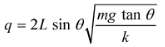
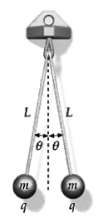
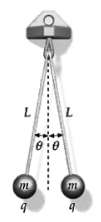
Two small spheres of mass m are suspended from a common point by threads of length L. When each sphere carries a charge q, each thread makes an angle ? with the vertical as shown in Figure. (a) Show that the charge q is given by where k is the Coulomb constant. (b) Find q?if m?= 10 g, L?= 50 cm,
(a) Suppose that in Problem 80, L = 1.5 m, m = 0.01 kg, and q = 0.75μC. What is the angle that each string makes with the vertical?(b) Find the angle that each string makes with the vertical if one mass carries a charge of 0.50μC, the other a charge of 1.0μC.
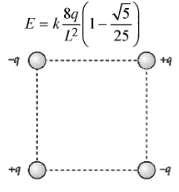
Four charges of equal magnitude are arranged at the corners of a square of side L as shown in figure. (a) Find the magnitude and direction of the force exerted on the charge in the lower left corner by the other charges. (b) Show that the electric field at the midpoint of one of the sides of the
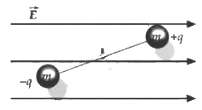
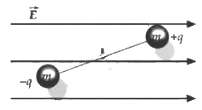
Figure shows a dumbbell consisting of two identical masses m?attached to the ends of a thin (massless) rod of length a?that is pivoted at its center. The masses carry charges of +q?and ?q?and the system is located in a uniform electric field E. Show that for small values of the angle ??between the
For the dumbbell in Figure let m?= 0.02 kg, a?= 0.3 m, and E?= (600 N/C)i. Initially the dumbbell is at rest and makes an angle of 60o with the x?axis. The dumbbell is then released, and when it is momentarily aligned with the electric field, its kinetic energy is 5 x 10?3 J. Determine the
An electron (charge –e, mass m) and a positron (charge +e, mass m) revolve around their common center of mass under the influence of their attractive coulomb force. Find the speed of each particle v in terms of e, m, k, and their separation r.
The equilibrium separation between the nuclei of the ionic molecule KBr is 0.282 nm. The masses of the two ions, K+ and Br –, are very nearly the same, 1.4 x 10⁻²⁵ kg, and each of the two ions carries a charge of magnitude e. Use the result of Problem 83 to determine the frequency of
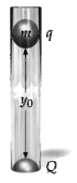
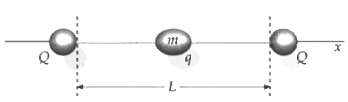
A small (point) mass m, which carries a charge q, is constrained to move vertically inside a narrow, frictionless cylinder (Figure). At the bottom of the cylinder is a point mass of charge Q having the same sign as q. (a) Show that the mass m?will be in equilibrium at a height y0 = (kqQ/mg)1/2. (b)
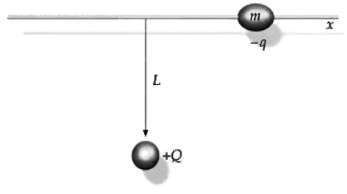
A small bead of mass m?and carrying a negative charge ?q?is constrained to move along a thin frictionless rod (Figure). A distance L?from this rod is a positive charge Q. Show that if the bead is displaced a distance x, where x?L, and released, it will exhibit simple harmonic motion. Obtain an
Repeat Problem 81 with the system located in a uniform electric field of 1.0 x 10⁵ N/C that points vertically downward.
Suppose that the two masses in Problem 80 are not equal. One mass is 0.01 kg, the other is 0.02 kg. The charges on the two masses are 2.0?C and 1.0?C, respectively. Determine the angle that each of the strings supporting the masses makes with the vertical.
A simple pendulum of length L = 1.0 m and mass M = 5.0 x 10⁻³ kg is placed in a uniform, vertically directed electric field E. The bob carries a charge of –8.0μC. The period of the pendulum is 1.2s. What is the magnitude and direction of E?
Two neutral polar molecules attract each other. Suppose that each molecule has a dipole moment p and that these dipoles are aligned along the x axis and separated by a distance d. Derive an expression for the force of attraction in terms of p and d.
A small bead of mass m, carrying a charge q, is constrained to slide along a thin rod of length L. Charges Q?are fixed at each end of the rod (Figure). (a) Obtain an expression for the electric field due to the two charges Q?as a function of x, where x?is the distance from the midpoint of the
Two equal positive charges Q are on the x axis at x = ½ L and x = ½ L.(a) Obtain an expression for the electric field as a function of y on the y axis.(b) A ring of mass m, which carries a charge q, moves on a thin frictionless rod along the y axis. Find the
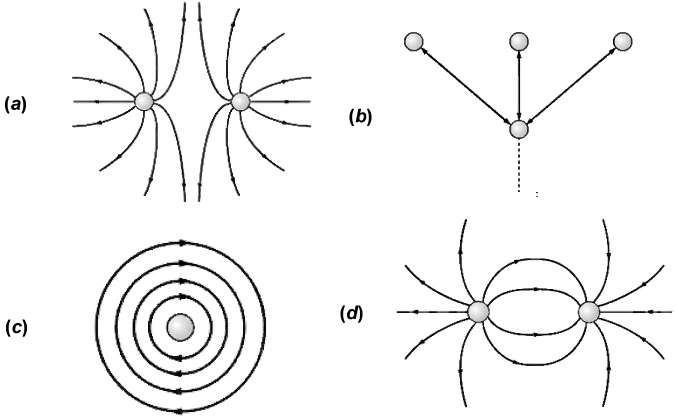
(Multiple choice) (1) Which of the following statements about Electric field lines is (are) not true?? (a) The number of lines leaving a positive charge or entering a negative charge is proportional to the charge.? (b) The lines begin on positive charges and end on negative charges.? (c) The
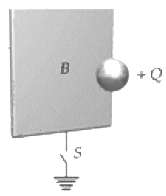
(Multiple choice) (1) A metal rectangle B is connected to ground through a switch S that is initially closed (Figure) While the charge +Q is near B, switch S is opened. The charge +Q is then removed. Afterward, what is the charge state of the metal rectangle B? (a) It is positively charged. (b) It
Two infinite vertical planes of charge are parallel to each other and are separated by a distance d = 4 m. Find the electric field to the left of the planes, to the right of the planes, and between the planes(a) When each plane has a uniform surface charge density σ = +3 μC/m2 and(b) When
A uniform line charge of linear charge density λ= 3.5 nC/m extends from x = 0 to x = 5 m.(a) What is the total charge? Find the electric field on the x axis at(b) x = 6 m,(c) x = 9 m, and(d) x = 250 m.(e) Find the field at x = 250 m, using the approximation that the charge is a point charge at the
A 2.75-μC charge is uniformly distributed on a ring of radius 8.5 cm. Find the electric field on the axis at(a) 1.2 cm,(b) 3.6 cm, and(c) 4.0 m from the center of the ring(d) Find the field at 4.0 m using the approximation that the ring is a point charge at the origin, and compare your results
A disk of radius 2.5 cm carries a uniform surface charge density of 3.6 μC/m2. Using reasonable approximations, find the electric field on the axis at distances of(a) 0.01 cm,(b) 0.04 cm,(c) 5 m, and(d) 5 cm.
For the disk charge of Problem 4, calculate exactly the electric field on the axis at distances of(a) 0.04 cm and(b) 5 m, and compare your results with those for parts (b) and (c) of Problem 4.
A uniform line charge extends from x = –2.5 cm to x = +2.5 cm and has a linear charge density of λ = 6.0 nC/m(a) Find the total charge. Find the electric field on the y axis at(b) y = 4 cm,(c) y = 12 cm, and(d) y = 4.5 m.(e) Find the field at y = 4.5 m, assuming the charge to be a point charge,
A disk of radius a lies in the yz plane with its axis along the x axis and carries a uniform surface charge density σ. Find the value of x for which Ex = ½σ/2є0.
A ring of radius a with its center at the origin and its axis along the x axis carries a total charge Q. Find Ex at(a) x = 0.2a,(b) x = 0.5a,(c) x = 0.7a,(d) x = a, and(e) x = 2a.(f) Use your results to plot Ex versus x for both positive and negative values of x.
Repeat Problem 8 for a disk of uniform surface charge density s.
A disk of radius 30 cm carries a uniform charge density ?. (a) Compare the approximation E?= 2?k??with the exact expression (Equation 23-11) for the electric field on the axis of the disk by computing the fractional difference ?E/E?? x/??x2+R2 for the distances x = 0.1, x = 0.2, and x = 3 cm. (b)
Show that Ex on the axis of a ring charge of radius a has its maximum and minimum values at x = +a/√2 and x = –a/√2 . Sketch Ex versus x for both positive and negative values of x.
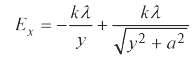
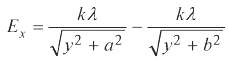
A line charge of uniform linear charge density ? lies along the x axis from x = 0 to x = a.? (a) Show that the x component of the electric field at a point on the y axis is given by (b) Show that if the line charge extends from x?= ?b?to x?= a, the x?component of the electric field at a point on
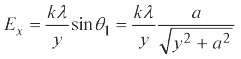
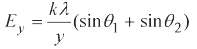
(a) A finite line charge of uniform linear charge density ? lies on the x axis from x = 0 to x = a. Show that the y component of the electric field at a point on the y axis is given by Where ?1 is the angle subtended by the line charge at the field point. (b) Show that if the line charge extends
A semicircular ring of radius R carries a uniform line charge of λ. Find the electric field at the center of the semicircle.
A hemispherical thin shell of radius R carries a uniform surface charge σ. Find the electric field at the center of the hemispherical shell (r = 0).
A line charge of linear charge density λ with the shape of a square of side L lies in the yz plane with its center at the origin. Find the electric field on the x axis at an arbitrary distance x, and compare your result to that for the field on the axis of a charged ring of radius r = ½L with its
Consider a uniform electric field E = 2 kN/C i.(a) What is the flux of this field through a square of side 10 cm in a plane parallel to the yz plane?(b) What is the flux through the same square if the normal to its plane makes a 30o angle with the x axis?
A single point charge q = +2 μC is at the origin. A spherical surface of radius 3.0 m has its center on the x axis at x = 5 m.(a) Sketch electric field lines for the point charge. Do any lines enter the spherical surface?(b) What is the net number of lines that cross the spherical surface,
An electric field is E = 300 N/C i for x > 0 and E = –300 N/C i for x < 0. A cylinder of length 20 cm and radius 4 cm has its center at the origin and its axis along the x axis such that one end is at x = +10 cm and the other is at x = –10 cm.(a) What is the flux through each end?(b) What
A positive point charge q is at the center of a cube of side L. A large number N of electric field lines are drawn from the point charge.(a) How many of the field lines pass through the surface of the cube?(b) How many lines pass through each face, assuming that none pass through the edges or
Careful measurement of the electric field at the surface of a black box indicates that the net outward flux through the surface of the box is 6.0 kN·m2/C.(a) What is the net charge inside the box?(b) If the net outward flux through the surface of the box were zero, could you conclude that there
A point charge q = +2 μC is at the center of a sphere of radius 0.5 m.(a) Find the surface area of the sphere.(b) Find the magnitude of the electric field at points on the surface of the sphere.(c) What is the flux of the electric field due to the point charge through the surface of the sphere?(d)
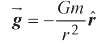
Since Newton's law of gravity and Coulomb's law have the same inverse-square dependence on distance, an expression analogous in form to Gauss's law can be found for gravity. The gravitational field g is the force per unit mass on a test mass m0. Then for a point mass m at the origin, the
A charge of 2 μC is 20 cm above the center of a square of side length 40 cm. Find the flux through the square.
Showing 4200 - 4300
of 8940
First
36
37
38
39
40
41
42
43
44
45
46
47
48
49
50
Last
Step by Step Answers

 Get 50% OFF
Claim Now
Get 50% OFF
Claim Now