New Semester
Started
Get
50% OFF
Study Help!
--h --m --s
Claim Now
Question Answers
Textbooks
Find textbooks, questions and answers
Oops, something went wrong!
Change your search query and then try again
S
Books
FREE
Study Help
Expert Questions
Accounting
General Management
Mathematics
Finance
Organizational Behaviour
Law
Physics
Operating System
Management Leadership
Sociology
Programming
Marketing
Database
Computer Network
Economics
Textbooks Solutions
Accounting
Managerial Accounting
Management Leadership
Cost Accounting
Statistics
Business Law
Corporate Finance
Finance
Economics
Auditing
Tutors
Online Tutors
Find a Tutor
Hire a Tutor
Become a Tutor
AI Tutor
AI Study Planner
NEW
Sell Books
Search
Search
Sign In
Register
study help
physics
electricity and magnetism
Fundamentals of Physics 8th Extended edition Jearl Walker, Halliday Resnick - Solutions
In a Millikan oil-drop experiment a uniform electric fleld of 1.92 x 10⁵ N/C is maintained in the region between two plates separated by 1.50 cm. Find the potential difference between the plates.
Consider a point charge q = 1.50 x 10⁻⁸ C, and take V = 0 at infinity.(a) What are the shape and dimensions of an equipotential surface having a potential of 30.0 V due to q alone?(b) Are surfaces whose potentials differ by a constant amount (1.0 V says) evenly spaced?
In the quark model of fundamental particles, a proton is composed of three quarks: two "up" quarks, each having charge + 2e/3, and one "down" quark, having charge – e/3. Suppose that the three quarks are equidistant from one another. Take that separation distance to be 1.32 x 10¹⁵ m and calculate
(a) A proton of kinetic energy 4.80MeV travels head-on toward a lead nucleus. Assuming that the proton does not penetrate the nucleus and that the only force between proton and nucleus is the Coulomb force, calculate the smallest center-to-center separation de between proton and nucleus when the
(a) Using Eq. 24-32, show that the electric potential at a point on the central axis of a thin ring (of charge q and radius R) and at distance e from the ring is V = 1/4πε0 q/√z2 + R2 (b) From this result, derive an expression for E at points on the ring's axis; compare your result with
What is the electric potential energy of the charge configuration of Figure a? Use the numerical values provided in Sample Problem 24-3.
A solid copper sphere whose radius is 1.0 cm has a very thin surface coating of nickel. Some of the nickel atoms are radioactive, each atom emitting an electron as it decays. Half of these electrons enter the copper sphere, each depositing 100keV of energy there. The other half of the electrons
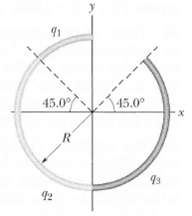
Figure shows three circular, non-conducting arcs of radius R = 8.50 cm. The charges on the arcs are q1 = 4.52μC, q2 = ?? 2.00q1, q3 = +3.00q1. With V = 0 at infinity, what is the net electric potential of the arcs at the common center of curvature?
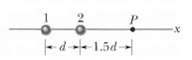
In Figure two particles of charges q1 and q2 are fixed to an x axis. If a third particle, of charge + 6.0μC, is brought from an infinite distance to point P, the three-particle system has the same electric potential energy as the original two-particle system. What is the charge ratio q1/q2?
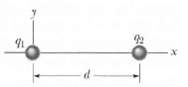
In Figure let the separation d between the particles be 1.0 m; let their charges be q1 = + q and q2 = + 2.0q; and let V = 0 at infinity. At what finite coordinate on the x axis is? (a) The net electric potential due to the two particles zero and (b) The net electric field due to them zero?
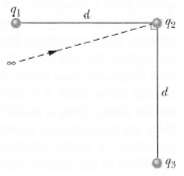
In Figure, a particle of charge q2 = +l5e is brought along the dashed line from infinity to the indicated point near two fixed particles of charges q1 = +2e and q3 = - q1. What is the ratio of the potential energy of this three-particle system to that of the original two-particle system?
In a certain situation, the electric potential varies along an x axis as shown in Figure. The scale of the vertical axis is set by Vs = 12.0 V. For the intervals(a) ab,(b) bc(c) cd,(d) de,(e) ef,(f) fg and(g) gh determine the r component of the electric field, and then plot, E, versus x(Ignore
A disk has radius R = 2.20 cm. Its surface charge density is 1.50 x 10⁻⁶ C/m2 from r = 0 to r = R/2 and 8.00 x 10⁻⁷ C/m2 from r = R/2 to r = R.(a) What is the total charge on the disk?(b) With V = 0 at infinity, what is the electric potential at a point on the perpendicular central axis of the
In Figure particle 1 of charge q1 = + e and particle 2 of charge q2 = – 5e are fixed on an x axis. Distance d = 5.60pm. What is the electric potential difference VA – VB?
Point charges of equal magnitudes (25nC) and opposite signs are placed on diagonally opposite corners of a 60 cm x 80 cm rectangle. Point A is the unoccupied corner nearest the positive charge, and point B is the other unoccupied corner. Determine the potential difference VB – VA.
A decade before Einstein published his theory of relativity, J. J. Thomson proposed that the electron might consist of small parts and attributed the electron's mass m to the electric potential energy of the interaction of the parts. Furthermore, he suggested that the energy equals mc2, where c is
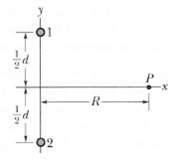
Figure shows three charged particles located on a horizontal axis. For points (such as P) on the axis with r >> d, show that the electric potential V(r) is given by
A point charge q1 = + 6.0e is fixed at the origin of a rectangular coordinate system, and a point charge q2 = – 10e is fixed at x = 8.6nm, y = 0. The locus of all points in the xy plane for which V = 0 (other than infinity) is a circle centered on the x axis, as shown in Figure Find(a) The
Charge q1 = – 7.2 x 10⁻⁹ C is at the origin, and charge q2 = 2.5 x 10⁻⁹ C is on the y axis at y = 0.50 m. Take the electric potential to be zero far from both charges.(a) Plot the intersection of the V = 5.0 V equipotential surface with the xy plane. It encloses one of the charges.(b) There are
In Figure three long parallel lines of charge, with the linear charge densities shown, extend perpendicular to the page in both directions. Sketch some electric field lines; also sketch the cross sections in the plane of the figure of some equipotential surfaces.
Two infinite lines of charge are parallel to and in the same plane as a z axis. One, of charge per unit length + λ, is a distance a to the right of this axis. The other, of charge per unit length – λ, is a distance a to the left of this axis. Sketch some of the equipotential surfaces due to
In a 1911, Ernest Rutherford modeled an atom as being a point of positive charge Ze surrounded by a negative charge - Ze uniformly distributed in a sphere of radius R centered on the point. At distance r within the sphere, the electric fleld is E = Ze/4πε0 (1/r2 – r(R3). He also gave the
At a certain location in the Philippines, Earth's magnetic field of 39μT is horizontal and directed due north. Suppose the net field is zero exactly 8.0 cm above a long, straight, horizontal wire that carries a constant current. What are the(a) Magnitude and(b) Direction of the current?
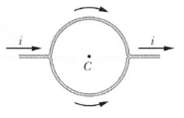
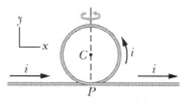
A straight conductor carrying current i = 5.0 A splits into identical semicircular arcs as shown in Figure. What is the magnetic field at the center C of the resulting circular loop?
A surveyor is using a magnetic compass 6.1 m below a power line in which there is a steady current of 100 A.(a) What is the magnetic field at the site of the compass due to the power line?(b) Will this field interfere seriously with the compass reading? The horizontal component of Earth's magnetic
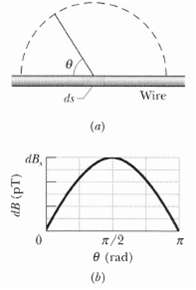
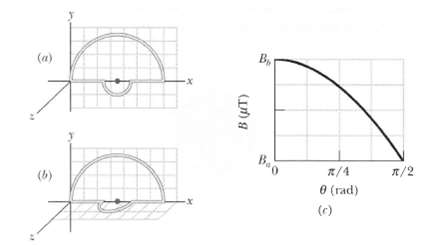
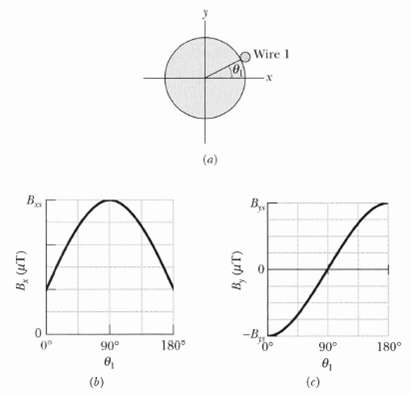
Figure a shows an element of length d s = 1.00μm in a very long straight wire carrying current. The current in that element sets up a differential magnetic field dB at points in the surrounding space. Figure b gives the magnitude dB of the field for points 2.5 cm from the element, as a function of
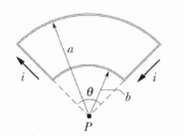
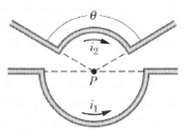
In Figure two circular arcs have radii a = 13.5 cm and b = 10.7 cm, subtend angle θ = 74.0?, carry current i = 0.411 A, and share the same center of curvature P. What are the (a) Magnitude and (b) Direction (into or out of the page) of the net magnetic field at P?
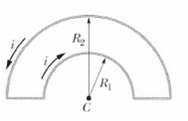
In Figure two semicircular arcs have radii R2 = 7.80 cm and R1 = 3.15 cm, carry current i = 0.281 A, and share the same center of curvature C. What are the (a) Magnitude and (b) Direction (into or out of the page) of the net magnetic field at C?
Two long straight wires are parallel and 8.0 cm apart. They are to carry equal currents such that the magnetic field at a point halfway between them has magnitude 300μT.(a) Should the currents be in the same or opposite directions?(b) How much current is needed?
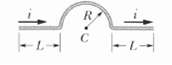
In Figure a wire forms a semicircle of radius R = 9.26 cm and two (radial) straight segments each of length L = 13.1 cm. The wire carries current i = 34.8 mA. What are the (a) Magnitude and (b) Direction (into or out of the page) of the net magnetic field at the semicircle's center of curvature C?
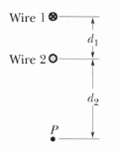
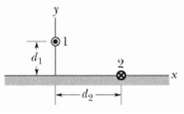
In Figure two long straight wires are perpendicular to the page and separated by distance d1 = 0.75 cm. Wire 1 carries 6.5 A into the page. What are the (a) Magnitude and (b) Direction (into or out of the page) of the current in wire 2 if the net magnetic field due to the two currents is zero at
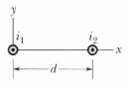
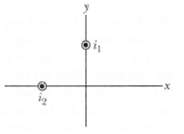
In Figure two long straight wires at separation d = 16.0 cm carry currents i1 = 3.61 mA and i2 = 3.00i1 out of the page. (a) At what point on the x axis shown is the net magnetic field due to the currents equal to zero? (b) If the two currents are doubled, is the point of zero magnetic fields
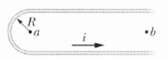
In Figure, a current i = 10 A is set up in a long hairpin conductor formed by bending a wire into a semicircle of radius R = 5.0 mm. Point b is midway between the straight sections and so distant from the semicircle that each straight section can be approximated as being an infinite wire. What are
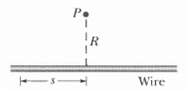
In Figure point P is at perpendicular distance R = 2.00 cm from a very long straight wire carrying a current. The magnetic field B set up at point P is due to contributions from all the identical current-length elements i d s along the wire. What is the distance s to the element making? (a) The
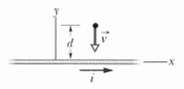
Figure shows a proton moving at velocity v = (-200 m/s) j toward a long straight wire with current i = 350 mA. At the instant shown, the proton's distance from the wire is d = 2.89 cm. In unit-vector notation, what is the magnetic force on the proton due to the current?
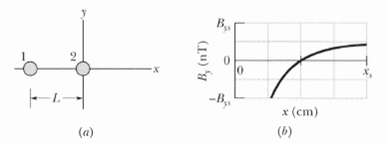
Figure ??a?? shows in cross section, two long, parallel wires carrying current and separated by distance L. The ratio i1/i2 of their currents is 4.00; the directions of the currents are not indicated. Figure ??b?? shows the y component B, of their net magnetic field along the x axis to the right of
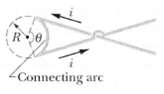
A wire with current i = 3.00 A is shown in Figure. Two semi-infinite straight sections, both tangents to the same circle, are connected by a circular arc that has a central angle θ and runs along the circumference of the circle. The arc and the two straight sections all lie in the same plane. If B
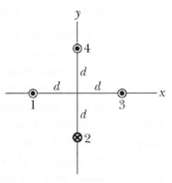
Figure shows, in cross section, four thin wires that are parallel, straight, and very long. They carry identical currents in the direction indicated. Initially all the four wires are at distance d = 15.0 cm from the origin of the coordinate system, where they create a net magnetic field B. (a) To
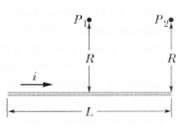
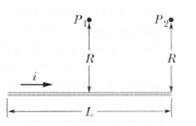
In Figure, point P1 is at distance R = 13.1 cm on the perpendicular bisector of a straight wire of length L = 18.0 cm carrying current i = 58.0mA. (Note that the wirer is not long). What is the magnitude of the magnetic field at P1 due toi?
Equation 29-4 gives the magnitude B of the magnetic field set up by a current in an infinitely long straight wire, at a point P at perpendicular distance R from the wire. Suppose that point P is actually at perpendicular distance R from the midpoint of a wire with a finite length L. Using Eq.29-4
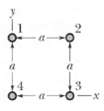
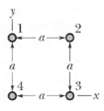
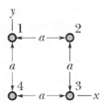
In Figure four long straight wires are perpendicular to the page, and their cross sections form a square of edge length a = 20 cm. The currents are out of the page in wires 1 and 4 and into the page in wires 2 and 3, and each wire carries 20 A. In unit-vector notation, what is the net magnetic
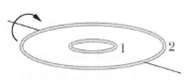
In Figure two concentric circular loops of wire carrying current in the same direction lie in the same plane. Loop 1 has radius 1.50 cm and carries 4.00 mA. Loop 2 has radius 2.50 cm and carries 6.00 mA. Loop 2 is to be rotated about a diameter while the net magnetic field B set up by the two loops
In Figure point P2 is at perpendicular distance R = 25.1cm from one end of straight wire of length L = 13.6 cm carrying current i = 0.693 A. (Note that the wire is not long.) What is the magnitude of the magnetic field at P2?
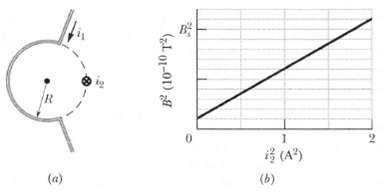
In Figure ??a?? wire 1 consists of a circular arc and two radial lengths; it carries current i1 = 0.50 A in the direction indicated. Wire 2, shown in cross section, is long, straight, and perpendicular to the plane of the figure. Its distance from the center of the arc is equal to the radius R of
Figure shows two current segments. The lower segment carries current i1 = 0.40 A and includes a circular arc with radius 5.0 cm, angle 180?, and center point P. The upper segment carries current i2 = 2i1 and includes a circular arc with radius 4.0 cm, angle 120?, and the same center point P. What
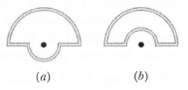
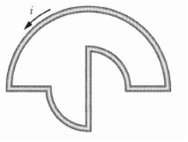
A current is set up in a wire loop consisting of a semicircle of radius 4.00cm, a smaller concentric semicircle and two radial straight lengths all in the same plane. Figure ??a?? shows the arrangement but is not drawn to scale. The magnitude of the magnetic field produced at the center of
In Figure two long straight wires (shown in cross section) carry currents i1 = 30.0 mA and i2 = 40.0 mA directly out of the page. They are equal distances from the origin, where they set up a magnetic field B. To what value must current i1 be changed in order to rotate B 20.0? clock wise?
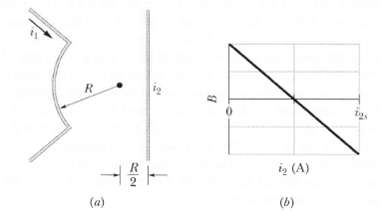
Figure ??a?? shows two wires, each carrying a current. Wire 1 consists of a circular arc of radius R and two radial lengths; it carries current i1 = 2.0 A in the direction indicated. Wire 2 is long and straight; it carries a current i2 that can be varied; and it is at distance R/2 from the center
One long wire lies along an x axis and carries a current of 30 A in the positive x direction. A second long wire is perpendicular to the xy plane, passes through the point (0, 4.0 m, 0) and carries a current of 40 A in the positive z direction. What is the magnitude of the resulting magnetic field
In Figure part of a long insulated wire carrying current r = 5.78 mA is bent into a circular section of radius R = 1.89 cm. In unit-vector notation, what is the magnetic field at the center of curvature C it the circular section (a) Lies in the plane of the page as shown and (b) Is perpendicular to
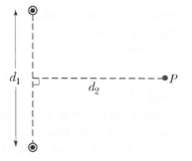
Figure shows two very long straight wires (in cross section) that each carry a current of 4.00 A directly out of the page. Distance d1 = 6.00 m and distance d2 = 4.00 m. What is the magnitude of the net magnetic field at point P, which lies on a perpendicular bisector to the wires?
The current-carrying wire loop in Figure ??a?? lies all in one plane and consists of a semicircle of radius 10.0 cm, a smaller semicircle with the same center, and two radial lengths. The smaller semicircle is rotated out of that plane by angle θ, until it is perpendicular to the plane (Figure b).
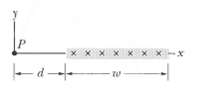
Figure shows a cross section of a long thin ribbon of width w = 491 cm that is carrying a uniformly distributed total current i = 4.67μA into the page. In unit-vector notation, what is the magnetic field B at a point P in the plane of the ribbon at a distance d = 2.16 cm from its edge?
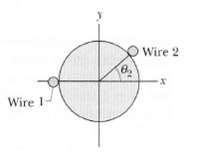
Figure shows, in cross section, two long straight wires held against a plastic cylinder of radius 20.0 cm. Wire 1 carries current i1 = 60.0 mA out of the page and is fixed in place a 2 carries current i1 = 40.0 mA out of the page and can be moved around the cylinder. At what (positive) angle θ2
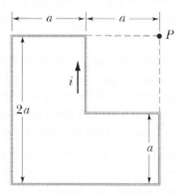
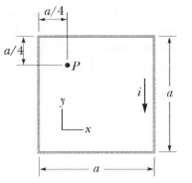
In Figure, length a is 4.7 cm (short) and current i is 13 A. What are the (a) Magnitude and (b) Direction (into or out of the page) of the magnetic field at point P?
Two long straight thin wires with current lie against an equally long plastic cylinder, at radius R = 20.0 cm from the cylinder's central axis. Figure ??a?? shows, in cross section, the cylinder and wire 1 but not wire 2. With wire 2 fixed in place, wire 1 is moved around the cylinder, from angle
Figure shows wire 1 in cross section; the wire is long and straight, carries a current of 4.00 mA out of the page, and is at distance d1 = 2.40 cm from a surface. Wire 2, which is parallel to wire 1 and also long, is at horizontal distance d2 = 5.00 cm from wire 1 and carries a current of 6.80 mA
In Figure four long straight wires are perpendicular to the page, and their cross sections form a square of edge length a = 8.50 cm. Each wire carries 15.0 A, and all the currents are out of the page. In unit-vector notation, what is the net magnetic force per meter of wire length on wire 1?
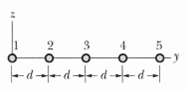
In Figure five long parallel wires in a xy plane are separated by distance d = 50.0 cm. The currents into the page are i1 = 2.00 A, i3 = 0.250 A, i4 = 4.00 A, and i5 = 2.00 A; the current out of the page is i2 = 4.00 A. What is the magnitude of the net force per unit length acting on the other
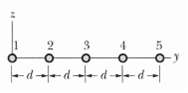
In Figure five long parallel wires in a xy plane are separated by distance d = 8.00 cm, have lengths of 10.0 m, and carry identical currents of 3.00 A out of the page. Each wire experiences a magnetic force due to the other wires. In unit vector notation, what is the net magnetic force on (a) Wire
In Figure four long straight wires are perpendicular to the page, and their cross sections form a square of edge length a = 13.5 cm. Each wire carries 7.50 A, and the currents are out of the page in wires 1 and 4 and into the page in wires 2 and 3. In unit-vector notation, what is the net magnetic
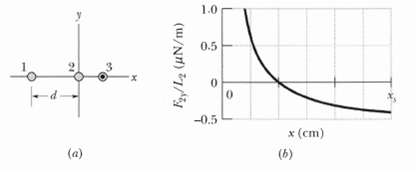
Figure ??a?? shows, in cross section, three current carrying wires that are long, straight, and parallel to one another. Wires 1 and 2 are fixed in place on an x axis, with separation d. Wire t has a current of 0.750 A, but the direction of the current is not given. Wire 3, with a current of 0.250
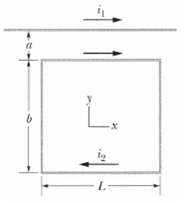
In Figure a long straight wire carries a current i1 = 30.0A and a rectangular loop carries current i2 = 20.0 A. Take a = 1.00 cm, b = 8.00 cm, and L = 30.0 cm. In unit vector notation, what is the net force on the loop due toi 1?
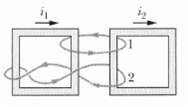
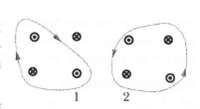
Figure shows two closed paths wrapped around two conducting loops carrying currents i1 = 5.0 A and i2 = 3.0 A. What is the value of the integral ф B ?? d s for? (a) Path 1 and (b) Path 2
Each of the eight conductors in Figure carries 2.0 A of current into or out of the page. Two paths are indicated for the line integral ф B ?? d s. What is the value of the integral for? (a) Path 1 and (b) Path 2?
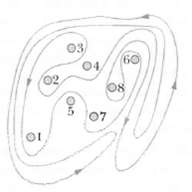
Eight wires cut the page perpendicularly at the points shown in Figure. A wire labeled with the integer k (k = 1, 2. 8) carries the current k i, where i = 4.50 mA. For those wires with odd k. the current is out of the page; for those with even k, it is into the page. Evaluate ф B ?? d s along the
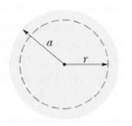
Figure shows a cross section across a diameter of a long cylindrical conductor of radius a = 2.00 cm carrying uniform current 170 A. What is the magnitude of the current's magnetic field at radial distance? (a) 0, (b) 1.00 cm, (c) 2.00 cm (wire's surface), and (d) 4.00cm?
In a particular region there is a uniform current density of 15 A/m2 in the positive z direction. What is the value of ф B ∙ d s when that line integral is calculated along the three straight-line segments from (x, y, z) coordinates (4d, 0, 0) to0) to (4d, 0, 0), where d = 20 cm?
The current density J inside a long, solid, cylindrical wire of radius a = 3.1 mm is in the direction of the central axis, and its magnitude varies linearly with radial distance r from the axis according to J = J0r/a, where J0 = 310 A/m2. Find the magnitude of the magnetic field at(a) r = 0,(b) r =
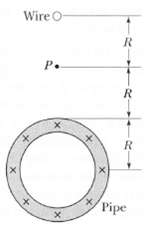
In Figure a long circular pipe with outside radius R = 2.6 cm carries a (uniformly distributed) current i = 8.00 mA into the page. A wire runs parallel to the pipe at a distance of 3.00R from center to center. Find the (a) Magnitude and (b) Direction (into or out of the page) of the current in the
A 200-turn solenoid having a length of 25 cm and a diameter of 10 cm carries a current of 0.29 A. Calculate the magnitude of the magnetic field d inside the solenoid.
A solenoid 1.30 m long and 2.60 cm in diameter carries a current of 18.0 A. The magnetic field inside the solenoid is 23.0mT. Find the length of the wire forming the solenoid.
A toroid having a square cross section, 5.00 cm on a side, and an inner radius of 15.0 cm has 500 turns and carries a current of 0.800 A. (It is made up of a square solenoid instead of a round one as in Figure bent into a doughnut shape.) What is the magnetic field inside the toroid at?(a) The
A solenoid that is 95.0 cm long has a radius of 2.00 cm and a winding of 1200 turns; it carries a current of 3.60 A. Calculate the magnitude of the magnetic field inside the solenoid.
A long solenoid with 10.0 turns/cm and a radius of 7.00 cm carries a current of 20.0 mA. A current of 6.00 A exists in a straight conductor located along the central axis of the solenoid.(a) At what radial distance from the axis will the direction of the resulting magnetic field be at 45.0° to the
An electron is shot into one end of a solenoid. As it enters the uniform magnetic field within the solenoid, its speed is 800 m/s and its velocity vector makes an angle of 30° with the central axis of the solenoid. The solenoid carries 4.0 A and has 8000 turns along its length. How many
A long solenoid has 100 turns/cm and carries current i. An electron moves within the solenoid in a circle of radius 2.30 cm perpendicular to the solenoid axis. The speed of the electron is 0.0460c (c = speed of light). Find the current i in the solenoid.
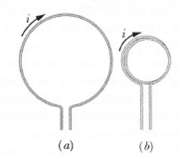
Figure a shows a length of wire carrying a current i and bent into a circular coil of one turn. In Figure b the same length of wire has been bent to give a coil of two turns, each of half the original radius. (a) If Ba and Bb, are the magnitudes of the magnetic fields at the centers of the two
What is the magnitude of the magnetic dipole moment μ of the solenoid?
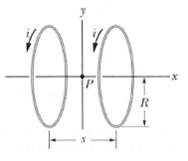
Figure shows an arrangement known as a Helmholtz coil. It consists of two circular coaxial coils, each of 200 turns and radius R = 25.0 cm, separated by a distance s = R. The two coils carry equal currents i = 12.2 mA in the same direction. Find the magnitude of the net magnetic field at P, midway
A student makes a short electromagnet by winding 300 turns of wire around a wooden cylinder of diameter d = 5.0 cm. The coil is connected to a battery producing a current of 4.0 A in the wire.(a) What is the magnitude of the magnetic dipole moment of this device?(b) At what axial distance z > d
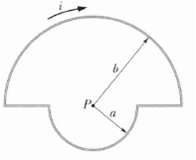
In Figure current i = 56.2 mA is set up in a loop having two radial lengths and two semicircles of radii a = 5.72 cm and b = 9.36 cm with a common center P. What are the (a) Magnitude and (b) Direction (into or out of the page) of the magnetic field at P and the (c) Magnitude and (d) Direction of
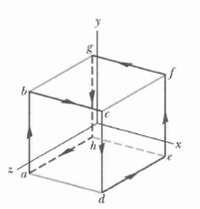
In Figure a conductor carries 6.0 A along the closed path abcdefgha running along 8 of the 12 edges of a cube of edge length 10 cm. (a) Taking the path to be a combination of three square current loops (bcfgb, abgha, and cdefc), find the net magnetic moment of the path in unit-vector notation. (b)
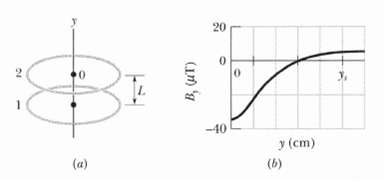
In Figure a, two circular loops, with different currents but the same radius of 4.0 cm, are centered on a y axis. They are initially separated by distance L = 3.0 cm, with loop 2 positioned at the origin of the axis. The currents in the two loops produce a net magnetic field at the origin, with y
A circular loop of radius 12 cm carries a current of 15 A. A flat coil of radius 0.82 cm, having 50 turns and a current of 1.3 A, is concentric with the loop. The plane of the loop is perpendicular to the plane of the coil. Assume the loop's magnetic field is uniform across the coil. What is the
Figure shows a closed loop with current i = 2.00 A. The loop consists of a half-circle of radius 4.00 m, two quarter-circles each of radius 2.00 m, and three radial straight wires. What is the magnitude of the net magnetic field at the common center of the circular sections?
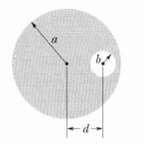
Figure shows a cross section of a long cylindrical conductor of radius a = 4.00 cm containing a long cylindrical hole of radius b = 1.50 cm. The central axes of the cylinder and hole are parallel and are distance d = 2.00 cm apart; current i = 5.25 A is uniformly distributed over the tinted
The magnitude of the magnetic field 88.0 cm from the axis of a long straight wire is 7.30μT. What is the current in the wire?
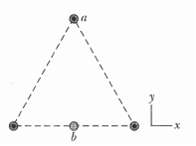
Three long wires are parallel to a z axis, and each carries a current of 10 A in the positive z direction their points of interaction with the xy plane from an equilateral triangle with sides of 50cm as shown in Figure. A fourth wire (wire b) passes through the mid point of the base of the triangle
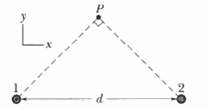
Figure shows, in cross section, two long parallel wires spaced by distance d = 10.0 cm; each carries 100 A, out of the page in wire 1. Point P is on a perpendicular bisector of the line connecting the wires. In unit-vector notation, what is the net magnetic field at P if the current in wire 2
A 10-gauge bare copper wire (2.6 mm in diameter) can carry a current of 50 A without overheating. For this current, what is the magnitude of the magnetic field at the surface of the wire?
A long vertical wire carries an unknown current. Coaxial with the wire is a long, thin, cylindrical conducting surface that carries a current of 30 mA upward. The cylindrical surface has a radius of 3.0 mm. If the magnitude of the magnetic field at a point 5.0 mm from the wire is 1.0μT, what are
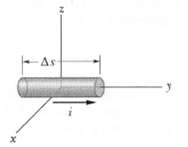
Figure shows a wire segment of length Δs = 3.0 cm, centered at the origin, carrying current i = 2.0 A in the positive y direction (as part of some complete circuit). To calculate the x magnitude of the magnetic field B produced by the segment at a point several meters from the origin, we can use B
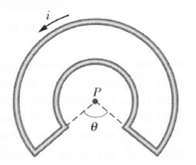
In Figure a closed loop carries current i = 200 mA. The loop consists of two radial straight wires and two concentric circular arcs of radii 2.00 m and 4.00 m. The angle θ is π/4 rad. What are the (a) Magnitude and (b) Direction (into or out of the page) of the net magnetic field at the center of
A cylindrical cable of radius 8.00 mm carries a current of 25.0 A, uniformly spread over its cross-sectional area. At what distance from the center of the wire is there a point within the wire where the magnetic field magnitude is 0.100mT?
A long wire carrying 100 A is perpendicular to the magnetic field lines of a uniform magnetic field of magnitude 5.0mT. At what distance from the wire is the net magnetic field equal to zero?
Two wires, both of length L, are formed into a circle and a square, and each carries current i. Show that the square produces a greater magnetic field at its center than the circle produces at its center.
A long straight wire carries a current of 50 A. An electron, traveling at 1.0 x 10⁷ m/s, is 5.0 cm from the wire. What is the magnitude of the magnetic force on the electron if the electron velocity is directed?(a) Toward the wire,(b) Parallel to the wire in the direction of the current, and(c)
In unit-vector notation, what is the magnetic field at point P in Figure if i = 10 A and a = 8.0 cm? (Note that the wires are not long.)
Figure shows, in cross section, two long parallel wires spaced by distance d = 18.6 cm. Each carries 4.23 A, out of the page in wire 1 and into the page in wire 2. In unit-vector notation, what is the magnetic field at point P at distance R = 34.2cm?
Showing 3900 - 4000
of 8940
First
33
34
35
36
37
38
39
40
41
42
43
44
45
46
47
Last
Step by Step Answers

 Get 50% OFF
Claim Now
Get 50% OFF
Claim Now