New Semester
Started
Get
50% OFF
Study Help!
--h --m --s
Claim Now
Question Answers
Textbooks
Find textbooks, questions and answers
Oops, something went wrong!
Change your search query and then try again
S
Books
FREE
Study Help
Expert Questions
Accounting
General Management
Mathematics
Finance
Organizational Behaviour
Law
Physics
Operating System
Management Leadership
Sociology
Programming
Marketing
Database
Computer Network
Economics
Textbooks Solutions
Accounting
Managerial Accounting
Management Leadership
Cost Accounting
Statistics
Business Law
Corporate Finance
Finance
Economics
Auditing
Tutors
Online Tutors
Find a Tutor
Hire a Tutor
Become a Tutor
AI Tutor
AI Study Planner
NEW
Sell Books
Search
Search
Sign In
Register
study help
physics
electricity and magnetism
Fundamentals of Physics 8th Extended edition Jearl Walker, Halliday Resnick - Solutions
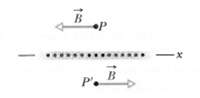
Figure shows a cross section of an infinite conducting sheet carrying a current per unit x length of λ; the current emerges perpendicularly out of the page.? (a) Use the Biot-Savart law and symmetry to show that for all points P above the sheet and all points P' below it, the magnetic field B is
Two long wires lie in a xy plane, and each carries a current in the positive direction of the x axis. Wire 1 is at y = 10.0 cm and carries 6.00 A; wire 2 is at y = 5.00 cm and carries 10.0 A.(a) In unit-vector notation, what is the net magnetic field B at the origin?(b) At what value of y does B =
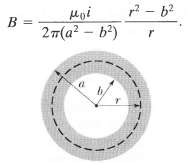
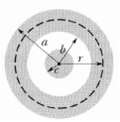
Figure shows a cross section of a hollow cylindrical conductor of radii a and b, carrying a uniformly distributed current t. (a) Show that the magnetic field magnitude B(r) for the radial distance r in the range b (b) Show that when r = a, this equation gives the magnetic field magnitude B at the
Three long wires all lie in a xy plane parallel to the x axis. They are spaced equally, 10 cm apart. The two outer wires each carry a current of 5.0 A in the positive x direction. What is the magnitude of the force on a 3.0 m section of either of the outer wires if the current in the center wire is
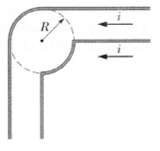
In Figure two infinitely long wires carry equal currents i. Each follows a 90? arc on the circumference of the same circle of radius R. Show that the magnetic field B at the center of the circle is the same as the field B a distance R below an infinite straight wire carrying a current i to the left.
A long wire is known to have a radius greater than 4.0 mm and to carry a current that is uniformly distributed over its cross section. The magnitude of the magnetic field due to that current is 0.28mT at a point 4.0 mm from the axis of the wire, and 0.20mT at a point 10 mm from the axis of the
A long, hollow, cylindrical conductor (inner radius 2.0 mm, outer radius 4.0 mm) carries a current of 24 A distributed uniformly across its cross section. A long thin wire that is coaxial with the cylinder carries a current of 24 A in the opposite direction. What is the magnitude of the magnetic
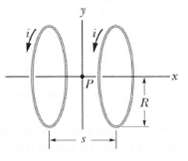
In Figure an arrangement known as Helmholtz coils consists of two circular coaxial coils, each of N turns and radius R, separated by distance s. The two coils carry equal currents i in the same direction. (a) Show that the first derivative of the magnitude of the net magnetic field of the coils
A square loop of wire of edge length a carries current i. Show that, at the center of the loop, the magnitude of the magnetic field produced by the current is B = 2√2μ0i/πa.
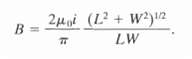
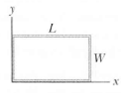
Show that the magnitude of the magnetic field produced at the center of a rectangular loop of wire of length L and width W, carrying a current i, is
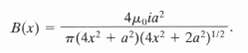
A square loop of wire of edge length a carries current i. Show that the magnitude of the magnetic field produced at a point on the central perpendicular axis of the loop and a distance x from its center is Prove that this result is consistent with the result shown in 87.
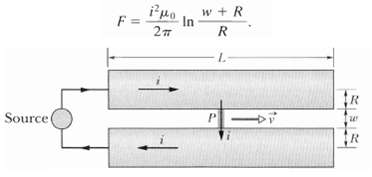
Figure is an idealized schematic drawing of a rail gun. Projectile P sits between two wide rails of circular cross section; a source of current sends current through the rails and through the (conducting) projectile (a fuse is not used). (a) Let w be the distance between the rails, R the radius of
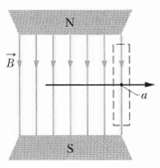
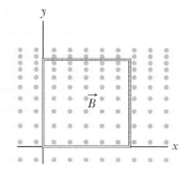
Show that a uniform magnetic field B cannot drop abruptly to zero (as is suggested by the lack of field lines to the right of point a in Figure) as one moves perpendicular to B, say along the horizontal arrow in the figure. In actual magnets, "fringing" of the magnetic field lines always occurs,
Show that if the thickness of a toroid is much smaller than its radius of curvature (a very skinny toroid), then Eq. 29-24for the field inside a toroid reduces to Eq. 29-23 for the field inside a solenoid. Explain why this result is to be expected.
Figure shows a cross section of a long conducting coaxial cable and gives its radii (a, b, c). Equal but opposite currents i are uniformly distributed in the two conductors. Derive expressions for B(r) with radial distance r in the ranges (a) r (b) c (c) b (d) t > a. (e) Test these
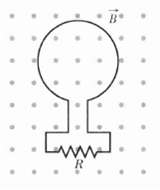
In Figure the magnetic flux through the loop increases according to the relation ф B = 6.0t2 + 7.0t, where ф B is in milliwebers and t is in seconds. (a) What is the magnitude of the emf induced in the loop when t = 2.0 s (b) Is the direction of the current through R to the right or left?
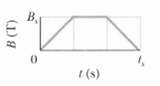
A wire loop of radius 12 cm and resistance 8.5?? is located in a uniform magnetic field E that changes in magnitude as given in Figure. The vertical axis scale is set by Bs = 0.50 T, and the horizontal axis scale is set by t s = 6.00 s. The loop's plane is perpendicular to B. What emf is induced in
A small loop of area 6.8 mm2 is placed inside a long solenoid that has 854turns/cm and carries a sinusoid ally varying current i of amplitude 1.28A and angular frequency 212 rad/s. The central axes of the loop and solenoid coincide. What is the amplitude of the emf induced in the loop?
An elastic conducting material is stretched into a circular loop of 12.0 cm radius. It is placed with its plane perpendicular to a uniform 0.800 T magnetic field. When released, the radius of the loop starts to shrink at an instantaneous rate of 75.0cm/s. What emf is induced in the loop at that
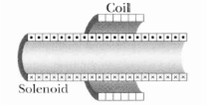
In Figure a 120-turn coil of radius 1.8 cm and resistance 5.3?? is coaxial with a solenoid of 220 turns/cm and diameter 3.2 cm. The solenoid current drops from 1.5 A to zero in time interval Δ t = 25ms. What current is induced in the coil during Δ t?
A uniform magnetic field B is perpendicular to the plane of a circular loop of diameter 10 cm formed from wire of diameter 2.5 mm and resistivity 1.69 x 10⁻⁸ Ω ∙ m. At what rate must the magnitude of B change to induce a 10A current in the loop?
In Figure a wire forms a closed circular loop, with radius R = 2.0m and resistance 4.0Ω. The circle is centered on a long straight wire; at time t = 0, the current in the long straight wire is 5.0 A rightward. Thereafter, the current changes according to i = 5.0 A - (2.0 A/s2) t2. (The straight
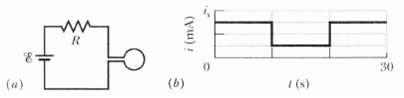
Figure a shows a circuit consisting of an ideal battery with emf ξ = 6.00μV a resistance R, and a small wire loop of area 5.0 cm2. For the time interval t = 10 s to r = 20 s, an external magnetic field is set up throughout the loop. The field is uniform, its direction is into the page in Figure
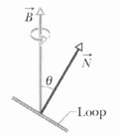
In Figure, a circular loop of wire 10cm in diameter (seen edge-on) is placed with its normal N at an angle θ = 30? with a direction of a uniform magnetic fields B of magnitude 0.50T. The loop is then rotated such that N rotates in a cone about the fields direction at the rate 100rev/min; angle θ
In Figure a, uniform magnetic field B increases in the magnetic with time t as given by the figure b, where the vertical axis scale is set by B = 3.0mT and the horizontal scale is set by t s = 3.0 s. A circular conducting loop of area 8.0 x 10⁴m2 lies in the field, in the plane of the page. The
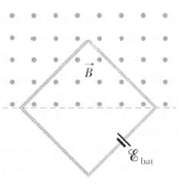
A square wire loop with 2.00 m sides is perpendicular to a uniform magnetic field, with half the area of the loop in the field as shown in Figure. The loop contains an ideal battery with emf ? = 20.0 V. If the magnitude of the field varies with time according to B = 0.0420 - 0.870t, with B in
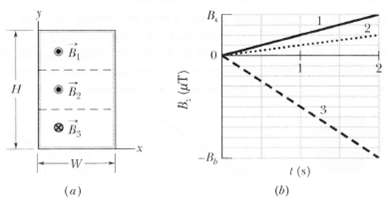
Figure a shows a wire that forms a rectangle (W = 20 cm, H = 30 cm) and has a resistance of 5.0m??). Its interior is split into three equal areas, with magnetic fields B1, B2, and B3. The fields are uniform within each region and directly out of or into the page as indicated. Figure b gives the
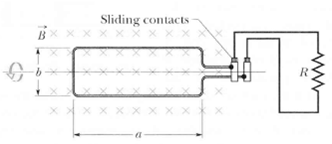
A rectangular coil of N turns and of length a and width b is rotated at frequency b in a uniform magnetic field B, as indicated in Figure. The coil is connected to co-rotating cylinders, against which metal brushes slide to make contact.(a) Show that the emf induced in the coil is given (as a
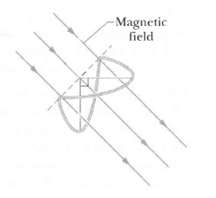
Figure shows a closed loop of wire that consists of a pair of equal semicircles, of radius 3.7 cm, lying in mutually perpendicular planes. The loop was formed by folding a flat circular loop along a diameter until the two halves became perpendicular to each other. A uniform magnetic field E of
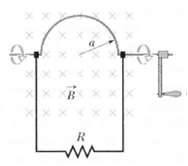
In Figure a stiff wire bent into a semicircle of radius a = 2.0 cm is rotated at constant angular speed 40 rev/s in a uniform 20mT magnetic field. What are the (a) Frequency and (b) Amplitude of the emf induced in the loop?
At a certain place, Earth's magnetic field has magnitude B = 0.590 gauss and is inclined downward at an angle of 70.0° to the horizontal. A flat horizontal circular coil of wire with a radius of 10.0 cm has 1000 turns and a total resistance of 85.0Ω. It is connected in series to a meter with
An electric generator contains a coil of 100 turns of wire, each forming a rectangular loop 50.0 cm by 30.0 cm. The coil is placed entirely in a uniform magnetic held with magnitude B = 3.50 T and with B initially perpendicular to the coil's plane. What is the maximum value of the emf produced when
In Figure a wire loop of dimensions L = 40.0 cm and W = 25.0 cm lies in a magnetic field F. What are the (a) Magnitude ξ and (b) Direction (clockwise or counterclockwise ?? or "none'" if ξ = 0) of the emf induced in the loop if B = (4.00 x 10⁻² T/m) y k? What are? (c) ξ and (d) The direction it
One hundred turns of (insulated) copper wire are wrapped around a wooden cylindrical core of cross-sectional area 1.20 x 10⁻³ m2. The two ends of the wire are connected to a resistor. The total resistance in the circuit is 13.0Ω. If an externally applied uniform longitudinal magnetic field in the
A rectangular loop (area = 0.15 m2) turns in a uniform magnetic field, B = 0.20 T. When the angle between the field and the normal to the plane of the loop is nl2 rad and increasing at 0.60 rad/s, what emf is induced in the loop?
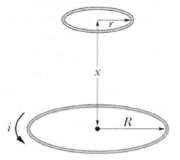
Figure shows two parallel loops of wire having a common axis. The smaller loop (radius r) is above the larger loop (radius R) by a distance x > R. Consequently, the magnetic field due to the counterclockwise current i in the larger loop is nearly uniform throughout the smaller loop. Suppose that
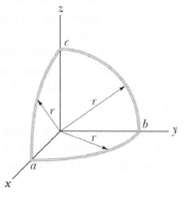
A wire is bent into three circular segments, each of radius r = l0 cm, as shown in Figure. Each segment is a quadrant of a circle, ab lying in the xy plane, b c lying in the y z plane, and ca lying in the z x plane. (a) If a uniform magnetic field B points in the positive x direction, what is the
A small circular loop of area 2.00 cm2 is placed in the plane of, and concentric with, a large circular loop of radius 1.00 m. The current in the large loop is changed at a constant rate from 200 A to -200 A (a change in direction) in a time of 1.00 s, beginning at t = 0. What is the magnitude of
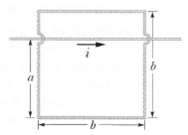
For the wire arrangement in Figure, a = 12.0 cm and b = 16.0 cm. The current in the long straight wire is given by i = 4.50t2 - 10.0t, where i is in amperes and r is in seconds. (a) Find the emf in the square loop at t = 3.00 s. (b) What is the direction of the induced current in the loop?
As seen in Figure, a square loop of wire has sides of length 2.0 cm. A magnetic field is directed out of the page; its magnitude is given by B = 4.0t2y, where B is in teslas, t is in seconds, and y is in meters. At r = 2.5 s, what are the (a) Magnitude and (b) Direction of the emf induced in the
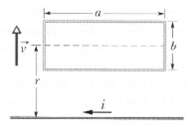
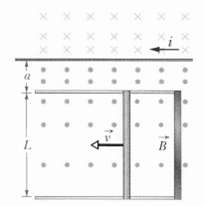
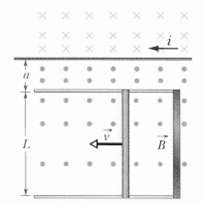
In Figure, a rectangular loop of wire with length a = 2.2 cm, width b = 0.80 cm, and resistance R = 0.40mΩ is placed near an infinitely long wire carrying current i = 4.7 A. The loop is then moved away from the wire at constant speed v = 3.2 mm/s. When the center of the loop is at distance r =
Two long, parallel copper wires of diameter 2.5 mm carry currents of 10 A in opposite directions.(a) Assuming that their central axes are 20 mm apart, calculate the magnetic flux per meter of wire that exists in the space between those axes.(b) What percentage of this flux lies inside the wires?(c)
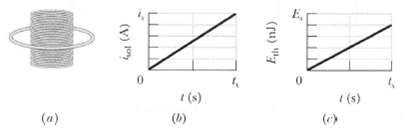
In Figure a, a circular loop of wire is concentric with a solenoid and lies in a plane perpendicular to the solenoid's central axis. The loop has radius 6.00 cm. The solenoid has radius 2.00 cm, consists of 8000 turns/m, and has a current i coil varying with time r as given in Figure b, where the
If 50.0 cm of copper wire (diameter = 1.00 mm) is formed into a circular loop and placed perpendicular to a uniform magnetic field that is increasing at the constant rate of 10.0mT/s, at what rate is thermal energy generated in the loop?
A loop antenna of area 2.00 cm2 and resistance 5.21μΩ is perpendicular to a uniform magnetic field of magnitude 17.0μT. The field magnitude drops to zero in 2.96ms. How much thermal energy is produced in the loop by the change in field?
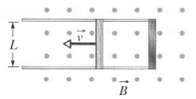
In Figure a metal rod is forced to move with constant velocity v along two parallel metal rails, connected with a strip of metal at one end. A magnetic field of magnitude B = 0.350 T points out of the page. (a) If the rails are separated by L = 25.0 cm and the speed of the rod is 55.0 cm/s, what
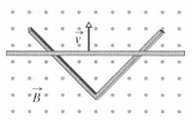
In Figure two straight conducting rails form a right angle. A conducting bar in contact with the rails starts at the vertex at time t = 0 and moves with a constant velocity of 5.20 m/s along them. A magnetic field with B = 0.350 T is directed out of the page. Calculate (a) The flux through the
The conducting rod shown in Figure has length L and is being pulled along horizontal, frictionless conducting rails at a constant velocity v. The rails are connected at one end with a metal strip. A uniform magnetic field B, directed out of the page, fills the region in which the rod moves. Assume
In Figure a long rectangular conducting loop, of width L, resistance R, and mass m, is hung in a horizontal, uniform magnetic field B that is directed into the page and that exists only above line aa. The loop is then dropped; during its fall, it accelerates until it reaches a certain terminal
Figure shows a rod of length L = 10.0 cm that is forced to move at constant speed v = 5.00 m/s along horizontal rails. The rod, rails, and connecting strip at the right form a conducting loop. The rod has resistance 0.400??; the rest of the loop has negligible resistance. A current i = 700A through
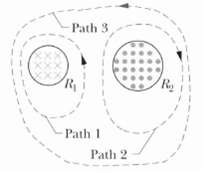
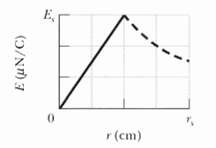
Figure shows two circular regions R1 and R2, with radii r1 = 20.0 cm and r2 = 30.0 cm. In R1 there is a uniform magnetic field of magnitude B1 = 50.0mT directed into the page, and in R2 there is a uniform magnetic field of magnitude B2 = 75.0mT directed out of the page (ignore fringing). Both
A long solenoid has a diameter of 12.0 cm. When a current i exists in its windings, a uniform magnetic field of magnitude B = 30.0mT is produced in its interior. By decreasing i., the field is caused to decrease at the rate of 6.50mT/s. Calculate the magnitude of the induced electric field (a)
A circular region in an xy plane is penetrated by a uniform magnetic field in the positive direction of the z axis. The field's magnitude B (in teslas) increases with time t (in seconds) according to B = at, where a is a constant. The magnitude E of the electric field set up by that increase in the
The magnetic field of a cylindrical magnet that has a pole-face diameter of 3.3 cm can be varied sinusoid ally between 29.6 T and 30.0 T at a frequency of 15 Hz. At a radial distance of 1.6 cm, what is the amplitude of the electric field induced by the variation?
The inductance of a closely packed coil of 400 turns is 8.0 mH. Calculate the magnetic flux through the coil when the current is 5.0 mA.
(a) If no current is in the coil, what magnetic flux links its turns?(b) When the current in the coil is 3.80 A in a certain direction, the net flux through the coil is found to vanish. What is the inductance of the coil?
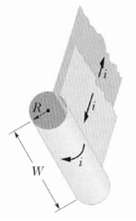
Figure shows a copper strip of width W = 16.0 cm that has been bent to form a shape that consists of a tube of radius R = 1.8 cm plus two parallel flat extensions. Current i = 35 mA is distributed uniformly across the width so that the tube is effectively a one-turn solenoid. Assume that the
Two identical long wires of radius a = 1.53 mm are parallel and carry identical currents in opposite directions. Their center-to-center separation is d = 14.2 cm. Neglect the flux within the wires but consider the flux in the region between the wires. What is the inductance per unit length of the
A 12 H inductor carries a current of 2.0 A. At what rate must the current be changed to produce a 60 V emf in the inductor?
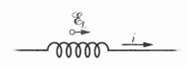
At a given instant the current and self-induced emf in an inductor are directed as indicated in Figure. (a) Is the current increasing or decreasing? (b) The induced emf is 17 V and the rate of change of the current is 25kA/s; find the inductance.
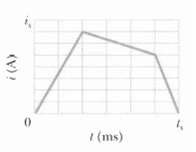
The current i through a 4.6 H inductor varies with time t as shown by the graph of Figure, where the vertical axis scale is set by is = 8.0A and the horizontal axis scale is set by t s = 6.0ms. The inductor has a resistance of 12??. Find the magnitude of the induced emf ξ during time intervals (a)
Inductors in series two inductors L1 and L2 ate connected in series and are separated by a large distance so that the magnetic field of one cannot affect the other.(a) Show that the equivalent inductance is given by L e q = L1 + L2.(b) What is the generalization of (a) for N inductors in series?
Inductors in parallel two inductors L1 and L2 are connected in parallel and separated by a large distance so that the magnetic field of one cannot affect the other.(a) Show that the equivalent inductance is given by 1/L e q = 1/L1 + L2(b) What is the generalization of (a) for N inductors in
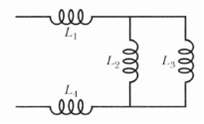
The inductor arrangement of Figure with L1 = 30.0 mH, L2 = 50.0 mH, L3 = 20.0 mH, and L4 = 15.0 mH, is to be connected to a varying current source. What is the equivalent inductance of the arrangement? (First see Problems 47 and 48.)
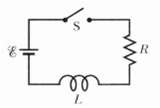
The switch in Figure is closed on a at time t = 0. What is the ratio ξ L/ξ of the inductor's self induced emf to the battery's emf?(a) Just after t = 0 and(b) At t = 2.00 τ L(c) At what multiple of τ L will ξ L/ξ = 0.500?
A battery is connected to a series RL circuit at time t = 0. At what multiple of τ L will the current be 0.100% less than its equilibrium value?
The current in an RL circuit builds up to one-third of its steady-state value in 5.00 s. Find the inductive time constant.
The current in an RL circuit drops from 1.0 A to 10 mA in the first second following removal of the battery from the circuit if L is 10 H find the resistance R in the circuit.
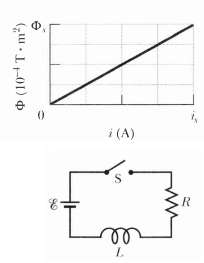
In Figure the inductor has 25 turns and the ideal battery has an emf of 16 V. Figure gives the magnetic flux ф through each turn versus the current i through the inductor. The vertical axis scale is set by ф s = 4.0 x 10⁻⁴ T ?? m2, and the horizontal axis scale is set by is = 2.00 A. If switch S
A solenoid having an inductance of 6.30pH is connected in series with a 1.20kΩ resistor.(a) If a 14.0 V battery is connected across the pair, how long will it take for the current through the resistor to reach 80.0% of its final value?(b) What is the current through the resistor at time t = 1.0τ
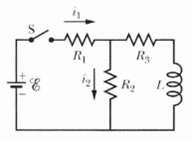
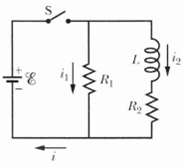
In Figure, ? = 100 V, R l = 10.0? R2 = 20.0?, R3 = 30.0?, and L = 2.00 H. Immediately after switch S is closed, what are(a) i1 and(b) i2? (Let currents in the indicated directions have positive values and currents in the opposite directions have negative values.) A long time later, what are?(c) i 1
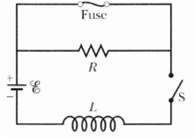
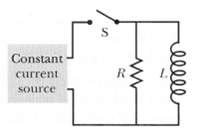
In Figure, R = 15??, L = 5.0 H, the ideal battery has ξ = 10 V and the fuse in the upper branch is an ideal 3.0 A fuse. It has zero resistance as long as the current through it remains less than 3.0 A. If the current reaches 3.0 A. the fuse "blows" and thereafter has infinite resistance. Switch S
Suppose the emf of the battery in the circuit shown in Figure varies with time t so that the current is given by i (t) = 3.0 + 5.0t, where i is in amperes and t is in seconds. The R = 4.0Ω and L = 6.0 H, and find an expression for the battery emf as a function of t.
In Figure after switch S is closed at time t = 0, the emf of the source is automatically adjusted to maintain a constant current i through S.(a) Find the current through the inductor as a function of time.(b) At what time is the current through the resistor equal to the current through theinductor?
A wooden toroidal core with a square cross section has an inner radius of l0 cm and an outer radius of 12cm. It is wound with one layer of wire (of diameter 1.0 mm and resistance per meter 0.020 Ω/m). What are?(a) The inductance and(b) The inductive time constant of the resulting toroid? Ignore
At t = 0, a battery is connected to a series arrangement of a resistor and an inductor. If the inductive time constant is 37 .0 ms, at what time is the rate at which energy is dissipated in the resistor equal to the rate at which energy is stored in the inductor's magnetic field?
At t = 0 a battery is connected to a series arrangement of a resistor and an inductor. At what multiple of the inductive time constant will the energy stored in the inductor's magnetic field are 0.500 its steady-state value?
A coil is connected in series with a 10.0kΩ resistor. An ideal 50.0 V battery is applied across the two devices, and the current reaches a value of 2.00 mA after 5.00ms.(a) Find the inductance of the coil.(b) How much energy is stored in the coil at this same moment?
A coil with an inductance of 2.0 H and a resistance of 10Ω is suddenly connected to an ideal battery with ξ = 100 V. At 0.10 s after the connection is made, what is the rate at which(a) Energy is being stored in the magnetic field,(b) Thermal energy is appearing in the resistance, and(c) Energy
For the circuit of Figure, assume that ξ = 10.0 V R = 6.70Ω and L = 5.50 H. The ideal battery is connected at time t = 0.(a) How much energy is delivered by the battery during the first 2.00 s?(b) How much of this energy is stored in the magnetic field of the inductor?(c) How much of this energy
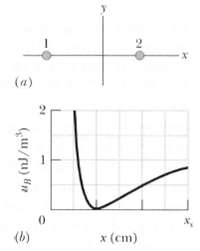
Figure a show, in cross section, two wires that are straight, parallel, and very long. The ratio i1/i2 of the current carried by wire I to that carried by wire 2 is 1/3. Wire 1 is fixed in place. Wire 2 can be moved along the positive side of the x axis so as to change the magnetic energy density u
What must be the magnitude of a uniform electric field if it is to have the same energy density as that possessed by a 0.50 T magnetic field?
A toroidal inductor with an inductance of 90.0 mH encloses a volume of 0.0200 m3. If the average energy density in the toroid is 70.0 J/m3, what is the current through the inductor?
A solenoid that is 85.0 cm long has a cross-sectional area of 17.0cm2. There are 950 turns of wire carrying a current of 6.60 A.(a) Calculate the energy density of the magnetic field inside the solenoid.(b) Find the total energy stored in the magnetic field there (neglect end effects).
A circular loop of wire 50 mm in radius carries a current of 100 A. Find the(i) Magnetic field strength and(ii) Energy density at the center of the loop.
A circular loop of wire 50 mm in radius carries a current of 100 A. Find the(a) Magnetic field strength and(b) Energy density at the center of the loop.
Two solenoids are part of the spark coil of an automobile. When the current in one solenoid falls from 6.0 A to zero in 2.5ms, an emf of 30 kV is induced in the other solenoid. What is the mutual inductance M of the solenoids?
Two coils are at fixed locations. When coil t has no current and the current in coil 2 increases at the rate 15.0 A/s, the emf in coil 1 is 25.0 mV.(a) What is their mutual inductance?(b) When coil 2 has no current and coil 1 has a current of 3.60A, what is the flux linkage in coil 2?
Coil 1 has L1 = 25 mH and N1 = 100 turns. Coil 2 has L2 = 40 mH and N2 = 200 turns. The coils are fixed in place; their mutual inductance M is 3.0 mH. A 6.0 mA current in coil 1 is changing at the rate of 4.0 A/s.(a) What magnetic flux ф12 links coil 1, and(b) What self-induced emf appears in that
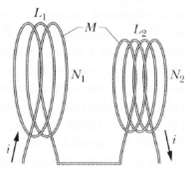
Two coils connected as shown in Figure separately have inductances L1 and L2. Their mutual inductance is M. (a) Show that this combination can be replaced by a single coil of equivalent inductance given by L e q = L1 + L2 + 2M. (b) How could the coils in Figure be reconnected to yield an equivalent
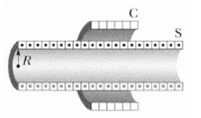
A coil C of N turns is placed around a long solenoid S of radius R and n turns per unit length, as in Figure.(a) Show that the mutual inductance for the coil-solenoid combination is given by M = μ0πR2nN. (b) Explain why M does not depend on the shape, size,, or
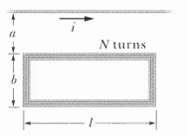
A rectangular loop of N closely packed turns is positioned near a long straight wire as shown in Figure. What is the mutual inductance M for the loop-wire combination if N = 100, a = 1.0cm, b = 8.0 cm, and l = 30cm?
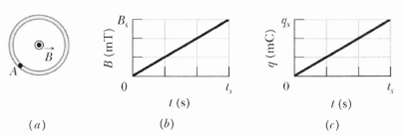
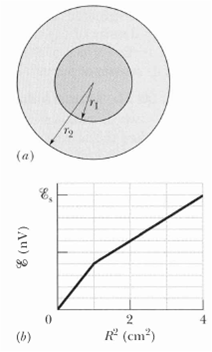
Figure a show two concentric circular regions in which uniform magnetic fields can change. Region 1, with radius r1 = 1.0 cm, has an outward magnetic field B1, that is increasing in magnitude. Region 2, with radius r2 = 2.0 cm, has an outward magnetic field B2, that may also be changing. Imagine
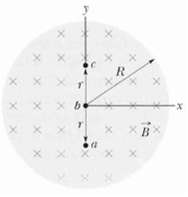
Figure shows a uniform magnetic field B confined to a cylindrical volume of radius R. The magnitude of B is decreasing at a constant rate of 10mT/s. In unit-vector notation, what is the initial acceleration of an electron released at? (a) Point a (radial distance r = 5.0 cm), (b) Point b (r = 0),
The inductance of a closely wound coil is such that an emf of 3.00 mV is induced when the current changes at the rate of 5.00 A/s. A steady current of 8.00A produces a magnetic flux of 40.0μWb through each turn.(a) Calculate the inductance of the coil.(b) How many turns does the coil have?
A square wire loop 20 cm on a side, with resistance 20mΩ, has its plane normal to a uniform magnetic field of magnitude B = 2.0 T. If you pull two opposite sides of the loop away from each other, the other two sides automatically draw toward each other, reducing the area enclosed by the loop. If
A square loop of wire is held in a uniform 0.24T magnetic field directed perpendicular to the plane of the loop. The length of each side of the square is decreasing at a constant rate of 5.0 cm/s. What emf is induced in the loop when the length is 12 cm?
In Figure a 12.0 V ideal battery, a 20.0?? resistor, and an inductor are connected by a switch at time t = 0. At what rate is the battery transferring energy to the inductor's field at t = 1.61τ L?
How long would it take, following the removal of the battery, for the potential difference across the resistor in an RL circuit (with L = 2.00 H, R = 3.00Ω) to decay to 10.0% of its initial value?
In Figure, the battery is ideal, ? = l0 V, R1 = 5.0?, R2 = 10?, and L = 5.0 H. Switch S is closed at time t = 0. Just afterwards, what are?(a) i 1,(b) i 2,(c) The current i S through the switch,(d) The potential difference V2 across resistor 2,(e) The potential difference V1 across the inductor,
Showing 4000 - 4100
of 8940
First
34
35
36
37
38
39
40
41
42
43
44
45
46
47
48
Last
Step by Step Answers

 Get 50% OFF
Claim Now
Get 50% OFF
Claim Now