New Semester
Started
Get
50% OFF
Study Help!
--h --m --s
Claim Now
Question Answers
Textbooks
Find textbooks, questions and answers
Oops, something went wrong!
Change your search query and then try again
S
Books
FREE
Study Help
Expert Questions
Accounting
General Management
Mathematics
Finance
Organizational Behaviour
Law
Physics
Operating System
Management Leadership
Sociology
Programming
Marketing
Database
Computer Network
Economics
Textbooks Solutions
Accounting
Managerial Accounting
Management Leadership
Cost Accounting
Statistics
Business Law
Corporate Finance
Finance
Economics
Auditing
Tutors
Online Tutors
Find a Tutor
Hire a Tutor
Become a Tutor
AI Tutor
AI Study Planner
NEW
Sell Books
Search
Search
Sign In
Register
study help
physics
electricity and magnetism
Fundamentals of Ethics for Scientists and Engineers 1st Edition Edmund G. Seebauer, Robert L. Barry - Solutions
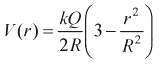
In Example 24-12 you derived the expression for the potential inside a solid sphere of constant charge density by first finding the electric field. In this problem you derive the same expression by direct integration. Consider a sphere of radius R containing a charge Q uniformly distributed. You
A nonconducting sphere of radius R has a volume charge density ρ = ρ0r/R, where ρ0 is a constant.(a) Show that the total charge is Q = πR3ρ0.(b) Show that the total charge inside a sphere of radius r < R is q = Qr4/R4.(c) Use Gauss's law to find the electric
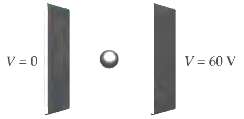
Figure shows two parallel metal plates maintained at potentials of 0 and 60 V. Midway between the plates is a copper sphere. Sketch the equipotential surfaces and the electric field lines between the twoplates.
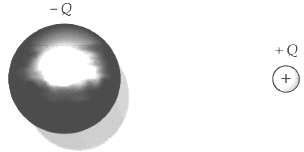
Figure shows a metal sphere carrying a charge ?Q?and a point charge +Q. Sketch the electric field lines and equipotential surfaces in the vicinity of this charge system.
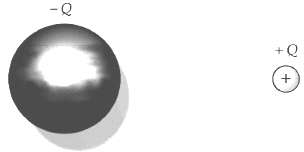
Repeat Problem 57 with the charge on the metal sphere changed to+Q.
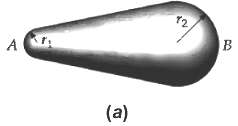
Sketch the electric field lines and the equipotential surfaces both near and far from the conductor shown in Figure(a), assuming that the conductor carries some chargeQ.
Two equal positive charges are separated by a small distance. Sketch the electric field lines and the equipotential surfaces for this system.
An infinite plane of charge has surface charge density 3.5 μC/m2. How far apart are the equipotential surfaces whose potentials differ by 100 V?
A point charge q = + 1/9 × 10–8 C is at the origin. Taking the potential to be zero at r = ∞, locate the equipotential surfaces at 20-V intervals from 20 to 100 V, and sketch them to scale. Are these surfaces equally spaced?
(a) Find the maximum net charge that can be placed on a spherical conductor of radius 16 cm before dielectric breakdown of the air occurs.(b) What is the potential of the sphere when it carries this maximum charge?
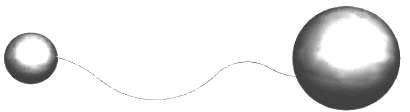
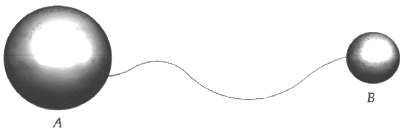
Charge is placed on two conducting spheres that are very far apart and connected by a long thin wire (Figure). The larger sphere has a diameter twice that of the smaller. Which sphere has the largest electric field near its surface? By what factor is it larger than that at the surface of the
Charge is placed on two conducting spheres that are very far apart and connected by a long thin wire. The radius of the smaller sphere is 5 cm and that of the larger sphere is 12 cm. The electric field at the surface of the larger sphere is 200 kV/m. Find the surface charge density on each sphere.
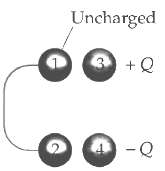
Two identical uncharged metal spheres connected by a wire are placed close by two similar conducting spheres with equal and opposite charges as shown in Figure. (a) Sketch the electric field lines between spheres 1 and 3 and between spheres 2 and 4. (b) What can be said about the potentials V1, V2,
An electric field is given by E = axi, where E is in newtons per coulomb, x is in meters, and a is a positive constant.(a) What are the SI units of a?(b) How much work is done by this field on a positive point charge q0 when the charge moves from the origin to some point x?(c) Find the potential
Two positive charges +q are on the y axis at y = +a and y = –a.(a) Find the potential V for any point on the x axis.(b) Use your result in (a) to find the electric field at any point on the x axis.
If a conducting sphere is to be charged to a potential of 10,000 V, what is the smallest possible radius of the sphere such that the electric field will not exceed the dielectric strength of air?
An isolated aluminum sphere of radius 5.0 cm is at a potential of 400 V. How many electrons have been removed from the sphere to raise it to this potential?
A point charge Q resides at the origin. A particle of mass m = 0.002 kg carries a charge of 4.0 μC. The particle is released from rest at x = 1.5 m. Its kinetic energy as it passes x = 1.0 m is 0.24 J. Find the charge Q.
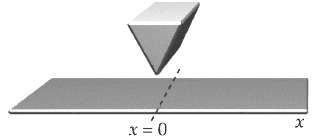
A conducting wedge is charged to a potential V with respect to a large conducting sheet (Figure). (a) Sketch the electric field lines and the equipotentials for this configuration. Where along the x axis is |E| greatest? (b) An electron of mass me leaves the sheet with zero velocity. What is its
A Van de Graaff generator has a potential difference of 1.25 MV between the belt and the outer shell. Charge is supplied at the rate of 200 μC/s. What minimum power is needed to drive the moving belt?
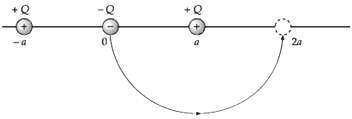
A positive point charge +Q?is located at x?= ?a. (a) How much work is required to bring a second equal positive point charge +Q?from infinity to x?= +a? (b) With the two equal positive point charges at x?= ?a?and x?= +a, how much work is required to bring a third charge ?Q?from infinity to the
A charge of 2 nC is uniformly distributed around a ring of radius 10 cm that has its center at the origin and its axis along the x axis. A point charge of 1 nC is located at x = 50 cm. Find the work required to move the point charge to the origin. Give your answer in both joules and electron volts.
The centers of two metal spheres of radius 10 cm are 50 cm apart on the x axis. The spheres are initially neutral, but a charge Q is transferred from one sphere to the other, creating a potential difference between the spheres of 100 V. A proton is released from rest at the surface of the
A spherical conductor of radius R1 is charged to 20 kV. When it is connected by a long, fine wire to a second conducting sphere far away, its potential drops to 12 kV. What is the radius of the second sphere?
A uniformly charged ring of radius a and charge Q lies in the yz plane with its axis along the x axis. A point charge Q’ is placed on the x axis at x = 2a.(a) Find the potential at any point on the x axis due to the total charge Q + Q’.(b) Find the electric field for any point on the x axis.
A metal sphere centered at the origin carries a surface charge of charge density σ = 24.6 nC/m2. At r = 2.0 m, the potential is 500 V and the magnitude of the electric field is 250 V/m. Determine the radius of the metal sphere.
Along the axis of a uniformly charged disk, at a point 0.6 m from the center of the disk, the potential is 80 V and the magnitude of the electric field is 80 V/m; at a distance of 1.5 m, the potential is 40 V and the magnitude of the electric field is 23.5 V/m. Find the total charge residing on the
When 235U captures a neutron, it fissions (splits) into two nuclei, in the process emitting several neutrons that can cause other uranium nuclei to fission. Assume that the fission products are two nuclei of equal charges of +46e and that these nuclei are at rest just after fission and are
A radioactive 210Po nucleus emits an α particle of charge +2e and energy 5.30 MeV. Assume that just after the α particle is formed and escapes from the nucleus, it is a distance R from the center of the daughter nucleus 206Pb, which has a charge +82e. Calculate R by setting the electrostatic
A uniformly charged ring with a total charge of 100 μC and a radius of 0.1 m lies in the yz plane with its center at the origin. A meterstick has a point charge of 10 μC on the end marked 0 and a point charge of 20 μC on the end marked 100 cm. How much work does it take to bring the meterstick
Three large conducting plates are parallel to one another with the outer plates connected by a wire. The inner plate is isolated and carries a charge density σt on the upper surface and σb on the lower surface, where σt + σb = 12 μC/m2. The inner plate is 1 mm from the top plate and 3 mm from
A point charge q1 is at the origin and a second point charge q2 is on the x axis at x = a as in Example 24-5.(a) Calculate the electric field everywhere on the x axis from the potential function given in that example.(b) Find the potential at a general point on the y axis.(c) Use your result from
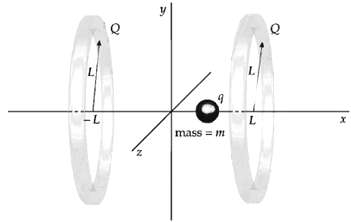
A particle of mass m carrying a positive charge q is constrained to move along the x axis. At x = ???L and x = L are two ring charges of radius L (Figure). Each ring is centered on the x axis and lies in a plane perpendicular to it. Each carries a positive charge Q. (a) Obtain an expression for the
Three concentric conducting spherical shells have radii a, b, and c such that a < b < c. Initially, the inner shell is uncharged, the middle shell has a positive charge Q, and the outer shell has a negative charge –Q.(a) Find the electric potential of the three shells.(b) If the inner and
Consider two concentric spherical metal shells of radii a and b, where b > a. The outer shell has a charge Q, but the inner shell is grounded. This means that the inner shell is at zero potential and that electric field lines leave the outer shell and go to infinity but other electric field
(Multiple choice) (1) A lithium nucleus and an ? particle are at rest. The lithium nucleus has a charge of +3e and a mass of 7 u; the ? particle has a charge of +2e and a mass of 4 u. Which of the methods below would accelerate them both to the same kinetic energy?? (a) Accelerate them through the
Three point charges are on the x axis: q1 at the origin, q2 at x = 3 m, and q3 at x = 6 m. Find the electrostatic potential energy for(a) q1 = q2 = q3 = 2 μC,(b) q1 = q2 = 2 μC and q3 = –2 μC, and(c) q1 = q3 = 2 μC and q2 = –2 μC.
Point charges q1, q2, and q3 are at the corners of an equilateral triangle of side 2.5 m. Find the electrostatic potential energy of this charge distribution if(a) q1 = q2 = q3 = 4.2 μC,(b) q1 = q2 = 4.2 μC and q3 = –4.2 μC,(c) q1 = q2 = –4.2 μC and q3 = +4.2 μC.
What is the electrostatic potential energy of an isolated spherical conductor of radius 10 cm that is charged to 2 kV?
Four point charges of magnitude 2 μC are at the corners of a square of side 4 m. Find the electrostatic potential energy if(a) All the charges are negative,(b) Three of the charges are positive and one is negative, and(c) Two are positive and two are negative.
Four charges are at the corners of a square centered at the origin as follows: q at (–a, +a); 2q at (a, a); –3q at (a, –a); and 6q at (–a, –a). A fifth charge +q is placed at the origin and released from rest. Find its speed when it is a great distance from the origin.
Four identical particles each with charge Q are at the corners of a square of side L. The particles are released one at a time proceeding clockwise around the square. Each particle is allowed to reach its final speed a long distance from the square before the next particle is released. What is the
An isolated spherical conductor of radius 10 cm is charged to 2 kV.(a) How much charge is on the conductor?(b) What is the capacitance of the sphere?(c) How does the capacitance change if the sphere is charged to 6 kV?
A capacitor has a charge of 30 μC. The potential difference between the conductors is 400 V. What is the capacitance?
(a) If a parallel-plate capacitor has a 0.15-mm separation, what must its area be for it to have a capacitance of 1 F?(b) If the plates are square, what is the length of their sides?
Half the charge is removed from a capacitor without changing its capacitance. What fraction of its stored energy is removed along with the charge?
(a) A 3-μF capacitor is charged to 100 V. How much energy is stored in the capacitor?(b) How much additional energy is required to charge the capacitor from 100 to 200 V?
A 10-μF capacitor is charged to Q = 4 μC.(a) How much energy is stored in the capacitor?(b) If half the charge is removed, how much energy remains?
(a) Find the energy stored in a 20-pF capacitor when it is charged to 5 μC.(b) How much additional energy is required to increase the charge from 5 to 10 μC?
A parallel-plate capacitor with a plate area of 2 m2 and a separation of 1.0 mm is charged to 100 V.(a) What is the electric field between the plates?(b) What is the energy per unit volume in the space between the plates?(c) Find the total energy by multiplying your answer to part (b) by the total
Energy prospectors from a distant planet are inspecting the earth to decide if its electrical energy resources are worth stealing. Measurements reveal that earth's electric field extends upward for 1000 m and has an average magnitude of 200 V/m. Estimate the electrical energy stored in the
A parallel-plate capacitor with plates of area 500 cm2 is charged to a potential difference V and is then disconnected from the voltage source. When the plates are moved 0.4 cm farther apart, the voltage between the plates increases by 100 V.(a) What is the charge Q on the positive plate of the
A ball of charge of radius R has a uniform charge density ρ and a total charge Q = 4/3 πR3ρ.(a) Find the electrostatic energy density at a distance r from the center of the ball for r < R and for r > R.(b) Find the energy in a spherical shell of volume 4πr2 dr for both r < R and r >
(a) How many 1.0-μF capacitors connected in parallel would it take to store a total charge of 1 mC with a potential difference of 10 V across each capacitor?(b) What would be the potential difference across the combination?(c) If the number of 1.0-μF capacitors found in part (a) is connected in
A 3.0-μF capacitor and a 6.0-μF capacitor are connected in series, and the combination is connected in parallel with an 8.0-μF capacitor. What is the equivalent capacitance of this combination?
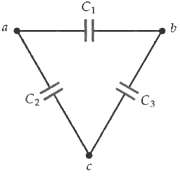
Three capacitors are connected in a triangular network as shown in Figure. Find the equivalent capacitance across terminals a and c.
A 10.0-μF capacitor and a 20.0-μF capacitor are connected in parallel across a 6.0-V battery.(a) What is the equivalent capacitance of this combination?(b) What is the potential difference across each capacitor?(c) Find the charge on each capacitor.
A 10.0-μF capacitor is connected in series with a 20.0-μF capacitor across a 6.0-V battery.(a) Find the charge on each capacitor.(b) Find the potential difference across each capacitor.
Three identical capacitors are connected so that their maximum equivalent capacitance is 15 μF.(a) Describe how the capacitors are combined.(b) There are three other ways to combine all three capacitors in a circuit. What are the equivalent capacitances for each arrangement?
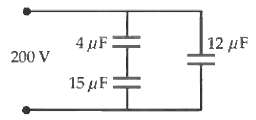
For the circuit shown in Figure, find (a) The total equivalent capacitance between the terminals, (b) The charge stored on each capacitor, and (c) The total stored energy.
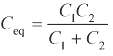
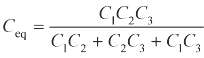
(a) Show that the equivalent capacitance of two capacitors in series can be written (b) Use this expression to show that Ceq (c) Show that the correct expression for the equivalent capacitance of three capacitors in seriesis
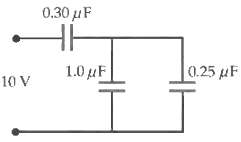
For the circuit shown in Figure, find (a) The total equivalent capacitance between the terminals, (b) The charge stored on each capacitor, and (c) The total storedenergy.
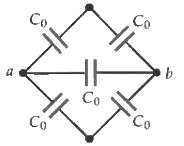
Five identical capacitors of capacitance C0 are connected in a bridge network as shown in Figure. (a) What is the equivalent capacitance between points a and b? (b) Find the equivalent capacitance if the capacitance between a and b is changed to10C0.
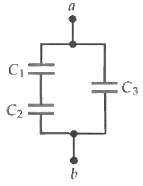
In Figure, C1 = 2 ?F, C2 = 6 ?F, and C3 = 3.5 ?F. (a) Find the equivalent capacitance of this combination. (b) If the breakdown voltages of the individual capacitors are V1 = 100 V, V2 = 50 V, and V3 = 400 V, what maximum voltage can be placed across points a and b?
Design a network of capacitors that has a capacitance of 2 μF and breakdown voltage of 400 V using only 2-μF capacitors that have individual breakdown voltages of 100 V.
Find all the different possible equivalent capacitances that can be obtained using a 1.0-, a 2.0-, and a 4.0-μF capacitor in any combination that includes all three or any two of the capacitors.
A parallel-plate capacitor has a capacitance of 2.0 μF and a plate separation of 1.6 mm.(a) What is the maximum potential difference between the plates such that dielectric breakdown of the air between the plates does not occur? (Use Emax = 3 MV/m.)(b) How much charge is stored at this maximum
An electric field of 2 × 10⁴ V/m exists between the plates of a circular parallel–plate capacitor that has a plate separation of 2 mm.(a) What is the voltage across the capacitor?(b) What plate radius is required if the stored charge is 10 μC?
A parallel-plate, air-gap capacitor has a capacitance of 0.14 μF. The plates are 0.5 mm apart.(a) What is the area of each plate?(b) What is the potential difference if the capacitor is charged to 3.2 μC?(c) What is the stored energy?(d) How much charge can the capacitor carry before dielectric
Design a 0.1-μF parallel-plate capacitor with air between the plates that can be charged to a maximum potential difference of 1000 V.(a) What is the minimum possible separation between the plates?(b) What minimum area must the plates of the capacitor have?
A coaxial communications cable connecting two cities has an inner radius of 0.8 mm and an outer radius of 6 mm. Its length is 8 × 10⁵ m (about 500 mi). Treat this cable as a cylindrical capacitor and calculate its capacitance.
A Geiger tube consists of a wire of radius 0.2 mm and length 12 cm and a coaxial cylindrical shell conductor of the same length and a radius of 1.5 cm.(a) Find the capacitance, assuming that the gas in the tube has a dielectric constant of 1.(b) Find the charge per unit length on the wire when the
A cylindrical capacitor consists of a long wire of radius R1 and length L with a charge +Q and a concentric outer cylindrical shell of radius R2, length L, and charge -Q. (a) Find the electric field and energy density at any point in space. (b) How much energy resides in a cylindrical shell between
Three concentric thin conducting cylindrical shells have radii of 0.2, 0.5, and 0.8 cm. The space between the shells is filled with air. The innermost and outermost cylinders are connected together. Find the capacitance per unit length of this system.
A spherical capacitor consists of two thin concentric spherical shells of radii R1 and R2. (a) Show that the capacitance is given by C = 4πe0R1R2 / (R2 – R1).(b) Show that when the radii of the shells are nearly equal, the capacitance is given approximately by the expression for the
A spherical capacitor has an inner sphere of radius R1 with a charge of +Q and an outer concentric spherical shell of radius R2 with a charge of –Q.(a) Find the electric field and the energy density at any point in space.(b) Calculate the energy in the electrostatic field in a spherical
A spherical shell of radius R carries a charge Q distributed uniformly over its surface. Find the radius r of the sphere such that half the total electrostatic field energy of the system is contained within that sphere.
Repeat Problem 50 if the charge Q resides not on a spherical shell but is distributed uniformly throughout a spherical volume of radius R. (See Problem 24.)
A 2.0-μF capacitor is charged to a potential difference of 12.0 V. The wires connecting the capacitor to the battery are then disconnected from the battery and connected across a second, initially uncharged, capacitor. The potential difference across the 2.0-μF capacitor then drops to 4 V. What
A 100-pF capacitor and a 400-pF capacitor are both charged to 2.0 kV. They are then disconnected from the voltage source and are connected together, positive plate to positive plate and negative plate to negative plate.(a) Find the resulting potential difference across each capacitor.(b) Find the
Two capacitors C1 = 4 μF and C2 = 12 μF are connected in series across a 12-V battery. They are carefully disconnected so that they are not discharged and are reconnected to each other with positive plate to positive plate and negative plate to negative plate.(a) Find the potential difference
A 1.2-μF capacitor is charged to 30 V. After charging, the capacitor is disconnected from the voltage source and is connected to another uncharged capacitor. The final voltage is 10 V.(a) What is the capacitance of the other capacitor?(b) How much energy was lost when the connection was made?
Work Problem 53 if the capacitors are connected positive plate to negative plate after they have been charged to 2.0 kV.
Work Problem 54 if the two capacitors are first connected in parallel across the 12-V battery and are then connected, with the positive plate of each capacitor connected to the negative plate of the other.
A 20-pF capacitor is charged to 3.0 kV and then removed from the battery and connected to an uncharged 50-pF capacitor.(a) What is the new charge on each capacitor?(b) Find the initial energy stored in the 20-pF capacitor and the final energy stored in the two capacitors. Is electrostatic potential
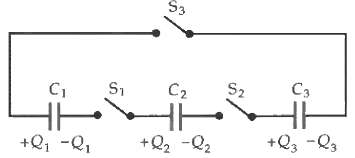
A parallel combination of three capacitors, C1 = 2 ?F, C2 = 4 ?F, and C3 = 6 ?F, is charged with a 200-V source. The capacitors are then disconnected from both the voltage source and each other and are reconnected positive plates to negative plates as shown in Figure. (a) What is the voltage across
Suppose the Geiger tube of Problem 45 is filled with a gas of dielectric constant κ = 1.8 and breakdown field of 2 × 10⁶ V/m.(a) What is the maximum potential difference that can be maintained between the wire and shell?(b) What is the charge per unit length on the wire?
Repeat Problem 49 with the space between the two spherical shells filled with a dielectric of dielectric constant κ.
A certain dielectric with a dielectric constant κ = 24 can withstand an electric field of 4 × 10⁷ V/m. Suppose we want to use this dielectric to construct a 0.1-μF capacitor that can withstand a potential difference of 2000 V.(a) What is the minimum plate separation?(b) What must the area of the
A parallel-plate capacitor has plates separated by a distance s. The space between the plates is filled with two dielectrics, one of thickness ¼ s and dielectric constant κ1, the other with thickness ¾ s and dielectric constant κ2. Find the capacitance of this capacitor in terms of C0, the
A parallel-plate capacitor with no dielectric has a capacitance C0. If the separation between the plates is d, and a slab with dielectric constant κ and thickness t < d is placed in the capacitor, find the new capacitance.
The membrane of the axon of a nerve cell is a thin cylindrical shell of radius r = 10–5 m, length L = 0.1 m, and thickness d = 10–8 m. The membrane has a positive charge on one side and a negative charge on the other, and acts as a parallel-plate capacitor of area A = 2πrL and separation d.
What is the dielectric constant of a dielectric on which the induced bound charge density is(a) 80% of the free charge density on the plates of a capacitor filled by the dielectric,(b) 20% of the free charge density, and(c) 98% of the free charge density?
Two parallel plates have charges Q and –Q. When the space between the plates is devoid of matter, the electric field is 2.5 × 10⁵ V/m. When the space is filled with a certain dielectric, the field is reduced to 1.2 × 10⁵ V/m.(a) What is the dielectric constant of the dielectric?(b) If Q = 10
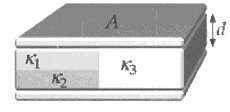
Find the capacitance of the parallel-plate capacitor shown in Figure.
A parallel–plate capacitor has plates of area 600 cm2 and a separation of 4 mm. The capacitor is charged to 100 V and is then disconnected from the battery.(a) Find the electric field E0 and the electrostatic energy U. A dielectric of constant κ = 4 is then inserted, completely filling the space
A parallel-plate capacitor is constructed using a dielectric whose constant varies with position. The plates have area A. The bottom plate is at y = 0 and the top plate is at y = y0. The dielectric constant is given as a function of y according to κ = 1 + (3/y0)y.(a) What is the capacitance?(b)
A 1.0-μF capacitor is connected in parallel with a 2.0-μF capacitor, and the combination is connected in series with a 6.0-μF capacitor. What is the equivalent capacitance of this combination?
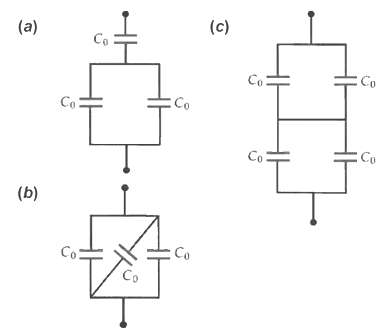
Determine the capacitance of each of the networks shown in Figure.
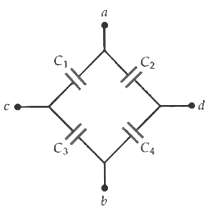
Figure shows four capacitors connected in the arrangement known as a capacitance bridge. The capacitors are initially uncharged. What must be the relation between the four capacitances so that the potential between points c and d is zero when a voltage V is applied between points a and b?
Showing 4400 - 4500
of 8940
First
38
39
40
41
42
43
44
45
46
47
48
49
50
51
52
Last
Step by Step Answers

 Get 50% OFF
Claim Now
Get 50% OFF
Claim Now