New Semester
Started
Get
50% OFF
Study Help!
--h --m --s
Claim Now
Question Answers
Textbooks
Find textbooks, questions and answers
Oops, something went wrong!
Change your search query and then try again
S
Books
FREE
Study Help
Expert Questions
Accounting
General Management
Mathematics
Finance
Organizational Behaviour
Law
Physics
Operating System
Management Leadership
Sociology
Programming
Marketing
Database
Computer Network
Economics
Textbooks Solutions
Accounting
Managerial Accounting
Management Leadership
Cost Accounting
Statistics
Business Law
Corporate Finance
Finance
Economics
Auditing
Tutors
Online Tutors
Find a Tutor
Hire a Tutor
Become a Tutor
AI Tutor
AI Study Planner
NEW
Sell Books
Search
Search
Sign In
Register
study help
physics
mechanics
Fundamentals of Ethics for Scientists and Engineers 1st Edition Edmund G. Seebauer, Robert L. Barry - Solutions
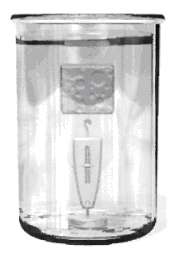
A large piece of cork weighs 0.285 N in air. When held submerged underwater by a spring scale as shown in Figure, the spring scale reads 0.855 N. Find the density of the cork.
As you step onto the Icarus spacecraft, you are supposed to give a very accurate report of your weight. As you approach the front of the line, you realize that you’ve forgotten to subtract the buoyant force exerted on you by the earth’s atmosphere. Estimate the correction that you’ll have to
A helium balloon lifts a basket and cargo of total weight 2000 N under standard conditions, in which the density of air is 1.29 kg/m3 and the density of helium is 0.178 kg/m3. What is the minimum volume of the balloon?
Zoe is packing her belongings and moving in with Margaret. Her books are in boxes, which she plans to float down the river to Margaret’s shack on a square raft that is 3 m on each side and 11 cm thick. It is made of wood having a specific gravity of 0.6. If each box has a mass of 20 kg, how many
An object has neutral buoyancy when its density equals that of the liquid in which it is submerged, which means that it neither floats nor sinks. If the average density of an 85-kg diver is 0.96 kg/L, what mass of lead should be added to give him neutral buoyancy?
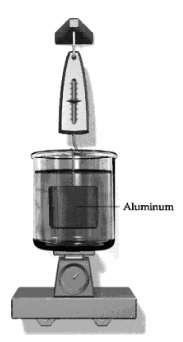
A beaker of mass 1 kg containing 2 kg of water rests on a scale. A 2-kg block of aluminum (specific gravity 2.70) suspended from a spring scale is submerged in the water as in Figure. Find the readings of bothscales.
A ship sails from seawater (specific gravity 1.025) into fresh water and therefore sinks slightly. When its load of 600,000 kg is removed, it returns to its original level. Assuming that the sides of the ship are vertical at the water line, find the mass of the ship before it was unloaded.
The hydrometer shown in figure is a device for measuring the density of liquids. The bulb contains lead shot, and the density can be read directly from the liquid level on the stem after the hydrometer has been calibrated. The volume of the bulb is 20mL, the stem is 15 cm long and has a diameter of
Water flows at 0.65 m/s through a hose with a diameter of 3cm. The diameter of the nozzle is 0.30 cm.(a) At what speed does the water pass through the nozzle?(b) If the pump at one end of the hose and the nozzle at the other end are at the same height, and if the pressure at the nozzle is
Water is flowing at 3 m/s in a horizontal pipe under a pressure of 200 kPa. The pipe narrows to half its original diameter.(a) What is the speed of flow in the narrow section?(b) What is the pressure in the narrow section?(c) How do the volume flow rates in the two sections compare?
The pressure in a section of horizontal pipe with a diameter of 2 cm is 142 kPa. Water flows through the pipe at 2.80 L/s. If the pressure at a certain point is to be reduced to 101 kPa by constricting a section of the pipe, what should the diameter of the constricted section be?
Blood flows in an aorta of radius 9 mm at 30 cm/s.(a) Calculate the volume flow rate in liters per minute.(b) Although the cross-sectional area of a capillary is much smaller than that of the aorta, there are many capillaries, so their total cross-sectional area is much larger. If all the blood
Dorothy is up on her 15-m x 15-m roof enjoying the view of Kansas. Suddenly, a strong wind blows down her ladder, leaving her stranded. She knows that a high wind reduces the air pressure on the roof, and that there is a danger that the atmospheric pressure inside the house will blow the roof off.
A large tank of water is tapped a distance h below the water surface by a small pipe as in Figure. Find the distance x reached by the water flowing out the pipe.
The $8-billion, 800-mile long Alaskan Pipeline has a capacity of 240,000 m3 of oil per day. It has a standard radius of 60 cm. Find the pressure P' at a point where the pipe has half the standard radius. Take the standard pressure to be P = 180kPa and the density of oil to be 800 kg/m3.
Water flows through a Venturi meter like that in Example 13-9 with a pipe diameter of 9.5 cm and a constriction diameter of 5.6 cm. The U-tube manometer is partially filled with mercury. Find the flow rate of the water in the pipe of 9.5-cm diameter if the difference in the mercury level in the
A firefighter holds a hose with a bend in it as in figure. Water is expelled from the hose in a stream of radius 1.5 cm at a speed of 30 m/s.(a) What mass of water emerges from the hose in 1 s?(b) What is the horizontal momentum of this water?(c) Before reaching the bend, the water has momentum
A fountain designed to stray a column of water 12 m into the air has a 1-cm-diameter nozzle at ground level. The water pump is 3 m below the ground. The pipe to the nozzle has a diameter of 2 cm. Find the necessary pump pressure.
In figure(a) Find the distance x at which the water strikes the ground as a function of h and H.(b) Show that there are two values of h that are equidistant from the point h = ½ H that give the same distance x.(c) Show that x is a maximum when h = ½ H. What is the value of this maximum distance x?
A horizontal tube with an inside diameter of 1.2 mm and a length of 25 cm has water flowing through it at 0.30mL/s. Find the pressure difference required to drive this flow if the viscosity of water is 1.00mPa∙s.
Blood takes about 1.0 s to pass through a 1-mm-long capillary of the human circulatory system. If the diameter of the capillary is 7 mm and the pressure drop is 2.60 kPa, find the viscosity of blood.
A certain object has a density just slightly less than that of water so that it floats almost completely submerged. However, the object is more compressible than water. What happens if the floating object is given a slight push to submerge it?
A glass of water is accelerating to the right along a horizontal surface. What is the origin of the force that produces the acceleration on a small element of water in the middle of the glass? Explain with a picture.
A 4.0-g Ping-Pong ball is attached by a thread to the bottom of a container. When the container is filled with water so that the ball is totally submerged, the tension in the thread is 2.8 x 10⁻² N. Determine the diameter of the ball.
Seawater has a bulk modulus of 2.3 x 10⁹ N/m2. Find the density of seawater at a depth where the pressure is 800 atm if the density at the surface is 1025 kg/m3.
Your car misses a turn and sinks into a small lake to a depth of 8 m. Your quick mind tells you that the chances of driving out are slim, so you’d better swim for it. The car door, however, is not budging, even though it seems undamaged.(a) If the outside area of the car door is 0.9 m2, what is
A solid cubical block of side length 0.6 m is suspended from a spring balance. When the block is in water, the spring balance reads 80% of the reading when the block is in air. Determine the density of the block.
When submerged in water, a block of copper has an apparent weight of 56 N. What fraction of this copper block will be submerged if floated on a pool of mercury?
A 4.5-kg block of material floats on ethanol with 10% of its volume above the liquid surface. What fraction of this block will be submerged if floated on water?
A block of wood of 1.5-kg mass floats on water with 68% of its volume submerged. A lead block is placed on the wood and the wood is then fully submerged. Find the mass of the lead block.
A Styrofoam cube, 25 cm on a side, is weighed on a simple beam balance. The balance is in equilibrium when a 20-g mass of brass is placed on the opposite pan of the balance. Find the true mass of the Styrofoam cube. We shall neglect the buoyancy of the brass.
A spherical shell of copper with an outer diameter of 12 cm floats on water with half its volume above the water surface. Determine the inner diameter of the shell.
A beaker filled with water is balanced on the left cup of a scale. A cube 4 cm on a side is attached to a string and lowered into the water so that it is completely submerged. The cube is not touching the bottom of the beaker. A weight m is added to the system to retain equilibrium. What is the
Crude oil has a viscosity of about 0.8 Pa∙s at normal temperature. A 50-km pipeline is to be constructed from an oil field to a tanker terminal. The pipeline is to deliver oil at the terminal at a rate of 500 L/s and the flow through the pipeline is to be laminar to minimize the pressure needed
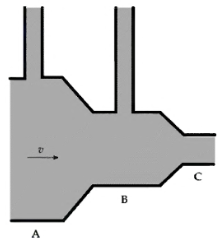
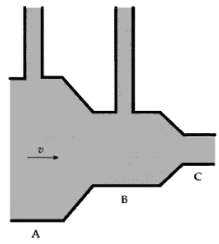
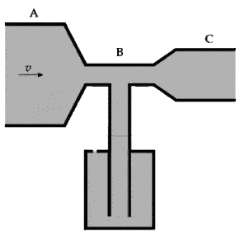
Water flows through the pipe in Figure and exits to the atmosphere at C. The diameter of the pipe is 2.0 cm at A, 1.0 cm at B, and 0.8 cm at C. The gauge pressure in the pipe at A is 1.22 atm and the flow rate is 0.8 L/s. The vertical pipes are open to the air. Find the level of the liquid–air
Repeat Problem 83 with the flow rate reduced to 0.6 L/s and the size of the opening at C reduced so that the pressure in the pipe at A remains unchanged.
Figure is a sketch of an aspirator, a simple device that can be used to achieve a partial vacuum in a reservoir connected to the vertical tube at B. An aspirator attached to the end of a garden hose may be used to deliver soap or fertilizer from the reservoir. Suppose that the diameter at A is 2.0
A cylindrical buoy at the entrance of a harbor has a diameter of 0.9 m and a height of 2.6 m. The mass of the buoy is 600 kg. It is attached to the bottom of the sea with a nylon cable of negligible mass. The specific gravity of the seawater is 1.025.(a) How much of the buoy is visible when the
If an oil-filled manometer can be read to A ± 0.05 mm, what is the smallest pressure change that can be detected?
A rectangular dam 30 m wide supports a body of water to a height of 25 m.(a) Neglecting atmospheric pressure, find the total force due to water pressure acting on a thin strip of the dam of height dy located at a depth y.(b) Integrate your result in part (a) to find the total horizontal force
A U-tube is filled with water until the liquid level is 28 cm above the bottom of the tube. An oil of specific gravity 0.78 is now poured into one arm of the U-tube until the level of the water in the other arm of the tube is 34 cm above the bottom of the tube. Find the level of the oil–water and
A U-tube contains liquid of unknown specific gravity. An oil of density 800 kg/m3 is poured into one arm of the tube until the oil column is 12 cm high. The oil–air interface is then 5.0 cm above the liquid level in the other arm of the U-tube. Find the specific gravity of the liquid.
A lead block is suspended from the underside of a 0.5-kg block of wood of specific gravity of 0.7. If the upper surface of the wood is just level with the water, what is the mass of the lead block?
A helium balloon can just lift a load of 750 N. The skin of the balloon has a mass of 1.5 kg.(a) What is the volume of the balloon?(b) If the volume of the balloon is twice that found in part (a), what is the initial acceleration of the balloon when it carries a load of 900 N?
A hollow sphere with an inner radius R and outer radius 2R is made of material of density ρ0 and is floating in a liquid of density 2ρ0. The interior is now filled with material of density ρ so that the sphere just floats completely submerged. Find ρ’.
A balloon is filled with helium at atmospheric pressure. The skin of the balloon has a mass of 2.8 kg and the volume of the balloon is 16 m3. What is the greatest weight that this balloon can lift?
As mentioned in the discussion of the law of atmospheres, the fractional decrease in atmospheric pressure is proportional to the change in altitude. Expressed in mathematical terms we have where C is a constant.(a) Show that P(h) = P0 e-Ch is a solution of the differential equation.(b) Show that if
A submarine has a total mass of 2.4 x 10⁶ kg, including crew and equipment. The vessel consists of two parts, the pressure hull, which has a volume of 2 x 10³ m3, and the diving tanks, which have a volume of 4 x 10² m3. When the sub cruises on the surface, the diving tanks are filled with air; when
A marine salvage crew raises a crate that measures 1.4 m x 0.75 m x 0.5 m. The average density of the empty crate is the same as seawater, 1.025 x 10³ kg/m3, and its mass when empty is 32 kg. The crate contains gold bullion that fills 36% of its volume; the remaining volume is filled with
When the hydrometer of Problem 42 is placed in a liquid whose specific gravity is greater than some minimum value the device floats with part of the glass tube above the liquid level. Consider a hydrometer that has a spherical bulb 2.4 cm in diameter. The glass tube attached to the bulb is 20 cm
A large beer keg of height H and cross-sectional area A1 is filled with beer. The top is open to atmospheric pressure. At the bottom is a spigot opening of area A2, which is much smaller than A1.(a) Show that when the height of the beer is h, the speed of the beer leaving the spigot is
(Multiple choice)(1)If the gauge pressure is doubled, the absolute pressure will be(a) Halved.(b) Doubled.(c) Unchanged.(d) Squared.(e) Not enough information is given to determine the effect.(2)A rock of mass M with a density twice that of water is sitting on the bottom of an aquarium tank filled
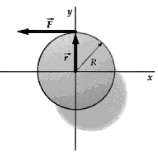
A force of magnitude F is applied horizontally in the negative x direction to the rim of a disk of radius R as shown in figure. Write F and r in terms of the unit vectors i, j, and k, and compute the torque produced by the force about the origin at the center of thedisk.
Compute the torque about the origin for the force F = -mg j acting on a particle at r = x i + yj, and show that this torque is independent of the y coordinate.
Find A x B for(a) A = 4i and B = 6i + 6j,(b) A = 4i and B = 6i + 6k, and(c) A = 2i + 3j andB = -3i + 2j.
Under what conditions is the magnitude of A x B equal to A ∙ B?
A particle moves in a circle of radius r with an angular velocity w.(a) Show that its velocity is v = ώ.(b) Show that its centripetal acceleration is αc = ώ x = ώ x (ώ x r).
If A = 4i, Bz = 0, |B| = 5, and A x B = 12 k, determine B.
If A = 3j, A x B = 9i, and A ∙ B = 12, find B
What is the angle between a particle’s linear momentum p and its angular momentum L?
A particle moving at constant velocity has zero angular momentum about a particular point. Show that the particle either has passed through that point or will pass through it.
A 2-kg particle moves at a constant speed of 3.5 m/s around a circle of radius 4 m.(a) What is its angular momentum about the center of the circle?(b) What is its moment of inertia about an axis through the center of the circle and perpendicular to the plane of the motion?(c) What is the angular
A 2-kg particle moves at constant speed of 4.5 m/s along a straight line.(a) What is the magnitude of its angular momentum about a point 6 m from the line?(b) Describe qualitatively how its angular speed about that point varies with time.
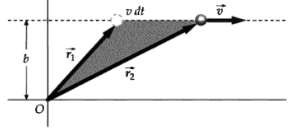
A particle is traveling with a constant velocity v along a line that is a distance b from the origin O (Figure). Let dA be the area swept out by the position vector from O to the particle in time dt. Show that dA/dt is constant in time and equal to 1/2L/m, where L is the angular momentum of the
A 15-g coin of diameter 1.5 cm is spinning at 10 rev/s about a vertical diameter at a fixed point on a tabletop.(a) What is the angular momentum of the coin about its center of mass?(b) What is its angular momentum about a point on the table 10 cm from the coin? If the coin spins about a vertical
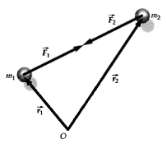
Two particles of masses m1 and m2 are located at r1 and r2 relative to some origin O as in Figure. They exert equal and opposite forces on each other. Calculate the resultant torque exerted by these internal forces about the origin O and show that it is zero if the forces F1 and F2 lie along the
A 1.8-kg particle moves in a circle of radius 3.4 m. The magnitude of its angular momentum relative to the center of the circle depends on time according to L = (4 N ∙ m)t.(a) Find the magnitude of the torque acting on the particle.(b) Find the angular speed of the particle as a function of
A uniform cylinder of mass 90 kg and radius 0.4 m is mounted so that it turns without friction on its fixed symmetry axis. It is rotated by a drive belt that wraps around its perimeter and exerts a constant torque. At time t = 0, its angular velocity is zero. At time t = 25 s, its angular velocity
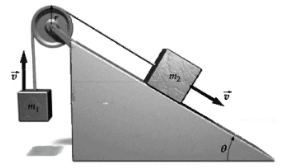
In Figure, the incline is frictionless and the string passes through the center of mass of each block. The pulley has a moment of inertia I and a radius r.(a) Find the net torque acting on the system (the two masses, string, and pulley) about the center of the pulley.(b) Write an expression
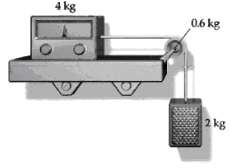
From her elevated DJ booth at a dance club, Caroline is lowering a 2-kg speaker using a 0.6-kg disk of radius 8 cm as a pulley (Figure). The speaker wire runs straight up from the speaker, over the pulley, and then horizontally across the table. She attaches the wire to the 4-kg amplifier on her
Work Problem 24 for the case in which the coefficient of friction between the table and the 4-kg amplifier is 0.25.
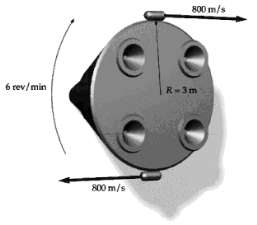
Figure shows the rear view of a spaceship that is rotating about its longitudinal axis at 6 rev/min. The occupants wish to stop this rotation. They have small jets mounted tangentially, at a distance R = 3 m from the axis, as indicated, and can eject 10 g/s of gas from each jet with a nozzle
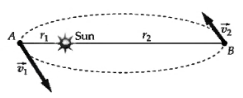
A planet moves in an elliptical orbit about the sun with the sun at one focus of the ellipse as in figure.(a) What is the torque produced by the gravitational force of attraction of the sun for the planet?(b) At position A, the planet is a distance r1 from the sun and is moving with a speed v1
A man stands on a frictionless platform that is rotating with an angular speed of 1.5 rev/s. His arms are outstretched, and he holds a heavy weight in each hand. The moment of inertia of the man, the extended weights, and the platform is 6 kg ∙ m2. When the man pulls the weights inward toward his
A small blob of putty of mass m falls from the ceiling and lands on the outer rim of a turntable of radius R and moment of inertia I0 that is rotating freely with angular speed ωi about its vertical fixed symmetry axis.(a) What is the post collision angular speed of the turntable plus putty?(b)
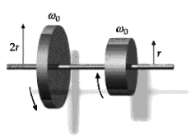
Two disks of identical mass but different radii (r and 2r) are spinning on frictionless bearings at the same angular speed ?0 but in opposite directions (Figure). The two disks are brought slowly together. The resulting frictional force between the surfaces eventually brings them to a common
A block of mass m sliding on a frictionless table is attached to a string that passes through a hole in the table. Initially, the block is sliding with speed v0 in a circle of radius r0. Find(a) The angular momentum of the block,(b) The kinetic energy of the block, and(c) The tension in the string.
At the beginning of each term, a physics professor named Dr. Zeus shows the class his expectations of them through a demonstration that he calls “Lesson #1.” He stands at the center of a turntable that can rotate without friction. He then takes a 2-kg globe of the earth and swings it around his
The sun’s radius is 6.96 x 10⁸ m, and it rotates with a period of 25.3 d. Estimate the new period of rotation of the sun if it collapses with no loss of mass to become a neutron star of radius 5 km.
Arriving at the baggage claim area in a small airport, Alan (mass m) discovers a large turntable (radius R and moment of inertia I) that is spinning out of control. Not wanting to pass up an opportunity for magnificence, Alan leaps onto the edge of the turntable, which continues to spin freely with
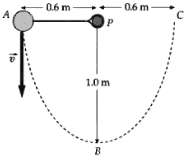
A 0.2-kg point mass moving on a frictionless horizontal surface is attached to a rubber band whose other end is fixed at point P. The rubber band exerts a force F = bx toward P, where x is the length of the rubber band and b is an unknown coefficient. The mass moves along the dotted line in Figure
A 2-g particle moves at a constant speed of 3 mm/s around a circle of radius 4 mm.(a) Find the magnitude of the angular momentum of the particle.(b) If L = √ℓ (ℓ + 1)h, find the value of ℓ (ℓ + 1) and the approximate value of ℓ.(c) Explain why the quantization of angular momentum is not
In the HBr molecule, the mass of the bromine nucleus is 80 times that of the hydrogen nucleus (a single proton); consequently, in calculating the rotational motion of the molecule, one may, to a good approximation, assume that the Br nucleus remains stationary as the H atom (mass 1.67 x 10⁻²⁷ kg)
The equilibrium separation between the nuclei of the nitrogen molecule is 0.11 nm. The mass of each nitrogen nucleus is 14 u, where u = 1.66 x 10⁻²⁷ kg. We wish to calculate the energies of the three lowest angular momentum states of the nitrogen molecule.(a) Approximate the nitrogen molecule as a
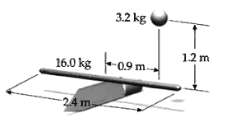
A 16.0-kg, 2.4-m-long rod is supported on a knife edge at its midpoint. A 3.2-kg ball of clay is dropped from rest from a height of 1.2 m and makes a perfectly inelastic collision with the rod 0.9 m from the point of support (Figure). Find the angular momentum of the rod-and-clay system immediately
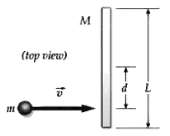
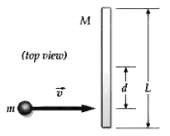
Figure shows a thin bar of length L and mass M, and a small blob of putty of mass m. The system is supported on a frictionless horizontal surface. The putty moves to the right with velocity v, strikes the bar at a distance d from the center of the bar, and sticks to the bar at the point of contact.
In Problem 50, replace the blob of putty with a small hard sphere of negligible size that collides elastically with the bar. Find d such that the sphere is at rest after the collision.
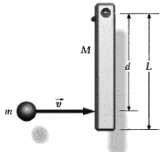
Figure shows a uniform rod of length L and mass M pivoted at the top. The rod, which is initially at rest, is struck by a particle of mass m at a point d = 0.8L below the pivot. Assume that the collision is perfectly inelastic. What must be the speed v of the particle so that the maximum angle
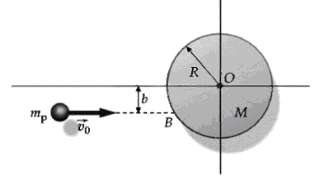
A projectile of mass mp is traveling at a constant velocity v0 toward a stationary disk of mass M and radius R that is free to rotate about a pivot through its axis O (Figure). Before impact, the projectile is traveling along a line displaced a distance b below the axis. The projectile strikes the
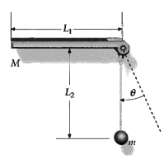
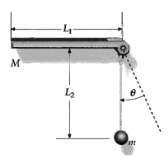
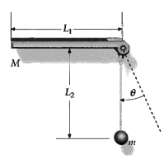
A uniform rod of length L1 and mass M = 0.75 kg is supported by a hinge at one end and is free to rotate in the vertical plane (Figure). The rod is released from rest in the position shown. A particle of mass m = 0.5 kg is supported by a thin string of length L2 from the hinge. The particle sticks
Returning to Figure, this time set L1 = 1.2 m, M = 2.0 kg, and L2 = 0.8 m. After the inelastic collision, ?max = 37o. Find m. How much energy is dissipated in this inelastic collision?
Suppose that in Figure, m = 0.4 kg, M = 0.75 kg, L1 = 1.2 m, and L2 = 0.8 m. What minimum initial angular velocity must be imparted to the rod so that the system will revolve completely about the hinge following the inelastic collision? How much energy is then dissipated in the inelasticcollision?
Repeat Problem 56 if the collision between the rod and particle is elastic.
The angular momentum of the propeller of a small airplane points forward.(a) As the plane takes off, the nose lifts up and the airplane tends to veer to one side. To which side does it veer and why?(b) If the plane is flying horizontally and suddenly turns to the right, does the nose of the plane
A car is powered by the energy stored in a single flywheel with an angular momentum L. Discuss the problems that would arise for various orientations of L and various maneuvers of the car. For example, what would happen if L points vertically upward and the car travels over a hilltop or through a
A bicycle wheel of radius 28 cm is mounted at the middle of an axle 50 cm long. The tire and rim weigh 30 N. The wheel is spun at 12 rev/s, and the axle is then placed in a horizontal position with one end resting on a pivot.(a) What is the angular momentum due to the spinning of the wheel? (Treat
A uniform disk of mass 2.5 kg and radius 6.4 cm is mounted in the center of a 10-cm axle and spun at 700rev/min. The axle is then placed in a horizontal position with one end resting on a pivot. The other end is given an initial horizontal velocity such that the precession is smooth with no
A particle of mass 3 kg moves with velocity v = 3 m/si along the line z = 0, y = 5.3 m.(a) Find the angular momentum L relative to the origin when the particle is at x = 12 m, y = 5.3 m.(b) A force F = –3 Ni is applied to the particle. Find the torque relative to the origin due to this force.
The position vector of a particle of mass 3 kg is given by r = 4i + 3t2 j, where r is in meters and t is in seconds. Determine the angular momentum and torque acting on the particle about the origin.
An ice skater starts her pirouette with arms outstretched, rotating at 1.5 rev/s. Estimate her rotational speed (in revolutions per second) when she brings her arms flat against her body.
Showing 6900 - 7000
of 21795
First
63
64
65
66
67
68
69
70
71
72
73
74
75
76
77
Last
Step by Step Answers

 Get 50% OFF
Claim Now
Get 50% OFF
Claim Now