New Semester
Started
Get
50% OFF
Study Help!
--h --m --s
Claim Now
Question Answers
Textbooks
Find textbooks, questions and answers
Oops, something went wrong!
Change your search query and then try again
S
Books
FREE
Study Help
Expert Questions
Accounting
General Management
Mathematics
Finance
Organizational Behaviour
Law
Physics
Operating System
Management Leadership
Sociology
Programming
Marketing
Database
Computer Network
Economics
Textbooks Solutions
Accounting
Managerial Accounting
Management Leadership
Cost Accounting
Statistics
Business Law
Corporate Finance
Finance
Economics
Auditing
Tutors
Online Tutors
Find a Tutor
Hire a Tutor
Become a Tutor
AI Tutor
AI Study Planner
NEW
Sell Books
Search
Search
Sign In
Register
study help
physics
mechanics
Fundamentals of Ethics for Scientists and Engineers 1st Edition Edmund G. Seebauer, Robert L. Barry - Solutions
A uniform disk of mass M and radius R is pivoted such that it can rotate freely about a horizontal axis through its center and perpendicular to the plane of the disk. A small particle of mass m is attached to the rim of the disk at the top, directly above the pivot. The system is given a gentle
A ring 1.5 m in diameter is pivoted at one point on its circumference so that it is free to rotate about a horizontal axis. Initially, the line joining the support and center is horizontal.(a) If released from rest, what is its maximum angular velocity?(b) What must its initial angular velocity be
You set out to design a car that uses the energy stored in a flywheel consisting of a uniform 100-kg cylinder of radius R. The flywheel must deliver an average of 2 MJ of mechanical energy per kilometer, with a maximum angular velocity of 400 rev/s. Find the least value of R such that the car can
A ladder that is 8.6 m long and has mass 60 kg is placed in a nearly vertical position against the wall of a building. You stand on a rung with your center of mass at the top of the ladder. Assume that your mass is 80 kg. As you lean back slightly, the ladder begins to rotate about its base away
Consider the situation in Problem 58 with a ladder of length L and mass M. Find the ratio of your speed as you hit the ground if you hang on to the ladder to your speed if you immediately step off as a function of the mass ratio M/m, where m is your mass.
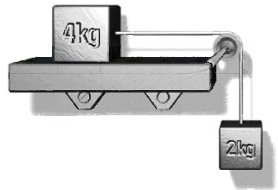
A 4-kg block resting on a frictionless horizontal ledge is attached to a string that passes over a pulley and is attached to a hanging 2-kg block (Figure). The pulley is a uniform disk of radius 8 cm and mass 0.6 kg. (a) Find the speed of the 2-kg block after it falls from rest a distance of
For the system in Problem 60, find the linear acceleration of each block and the tension in the string.
Work Problem 60 for the case in which the coefficient of friction between the ledge and the 4-kg block is 0.25.
Work Problem 61 for the case in which the coefficient of friction between the ledge and the 4-kg block is 0.25.
In 1993, a giant yo-yo of mass 400 kg and measuring about 1.5 m in radius was dropped from a crane 57 m high. Assuming the axle of the yo-yo had a radius of r = 0.1 m, find the velocity of the descent v at the end of the fall.
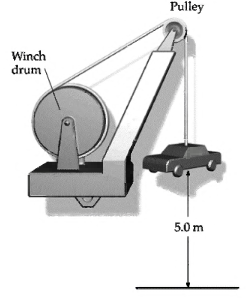
A 1200-kg car is being unloaded by a winch. At the moment shown in Figure, the gearbox shaft of the winch breaks, and the car falls from rest. During the car’s fall, there is no slipping between the (massless) rope, the pulley, and the winch drum. The moment of inertia of the winch drum is 320
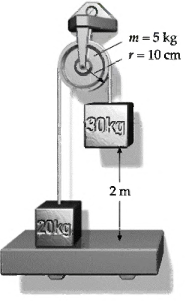
The system in Figure is released from rest. The 30-kg block is 2 m above the ledge. The pulley is a uniform disk with a radius of 10 cm and mass of 5 kg. Find (a) The speed of the 30-kg block just before it hits the ledge, (b) The angular speed of the pulley at that time, (c) The
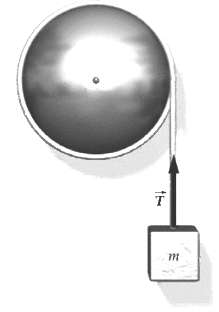
A uniform sphere of mass M and radius R is free to rotate about a horizontal axis through its center. A string is wrapped around the sphere and is attached to an object of mass m as shown in Figure. Find (a) The acceleration of the object, and (b) The tension in thestring.
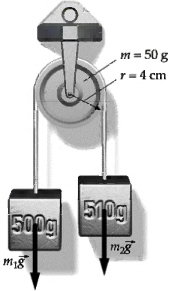
An Atwood’s machine has two objects of mass m1 = 500 g and m2 = 510 g, connected by a string of negligible mass that passes over a frictionless pulley (Figure). The pulley is a uniform disk with a mass of 50 g and a radius of 4 cm. The string does not slip on the pulley. (a) Find the
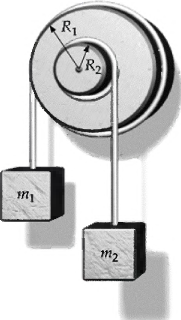
Two objects are attached to ropes that are attached to wheels on a common axle as shown in Figure. The total moment of inertia of the two wheels is 40 kg·m2. The radii of the wheels are R1 = 1.2 m and R2 = 0.4 m. (a) If m1 = 24 kg, find m2 such that there is no angular acceleration of the
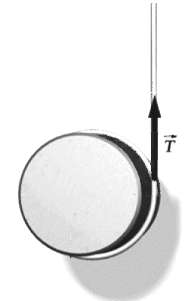
A uniform cylinder of mass M and radius R has a string wrapped around it. The string is held fixed, and the cylinder falls vertically as shown in Figure. (a) Show that the acceleration of the cylinder is downward with a magnitude a = 2g/3. (b) Find the tension in the string.
The cylinder in Figure is held by a hand that is accelerated upward so that the center of mass of the cylinder does not move. Find (a) The tension in the string, (b) The angular acceleration of the cylinder, and (c) The acceleration of the hand.
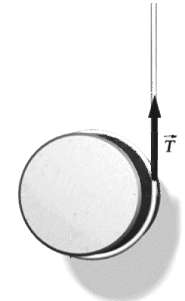
A 0.1-kg yo-yo consists of two solid disks of radius 10 cm joined together by a massless rod of radius 1 cm and a string wrapped around the rod. One end of the string is held fixed and is under constant tension T as the yo-yo is released. Find the acceleration of the yo-yo and the tension T.
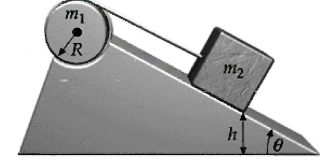
A uniform cylinder of mass m1 and radius R is pivoted on frictionless bearings. A massless string wrapped around the cylinder connects to a mass m2, which is on a frictionless incline of angle θ as shown in Figure. The system is released from rest with m2 a height h above the bottom
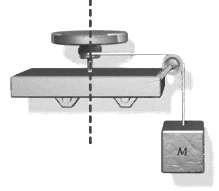
A device for measuring the moment of inertia of an object is shown in Figure. A circular platform has a concentric drum of radius 10 cm about which a string is wound. The string passes over a frictionless pulley to a weight of mass M. The weight is released from rest, and the time for it to drop a
A ball rolls without slipping along a horizontal plane. Show that the frictional force acting on the ball must be zero.
A homogeneous cylinder of radius 18 cm and mass 60 kg is rolling without slipping along a horizontal floor at 5 m/s. How much work is needed to stop the cylinder?
Find the percentages of the total kinetic energy associated with rotation and translation, respectively, for an object that is rolling without slipping if the object is(a) A uniform sphere,(b) A uniform cylinder, or(c) A hoop.
A hoop of radius 0.40 m and mass 0.6 kg is rolling without slipping at a speed of 15 m/s toward an incline of slope 30o. How far up the incline will the hoop roll, assuming that it rolls without slipping?
A ball rolls without slipping down an incline of angle θ. The coefficient of static friction is μs. Find(a) The acceleration of the ball,(b) The force of friction, and(c) The maximum angle of the incline for which the ball will roll without slipping.
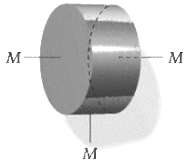
An empty can of total mass 3M is rolling without slipping. If its mass is distributed as in Figure, what is the value of the ratio of kinetic energy of translation to the kinetic energy of rotation about its center of mass?
A bicycle of mass 14 kg has 1.2-m diameter wheels, each of mass 3 kg. The mass of the rider is 38 kg. Estimate the fraction of the total kinetic energy of bicycle and rider associated with rotation of the wheels.
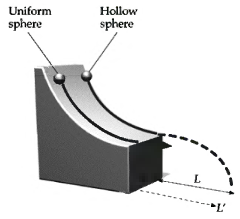
A hollow sphere and uniform sphere of the same mass m and radius R roll down an inclined plane from the same height H without slipping (Figure). Each is moving horizontally as it leaves the ramp. When the spheres hit the ground, the range of the hollow sphere is L. Find the range
A hollow cylinder and a uniform cylinder are rolling horizontally without slipping. The speed of the hollow cylinder is v. The cylinders encounter an inclined plane that they climb without slipping. If the maximum height they reach is the same, find the initial speed v¢ of the uniform cylinder.
A hollow, thin-walled cylinder and a solid sphere start from rest and roll without slipping down an inclined plane of length 3 m. The cylinder arrives at the bottom of the plane 2.4 s after the sphere. Determine the angle between the inclined plane and the horizontal.
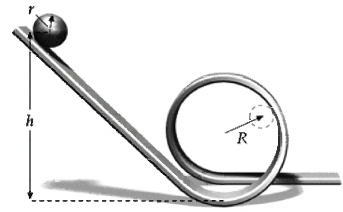
A uniform solid sphere of radius r starts from rest at a height h and rolls without slipping along the loop-the-loop track of radius R as shown in Figure. (a) What is the smallest value of h for which the sphere will not leave the track at the top of the loop? (b) What
A wheel has a thin 3.0-kg rim and four spokes each of mass 1.2 kg. Find the kinetic energy of the wheel when it rolls at 6 m/s on a horizontal surface.
Two uniform 20-kg disks of radius 30 cm are connected by a short rod of radius 2 cm and mass 1 kg. When the rod is placed on a plane inclined at 30o, such that the disks hang over the sides, the assembly rolls without slipping. Find(a) The linear acceleration of the system, and(b) The angular
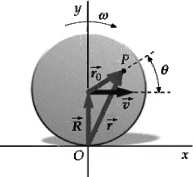
A wheel of radius R rolls without slipping at a speed V. The coordinates of the center of the wheel are X, Y. (a) Show that the x and y coordinates of point P in Figure are X + r0 cos θ and R + r0 sin θ, respectively,. (b) Show that the total velocity v of point
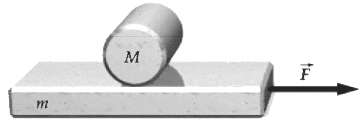
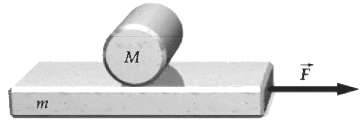
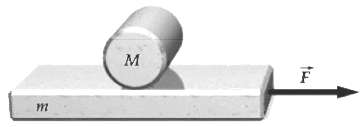
A uniform cylinder of mass M and radius R rests on a block of mass m, which in turn is at rest on a horizontal, frictionless table (Figure 9-58). If a horizontal force is applied to the block, it accelerates and the cylinder rolls without slipping. Find the acceleration of the block.
(a) Find the angular acceleration of the cylinder in Problem 96. Is the cylinder rotating clockwise or counter-clockwise? (b) What is the cylinder's linear acceleration relative to the table? Let the direction of be the positive direction. (c) What is the linear acceleration of the cylinder
If the force in Problem 96 acts over a distance d, find (a) The kinetic energy of the block, and (b) The kinetic energy of the cylinder. (c) Show that the total kinetic energy is equal to the work done on thesystem.
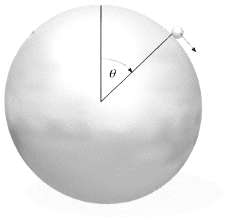
A marble of radius 1 cm rolls from rest without slipping from the top of a large sphere of radius 80 cm, which is held fixed (Figure). Find the angle from the top of the sphere to the point where the marble breaks contact with thesphere.
A bowling ball of mass M and radius R is thrown such that at the instant it touches the floor it is moving horizontally with a speed v0 and is not rotating. It slides for a time t1 a distance s1 before it begins to roll without slipping. (a) If μk is the coefficient of sliding
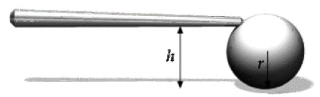
A cue ball of radius r is initially at rest on a horizontal pool table (Figure). It is struck by a horizontal cue stick that delivers a force of magnitude P0 for a very short time Δt. The stick strikes the ball at a point h above the ball’s point of contact with the table. Show that
A uniform spherical ball is set rotating about a horizontal axis with an angular speed ω0 and is placed on the floor. If the coefficient of sliding friction between the ball and the floor is μk, find the speed of the center of mass of the ball when it begins to roll without slipping.
A uniform solid ball resting on a horizontal surface has a mass of 20 g and a radius of 5 cm. A sharp force is applied to the ball in a horizontal direction 9 cm above the horizontal surface. The force increases linearly from 0 to a peak value of 40,000 N in 10-4 s and then decreases linearly to 0
A 0.3-kg billiard ball of radius 3 cm is given a sharp blow by a cue stick. The applied force is horizontal and passes through the center of the ball. The initial velocity of the ball is 4 m/s. The coefficient of kinetic friction is 0.6. (a) For how many seconds does the ball slide before it
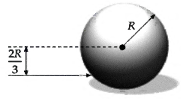
A billiard ball initially at rest is given a sharp blow by a cue stick. The force is horizontal and is applied at a distance 2R/3 below the centerline, as shown in Figure. The initial speed of the ball is v0, and the coefficient of kinetic friction is μk. (a) What is the initial angular speed
A bowling ball of radius R is given an initial velocity v0 down the lane and a forward spin ω0 = 3v0/R. The coefficient of kinetic friction is μk. (a) What is the speed of the ball when it begins to roll without slipping? (b) For how long does the ball slide before it begins to
A solid cylinder of mass M resting on its side on a horizontal surface is given a sharp blow by a cue stick. The applied force is horizontal and passes through the center of the cylinder so that the cylinder begins translating with initial velocity v0. The coefficient of sliding friction between
The moon rotates as it revolves around the earth so that we always see the same side. Use this fact to find the angular velocity (in rad/s) of the moon about its axis. (The period of revolution of the moon about the earth is 27.3 days.)
Find the moment of inertia of a hoop about an axis perpendicular to the plane of the hoop and through its edge.
The radius of a park merry-go-round is 2.2 m. To start it rotating, you wrap a rope around it and pull with a force of 260 N for 12 s. During this time, the merry-go-round makes one complete rotation.(a) Find the angular acceleration of the merry-go-round.(b) What torque is exerted by the rope on
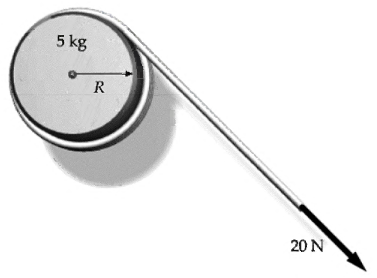
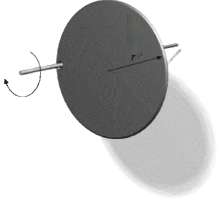
A uniform disk of radius 0.12 m and mass 5 kg is pivoted such that it rotates freely about its central axis (Figure). A string wrapped around the disk is pulled with a force of 20 N.(a) What is the torque exerted on the disk? (b) What is the angular acceleration of the disk? (c) If the
A 0.25-kg rod of length 80 cm is suspended by a frictionless pivot at one end. It is held horizontal and released. Immediately after it is released, what is(a) The acceleration of the center of the rod, and(b) The initial acceleration of a point on the end of the rod?(c) Find the linear velocity of
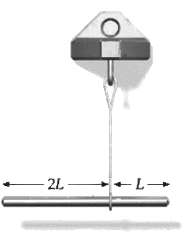
A uniform rod of length 3L is pivoted as shown in Figure and held in a horizontal position. What is the initial angular acceleration ? of the rod upon release?
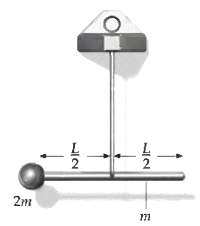
A uniform rod of length L and mass m is pivoted at the middle as shown in Figure. It has a load of mass 2m attached to one of the ends. If the system is released from a horizontal position, what is the maximum velocity of theload?
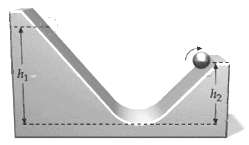
A marble of mass M and radius R rolls without slipping down the track on the left from a height h1 as shown in Figure. The marble then goes up the frictionless track on the right to a height h2. Find h2.
A uniform disk with a mass of 120 kg and a radius of 1.4 m rotates initially with an angular speed of 1100 rev/min.(a) A constant tangential force is applied at a radial distance of 0.6 m. What work must this force do to stop the wheel?(b) If the wheel is brought to rest in 2.5 min, what torque
A park merry-go-round consists of a 240-kg circular wooden platform 4.00 m in diameter. Four children running alongside push tangentially along the platform’s circumference until, starting from rest, the merry-go-round reaches a steady speed of one complete revolution every 2.8 s.(a) If each
A hoop of mass 1.5 kg and radius 65 cm has a string wrapped around its circumference and lies flat on a horizontal frictionless table. The string is pulled with a force of 5 N.(a) How far does the center of the hoop travel in 3 s?(b) What is the angular velocity of the hoop about its center of mass
A vertical grinding wheel is a uniform disk of mass 60 kg and radius 45 cm. It has a handle of radius 65 cm of negligible mass. A 25-kg load is attached to the handle when it is in the horizontal position. Neglecting friction, find(a) The initial angular acceleration of the wheel, and(b) The
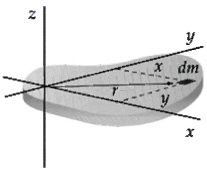
In this problem, you are to derive the perpendicular-axis theorem for planar objects, which relates the moments of inertia about two perpendicular axes in the plane of Figure to the moment of inertia about a third axis that is perpendicular to the plane of figure. Consider the mass element
A uniform disk of radius R and mass M is pivoted about a horizontal axis parallel to its symmetry axis and passing through its edge such that it can swing freely in a vertical plane (Figure). It is released from rest with its center of mass at the same height as the pivot. (a) What is the angular
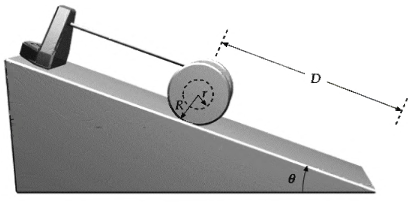
A spool of mass M rests on an inclined plane at a distance D from the bottom. The ends of the spool have radius R, the center has radius r, and the moment of inertia of the spool about its axis is I. A long string of negligible mass is wound many times around the center of the spool. The
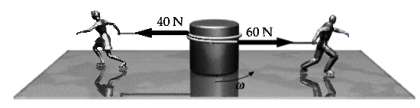
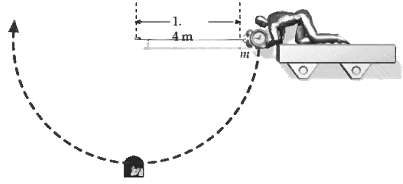
Ian has suggested another improvement for the game of hockey. Instead of the usual two-minute penalty, he would like to see an offender placed in a barrel at mid-ice and then spun in a circle by the other team. When the offender is silly with dizziness, he is put back into the game. Assume that a
A solid metal rod 1.5 m long is free to rotate without friction about a fixed, horizontal axis perpendicular to the rod and passing through one end. The other end is held in a horizontal position. Small coins of mass m are placed on the rod 25 cm, 50 cm, 75 cm, 1 m, 1.25 m, and 1.5 m from the
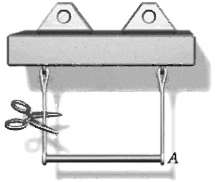
A thin rod of length L and mass M is supported in a horizontal position by two strings, one attached to each end as shown in Figure. If one string is cut, the rod begins to rotate about the point where it connects to the other string (point A in the figure). (a) Find the initial acceleration of the
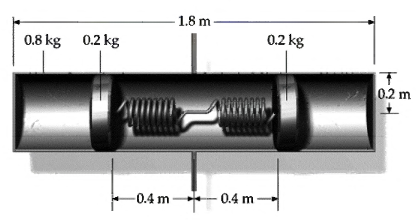
Figure shows a hollow cylinder of length 1.8 m, mass 0.8 kg, and radius 0.2 m. The cylinder is free to rotate about a vertical axis that passes through its center and is perpendicular to the cylinder’s axis. Inside the cylinder are two masses of 0.2 kg each, attached to springs of spring constant
Suppose that for the system described in Problem 129, the spring constants are each k = 60 N/m. The system starts from rest and slowly accelerates until the masses are 0.8 m from the center of the cylinder. How much work was done in the process?
A string is wrapped around a uniform cylinder of radius R and mass M that rests on a horizontal frictionless surface. The string is pulled horizontally from the top with force F.(a) Show that the angular acceleration of the cylinder is twice that needed for rolling without slipping, so that the
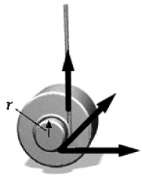
Figure shows a solid cylinder of mass M and radius R to which a hollow cylinder of radius r is attached. A string is wound about the hollow cylinder. The solid cylinder rests on a horizontal surface. The coefficient of static friction between the cylinder and surface is ?s. If a light tension is
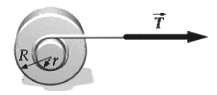
A heavy, uniform cylinder has a mass m and a radius R (Figure). It is accelerated by a force T, which is applied through a rope wound around a light drum of radius r that is attached to the cylinder. The coefficient of static friction is sufficient for the cylinder to roll without slipping. (a)
A uniform stick of length L and mass M is hinged at one end. It is released from rest at an angle θ0 with the vertical. Show that when the angle with the vertical is θ, the hinge exerts a force Fr along the stick and a force Ft perpendicular to the stick given by Fr = 1/2Mg(5 cos θ - 3 cos
(1) True or false: (a) Angular velocity and linear velocity have the same dimensions. (b) All parts of a rotating wheel must have the same angular velocity. (c) All parts of a rotating wheel must have the same angular acceleration.(2)Starting from rest, a disk takes 10 revolutions to
What are the advantages and disadvantages of using the conservation of mechanical energy rather than Newton’s laws to solve problems?
A block of mass m is pushed up against a spring, compressing it a distance x, and the block is then released. The spring projects the block along a frictionless horizontal surface, giving the block a speed v. The same spring projects a second block of mass 4m, giving it a speed 3v. What distance
A pendulum of length L with a bob of mass m is pulled aside until the bob is a distance L/4 above its equilibrium position. The bob is then released. Find the speed of the bob as it passes the equilibrium position.
When she hosts a garden party, Julie likes to launch bagels to her guests with a spring device that she has devised. She places one of her 200-g bagels against a horizontal spring mounted on her gazebo. The force constant of the spring is 300 N/m, and she compresses it 9 cm.(a) Find the work done
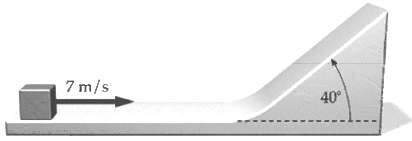
A 3-kg block slides along a frictionless horizontal surface with a speed of 7 m/s (Figure). After sliding a distance of 2 m, the block makes a smooth transition to a frictionless ramp inclined at an angle of 40° to thehorizontal.
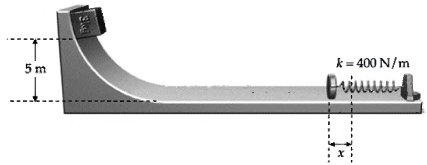
The 3-kg object in Figure is released from rest at a height of 5 m on a curved frictionless ramp. At the foot of the ramp is a spring of force constant k = 400 N/m. The object slides down the ramp and into the spring, compressing it a distance x before coming momentarily to rest. (a) Find
A 15-g ball is shot from a spring gun whose spring has a force constant of 600 N/m. The spring can be compressed 5 cm. How high will the ball go if the gun is aimed vertically?
A stone is projected horizontally with a speed of 20 m/s from a bridge 16 m above the surface of the water. What is the speed of the stone as it strikes the water?
At a dock, a crane lifts a 4000-kg container 30 m, swings it out over the deck of a freighter, and lowers the container into the hold of the freighter, which is 8 m below the level of the dock. How much work is done by the crane? (Neglect friction losses.)
A16-kg child on a play ground swing moves with a speed of 3.4 m/s when the 6-m-long swing is at its lowest point. What is the angle that the swing makes with the vertical when the child is at the highest point?
In 1983, Jacqueline De Creed, driving a 1967 Ford Mustang, made a jump of 71 m, taking off from a ramp inclined at 30° with the horizontal. If the mass of the car and driver was about 900 kg, find the kinetic energy K and potential energy U of De Creed's vehicle at the top point of her flight.
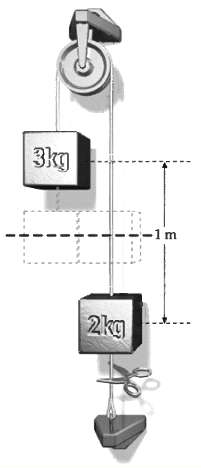
The system in figure is initially at rest when the lower string is cut. Find the speed of the objects when they are at the same height
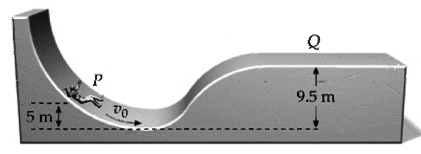
While traveling in the far north, one of y our companions gets snow blindness, and you have to lead him along by the elbow. Looking back, you see your other companion, Sandy, fall and slide along the frictionless surface of the frozen river valley shown in Figure. If point Q is 4.5 m higher than
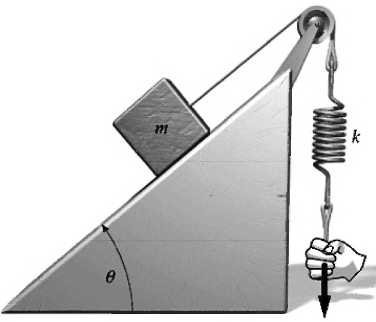
A block rests on an inclined plane as in Figure. A spring to which it is attached via a pulley is being pulled downward with gradually increasing force. The value of µs is known. Find the potential energy U of the spring at the moment when the block begins to move.
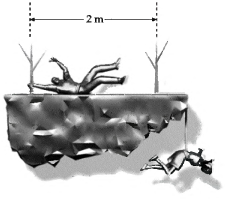
Sandy is sliding helplessly across the frictionless ice with her climbing rope trailing behind (Figure). Racing after her, you get hold of her rope just as she goes over the edge of a cliff. You manage to grab a tree branch in time to keep from going over yourself. Let U = 0 for the position of
A 2.4-kg block is dropped from a height of 5.0 m onto a spring of spring constant 3955 N/m. When the block is momentarily at rest, the spring has compressed by 25 cm. Find the speed of the block when the compression of the spring is 15.0 cm.
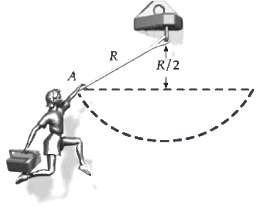
Red is a girl of mass m who is taking a picnic lunch to her grandmother. She ties a rope of length R to a tree branch over a creek and starts to swing from rest at point A, which is a distance R/2 lower than the branch (Figure). What is the minimum breaking tension for the rope if it is not to
A ball at the end of a string moves in a vertical circle with constant energy E. What is the difference between the tension at the bottom of the circle and the tension at the top?
A stone is thrown upward at an angle of 53 ° above the horizontal. Its maximum height during the trajectory is 24 m. What was the stone's initial speed?
A baseball of mass 0.17 kg is thrown from the roof of a building 12 m above the ground. Its initial velocity is 30 m/s at an angle of 40° above the horizontal.(a) What is the maximum height of the ball?(b) What is the work done by gravity as the ball moves from the roof to its maximum height?(c)
An 80-cm-long pendulum with a 0.6-kg bob is released from rest at initial angle θ0 with the vertical. At the bottom of the swing, the speed of the bob is 2.8 m/s.(a) What was the initial angle of the pendulum?(b) What angle does the pendulum make with the vertical when the speed of the bob is 1.4
The Royal Gorge bridge over the Arkansas River is about L = 310 m high. A bungee jumper of mass 60 kg has an elastic cord of length d = 50 m attached to her feet. Assume that the cord acts like a spring of force constant k. The jumper leaps, barely touches the water, and after numerous ups and
A pendulum consists of a 2-kg bob attached to a light string of length 3 m. The bob is struck horizontally so that it has an initial horizontal velocity of 4.5 m/s. For the point at which the string makes an angle of 30° with the vertical, what is(a) The speed?(b) The potential energy?(c) The
Lou is trying to kill mice by swinging a clock of mass m attached to one end of a light (massless) stick 1.4 m in length hanging on a nail in the wall (Figure). The clock end of the stick is free to rotate around its other end in a vertical circle. Lou raises the clock until the stick is
A pendulum consists of a string of length L and a bob of mass m. The string is brought to a horizontal position and the bob is given the minimum initial speed enabling the pendulum to make a full turn in the vertical plane.(a) What is the maximum kinetic energy K of the bob?(b) What is the tension
A child whose weight is 360 N swings out over a pool of water using a rope attached to the branch of a tree at the edge of the pool. The branch is 12 m above ground level and the surface of the pool is 1.8 m below ground level. The child holds onto the rope at a point 10.6 m from the branch and
Walking by a pond, you find a rope attached to a tree limb 5.2 m off the ground. You decide to use the rope to swing out over the pond. The rope is a bit frayed but supports your weight. You estimate that the rope might break if the tension is 80 N greater than your weight. You grab the rope at a
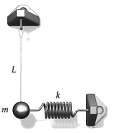
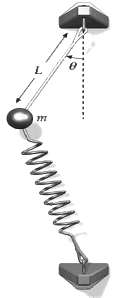
A pendulum of length L has a bob of mass m attached to a light string, which is attached to a spring of force constant k. With the pendulum in the position shown in Figure, the spring is at its unstretched length. If the bob is now pulled aside so that the string makes a small angle ? with the
A pendulum is suspended from the ceiling and attached to a spring fixed at the opposite end directly below the pendulum support (Figure). The mass of the pendulum bob is m, the length of the pendulum is L, and the spring constant is k. The unstretched length of the spring is L/2 and the distance
Showing 6300 - 6400
of 21795
First
57
58
59
60
61
62
63
64
65
66
67
68
69
70
71
Last
Step by Step Answers

 Get 50% OFF
Claim Now
Get 50% OFF
Claim Now