New Semester
Started
Get
50% OFF
Study Help!
--h --m --s
Claim Now
Question Answers
Textbooks
Find textbooks, questions and answers
Oops, something went wrong!
Change your search query and then try again
S
Books
FREE
Study Help
Expert Questions
Accounting
General Management
Mathematics
Finance
Organizational Behaviour
Law
Physics
Operating System
Management Leadership
Sociology
Programming
Marketing
Database
Computer Network
Economics
Textbooks Solutions
Accounting
Managerial Accounting
Management Leadership
Cost Accounting
Statistics
Business Law
Corporate Finance
Finance
Economics
Auditing
Tutors
Online Tutors
Find a Tutor
Hire a Tutor
Become a Tutor
AI Tutor
AI Study Planner
NEW
Sell Books
Search
Search
Sign In
Register
study help
physics
mechanics
Fundamentals of Ethics for Scientists and Engineers 1st Edition Edmund G. Seebauer, Robert L. Barry - Solutions
Why don’t you feel the gravitational attraction of a large building when you walk near it?
Astronauts orbiting in a satellite 300 km above the surface of the earth feel weightless. Why? Is the force of gravity exerted by the earth on them negligible at this height?
One of Jupiter’s moons, Io, has a mean orbital radius of 4.22 x 10⁸ m and a period of 1.53 x 10⁵ s.(a) Find the mean orbital radius of another of Jupiter’s moons, Callisto, whose period is 1.44 x 10⁶ s.(b) Use the known value of G to compute the mass of Jupiter.
The mass of Saturn is 5.69 x 1026 kg.(a) Find the period of its moon Mimas, whose mean orbital radius is 1.86 x 10⁸ m.(b) Find the mean orbital radius of its moon Titan, whose period is 1.38 x 10⁶ s.
Calculate the mass of the earth from the period of the moon T = 27.3 d, its mean orbital radius
Use the period of the earth (1 y), its mean orbital radius (1.496 x 10¹¹ m), and the value of G to calculate the mass of the sun
An object is dropped from a height of 6.37 x 10⁶ m above the surface of the earth. What is its initial acceleration?
Suppose you leave the solar system and arrive at a planet that has the same mass per unit volume as the earth but has 10 times the earth’s radius. What would you weigh on this planet compared with what you weigh on earth?
Suppose that the earth retained its present mass but was somehow compressed to half its present radius. What would be the value of g, the acceleration due to gravity, at the surface of this new, compact planet?
A planet moves around a massive sun with constant angular momentum. When the planet is at perihelion, it has a speed of 5 x 10⁴ m/s and is 1.0 x 10¹⁵ m from the sun. The orbital radius increases to 2.2 x 10¹⁵ m at aphelion. What is the planet’s speed at aphelion?
A comet orbits the sun with constant angular momentum. It has a maximum radius of 150 AU, and at aphelion its speed is 7 x 10³ m/s. The comet’s closest approach to the sun is 0.4 AU. What is its speed at perihelion?
The speed of an asteroid is 20 km/s at perihelion and 14 km/s at aphelion. Determine the ratio of the aphelion to perihelion distance.
A satellite with a mass of 300 kg moves in a circular orbit 5 x 10⁷ m above the earth’s surface.(a) What is the gravitational force on the satellite?(b) What is the speed of the satellite?(c) What is the period of the satellite?
At the airport, a physics student weighs 800 N. The student boards a jet plane that rises to an altitude of 9500 m. What is the student’s loss in weight?
Suppose that Kepler had found that the period of a planet’s circular orbit is proportional to the square of the orbit radius. What conclusion would Newton have drawn concerning the dependence of the gravitational attraction on distance between two masses?
A superconducting gravity meter can measure changes in gravity of the order ∆g/g = 10-11.(a) Estimate the maximum range at which an 80-kg person can be detected by this gravity meter. Assume that the gravity meter is stationary, and that the person’s mass can be considered to be concentrated at
During a solar eclipse, when the moon is between the earth and the sun, the gravitational pull of the moon and the sun on a student are in the same direction.(a) If the pull of the earth on the student is 800 N, what is the force of the moon on the student?(b) What is the force of the sun on the
Suppose that the attractive interaction between a star of mass M and a planet of mass m << M were of the form F = KMm/r, where K is the gravitational constant. What would be the relation between the radius of the planet’s circular orbit and its period?
The mass of the earth is 5.97 x 1024 kg and its radius is 6370 km. The radius of the moon is 1738 km. The acceleration of gravity at the surface of the moon is 1.62 m/s2. What is the ratio of the average density of the moon to that of the earth?
A plumb bob near a large mountain is slightly deflected from the vertical by the gravitational attraction of the mountain. Estimate the order of magnitude of the angle of deflection using any assumptions you like.
Why is G so difficult to measure?
The masses in a Cavendish apparatus are m1 = 10 kg and m2 = 10 g, the separation of their centers is 6 cm, and the rod separating the two small masses is 20 cm long.(a) What is the force of attraction between the large and small masses?(b) What torque must be exerted by the suspension to balance
The masses in a Cavendish apparatus are m1 = 12 kg and m2 = 15 g, and the separation of their centers is 7 cm.(a) What is the force of attraction between these two masses?(b) If the rod separating the two small masses is 18 cm long, what torque must be exerted by the suspension to balance the
How would everyday life change if gravitational and inertial mass were not identical?
If gravitational and inertial mass were not identical, what would change for(a) An offensive lineman on a football team?(b) A car?(c) A paperweight?
A standard object defined as having a mass of exactly 1 kg is given an acceleration of 2.6587 m/s2 when a certain force is applied to it. A second object of unknown mass acquires an acceleration of 1.1705 m/s2 when the same force is applied to it.(a) What is the mass of the second object?(b) Is the
The weight of a standard object defined as having a mass of exactly 1 kg is measured to be 9.81 N. In the same laboratory, a second object weighs 56.6 N.(a) What is the mass of the second object?(b) Is the mass you determined in part (a) gravitational or inertial mass?
(a) Taking the potential energy to be zero at infinite separation, find the potential energy of a 100-kg object at the surface of the earth. (Use 6.37 x 10⁶ m for the earth’s radius.)(b) Find the potential energy of the same object at a height above the earth’s surface equal to the earth’s
A point mass m0 is initially at the surface of a large sphere of mass M and radius R. How much work is needed to remove it to a very large distance away from the large sphere?
Suppose that in space there is a duplicate earth, except that it has no atmosphere, is not rotating, and is not in motion around any sun. What initial velocity must a spacecraft on its surface have to travel vertically upward a distance above the surface of the planet equal to one earth radius?
An object is dropped from rest from a height of 4 x 10⁶ m above the surface of the earth. If there is no air resistance, what is its speed when it strikes the earth?
An object is projected upward from the surface of the earth with an initial speed of 4 km/s. Find the maximum height it reaches.
A spherical shell has a radius R and a mass M.(a) Write expressions for the force exerted by the shell on a point mass m0 when m0 is outside the shell and when it is inside the shell.(b) What is the potential-energy function U(r) for this system when the mass m0 is at a distance r (r ≥ R) if
Our galaxy can be considered to be a large disk of radius R and mass M of approximately uniform mass density.(a) Consider a ring element of radius r and thickness dr of such a disk. Find the gravitational potential energy of a 1-kg mass on the axis of this element a distance
The assumption of uniform mass density in Problem 44 is rather unrealistic. For most galaxies, the mass density increases greatly toward the center of the galaxy. Repeat Problem 44 using a surface mass density of the form s(r) = C/r, where s(r) is the mass per unit area of the disk at a distance r
What is the effect of air resistance on the escape speed near the earth’s surface?
Would it be possible in principle for the earth to escape from the solar system?
The planet Saturn has a mass 95.2 times that of the earth and a radius 9.47 times that of the earth. Find the escape speed for objects near the surface of Saturn.
Find the escape speed for a rocket leaving the moon. The acceleration of gravity on the moon is 0.166 times that on earth, and the moon’s radius is 0.273RE.
A particle is projected from the surface of the earth with a speed equal to twice the escape speed. When it is very far from the earth, what is its speed?
What initial speed should a particle be given if it is to have a final speed when it is very far from the earth equal to its escape speed?
A space probe launched from the earth with an initial speed vi is to have a speed of 60 km/s when it is very far from the earth. What is vi?
(a) Calculate the energy in joules necessary to launch a 1-kg mass from the earth at escape speed.(b) Convert this energy to kilowatt-hours.(c) If energy can be obtained at 10 cents per kilowatt-hour, what is the minimum cost of giving an 80-kg astronaut enough energy to escape the earth’s
Show that the escape speed from a planet is related to the speed of a circular orbit just above the surface of the planet by ve = 2vc, where vc is the speed of the object in the circular orbit.
Find the speed of the earth vc as it orbits the sun, assuming a circular orbit. Use this and the result of Problem 55 to calculate the speed veS needed by the earth to escape from the sun.
If an object has just enough energy to escape from the earth, it will not escape from the solar system because of the attraction of the sun. Use Equation 11-19 with MS replacing ME and the distance to the sun rS replacing RE to calculate the speed veS needed to escape from the sun’s gravitational
Why is it reasonable to neglect the other planets in calculating the speed needed to escape from the solar system? Would you expect the actual value of this speed to be greater or less than that calculated in Problem 57?
An object is projected vertically from the surface of the earth. Show that the maximum height reached by the object is H = REH’ / (RE – H’), where H’ is the height that it would reach if the gravitational field were constant.
An object (say, a newly discovered comet) enters the solar system and makes a pass around the sun. How can we tell if the object will return many years later, or if it will never return?
A spacecraft of 100 kg mass is in a circular orbit about the earth at a height h = 2RE.(a) What is the period of the spacecraft’s orbit about the earth?(b) What is the spacecraft’s kinetic energy?(c) Express the angular momentum L of the spacecraft about the earth in terms of its kinetic energy
Many satellites orbit the earth about 1000 km above the earth’s surface. Geosynchronous satellites orbit at a distance of 4.22 x 10⁷ m from the center of the earth. How much more energy is required to launch a 500-kg satellite into a geosynchronous orbit than into an orbit 1000 km above the
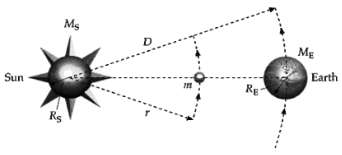
It is theoretically possible to place a satellite at a position between the earth and the sun on the line joining them, where the gravitational forces of the sun and the earth on the satellite combine in such a way that the satellite will execute a circular orbit around the sun that is synchronous
A 3-kg mass experiences a gravitational force of 12 N i at some point P, what is the gravitational field at that point?
The gravitational field at some point is given by g = 2.5 x 10⁻⁶ N/kg j. What is the gravitational force on a mass of 4 g at that point?
A point mass m is on the x axis at x = L and a second equal point mass m is on the y axis at y = L.(a) Find the gravitational field at the origin.(b) What is the magnitude of this field?
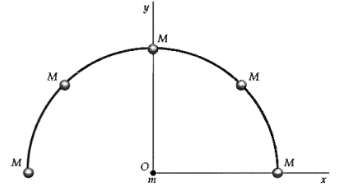
Five equal masses M are equally spaced on the arc of a semicircle of radius R as in Figure. A mass m is located at the center of curvature of the arc. (a) If M is 3 kg, m is 2 kg, and R is 10 cm, what is the force on m due to the five masses? (b) If m is removed, what is the gravitational field at
A point mass m1 = 2 kg is at the origin and a second point mass m2 = 4 kg is on the x axis at x = 6 m. Find the gravitational field at(a) x = 2 m, and(b) x = 12 m.(c) Find the point on the x axis for which g = 0.
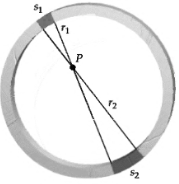
(a) Show that the gravitational field of a ring of uniform mass is zero at the center of the ring.(b) Figure shows a point P in the plane of the ring but not at its center. Consider two elements of the ring of length s1 and s2 at distances of r1 and r2, respectively.1. What is the ratio of the
Show that the maximum value of |gx| for the field of Example 11-7 occurs at the points x = ± a / √2.
A nonuniform stick of length L lies on the x axis with one end at the origin. Its mass density λ (mass per unit length) varies as λ = Cx, where C is a constant. (Thus, an element of the stick has mass dm = λ dx.)(a) What is the total mass of the stick? (b)
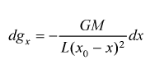
A uniform rod of mass M and length L lies along the x axis with its center at the origin. Consider an element of length dx at a distance x from the origin.(a) Show that this element produces a gravitational field at a point x0 on the x axis (x0 > ½L) given by(b)
Explain why the gravitational field increases with r rather than decreasing as 1/r2 as one moves out from the center inside a solid sphere of uniform mass.
A spherical shell has a radius of 2 m and a mass of 300 kg. What is the gravitational field at the following distances from the center of the shell:(a) 0.5 m;(b) 1.9 m;(c) 2.5 m?
A spherical shell has a radius of 2 m and a mass of 300 kg, and its center is located at the origin of a coordinate system. Another spherical shell with a radius of 1 m and mass 150 kg is inside the larger shell with its center at 0.6 m on the x axis. What is the gravitational force of attraction
Two spheres, S1 and S2, have equal radii R and equal masses M. The density of sphere S1 is constant, whereas that of sphere S2 depends on the radial distance according. If the acceleration of gravity at the surface of sphere S1 is g1, compute the acceleration of gravity at the surface of sphere S2?
Two homogeneous spheres, S1 and S2, have equal masses but different radii, R1 and R2. If the acceleration of gravity on the surface of sphere S1 is g1, what is the acceleration of gravity on the surface of sphere S2?
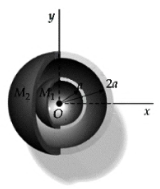
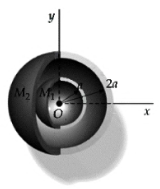
Two concentric uniform spherical shells have masses M1 and M2 and radii a and 2a as in Figure. What is the magnitude of the gravitational force on a point mass m located?(a) A distance 3a from the center of the shells?(b) A distance 1.9a from the center of the shells?(c) A
The inner spherical shell in Problem 78 is shifted such that its center is now at x = 0.8a. The points 3a, 1.9a, and 0.9a lie along the same radial line from the center of the larger spherical shell.(a) What is the force on m at x = 3a?(b) What is the force on m at x =
Suppose the earth were a sphere of uniform mass. If there were a deep elevator shaft going 15,000 m into the earth, what would be the loss in weight at the bottom of this deep shaft for a student who weighs 800 N at the surface of the earth?
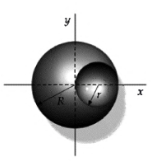
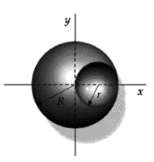
A sphere of radius R has its center at the origin. It has a uniform mass density r0, except that there is a spherical cavity in it of radius r = ½ R centered at x = ½R as in Figure. Find the gravitational field at points on the x axis for | x | > R.
For the sphere with the cavity in Problem 81, show that the gravitational field inside the cavity is uniform, and find its magnitude and direction.
A straight, smooth tunnel is dug through a spherical planet whose mass density r0 is constant. The tunnel passes through the center of the planet and is perpendicular to the planet’s axis of rotation, which is fixed in space. The planet rotates with an angular velocity w such that objects in the
The density of a sphere is given by ρ(r) = C/r. The sphere has a radius of 5 m and a mass of 1011 kg. (a) Determine the constant C.(b) Obtain expressions for the gravitational field for (1) r > 5 m, and (2) r < 5 m.
A hole is drilled into the sphere of Problem 84 toward the center of the sphere to a depth of 2 km below the sphere’s surface. A small mass is dropped from the surface into the hole. Determine the speed of the small mass as it strikes the bottom of the hole.
The solid surface of the earth has a density of about 3000 kg/m3. A spherical deposit of heavy metals with a density of 8000 kg/m3 and radius of 1000 m is centered 2000 m below the surface. Find ∆g/g at the surface directly above this deposit, where ∆g is the increase in the
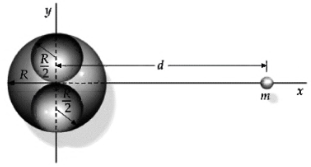
Two identical spherical hollows are made in a lead sphere of radius R. The hollows have a radius R/2. They touch the outside surface of the sphere and its center as in Figure. The mass of the lead sphere before hollowing was M.(a) Find the force of attraction of a small sphere of mass m to the
If K is the kinetic energy of the moon in its orbit around the earth, and U is the potential energy of the earth–moon system, what is the relationship between K and U?
The semimajor axis of Ganymede, a moon of Jupiter discovered by Galileo, is 1.07 x 10⁶ km, and its period is 7.155 days. Determine the mass of Jupiter.
Calculate the mass of the earth using the known values of G, g, and RE.
Uranus has a moon, Umbriel, whose mean orbital radius is 2.67 x 10⁸ m and whose period is 3.58 x 10⁵ s.(a) Find the period of another of Uranus’s moons, Oberon, whose mean orbital radius is 5.86 x 10⁸ m.(b) Use the known value of G to find the mass of Uranus.
Joe and Sally learn that there is a point between the earth and the moon where the gravitational effects of the two bodies balance each other. Being of a New Age bent, they decide to try to conceive a child free from the bondage of gravity, so they book an earth-to-moon trip. How far from the
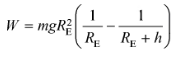
The force exerted by the earth on a particle of mass m a distance r from the center of the earth has the magnitude GMEm/r2 = mgRE2/r2.(a) Calculate the work you must do against gravity to move the particle from a distance r1 to r2.s(b) Show that when r1 = RE and r2 = RE + h, the result
Suppose that the gravitational force of attraction depended not on 1/r2 but was proportional to the distance between the two masses, like the force of a spring. In a planetary system like the solar system, what would then be the relation between the period of a planet and its orbit radius, assuming
A uniform sphere of radius 100 m and density 2000 kg/m3 is in free space far from other massive objects.(a) Find the gravitational field outside of the sphere as a function of r.(b) Find the gravitational field inside the sphere as a function of r.
Two spherical planets have identical mass densities. Planet P1 has a radius R1, and planet P2 has a radius R2. If the acceleration of gravity at the surface of planet P1 is g1, what is the acceleration of gravity at the surface of planet P2?
Jupiter has a mass 320 times that of Earth and a volume 1320 times that of Earth. A “day” on Jupiter is 9 h 50 min long. Find the height h above Jupiter at which a satellite must be revolving to have a period equal to 9 h 50 min.
The average density of the moon is r = 3340 kg/m3. Find the minimum possible period T of a spacecraft orbiting the moon. The minimum period is when the orbit radius equals the object’s radius, i.e., orbit just above the surface of the moon.
A satellite is circling around the moon (radius 1700 km) close to the surface at a speed v. A projectile is launched from the moon vertically up at the same initial speed v. How high will it rise?
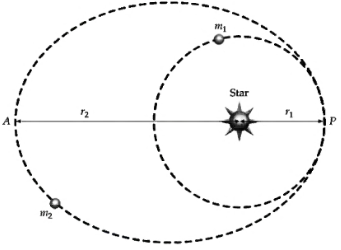
Two space colonies of equal mass orbit a star (Figure). The Yangs in m1 move in a circular orbit of radius 1011 m with a period of 2 y. The Yins in m2 move in an elliptical orbit with a closest distance r1 = 1011 m and a farthest distance r2 = 1.8 x 10¹¹ m.(a) Using the fact that the mean
In a binary star system, two stars orbit about their common center of mass. If the stars have masses m1 and m2 and are separated by a distance r, show that the period of rotation is related to r by T2 = 4pr3 / [G(m1 + m2)].
Two particles of mass m1 and m2 are released from rest with infinite separation. Find their speeds v1 and v2 when their separation distance is r.
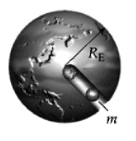
A hole is drilled from the surface of the earth to its center as in Figure. Ignore the earth’s rotation and air resistance.(a) How much work is required to lift a particle of mass m from the center of the earth to the earth’s surface?(b) If the particle is dropped from rest at the surface
A thick spherical shell of mass M and uniform density has an inner radius R1 and an outer radius R2. Find the gravitational field gr as a function of r for all possible values of r. Sketch a graph of gr versus r.
(a) Sketch a plot of the gravitational field gx versus x due to a uniform ring of mass M and radius R whose axis is the x axis.(b) At what points is the magnitude of gx maximum?
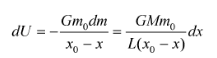
In this problem, you are to find the gravitational potential energy of the stick in Example 11-8 and a point mass m0 that is on the x axis at x0.(a) Show that the potential energy of an element of the stick dm and m0 is given bywhere U = 0 at x0 = ∞.(b) Integrate your result
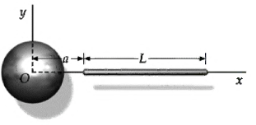
A uniform sphere of mass M is located near a thin, uniform rod of mass m and length L as in Figure. Find the gravitational force of attraction exerted by the sphere on the rod.
A uniform rod of mass M = 20 kg and length L = 5 m is bent into a semicircle. What is the gravitational force exerted by the rod on a point mass m = 0.1 kg located at the center of the circular arc?
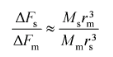
Both the sun and the moon exert gravitational forces on the oceans of the earth, causing tides.(a) Show that the ratio of the force exerted by the sun to that exerted by the moon is MSr2m/Mmr2S, where MS and Mm are the masses of the sun and moon and rs and rm are the distances from the earth to the
(Multiple choice)(1) True or false: (a) Kepler's law of equal areas implies that gravity varies inversely with the square of the distance. (b) The planet closest to the sun, on the average, has the shortest period of revolution about the sun.(2)If the mass of a satellite is doubled, the
A seesaw consists of a 4-m board pivoted at the center. A 28-kg child sits on one end of the board. Where should a 40-kg child sit to balance the seesaw?
Showing 6700 - 6800
of 21795
First
61
62
63
64
65
66
67
68
69
70
71
72
73
74
75
Last
Step by Step Answers

 Get 50% OFF
Claim Now
Get 50% OFF
Claim Now