New Semester
Started
Get
50% OFF
Study Help!
--h --m --s
Claim Now
Question Answers
Textbooks
Find textbooks, questions and answers
Oops, something went wrong!
Change your search query and then try again
S
Books
FREE
Study Help
Expert Questions
Accounting
General Management
Mathematics
Finance
Organizational Behaviour
Law
Physics
Operating System
Management Leadership
Sociology
Programming
Marketing
Database
Computer Network
Economics
Textbooks Solutions
Accounting
Managerial Accounting
Management Leadership
Cost Accounting
Statistics
Business Law
Corporate Finance
Finance
Economics
Auditing
Tutors
Online Tutors
Find a Tutor
Hire a Tutor
Become a Tutor
AI Tutor
AI Study Planner
NEW
Sell Books
Search
Search
Sign In
Register
study help
physics
mechanics
Fundamentals of Ethics for Scientists and Engineers 1st Edition Edmund G. Seebauer, Robert L. Barry - Solutions
A 0.20-kg stone attached to a 0.8-m long string is rotated in the horizontal plane. The string makes an angle of 20° with the horizontal. Determine the speed of the stone.
A 0.75-kg stone attached to a string is whirled in a horizontal circle of radius 35 cm as in the conical pendulum of Example. The string makes an angle of 30° with the vertical.(a) Find the speed of the stone.(b) Find the tension in the string.
A pilot of mass 50 kg comes out of a vertical dive in a circular arc such that her upward acceleration is 8.5g.(a) What is the magnitude of the force exerted by the airplane seat on the pilot at the bottom of the arc?(b) If the speed of the plane is 345 km/h, what is the radius of the circular arc?
A 65-kg airplane pilot pulls out of a dive by following the arc of a circle whose radius is 300 m. At the bottom of the circle, where her speed is 180 km/h,(a) What are the direction and magnitude of her acceleration?(b) What is the net force acting on her at the bottom of the circle?(c) What is
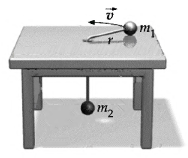
Mass m1 moves with speed v in a circular path of radius R on a frictionless horizontal table (Figure). It is attached to a string that passes through a frictionless hole in the center of the table. A second mass m2 is attached to the other end of the string. Derive an expression for R in terms of
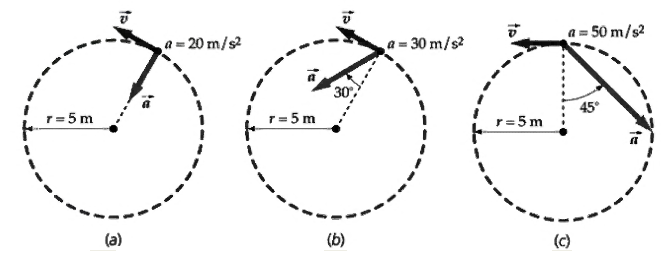
In Figure particles are shown traveling counterclockwise in circles of radius 5 m. The acceleration vectors are indicated at three specific times. Find the values of v and dv/dt for each of these times.
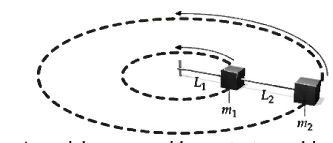
A block of mass m1 is attached to a cord of length L1, which is fixed at one end. The block moves in a horizontal circle on a frictionless table. A second block of mass m2 is attached to the first by a cord of length L2 and also moves in a circle, as shown in Figure. If the period of the motion is
A particle moves with constant speed in a circle of radius 4 cm. It takes 8 s to make a complete trip. Draw the path of the particle to scale, and indicate the particle’s position at 1-s intervals. Draw displacement vectors for each interval. These vectors also indicate the directions for the
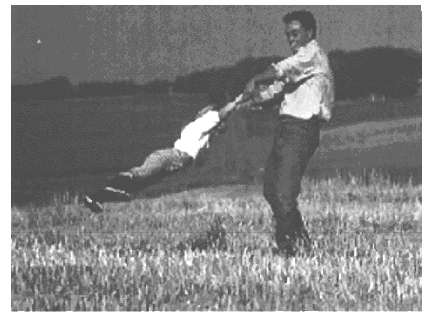
A man swings his child in a circle of radius 0.75 m, as shown in the photo. If the mass of the child is 25 kg and the child makes one revolution in 1.5 s, what are the magnitude and direction of the force that must be exerted by the man on the child? (Assume the child to be a pointparticle.)
The string of a conical pendulum is 50 cm long and the mass of the bob is 0.25 kg. Find the angle between the string and the horizontal when the tension in the string is six times the weight of the bob. Under those conditions, what is the period of the pendulum?
Frustrated with his inability to make a living through honest channels, Lou sets up a deceptive weightloss scam. The trick is to make insecure customers believe that they can "think those extra pounds away" if they will only take a ride in a van that Lou claims to be "specially equipped to enhance
A 100-g disk sits on a horizontally rotating turntable. The turntable makes one revolution each second. The disk is located 10 cm from the axis of rotation of the turntable. (a) What is the frictional force acting on the disk? (b) The disk will slide off the turntable if it is located at
A tether ball of mass 0.25 kg is attached to a vertical pole by a cord 1.2 m long. Assume the cord attaches to the center of the ball. If the cord makes an angle of 20° with the vertical, then(a) What is the tension in the cord?(b) What is the speed of the ball?
An object on the equator has an acceleration toward the center of the earth because of the earth's rotation and an acceleration toward the sun because of the earth's motion along its orbit. Calculate the magnitudes of both accelerations, and express them as fractions of the free-fall acceleration
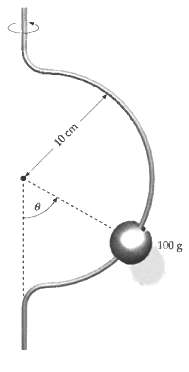
A small bead with a mass of 100 g slides along a semicircular wire with a radius of 10 cm that rotates about a vertical axis at a rate of 2 revolutions per second, as in Figure. Find the values of ? for which the bead will remain stationary relative to the rotating wire.
Consider a bead of mass m that is free to move on a thin, circular wire of radius r. The bead is given an initial speed v0, and there is a coefficient of kinetic friction µk. The experiment is performed in a spacecraft drifting in space. Find the speed of the bead at any subsequent time t.
Revisiting the previous problem,(a) Find the centripetal acceleration of the bead.(b) Find the tangential acceleration of the bead.(c) What is the magnitude of the resultant acceleration?
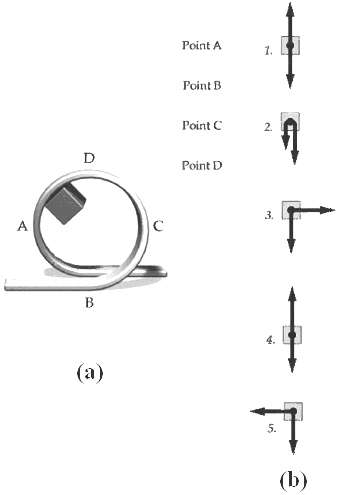
A block is sliding on a frictionless surface along a loop-the-loop, as in Figure (a). The block is moving fast enough that it never loses contact with the track. Match the points along the track to the appropriate free-body diagrams Figure (b).
Suppose you ride a bicycle on a horizontal surface in a circle with a radius of 20 m. The resultant force exerted by the road on the bicycle (normal force plus frictional force) makes an angle of 15° with the vertical.(a) What is y our speed?(b) If the frictional force is half its maximum value,
A curve of radius 150 m is banked at an angle of 10°. An 800-kg car negotiates the curve at 85 km/h without skidding. Find(a) The normal force on the tires exerted by the pavement,(b) The frictional force exerted by the pavement on the tires of the car, and(c) The minimum coefficient of static
On another occasion, the car in the previous problem negotiates the curve at 38 km/h. Find(a) The normal force exerted on the tires by the pavement, and(b) The frictional force exerted on the tires by the pavement.
A civil engineer is asked to design a curved section of roadway that meets the following conditions: With ice on the road, when the coefficient of static friction between the road and rubber is 0.08, a car at rest must not slide into the ditch and a car traveling less than 60 km/h must not skid to
A curve of radius 30 m is banked so that a 950- kg car traveling 40 km/h can round it even if the road is so icy that the coefficient of static friction is approximately zero. Find the range of speeds at which a car can travel around this curve without skidding if the coefficient of static friction
How would you expect the value of b for air resistance to depend on the density of air?
What are the dimensions and SI units of the constant b in the retarding force bvn if(a) n = 1,(b) n=2?
A small pollution particle settles toward the earth in still air with a terminal speed of 0.3 mm/s. The particle has a mass of 10−10 g and a retarding force of the form bv. What is the value of b?
A Ping-Pong ball has a mass of 2.3 g and a terminal speed of 9 m/s. The retarding force is of the form bv2. What is the value of b?
A sky diver of mass 60kg can slow herself to a constant speed of 90 km/h by adjusting her form.(a) What is the magnitude of the upward drag force on the sky diver? (b) If the drag force is equal to bv2, what is the value of b?
Newton showed that the air resistance on a falling object with a circular cross section should be approximately ½ρπr2v2 , where ρ = 1.2 kg/m3, the density of air. Find the terminal speed for a 56-kg sky diver, assuming that his cross-sectional area is equivalent to that of a disk of radius 0.30
An 800-kg car rolls down a very long 6° grade. The drag force for motion of the car has the form Fd = 100 N + (1.2 N·s2/m2)v2. What is the terminal velocity for the car rolling down this grade?
While claims of hailstones the size of golf balls may be a slight exaggeration, hailstones are often substantially larger than raindrops. Estimate the terminal velocity of a raindrop and a large hailstone. (See Problem 84.)
(a) A parachute creates enough air resistance to keep the downward speed of an 80-kg sky diver to a constant 6.0 m/s. Assuming that the force of air resistance is given by f = bv2, calculate b for this case. (b) A sky diver free-falls until his speed is 60 m/s before opening his parachute. If
An object falls under the influence of gravity and a drag force Fd = -bv. (a) By applying Newton’s second law, show that the acceleration of the object can be written a = dv/dt = g - (b/m)v. (b) Rearrange this equation to obtain dv/(v - vt) = -(g/vt)dt, where vt = mg/b. (c)
Small spherical particles experience a viscous drag force given by Stokes' law: Fd = 6πηrv, where r is the radius of the particle, v is its speed, and η is the viscosity of the fluid medium. (a) Estimate the terminal speed of a spherical pollution particle of radius 10−5 m and density of
An air sample containing pollution particles of the size and density given in Problem 89 is captured in a test tube 8.0 cm long. The test tube is then placed in a centrifuge with the midpoint of the test tube 12 cm from the center of the centrifuge. The centrifuge spins at 800 revolutions per
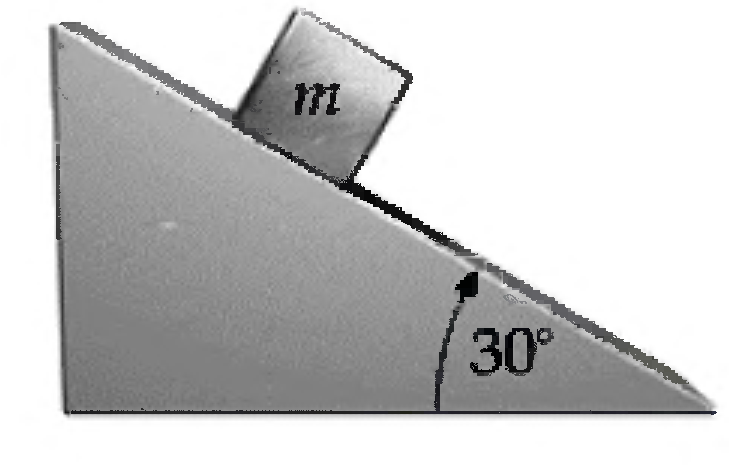
A 4.5-kg block slides down an inclined plane that makes an angle of 28° with the horizontal. Starting from rest, the block slides a distance of 2.4 m in 5.2s. Find the coefficient of kinetic friction between the block and plane.
A model airplane of mass 0.4 kg is attached to a horizontal string and flies in a horizontal circle of radius 5.7 m. (The weight of the plane is balanced by the upward "lift" force of the air on the wings of the plane.) The plane makes 1.2 revolutions every 4 s.(a) Find the speed v of the
Show with a force diagram how a motorcycle can travel in a circle on the inside vertical wall of a hollow cylinder. Assume reasonable parameters (coefficient of friction, radius of the circle, mass of the motorcycle, or whatever is required), and calculate the minimum speed needed.
An 800-N box rests on a plane inclined at 30° to the horizontal. A physics student finds that she can prevent the box from sliding if she pushes on it with a force of at least 200 N parallel to the surface.(a) What is the coefficient of static friction between the box and the surface?(b) What is
The position of a particle is given by the vector r = –10 m cos ωt i + 10m sin ωt j, where ω = 2 s-1.(a) Show that the path of the particle is a circle. (b) What is the radius of the circle? (c) Does the particle move clockwise or counterclockwise around the circle? (d) What is
A crate of books is to be put on a truck with the help of some planks sloping up at 30°. The mass of the crate is 100 kg, and the coefficient of sliding friction between it and the planks is 0.5. You and your friends push horizontally with a force F. Once the crate has started to move, how large
Brother Bernard is a very large dog with a taste for tobogganing. Ernie gives him a ride down Idiots' Hill---so named because it is a steep slope that levels out at the bottom for 10 m, and then drops into a river. When they reach the level ground at the bottom, their speed is 40 km/h, and Ernie,
A brick slides down an inclined plank at constant speed when the plank is inclined at an angle θ0. If the angle is increased to θ1, the block accelerates down the plank with acceleration a. The coefficient of kinetic friction is the same in both cases. Given θ0 and θ1, calculate a.
One morning, Lou was in a particularly deep and peaceful slumber. Unfortunately, he had spent the night in the back of a dump truck, and Barry, the driver, was keen to go off to work and start dumping things. Rather than risk a ruckus with Lou, Barry simply raised the back of the truck, and when it
In a carnival ride, the passenger sits on a seat in a compartment that rotates with constant speed in a vertical circle of radius r = 5 m. The heads of the seated passengers always point toward the axis of rotation.(a) If the carnival ride completes one full circle in 2 s, find the acceleration of
A flat-topped toy cart moves on frictionless wheels, pulled by a rope under tension T. The mass of the cart is m1. A load of mass m2 rests on top of the cart with a coefficient of static friction µs. The cart is pulled up a ramp that is inclined at angle θ above the horizontal. The rope is
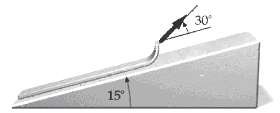
A sled weighing 200 N rests on a 15? incline, held in place by static friction (Figure). The coefficient of static friction is 0.5. (a) What is the magnitude of the normal force on the sled? (b) What is the magnitude of the static friction on the sled? (c) The sled is now pulled up the incline at
A child slides down a slide inclined at 30° in time t1. The coefficient of kinetic friction between her and the slide i s µk. She finds that if she sits on a small cart with frictionless wheels, she slides down the same slide in time 1/2t1. Find µk.
The position of a particle of mass m = 0.8 kg as a function of time is r = x i + y j = R sin ωt i + R cos ωt j, where R = 4.0 m, and ω = 2π s-1. (a) Show that this path of the particle is a circle of radius R with its center at the origin. (b) Compute the
In an amusement-park ride, riders stand with their backs against the wall of a spinning vertical cylinder. The floor falls away and the riders are held up by friction. If the radius of the cylinder is 4 m, find the minimum number of revolutions per minute necessary to prevent the riders from
Some bootleggers race from the police down a road that has a sharp, level curve with a radius of 30 m. As they go around the curve, the bootleggers squirt oil on the road behind them, reducing the coefficient of static friction from 0.7 to 0.2. When taking this curve, what is the maximum safe speed
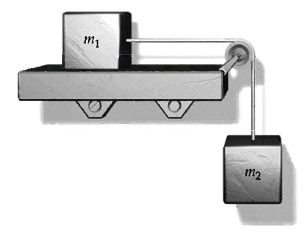
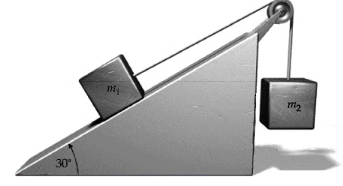
A mass m1 on a horizontal shelf is attached by a thin string that passes over a frictionless peg to a 2.5- kg mass m2 that hangs over the side of the shelf 1.5 m above the ground (Figure). The system is released from rest at t = 0 and the 2.5-kg mass strikes the ground at t = 0.82 s. The system is
(a) Show that a point on the surface of the earth at latitude θ has an acceleration relative to a reference frame not rotating with the earth with a magnitude of 3.37 cos θ cm/s2. What is the direction of this acceleration? (b) Discuss the effect of this acceleration on the apparent weight
(Multiple choice)(1)True or false: (a) The force of static friction always equals μsFn. (b) The force of friction always opposes the motion of an object. (c) The force of friction always opposes sliding. (d) The force of kinetic friction always equals μkFn.(2)A block of mass m
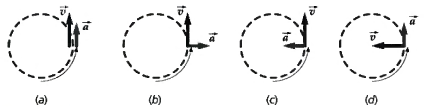
(Multiple choice)(1)True/FalseAn object cannot move in a circle unless there is a net force acting on it?(2)An object moves in a circle counterclockwise with constant speed (Figure). Which figure shows the correct velocity and acceleration vectors?(3)A particle is traveling in a vertical circle at
(Multiple choice)(1)A car speeds along the curved exit ramp of a freeway. The radius of the curve is 80 m. A 70-kg passenger holds the arm rest of the car door with a 220-N force to keep from sliding across the front seat of the car. (Assume that the exit ramp is not banked and ignore friction with
Two points are on a disk turning at constant angular velocity, one point on the rim and the other halfway between the rim and the axis. Which point moves the greater distance in a given time? Which turns through the greater angle? Which has the greater speed? The greater angular velocity? The
A particle moves in a circle of radius 90 m with a constant speed of 25 m/s. (a) What is its angular velocity in radians per second about the center of the circle? (b) How many revolutions does it make in 30 s?
A wheel starts from rest with a constant angular acceleration of 2.6 rad/s2 and rolls for 6 s. At the end of that time,(a) What is its angular velocity?(b) Through what angle has the wheel turned?(c) How many revolutions has it made?(d) What is the speed and acceleration of a point 0.3 m from the
When a turntable rotating at f rev/min is shut off, it comes to rest in 26 s. Assuming constant angular acceleration, find (a) The angular acceleration, (b) The average angular velocity of the turntable, and (c) The number of revolutions it makes before stopping.
A disk of radius 12 cm, initially at rest, begins rotating about its axis with a constant angular acceleration of 8 rad/s2. At t = 5 s, what are (a) The angular velocity of the disk,(b) The tangential acceleration at and the centripetal acceleration ac of a point on the edge of the disk?
Radio announcers who still play vinyl records have to be careful when cuing up live recordings. While studio albums have blank spaces between the songs, live albums have audiences cheering. If the volume levels are left up when the turntable is turned on, it sounds as though the audience has
A Ferris wheel of radius 12 m rotates once in 27 s. (a) What is its angular velocity in radians per second? (b) What is the linear speed of a passenger?(c) What is the centripetal acceleration of a passenger?
A cyclist accelerates from rest. After 8 s, the wheels have made 3 rev. (a) What is the angular acceleration of the wheels?(b) What is the angular velocity of the wheels after 8 s?
What is the angular velocity of the earth in rad/s as it rotates about its axis?
A bicycle has wheels of 1.2 m diameter. The bicyclist accelerates from rest with constant acceleration to 24 km/h in 14.0 s. What is the angular acceleration of the wheels?
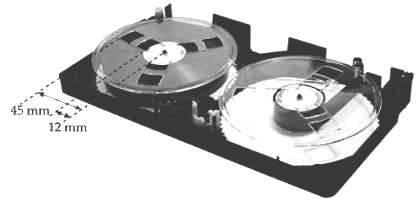
The tape in a standard VHS videotape cassette has a length L = 246 m; the tape plays for 2.0 h (Figure). As the tape starts, the full reel has an outer radius of about R = 45 mm, and an inner radius of about r = 12 mm. At some point during the play, both reels have the same angular speed. Calculate
Can an object continue to rotate in the absence of torque?
Does an applied net torque always increase the angular speed of an object?
A disk-shaped grindstone of mass 1.7 kg and radius 8 cm is spinning at 730 rev/min. After the power is shut off, a woman continues to sharpen her ax by holding it against the grindstone for 9 s until the grindstone stops rotating.(a) What is the angular acceleration of the grindstone?(b) What is
A 2.5-kg cylinder of radius 11 cm is initially at rest. A rope of negligible mass is wrapped around it and pulled with a force of 17 N. Find(a) The torque exerted by the rope,(b) The angular acceleration of the cylinder, and(c) The angular velocity of the cylinder at t = 5 s.
A wheel mounted on an axis that is not frictionless is initially at rest. A constant external torque of 50 N·m is applied to the wheel for 20 s, giving the wheel an angular velocity of 600 rev/min. The external torque is then removed, and the wheel comes to rest 120 s later. Find(a) The moment of
A pendulum consisting of a string of length L attached to a bob of mass m swings in a vertical plane. When the string is at an angle θ to the vertical, (a) What is the tangential component of acceleration of the bob? (b) What is the torque exerted about the pivot point? (c) Show
A uniform rod of mass M and length L is pivoted at one end and hangs as in Figure so that it is free to rotate without friction about its pivot. It is struck by a horizontal force F0 for a short time Δt at a distance x below the pivot as shown. (a) Show that the speed of
A uniform horizontal disk of mass M and radius R is rotating about its vertical axis with an angular velocity ω. When it is placed on a horizontal surface, the coefficient of kinetic friction between the disk and surface is μk. (a) Find the torque dτ exerted by the force of
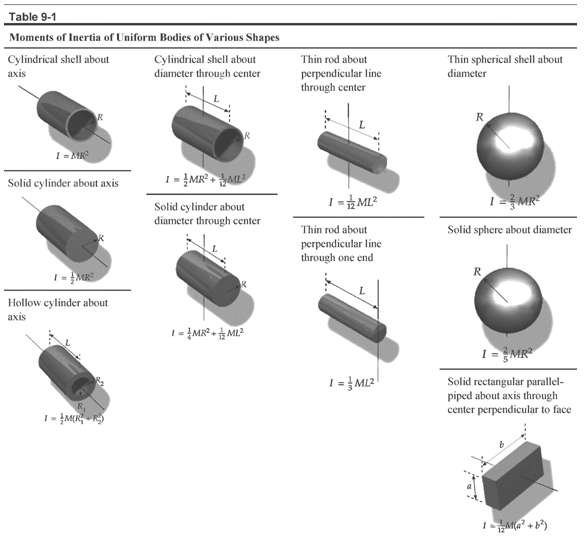
A tennis ball has a mass of 57 g and a diameter of 7 cm. Find the moment of inertia about its diameter. Assume that the ball is a thin spherical shell.
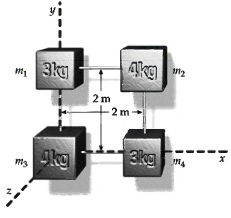
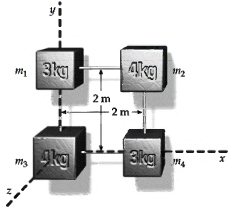
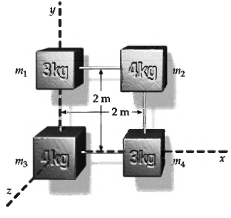
Four particles at the corners of a square with side length L = 2 m are connected by massless rods (Figure). The masses of the particles are m1 = m3 = 3 kg and m2 = m4 = 4 kg. Find the moment of inertia of the system about the z axis.
Use the parallel-axis theorem and your results for Problem 30 to find the moment of inertia of the four-particle system in Figure about an axis that is perpendicular to the plane of the masses and passes through the center of mass of the system. Check your result by direct computation.
For the four-particle system of Figure, (a) Find the moment of inertia Ix about the x axis, which passes through m3 and m4, and (b) Find Iy about the y axis, which passes through m1 and m4.
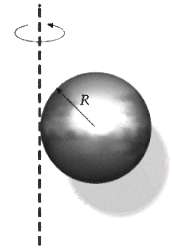
Use the parallel-axis theorem to find the moment of inertia of a solid sphere of mass M and radius R about an axis that is tangent to the sphere(Figure).
A 1.0-m-diameter wagon wheel consists of a thin rim having a mass of 8 kg and six spokes each having a mass of 1.2 kg. Determine the moment of inertia of the wagon wheel for rotation about its axis.
Two point masses m1 and m2 are separated by a massless rod of length L. (a) Write an expression for the moment of inertia about an axis perpendicular to the rod and passing through it at a distance x from mass m1. (b) Calculate dI/dx and show that I is at a minimum when the axis
A uniform rectangular plate has mass m and sides of lengths a and b. (a) Show by integration that the moment of inertia of the plate about an axis that is perpendicular to the plate and passes through one corner is m(a2 + b2)/3. (b) What is the moment of inertia about an axis
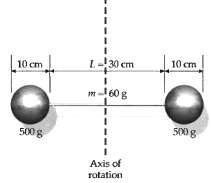
Tracey and Corey are doing intensive research on theoretical baton-twirling. Each is using "The Beast" as a model baton: two uniform spheres, each of mass 500 g and radius 5 cm, mounted at the ends of a 30-cm uniform rod of mass 60 g (Figure). Tracey and Corey want to calculate the moment of
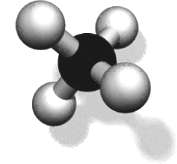
The methane molecule (CH4) has four hydrogen atoms located at the vertices of a regular tetrahedron of side length 1.4 nm, with the carbon atom at the center of the tetrahedron (Figure). Find the moment of inertia of this molecule for rotation about an axis that passes through the carbon atom and
A hollow cylinder has mass m, an outside radius R2, and an inside radius R1. Show that its moment of inertia about its symmetry axis is given by I = ½m(R22 + R12).
Show that the moment of inertia of a spherical shell of radius R and mass m is 2mR2/3. This can be done by direct integration or, more easily, by finding the increase in the moment of inertia of a solid sphere when its radius changes. To do this, first show that the moment of inertia of a solid
The density of the earth is not quite uniform. It varies with the distance r from the center of the earth as r = C(1.22 - r/R), where R is the radius of the earth and C is a constant. (a) Find C in terms of the total mass M and the radius R. (b) Find the
Use integration to determine the moment of inertia of a right circular homogeneous cone of height H, base radius R, and mass density ρ about its symmetry axis.
Use integration to determine the moment of inertia of a hollow, thin-walled, right circular cone of mass M, height H, and base radius R about its symmetry axis.
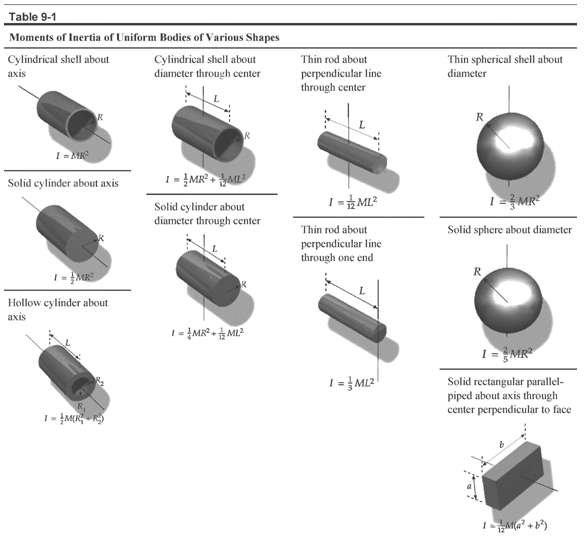
Use integration to determine the moment of inertia of a thin uniform disk of mass M and radius R for rotation about a diameter. Check your answer by referring to Table 9-1.
Use integration to determine the moment of inertia of a thin circular hoop of radius R and mass M for rotation about a diameter. Check your answer by referring to Table 9-1.
A roadside ice-cream stand uses rotating cones to catch the eyes of travelers. Each cone rotates about an axis perpendicular to its axis of symmetry and passing through its apex. The sizes of the cones vary, and the owner wonders if it would be more energy-efficient to use several smaller cones or
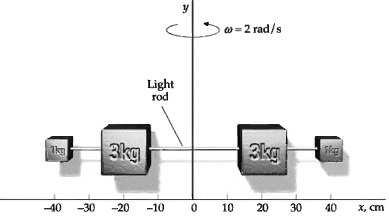
The particles in Figures are connected by a very light rod whose moment of inertia can be neglected. They rotate about the y axis with angular velocity ω = 2 rad/s.(a) Find the speed of each particle, and use it to calculate the kinetic energy of this system directly from ∑1/2mivi2. (b)
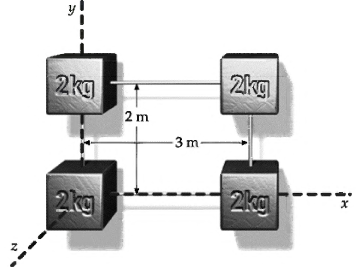
Four 2-kg particles are located at the corners of a rectangle of sides 3 m and 2 m as shown in Figure.(a) Find the moment of inertia of this system about the z axis.(b) The system is set rotating about this axis with a kinetic energy of 124 J. Find the number of revolutions the system makes per
A solid ball of mass 1.4 kg and diameter 15 cm is rotating about its diameter at 70 rev/min. (a) What is its kinetic energy? (b) If an additional 2 J of energy are supplied to the rotational energy, what is the new angular speed of the ball?
An engine develops 400 N·m of torque at 3700 rev/min. Find the power developed by the engine.
Two point masses m1 and m2 are connected by a massless rod of length L to form a dumbbell that rotates about its center of mass with angular velocity ω. Show that the ratio of kinetic energies of the masses is K1 / K2 = m2/m1.
Calculate the kinetic energy of rotation of the earth, and compare it with the kinetic energy of motion of the earth’s center of mass about the sun. Assume the earth to be a homogeneous sphere of mass 6.0 × 1024 kg and radius 6.4 × 10⁶ m. The radius of the earth’s orbit is 1.5 × 10¹¹m.
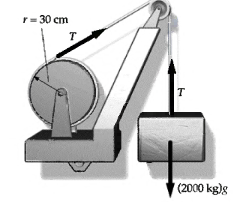
A 2000-kg block is lifted at a constant speed of 8 cm/s by a steel cable that passes over a massless pulley to a motor-driven winch (Figure). The radius of the winch drum is 30 cm. (a) What force must be exerted by the cable?(b) What torque does the cable exert on the winch drum? (c) What
Showing 6200 - 6300
of 21795
First
56
57
58
59
60
61
62
63
64
65
66
67
68
69
70
Last
Step by Step Answers

 Get 50% OFF
Claim Now
Get 50% OFF
Claim Now