New Semester
Started
Get
50% OFF
Study Help!
--h --m --s
Claim Now
Question Answers
Textbooks
Find textbooks, questions and answers
Oops, something went wrong!
Change your search query and then try again
S
Books
FREE
Study Help
Expert Questions
Accounting
General Management
Mathematics
Finance
Organizational Behaviour
Law
Physics
Operating System
Management Leadership
Sociology
Programming
Marketing
Database
Computer Network
Economics
Textbooks Solutions
Accounting
Managerial Accounting
Management Leadership
Cost Accounting
Statistics
Business Law
Corporate Finance
Finance
Economics
Auditing
Tutors
Online Tutors
Find a Tutor
Hire a Tutor
Become a Tutor
AI Tutor
AI Study Planner
NEW
Sell Books
Search
Search
Sign In
Register
study help
physics
mechanics
Fundamentals of Ethics for Scientists and Engineers 1st Edition Edmund G. Seebauer, Robert L. Barry - Solutions
A man stands on roller skates next to a rigid wall. To get started, he pushes off against the wall.Discuss the energy changes pertinent to this situation.
Discuss the energy changes involved when a car starts from rest and accelerates so that the car's wheels do not slip. What external force accelerates the car? Does this force do work?
Assume that you can expend energy at a constant rate of 250 W. Estimate how fast you can run up four flights of stairs, with each flight 3.5 m high.
A 70-kg skater pushes off the wall of a skating rink, acquiring a speed of 4 m/s.(a) How much work is done on the skater?(b) What is the change in the mechanical energy of the skater?(c) Discuss the conservation of energy as applied to the skater.
In a volcanic eruption, 4 km3 of mountain with a density of 1600 kg/m3 was lifted an average height of 500 m. (a) How much energy in joules was released in this eruption? (b) The energy released by thermonuclear bombs is measured in megatons of TNT, where 1 megaton of TNT = 4.2 × 10¹⁵ J.
An 80-kg physics student climbs a 120-m hill.(a) What is the increase in the gravitational potential energy of the student?(b) Where does this energy come from?(c) The student's body is 20% efficient; that is, for every 20 J that are converted to mechanical energy, 100 J of internal energy are
In 1993, Carl Fentham of Great Britain raised a full keg of beer (mass 62 kg) to a height of about 2 m 676 times in 6 h. Assuming that work was done only as the keg was going up, estimate how many such kegs of beer he would have to drink to reimburse his energy expenditure. (1 liter of beer is
Discuss the energy considerations when you pull a box along a rough road.
A 2000-kg car moving at an initial speed of 25 m/s along a horizontal road skids to a stop in 60 m.(a) Find the energy dissipated by friction.(b) Find the coefficient of kinetic friction between the tires and the road.
An 8-kg sled is initially at rest on a horizontal road. The coefficient of kinetic friction between the sled and the road is 0.4. The sled is pulled a distance of 3 m by a force of 40 N applied to the sled at an angle of 30° to the horizontal.(a) Find the work done by the applied force.(b) Find
Returning to Problem 8, suppose the surfaces described are not frictionless and that the coefficient of kinetic friction between the block and the surfaces is 0.30. Find(a) The speed of the block when it reaches the ramp, and(b) The distance that the block slides up the ramp before coming
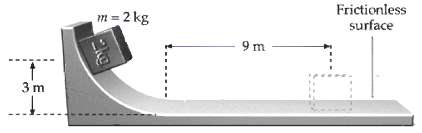
The 2-kg block in Figure slides down a frictionless curved ramp, starting from rest at a height of 3 m. The block then slides 9 m on a rough horizontal surface before coming to rest. (a) What is the speed of the block at the bottom of the ramp? (b) What is the energy dissipated by friction? (c)
A 20-kg girl slides down a playground slide that is 3.2 m high. When she reaches the bottom of the slide, her speed is 1.3 m/s.(a) How much energy was dissipated by friction?(b) If the slide is inclined at 20°, what is the coefficient of friction between the girl and the slide?
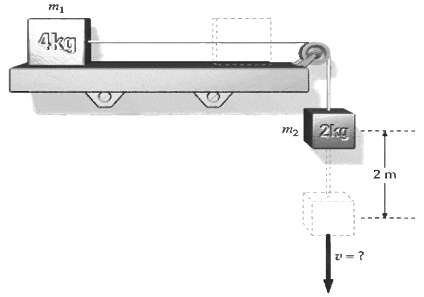
In Figure, the coefficient of kinetic friction between the 4-kg block and the shelf is 0.35. (a) Find the energy dissipated by friction when the 2-kg block falls a distance y. (b) Find the total mechanical energy E of the two-block system after the 2-kg block falls a distance y, assuming that E = 0
Nils Lied, an Australian meteorologist, once played golf on the ice in Antarctica and drove a ball a horizontal distance of 2400 m. For a rough estimate, let us assume that the ball took off at θ = 45°, flew a horizontal distance of 200 m without air resistance, and then slid on the ice without
A particle of mass m moves in a horizontal circle of radius r on a rough table. It is attached to a horizontal string fixed at the center of the circle. The speed of the particle is initially v0. After completing one full trip around the circle, the speed of the particle is ½vo(a) Find the energy
In 1987, British skier Graham Wilkie achieved a speed of v = 211 km/h going downhill. Assuming that he reached the maximum speed at the end of the hill and then continued on the horizontal surface, find the maximum distance d he could have covered on the horizontal surface. Take the coefficient of
During a move, Kate and Lou have to push Kate's 80-kg stove up a rough loading ramp, pitched at an angle of 10°, to get it into a truck. They push it along the horizontal floor to pick up speed and give it one last push at the bottom of the ramp, hoping for the best. Unfortunately, the stove stops
A 2.4-kg box has an initial velocity of 3.8 m/s upward along a rough plane inclined at 37° to the horizontal. The coefficient of kinetic friction between the box and plane is 0.30. How far up the incline does the box travel? What is its speed when it passes its starting point on its way down the
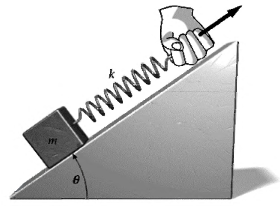
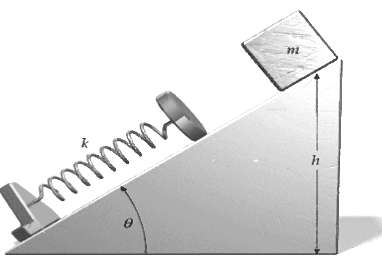
A block of mass m rests on a rough plane inclined at θ with the horizontal (Figure). The block is attached to a spring of constant k near the top of the plane. The coefficients of static and kinetic friction between the block and plane are µs and µk, respectively. The spring is slowly pulled
How much rest mass is consumed in the core of a nuclear-fueled electric generating plant in producing(a) One joule of thermal energy?(b) Enough energy to keep a 100-W light bulb burning for 10 years?
(a) Calculate the rest energy in 1 g of dirt.(b) If you could convert this energy into electrical energy and sell it for 10 cents per kilowatt-hour, how much money would you get?(c) If you could power a 100-W light bulb with this energy, for how long could you keep the bulb lit?
A muon has a rest energy of 105.7 MeV. Calculate its rest mass in kilograms.
For the fusion reaction in Example 7-14, calculate the number of reactions per second that are necessary to generate 1 kW of power.
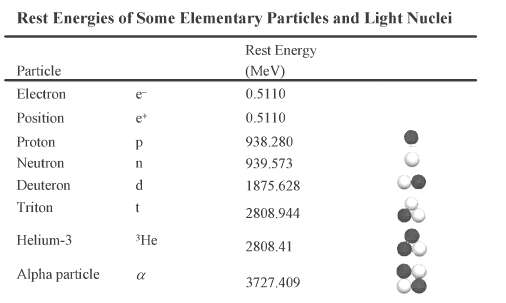
How much energy is needed to remove one neutron from 4He, leaving 3He plus a neutron? (The rest energy of 3He is 2808.41 MeV.)
A free neutron at rest decays into a proton plus an electron: n ? p + e. Use Table to calculate the energy released in this reaction.
In one nuclear fusion reaction, two 2H nuclei combine to produce 4He.(a) How much energy is released in this reaction?(b) How many such reactions must take place per second to produce 1 kW of power?
A large nuclear power plant produces 3000 MW of power by nuclear fission, which converts matter into energy.(a) How many kilograms of matter does the plant consume in one year?(b) In a coal-burning power plant, each kilogram of coal releases 31 MJ of energy when burned. How many kilograms of coal
Our bodies convert internal chemical energy into work and heat at the rate of about 100 W, which is called our metabolic rate.(a) How much internal chemical energy do we use in 24 h?(b) The energy comes from the food that we eat and is usually measured in kilocalories, where 1 kcal = 4.184 kJ. How
A 3.5-kg box rests on a horizontal frictionless surface in contact with a spring of spring constant 6800 N/m. The spring is fixed at its other end and is initially at its uncompressed length. A constant horizontal force of 70 N is applied to the box so that the spring compresses. Determine the
The average energy per unit time per unit area that reaches the upper atmosphere of the earth from the sun, called the solar constant, is 1.35 kW/m2. Because of absorption and reflection by the atmosphere, about 1 kW/m2 reaches the surface of the earth on a clear day. How much energy is collected
When the jet-powered car Spirit of America went out of control during a test drive at Bonneville Salt Flats, Utah, it left skid marks about 9.5 km long. (a) If the car was moving initially at a speed of v = 708 km/h, estimate the co-efficient of kinetic friction μk. (b) What was the
A T-bar tow is required to pull 80 skiers up a 600-m slope inclined at 15° above horizontal at a speed of 2.5 m/s. The coefficient of kinetic friction is 0.06. Find the motor power required if the mass of the average skier is 75 kg.
A 1200-kg elevator driven by an electric motor can safely carry a maximum load of 800 kg. What is the power provided by the motor when the elevator ascends with a full load at a speed of 2.3 m/s?
To reduce the power requirement of elevator motors, elevators are counterbalanced with weights connected to the elevator by a cable that runs over a pulley at the top of the elevator shaft. If the elevator in Problem 75 is counterbalanced with a mass of 1500 kg, what is the power provided by the
The spring constant of a toy dart gun is 5000 N/m. To cock the gun the spring is compressed 3 cm. The 7-g dart, fired straight upward, reaches a maximum height of 24 m. Determine the energy dissipated by air friction during the dart's ascent. Estimate the speed of the projectile when it returns to
A 0.050-kg dart is fired vertically from a spring gun that has a spring constant of 4000 N/m. Prior to release, the spring was compressed by 10.7 cm. When the dart is 6.8 m above the gun, its upward speed is 28 m/s. Determine the maxi mum height reached by the dart.
In a volcanic eruption, a 2-kg piece of porous volcanic rock is thrown vertically upward with an initial speed of 40 m/s. It travels upward a distance of 50 m before it begins to fall back to the earth.(a) What is the initial kinetic energy of the rock?(b) What is the increase in thermal energy due
A block of mass m starts from rest at a height h and slides down a frictionless plane inclined at ? with the horizontal as shown in Figure. After sliding a distance L, the block strikes a spring of force constant k. Find the compression of the spring when the block is momentarily at rest.
A car of mass 1500 kg traveling at 24 m/s is at the foot of a hill that rises 120 m in 2.0 km. At the top of the hill, the speed of the car is 10 m/s. Find the average power delivered by the car's engine, neglecting any frictional losses.
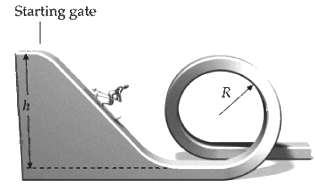
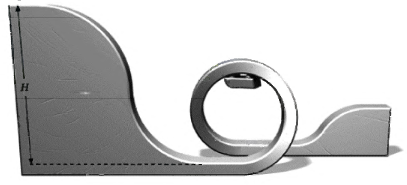
In a new ski jump event, a loop is installed at the end of the ramp as shown in Figure. This problem addresses the physical requirement such an event would place on the skiers. Neglect friction. (a) Along the track of the ramp and the loop, where do the legs of the skier have to support the maximum
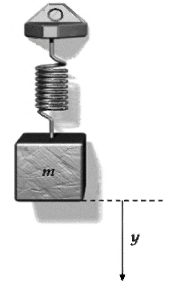
A mass m is suspended from the ceiling by a spring and is free to move vertically in the y direction as indicated in Figure. We are given that the potential energy as a function of position is U = ½ky2 – 3gy (a) Sketch U as a function of y. What value of y corresponds to the unstretched
A spring-loaded gun is cocked by compressing a short, strong spring by a distance d. The gun fires a signal flare of mass m directly upward. The flare has speed v0 as it leaves the spring and is observed to rise to a maximum height h above the point where it leaves the spring. After it leaves the
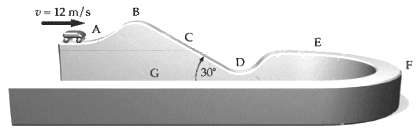
A roller-coaster car having a total mass (including passengers) of 500 kg travels freely along the winding frictionless track in Figure .Points A, E, and G are horizontal straight sections, all at the same height of 10 m above ground. Point C is at a height of 10 m above the ground on a section
An elevator (mass M = 2000 kg) is moving downward at v0 = 1.5 m/s. A braking system prevents the downward speed from increasing. (a) At what rate (in J/s) is the braking system converting mechanical energy to thermal energy?(b) While the elevator is moving downward at v0 = 1.5 m/s, the braking
To measure the force of friction on a moving car, engineers turn off the engine and allow the car to coast down hills of known steepness. The engineers collect the following data: 1. On a 2.87° hill, the car can coast at a steady 20 m/s. 2. On a 5.74° hill, the steady coasting speed is
A 50,000-kg barge is pulled along a canal at a constant speed of 3 km/h by a heavy tractor. The towrope makes an angle of 18° with the velocity vector of the barge. The tension in the towrope is 1200 N. If the towrope breaks, how far will the barge move before coming to rest? Assume that the drag
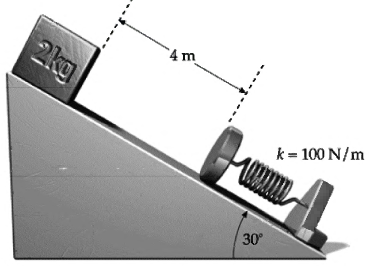
A 2-kg block is released 4 m from a massless spring with a force constant k = 100 N/m that is fixed along a frictionless plane inclined at 30°, as shown in Figure. (a) Find the maximum compression of the spring. (b) If the plane is rough rather than frictionless, and the coefficient of
A train with a total mass of 2 × 10⁶ kg rises 707 m in a travel distance of 62 km at an average speed of 15.0 km/h. If the frictional force is 0.8% of the weight, find (a) The kinetic energy of the train, (b) The total change in its potential energy, (c) The energy dissipated by
While driving, one expects to spend more energy accelerating than driving at a constant speed.(a) Neglecting friction, calculate the energy required to give a 1200-kg car a speed of 50 km/h.(b) If friction results in a retarding force of 300 N at a speed of 50 km/h, what is the energy needed to
In one model of jogging, the energy expended is assumed to go into accelerating and decelerating the legs. If the mass of the leg is m and the running speed is v, the energy needed to accelerate the leg from rest to v is ½ mv2 and the same energy is needed to decelerate the leg back to rest for
On July 31, 1994, Sergei Bubka pole-vaulted over a height of 6.14 m. If his body was momentarily at rest at the top of the leap, and all of the energy required to raise his body derived from his kinetic energy just prior to planting his pole, how fast was he moving just before takeoff? Neglect the
A 5-kg block is held against a spring of force constant 20 N/cm, compressing it 3 cm. The block is released and the spring extends, pushing the block along a rough horizontal surface. The coefficient of friction between the surface and the block is 0.2.(a) Find the work done on the block by the
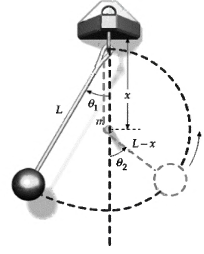
A pendulum of length L has a bob of mass m. It is released from some angle θ1. The string hits a peg at a distance x directly below the pivot as in Figure, effectively shortening the length of the pendulum. Find the maximum angle θ2 between the string and the vertical when the bob is to the right
A block of mass m is dropped onto the top of a vertical spring whose force constant is k. If the block is released from a height h above the top of the spring,(a) What is the maximum kinetic energy of the block?(b) What is the maximum compression of the spring?(c) At what compression is the block's
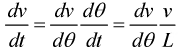
The bob of a pendulum of length L is pulled aside so the string makes an angle θ0 with the vertical, and the bob is then released. In Example 7-2, the conservation of energy was used to obtain the speed of the bob at the bottom of its swing. In this problem, you are to obtain the same result using
(Multiple choice)(1)Two objects of unequal mass are connected by a massless cord passing over a frictionless peg. After the objects are released from rest, which of the following statements are true? (U = gravitational potential energy, K = kinetic energy of the system.)(a) ∆U < 0 and ∆K >
(Multiple choice)(1) True or false:(a) The total energy of a system cannot change. (b) When you jump into the air, the floor does work on you, increasing your potential energy.(2)A body falling through the atmosphere (air resistance is present) gains 20 J of kinetic energy. The amount of
Give an example of a three-dimensional object that has no mass at its center of mass.
Three point masses of 2 kg each are located on the x axis at the origin, x = 0.20 m, and x = 0.50 m. Find the center of mass of the system.
A 24-kg child is 20 m from an 86-kg adult. Where is the center of mass of this system?
Three objects of 2 kg each are located in the xy plane at points (10 cm, 0), (0, 10 cm), and (10 cm, 10 cm). Find the location of the center of mass.
Find the center of mass xcm of the three masses in figure.
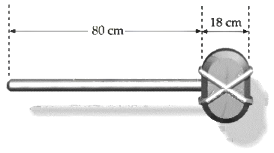
Alley Oop's club-ax consists of a symmetrical 8-kg stone attached to the end of a uniform 2.5-kg stick that is 98 cm long. The dimensions of the club-ax are shown in figure. How far is the center of mass from the handle end of the club-ax?
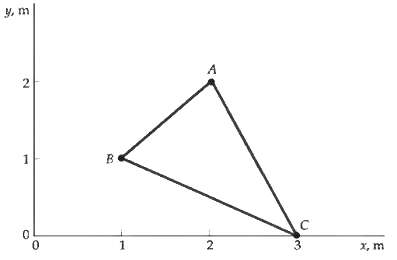
Three balls A, B, and C, with masses of 3 kg, 1 kg, and 1 kg, respectively, are connected by massless rods. The balls are located as in Figure. What are the coordinates of the center ofmass?
By symmetry, locate the center of mass of an equilateral triangle of side length a located with one vertex on the y axis and the others at (−a/2, 0) and (+a/2, 0).
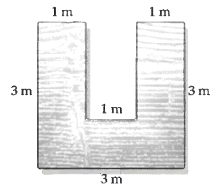
The uniform sheet of plywood in figure has a mass of 20 kg. Find its center ofmass.
Show that the center of mass of a uniform semicircular disk of radius R is at a point (4/3π) R from the center of the circle.
A baseball bat of length L has a peculiar linear density (mass per unit length) given by λ = λ0 (1 + x2/L2). Find the x coordinate of the center of mass in terms of L.
Find the center of mass of a homogeneous solid hemisphere of radius R and mass M.
Find the center of mass of a thin hemispherical shell.
A sheet of metal is cut in the shape of a parabola. The edge of the sheet is given by the Expression y = ax2, and y ranges from y = 0 to y = b. Find the center of mass in terms of a and b.
On the night before your physics exam, you hear a banging on your door, and in walks Kelly. She says, "There's a big problem here. According to Newtonian physics, only external forces can cause the center of mass of a system to accelerate. But a car accelerates because of its own engine, so
Two 3-kg masses have velocities v1 = 2m/s i + 3m/s j and v2 = 4m/s i – 6m/s j. Find the velocity of the center of mass for the system.
A 1500-kg car is moving westward with a speed of 20 m/s, and a 3000-kg truck is traveling east with a speed of 16 m/s. Find the velocity of the center of mass of the system.
A force F = 12N i is applied to the 3-kg ball in Problem 7. What is the acceleration of the center of mass?
A block of mass m is attached to a string and suspended inside a hollow box of mass M. The box rests on a scale that measures the system's weight. (a) If the string breaks, does the reading on the scale change? Explain your reasoning. (b) Assume that the string breaks and mass m falls
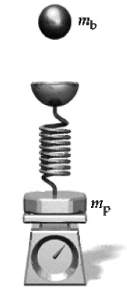
A vertical spring of force constant k is attached at the bottom to form of mass mp, and at the top to a massless cup, as in Figure. The platform rests on a scale. A ball of mass mb is placed in the cup. What is the reading on the scale when (a) The spring is compressed an amount d =
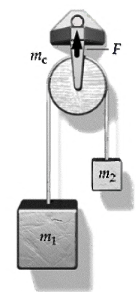
In the Atwood's machine in Figure, the string passes over a fixed, frictionless cylinder of mass mc. (a) Find the acceleration of the center of mass of the two-block-and-cylinder system. (b) Use Newton's second law for systems to find the force F exerted by the support. (c) Find the
Repeat Problems 22a and 22b with the ball dropped into the cup from a height h above the cup.From 22a and 22b(a) The spring is compressed an amount d = mg/k?(b) The ball comes to rest momentarily with the spring compressed?
How is the recoil of a rifle related to momentum conservation?
A man is stranded in the middle of an ice rink that is perfectly frictionless. How can he get to the edge?
A girl jumps from a boat to a dock. Why does she have to jump more energy than she would need if she were jumping the same distance one dock to another?
Much early search in rocket motion was done by Robert Goddard, physics professor at Clark College in Worcester, Massachusetts. A quotation from a 1921 editorial in the New York Times illustrates the public acceptance of his work: "That Professor Goddard with his 'chair' at Clark College and the
Liz, Jay, and Tara discover that sinister chemicals are leaking at a steady rate from a hole in the bottom of a railway car. To collect evidence of a potential environmental mishap, they videotape the car as it rolls without friction at an initial speed v0. Tara claims that careful analysis of the
A girl of mass 55 kg jumps off the bow of a 75-kg canoe that is initially at rest. If her velocity is 2.5 m/s to the right, what is the velocity of the canoe after she jumps?
Two masses of 5 kg and 10 kg are connected by a compressed spring and rest on a frictionless table. After the spring is released, the smaller mass has a velocity of 8 m/s to the left. What is the velocity of the larger mass?
A shell of mass m and speed v explodes into two identical fragments. If the shell was moving horizontally with respect to the earth, and one of the fragments is subsequently moving vertically with the speed v, find the velocity v’ of the other fragment.
In a circus act, Marcello (mass 70.0 kg) is shot from a cannon with a muzzle velocity of 24.0 m/s at an angle of 30° above horizontal. His partner, Tina (mass 50.0 kg), stands on an elevated platform located at the top of his trajectory. He grabs her as he flies by and the two fly off together.
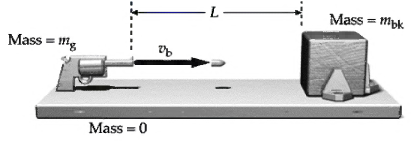
A block and a handgun loaded with one bullet are firmly affixed to opposite ends of a massless cart that rests on a level frictionless air table (Figure). The mass of the handgun is mg, the mass of the block is mbk, and the mass of the bullet is mbt. The gun is aimed so that when fired, the bullet
A small object of mass m slides down a wedge of mass 2m and exits smoothly onto a frictionless table. The wedge is initially at rest on the table. If the object is initially at rest at a height h above the table, find the velocity of the wedge when the object leaves it.
Describe how a basketball is moving when(a) Its total kinetic energy is just the energy of motion of its center of mass, and(b) Its total kinetic energy is the energy of its motion relative to its center of mass.
Two bowling balls are moving with the same velocity, but one just slides down the alley, whereas the other rolls down the alley. Which ball has more energy?
A 3-kg block is traveling to the right at 5 m/s, and a second 3-kg block is traveling to the left at 2 m/s.(a) Find the total kinetic energy of the two blocks in this reference frame.(b) Find the velocity of the center of mass of the two-body system.(c) Find the velocities of the two blocks
Repeat Problem 40 with the second, 3-kg block replaced by a block having a mass of 5 kg and moving to the right at 3 m/s.(From problem 40)(a) Find the total kinetic energy of the two blocks in this reference frame.(b) Find the velocity of the center of mass of the two-body system.(c) Find the
Explain why a safety net can save the life of a circus performer.
How might you estimate the collision time of a baseball and bat?
Why does a wine glass survive a fall onto a carpet but not onto a concrete floor?
A soccer ball of mass 0.43 kg leaves the foot of the kicker with an initial speed of 25 m/s.(a) What is the impulse imparted to the ball by the kicker?(b) If the foot of the kicker is in contact with the ball for 0.008 s, what is the average force exerted by the foot on the ball?
A 0.3-kg brick is dropped from a height of 8 m. It hits the ground and comes to rest.(a) What is the impulse exerted by the ground on the brick?(b) If it takes 0.0013 s from the time the brick first touches the ground until it comes to rest, what is the average force exerted by the ground on the
Showing 6400 - 6500
of 21795
First
58
59
60
61
62
63
64
65
66
67
68
69
70
71
72
Last
Step by Step Answers

 Get 50% OFF
Claim Now
Get 50% OFF
Claim Now