New Semester
Started
Get
50% OFF
Study Help!
--h --m --s
Claim Now
Question Answers
Textbooks
Find textbooks, questions and answers
Oops, something went wrong!
Change your search query and then try again
S
Books
FREE
Study Help
Expert Questions
Accounting
General Management
Mathematics
Finance
Organizational Behaviour
Law
Physics
Operating System
Management Leadership
Sociology
Programming
Marketing
Database
Computer Network
Economics
Textbooks Solutions
Accounting
Managerial Accounting
Management Leadership
Cost Accounting
Statistics
Business Law
Corporate Finance
Finance
Economics
Auditing
Tutors
Online Tutors
Find a Tutor
Hire a Tutor
Become a Tutor
AI Tutor
AI Study Planner
NEW
Sell Books
Search
Search
Sign In
Register
study help
physics
mechanics
Fundamentals of Ethics for Scientists and Engineers 1st Edition Edmund G. Seebauer, Robert L. Barry - Solutions
You run a race with your girlfriend. At first you each have the same kinetic energy, but you find that she is beating you. When you increase your speed by 25%, you are running at the same speed she is. If your mass is 85 kg, what is her mass?
How does the work required to stretch a spring 2 cm from its natural length compare with that required to stretch it 1 cm from its natural length?
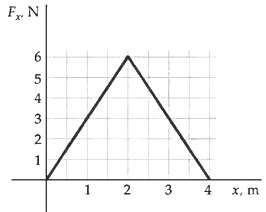
A 3-kg particle is moving with a speed of 2 m/s when it is at x = 0. It is subjected to a single force Fx that varies with position as shown in Figure. (a) What is the kinetic energy of the particle when it is at x = 0? (b) How much work is done by the force as the particle moves from x = 0 to x =
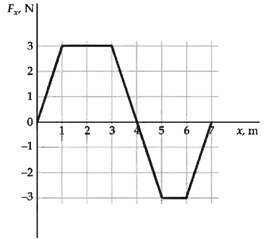
A 4-kg particle is initially at rest at x = 0. It is subjected to a single force Fx that varies with position as shown in Figure. Find the work done by the force as the particle moves (a) From x = 0 to x = 3 m, and (b) From x = 3 m to x = 6 m. Find the kinetic energy of the particle when it is
A force Fx acts on a particle. The force is related to the position of the particle by the formula Fx = Cx3, where C is a constant. Find the work done by this force on the particle when the particle moves from x = 1.5m to x = 3m.
Lou's latest invention, aimed at urban dog owners, is the X-R-Leash. It is made of a rubber-like material that exerts a force Fx = −kx − ax2 when it is stretched a distance x, where k and a are constants. The ad claims, "You'll never go back to your old dog leash after you've had the thrill of
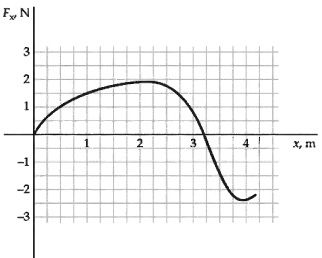
A 3-kg object is moving with a speed of 2.40 m/s in the x direction when it passes the origin. It is acted on by a single force Fx that varies with x as shown in Figure. (a) What is the work done by the force from x = 0 to x = 2 m?(b) What is the kinetic energy of the object at x = 2
Near Margaret's cabin is a 20-m water tower that attracts many birds during the summer months.During a hot spell last year, the tower went dry, and Margaret had to have her water hauled in. She got lonesome without the birds visiting, so she decided to carry some water up the tower to attract them
Suppose there is a net force acting on a particle but it does no work. Can the particle be moving in a straight line?
A 6-kg block slides down a frictionless incline making an angle of 60° with the horizontal.(a) List all the forces acting on the block, and find the work done by each force when the block slides 2 m (measured along the incline).(b) What is the total work done on the block?(c) What is the speed of
An 85-kg cart is deposited on a 1.5-m platform after being rolled up an incline formed by a plank of length L that has been laid from the lower level to the top of the platform. (Assume that the rolling is equivalent to sliding without friction.) (a) Find the force parallel to the incline needed to
A 2-kg object attached to a horizontal string moves with a speed of 2.5 m/s in a circle of radius 3 m on a frictionless horizontal surface.(a) Find the tension in the string.(b) List the forces acting on the object, and find the work done by each force during one revolution.
What is the angle between the vectors A and B if A•B = -AB?
Two vectors A and B have magnitudes of 6 m and make an angle of 60o with each other. Find A•B.
Find A·B for the following vectors:(a). A = 3 i - 6 j, B = -4 i + 2 j;(b). A = 5 i + 5 j, B = 2 i - 4 j; and(c). A = 6 i + 4 j, B = 4 i - 6 j.
Find A·B for the following vectors:(a) A = 3 i - 6 j, B = -4 i + 2 j;(b) A = 5 i + 5 j, B = 2 i - 4 j;(c) A = 6 i + 4 j, B = 4 i - 6 j.
A 2-kg object is given a displacement Δs = (3 i + 3 j - 2 k) m along a straight line. During the displacement, a constant force F = (2 i - 1 j + 1 k) N acts on the object. (a) Find the work done by F for this displacement. (b) Find the component of F in
(a) Find the unit vector that is parallel to the vector A = Ax i + Ay j + Az k. (b) Find the component of the vector A = 2 i - j - k in the direction of the vector B = 3 i + 4 j.
When a particle moves in a circle with constant speed, the magnitudes of its position vector and velocity vector are constant. (a) Differentiate r·r = r2 = constant with respect to time to show that v·r = 0 and therefore v┴r. (b) Differentiate v·v = v2 = constant with respect to time
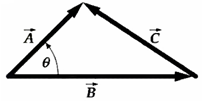
Vectors A, B, and C for a triangle as shown in Figure. The angle between A and B is θ, and the vectors are related by C = A - B. Compute C·C in terms of A, B, and θ, and derive the law of cosines, C2 = A2 + B2 - 2AB cos θ.
Force A does 5 J of work in 10 s. Force B does 3 J of work in 5 s. Which force delivers greater power?
A 5-kg box is lifted by a force equal to the weight of the box. The box moves upward at a constant velocity of 2 m/s.(a) What is the power input of the force?(b) How much work is done by the force in 4 s?
Fluffy has just caught a mouse, and decides that the only decent thing to do is to bring it to the bedroom so that his human roommate can admire it when she wakes up. A constant horizontal force of 3 N is enough to drag the mouse across the rug at a constant speed v. If Fluffy's force does work at
As single force of 5 N acts in the x direction on an 8-kg object(a) If the object starts from rest at x = 0 at time t = 0, find its velocity v as a function of time.(b) Write an expression for the power input as a function of time.(c) What is the power input of the force at time t = 3 s?
Find the power input of a force F acting on a particle that moves with a velocity v for (a) F = 4 N i + 3 N k, v = 6 m/s i; (b) F = 6 N i - 5 N j, v = - 5 m/s i + 4 m/s j;(c) F = 3 N i + 6 N j, v = 2 m/s i + 3 m/s j.
A particle of mass m moves from rest at t = 0 under the influence of a single force of magnitude F. Show that the power delivered by the force at time t is P = F2t/m.
At a speed of 20 km/h, a 1200-kg car accelerates at 3 m/s2 using 20 kW of power. How much power must be expended to accelerate the car at 2 m/s2 at a speed of 40 km/h?
A car manufacturer claims that his car can accelerate from rest to 100 km/h in 8 s. The car's mass is 800 kg.(a) Assuming that this performance is achieved at constant power, determine the power developed by the car's engine.(b) What is the car's speed after 4 s? (Neglect friction and air
Show that the position of the truck in Example 6 - 11 is related to its speed by x = (m/3P)v3.
A 700-kg car accelerates from rest under constant power. At the end of 8.0 s, its speed is 90 km/h and it is located 133 m from its starting point. If the car continues to accelerate using the same power, what will its speed be at the end of 10 s and how far will the car be from the starting point?
A 4.0-kg object initially at rest at x = 0 is accelerated at constant power of 8.0 W. At t = 9.0 s, it is at x = 36.0 m. Find its speed at t = 6.0 s and its position at that instant.
A 700-kg car accelerates from rest under constant power at t = 0. At t = 9 sit is 117.7 m from its starting point and its acceleration is then 1.09 m/s2. Find the power expended by the car's engine, neglecting frictional losses.
When you climb a mountain, is the work done on you by gravity different if you take a short, steep trail instead of a long, gentle trail? If not, why do you find one trail easier?
Which of the following forces are conservative and which are nonconservative?(a) The frictional force exerted on a sliding box(b) The force exerted by a linear spring that obeys Hooke's law(c) The force of gravity(d) The wind resistance on a moving car
An 80-kg man climbs up a 6-m high flight of stairs. What is the increase in gravitational potential energy?
One of the highlights of Sharika's concert is her daredevil swan dive into the audience from a height of 2 m above the crowd's outstretched hands. If her mass is 60 kg, and the time of her dive is defined as t = 0,(a) What is her initial potential energy relative to U = 0 at the position of the
Water flows over Victoria Falls, which is 128 m high, at an average rate of 1.4 × 10⁶ kg/s. If half the potential energy of this water were converted into electric energy, how much power would be produced by these falls?
A 2-kg box slides down a long, frictionless incline of angle 30°. It starts from rest at time t = 0 at the top of the incline at a height of 20 m above the ground.(a) What is the original potential energy of the box relative to the ground?(b) From Newton's laws, find the distance the box travels
A force Fx = 6 N is constant.(a) Find the potential-energy function U associated with this force for an arbitrary reference position x0 at which U = 0.(b) Find U such that U = 0 at x = 4 m.(c) Find U such that U = 14 J at x = 6 m.
A spring has a force constant of k = 104 N/m. How far must it be stretched for its potential energy to be (a) 50 J and (b) 100 J?
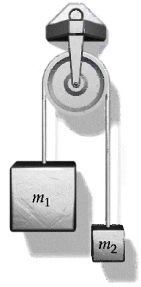
A simple Atwood's machine uses two masses, m1 and m2 (Figure). Starting from rest, the speed of the two masses is 4.0 m/s at the end of 3.0s. At that instant, the kinetic energy of the system is 80 J and each mass has moved a distance of 6.0 m. Determine the values of m1 and m2.
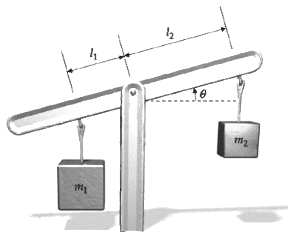
A straight rod of negligible mass is mounted on a frictionless pivot as in Figure. Masses m1 and m2 are suspended at distances l1 and l2.? (a) Write an expression for the gravitational potential energy of the masses as a function of the angle ? made by the rod and the horizontal.? (b) For what
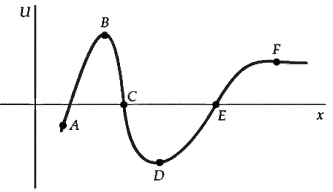
Figure shows the plot of a potential-energy function U versus x. (a) At each point indicated, state whether the force Fx is positive, negative, or zero. (b) At which point does the force have the greatest magnitude? (c) Identify any equilibrium points, and state whether the
(a) Find the force Fx associated with the potential-energy function U Ax 4, where A is a constant. (b) At what point(s) is the force zero?
A potential-energy function is given by U = C/x, where C is a positive constant. (a) Find the force Fx as a function of x. (b) Is this force directed toward the origin or away from it? (c) Does the potential energy increase or decrease as x increases? (d) Answer parts (b) and
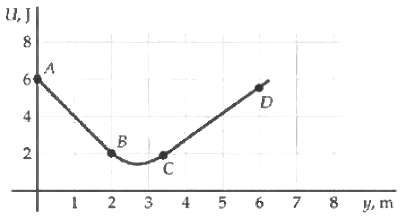
On the potential-energy curve for U versus y shown in Figure, the segments AB and CD are straight lines. Sketch a plot of the force Fy versus y.
The force acting on an object is given by Fx = a/x2. Determine the potential energy of the object as a function of x.
The potential energy of an object is given by U(x) = 3x2 − 2x3, where U is in joules and x is in meters. (a) Determine the force acting on this object. (b) At what positions is this object in equilibrium? (c) Which of these equilibrium positions are stable and which are unstable?
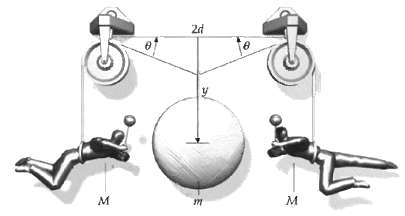
During a Dead Wait concert, Sharika and Chico, each of mass M, are attached to the ends of a light rope that is hung over two frictionless pulleys, as shown in Figure 6-38. A large gong of mass m is attached to the middle of the rope, between the pulleys, and Sharika and Chico beat it madly in lieu
The potential energy of an object is given by U(x) = 8x2 −x4, where U is in joules and x is in meters. (a) Determine the force acting on this object. (b) At what positions is this object in equilibrium? (c) Which of these equilibrium positions are stable and which are unstable?
The force acting on an object is given by F(x) = x3 4x. Locate the positions of unstable and stable equilibrium and show that at these points U(x) is a local maximum or minimum, respectively.
The potential energy of a 4-kg object is given by U = 3x2 − x3 for x ≤ 3 m, and U = 0 for x ≥ 3 m, where U is in joules and x is in meters. (a) At what positions is this object in equilibrium? (b) Sketch a plot of U versus x. (c) Discuss the stability of the equilibrium for the
A force is given by Fx = Ax-3, where A = 8 N•m3.(a) For positive values of x, does the potential energy associated with this force increase or decrease with increasing x? (You can determine the answer to this question by imagining what happens to a particle that is placed at rest at some point x
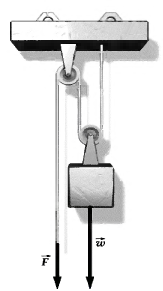
Figure shows two pulleys arranged to help lift a heavy load. A rope runs around two massless, frictionless pulleys and the weight w hangs from one pulley. You exert a force of magnitude F on the free end of the cord. (a) If the weight is to move up a distance h, through what distance must the
In February 1995, a total of 54.3 billion kW-h of electrical energy was generated by nuclear power plants in the United States. At the same time, the population of the United States was about 255 million people. If the average American has a mass of 60 kg, and if the entire energy output of all
One of the most powerful cranes in the world, operating in Switzerland, can slowly raise a load of M = 6000 tonne to a height of h = 12.0 m (1 tonne = 1000 kg).(a) How much work is done by the crane?(b) If it takes 1.00 min to lift the load at constant velocity to this height, find the power
In Australia, there used to be a ski lift of length 5.6 km. It took about 60 min for a gondola to travel all the way up. If there were 12 gondolas going up at once, each of mass 550 kg, and the angle of ascent was 30°, estimate the power P of the engine needed to operate the ski lift.
A 2.4-kg object attached to a horizontal string moves with constant speed in a circle of radius R on a frictionless horizontal surface. The kinetic energy of the object is 90 J and the tension in the string is 360 N. Find R.
How high must an 800-kg Ford Escort be lifted to gain an amount of potential energy equal to the kinetic energy it has when it is moving at 100 km/h?
The movie crew arrives in the Badlands ready to shoot a scene. The script calls for a car to crash into a vertical rock face at 100 km/h. unfortunately, the car won't start, and there is no mechanic in sight. They are about to skulk back to the studio to face the producer's wrath when the cameraman
The force acting on a particle that is moving along the x axis is given by Fx = -ax2, where a is a constant. Calculate the potential-energy function U relative to U = 0 at x = 0, and sketch a graph of U versus x.
Water from behind a dam flows through a large turbine at a rate of 1.5 × 10⁶ kg/min. The turbine is located 50 m below the surface of the reservoir, and the water leaves the turbine with a speed of 5 m/s. (a) Neglecting any energy dissipation, what is the power output of the turbine?(b) How
A force acts on a cart of mass m in such away that the speed v of the cart increases with distance x as v = Cx, where C is a constant. (a) Find the force acting on the cart as a function of position.(b) What is the work done by the force in moving the cart from x = 0 to x = x1?
A force F = (2 N/m2)x2 i is applied to a particle. Find the work done on the particle as it moves a total distance of 5 m (a) Parallel to the y axis from point (2 m, 2 m) to point (2 m, 7 m)(b) In a straight line from (2 m, 2 m) to (5 m, 6 m).
A particle of mass m moves along the x axis. Its position varies with time according to x = 2t3 − 4t2 where x is in meters and t is in seconds. Find (a) The velocity and acceleration of the particle at any time t; (b) The power delivered to the particle at any time t; and (c) The
A 3-kg particle starts from rest at x = 0 and moves under the influence of a single force Fx = 6 + 4x − 3x2 where Fx is in Newtons and x is in meters. (a) Find the work done by the force as the particle moves from x = 0 to x = 3 m. (b) Find the power delivered to the particle when it is
The initial kinetic energy imparted to a 20-g bullet is 1200 J. Neglecting air resistance, find the range of this projectile when it is fired at an angle such that the range equals the maximum height attained.
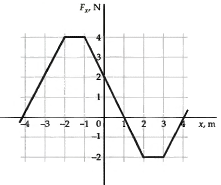
A force Fx acting on a particle is shown as a function of x in Figure. (a) From the graph, calculate the work done by the force when the particle moves from x = 0 to the following values of x: −4, −3, − 2, −1, 0, 1, 2, 3, and 4 m. (b) Plot the potential energy U versus x for the
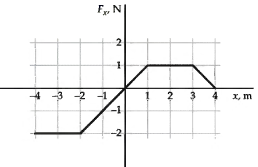
Repeat Problem 91 for the force Fx shown in Figure.(a) From the graph, calculate the work done by the force when the particle moves from x = 0 to the following values of x: −4, −3, − 2, −1, 0, 1, 2, 3, and 4 m. (b) Plot the potential energy U versus x for the range of values of x from
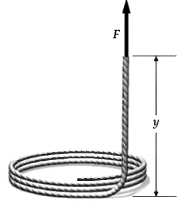
A rope of length L and mass per unit length of µ lies coiled on the floor. (a) What force F is required to hold one end of the rope a distance y < L above the floor as shown in Figure? (b) Find the work required to lift one end of the rope from the floor to a height l < L by integrating
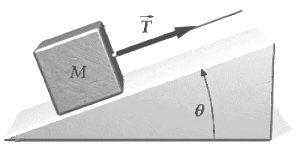
A box of mass M is at the bottom of a frictionless inclined plane (Figure). The box is attached to a string that pulls with a constant tension T. (a) Find the work done by the tension T when the box has moved a distance x along the plane. (b) Find the speed of the box as a function of x and ?. (c)
A force in the xy plane is given by F = (F0/r)(yi - xj), where F0 is a constant and r = √x2 + y2 . (a) Show that the magnitude of this force is F0 and that its direction is perpendicular to r = xi + yj. (b) Find the work done by this force on a particle that moves in a circle of radius
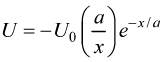
A theoretical formula for the potential energy associated with the nuclear force between two protons, two neutrons, or a neutron and a proton is the Yukawa potential:Where U0 and a are constants. (a) Sketch U versus x using U0 = 4 pJ (a picojoule, pJ, is 1 × 10-12J) and a = 2.5 fm (a
(Multiple choice)(1) True or false: (a) Only the net force acting on an object can do work. (b) No work is done on a particle that remains at rest. (c) A force that is always perpendicular to the velocity of a particle never does work on the particle.(2)An object initially has
(Multiple choice)(1)A woman runs up a flight of stairs. The gain in her gravitational potential energy is U. If she runs up the same stairs with twice the speed, what will be her gain in potential energy(a) U (b) 2U (c) U/2 (d) 4U (e) U/4(2)Which of the following statements is
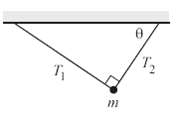
A mass m, held up by two strings, hangs from a ceiling, as shown in Figure. The strings form a right angle. In terms of the angle ??¸ shown, what is the tension in each string?
A block sits on a plane that is inclined at an angle θ. Assume that the friction force is large enough to keep the block at rest. What are the horizontal components of the friction and normal forces acting on the block? For what θ are these horizontal components maximum?
A frictionless planar curve is in the shape of a function which has its endpoints at the same height but is otherwise arbitrary. A chain of uniform mass per unit length rests on the curve from end to end, as shown in Figure. Show by considering the net force of gravity along the curve that the
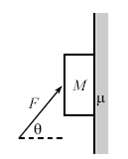
A book of mass M?is positioned against a vertical wall. The coefficient of friction between the book and the wall is ?. You wish to keep the book from falling by pushing on it with a force F?applied at an angle ??with respect to the horizontal (??/2 2), as shown in Fig. For a given ?, what is the
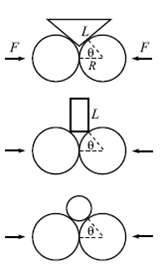
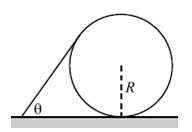
Each of the following planar objects is placed, as shown in Fig. between two frictionless circles of radius R. The mass density of each object is Ï??, and the radii to the points of contact make an angle ??¸ with the horizontal. For each case, find the horizontal force that must be applied to the
A rope with length L and mass density Ï per unit length is suspended vertically from one end. Find the tension as a function of height along the rope.
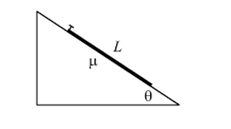
A rope with length L and mass density ρ per unit length lies on a plane inclined at angle θ (see Figure). The top end is nailed to the plane, and the coefficient of friction between the rope and plane is μ. What are the possible values for the tension at the top of the rope?
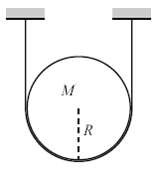
(a) A disk of mass M and radius R is held up by a massless string, as shown in Fig. The surface of the disk is frictionless. What is the tension in the string? What is the normal force per unit length the string applies to the disk? (b) Let there now be friction between the disk and the string,
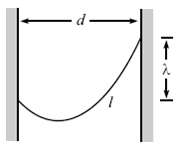
(a) A chain with uniform mass density per unit length hangs between two given points on two walls. Find the shape of the chain. Aside from an arbitrary additive constant, the function describing the shape should contain one unknown constant. (b) The unknown constant in your answer depends on the
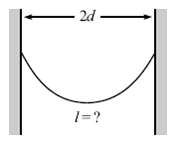
A chain with uniform mass density per unit length hangs between two supports located at the same height, a distance 2d apart (see Fig.). What should the length of the chain be so that the magnitude of the force at the supports is minimized? You may use the fact that a hanging chain takes the form,
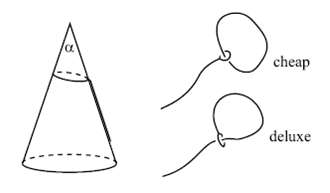
A mountain climber wishes to climb up a frictionless conical mountain. He wants to do this by throwing a lasso (a rope with a loop) over the top and climbing up along the rope. Assume that the climber is of negligible height, so that the rope lies along the mountain, as shown in Fig. At the bottom
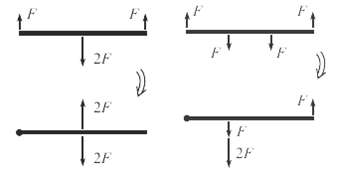
This problem gives another way of demonstrating Claim 1.1, using an inductive argument. We'll get you started, and then you can do the general case. Consider the situation where forces F are applied upward at the ends of a stick of length ?, and a force 2F is applied downward at the midpoint (see
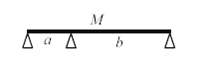
A stick of mass M is held up by supports at each end, with each support providing a force of Mg/2. Now put another support somewhere in the middle, say, at a distance ? from one support and b from the other; see Fig. What forces do the three supports now provide? Can you solve this?
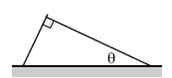
One stick leans on another as shown in Fig. A right angle is formed where they meet, and the right stick makes an angle ? with the horizontal. The left stick extends infinitesimally beyond the end of the right stick. The coefficient of friction between the two sticks is ?. The sticks have the same
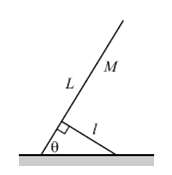
A ladder of length L and mass M has its bottom end attached to the ground by a pivot. It makes an angle ? with the horizontal, and is held up by a massless stick of length ? which is also attached to the ground by a pivot (see Fig). The ladder and the stick are perpendicular to each other. Find the
A stick of mass density ? per unit length rests on a circle of radius R (see Fig.). The stick makes an angle ? with the horizontal and is tangent to the circle at its upper end. Friction exists at all points of contact, and assume that it is large enough to keep the system at rest. Find the
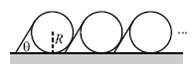
A large number of sticks (with mass density ? per unit length) and circles (with radius R) lean on each other, as shown in Fig. Each stick makes an angle ? with the horizontal and is tangent to a circle at its upper end. The sticks are hinged to the ground, and every other surface is frictionless
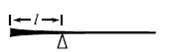
Given a semi-infinite stick (that is, one that goes off to infinity in one direction), determine how its density should depend on position so that it has the following property: If the stick is cut at an arbitrary location, the remaining semi-infinite piece will balance on a support that is located
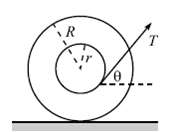
A spool consists of an axle of radius r and an outside circle of radius R which rolls on the ground. A thread is wrapped around the axle and is pulled with tension T, at an angle ? with the horizontal (see Fig). (a) Given R and r, what should ??¸ be so that the spool does not move? Assume that the
One night, Lucy picked up a strange message on her ham radio. “Help! We ran away from Earth to live in peace and serenity, and we got disoriented. All we know is that we are orbiting the sun with a period of 5 years. Where are we?” Lucy did some calculations and told the travelers their mean
Halley’s comet has a period of about 76 y. What is its mean distance from the sun?
A comet has a period estimated to be about 4210 y. What is its mean distance from the sun? (4210 y was the estimated period of the comet Hale–Bopp, which was seen in the Northern Hemisphere in early 1997. Gravitational interactions with the major planets that occurred during this apparition of
The radius of the earth’s orbit is 1.496 x 10¹¹ m and that of Uranus is 2.87 x 10¹² m. What is the period of Uranus?
The asteroid Hektor, discovered in 1907, is in a nearly circular orbit of radius 5.16 AU about the sun. Determine the period of this asteroid.
The asteroid Icarus, discovered in 1949, was so named because its highly eccentric elliptical orbit brings it close to the sun at perihelion. The eccentricity e of an ellipse is defined by the relation dp = a(1 - e), where dp is the perihelion distance and a is the semimajor axis. Icarus has an
Showing 6600 - 6700
of 21795
First
60
61
62
63
64
65
66
67
68
69
70
71
72
73
74
Last
Step by Step Answers

 Get 50% OFF
Claim Now
Get 50% OFF
Claim Now