New Semester
Started
Get
50% OFF
Study Help!
--h --m --s
Claim Now
Question Answers
Textbooks
Find textbooks, questions and answers
Oops, something went wrong!
Change your search query and then try again
S
Books
FREE
Study Help
Expert Questions
Accounting
General Management
Mathematics
Finance
Organizational Behaviour
Law
Physics
Operating System
Management Leadership
Sociology
Programming
Marketing
Database
Computer Network
Economics
Textbooks Solutions
Accounting
Managerial Accounting
Management Leadership
Cost Accounting
Statistics
Business Law
Corporate Finance
Finance
Economics
Auditing
Tutors
Online Tutors
Find a Tutor
Hire a Tutor
Become a Tutor
AI Tutor
AI Study Planner
NEW
Sell Books
Search
Search
Sign In
Register
study help
physics
mechanics
Introductory Classical Mechanics 1st edition David Morin - Solutions
Two ice skaters hold hands and rotate, making one revolution in 2.5 s. Their masses are 55 kg and 85 kg, and they are separated by 1.7 m. Find(a) The angular momentum of the system about their center of mass, and(b) The total kinetic energy of the system.
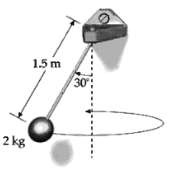
A 2-kg ball attached to a string of length 1.5 m moves in a horizontal circle as a conical pendulum (Figure). The string makes an angle q = 30o with the vertical. (a) Show that the angular momentum of the ball about the point of support P has a horizontal component toward the center of the circle
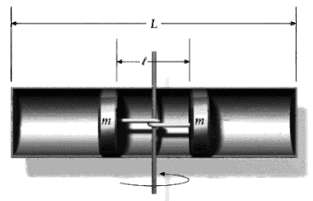
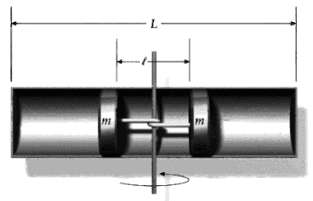
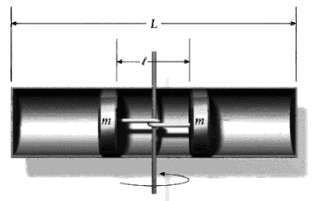
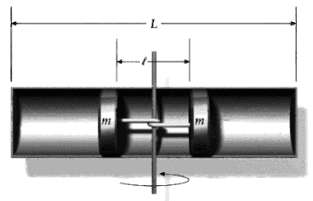
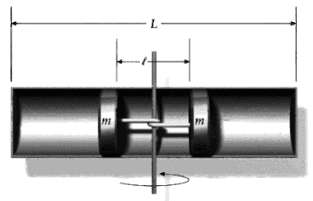
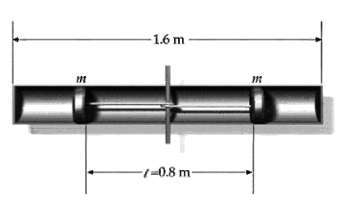
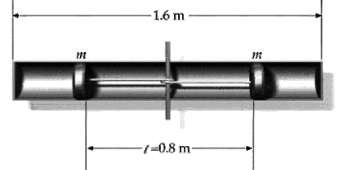
Figure shows a hollow cylindrical tube of mass M, length L, and moment of inertia ML2/10. Inside the cylinder are two masses m, separated a distance ? and tied to a central post by a thin string. The system can rotate about a vertical axis through the center of the cylinder. With the system
Repeat Problem 77, this time adding friction between the masses and walls of the cylinder. However, the coefficient of friction is not enough to prevent the masses from reaching the ends of the cylinder. Can the final energy of the system be determined without knowing the coefficient of
Suppose that in Figure, ? = 0.6 m, L = 2.0 m, M = 0.8 kg, and m = 0.4 kg. The system rotates at w such that the tension in the string is 108 N just before it breaks. Determine the initial and final angular velocities and initial and final energies of the system. Assume that the inside walls of the
For Problem 77, determine the radial velocity of each mass just before it reaches the end of the cylinder.
Given the numerical values of Problem 79, suppose the coefficient of friction between the masses and the walls of the cylinder is such that the masses cease sliding 0.2 m from the ends of the cylinder. Determine the initial and final angular velocities of the system and the energy dissipated
Kepler’s second law states: The radius vector from the sun to a planet sweeps out equal areas in equal times. Show that this law follows directly from the law of conservation of angular momentum and the fact that the force of gravitational attraction between a planet and the sun acts along the
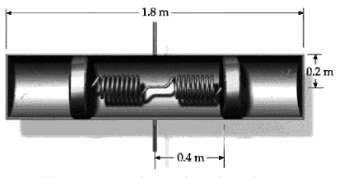
Figure shows a hollow cylinder of length 1.8 m, mass 0.8 kg, and radius 0.2 m that is free to rotate about a vertical axis through its center and perpendicular to the cylinder's axis. Inside the cylinder are two thin disks of 0.2 kg each, attached to springs of spring constant k and unstretched
(a) Assuming the earth to be a homogeneous sphere of radius r and mass m, show that the period T of the earth’s rotation about its axis is related to its radius by T = (4πm/5L)r2, where L is the angular momentum of the earth due to its rotation.(b) Suppose that the radius r changes by a very
The polar ice caps contain about 2.3 x 10¹⁹ kg of ice. This mass contributes negligibly to the moment of inertia of the earth because it is located at the poles, close to the axis of rotation. Estimate the change in the length of the day that would be expected if the polar ice caps were to melt and
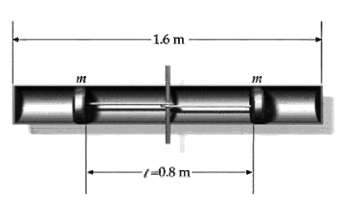
Figure shows a hollow cylinder of mass M = 1.2 kg and length L = 1.6 m that is free to rotate about a vertical axis through its center. Inside the cylinder are two disks, each of mass 0.4 kg that are tied to a central post by a thin string and separated by a distance l = 0.8 m. The string breaks if
For the system of Problem 86, find the angular velocity of the system just before and just after the point masses pass the ends of the cylinder.
Repeat Problem 86 with the radius of the hollow cylinder as 0.4 m and the masses treated as thin disks rather than pointmasses.
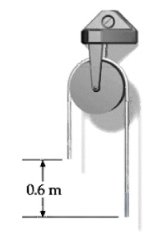
Figure shows a pulley in the shape of a uniform disk with a heavy rope hanging over it. The circumference of the pulley is 1.2 m and its mass is 2.2 kg. The rope is 8.0 m long and its mass is 4.8 kg. At the instant shown in the figure, the system is at rest and the difference in height of the two
(Multiple choice)(1) True or False:(a) If two vectors are parallel, their cross product must be zero.(b) When a disk rotates about its symmetry axis, is along the axis.(c) The torque exerted by a force is always perpendicular to the force.(2)Two vectors A and B have equal magnitude. Their cross
(Multiple choice)(1) True or false:If the net torque on a rotating system is zero, the angular velocity of the system cannot change.(2)If the angular momentum of a system is constant, which of the following statements must be true? (a) No torque acts on any part of the system. (b) A
(Multiple choice)(1)The angular momentum vector for a spinning wheel lies along its axle and is pointed east. To make this vector point south, it is necessary to exert a force on the east end of the axle in which direction? (a) Up (b) Down (c) North (d) South (e) East(2)A
(a) A block starts at rest and slides down a frictionless plane inclined at angle θ. What should θ be so that the block travels a given horizontal distance in the minimum amount of time?(b) Same question, but now let there be a coefficient of kinetic friction, µ, between the block and the plane.
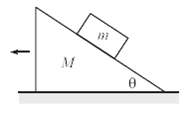
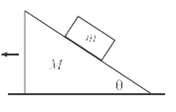
A block of mass m is held motionless on a frictionless plane of mass M and angle of inclination ? (see Fig.). The plane rests on a frictionless horizontal surface. The block is released. What is the horizontal acceleration of the plane?
A block is placed on a plane inclined at angle θ. The coefficient of friction between the block and the plane is µ = tan θ. The block is given a kick so that it initially moves with speed V horizontally along the plane (that is, in the direction perpendicular to the direction pointing straight
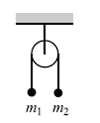
A massless pulley hangs from a fixed support. A massless string connecting two masses, m1 and m2, hangs over the pulley (see Fig.). Find the acceleration of the masses and the tension in thestring.
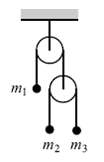
A double Atwood's machine is shown in Fig., with masses m1, m2, and what are the accelerations of themasses?
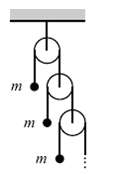
Consider the infinite Atwood's machine shown in Fig. A string passes over each pulley, with one end attached to a mass and the other end attached to another pulley. All the masses are equal to m, and all the pulleys and strings are massless. The masses are held fixed and then simultaneously
N + 2 equal masses hang from a system of pulleys, as shown in Fig. What are the accelerations of all themasses?
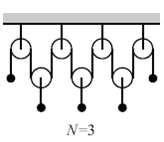
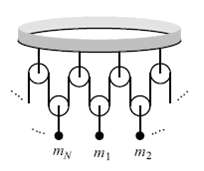
Consider the system of pulleys shown in Fig. The string (which is a loop with no ends) hangs over N fixed pulleys. N masses, m1, m2, ., mN, are attached to N pulleys that hang on the string. What are the accelerations of all themasses?
A particle of mass m is subject to a force F(t) = me−bt. The initial position and speed are zero. Find x(t).
A chain of length ℓ is held stretched out on a frictionless horizontal table, with a length y0 hanging down through a hole in the table. The chain is released. As a function of time, find the length that hangs down through the hole (don’t bother with t after the chain loses contact with the
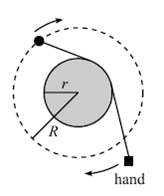
A mass, which is free to move on a horizontal frictionless plane, is attached to one end of a massless string which wraps partially around a frictionless vertical pole of radius r (see the top view in Fig.). You hold onto the other end of the string. At t = 0, the mass has speed v0 in the
A beach ball is thrown upward with initial speed v0. Assume that the drag force from the air is F = −mαv. What is the speed of the ball, vf , when it hits the ground? (An implicit equation is sufficient.) Does the ball spend more time or less time in the air than it would if it were
Consider a pencil that stands upright on its tip and then falls over. Let’s idealize the pencil as a mass m sitting at the end of a massless rod of length ℓ.19 (a) Assume that the pencil makes an initial (small) angle θ0 with the vertical, and that its initial angular speed is
A ball is thrown with speed υ from the edge of a cliff of height h. At what inclination angle should it be thrown so that it travels the maximum horizontal distance? What is this maximum distance? Assume that the ground below the cliff is horizontal.
A ball is dropped from rest at height h, and it bounces off a surface at height y (with no loss in speed). The surface is inclined so that the ball bounces off at an angle of θ with respect to the horizontal. What should y and θ be so that the ball travels the maximum horizontal distance?
A ball is thrown at speed ? from zero height on level ground. Let ?0 be the angle at which the ball should be thrown so that the distance traveled through the air is maximum. Show that ?0 satisfiesYou can show numerically that ?0 ? 56.5o
A ball is thrown at speed υ from zero height on level ground. At what angle should it be thrown so that the area under the trajectory is maximum?
A ball is thrown straight upward so that it reaches a height h. It falls down and bounces repeatedly. After each bounce, it returns to a certain fraction f of its previous height. Find the total distance traveled, and also the total time, before it comes to rest. What is its average speed?
Show that the acceleration of a particle moving in a circle is υ2/r. To do this, draw the position and velocity vectors at two nearby times, and then make use of some similar triangles.
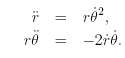
Consider a free particle in a plane. Using Cartesian coordinates, it is trivial to show that the particle moves in a straight line. The task of this problem is to demonstrate this result in a much more cumbersome way, using eqs. (2.52). More precisely, show that cos ? = r0/r for a free particle,
Consider a particle that feels an angular force only, of the form Fθ = mrθ. (There’s nothing all that physical about this force. It simply makes the F = mα equations solvable.) Show that r = √Aln r + B, where A and B are constants of integration, determined by the initial
A block of mass m is held motionless on a frictionless plane of mass M and angle of inclination ? (see Fig.). The plane rests on a frictionless horizontal surface. The block is released. What is the horizontal acceleration of the plane?
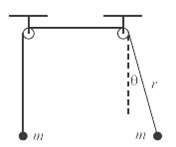
Two equal masses, m, connected by a string, hang over two pulleys (of negligible size), as shown in Fig. The left one moves in a vertical line, but the right one is free to swing back and forth (in the plane of the masses and pulleys). Find the equations of motion for r and ?, as shown. Assume that
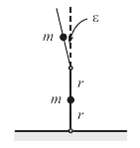
Two massless sticks of length 2r, each with a mass m fixed at its middle, are hinged at an end. One stands on top of the other, as shown in Fig. The bottom end of the lower stick is hinged at the ground. They are held such that the lower stick is vertical, and the upper one is tilted at a small
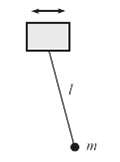
A pendulum consists of a mass m and a massless stick of length ? The pendulum support oscillates horizontally with a position given by x(t) = A cos(?t) (see Fig.). Calculate the angle of the pendulum as a function of time.
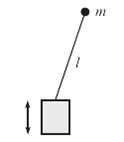
A pendulum consists of a mass m at the end of a massless stick of length ? The other end of the stick is made to oscillate vertically with a position given by y(t) = A cos(?t), where A
(a) In eq. (5.25), let t1 = 0 and t2 = T, for convenience. And let ?(t) be an easy-to-deal-with ??triangular?? function, of the formUnder what conditions is the harmonic-oscillator ?S in eq. (5.25) negative?(b) Answer the same question, but now with ?(t) = ? sin(?t=T ).
A mass m slides down a frictionless plane that is inclined at angle θ. Show, using the method in Section 5.3, that the normal force from the plane is the familiar mg cos θ.
A stick is pivoted at the origin and is arranged to swing around in a horizontal plane at constant angular speed ? A bead of mass m slides frictionlessly along the stick. Let r be the radial position of the bead. Find the conserved quantity E given in eq. (5.52). Explain why this quantity is not
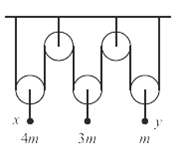
Consider the Atwood's machine shown in Fig. The masses are 4m, 3m, and m. Let x and y be the heights of the left and right masses, relative to their initial positions. Find the conservedmomentum.
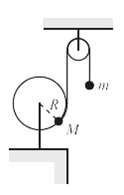
A mass M is attached to a massless hoop (of radius R) which lies in a vertical plane. The hoop is free to rotate about its fixed center. M is tied to a string which winds part way around the hoop, then rises vertically up and over a massless pulley. A mass m hangs on the other end of the string
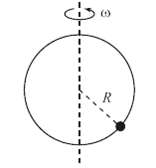
A bead is free to slide along a frictionless hoop of radius R. The hoop rotates with constant angular speed ? around a vertical diameter (see Fig). Find the equation of motion for the position of the bead. What are the equilibrium positions? What is the frequency of small oscillations about the
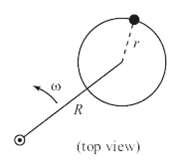
A bead is free to slide along a frictionless hoop of radius r. The plane of the hoop is horizontal, and the center of the hoop travels in a horizontal circle of radius R, with constant angular speed ?, about a given point (see Fig.). Find the equation of motion for the position of the bead. Also,
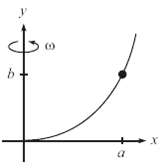
The curve y(x) = b(x/a)? is rotated around the y-axis with constant frequency ? (see Fig.). A bead moves frictionlessly along the curve. Find the frequency of small oscillations about the equilibrium point. Under what conditions do oscillations exist? (This problem gets a little messy.)
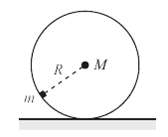
A mass m is fixed to a given point on the edge of a wheel of radius R. The heel is massless, except for a mass M located at its center (see Fig.). The wheel rolls without slipping on a horizontal table. Find the equation of motion for the angle through which the wheel rolls. For the case where the
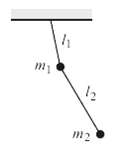
Consider a double pendulum made of two masses, m1 and m2, and two rods of lengths ?1 and ?2 (see Fig.). Find the equations of motion. For small oscillations, find the normal modes and their frequencies for the special case ?1 = ?2 (and consider the cases m1 = m2, m1 >> m2, and m1 > ?2, and
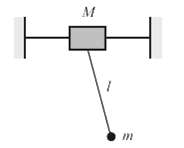
A mass M is free to slide along a frictionless rail. A pendulum of length ? and mass m hangs from M (see Fig.). Find the equations of motion. For small oscillations, find the normal modes and their frequencies.
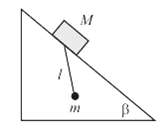
A mass M is free to slide down a frictionless plane inclined at angle ?. A pendulum of length ? and mass m hangs from M (see Fig.). Find the equations of motion. For small oscillations, find the normal modes and their frequencies.
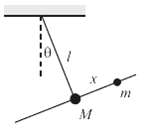
A mass M is fixed at the right-angled vertex where a massless rod of length ? is connected to a very long massless rod (see Fig). A mass m is free to move frictionlessly along the long rod. The rod of length ? is hinged at a support, and the whole system is free to rotate, in the plane of the rods,
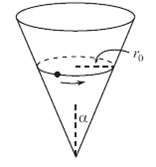
A particle slides on the inside surface of a frictionless cone. The cone is fixed with its tip on the ground and its axis vertical. The half-angle at the tip is ? (see Fig.). Let r(t) be the distance from the particle to the axis, and let ?(t) be the angle around the cone. Find the equations of
In the spirit of Section 5.8, show that the shortest path between two points in a plane is a straight line.
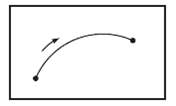
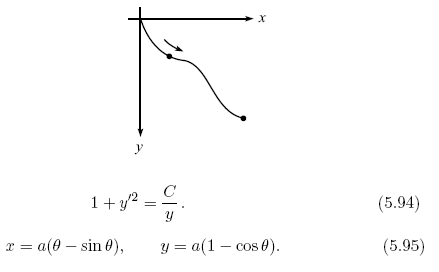
Assume that the speed of light in a given slab of material is proportional to the height above the base of the slab.13 Show that light moves in circular arcs in this material; see Fig. You may assume that light takes the path of least time between two points (Fermat??s principle of leasttime).
A bead is released from rest at the origin and slides down a frictionless wire that connects the origin to a given point, as shown in Fig. You wish to shape the wire so that the bead reaches the endpoint in the shortest possible time. Let the desired curve be described by the function y(x), with
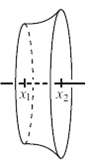
Derive the shape of the minimal surface discussed in Section 5.8, by demanding that a cross-sectional ??ring?? (that is, the region between the planes x = x1 and x = x2) is in equilibrium; see Fig.
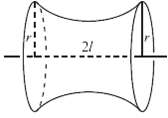
Consider the minimal surface from Section 5.8, and look at the special case where the two rings have the same radius (see Fig). Let 2 ? be the distance between the rings. What is the largest value of ?/r for which a minimal surface exists? You will have to solve something numerically here.
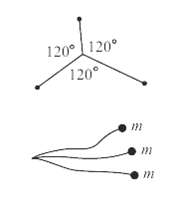
The shortest configuration of string joining three given points is the one shown at the top of Fig, where all three angles are 120o.17 Explain how you could experimentally prove this fact by cutting three holes in a table and making use of three equal masses attached to the ends of strings (the
A particle moves toward x = 0 under the influence of a potential V (x) = −A|x|n, where A > 0 and n > 0. The particle has barely enough energy to reach x = 0. For what values of n will it reach x = 0 in a finite time?
A small ball rests on top of a fixed frictionless sphere. The ball is given a tiny kick and slides downward. At what point does it lose contact with the sphere?
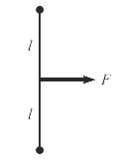
(a) A massless string of length 2? connects two hockey pucks that lie on frictionless ice. A constant horizontal force F is applied to the midpoint of the string, perpendicular to it (see Fig.). How much kinetic energy is lost when the pucks collide, assuming they stick together?(b) The answer you
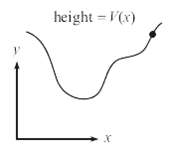
A bead, under the influence of gravity, slides along a frictionless wire whose height is given by the function V (x) (see Fig.). Find an expression for the bead??s horizontal acceleration x. (It can depend on whatever quantities you need it to depend on.) You should find that the result is not the
A bead, under the influence of gravity, slides along a frictionless wire whose height is given by the function y(x). Assume that at position (x,y) = (0,0), the wire is vertical and the bead passes this point with a given speed v0 downward. What should the shape of the wire be (that is, what is y as
A particle moves under the influence of the potential V (x) = −Cxne−ax. Find the frequency of small oscillations around the equilibrium point.
The potential for a mass hanging from a spring is V (y) = ky2/2+mgy, where y = 0 corresponds to the position of the spring when nothing is hanging from it. Find the frequency of small oscillations around the equilibrium point.
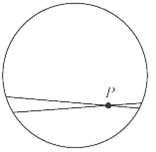
Show that the gravitational force inside a spherical shell is zero by showing that the pieces of mass at the ends of the thin cones in Fig. give canceling forces at pointP.
(a) Find the escape velocity (that is, the velocity above which a particle will escape to r = ∞) for a particle on a spherical planet of radius R and mass M. What is the numerical value for the earth? The moon? The sun? (b) Approximately how small must a spherical planet be in order for a
(a) A hole of radius R is cut out from an infinite flat sheet of mass density σ. Let L be the line that is perpendicular to the sheet and that passes through the center of the hole. What is the force on a mass m that is located on L, at a distance x from the center of the hole?(b) If a particle is
Consider a cube of uniform mass density. Find the ratio of the gravitational potential energy of a mass at a corner to that of a mass at the center.
A snowball is thrown against a wall. Where does its momentum go? Where does its energy go?
For some odd reason, you decide to throw baseballs at a car of mass M, which is free to move frictionlessly on the ground. You throw the balls at the back of the car at speed u, and at a mass rate of σ kg/s (assume the rate is continuous, for simplicity). If the car starts at rest, find its
Do the previous problem except now assume that the back window is open, so that the balls collect inside the car?
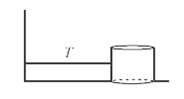
At t = 0, a massless bucket contains a mass M of sand. It is connected to a wall by a massless spring with constant tension T (that is, independent of length).18 See Fig. The ground is frictionless, and the initial distance to the wall is L. At later times, let x be the distance from the wall, and
Consider the setup in Problem 16, but now let the sand leak at a rate proportional to the bucket’s acceleration. That is, dm/dt = bx. Note that x is negative, so dm is also.(a) Find the mass as a function of time, m(t).(b) Find v(t) and x(t) for the times when the bucket contains a nonzero amount
A billiard ball collides elastically with an identical stationary one. Use the fact that mv2/2 may be written as m(v ∙ v)/2 to show that the angle between the resulting trajectories is 90o.
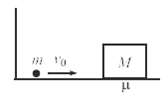
A ball of mass m and initial speed v0 bounces back and forth between a fixed wall and a block of mass M (with M >> m). See Fig. M is initially at rest. Assume that the ball bounces elastically and instantaneously. The coefficient of kinetic friction between the block and the ground is ?.
A sheet of mass M moves with speed V through a region of space that contains particles of mass m and speed v. There are n of these particles per unit volume. The sheet moves in the direction of its normal. Assume m V, what is the drag force per unit area on the sheet? Assume, for simplicity, that
A cylinder of mass M and radius R moves with speed V through a region of space that contains particles of mass m that are at rest. There are n of these particles per unit volume. The cylinder moves in a direction perpendicular to its axis. Assume m
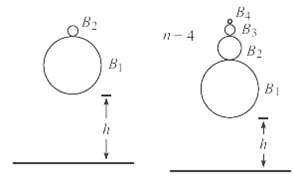
(a) A tennis ball with a small mass m2 sits on top of a basketball with a large mass m1 (see Fig.). The bottom of the basketball is a height h above the ground, and the bottom of the tennis ball is a height h+d above the ground. The balls are dropped. To what height does the tennis ball bounce?(b)
A mass M, initially moving at speed v, collides and sticks to a mass m, initially at rest. Assume M >> m, and work in this approximation. What are the final energies of the two masses, and how much energy is lost to heat, in:(a) The lab frame?(b) The frame in which M is initially at rest?
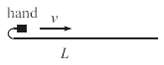
A chain of length L and mass density ? lies straight on a frictionless horizontal surface. You grab one end and pull it back along itself, in a parallel manner (see Fig.). Assume that you pull it at constant speed v. What force must you apply? What is the total work that you do, by the time the
A rope of mass density σ lies in a heap on the floor. You grab an end and pull horizontally with constant force F. What is the position of the end of the rope, as a function of time, while it is unravelling? Assume that the rope is greased, so that it has no friction with itself.
A rope of length L and mass density σ lies in a heap on the floor. You grab one end of the rope and pull upward with a force such that the rope moves at constant speed v. What is the total work you do, by the time the rope is completely off the floor? How much energy is lost to heat, if any?
(a) A rope of length L lies in a straight line on a frictionless table, except for a very small piece at one end which hangs down through a hole in the table. This piece is released, and the rope slides down through the hole. What is the speed of the rope at the instant it loses contact with
Assume that a cloud consists of tiny water droplets suspended (uniformly distributed, and at rest) in air, and consider a raindrop falling through them. What is the acceleration of the raindrop? Assume that the raindrop is initially of negligible size and that when it hits a water droplet, the
A ball with moment of inertia ηmr2 rests on top of a fixed sphere. There is friction between the ball and the sphere. The ball is given an infinitesimal kick and rolls down without slipping. Assuming that r is much smaller than the radius of the sphere, at what point does the ball lose contact
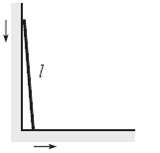
A ladder of length ? and uniform mass density stands on a frictionless floor and leans against a frictionless wall. It is initially held motionless, with its bottom end an infinitesimal distance from the wall. It is then released, whereupon the bottom end slides away from the wall, and the top end
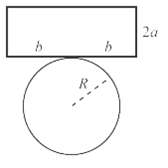
A rectangle of height 2a and width 2b rests on top of a fixed cylinder of radius R (see Fig.). The moment of inertia of the rectangle around its center is I. The rectangle is given an infinitesimal kick, and then ??rolls?? on the cylinder without slipping. Find the equation of motion for the tilt
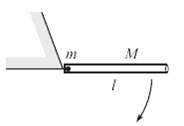
A tube of mass M and length ? is free to swing by a pivot at one end. A mass m is positioned inside the tube at this end. The tube is held horizontal and then released (see Fig). Let ? be the angle of the tube with respect to the horizontal, and let x be the distance the mass has traveled along the
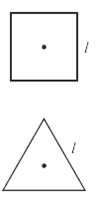
In the spirit of Section 7.3.2, find the moments of inertia of the following objects (see Fig).(a) A uniform square of mass m and side ? (axis through center, perpendicular to plane).(b) A uniform equilateral triangle of mass m and side ? (axis through center, perpendicular to plane).
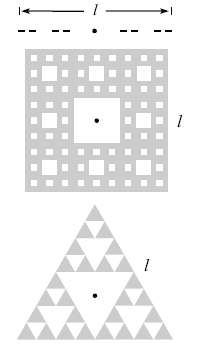
In the spirit of Section 7.3.2, find the moments of inertia of the following fractal objects. (Be careful how the mass scales.) (a) Take a stick of length ?, and remove the middle third. Then remove the middle third from each of the remaining two pieces. Then remove the middle third from each of
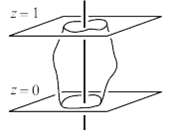
A moldable blob of matter of mass M is to be situated between the planes z = 0 and z = 1 (see Fig) so that the moment of inertia around the z-axis be as small as possible. What shape should the blobtake?
Given a collection of particles with positions ri, let the force on the ith particle, due to all the others, be Finti . Assuming that the force between any two particles is directed along the line between them, use Newton’s third law to show that ∑i ri ×Finti = 0.
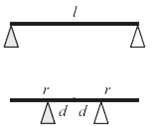
(a) A uniform rod of length ? and mass m rests on supports at its ends. The right support is quickly removed (see Fig). What is the force on the left support immediately thereafter?(b) A rod of length 2r and moment of inertia ?mr2 rests on top of two supports, each of which is a distance d away
Showing 7000 - 7100
of 21795
First
64
65
66
67
68
69
70
71
72
73
74
75
76
77
78
Last
Step by Step Answers

 Get 50% OFF
Claim Now
Get 50% OFF
Claim Now