New Semester
Started
Get
50% OFF
Study Help!
--h --m --s
Claim Now
Question Answers
Textbooks
Find textbooks, questions and answers
Oops, something went wrong!
Change your search query and then try again
S
Books
FREE
Study Help
Expert Questions
Accounting
General Management
Mathematics
Finance
Organizational Behaviour
Law
Physics
Operating System
Management Leadership
Sociology
Programming
Marketing
Database
Computer Network
Economics
Textbooks Solutions
Accounting
Managerial Accounting
Management Leadership
Cost Accounting
Statistics
Business Law
Corporate Finance
Finance
Economics
Auditing
Tutors
Online Tutors
Find a Tutor
Hire a Tutor
Become a Tutor
AI Tutor
AI Study Planner
NEW
Sell Books
Search
Search
Sign In
Register
study help
physics
mechanics
Fundamentals of Ethics for Scientists and Engineers 1st Edition Edmund G. Seebauer, Robert L. Barry - Solutions
A meteorite of mass 30.8 tonne (1 tonne = 1000 kg) is exhibited in the Hayden Planetarium in New York. Suppose the kinetic energy of the meteorite as it hit the ground was 617 MJ. Find the impulse I experienced by the meteorite up to the time its kinetic energy was halved (which took about t = 3.0
When a 0.15-kg baseball is hit, its velocity changes from +20 m/s to -20 m/s.(a) What is the magnitude of the impulse delivered by the bat to the ball?(b) If the baseball is in contact with the bat for 1.3 ms, what is the average force exerted by the bat on the ball?
A 300-g handball moving with a speed of 5.0 m/s strikes the wall at an angle of 40° and then bounces off with the same speed at the same angle. It is in contact with the wall for 2 ms. What is the average force exerted by the ball on the wall?
A 2000-kg car traveling at 90 km/h crashes into a concrete wall that does not give at all.(a) Estimate the time of the collision, assuming that the center of the car travels halfway to the wall with constant deceleration. (Use any reasonable length for the car.)(b) Estimate the average force
You throw a 150-g ball to a height of 40 m.(a) Use a reasonable value for the distance the ball moves while it is in your hand to calculate the average force exerted by your hand and the time the ball is in your hand while you throw it.(b) Is it reasonable to neglect the weight of the ball while it
A handball of mass 300 g is thrown straight against a wall with a speed of 8 m/s. It rebounds with the same speed.(a) What impulse is delivered to the wall?(b) If the ball is in contact with the wall for 0.003 s, what average force is exerted on the wall by the ball?(c) The ball is caught by a
The great limestone caverns were formed by dripping water.(a) If water droplets of 0.03 mL fall from a height of 5 m at a rate of 10 per minute, what is the average force exerted on the limestone floor by the droplets of water?(b) Compare this force to the weight of a water droplet.
A favorite game at picnics is the egg toss. Two people toss a raw egg back and forth as they move farther apart. If the force required to break the egg’s shell is about 5 N and the mass of the egg is 50 g, estimate the maximum separation distance for the egg throwers. Make whatever assumptions
Under what conditions can all the initial kinetic energy of colliding bodies be lost in a collision?
Consider a perfectly inelastic collision of two objects of equal mass.(a) Is the loss of kinetic energy greater if the two objects have oppositely directed velocities of equal magnitude v /2, or if one of the two objects is initially at rest and the other has an initial velocity of v?(b) In which
Joe and Sal decide that little Ronny is well-behaved enough to sit at the table with the family for Thanksgiving dinner. They are wrong. Ronny throws a 150-g handful of mashed potatoes horizontally with a speed of 5 m/s. It strikes a 1.2-kg gravy boat that is initially at rest on the frictionless
A 2000-kg car traveling to the right at 30 m/s is chasing a second car of the same mass that is traveling to the right at 10 m/s.(a) If the two cars collide and stick together, what is their speed just after the collision?(b) What fraction of the initial kinetic energy of the cars is lost during
An 85-kg running back moving at 7 m/s makes a perfectly inelastic collision with a 105-kg linebacker who is initially at rest. What is the speed of the players just after their collision?
A 5.0-kg object with a speed of 4.0 m/s collides head-on with a 10-kg object moving toward it with a speed of 3.0 m/s. The 10-kg object stops dead after the collision.(a) What is the final speed of the 5-kg object?(b) Is the collision elastic?
A ball of mass m moves with speed v to the right toward a much heavier bat that is moving to the left with speed v. Find the speed of the ball after it makes an elastic collision with the bat.
During the Great Muffin Wars of '98, students from rival residences became familiar with the characteristics of various muffins. Mushy Pumpkin Surprise, for example, was good for temporarily blinding an attacker, while Mrs. O'Brien's Bran Muffins, having the density of lacrosse balls, were used
Repeat Problem 64 with a second (illegal) muffin having a mass of 0.5 kg and moving to the right at 3 m/s.From problem no 64(a) It is a perfectly inelastic collision of two pumpkin muffins, and(b) It is an elastic collision of two bran muffins.
A proton of mass m undergoes a head-on elastic collision with a stationary carbon nucleus of mass 12m. The speed of the proton is 300 m/s.(a) Find the velocity of the center of mass of the system.(b) Find the velocity of the proton after the collision.
A 3-kg block moving at 4 m/s makes an elastic collision with a stationary block of mass 2 kg. Use conservation of momentum and the fact that the relative velocity of recession equals the relative velocity of approach to find the velocity of each block after the collision. Calculate the initial and
Night after night, Lucy is tormented by nocturnal wailing from the house next door. One day she seizes a revolver, stalks to the neighbor’s window with a crazed look in her eye, takes aim, and fires a 10-g bullet into her target: a 1.2 kg saxophone that rests on a frictionless surface. The bullet
A block of mass m1 = 2 kg slides along a frictionless table with a speed of 10 m/s. Directly in front of it, and moving in the same direction with a speed of 3 m/s, is a block of mass m2 = 5 kg. A massless spring with spring constant k = 1120 N/m is attached to the second block as in
A bullet of mass m is fired vertically from below into a block of wood of mass M that is initially at rest, supported by a thin sheet of paper. The bullet blasts through the block, which rises to a height of H above its initial position before falling back down. The bullet continues rising to
A proton of mass m is moving with initial speed v0 toward an α particle of mass 4m, which is initially at rest. Because both particles carry positive electrical charge, they repel each other.Find the speed v' of the α particle(a) When the distance between the two particles is least,(b) When the
A 16-g bullet is fired into the bob of a ballistic pendulum of mass 1.5 kg. When the bob is at its maximum height, the strings make an angle of 60° with the vertical. The length of the pendulum is 2.3 m. Find the speed of the bullet.
A bullet of mass m1 is fired with a speed v into the bob of a ballistic pendulum of mass m2. The bob is attached to a very light rod of length L that is pivoted at the other end. The bullet is stopped in the bob. Find the minimum v such that the bob will swing through a complete circle.
A bullet of mass m1 is fired with a speed v into the bob of a ballistic pendulum of mass m2. Find the maximum height h attained by the bob if the bullet passes through the bob and emerges with a speed v/2.
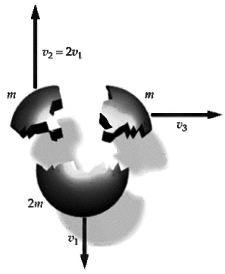
A 3-kg bomb slides along a frictionless horizontal plane in the x direction at 6 m/s. It explodes into two pieces, one of mass 2 kg and the other of mass 1 kg. The 1-kg piece moves along the horizontal plane in the y direction at 4 m/s.(a) Find the velocity of the 2-kg piece.(b) What is the
The beryllium isotope 4Be is unstable and decays into two α particles (helium nuclei of mass m = 6.68 × 10⁻²⁷ kg) with the release of 1.5 × 10⁻¹⁴J of energy. Determine the velocities of the two α particles that arise from the decay of a 4Be nucleus at rest.
The light isotope of lithium, 5Li, is unstable and breaks up spontaneously into a proton (hydrogen nucleus) and an α particle (helium nucleus). In this process, a total energy of 3.15 × 10⁻¹³J is released, appearing as the kinetic energy of the two reaction products. Determine the velocities of
Jay and Dave decide that the best way to protest the opening of a new incinerator is to launch a stink bomb into the middle of the ceremony. They calculate that a 6-kg projectile launched with an initial speed of 40 m/s at an angle of 30° will do the trick. The bomb will explode on impact, no one
A projectile of mass m = 3 kg is fired with initial speed of 120 m/s at an angle of 30° with the horizontal. At the top of it s trajectory, the projectile explodes into two fragments of masses 1 kg and 2 kg. The 2-kg fragment, lands on the ground directly below the point of explosion 3.6 s after
The boron isotope 9B is unstable and disintegrates into a proton and two α particles. The total energy released as kinetic energy of the decay products is 4.4 × 10⁻¹⁴ J. In one such event, with the 9B nucleus at rest prior to decay, the velocity of the proton is measured to be 6.0 × 10⁶ m/s.
The coefficient of restitution for steel on steel is measured by dropping a steel ball onto a steel plate that is rigidly attached to the earth. If the ball is dropped from a height of 3 m and rebounds to a height of 2.5 m, what is the coefficient of restitution?
According to the official rules of racquetball, a ball acceptable for tournament play must bounce to a height of between 173 and 183 cm when dropped from a height of 254 cm at room temperature. What is the acceptable range of values for the coefficient of restitution for the racquet-ball−floor
A ball bounces to 80% of its original height.(a) What fraction of its mechanical energy is lost each time it bounces?(b) What is the coefficient of restitution of the ball −floor system?
A 2-kg object moving at 6 m/s collides with a 4- kg object that is initially at rest. After the collision, the 2-kg object moves backward at 1 m/s.(a) Find the velocity of the 4-kg object after the collision.(b) Find the energy lost in the collision.(c) What is the coefficient of restitution for
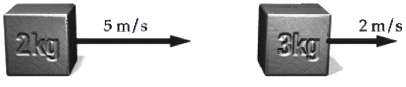
A 2-kg block moving to the right with speed 5 m/s collides with a 3-kg block that is moving in the same direction at 2 m/s, as in Figure. After the collision, the 3-kg block moves at 4.2 m/s. Find (a) The velocity of the 2-kg block after the collision, and (b) The coefficient of restitution for the
In a pool game, the cue ball, which has an initial speed of 5 m/s, makes an elastic collision with the eight ball, which is initially at rest. After the collision, the eight ball moves at an angle of 30° with the original direction of the cue ball.(a) Find the direction of motion of the cue ball
An object of mass M1 = m collides with velocity v0 i into an object of mass M2 = 2m with velocity 1/2v0 j. Following the collision, the mass m2 has a velocity v0/4 i. (a) Determine the velocity of the mass m1 after the collision. (b) Was this an elastic collision? If not,
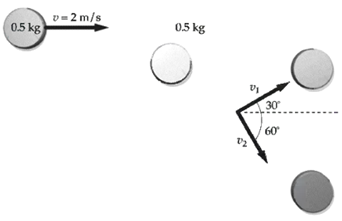
A puck of mass 0.5 kg approaches a second, similar puck that is stationary on frictionless ice. The initial speed of the moving puck is 2 m/s. After the collision, one puck leaves with a speed v1 at 30° to the original line of motion; the second puck leaves with speed v2 at 60°, as in Figure.(a)
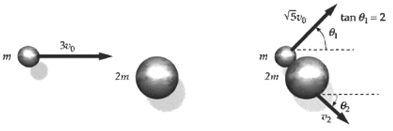
Figure shows the result of a collision between two objects of unequal mass. (a) Find the speed v2 of the larger mass after the collision and the angle θ2. (b) Show that the collision is elastic.
A ball moving at 10 m/s makes an off-center elastic collision with another ball of equal mass that is initially at rest. The incoming ball is deflected at an angle of 30° from its original direction of motion. Find the velocity of each ball after the collision.
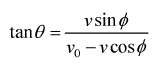
A particle has an initial speed v0. It collides with a second particle that is at rest and is deflected through an angle ?. Its speed after the collision is v. The second particle recoils. Its velocity makes an angle ? with the initial direction of the first particle.? (a) Show that (b) Do you
Describe a perfectly inelastic collision as viewed in the center-of-mass reference frame.
A particle with momentum p1 in one dimension makes an elastic collision with a second particle of momentum p2 = −p1 in the center-of-mass reference frame. After the collision its momentum is. Write the total initial and final energies in terms in terms of p1 and p1', and show that p1' = ±p1. If
A 3-kg block is traveling to the right at 5 m/s, and a 1-kg block is traveling to the left at 3 m/s.(a) Find the velocity vcm of the center of mass. (b) Subtract vcm from the velocity of each block to find the velocity of each block in the center-of-mass reference frame. (c) After they
Repeat Problem 94 with a second block having a mass of 5 kg and moving to the right at 3 m/s.Following same procedures one obtains:(a) Find the velocity vcm of the center of mass. (b) Subtract vcm from the velocity of each block to find the velocity of each block in the center-of-mass
A rocket burns fuel at a rate of 200 kg/s and exhausts the gas at a relative speed of 6 km/s. Find the thrust of the rocket.
The payload of a rocket is 5% of its total mass, the rest being fuel. If the rocket starts from rest and moves with no external forces acting on it, what is its final velocity if the exhaust velocity of its gas is 5 km/s?
A rocket moves in free space with no external forces acting on it. It starts from rest and has an exhaust speed of 3 km/s. Find the final velocity if the payload is(a) 20%,(b) 10%,(c) 1%.
A rocket has an initial mass of 30,000 kg, of which 20% is the payload. It burns fuel at a rate of 200 kg/s and exhausts its gas at a relative speed of 1.8 km/s. Find(a) The thrust of the rocket,(b) The time until burnout, and(c) Its final speed assuming it moves upward near the surface of the
Why can friction and the force of gravity usually be neglected in collision problems?
As a pendulum bob swings back and forth, is the momentum of the bob conserved? Explain why or why not.
A model-train car of mass 250 g traveling with a speed of 0.50 m/s links up with another car of mass 400 g that is initially at rest. What is the speed of the cars immediately after they have linked together? Find the initial and final kinetic energies.
(a) Find the total kinetic energy of the two model-train cars of Problem 103 before they couple.(b) Find the initial velocities of the two cars relative to the center of mass of the system, and use them to calculate the initial kinetic energy of the system relative to the center of mass.(c) Find
A 4-kg fish is swimming at 1.5 m/s to the right. He swallows a 1.2-kg fish swimming toward him at 3 m/s. Neglecting water resistance, what is the velocity of the larger fish immediately after his lunch?
A 3-kg block moves at 6 m/s to the right while a 6-kg block moves at 3 m/s to the right. Find(a) The total kinetic energy of the two-block system,(b) The velocity of the center of mass,(c) The center-of-mass kinetic energy,(d) The kinetic energy relative to the center of mass.
A 1500-kg car traveling north at 70 km/h collides at an intersection with a 2000-kg car traveling west at 55 km/h. The two cars stick together.(a) What is the total momentum of the system before the collision?(b) Find the magnitude and direction of the velocity of the wreckage just after the
The great white shark can have a mass as great as 3000 kg. Suppose such a shark is cruising the ocean when it spots a meal below it: a 200.0-kg fish swimming horizontally at 8.00 m/s. The shark rushes vertically downward at 3.00 m/s and swallows the prey at once. At what angle to the vertical θ
Repeat Problem 106 for a 3-kg block moving at 6 m/s to the right and a 6-kg block moving at 3 m/s to the left. Follow the procedures outlined in Problem 8-106. One obtains the following results.(a) The total kinetic energy of the two-block system,(b) The velocity of the center of mass,(c) The
Repeat Problem 106 for a 3-kg block moving at 10 m/s to the right and a 6-kg block moving at 1 m/s to the right. Follow the procedures outlined in Problem 8-106. One obtains the following results(a) The total kinetic energy of the two-block system,(b) The velocity of the center of mass,(c) The
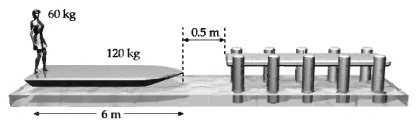
A 60-kg woman stands on the back of a 6-m-long, 120-kg raft that is floating at rest in still water with no friction. The raft is 0.5 m from a fixed pier, as in Figure. (a) The woman walks to the front of the raft and stops. How far is the raft from the pier now? (b) While the woman
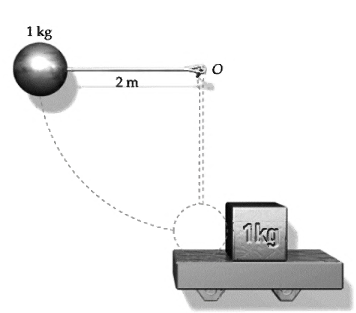
A 1-kg steel ball and a 2-m cord of negligible mass make up a simple pendulum that can pivot without friction about the point O, as in Figure. This pendulum is released from rest in a horizontal position and when the ball is at its lowest point it strikes a 1-kg block sitting at rest on a rough
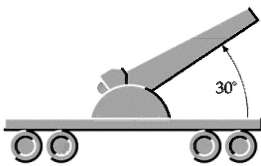
In World War I, the most awesome weapons of war were huge cannons mounted on railcars. Figure shows such a cannon, mounted so that it will project a shell at an angle of 30°. With the car initially at rest, the cannon fires a 200-kg projectile at 125 m/s. Now consider a system composed of a
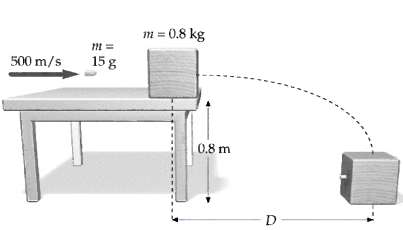
A 15-g bullet traveling at 500 m/s strikes an 0.8-kg block of wood that is balanced on a table edge 0.8 m above the ground (Figure). If the bullet buries itself in the block, find the distance D at which the block hits the floor.
In hand-pumped railcar races, a speed of 32 km/h has been achieved by teams of four. A car of mass 350 kg is moving at that speed toward a river when Carlos, the chief pumper, notices that the bridge ahead is out. All four people (of mass 75 kg each) jump simultaneously backward off the car with a
A constant force F = 12Ni is applied to the 8-kg mass of Problem 5 at t = 0.(a) What is the velocity of the center of mass of the three-particle system at t = 5 s?(b) What is the location of the center of mass at t = 5s?
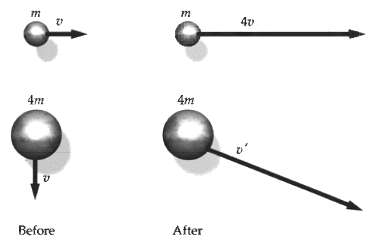
Two particles of mass m and 4m are moving in a vacuum at right angles as in Figure. A force acts on both particles for a time T. As a result, the velocity of the particle m is 4v in its original direction. Find the new velocity of the particle of mass4m.
An open railroad car of mass 20,000 kg is rolling without friction at 5 m/s along a level track when it starts to rain. After the car has collected 2000 kg of water, the rain stops.(a) What is the car's velocity?(b) As the car is rolling along, the water begins leaking out of a hole in the bottom
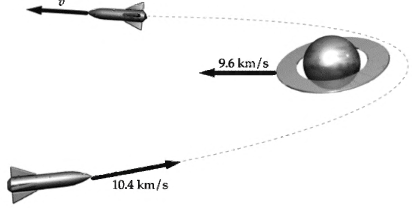
In the "slingshot effect," the transfer of energy in an elastic collision is used to boost the energy of a space probe so that it ca n escape from the solar system. Figure shows a space probe moving at 10.4 km/s (relative to the sun) toward Saturn, which is moving at 9.6 km/s (relative to the sun)
You (mass 80 kg) and your friend (mass unknown) are in a rowboat (mass 60 kg) on a calm lake. You are at the center of the boat rowing and she is at the back, 2 m from the center. You get tired and stop rowing. She offers to row and after the boat comes to rest, you change places. You notice that
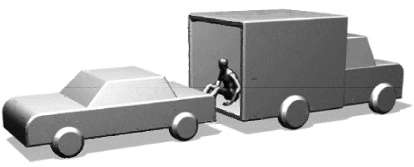
A small car of mass 800 kg is parked behind a small truck of mass 1600 kg on a level road (Figure). The brakes of both the car and the truck are off so that they are free to roll with negligible friction. A man sitting on the tail-gate of the truck shoves the car away by exerting a constant force
A13-kg block is at rest on a level floor. A400-g glob of putty is thrown at the block such that it travels horizontally, hits the block, and sticks to it. The block and putty slide 15 cm along the floor. If the coefficient of sliding friction is 0.4, what is the initial speed of the putty?
A careless driver rear-ends a car that is halted at a stop sign. Just before impact, the driver slams on his brakes, locking the wheels. The driver of the struck car also has his foot solidly on the brake pedal, locking his brakes. The mass of the struck car is 900 kg, and that of the initially
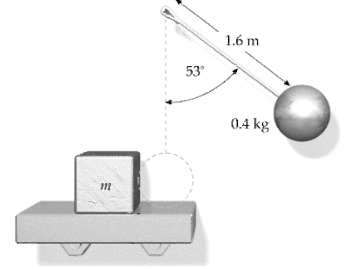
A pendulum consists of a 0.4-kg bob attached to a string of length 1.6 m. A block of mass m rests on a horizontal frictionless surface (Figure). The pendulum is released from rest at an angle of 53? with the vertical and the bob collides elastically with the block. Following the collision, the
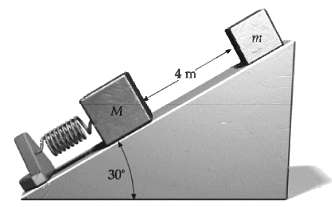
Initially, mass m = 1.0 kg and mass M are both at rest on a frictionless inclined plane (Figure). Mass M rests against a spring that has a spring constant of 11,000 N/m. The distance along the plane between m and M is 4.0 m. Mass m is released, makes an elastic collision with mass M, and rebounds a
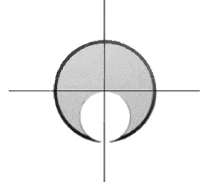
A circular plate of radius r has a circular hole cut out of it having radius r/2 (Figure). Find the center of mass of the plate.
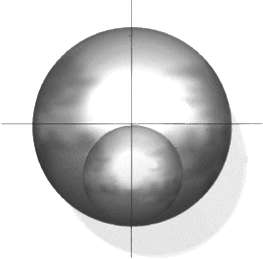
Using the hint from Problem 126, find the center of mass of a solid sphere of radius r that has a spherical cavity of radius r/2, as in Figure.
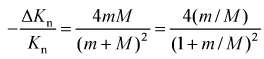
A neutron of mass m makes an elastic head-on collision with a stationary nucleus of mass M.? (a) Show that the energy of the nucleus after the collision is Knucleus = [4m M / (m + M)2]Kn , where Kn is the initial energy of the neutron.? (b) Show that the fraction of energy lost by the neutron in
The mass of a carbon nucleus is approximately 12 times the mass of a neutron. (a) Use the results of Problem 128 to show that after N head-on collisions of a neutron with carbon nuclei at rest, the energy of the neutron is approximately 0.716NE0, where E0 is its original energy. Neutrons
On average, a neutron loses 63% of its energy in an elastic collision with a hydrogen atom and 11% of its energy in an elastic collision with a carbon atom. The numbers are lower than the ones we have been using in earlier problems because most collisions are not head-on. Calculate the number of
A rope of length L and mass M lies coiled on a table. Starting at t = 0, one end of the rope is lifted from the table with a force F such that it moves with a constant velocity v,(a) Find the height of the center of mass of the rope as a function of time.(b) Differentiate your result in (a) twice
A tennis ball of mass mt is held a small distance above a basketball of mass mb. Both are dropped from a height h above the floor. (Take h to be the distance to the center of the basketball.) The basketball collides elastically with the floor. Find the speed vt of the tennis ball after it then
Repeat Problem 24 if the cup has a mass mc and the ball collides with it in-elastically.
Two astronauts at rest face each other in space. One, with mass m1, throws a ball of mass mb to the other, whose mass is m2. She catches the ball and throws it back to the first astronaut. If they each throw the ball with a speed of v relative to themselves, how fast are they moving after each has
The ratio of the mass of the earth to the mass of the moon in Me/mm = 81.3. The radius of the earth is about 6370 km, and the distance from the earth to the moon is about 384,000 km. (a) Locate the center of mass of the earth--moon system relative to the surface of the earth. (b) What
You wish to enlarge a skating surface so you stand on the ice at one end and aim a hose horizontally to spray water on the schoolyard pavement. Water leaves the hose at 2.4 kg/s with speed 30 m/s. If your mass is 75 kg, what is your recoil acceleration?
A neutron at rest decays into a proton plus an electron. The conservation of momentum implies that the electron and proton should have equal and opposite momentum. However, experimentally they do not. This apparent nonconservation of momentum led Wolfgang Pauli to suggest in 1931 that there was a
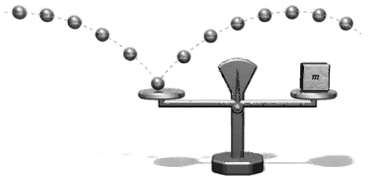
A stream of glass beads, each with a mass of 0.5 g, comes out of a horizontal tube at a rate of 100 per second (Figure). The beads fall a distance of 0.5 m to a balance pan and bounce back to their original height. How much mass must be placed in the other pan of the balance to keep the pointer at
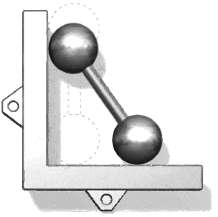
A dumbbell consisting of two balls of mass m connected by a massless rod of length L rests on a frictionless floor against a frictionless wall until it begins to slide down the wall as in Figure. Find the speed v of the bottom ball at the moment when it equals the speed of the topone.
A chain of length L and mass m is held vertically so that the bottom link just touches the floor. It is then dropped. (a) Show that the acceleration of the top end of the chain is g. (b) If the chain is moving downward with speed v at time t, and speed v + ∆v at time t + ∆v, find an
(Multiple Choice)(1)Two pucks of mass m1 and m2 lie unconnected on a frictionless table. A horizontal force F1 is exerted on m1 only. What is the magnitude of the acceleration of the center of mass of the pucks? (a) F1/m1 (b) F1 /(m1 + m2) (c) F1/m2 (d) (m1 + m2)F1/m1m2(2)The
A heavy box is to be moved from the top of one table to the top of another table of the same height on the other side of the room. Is work required to do this?
To get out of bed in the morning, do you have to do work?
By what factor does the kinetic energy of a car change when its speed is doubled?
An object moves in a circle at constant speed. Does the force that accounts for its acceleration do work on it? Explain.
A 15-g bullet has a speed of 1.2 km/s.(a) What is its kinetic energy in joules?(b) What is its kinetic energy if its speed is halved?(c) What is its kinetic energy if its speed is doubled?
Find the kinetic energy in joules of(a) A 0.145-kg baseball moving with a speed of 45 m/s and(b) A 60-kg jogger running at a steady pace of 9 min/mi.
A 6-kg box is raised from rest a distance of 3m by a vertical force of 80 N. Find(a) The work done by the force,(b) The work done by gravity, and(c) The final kinetic energy of the box.
A constant force of 80N acts on a box of mass of 5.0 kg that is moving in the direction of the applied force with a speed of 20 m/s. Three seconds later the box is moving with a speed of 68 m/s. Determine the work done by this force.
Showing 6500 - 6600
of 21795
First
59
60
61
62
63
64
65
66
67
68
69
70
71
72
73
Last
Step by Step Answers

 Get 50% OFF
Claim Now
Get 50% OFF
Claim Now