New Semester
Started
Get
50% OFF
Study Help!
--h --m --s
Claim Now
Question Answers
Textbooks
Find textbooks, questions and answers
Oops, something went wrong!
Change your search query and then try again
S
Books
FREE
Study Help
Expert Questions
Accounting
General Management
Mathematics
Finance
Organizational Behaviour
Law
Physics
Operating System
Management Leadership
Sociology
Programming
Marketing
Database
Computer Network
Economics
Textbooks Solutions
Accounting
Managerial Accounting
Management Leadership
Cost Accounting
Statistics
Business Law
Corporate Finance
Finance
Economics
Auditing
Tutors
Online Tutors
Find a Tutor
Hire a Tutor
Become a Tutor
AI Tutor
AI Study Planner
NEW
Sell Books
Search
Search
Sign In
Register
study help
physics
thermodynamics
Fundamentals of Ethics for Scientists and Engineers 1st Edition Edmund G. Seebauer, Robert L. Barry - Solutions
A pressure as low as P = 7 x 10–11 Pa has been obtained. Suppose a chamber contains helium at this pressure and at room temperature (300 K). Estimate the mean free path l and the collision time t for helium in the chamber. Take the diameter of a helium molecule to be 10–10 m.
Oxygen (O2) is confined to a cubic container 15 cm on a side at a temperature of 300 K. Compare the average kinetic energy of a molecule of the gas to the change in its gravitational potential energy if it falls from the top of the container to the bottom.
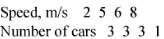
The class in Room 101 prepares their traditional greeting for a substitute teacher. Ten toy cars are wound up and released as the teacher arrives. The cars have the following speeds. Calculate (a) The average speed, and (b) The rms speed of thecars.
Show that f(v) given by Equation 18-37 is maximum when v = ?2kT/m.
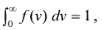
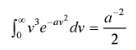
Since f(v) dv gives the fraction of molecules that have speeds in the range dv, the integral of f(v) dv over all the possible ranges of speeds must equal 1. Given the integral show that where f(v) is given by Equation 18-37.
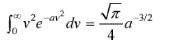
Given the integral calculate the average speed vav of molecules in a gas using the Maxwell-Boltzmann distribution function.
In Chapter, we found that the escape speed at the surface of a planet of radius R is ve = 2gR, where g is the acceleration due to gravity.(a) At what temperature is vrms for O2 equal to the escape speed for the earth?(b) At what temperature is vrms for H2 equal to the escape speed for the earth?(c)
Why might the Celsius and Fahrenheit scales be more convenient than the absolute scale for ordinary, nonscientific purposes?
Two different gases are at the same temperature. What can you say about the rms speeds of the gas molecules? What can you say about the average kinetic energies of the molecules?
Explain in terms of molecular motion why the pressure on the walls of a container increases when a gas is heated at constant volume.
Explain in terms of molecular motion why the pressure on the walls of a container increases when the volume of a gas is reduced at constant temperature.
At what temperature will the rms speed of an H2 molecule equal 331 m/s?
A solid-state temperature transducer is essentially a linear amplifier whose amplification is linearly temperature dependent. If the amplification is 25 times at 20oC and 60 times at 70oC, what is the temperature when the amplification is 45 times?
(a) If 1 mol of a gas in a container occupies a volume of 10 L at a pressure of 1 atm, what is the temperature of the gas in kelvins?(b) The container is fitted with a piston so that the volume can change. When the gas is heated at constant pressure, it expands to a volume of 20 L. What is the
A cubic metal box with sides of 20 cm contains air at a pressure of 1 atm and a temperature of 300 K. The box is sealed so that the volume is constant, and it is heated to a temperature of 400 K. Find the net force on each wall of the box.
Water, H2O, can be converted into H2 and O2 gas by electrolysis. How many moles of these gases result from the electrolysis of 2 L of water?
A massless cylinder 40 cm long rests on a horizontal frictionless table. The cylinder is divided into two equal sections by a membrane. One section contains nitrogen and the other contains oxygen. The pressure of the nitrogen is twice that of the oxygen. How far will the cylinder move if the
A cylinder contains a mixture of nitrogen gas (N2) and hydrogen gas (H2). At a temperature T1 the nitrogen is completely dissociated but the hydrogen does not dissociate at all, and the pressure is P1. If the temperature is doubled to T2 = 2T1, the pressure is tripled due to complete dissociation
A vertical closed cylinder of cross-sectionaal area A is divided into two equal parts by a heavy insulating movable piston of mass mp. The top part contains nitrogen at a temperature T1 and pressure P1, and the bottom part is filled with oxygen at a temperature 2T1. The cylinder is turned
Three insulated vessels of equal volumes V are connected by thin tubes that can transfer gas but do not transfer heat. Initially all vessels are filled with the same type of gas at a temperature T0 and pressure P0. Then the temperature in the first vessel is doubled and the temperature in the
At the surface of the sun, the temperature is about 6000 K, and all the substances present are gaseous. From data given by the light spectrum of the sun, it is known that most elements are present.(a) What is the average kinetic energy of translation of an atom at the surface of the sun?(b) What is
A constant-volume gas thermometer with a triple -point pressure P3 = 500 torr is used to measure the boiling point of some substance. When the thermometer is placed in thermal contact with the boiling substance, its pressure is 734 torr. Some of the gas in the thermometer is then allowed to escape
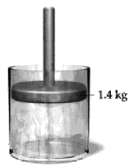
A cylinder 2.4 m tall is filled with an ideal gas at standard temperature and pressure (Figure). The top of the cylinder is then closed with a tight-fitting piston whose mass is 1.4 kg and the piston is allowed to drop until it is in equilibrium. (a) Find the height of the piston, assuming that the
(Multiple choice)(1) True of false:(a) Two objects in thermal equilibrium with each other must be in thermal equilibrium with a third object.(b) The Fahrenheit and Celsius temperature scales differ only in the choice of the zero temperature.(c) The Kelvin is the same size as the Celsius degree.(d)
(Multiple choice)(1)If the temperature of an ideal gas is doubled while maintaining constant pressure, the average speed of the molecules (a) Remains constant. (b) Increases by a factor of 4. (c) Increases by a factor of 2. (d) Increases by a factor of √2(2)If both temperature
Sam the shepherd's partner, Bernard, who is a working dog, consumes 2500 kcal of food each day.(a) How many joules of energy does Bernard consume each day?(b) Sam and Bernard often find themselves sleeping out in the cold night. If the energy consumed by Bernard is dissipated as heat at a steady
A 50-g piece of aluminum at 20oC is cooled to 196oC by placing it in a large container of liquid nitrogen at that temperature. How much nitrogen is vaporized? (Assume that the specific heat of aluminum is constant and is equal to 0.90 kJ/kg ∙ K.)
If 500 g of molten lead at 327oC is poured into a cavity in a large block of ice at 0oC, how much of the ice melts?
A 30-g lead bullet initially at 20oC comes to rest in the block of a ballistic pendulum. Assume that half the initial kinetic energy of the bullet is converted into thermal energy within the bullet. If the speed of the bullet was 420 m/s, what is the temperature of the bullet immediately after
A 1400-kg car traveling at 80 km/h is brought to rest by applying the brakes. If the specific heat of steel is 0.11 cal/g ∙ K, what total mass of steel must be contained in the steel brake drums if the temperature of the brake drums is not to rise by more than 120oC?
A 200-g piece of lead is heated to 90oC and is then dropped into a calorimeter containing 500 g of water that is initially at 20oC, neglecting the heat capacity of the container find the final temperature of the lead and water.
The specific heat of a certain metal can be determined by measuring the temperature change that occurs when a piece of the metal is heated and then placed in an insulated container made of the same material and containing water. Suppose a piece of metal has a mass of 100 g and is initially at
A 25-g glass tumbler contains 200 mL of water at 24oC. If two 15-g ice cubes each at a temperature of 3oC are dropped into the tumbler, what is the final temperature of the drink? Neglect thermal conduction between the tumbler and the room.
A 200-g piece of ice at 0oC is placed in 500 g of water at 20oC. The system is in a container of negligible heat capacity and is insulated from its surroundings.(a) What is the final equilibrium temperature of the system?(b) How much of the ice melts?
A 3.5-kg block of copper at a temperature of 80oC is dropped into a bucket containing a mixture of ice and water whose total mass is 1.2 kg. When thermal equilibrium is reached the temperature of the water is 8oC. How much ice was in the bucket before the copper block was placed in it? (Neglect the
A well-insulated bucket contains 150 g of ice at 0oC.(a) If 20 g of steam at 100oC is injected into the bucket, what is the final equilibrium temperature of the system?(b) Is any ice left afterward?
A calorimeter of negligible mass contains 1 kg of water at 303 K and 50 g of ice at 273 K. Find the final temperature T. Solve the same problem if the mass of ice is 500 g.
A 200-g aluminum calorimeter contains 500 g of water at 20oC. A 100-g piece of ice cooled to 20oC is placed in the calorimeter.(a) Find the final temperature of the system, assuming no heat loss. (Assume that the specific heat of ice is 2.0 kJ/kg ∙ K.)(b) A second 200-g piece of ice at 20oC is
The specific heat of a 100-g block of material is to be determined. The block is placed in a 25-g copper calorimeter that also holds 60 g of water. The system is initially at 20oC. Then 120mL of water at 80oC are added to the calorimeter vessel. When thermal equilibrium is attained, the temperature
Between innings at his weekly softball game, Stan likes to have a sip or two of beer. He usually consumes about 6 cans, which he prefers at exactly 40oF. His wife Bernice puts a six-pack of 12-ounce aluminum cans of beer (1 ounce has a mass of 28.4 g) originally at 80oF in a well-insulated
A 100-g piece of copper is heated in a furnace to a temperature t. The copper is then inserted into a 150-g copper calorimeter containing 200 g of water. The initial temperature of the water and calorimeter is 16oC, and the final temperature after equilibrium is established is 38oC. When the
A 200-g aluminum calorimeter contains 500 g of water at 20oC. Aluminum shot of mass 300 g is heated to 100oC and is then placed in the calorimeter.(a) Using the value of the specific heat of aluminum given in Table 19-1, find the final temperature of the system, assuming that no heat is lost to the
A diatomic gas does 300 J of work and also absorbs 600 cal of heat. What is the change in internal energy of the gas?
If 400 kcal is added to a gas that expands and does 800 kJ of work, what is the change in the internal energy of the gas?
A lead bullet moving at 200 m/s is stopped in a block of wood. Assuming that all of the energy change goes into heating the bullet, find the final temperature of the bullet if its initial temperature is 20oC.
(a) At Niagara Falls, the water drops 50 m. If the change in potential energy goes into the internal energy of the water, compute the increase in its temperature.(b) Do the same for Yosemite Falls, where the water drops 740 m. (These temperature rises are not observed because the water cools by
When 20 cal of heat are absorbed by a gas, the system performs 30 J of work. What is the change in the internal energy of the gas?
A lead bullet initially at 30oC just melts upon striking a target. Assuming that all of the initial kinetic energy of the bullet goes into the internal energy of the bullet to raise its temperature and melt it, calculate the speed of the bullet upon impact.
A piece of ice is dropped from a height H.(a) Find the minimum value of H such that the ice melts when it makes an inelastic collision with the ground. Assume that all the mechanical energy lost goes into melting the ice.(b) Is it reasonable to neglect the variation in the acceleration of gravity
On a cold day you can warm your hands by rubbing them together.(a) Assume that the coefficient of friction between your hands is 0.5, that the normal force between your hands is 35 N, and that you rub them together at an average speed of 35 cm/s. What is the rate at which heat is generated?(b)
A real gas cools during a free expansion, though an ideal gas does not. Explain.
The gas is allowed to expand at constant pressure to a volume of 3 L. It is then cooled at constant volume until its pressure is 2 atm.(a) Show this process on a PV diagram, and calculate the work done by the gas.(b) Find the heat added during this process.
The gas is first cooled at constant volume until its pressure is 2 atm. It is then allowed to expand at constant pressure until its volume is 3 L.(a) Show this process on a PV diagram, and calculate the work done by the gas.(b) Find the heat added during this process.
The gas is allowed to expand isothermally until its volume is 3 L and its pressure is 1 atm. It is then heated at constant volume until its pressure is 2 atm.(a) Show this process on a PV diagram, and calculate the work done by the gas.(b) Find the heat added during this process.
The gas is heated and is allowed to expand such that it follows a straight-line path on a PV diagram from its initial state to its final state.(a) Show this process on a PV diagram, and calculate the work done by the gas.(b) Find the heat added during this process.
One mole of the ideal gas is initially in the state P0 = 1 atm, V0 = 25 L. As the gas is slowly heated, the plot of its state on a PV diagram moves in a straight line to the state P = 3 atm, V = 75 L. Find the work done by the gas.
One mole of the ideal gas is heated so that T = AP2, where A is a constant. The temperature changes from T0 to 4T0. Find the work done by the gas.
One mole of an ideal gas initially at a pressure of 1 atm and a temperature of 0oC is compressed isothermally and quasi-statically until its pressure is 2 atm. Find(a) The work needed to compress the gas, and(b) The heat removed from the gas during the compression.
An ideal gas initially at 20oC and 200 kPa has a volume of 4 L. It undergoes a quasi-static, isothermal expansion until its pressure is reduced to 100 kPa. Find(a) The work done by the gas, and(b) The heat added to the gas during the expansion.
The heat capacity at constant volume of a certain amount of a monatomic gas is 49.8 J/K.(a) Find the number of moles of the gas.(b) What is the internal energy of the gas at T = 300 K?(c) What is the heat capacity of the gas at constant pressure?
The Dulong–Petit law was originally used to determine the molecular mass of a substance from its measured heat capacity. The specific heat of a certain solid is measured to be 0.447 kJ/kg ∙ K.(a) Find the molecular mass of the substance.(b) What element is this?
The specific heat of air at 0oC is listed in a handbook as having the value of 1.00 J/g ∙ K measured at constant pressure.(a) Assuming that air is an ideal gas with a molar mass M = 29.0 g/mol, what is its specific heat at 0oC and constant volume?(b) How much internal energy is there in 1 L of
One mole of an ideal diatomic gas is heated at constant volume from 300 to 600 K.(a) Find the increase in internal energy, the work done, and the heat added.(b) Find the same quantities if this gas is heated from 300 to 600 K at constant pressure. Use the first law of thermodynamics and your
A diatomic gas (molar mass M) is confined to a closed container of volume V at a pressure P0. What amount of heat Q should be transferred to the gas in order to triple the pressure? (Express your answer in terms of P0 and V.)
One mole of air (cv = 5R/2) is confined at atmospheric pressure in a cylinder with a piston at 0oC. The initial volume occupied by gas is V. Find the volume of gas V’ after the equivalent of 13,200 J of heat is transferred to it.
The heat capacity of a certain amount of a particular gas at constant pressure is greater than that at constant volume by 29.1 J/K.(a) How many moles of the gas are there?(b) If the gas is monatomic, what are Cv and Cp?(c) If the gas consists of diatomic molecules that rotate but do not vibrate,
One mole of a monatomic ideal gas is initially at 273 K and 1 atm.(a) What is its initial internal energy?(b) Find its final internal energy and the work done by the gas when 500 J of heat are added at constant pressure.(c) Find the same quantities when 500 J of heat are added at constant volume.
A certain molecule has vibrational energy levels that are equally spaced by 0.15 eV. Find the critical temperature Tc such that for T >> Tc you would expect the equipartition theorem to hold and for T << Tc you would expect the equipartition theorem to fail.
One mole of an ideal gas (γ = 5/3) expands adiabatically and quasi-statically from a pressure of 10 atm and a temperature of 0oC to a pressure of 2 atm. Find(a) The initial and final volumes,(b) The final temperature, and(c) The work done by the gas.
An ideal gas at a temperature of 20oC is compressed quasi-statically and adiabatically to half its original volume.Find its final temperature if(a) Cv = 3/2, nR and(b) Cv = 5/2 nR.
Two moles of neon gas initially at 20oC and a pressure of 1 atm are compressed adiabatically to one-fourth of their initial volume. Determine the temperature and pressure following compression.
Half a mole of an ideal monatomic gas at a pressure of 400 kPa and a temperature of 300 K expands until the pressure has diminished to 160 kPa. Find the final temperature and volume, the work done, and the heat absorbed by the gas if the expansion is(a) Isothermal, and(b) Adiabatic.
Repeat Problem 60 for a diatomic gas.
One-half mole of helium is expanded adiabatically and quasi-statically from an initial pressure of 5 atm and temperature of 500 K to a final pressure of 1 atm. Find(a) The final temperature,(b) The Final volume,(c) The work done by the gas, and(d) The change in the internal energy of the gas.
A hand pump is used to inflate a bicycle tire to a gauge pressure of 482 kPa (about 70 lb/in2). How much work must be done if each stroke of the pump is an adiabatic process? Atmospheric pressure is 1 atm, the air temperature is initially 20oC, and the volume of the air in the tire remains constant
An ideal gas at initial volume V1 and pressure P1 expands quasi-statically and adiabatically to volume V2 and pressure P2. Calculate the work done by the gas directly by integrating P dV, and show that your result is the same as that given by Equation19-39.
One mole of N2 (Cv = R 2/5R) gas is originally at room temperature (20°C) and a pressure of 5 atm. It is allowed to expand adiabatically and quasi-statically until its pressure equals the room pressure of 1 atm. It is then heated at constant pressure until its temperature is again 20°C. During
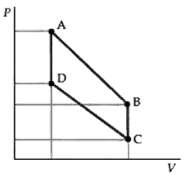
Two moles of an ideal monatomic gas have an initial pressure P1 = 2 atm and an initial volume V1 = 2 L. The gas is taken through the following quasi-static cycle: It is expanded isothermally until it has a volume V2 = 4 L. It is then heated at constant volume until it has a pressure P3 = 2 atm. It
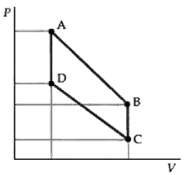
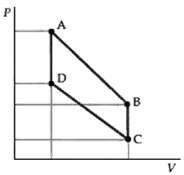
At point D in Figure the pressure and temperature of 2 mol of an ideal monatomic gas are 2 atm and 360 K. The volume of the gas at point B on the PV diagram is three times that at point D and its pressure is twice that at point C. Paths AB and CD represent isothermal processes. The gas is carried
Repeat Problem 67 with the paths AB and CD representing adiabatic processes.
Repeat Problem 67 with a diatomic gas.
Repeat Problem 68 with a diatomic gas.
An ideal gas of n mol is initially at pressure P1, volume V1, and temperature Th. It expands isothermally until its pressure and volume are P2 and V2. It then expands adiabatically until its temperature is Tc and its pressure and volume are P3 and V3. It is then compressed isothermally until it is
The 1-L fuel tank of a gas grill contains 600 g of propane (C3H8) at a pressure of 2MPa. What can you say about the phase state of the propane?
The volume of three moles of a monatomic gas is increased from 50 L to 200 L at constant pressure. The initial temperature of the gas is 300 K. How much heat must be supplied to the gas?
In the process of compressing n moles of an ideal diatomic gas to one-fifth of its initial volume, 180 kJ of work is done on the gas. If this is accomplished isothermally at room temperature (293 K), how many calories of heat are removed from the gas?
What is the number of moles n of the gas in Problem79?
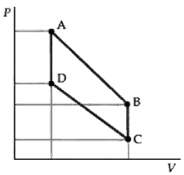
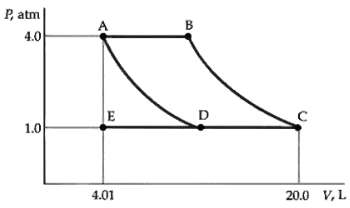
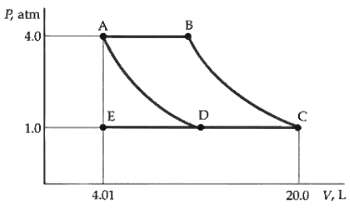
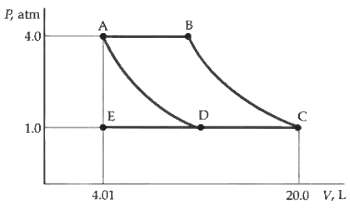
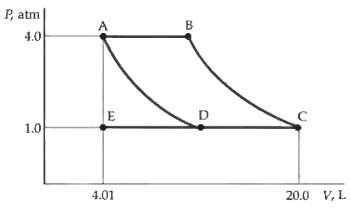
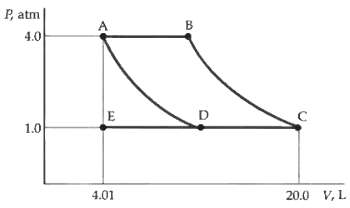
The PV diagram in figure represents 3 mol of an ideal monatomic gas. The gas is initially at point A. The paths AD and BC represent isothermal changes. If the system is brought to point C along the path AEC, find (a) The initial and final temperatures, (b) The work done by the gas, and (c) The heat
Repeat Problem 81 with the gas following path ABC.
Repeat Problem 82 with the gas following path ADC.
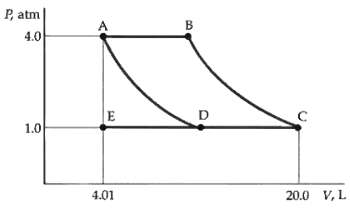
Suppose that the paths AD and BC represent adiabatic processes. What then are the work done by the gas and the heat absorbed by the gas in following the path ABC?
Repeat Problem 84 for the path ADC.
At very low temperatures, the specific heat of a metal is given by c = aT + bT 3. For the metal copper, a = 0.0108 J / kg ∙ K2 and b = 7.62 x 10⁻⁴ J / kg ∙ K4.(a) What is the specific heat of copper at 4 K?(b) How much heat is required to heat copper from 1 to 3 K?
Two moles of a diatomic ideal gas are compressed isothermally from 18 L to 8 L. In the process, 170 calories escape from the system. Determine the amount of work done by the gas, the change in internal energy, and the initial and final temperatures of the gas.
Suppose the two moles of a diatomic ideal gas in Problem 87 are compressed from 18 L to 8 L adiabatically. The work done on the gas is 820 J. Find the initial temperature and the initial and final pressures.
How much work must be done to 30 grams of CO at standard temperature and pressure to compress it to a fifth of its initial volume if the process is(a) Isothermal;(b) Adiabatic?
Repeat Problem 91 if the gas is CO2.
Repeat Problem 91 if the gas is argon.
A thermally insulated system consists of 1 mol of a diatomic ideal gas at 100 K and 2 mol of a solid at 200 K that are separated by a rigid insulating wall. Find the equilibrium temperature of the system after the insulating wall is removed, assuming that the solid obeys the Dulong-Petit law.
When an ideal gas undergoes a temperature change at constant volume, its energy changes by ∆U = Cv, ∆T(a) Explain why this result holds for an ideal gas for any temperature change independent of the process.(b) Show explicitly that this result holds for the expansion of an ideal gas at constant
Showing 1700 - 1800
of 7586
First
11
12
13
14
15
16
17
18
19
20
21
22
23
24
25
Last
Step by Step Answers

 Get 50% OFF
Claim Now
Get 50% OFF
Claim Now