New Semester
Started
Get
50% OFF
Study Help!
--h --m --s
Claim Now
Question Answers
Textbooks
Find textbooks, questions and answers
Oops, something went wrong!
Change your search query and then try again
S
Books
FREE
Study Help
Expert Questions
Accounting
General Management
Mathematics
Finance
Organizational Behaviour
Law
Physics
Operating System
Management Leadership
Sociology
Programming
Marketing
Database
Computer Network
Economics
Textbooks Solutions
Accounting
Managerial Accounting
Management Leadership
Cost Accounting
Statistics
Business Law
Corporate Finance
Finance
Economics
Auditing
Tutors
Online Tutors
Find a Tutor
Hire a Tutor
Become a Tutor
AI Tutor
AI Study Planner
NEW
Sell Books
Search
Search
Sign In
Register
study help
physics
thermodynamics
Fundamentals of Ethics for Scientists and Engineers 1st Edition Edmund G. Seebauer, Robert L. Barry - Solutions
One mole of an ideal monatomic gas is heated at constant volume from 300 to 600 K.(a) Find the heat added, the work done by the gas, and the change in its internal energy.(b) Find these same quantities if the gas is heated from 300 to 600 K at constant pressure.
Heat in the amount of 500 J is supplied to 2 mol of an ideal diatomic gas.(a) Find the change in temperature if the pressure is kept constant.(b) Find the work done by the gas.(c) Find the ratio of the final volume of the gas to the initial volume if the initial temperature is 20oC.
An insulated cylinder is fitted with a movable piston to maintain constant pressure. The cylinder initially contains 100 g of ice at –10oC. Heat is supplied to the contents at a constant rate by a 100-W heater. Make a graph showing the temperature of the cylinder contents as a function of time
For the winter festival, a sculptor creates a 20-kg statue of a skier made of ice at 0oC. To show off the statue's stability, the sculptor hires someone to repeatedly slide the statue down a plane 8 m long and inclined at 30o. Unfortunately, the sculptor forgot about the thermal energy produced by
Two moles of a diatomic ideal gas expand adiabatically. The initial temperature of the gas is 300 K. The work done by the gas during the expansion is 3.5 kJ. What is the final temperature of the gas?
One mole of monatomic gas, initially at temperature T, undergoes a process in which its temperature is quadrupled and its volume is halved. Find the amount of heat Q transferred to the gas. It is known that in this process the pressure was never less than the initial pressure, and the work done on
A vertical heat-insulated cylinder is divided into two parts by a movable piston of mass m. Initially the piston is held at rest. The top part is evacuated and the bottom part is filled with 1 mole of diatomic ideal gas at temperature 300 K. After the piston is released and the system comes to
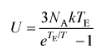
According to the Einstein model of a crystalline solid, the internal energy per mole is given by where TE is a characteristic temperature called the Einstein temperature, and T is the temperature of the solid in kelvins. Evaluate the molar internal energy of diamond (TE = 1060 K) at 300 K and 600
In an isothermal expansion, an ideal gas at an initial pressure P0 expands until its volume is twice its initial volume.(a) Find its pressure after the expansion.(b) The gas is then compressed adiabatically and quasi-statically back to its original volume, at which point its pressure is 1.32P0. Is
Prove that the slope of the adiabatic curve passing through a point on the PV diagram for an ideal gas is g times the slope of the isothermal curve passing through the same point.
The combustion of benzene is represented by the chemical reaction 2(C6H6) + 15(O2) → 12(CO2) + 6(H2O). The amount of energy released in the combustion of two mol of benzene is 1516 kcal. One mol of benzene and 7.5 mol of oxygen at 300 K are confined in an insulated enclosure at a pressure of 1
Repeat Problem 106, parts (a) and (b), using as the combustible substance 1 mol of acetylene for which the combustion reaction is 2(C2H2) + 5(O2) → 4(CO2) + 2(H2O). The combustion of 1 mol of acetylene releases 300 kcal.
Carbon monoxide and oxygen combine to form carbon dioxide with an energy release of 280 kJ/mol of CO according to the reaction 2(CO) + O2 → 2(CO2). Two mol of CO and one mol of O2 at 300 K are confined in an 80-L container; the combustion reaction is initiated with a spark.(a) What is the
Suppose that instead of pure oxygen, just enough air is mixed with the two mol of CO in the container of Problem 108 to permit complete combustion. Air is 80% N2 and 20% O2 by weight, and the nitrogen does not participate in the reaction. What then are the answers to parts (a), (b), and (c) of
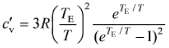
Use the expression given in Problem 103 for the internal energy per mole of a solid according to the Einstein model to show that the molar heat capacity at constant volume is givenby
(a) Use the results of Problem 110 to show that the Dulong–Petit law, cv En = B6d /2n n = 1, 2, 3… holds for the Einstein model when T > TE.(b) For diamond, TE is approximately 1060 K. Numerically integrate ∆U = ∫ c’v to find the increase in the internal energy if 1 mol of diamond
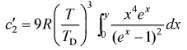
A refinement of the Einstein model by Debye resulted in the following expression for the specific heat: where TD is called the Debye temperature and y = TD / T. Show that when T?>> TD, the above expression reduces to the Dulong?Petit result cv = 3R.
(Multiple choice) (1) The temperature change of two blocks of masses MA and MB is the same when they absorb equal amounts of heat. It follows that the specific heats are related by (a) cA = (MA/MB)cB. (b) cA = (MB/MA)cB. (c) cA = cB. (d) None of the above. (2) The specific heat of aluminum is more
Where does the energy come from in an internal-combustion engine? In a steam engine?
An engine with 20% efficiency does 100 J of work in each cycle.(a) How much heat is absorbed in each cycle?(b) How much heat is rejected in each cycle?
An engine absorbs 400 J of heat and does 120 J of work in each cycle.(a) What is its efficiency?(b) How much heat is rejected in each cycle?
An engine absorbs 100 J and rejects 60 J in each cycle.(a) What is its efficiency?(b) If each cycle takes 0.5 s, find the power output of this engine in watts.
A refrigerator absorbs 5 kJ of energy from a cold reservoir and rejects 8 kJ to a hot reservoir.(a) Find the coefficient of performance of the refrigerator.(b) The refrigerator is reversible and is run backward as a heat engine between the same two reservoirs. What is its efficiency?
An engine operates with 1 mol of an ideal gas for which R Cv = 3/2R and R Cp = 5/2p = as its working substance. The cycle begins at P1 = 1 atm and V1 = 24.6 L. The gas is heated at constant volume to P2 = 2 atm. It then expands at constant pressure until V2 = 49.2 L. During these two steps, heat is
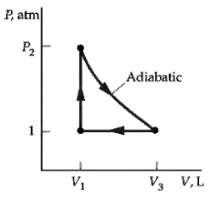
An engine using 1 mol of a diatomic ideal gas performs a cycle consisting of three steps: (1) an adiabatic expansion from an initial pressure of 2.64 atm and an initial volume of 10 L to a pressure of 1 atm and a volume of 20 L, (2) a compression at constant pressure to its original volume of 10 L,
An engine using 1 mol of an ideal gas initially at V1 = 24.6 L and T = 400 K performs a cycle consisting of four steps: (1) an isothermal expansion at T = 400 K to twice its initial volume, (2) cooling at constant volume to T = 300 K, (3) an isothermal compression to its original
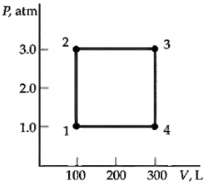
One mole of an ideal monatomic gas at an initial volume V1 = 25 L follows the cycle shown in figure. All the processes are quasi-static. Find (a) The temperature of each state of the cycle, (b) The heat flow for each part of the cycle, and (c) The efficiency of thecycle.
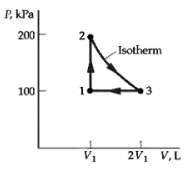
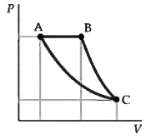
An ideal gas (? = 1.4) follows the cycle shown in figure. The temperature of state 1 is 200 K. Find (a) The temperatures of the other three states of the cycle and (b) The efficiency of the cycle.
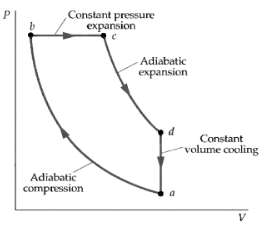
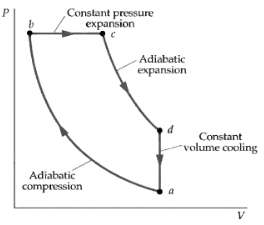
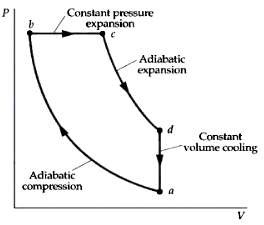
The diesel cycle shown in figure approximates the behavior of a diesel engine. Process ab is an adiabatic compression, process bc is an expansion at constant pressure, process cd is an adiabatic expansion, and process da is cooling at constant volume. Find the efficiency of this cycle in terms of
In the Stirling cycle shown in figure, process ab is an isothermal compression, process bc is heating at constant volume, process cd is an isothermal expansion, and process da is cooling at constant volume. Find the efficiency of the Stirling cycle in terms of the temperatures Th and Tc and the
The Clausius equation of state is P(V – bn) = nRT, where b is a constant. Show that the efficiency of a Carnot cycle is the same for a gas that obeys this equation of state as it is for one that obeys the ideal-gas equation of state, PV = nRT.
A certain engine running at 30% efficiency draws 200 J of heat from a hot reservoir. Assume that the refrigerator statement of the second law of thermodynamics is false, and show how this engine combined with a perfect refrigerator can violate the heat-engine statement of the second law.
A certain refrigerator takes in 500 J of heat from a cold reservoir and gives off 800 J to a hot reservoir. Assume that the heat-engine statement of the second law of thermodynamics is false, and show how a perfect engine working with this refrigerator can violate the refrigerator statement of the
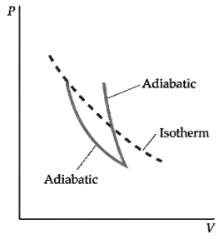
If two adiabatic curves intersect on a PV diagram, a cycle could be completed by an isothermal path between the two adiabatic curves shown in figure. Show that such a cycle could violate the second law of thermodynamics.
A Carnot engine works between two heat reservoirs at temperatures Th = 300 K and Tc = 200 K.(a) What is its efficiency?(b) If it absorbs 100 J from the hot reservoir during each cycle, how much work does it do?(c) How much heat does it give off during each cycle?(d) What is the COP of this engine
A refrigerator works between an inside temperature of 0oC and a room temperature of 20oC.(a) What is the largest possible coefficient of performance it can have?(b) If the inside of the refrigerator is to be cooled to –10oC, what is the largest possible coefficient of performance it can have,
An engine removes 250 J from a reservoir at 300 K and exhausts 200 J to a reservoir at 200 K.(a) What is its efficiency?(b) How much more work could be done if the engine were reversible?
A reversible engine working between two reservoirs at temperatures Th and Tc has an efficiency of 30%. Working as a heat engine, it gives off 140 J of heat to the cold reservoir. A second engine working between the same two reservoirs also gives off 140 J to the cold reservoir. Show that if the
A reversible engine working between two reservoirs at temperatures Th and Tc has an efficiency of 20%. Working as a heat engine, it does 100 J of work in each cycle. A second engine working between the same two reservoirs also does 100 J of work in each cycle. Show that if the efficiency of the
A Carnot engine works between two heat reservoirs as a refrigerator. It does 50 J of work to remove 100 J from the cold reservoir and gives off 150 J to the hot reservoir during each cycle. Its coefficient of performance COP = Qc /W = (100 J) / (50 J) = 2.(a) What is the efficiency of the Carnot
A Carnot engine works between two heat reservoirs at temperatures Th = 300 K and Tc = 200K.(a) What is its efficiency?(b) If it absorbs 100 J from the hot reservoir during each cycle, how much work does it do?(c) How much heat does it give off in each cycle?(d) What is the coefficient of
In the cycle shown in figure 1 mol of an ideal gas (? = 1.4) is initially at a pressure of 1atm and a temperature of 0oC. The gas is heated at constant volume to t2 = 150oC and is then expanded adiabatically until its pressure is again 1 atm. It is then compressed at constant pressure back to its
A steam engine takes in superheated steam at 270oC and discharges condensed steam from its cylinder at 50oC. Its efficiency is 30%.(a) How does this efficiency compare with the maximum possible efficiency for these temperatures?(b) If the useful power output of the engine is 200 kW, how much heat
A heat pump delivers 20 kW to heat a house. The outside temperature is –10oC and the inside temperature of the hot-air supply for the heating fan is 40oC.(a) What is the coefficient of performance of a Carnot heat pump operating between these temperatures?(b) What must be the minimum power of the
Rework Problem 29 for an outside temperature of –20oC
A refrigerator is rated at 370 W.(a) What is the maximum amount of heat it can remove in 1 min if the inside temperature of the refrigerator is 0oC and it exhausts into a room at 20oC?(b) If the COP of the refrigerator is 70% of that of an ideal pump, how much heat can it remove in 1 min?
Rework Problem 31 for a room temperature of 35oC.
Two moles of an ideal gas at T = 400 K expand quasi-statically and isothermally from an initial volume of 40 L to a final volume of 80 L.(a) What is the entropy change of the gas?(b) What is the entropy change of the universe for this process?
Jay approached his guru in a depressed mood. "I want to change the world, but I feel helpless," he said. The guru turned and pushed a 5-kg rock over a ledge. It hit the ground 6 m below and came to rest. "There," said the guru. "I have changed the world." If the rock, the ground, and the atmosphere
A system absorbs 200 J of heat reversibly from a reservoir at 300 K and gives off 100 J reversibly to a reservoir at 200 K as it moves from state A to state B. During this process, the system does 50 J of work.(a) What is the change in the internal energy of the system?(b) What is the change in
A system absorbs 300 J from a reservoir at 300 K and 200 J from a reservoir at 400 K. It then returns to its original state, doing 100 J of work and rejecting 400 J of heat to a reservoir at a temperature T.(a) What is the entropy change of the system for the complete cycle?(b) If the cycle is
Two moles of an ideal gas originally at T = 400 K and V = 40 L undergo a free expansion to twice their initial volume. What is(a) The entropy change of the gas, and(b) The entropy change of the universe?
A 200-kg block of ice at 0oC is placed in a large lake. The temperature of the lake is just slightly higher than 0oC, and the ice melts.(a) What is the entropy change of the ice?(b) What is the entropy change of the lake?(c) What is the entropy change of the universe (the ice plus the lake)?
A 100-g piece of ice at 0oC is placed in an insulated container with 100 g of water at 100oC.(a) When thermal equilibrium is established, what is the final temperature of the water? Ignore the heat capacity of the container.(b) Find the entropy change of the universe for this process.
A 1-kg block of copper at 100oC is placed in a calorimeter of negligible heat capacity containing 4 L of water at 0oC. Find the entropy change of(a) The copper block,(b) The water, and(c) The universe.
If a 2-kg piece of lead at 100oC is dropped into a lake at 10oC, find the entropy change of the universe.
A 1500-kg car traveling at 100 km/h crashes into a concrete wall. If the temperature of the air is 20oC, calculate the entropy change of the universe.
Find the net change in entropy of the universe when 10 g of steam at 100oC and a pressure of 1 atm are introduced into a calorimeter of negligible heat capacity containing 150 g of water and 150 g of ice at 0oC.
If 500 J of heat is conducted from a reservoir at 400 K to one at 300 K,(a) What is the change in entropy of the universe, and(b) How much of the 500 J of heat conducted could have been converted into work using a cold reservoir at 300 K?
One mole of an ideal gas first undergoes a free expansion from V1 = 12.3 L and T1 = 300 K to V2 = 24.6 L and T2 = 300 K. It is then compressed isothermally and quasi-statically back to its original state.(a) What is the entropy change of the universe for the complete cycle?(b) How much work is
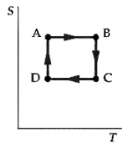
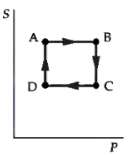
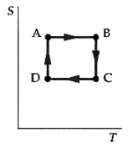
Figure shows a thermodynamic cycle on an ST diagram. Identify this cycle and sketch it on a PVdiagram.
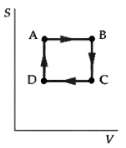
Figure shows a thermodynamic cycle on an SV diagram. Identify the type of engine represented by thisdiagram.
Sketch an ST diagram of the Otto cycle.
Sketch an SV diagram of the Carnot cycle.
Sketch an SV diagram of the Otto cycle.
Figure shows a thermodynamic cycle on an SP diagram. Make a sketch of this cycle on a PVdiagram.
An engine with an output of 200 W has an efficiency of 30%. It works at 10 cycles/s.(a) How much work is done in each cycle?(b) How much heat is absorbed and how much is given off in each cycle?
Which has a greater effect on increasing the efficiency of a Carnot engine, a 5-K increase in the temperature of the hot reservoir or a 5-K decrease in the temperature of the cold reservoir?
In each cycle, an engine removes 150 J from a reservoir at 100oC and gives off 125 J to a reservoir at 20oC.(a) What is the efficiency of this engine?(b) What is the ratio of its efficiency to that of a Carnot engine working between the same reservoirs? (This ratio is called the second law
An engine removes 200 kJ of heat from a hot reservoir at 500 K in each cycle and exhausts heat to a cold reservoir at 200 K. Its efficiency is 85% of a Carnot engine working between the same reservoirs.(a) What is the efficiency of this engine?(b) How much work is done in each cycle?(c) How much
To maintain the temperature inside a house at 20oC, the power consumption of the electric baseboard heaters is 30 kW on a day when the outside temperature is – 7oC. At what rate does this house contribute to the increase in the entropy of the universe?
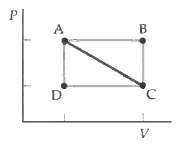
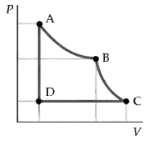
The system represented in figure (Problem 54) is 1 mol of an ideal monatomic gas. The temperatures at points A and B are 300 and 750 K, respectively. What is the thermodynamic efficiency of the cyclic process ABCDA?
A sailor is in a tropical ocean on a boat. She has a 2-kg piece of ice at 0oC, and the temperature of the ocean is Th = 27oC. Find the maximum work W that can be done using the fusion of ice.
(a) Which process is more wasteful: (1) a block moving with 500 J of kinetic energy being slowed to rest by friction when the temperature of the atmosphere is 300 K or (2) 1 kJ of heat being conducted from a reservoir at 400 K to one at 300 K?(b) What is the change in entropy of the universe for
Helium gas (γ = 1.67) is initially at a pressure of 16 atm, a volume of 1 L, and a temperature of 600 K. It is expanded isothermally until its volume is 4 L and is then compressed at constant pressure until its volume and temperature are such that an adiabatic compression will return the gas to
A heat engine that does the work of blowing up a balloon at a pressure of 1 atm extracts 4 kJ from a hot reservoir at 120oC. The volume of the balloon increases by 4 L, and heat is exhausted to a cold reservoir at a temperature Tc. If the efficiency of the heat engine is 50% of the efficiency of a
Show that the COP of a Carnot refrigerator is related to the efficiency of a Carnot engine by COP = Tc / (εCTh).
A freezer has a temperature TC = –23◦C. The air in the kitchen has a temperature Th = + 27◦C. Since the heat insulation is not perfect, some heat flows into the freezer at a rate of 50 W. Find the power of the motor that is needed to maintain the temperature in the freezer.
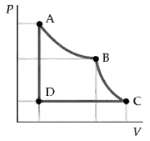
Two moles of a diatomic gas are taken through the cycle ABCA as shown on the PV diagram in figure. At A the pressure and temperature are 5 atm and 600 K. The volume at B is twice that at A. The segment BC is an adiabatic expansion and the segment CA is an isothermal compression. (a) What is the
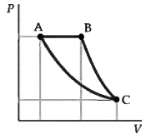
Two moles of a diatomic gas are carried through the cycle ABCDA shown in the PV diagram in figure. The segment AB represents an isothermal expansion, the segment BC an adiabatic expansion. The pressure and temperature at A are 5 atm and 600 K. The volume at B is twice that at A. The pressure at D
Repeat Problem 72 for a monatomic gas.
Repeat Problem 72 for a monatomic gas.
Compare the efficiency of the Otto engine and the Carnot engine operating between the same maximum and minimum temperatures.
Compare the efficiency of the Stirling cycle (see figure) and the Carnot engine operating between the same maximum and minimum temperatures.
Using the equation for the entropy change of an ideal gas when the volume and temperature change and TVγ–1 is a constant, show explicitly that the entropy change is zero for a quasi-static adiabatic expansion from state (V1, T1) to state (V2, T2).
(a) Show that if the refrigerator statement of the second law of thermodynamics were not true, the entropy of the universe could decrease.(b) Show that if the heat-engine statement of the second law were not true, the entropy of the universe could decrease.(c) An alternative statement of the second
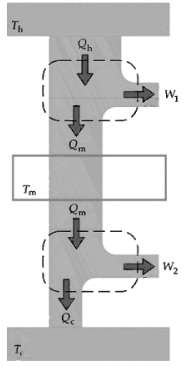
Suppose that two heat engines are connected in series, such that the heat exhaust of the first engine is used as the heat input of the second engine as shown in figure. The efficiencies of the engines are e 1 and e 2 respectively. Show that the net efficiency of the combination is givenby
Suppose that each engine in figure is an ideal reversible heat engine. Engine 1 operates between temperatures Th and Tm and Engine 2 operates between Tm and Tc, where Th > Tm > Tc. Show thatThis means that two reversible heat engines in series are equivalent to one reversible heat engine
The cooling compartment of a refrigerator and its contents are at 5◦C and have an average heat capacity of 84 kJ/K. The refrigerator exhausts heat to the room, which is at 25◦C. What minimum power will be required by the motor that runs the refrigerator if the temperature of the cooling
An insulated container is separated into two chambers of equal volume by a thin partition. On one side of the container there are twelve 131Xe atoms, on the other side there are twelve 132Xe atoms. The partition is then removed. Calculate the change in entropy of the system after equilibrium has
(Multiple choice)(1)On a humid day, water vapor condenses on a cold surface. During condensation, the entropy of the water (a) Increases. (b) Remains constant. (c) Decreases. (d) May decrease or remain unchanged.(2)In a reversible adiabatic process, (a) The internal energy
A steel ruler has a length of 30 cm at 20°C. What is its length at 100°C?
Abridge 100 m long is built of steel. If it is built as a single, continuous structure, how much will its length change from the coldest winter days (– 30 °C) to the hottest summer days (40°C)?
(a) Define a coefficient of area expansion. (b) Calculate it for a square and a circle, and show that it is 2 times the coefficient of linear expansion.
The density of aluminum is 2.70 × 10³ kg/m3 at 0°C. What is the density of aluminum at 200°C?
A copper collar is to fit tightly about a steel shaft whose diameter is 6.0000 cm at 20°C. The inside diameter of the copper collar at that temperature is 5.9800 cm. To what temperature must the copper collar be raised so that it will just slip on the steel shaft, assuming that the steel shaft
Repeat Problem 7 when the temperature of both the steel shaft and copper collar are raised simultaneously.
A container is filled to the brim with 1.4 L of mercury at 20°C. When the temperature of container and mercury is raised to 60°C, 7.5 mL of mercury spill over the brim of the container. Determine the linear expansion coefficient of the container.
A hole is drilled in an aluminum plate with a steel drill bit whose diameter at 20°C is 6.245 cm. In the process of drilling, the temperature of the drill bit and of the aluminum plate rise to 168°C. What is the diameter of the hole in the aluminum plate when it has cooled to room temperature?
Len sells trees that double in price when they are over 2.00 m high. To make a standard, he cuts an aluminum rod 2.00 m in length, as measured by a steel measuring tape. That day, the temperature of both the rod and the tape is 25°C. What will the tape indicate the length of the rod to be when
Showing 1800 - 1900
of 7586
First
12
13
14
15
16
17
18
19
20
21
22
23
24
25
26
Last
Step by Step Answers

 Get 50% OFF
Claim Now
Get 50% OFF
Claim Now




.PNG)


