New Semester
Started
Get
50% OFF
Study Help!
--h --m --s
Claim Now
Question Answers
Textbooks
Find textbooks, questions and answers
Oops, something went wrong!
Change your search query and then try again
S
Books
FREE
Study Help
Expert Questions
Accounting
General Management
Mathematics
Finance
Organizational Behaviour
Law
Physics
Operating System
Management Leadership
Sociology
Programming
Marketing
Database
Computer Network
Economics
Textbooks Solutions
Accounting
Managerial Accounting
Management Leadership
Cost Accounting
Statistics
Business Law
Corporate Finance
Finance
Economics
Auditing
Tutors
Online Tutors
Find a Tutor
Hire a Tutor
Become a Tutor
AI Tutor
AI Study Planner
NEW
Sell Books
Search
Search
Sign In
Register
study help
physics
thermodynamics
Fundamentals of Physics 8th Extended edition Jearl Walker, Halliday Resnick - Solutions
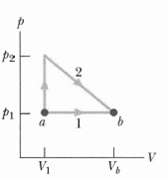
The p-V diagram in Figure shows two paths along which a sample of gas can be taken from state a to state 4 where Vb = 3.0V1. Path 1 requires that energy equal to 5.0p1V1 be transferred to the gas as heat. Path2 requires that energy equal to 5.5p1V1 be transferred to the gas as heat. What is the
A cube of edge length 6.0 x 10⁻⁶ m, emissivity 0.75, and temperature – 100oC floats in an environment at – 150oC. What is the cube's net thermal radiation transfer rate?
A flow calorimeter is a device used to measure the specific heat of a liquid. Energy is added as heat at a known rate to a stream of the liquid as it passes through the calorimeter at a known rate. Measurement of the resulting temperature difference between the inflow and the outflow points of the
An object of mass 6.00 kg falls through a height of 50.0 m and, by means of a mechanical linkage, rotates a paddle wheel that stirs 0.600 kg of water. Assume that the initial gravitational potential energy of the object is fully transferred to thermal energy of the water, which is initially at
Gold has a molar mass of 197g/mol.(a) How many moles of gold are in a 2.50 g sample of pure gold?(b) How many atoms are in the sample?
Find the mass in kilograms of 7.50 x 1024 atoms of arsenic, which has a molar mass of 74.9 g/mol.
The best laboratory vacuum has a pressure of about 1.00 x 10⁻¹⁸ atm, or 1.01 x 10⁻¹³ Pa. How many gas molecules are there per cubic centimeter in such a vacuum at 293 K?
Compute(a) The number of moles and(b) The number of molecules in 1.00 cm3 of an ideal gas at a pressure of 100 Pa and a temperature of 220 K.
An automobile tire has a volume of 1 .64 x 10-2 m3 and contains air at a gauge pressure (pressure above atmospheric pressure) of 165 kPa when the temperature is 0.00"C. What is the gauge pressure of the air in the tires when its temperature rises to 27.0oC and its volume increases to 1.67 x 10⁻²
A quantity of ideal gas at 10.0oC and 100 kPa occupies a volume of 2.50 m3.(a) How many moles of the gas are present?(b) If the pressure is now raised to 300 kPa and the temperature is raised to 30.0oC, how much volume does the gas occupy? Assume no leaks.
Oxygen gas having a volume of 1000 cm3 at 40.0oC and 1.01 x 10⁵ Pa expands until its volume is 1500 cm3 and its pressure is 1.06 x 10s Pa. Find(a) The number of moles of oxygen present and(b) The final temperature of the sample.
A container encloses 2 mol of an ideal gas that has molar mass M1 and 0.5 mol of a second ideal gas that has molar mass M2 = 3M1 What fraction of the total pressure on the container wall is attributable to the second gas? (The kinetic theory explanation of pressure leads to the experimentally
Suppose 1.80 mol of an ideal gas is taken from a volume of 3.00 m3 to a volume of 1.50 m3 via an isothermal compression at 30oC.(a) How much energy is transferred as heat during the compression, and(b) Is the transfer to or from the gas?
Water bottle in a hot car in the American Southwest, the temperature in a closed car parked in sunlight during the summer can be high enough to burn flesh. Suppose a bottle of water at a refrigerator temperature of 5.00oC is opened, then closed, and then left in a closed car with an internal
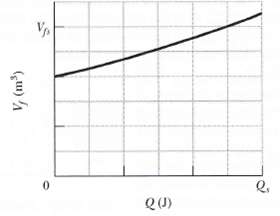
Suppose 0.825 mol of an ideal gas undergoes an isothermal expansion as energy is added to it as heat Q. It Figure 19-20 shows the final volume V1versus Q, what is the gas temperature? The scale of the vertical axis is set by Vfs = 0.30 m3, and the scale of the horizontal axis is set by Qs =1200J.
In the temperature range 310 K to 330 K, the pressure p of a certain non ideal gas is related to volume V and temperature T by how much work is done by the gas if its temperature is raised from 315 K to 325 K while the pressure is heldconstant?
Air that initially occupies 0.140 m3 at a gauge pressure of 103.0 kPa is expanded isothermally to a pressure of 101.3 kPa and then cooled at constant pressure until it reaches its initial volume. Compute the work done by the air. (Gauge pressure is the difference between the actual pressure and
Submarine rescue when the U. S. submarine Squalus became disabled at a depth of 80m, o cylindrical chamber was lowered from a ship to rescue the crew. The chamber had a radius of 1.00 m and a height of 4.00 m, was open at the bottom, and held two rescuers. It slid along a guide cable that a diver
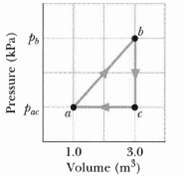
A sample of an ideal gas is taken through the cyclic process abca shown in Figure. The scale of the vertical axis is set by p?? = 7 .5 kPa and pb = 2.5 kPa. At point a, T = 200 K. (a) How many moles of gas are in the sample? What are (b) The temperature of the gas at point b, (c) The temperature of
An air bubble of volume 20 cm3 is at the bottom of a lake 40 m deep, where the temperature is 4.0oC. The bubble rises to the surface, which is at a temperature of 20oC.Take the temperature of the bubble's air to be the same as that of the surrounding water. Just as the bubble reaches the surface,
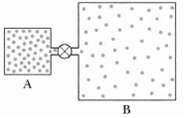
Container A in Figure holds an ideal gas at a pressure of 5.0 x 10⁵ Pa and a temperature of 300 K. It is connected by a thin tube (and a closed valve) to container B, with four times the volume of A. Container B holds the same ideal gas at a pressure of 1.0 x 10⁵ Pa and a temperature of 400 K. The
Calculate the rms speed of helium atoms at 1000 K. See Appendix F for the molar mass of helium atoms.
The lowest possible temperature in outer space is 2.7 K. What is the rms speed of hydrogen molecules at this temperature? (The molar mass is given in Table 19-1.)
Find the rms speed of argon atoms at 313 K. See Appendix F for the molar mass of argon atoms.
(a) Compute the rms speed of a nitrogen molecule at 20.0oC, the molar mass of nitrogen molecules (Nr) is given in Table 19-1 at what temperatures will the rms speed be(b) Half that value and(c) Twice that value?
The temperature and pressure in the Sun's atmosphere are 2.00 x 10⁶ K and 0.0300 Pa. Calculate the rms speed of free electrons (mass 9.11 x 10⁻³¹ kg) there, assuming they are an ideal gas.
A beam of hydrogen molecules (H2) is directed toward a wall, at an angle of 55o with the normal to the wall. Each molecule in the beam has a speed of 1.0 km/s and a mass of 3.3 x 10⁻²⁴ g. The beam strikes the wall over an area of.2.0cm2, at the rate of 1023 molecules per second. What is the beam's
At 273 K and 1.00 x l0-2 atm, the density of a gas is 1.24 x 10⁻⁵ glcm3.(a) Find vrms, for the gas molecules.(b) Find the molar mass of the gas and(c) Identify the gas.
Determine the average value of the translational kinetic energy of the molecules of an ideal gas at(a) 0.00oC and(b) 100oC. What is the translational kinetic energy per mole of an ideal gas at(c) 0.00oC and(d) 100oC?
What is the average translational kinetic energy of nitrogen molecules at 1600 K?
Water standing in the open at 32.0oC evaporates because of the escape of some of the surface molecules. The heat of vaporization (539cal/g) is approximately equal to en, where e is the average energy of the escaping molecules and n is the number of molecules per gram.(a) Find ε.(b) What is the
The mean free path of nitrogen molecules at 0.0oC and 1.0 atm is 0.80 x 10⁻⁵ cm. At this temperature and pressure there are 2.7 x 10¹⁹molecules/cm3. What is the molecular diameter?
The atmospheric density at an altitude of 2500 km is about 1 molecule/cm3.(a) Assuming the molecular diameter of 2.0 x 10⁻⁸ cm, find the mean free path predicted by Eq. 19-25. (b) Explain whether the predicted value is meaningful.
At what frequency would the wavelength of sound in air be equal to the mean free path of oxygen molecules at 1.0 atm pressure and 0.00oC? Take the diameter of an oxygen molecule to be 3.0 x 10⁻⁸ cm.
In a certain particle accelerator, protons travel around a circular path of diameter 23.0 m in an evacuated chamber, whose residual gas is at 295 K and 1.00 x 10⁻⁶ torr pressure.(a) Calculate the number of gas molecules per cubic centimeter at this pressure.(b) What is the mean free path of the gas
At 20oC and 750 torr pressure, the mean free paths for argon gas (Ar) and nitrogen gas (N2) are λAr = 9.9 x 10⁻⁶ cm and λA2 = 27.5 x 10⁻⁶ cm.(a) Find the ratio of the diameter of an Ar atom to that of an N2 molecule. What is the mean free path of argon at?(b) 20oC and 150 torr, and(c) – 40oC
Ten particles are moving with the following speeds: four at 200 m/s, two at 500 m/s, and four at 600 m/s. Calculate their(a) Average and(b) Rms speeds.(c) Is vrms > V avg?
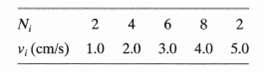
The speeds of 22 particles are as follows (Ni represents the number of particles that have speed vi): What are (a) V avg, (b) Vrms, and (c)vp?
The speeds of 10 molecules are 2.0, 3.0, 4.0, ., 11 km/s. What are their(a) Average speed and(b) Rms speed?
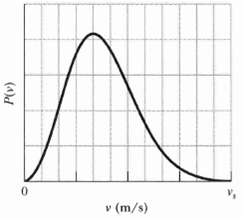
Figure gives the probability distribution for nitrogen gas. The scale of the horizontal axis is set by vs = 1200m/s. What are the (a) Gas temperature and (b) Rms speed of themolecules?
At what temperature does the rms speed of?(a) H2 (molecular hydrogen) and(b) O2 (molecular oxygen) equals the escape speed from Earth (Table 13-2)? At what temperature does the rms speed of?(c) H2 and(d) O2 equals the escape speed from the Moon (where the gravitational acceleration at the surface
Two containers are at the same temperature. The first contains gas with pressure pt, molecular mass m1, and rms speed vrms1.The second contains gas with pressure 2.0p1, molecular mass m2, and average speed vavg2 = 2.0vrms1. Find the mass ratio m1/m2.
A hydrogen molecule (diameter L.0 x 10-8 cm), traveling at the rms speed, escapes from a 4000 K furnace into a chamber containing cold argon atoms (diameter 3.0 x 10⁻⁸ cm) at a density of 4.0 x 101e atoms/cm3.(a) What is the speed of the hydrogen molecule?(b) If it collides with an argon atom, what
It is found that the most probable speed of molecules in a gas when it has (uniform) temperature T2 is the same as the rms speed of the molecules in this gas when it has (uniform) temperature T1. Calculate T2/T1.
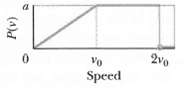
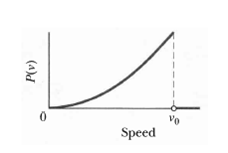
Figure shows a hypothetical speed distribution for a sample of N gas particles (not that P(v) = 0 for speed v > 2v0). What are the values of? (a) Av0, (b) vavg/v0, and (c) vrms/v0? (d) What fraction of the particles has a speed between 1.5v0 and2.0v0?
What is the internal energy of 1.0 mol of an ideal monatomic gas at 273 K?
The temperature of 2.00 mol of an ideal monatomic gas is raised 15.0 K at constant volume. What are(a) The work W done by the gas,(b) The energy transferred as heat Q,(c) The change ΔEint in the internal energy of the gas, and(d) The change ΔK in the average kinetic energy per atom?
Under constant pressure, the temperature of 2.00 mol of an ideal monatomic gas is raised 15.0 K. What are?(a) The work V/done by the gas,(b) The energy transferred as heat Q,(c) The change ΔEint, in the internal energy of the gas, and(d) The change AK in the average kinetic energy per atom?
A container holds a mixture of three non reacting gases: 2.40 mol of gas 1 with Cv1 = 12.0 J/mol ?? K, 1.50 mol of gas 2 with Cv2 = 12.8 J/mol ?? K and 3.20 mol of gas 3 with Cv3 = 20.0 J/mol ?? K. What is CV of the mixture?
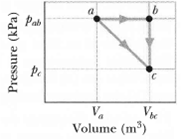
One mole of an ideal diatomic gas goes from a to c along the diagonal path in Figure. The scale of the vertical axis is set by pab = 5.0kPa and pc = 2.0 kPa, and the scale of the horizontal axis is set by Vbc = 4.0 m3 and Va = 2.0 m3.During the transition,(a) What is the change in internal energy
The mass of a gas molecule can be computed from its specific heat at constant volume cv. (Note that this is not Cv) Take cv = 0.075 cal/g ∙ Co for argon and calculate(a) The mass of an argon atom and(b) The molar mass of argon.
When 20.9 J was added as heat to a particular ideal gas, the volume of the gas changed from 50.0 cm3 to 100 cm3 while the pressure remained at 1.00 atm.(a) By how much did the internal energy of the gas change? If the quantity of gas present was 2.00 x 10⁻³ mol, find(b) Cp, and(c) Cv.
The temperature of 3.00 mol of an ideal diatomic gas is increased by 40.0 Co without the pressure of the gas changing. The molecules in the gas rotate but do not oscillate. (a) How much energy is transferred to the gas as heat? (b) What is the change in the internal energy of the gas? (c) How much
We give 70J as heat to a diatomic gas, which then expands at constant pressure. The gas molecules rotate but do not oscillate. By how much does the internal energy of the gas increase?
When 1.0 mol of oxygen (O2) gar is heated at constant pressure starting at OoC, how much energy must be added to the gas as heat to double its volume? (The molecules rotate but do not oscillate.)
Suppose 12.0g of oxygen (O2) gas is heated at constant atmospheric pressure from 25.0oC to 125oC. (a) How many moles of oxygen are present? (See Table 19-1, for the molar mass.) (b) How much energy is transferred to the oxygen as heat? (The molecules rotate but do not oscillate.)(c) What fraction
Suppose 4.00 mol of an ideal diatomic gas, with molecular rotation but not oscillation, experienced a temperature increase of 60.0 K under constant-pressure conditions. What are? (a) The energy transferred as heat Q, (b) The change ΔEint, in internal energy of the gas, (c) The work W
Suppose 1.00 L of a gas with γ = 1.30, initially at 273 K and 1.00 atm, is suddenly compressed adiabatically to half its initial volume. Find it’s final (a) Pressure and (b) Temperature. (c) If the gas is then cooled to 273 K at constant pressure, what is its final volume?
A certain gas occupies a volume of 4.3 L at a pressure of 1.2 atm and a temperature of 310 K. It is compressed adiabatically to a volume of 0.76 L. Determine(a) The final pressure and(b) The final temperature, assuming the gas to be an ideal gas for which γ = 1.4.
We know that for an adiabatic process pVγ = a constant. Evaluate "a constant" for an adiabatic process involving exactly 2.0 mol of an ideal gas passing through the state having exactly p = 1.0 atm and T = 300 K. Assume a diatomic gas whose molecules rotate but do not oscillate.
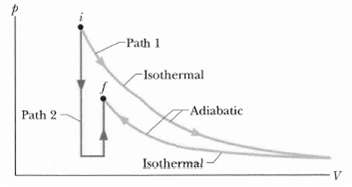
Figure shows two paths that may be taken by a gas from an initial point i to a final point f. Path 1 consists of an isothermal expansion (work is 50 J in magnitude), an adiabatic expansion (work is 40 J in magnitude), an isothermal compression (work is 30 J in magnitude), and then an adiabatic
Adiabatic wind the normal airflow over the Rocky Mountains is west to east. The air loses much of its moisture content and is chilled as it climbs the western side of the mountains. When it descends on the eastern side, the increase in pressure toward lower altitudes causes the temperature to
A gas is to be expanded from initial state i to final state f along either path 1 or path 2 on a p-V diagram. Path 1 consists of three steps: an isothermal expansion (work is 40 J in magnitude), an adiabatic expansion (work is 20 J in magnitude), and another isothermal expansion (work is 30 J in
Opening champagne In a bottle of champagne, the pocket of gas (primarily carbon dioxide) between the liquid and the cork is at pressure of pi = 5.00 atm. When the cork is pulled from the bottle, the gas undergoes an adiabatic expansion until its pressure matches the ambient air pressure of 1.00
The volume of an ideal gas is adiabatically reduced from 200 L to 74.3 L. The initial pressure and temperature are 1.00 atm and 300 K. The final pressure is 4.00 atm.(a) Is the gas monatomic, diatomic, or polyatomic?(b) What is the final temperature?(c) How many moles are in the gas?
An ideal diatomic gas, with rotation but no oscillation, undergoes an adiabatic compression. Its initial pressure and volume are 1 .20 atm and 0.200 m3. Its final pressure is 2.40 atm. How much work is done by the gas?
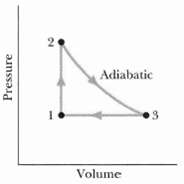
Figure shows a cycle undergone by 1.00 mol of an ideal monatomic gas. The temperatures are T1 = 300 K, T2 = 600 K, and T3 = 455 K. For 1 ? 2, what are?(a) Heat Q,(b) The change in internal energy ?Eint, and(c) The work done W?For 2 ? 3, what are?(d) Q,(e) ?Eint, and(f) W? For 3 ? 1, what are?(g)
In an interstellar gas cloud at 50.0 K, the pressure is 1.00 x 10⁻⁸ Pa. Assuming that the molecular diameters of the gases in the cloud are all 20.0nm, what is their mean free path?
The temperature of 3.00 mol of a gas with Cv = 6.00cal/mol ∙ K is to be raised 50.0 K. If the process is at constant volume, what are?(a) The energy transferred as heat Q,(b) The work W done by the gas,(c) The change ΔEint in internal energy of the gas, and(d) The change AK in the total
Oxygen (O2) gas at 273 K and 1.0 atm is confined to a cubical container 10 cm on a side. Calculate ΔUg/Kavg, where ΔUg is the change in the gravitational potential energy of an oxygen molecule falling the height of the box and Kavg is the molecule's average translational kinetic energy.
The envelope and basket of a hot-air balloon have a combined weight of 2.45kN, and the envelope has a capacity (volume) of 2.18 x 10³ m3. When it is fully inflated, what should be the temperature of the enclosed air to give the balloon a lifting capacity (force) of 2.67kN (in addition to the
(a) An ideal gas initially at pressure ps undergoes a free expansion until its volume is 3.00 times its initial volume. What then is the ratio of its pressure to p0? (b) The gas is next slowly and adiabatically compressed back to its original volume. The pressure after compression is (3.00)1/3 p0.
The temperature of 2.00 mol of an ideal monatomic gas is raised 15.0 K in an adiabatic process. What are?(a) The work W done by the gas,(b) The energy transferred as heat Q,(c) The change ΔEint in internal energy of the gas, and(d) the change ΔEint in the average kinetic energy per atom?
During a compression at a constant pressure of 250 Pa, the volume of an ideal gas decreases from 0.80 m3 to 0.20 m3. The initial temperature is 360 K, and the gas loses 210 J as heat. What are(a) The change in the internal energy of the gas and(b) The final temperature of the gas?
At what frequency do molecules (diameter 290 pm) collide in (an ideal) oxygen gas (O2) at temperature 400 K and pressure 2.00 atm?
An ideal gas consists of 1.50mol of diatomic molecules that rotate but do not oscillate. The molecular diameter is 250 pm. The gas is expanded at a constant pressure of 1.50 x 10⁵ Pa, with a transfer of 200 J as heat. What is the change in the mean free path of the molecules?
An ideal monatomic gas initially has a temperature of 330 K and a pressure of 6.00 atm. It is to expand from volume 500 cm3 to volume 1500 cm3. If the expansion is isothermal, what are?(a) The final pressure and(b) The work done by the gas? If, instead, the expansion is adiabatic, what are?(c) The
An ideal gas with 3.00 mol is initially in state 1 with pressure p1 = 20.0 atm and volume V1 = 1500 cm3. First it is taken to state 2 with pressure p2 = 1.50p1 and volume V2 = 2.00V1. Then it is taken to state 3 with pressure p3 = 2.00p1 and volume V3 = 0.500V1. What is the temperature of the gas
An ideal gas undergoes an adiabatic compression from p = 1.0 atm, V = 1.0 x 10⁶L, T = 0.0oC to p = 1.0 x 10⁵ atm, V = l0 x 103 L.(a) Is the gas monatomic, diatomic, or polyatomic?(b) What is its final temperature?(c) How many moles of gas are present? What is the total translational kinetic energy
An ideal gas, at initial temperature T1 and initial volume 2.0m3, is expanded adiabatically to a volume of 4.0 m3, then expanded isothermally to a volume of 10 m3, and then compressed adiabatically back to T1. What is its final volume?
A sample of ideal gas expands from an initial pressure and volume of.32 atm and 1.0L to a final volume of 4.0L. The initial temperature is 300 K. If the gas is monatomic and the expansion isothermal, what are the (a) Final pressure pf,(b) Final temperature Tf, and (c) Work 17 done by the gas? If
Calculate the work done by an external agent during an isothermal compression of 1.00 mol of oxygen from a volume of 22.4 L at 0oC and 1.00 atm to a volume of 16.8 L.
A steel tank contains 300 g of ammonia gas (NH3) at a pressure of 1.35 x 10⁶ Pa and a temperature of 77oC.(a) What is the volume of the tank in liters?(b) Later the temperature is 22oC and the pressure is 8.7 x 10⁵ Pa. How many grams of gas have leaked out of the tank?
At what temperature do atoms of helium gas have the same rms speed as molecules of hydrogen gas at 20.0oC? (The molar masses are given in Table 19-1.)
Figure shows a hypothetical speed distribution for particles of a certain gas: P(v) = Cv2 for 0 < v < v0 and P(r) 0 for v > v0. Find(a) An expression for C in terms of v0,(b) The average speed of the particles, and(c) Their rms speed.
In an industrial process the volume of 25.0 mol of a monatomic ideal gas is reduced at a uniform rate from 0.616 m3 to 0.308 m3 in 2.00 h while its temperature is increased at a uniform rate from 27 .0oC to 450oC. Throughout the process, the gas passes through thermodynamic equilibrium states. What
An ideal gas undergoes isothermal compression from an initial volume of 4.00 m3 to a final volume of 3.00 m3. There is 3.50 mol of the gas, and its temperature is 10.0oC.(a) How much work is done by the gas?(b) How much energy is transferred as heat between the gas and its environment?
(a) What is the number of molecules per cubic meter in air at 20oC and at a pressure of 1.0 atm (= 1.01 x 10⁵ Pa)?(b) What is the mass of 1.0 m3 of this air? Assume that 75% of the molecules are nitrogen (N2) and 25% are oxygen (O2).
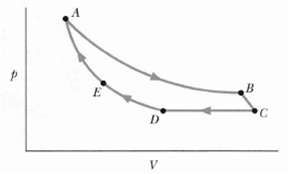
Figure shows a cycle consisting of five paths: AB is isothermal at 300 K, BC is adiabatic with work = 5.0 J, CD is at a constant pressure of 5 atm, D E is isothermal, and EA is adiabatic with a change in internal energy of 8.0 J. What is the change in internal energy of the gas along pathCD?
An ideal gas initially at 300 K is compressed at a constant pressure of 25 N/m2 from a volume of 3.0 m3 to a volume of 1.8 m3. In the process, 75 J is lost by the gas as heat. What are?(a) The change in internal energy of the gas and(b) The final temperature of the gas?
An ideal gas is taken through a complete cycle in three steps: adiabatic expansion with work equal to 125 J, isothermal contraction at 325 K, and increase in pressure at constant volume.(a) Draw a p-V diagram for the three steps.(b) How much energy is transferred as heat in step 3, and(c) Is it
(a) What is the volume occupied by 1.00 mol of an ideal gas at standard conditions–that is, 1.00 atm (= 1.01 x 10⁵ Pa) and 273 K?(b) Show that the number of molecules per cubic centimeter (the Loschmidt number) at standard conditions is 2.69 x 10⁹?
A 2.50mol sample of an ideal gas expands reversibly and isothermally at 360K until its volume is doubled. What is the increase in entropy of the gas?
How much energy must be transferred as heat for a reversible isothermal expansion of an ideal gas at 132oC if the entropy of the gas increases by 46.0 J/K?
Find(a) The energy absorbed as heat and(b) The change in entropy of a 2.00 kg block of copper whose temperature is increased reversibly from 25.0oC to 1,00oC. The specific heat of copper is 386 J/kg ∙ K.
(a) What is the entropy change of a 12.0 g ice cube that melts completely in a bucket of water whose temperature is just above the freezingpoint of water?(b) What is the entropy change of a 5.00 g spoonful of water that evaporates completely on a hot plate whose temperature is slightly above the
Suppose 4.00 mol of an ideal gas undergoes a reversible isothermal expansion from volume V1 to volume V2 = 2.00 V1 at temperature T = 400 K. Find(a) The work done by the gas and(b) The entropy change of the gas.(c) If the expansion is reversible and adiabatic instead of isothermal, what is the
An ideal gas undergoes a reversible isothermal expansion at 77.0C, increasing its volume from 1.30 L to 3.40L. The entropy change of the gas is 22.0 J/K. How many moles of gas are present?
In an experiment, 200 g of aluminum (with a speciflc heat of 900 J/kg'K) at 100oC is mixed with 50.0 g of water at 20.0oC, with the mixture thermally isolated.(a) What is the equilibrium temperature? What are the entropy changes of?(b) The aluminuffi,(c) The water, and(d) The aluminum-water system?
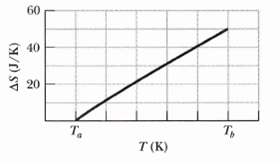
A 364g block is put in contact with a thermal reservoir. The block is initially at a lower temperature than the reservoir. Assume that the consequent transfer of energy as heat from the reservoir to the block is reversible. Figure gives the change in entropy ΔS of the block until thermal
Showing 1500 - 1600
of 7586
First
9
10
11
12
13
14
15
16
17
18
19
20
21
22
23
Last
Step by Step Answers

 Get 50% OFF
Claim Now
Get 50% OFF
Claim Now