New Semester
Started
Get
50% OFF
Study Help!
--h --m --s
Claim Now
Question Answers
Textbooks
Find textbooks, questions and answers
Oops, something went wrong!
Change your search query and then try again
S
Books
FREE
Study Help
Expert Questions
Accounting
General Management
Mathematics
Finance
Organizational Behaviour
Law
Physics
Operating System
Management Leadership
Sociology
Programming
Marketing
Database
Computer Network
Economics
Textbooks Solutions
Accounting
Managerial Accounting
Management Leadership
Cost Accounting
Statistics
Business Law
Corporate Finance
Finance
Economics
Auditing
Tutors
Online Tutors
Find a Tutor
Hire a Tutor
Become a Tutor
AI Tutor
AI Study Planner
NEW
Sell Books
Search
Search
Sign In
Register
study help
business
introduction to probability statistics
Introduction To Probability Statistics And Random Processes 1st Edition Hossein Pishro-Nik - Solutions
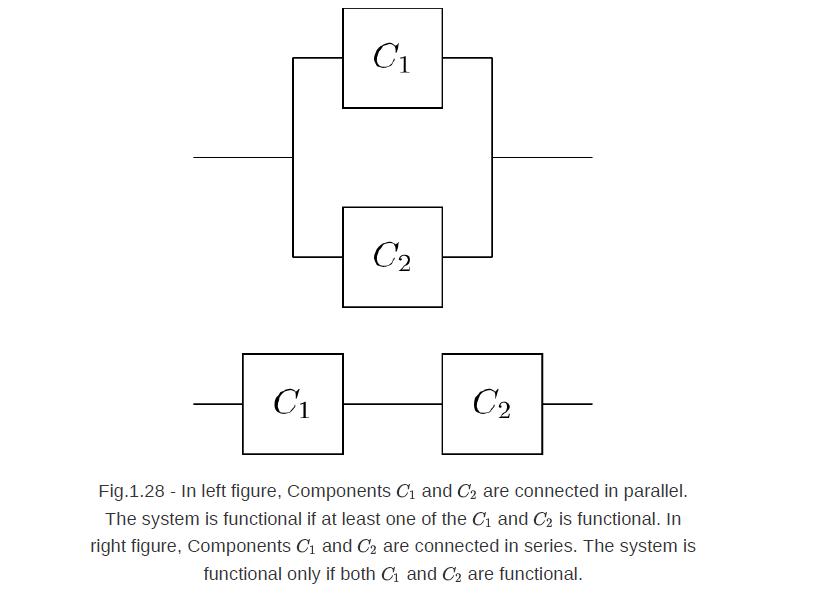
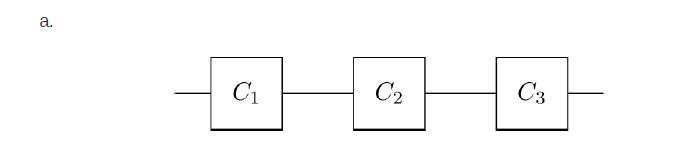
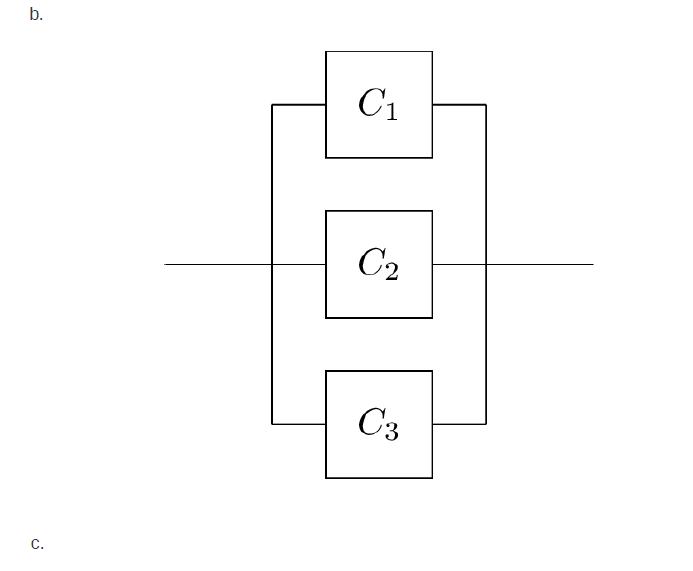
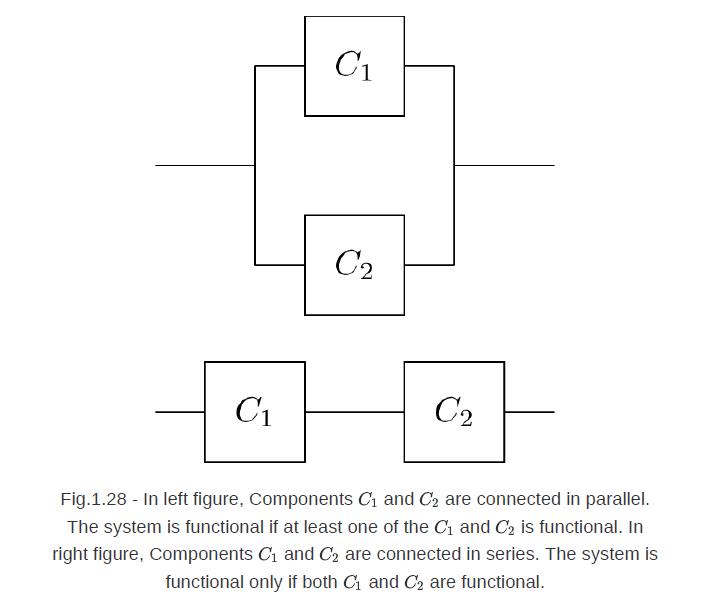
Real-life systems often are composed of several components. For example, a system may consist of two components that are connected in parallel as shown in Figure 1.28. When the system's components are connected in parallel, the system works if at least one of the components is functional. The
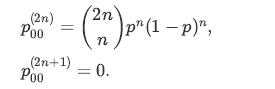
Consider the Markov chain shown in Figure 11.35.This is known as the simple random walk. Show thatUsing Stirling's formula, it can be shown thatis finite if and only if p ≠ 1/2. Thus, we conclude that the simple random walk is recurrent if p = 1/2 and is transient if p ≠ 1/2.
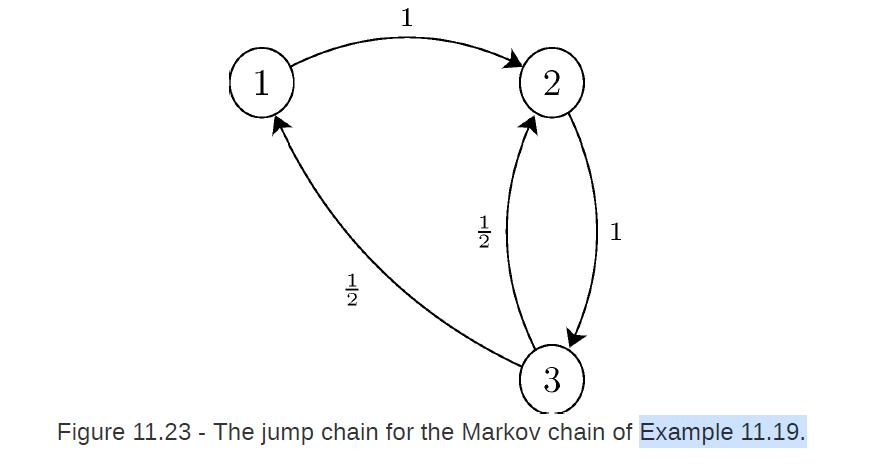
Consider a continuous-time Markov chain X(t) that has the jump chain shown in Figure 11.23. Assume the holding time parameters are given by λ1 = 2, λ2 = 1, and λ3 = 3. Find the limiting distribution for X(t). 1 1 2 1 3 Figure 11.23 - The jump chain for the Markov chain of Example 11.19.
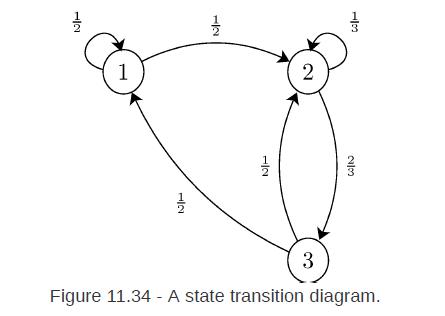
Consider the Markov chain shown in Figure 11.34.a. Is this chain irreducible?b. Is this chain aperiodic?c. Find the stationary distribution for this chain.d. Is the stationary distribution a limiting distribution for the chain? 를 1 를 1 2 2 3 01 23 Figure 11.34 - A state transition diagram.
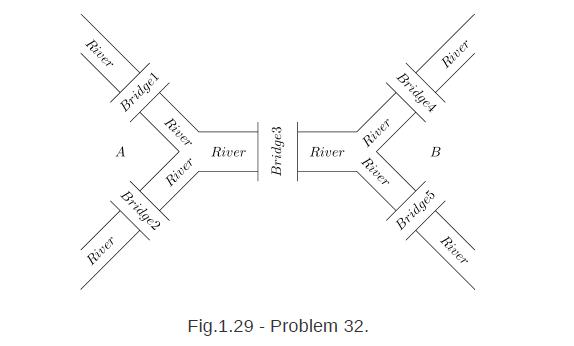
You would like to go from point A to point B in Figure 1.28. There are 5 bridges on different branches of the river as shown in Figure 1.29.Bridge i is open with probability Pi, i = 1, 2, 3, 4, 5. Let A be the event that there is a path from A to B and let Bk be the event that kth bridge is open.a.
You choose a point (X,Y ) uniformly at random in the unit square S = {(x, y) ∈ R2 : 0 ≤ x ≤ 1, 0 ≤ y ≤ 1}.Let A be the event {(x, y) ∈ S : |x −y| ≤ 1/2} and B be the event {(x, y) ∈ S : y ≥ x}.a. Show sets A and B in the x-y plane.b. Find P(A) and P(B).c. Are A and B independent?
One way to d esign a spam filter is to look at the words in an email. In particular, some words are more frequent in spam emails. Suppose that we have the following information:50% of emails are spam;1% of spam emails contain the word "refinance";0.001% of non-spam emails contain the word
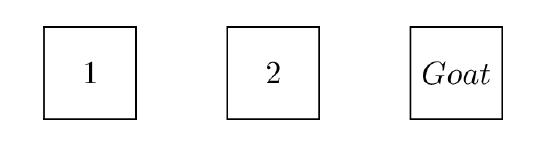
You are in a game show, and the host gives you the choice of three doors. Behind one door is a car and behind the others are goats. You pick a door, say Door 1. The host who knows what is behind the doors opens a different door and reveals a goat (the host can always open such a door because there
I toss a fair die twice, and obtain two numbers X and Y . Let A be the event that X = 2, B be the event that X +Y = 7, and C be the event that Y = 3.a. Are A and B independent?b. Are A and C independent?c. Are B and C independent?d. Are A, B, and C are independent?
You and I play the following game: I toss a coin repeatedly. The coin is unfair and P(H) = p. The game ends the first time that two consecutive heads (HH) or two consecutive tails (TT) are observed. I win if (HH) is observed and you win if (TT) is observed. Given that I won the game, find the
A box contain s two coins: a regular coin and one fake two-headed coin (P(H)=1). I choose a coin at random and toss it n times. If the first n coin tosses result in heads, what is the probability that the (n +1)th coin toss will also result in heads?
A family has n children, n ≥ 2. We ask the father: "Do you have at least one daughter?" He responds "Yes!" Given this extra information, what is the probability that all n children are girls? In other words, what is the probability that all of their children are girls, given that at least one of
A family has n children, n ≥ 2. We ask from the father, "Do you have at least one daughter named Lilia?" He replies, "Yes!" What is the probability that all of their children are girls? In other words, we want to find the probability that all n children are girls, given that the family has at
A family has n children. We pick one of them at random and find out that she is a girl. What is the probability that all their children are girls?
A coffee shop has 4 different types of coffee. You can order your coffee in a small, medium, or large cup. You can also choose whether you want to add cream, sugar, or milk (any combination is possible, for example, you can choose to add all three). In how many ways can you order your coffee?
Suppose that I want to purchase a tablet computer. I can choose either a large or a small screen; a 64GB, 128GB, or 256GB storage capacity, and a black or white cover. How many different options do I have?
I need to choose a password for a computer account. The rule is that the password must consist of two lowercase letters (a to z) followed by one capital letter (A to Z) followed by four digits (0, 1,⋯, 9). For example, the following is a valid passwordFind the total number of possible passwords,
Eight committee members are meeting in a room that has twelve chairs. In how many ways can they sit in the chairs?
There are 20 black cell phones and 30 white cell phones in a store. An employee takes 10 phones at random. Find the probability thata. There will be exactly 4 black cell phones among the chosen phones;b. There will be less than 3 black cell phones among the chosen phones.
Let A be a set with |A| = n
Five cards are dealt from a shuffled deck. What is the probability that the dealt hand containsa. Exactly one ace;b. At least one ace?
If k people are at a party, what is the probability that at least two of them have the same birthday? Suppose that there are n = 365 days in a year and all days are equally likely to be the birthday of a specific person.
Five cards are dealt from a shuffled deck. What is the probability that the dealt hand contains exactly two aces, given that we know it contains at least one ace?
Shuffle a deck of 52 cards. How many outcomes are possible? (In other words, how many different ways can you order 52 distinct cards? How many different permutations of 52 distinct cards exist?)
The 52 cards in a shuffled deck are dealt equally among four players, call them A, B, C, and D. If A and B have exactly 7 spades, what is the probability that C has exactly 4 spades?
I choose 3 cards from the standard deck of cards. What is the probability that these cards contain at least one ace?
There are 50 students in a class and the professor chooses 15 students at random. What is the probability that you or your friend Joe are among the chosen students?
Show the following identities for non-negative integers k and m and n, using combinatorial interpretation arguments. 1. We have 2-0 (2) = 2². k=0 2. For 0 ≤ k
How many distinct sequences can we make using 3 letter "A"s
In how many ways can you arrange the letters in the word "Massachusetts"?
You have a biased coin for which P(H) = p. You toss the coin 20 times. What is the probability thata. You observe 8 heads and 12 tails;b. You observe more than 8 heads and more than 8 tails?
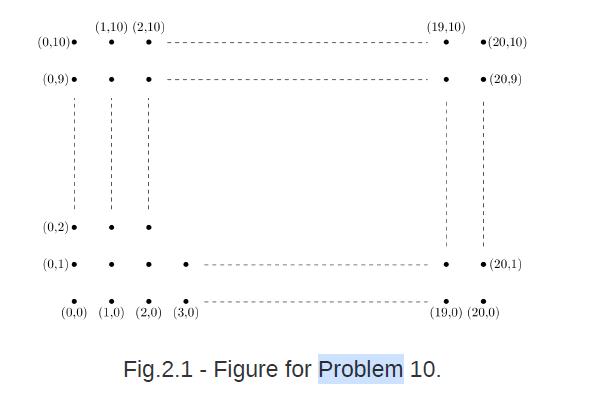
A wireless sensor grid consists of 21 ×11 = 231 sensor nodes that are located at points (i, j) in the plane such that i ∈ {0, 1,⋯, 20} and j ∈ {0, 1, 2,⋯, 10} as shown in Figure 2.1. The sensor node located at point (0, 0) needs to send a message to a node located at (20, 10). The messages
Suppose that I have a coin for which P(H) = p and P(T) = 1 −p. I toss the coin 5 times.a. What is the probability that the outcome is THHHH?b. What is the probability that the outcome is HTHHH?c. What is the probability that the outcome is HHTHH?d. What is the probability that I will observe
In Problem 10, assume that all the appropriate paths are equally likely. What is the probability that the sensor located at point (10, 5) receives the message? That is, what is the probability that a randomly chosen path from (0, 0) to (20, 10) goes through the point (10, 5)?Problem 10A wireless
Ten people hav e a potluck. Five people will be selected to bring a main dish, three people will bring drinks, and two people will bring dessert. How many ways they can be divided into these three groups?
In Problem 10, assume that if a sensor has a choice, it will send the message to the above sensor with probability pa and will send the message to the sensor to the right with probability pr = 1 −pa. What is the probability that the sensor located at point (10, 5) receives the message?Problem 10A
I roll a die 18 times. What is the probability that each number appears exactly 3 times?
Ten passengers get on an airport shuttle at the airport. The shuttle has a route that includes 5 hotels, and each passenger gets off the shuttle at his/her hotel. The driver records how many passengers leave the shuttle at each hotel. How many different possibilities exist?
There are two coins in a bag. For Coin 1, P(H) = 1/2 and for Coin 2, P(H) = 1/3. Your friend chooses one of the coins at random and tosses it 5 times.a. What is the probability of observing at least 3 heads?b. * You ask your friend: "Did you observe at least three heads?". Your friend replies,
There are 15 people in a party, including Hannah and Sarah. We divide the 15 people into 3 groups, where each group has 5 people. What is the probability that Hannah and Sarah are in the same group?
You roll a die 5 times. What is the probability that at least one value is observed more than once?
I have 10 red and 10 blue cards. I shuffle the cards and then label the cards based on their orders: I write the number one on the first card, the number two on the second card, and so on. What is the probability thata. All red cards are assigned numbers less than or equal to 15?b. Exactly 8 red
I have two bags. Bag 1 contains 10 blue marbles, while Bag 2 contains 15 blue marbles. I pick one of the bags at random, and throw 6 red marbles in it. Then I shake the bag and choose 5 marbles (without replacement) at random from the bag. If there are exactly 2 red marbles among the 5 chosen
How many distinct solutions does the following equation have such that all xi ∈ N? x1 + x2 + x3 + x4 + x5 = 100 €
In a communication system, packets are transmitted from a sender to a receiver. Each packet is received with no error with probability p independently from other packets (with probability 1 −p the packet is lost). The receiver can decode the message as soon as it receives k packets with no error.
How many distinct solutions does the following equation have? x1 + x₂ + x3 + x4 = 100, such that x₁ € {0, 1,2,,10}, x2, x3, x4 € {0, 1, 2, 3,...}.
For this problem suppose that the xi's must be non-negative integers, i.e., xi ∈ {0, 1, 2,⋯} for i = 1, 2, 3. How many distinct solutions does the following equation have such that at least one of the xi's is larger than 40? x1 + x2 + x3 = 100
I toss a coin five times. This is a random experiment and the sample space can be written as S = {TTTTT,TTTTH,...,HHHHн}. =
Find the range for each of the following random variables.1. I toss a coin 100 times. Let X be the number of heads I observe.2. I toss a coin until the first heads appears. Let Y be the total number of coin tosses.3. The random variable T is defined as the time (in hours) from now until the next
Let X be the number of the cars being repaired at a repair shop. We have the following information:At any time, there are at most 3 cars being repaired.The probability of having 2 cars at the shop is the same as the probability of having one car.The probability of having no car at the shop is the
I toss a fair coin twice, and let X be defined as the number of heads I observe. Find the range of X, RX, as well as its probability mass function PX.
I roll two dice and observe two numbers X and Y . If Z = X −Y , find the range and PMF of Z.
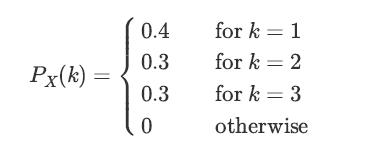
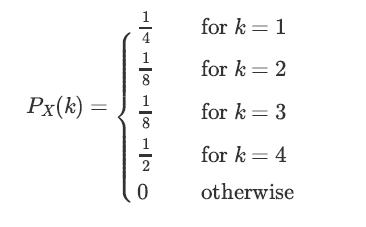
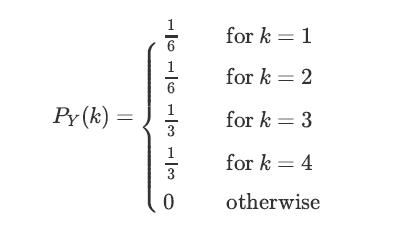
Let X and Y be two independent discrete random variables with the following PMFs:anda. Find P(X ≤ 2 and Y ≤ 2).b. Find P(X > 2 or Y > 2).c. Find P(X > 2|Y > 2).d. Find P(X Px(k)= 1 8 8 H 2 0 for k = 1 for k = 2 for k= 3 for k = 4 otherwise
I have an unfair coin for which P(H) = p, where 0 < p < 1. I toss the coin repeatedly until I observe a heads for the first time. Let Y be the total number of coin tosses. Find the distribution of Y .
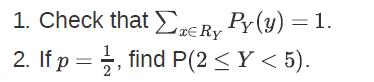
For the random variable Y in Example 3.4,Example 3.4I have an unfair coin for which P(H) = p, where 0 1. Check that ΣERY PY (y) = 1. Ry 2. If p, find P(2 ≤ Y
I toss a coin twice and define X to be the number of heads I observe. Then, I toss the coin two more times and define Y to be the number of heads that I observe this time. Find P(X 1) P((X < (Y > 1)).
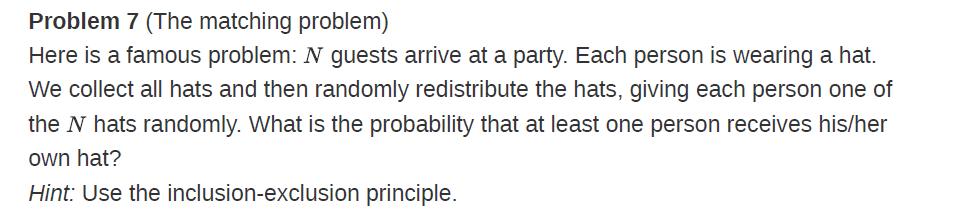
N guests arrive at a party. Each person is wearing a hat. We collect all the hats and then randomly redistribute the hats, giving each person one of the N hats randomly. Let XN be the number of people who receive their own hats. Find the PMF of XN.We previously found that (Problem 7 in Section
Let X ∼ Binomial(n, p) and Y ∼ Binomial(m, p) be two independent random variables. Define a new random variable as Z = X + Y . Find the PMF of Z.
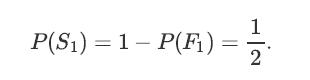
Suppose you take a pass-fail test repeatedly. Let Sk be the event that you are successful in your kth try, and Fk be the event that you fail the test in your kth try. On your first try, you have a 50 percent chance of passing the test.Assume that as you take the test more often, your chance of
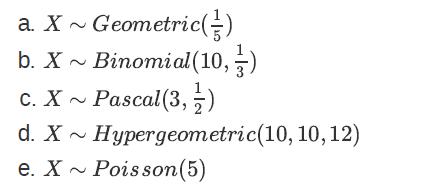
For each of the following random variables, find P(X > 5), P(2 < X ≤ 6) and P(X > 5|X < 8).
The number of emails that I get in a weekday can be modeled by a Poisson distribution with an average of 0.2 emails per minute.1. What is the probability that I get no emails in an interval of length 5 minutes?2. What is the probability that I get more than 3 emails in an interval of length 10
In this problem, we would like to show that the geometric random variable is memoryless. Let X ∼ Geometric(p). Show thatWe can interpret this in the following way: Remember that a geometric random variable can be obtained by tossing a coin repeatedly until observing the first heads. If we toss
Let X be a discrete random variable with range RX = {1, 2, 3, . . . }. Suppose the PMF of X is given bya. Find and plot the CDF of X, FX(x).b. Find P(2 c. Find P(X > 4). Px (k) = for k=1,2,3,... 1 2k
An urn consists of 20 red balls and 30 green balls. We choose 10 balls at random from the urn. The sampling is done without replacement (repetition not allowed).a. What is the probability that there will be exactly 4 red balls among the chosen balls?b. Given that there are at least 3 red balls
Let X ∼ Bernoulli(p). Find EX.
The number of emails that I get in a weekday (Monday through Friday) can be modeled by a Poisson distribution with an average of 1/6 emails per minute. The number of emails that I receive on weekends (Saturday and Sunday) can be modeled by a Poisson distribution with an average of 1/30 emails per
Let X ∼ Geometric(p). Find EX
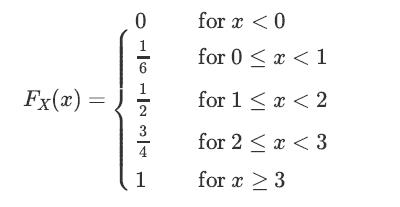
Let X be a discrete random variable with the following CDF:Find the range and PMF of X. Fx(x) = 0 1 T 2 3 4 1 for x < 0 for 0 < x < 1 for 1 < x < 2 for 2 < x < 3 for x ≥ 3
Let X ∼ Poisson(λ). Find EX.
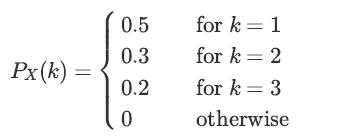
Let X be a discrete random variable with the following PMFa. Find EX.b. Find Var(X) and SD(X).c. If Y = 2/X, find EY . Px (k) = 0.5 0.3 0.2 0 for k = 1 for k = 2 for k= 3 otherwise
Let X ∼ Binomial(n, p). Find EX.
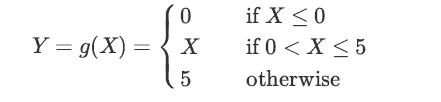
Let X be a discrete random variable with the following PMFThe random variable Y = g(X) is defined asFind the PMF of Y . Px(k)= = 21 0 for k € {-10, -9,,-1,0, 1,, 9, 10} otherwise
Let X ∼ Geometric(1/3), and let Y = |X −5|. Find the range and PMF of Y .
Let X ∼ Pascal(m, p). Find EX. (Try to write X = X1 + X2 +⋯+Xm, such that you already know EXi.)
Let X be a discrete random variable with rangesuch that ㅠ 3T Rx = {0, 1, 2, ³, }, 4 4
Let X be a discrete random variable with PX(k) = 1/5 for k = −1, 0, 1, 2, 3. Let Y = 2|X|. Find the range and PMF of Y.
Let X ∼ Pascal(m, p). Find V ar(X).
Prove E[aX +b] = aEX +b (linearity of expectation).
Suppose tha t Y = −2X +3. If we know EY = 1 and EY2 = 9, find EX and V ar(X).
I roll a fair die and let X be the resulting number. Find EX, Var(X), and σX.
There are 1000 households in a town. Specifically, there are 100 households with one member, 200 households with 2 members, 300 households with 3 members, 200 households with 4 members, 100 households with 5 members, and 100 households with 6 members. Thus, the total number of people living in the
Suppose that there are N different types of coupons. Each time you get a coupon, it is equally likely to be any of the N possible types. Let X be the number of coupons you will need to get before having observed each coupon at least once. a. Show that you can write X = Xo + X₁ + + XN-1,
If X ∼ Binomial(n, p) find Var(X).
Let X be a random variable with mean EX = μ. Define the function f(α) asFind the value of α that minimizes f. f(a) = E[(X-a)²].
Here is a famous problem called the St. P etersburg Paradox. Wikipedia states the problem as follows: "A casino offers a game of chance for a single player in which a fair coin is tossed at each stage. The pot starts at 1 dollar and is doubled every time a head appears. The first time a tail
The median of a random variable X is defined as any number m that satisfies both of the following conditions:Note that the median of X is not necessarily unique. Find the median of X ifa. The PMF of X is given byb. X is the result of a rolling of a fair die.c. X ∼ Geometric(p), where 0 P(X ≥
You are offered to play the following game. You roll a fair die once and observe the result which is shown by the random variable X. At this point, you can stop the game and win X dollars. You can also choose to roll the die for the second time to observe the value Y. In this case, you will win Y
I choose a real number uniformly at random in the interval [a, b], and call it X. By uniformly at random, we mean all intervals in [a, b] that have the same length must have the same probability. Find the CDF of X.
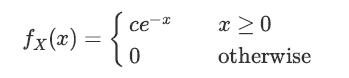
Let X be a continuous random variable with the following PDFwhere c is a positive constant.a. Find c.b. Find the CDF of X, FX(x).c. Find P(1 fx(x) = { ce-x 0 x ≥ 0 otherwise
Choose a real number uniformly at random in the interval [2, 6] and call it X.a. Find the CDF of X, FX(x).b. Find EX.
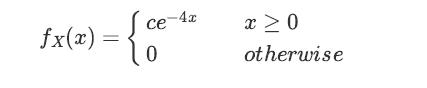
Let X be a continuous random variable with the following PDFwhere c is a positive constant.a. Find c.b. Find the CDF of X, FX(x).c. Find P(2 d. Find EX. fx(x) = {: 0 ce 4x x ≥ 0 otherwise
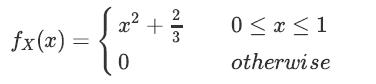
Let X be a continuous random variable with PDFa. Find E(Xn), for n = 1, 2, 3,⋯.b. Find the variance of X. fx(x) = √ √ ₂² + ²/ x2 { 10 0 ≤ x ≤ 1 otherwise
Let X ∼ Uniform(a, b). Find EX.
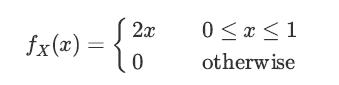
Let X be a continuous random variable with PDFFind the expected value of X. fx(x) {} 0 2x 0≤x≤1 otherwise
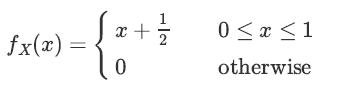
Let X be a continuous random variable with PDFFind E(Xn), where n ∈ N. √ - {₁ {ő 0 fx(x) = + 1/1/202 x + 0≤x≤1 otherwise
Let X be a uniform(0, 1) random variable, and let Y = e−X.a. Find the CDF of Y.b. Find the PDF of Y.c. Find EY.
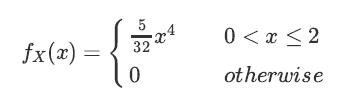
Let X be a continuous random variable with PDFand let Y = X2.a. Find the CDF of Y.b. Find the PDF of Y.c. Find EY. fx(x): = 32 0 0 < x≤2 otherwise
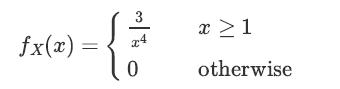
Let X be a continuous random variable with PDFFind the mean and variance of X. fx(x) = 0 x ≥ 1 otherwise
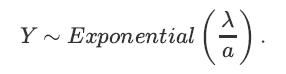
Let X ∼ Exponential(λ), and Y = aX, where a is a positive real number. Show that Y ~ Exponential (à).
Let X be a Uniform(0, 1) random variable, and let Y = eX.a. Find the CDF of Y.b. Find the PDF of Y.c. Find EY.
Showing 6700 - 6800
of 7136
First
58
59
60
61
62
63
64
65
66
67
68
69
70
71
72
Step by Step Answers

 Get 50% OFF
Claim Now
Get 50% OFF
Claim Now
















![Px (0) = Px() = Px() = Px() = Px (T) = . Find E[sin(X)].](https://dsd5zvtm8ll6.cloudfront.net/images/question_images/1698/2/1/7/3366538bd787b1041698217334697.jpg)

![f(a) = E[(X-a)].](https://dsd5zvtm8ll6.cloudfront.net/images/question_images/1698/2/2/0/1356538c8678372c1698220130114.jpg)