New Semester
Started
Get
50% OFF
Study Help!
--h --m --s
Claim Now
Question Answers
Textbooks
Find textbooks, questions and answers
Oops, something went wrong!
Change your search query and then try again
S
Books
FREE
Study Help
Expert Questions
Accounting
General Management
Mathematics
Finance
Organizational Behaviour
Law
Physics
Operating System
Management Leadership
Sociology
Programming
Marketing
Database
Computer Network
Economics
Textbooks Solutions
Accounting
Managerial Accounting
Management Leadership
Cost Accounting
Statistics
Business Law
Corporate Finance
Finance
Economics
Auditing
Tutors
Online Tutors
Find a Tutor
Hire a Tutor
Become a Tutor
AI Tutor
AI Study Planner
NEW
Sell Books
Search
Search
Sign In
Register
study help
business
probability and stochastic modeling
Probability And Stochastic Modeling 1st Edition Vladimir I. Rotar - Solutions
A husband and wife played the same slot machine together. The wife started to play first, played until the first win and yielded her place to the husband. Then the husband played until his first win and after that both quit. If both together played 11 times, what is the probability that the wife
(a) Two independent r.v.’s, X1 and X2, take on values 1,2 with equal probabilities. Without calculations, guesswhether all possible values of the sum X1 + X2 are also equally likely. Give a heuristic explanation. Using the convolution formula, find all probabilities fn = P(X1 +X2 = n). Graph fn
Find the distribution of the sum X1+X2 of independent r.v.’s
Regarding the convolution formula (1.2.5), is it true that f(1) ∗ f(2) = f(2) ∗ f(1)?
A husband and wife have two cars. They can purchase special auto insurance policies for each car separately, such that each policy covers the loss only for the first accident occurred in the same year. Suppose that the numbers of accidents connected with each car are independent r.v.’s N1,N2 with
Consider the game from Example 1.1-7, and suppose that the coin was tossed n times. Let Wn be the total winnings of the first player.(a) Which values can Wn assume?(b) Find P(Wn = 0), (c) Find P(Wn = k) for all k = 0,±1,±2, ...
Show without any calculations and using no particular formulas that the sum of two independent binomial r.v.’s with parameters (n1, p) and (n2, p) respectively, is a binomial r.v. with parameters (n1+n2, p).
Let r.v.’s X1 and X2 assume the same values, and their joint distribution is symmetric in the sense that fij = f ji.(a) How will the table of joint probabilities look in this case?(b) Do X1,X2 have the same marginal distributions?(c) Can X1,X2 be dependent?(d) Show that P(X1 > X2) = P(X2 >
Let r.v.’s X1 and X2 be i.i.d. Show that P(X1 > X2) = P(X2 > X1).
Are r.v.’s X1 ≡ 3 and X2 ≡ 5 independent? (X ≡ a means that X takes on only one value a.)
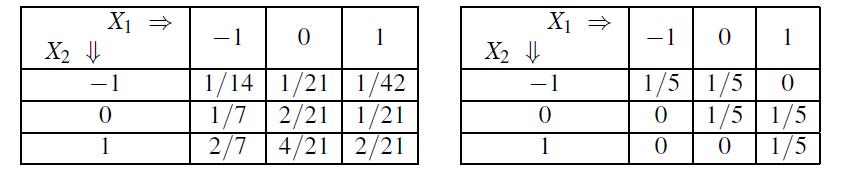
The two tables below give two different joint probability distributions of a random vector (X1,X2):For both cases, find the marginal probabilities; figure out whether the random variables are dependent; find P(X1 = 0|X2 = 0), compare it with P(X1 = 0), and explain the result of the comparison.
Let r.v.’s X1,X2 be the numbers on two dice rolled. How does the table of joint and marginal probabilities look in this case? Realize how this simple table may be of help for finding the distribution of X1 +X2, the sum of the numbers on the dice. Find this distribution using the table.
Let r.v.’s X1 and X2 be independent and both have the geometric distribution with parameter p = 1/2. Find P(X1 = X2).
The distribution of the number of telephone calls a manager is receiving during an hour is well approximated by the Poisson distribution with parameter λ = 4. Calculate the probability that during an hour, there will be at least 3 calls.
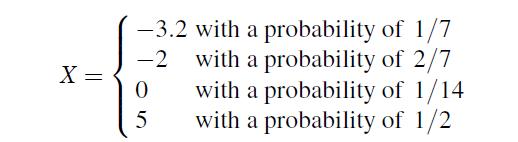
Let a r.v.Graph the (cumulative) distribution function of X. If you show this graph to somebody who is taking a course in Probability, how would she/he compute P(−3 ≤ X ≤ 3) just looking at the graph?
There are six items in a row. You mark at random two of them. Find the distribution of the number of items between the marked items.
A bag contains 5 red marbles and 15 blue marbles. Two marbles are drawn from the bag without replacement. Write the distribution of the number of red marbles selected.
Let X be the product of the numbers on two dice rolled. (a) Does X assume all values between 1 and 36? (b) Trying to provide all calculations in mind (they are easy), find P(X ≤ 36), P(X < 36), P(X ≤ 30), P(X < 30), P(X = 1). (c) Find the probability that X is a prime number. (By definition,
You draw two cards from a deck. If they are of different color, you win nothing. If both are black, you win $5. If both are red, you win $10, and additional $15 if the two cards are a red ace and king. Write the probability distribution for the amount you will win.
(a) Which distribution below would you call symmetric, and which “skewed”?(b) Rigorously speaking, the distribution of a discrete r.v. X is said to be symmetric if for a number s called a center of symmetry, P(X = s+x) = P(X = s−x) for any x > 0. Explain the sense of this definition, and
“Hickory, dickory, dock,The mouse ran up the clock.The clock struck one,The mouse ran down,Hickory, dickory, dock.”Suppose a word is chosen at random from this famous nursery rhyme. Write the probability distribution of the (random) number of letters in this word.
Suppose that in the situation of the two-armed bandit problem in Section 2.7, you follow the strategy suggested there.(a) Show that (i) if you lose at the first time, then you will switch; (ii) if you win at the first time, and p1 < 1/2 , then you will never switch at the second time.(b) Let p1
A company is advertising a product it produces. The management places an advertisement in newspapers, and a fancy advertisement on TV. The following average figures have been observed. Among 50 potential buyers, one sees an ad in a newspaper and only there, and five see the ad on TV (and perhaps in
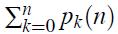
Using software, compute p3(4), p2(4), p3(10), p5(10), and p8(10) in the model of Section 3.6. Compare the results with what approximation (3.6.4) gives. Explain the result of the comparison, and provide a general rule of thumb for using (3.6.4).
Ten guests came to a diner party. The host had had plans where each guest would sit, but the guests ignored it and chose seats at random. Find the probability that at most two guests chose the seats that had been intended for them.
Consider the matching scheme of Section 3.6. Explain without calculations why pn−1(n) must be equal to zero, and whymust be equal to one. Show that both assertions are consistent with (3.6.1).
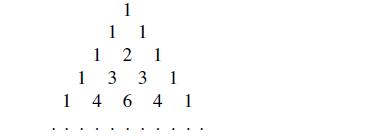
Prove thatrigorously, and give a combinatorial interpretation. Proceeding from (4.1), show that all combinations (n k) can be arranged in the triangle below, which is constructed in the following way. We start with one in the first row as is shown below, and then, moving down, add two adjacent
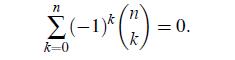
Using the binomial formula, prove that
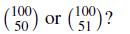
(a) Which is larger:(b) For a fixed n, consider (n k) as a function of k. Figure out for which k it is increasing and for which it is decreasing. Where does it attain its maximal value for an even n, for an odd n? In what sense is the picture symmetric? (Advice: Compare the values for k and k +
Explain without any calculations why
There are 4 roses and 5 lilies. Five flowers are randomly selected. Find the probability that the bouquet will contain 2 roses and 3 lilies.
Ten women and nine men attend a lecture. Suppose that all orders in which they can leave the room after the lecture is over are equally likely. Find the probability that(a) All women will leave first,(b) The second person leaving the room will be a woman.
Fifteen people are randomly seated in a row of thirty chairs. Write a formula for the probability that the people will occupy fifteen adjacent seats?
In a country, there are only five first names for boys, and all five names are equally likely to be given.(a) Find the probability that four boys selected at random have different names. (b) Find the same probability for six boys.
(a) Write a counterpart of (2.5.4) for three events. (Advice: Start with P(A ∪ B ∪ C)= P((A ∪ B) ∪ C), and use (2.5.4).) (b) Prove (2.5.6) by induction. P(AUB)=P(A) + P(B) P(AB). (2.5.4)
Let P(A) = 0.9 and P(B) = 0.2. Can P(AB) = 0? In general, if P(A) + P(B) > 1, can P(AB) = 0? Eventually, show that P(AB) ≥ P(A) + P(B) − 1, and find to which value P(AB) can be equal if P(A) = 0.9 and P(B) = 0.2.
Let A and B be events, and let C be the event that exactly one of the events A or B occurs. Using operations on events, write a formula for C. Write a formula for P(C) in terms of P(A), P(B), and P(AB).
In a city of Pleasant Corner, 20% of households have a pool, 60% have air conditioning, and 70% have at least one of these features. Find the probabilities of all possible combinations of these features. Illustrate it by the Venn diagram.
In an area, for two consecutive days, the probability that it is raining on both is 0.1, and the probability that there is no rain on any of these two days is 0.6. Also, it is equally likely whether the first day is rainy and the second is not, or vice versa. Find the probabilities of all possible
Explain why it is impossible to build a discrete model with an infinite number of outcomes, for which all outcomes are equally likely.
Similar to Proposition 1, show that for any events A1, A2, ...,where ∪iAi and ∩iAi stand for the union and intersection of all Ai’s, respectively. (UA) = NA, (NA) = UA,
Mark each statement below true or false.(a) In any probability model, the number of all possible outcomes is finite.(b) In any probability model, all outcomes are equally likely.(c) P(A∪B) = P(A)+P(B) for any events A and B.(d) P(Ac) = 1−P(A) for any event A.
Prove the second relation in (1.2.2) replacing A by Ac and B by Bc in the first. (AUB) = AnB, (ANB) = AUB. (1.2.2)
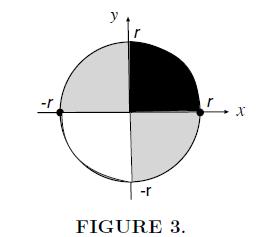
In Example 1.2-4, describe AcBc.EXAMPLE 4. Let A={(x,y) ∈ Ω : x ≥ 0} and B = {(x,y) ∈ Ω : y ≥ 0}. The situation is illustrated in Fig. 3. The set A corresponds to the right half of the disk (x’s are positive) and the set B to the top half of the disk (y’s are positive). The whole
Describe the sample space for the situations below and compute |Ω|.(a) There are two political parties in a country. Each of n citizens either votes for a party, or does not vote at all, or uses his right to come and vote against both parties.(b) A professor fills out an attendance list for a
Two dice are rolled. Let A = {the sum of the dice is odd}, B = {at least one die is even}, C = {at least one die is odd}. For each pair of these events, figure out whether the events in the pair are disjoint. Compare the events in each of the following pairs of events: A and B ∪ C, A and BC, AB
Suppose that A and B are disjoint, P (A) = 0.4 and P (B) = 0.5. Find the probabilities that (a) Either A or B occur;(b) Both A and B occur;(c) A occurs but B does not.
A point (a,b) is chosen from the square R = {0 ≤ a ≤ 1,0 ≤ b ≤ 1}. Suppose that the probability distribution on R is uniform; that is, the probability that a point (a,b) comes from a region in R, equals the area of this region.(a) Find the probabilities that a ≥ b and 2a ≥
Prove that P(ABc) = P(A) − P(AB), and draw an illustration picture.
How many seven-digit telephone numbers can be arranged if a telephone number does not begin with 0 or 1? Find the probabilities that a randomly selected number contains exactly three ones, exactly three fours?
In Example 3.2-3, what is the probability to get the car if you follow the switching-strategy?Example 3.2-3The name comes from a game show host. You are on a game show. There are three doors: behind one door is a car; behind the others are goats. You pick a door and may get what is behind it.
Clearly, starting from zero, there are 100,000 numbers which may be written by five digits or less. Show that this also follows from the basic counting principle. How many numbers may be written using five digits in the binary system?
You mark five cells from fifty in a lottery ticket. Find the probability that you have guessed all five numbers; exactly three of them.
You select at random k numbers from the sequence 1, ...,n. Show that the probability that you will choose a particular combination of numbers, say, 1,2, ...,k, is 1/ (n k). Suppose that now you select k numbers one at a time without replacement, and distinguish samples containing the same numbers
Similar to Example 2.2-7c, prove that the probability of selecting a red ball at any draw is the same as at the first draw. Example 2.2-7cThere are exactly two participants in a contest that consists in answering questions. The first contestant chooses at random one question out of eight, and
In Bridge, fifty-two cards are dealt to four players, thirteen to each.(a) Write a formula for p1, the probability that a particular player, say, the first, will get a whole suit (all thirteen cards will come from the same suit).(b) Write a formula for p12, the probability that two particular
There are ten pairs of shoes in a closet.(a) If you choose two shoes at random, what is the probability that it will be a pair?(b) You have chosen four shoes at random. Find the probability that among them, there will be at least one pair in two ways: directly and computing the probability of the
Let P(A1) = P(A2) = 1. Show that P(A1 ∪ A2) = P(A1A2) = 1.
Among 200 items, there are 10 defective. If you choose at random 20, what is the probability, that all will be non-defective?
Each week, on one of the weekdays, Joan receives a flyer advertisement from a particular store. It happened that in four of the last five weeks, the fliers came on Fridays. Given this, to what extent is it plausible that all weekdays are equally likely to be a day of receipt?
In a party of ten, each person shakes hands with each. What is the number of all handshakes?
Suppose n cards from a well shuffled deck of 52 are dealt out. If 5 ≤ n ≤ 52, what is the probability that the first five cards are(a) Spades,(b) Red?
Seven apples, three oranges, and five lemons are randomly distributed into three boxes. No box can contain more than five fruits. Find the probability that(a) Each box contains an orange;(b) Exactly one box contains no oranges. (There are 15 fruits and 15 places in the boxes.)
A professor is preparing a final for n students. Each student will be given a theoretical question and a particular problem on calculations. The professor has prepared n theoretical questions and n calculation problems. How many combinations of a theoretical question and calculation problem can be
Suppose that for each member of a family of five people, all months are equally likely to be that of the birthday. Find the probabilities that(a) All five were born in the same month; (b) All five were born in different months;(c) Two were born in the same month, two in another month, and one in a
Each of one hundred students independently chooses one of five elective courses. Write a formula for the probability that each course will be chosen by twenty students.
An elevator in a ten-floor building leaves the first floor with six passengers. Assuming all possible outcomes to be equally likely, find the probabilities of the following events.(a) Three passengers will get off the elevator on the second floor, one passenger on the third floor, and two on the
A well-shuffled deck of 52 cards is dealt out. Find the probabilities of the following events.(a) The fourth card is a king.(b) Among the first five cards, there are cards from each suit.(c) There are k cards between the king and ace of spades.
John has five pairs of shoes. If he puts the shoes absolutely randomly into five shoe boxes, what is the probability that(a) Each pair will go to the same box;(b) Each box will have one left and one right shoe?
Find the probabilities that(a) On the k-th day (k < n), there will be a division that will not have been inspected;(b) On the kth day (k < n), each division will have been inspected;(c) On the (n + 1)th day, each division will have been inspected.
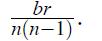
There are n ≥ 3 pairs of socks in a drawer, and three pairs are black. Find the probability that two randomly selected socks are black. Does this probability get larger when n is increasing?For which n is this probability less than 1/5?
In the city of Pleasant Corner, 20% of houses have a pool, 60%—air conditioning. Suppose that for each citizen of Pleasant Corner, the decisions whether to have a pool and whether to have air conditioning are independent. Find the probability that a citizen chosen at random has either a pool or
Derive (1.3.4.5) from (1.2.2). n P(Bk.n) = = (x^)^ * = *. n! P k! (n-k)! P^ q (1.2.2)
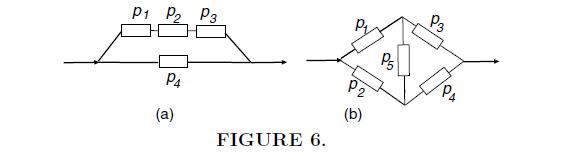
A system consists of components configured as shown in Fig. 6a; pi is the probability that component i works; the components function independently. Find the probability that a signal will go through. P1 P P3 P4 (a) FIGURE 6. P2 (b) P5 P3
Prove that, if A and B are independent, the same is true for Ac and B, Ac and Bc.
(a) Consider two singletons, [ω1] and [ω2]; that is, events containing only one outcome each. Are they independent?(b) Are disjoint events independent?(c) Let P(A1) = P(A2) = 1. Are A1,A2 independent?
Two cards are selected at random from a deck of 52. Guess whether the events A1 = {at least one card is a king}, A2 = {at least one card is an ace} are independent. Justify your guess rigorously.
Two dice are rolled. Let X and Y be the numbers appeared; and events A = {X is even}, B = {X+Y is even}, A = {X is divided by 4}, B = {X+Y is divided by 4}. Check for independence the pairs A, B and A, B.
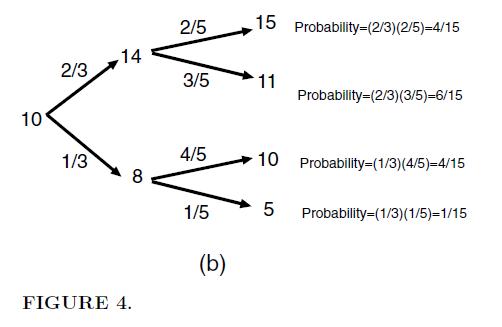
(a) Consider the tree in Fig. 4b, Section 2.2. Are the events A={on the second day, the price is larger than 9}, B = {on the second day, the price is smaller than 12} independent?(b) In general, if Ω = {ω1, ω2, ω3, ω4} with given elementary probabilities, in which case are the events A =
Explain why for a fixed n, the events Bk,n in Section 1.2.1 are disjoint, and why the total sum of all probabilities P(Bk,n) must be one. Give a heuristic explanation and show it rigorously using the binomial formula (1.3.4.7). P([0])= pkqn-k (1.2.1)
(a) Consider two trials. We do not impose any independence condition but assume that all outcomes are equally likely. Our intuition tells us that in this case, trials are independent in the sense that, for example, the events A1 = { the first trial is successful} and A2 = { the second trial is
Two dice were rolled. Let A1 = {the first die rolled an even number}, A2 ={the second die rolled an odd number}, A3 ={the sum of the results is odd}. Showthat these events are pairwise independent but are mutually dependent.
Make sure that definition (1.1.4) for n = 3 indeed leads to the definition of mutual independence for three events.
To be hired by a company, an applicant should pass two tests. The first test contains 10 questions, and for each question, the probability of giving a correct answer is p1. The second test contains 20 questions, and for each question of this test, the probability of a correct answer is p2. Whether
9% of people who are given a particular drug experience a side effect. Find the probability that at least two of fifteen people selected at random will have side effects.
Four dice are rolled five times. Write an expression for the probability that exactly three times all four dice will show six.
We toss a coin 100 times and are interested in the probability that there will be at most 50 heads. Explain why this probability is larger than 0.5, while if you toss 101 times, it is exactly 0.5. Compute these probabilities using Excel or another software.
In a university, 55% of students are females. Consider the probability that in a class of 100 students there will be at most 55 females. Do you expect that this probability is 0.55? Check your guess using software. (Comments: The fact that the “probability of a female” is 0.55, means that on
You are rolling a die. One face of the die is painted green, another red, and the rest of the faces are black. Find the probabilities of the following events.(a) In the first three rolls, the die lands with black faces up, and in the next two with green faces up.(b) In five rolls, the die shows a
You roll a regular die six times. Write formulas for the probabilities of the following events.(a) The first three rolls show “six”, the fourth and fifth “five”, and the sixth “four”.(b) The die will roll “six” three times, “five” two times, and “four” one time.
For a family having two children, assuming that all outcomes are equally likely, find the probability that there is at least one boy given that there is at least one girl.
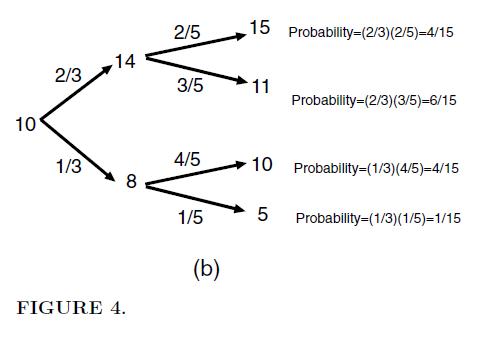
For the tree in Fig. 4b, Section 2.2, find the probability that the price increased on the first day given that it did not exceed 14 on the second day. 10 2/3 1/3 14 FIGURE 4. 8 2/5 3/5 4/5 1/5 (b) 15 Probability=(2/3)(2/5)=4/15 11 Probability=(2/3)(3/5)-6/15 10 Probability=(1/3)(4/5)=4/15 5
Two dice are rolled. Given that the sum is divided by 3, find the probability of two threes.
In a game of bridge, you did not get spades. Write a formula for the probability that your partner does not have spades too. (Bridge is played with a standard 52-card deck by two pairs of partners; each player gets 13 cards.)
Find P(A1 |A2) in Example 1.1-6 for both cases. Try to minimize calculations.Now, let A1 = {x1 ≥ 0}, A2 = {x2 ≥ 0}. Figure out whether A1 and A2 are independent for both cases.
Show that if A ⊆ B, then P(A|B) = P(A)/P(B). Find P(A|B) for A ⊇ B, and for disjoint A and B. Explain why the last two answers are obvious.
Consider the binomial tree in Section 1.2.2. Suppose that the probabilities of “moving up and down” on the first day equal 1/2, but on the second day, the price moves up with a probability of p1 if on the first day it moved up, and with a probability of p2 if on the first day it
In a multiple choice exam, a question has two answers, only one of which is correct. Suppose 80% of students know the answer, and those who do not know choose an answer at random.(a)What is the probability that a student chosen at random will answer the question correctly?(b) Suppose a student has
In a region, a hiker may come across a rattlesnake. For a mountain area and a randomly chosen day, the probability of this event is 0.02; for valleys, it is 0.01. Joan, when choosing one from these two areas, does it at random.(a) What is the probability that Joan will see a rattlesnake on a
An urn has b black and r red balls. A ball is drawn and put back into the urn together with c balls of the same color. (So, now there are b+r+c balls in the urn.)After that again a ball is drawn.(a) Do you expect that the probability that the second ball is red, depends on c?(b) Prove that this
Showing 6800 - 6900
of 6914
First
56
57
58
59
60
61
62
63
64
65
66
67
68
69
70
Step by Step Answers

 Get 50% OFF
Claim Now
Get 50% OFF
Claim Now

















![P([0])= pkqn-k (1.2.1)](https://dsd5zvtm8ll6.cloudfront.net/images/question_images/1704/3/6/5/53465968ddeb8d5f1704365535563.jpg)