New Semester
Started
Get
50% OFF
Study Help!
--h --m --s
Claim Now
Question Answers
Textbooks
Find textbooks, questions and answers
Oops, something went wrong!
Change your search query and then try again
S
Books
FREE
Study Help
Expert Questions
Accounting
General Management
Mathematics
Finance
Organizational Behaviour
Law
Physics
Operating System
Management Leadership
Sociology
Programming
Marketing
Database
Computer Network
Economics
Textbooks Solutions
Accounting
Managerial Accounting
Management Leadership
Cost Accounting
Statistics
Business Law
Corporate Finance
Finance
Economics
Auditing
Tutors
Online Tutors
Find a Tutor
Hire a Tutor
Become a Tutor
AI Tutor
AI Study Planner
NEW
Sell Books
Search
Search
Sign In
Register
study help
engineering
chemical biochemical and engineering
Chemical Biochemical And Engineering Thermodynamics 5th Edition Stanley I. Sandler - Solutions
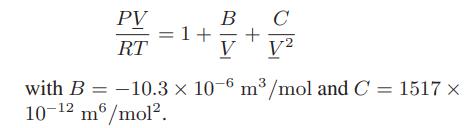
Redo Problem 6.29 using Aspen PlusProblem 6.29Nitrogen is to be isothermally compressed at 0°C from 1 bar to 100 bar. Compute the work required for this compression; the change in internal energy, enthalpy; Helmholtz and Gibbs energies of the gas; and the heat that must be removed to keep the gas
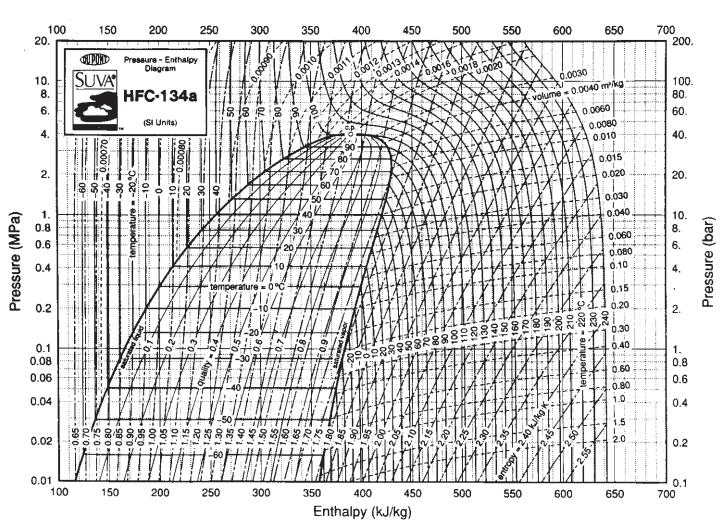
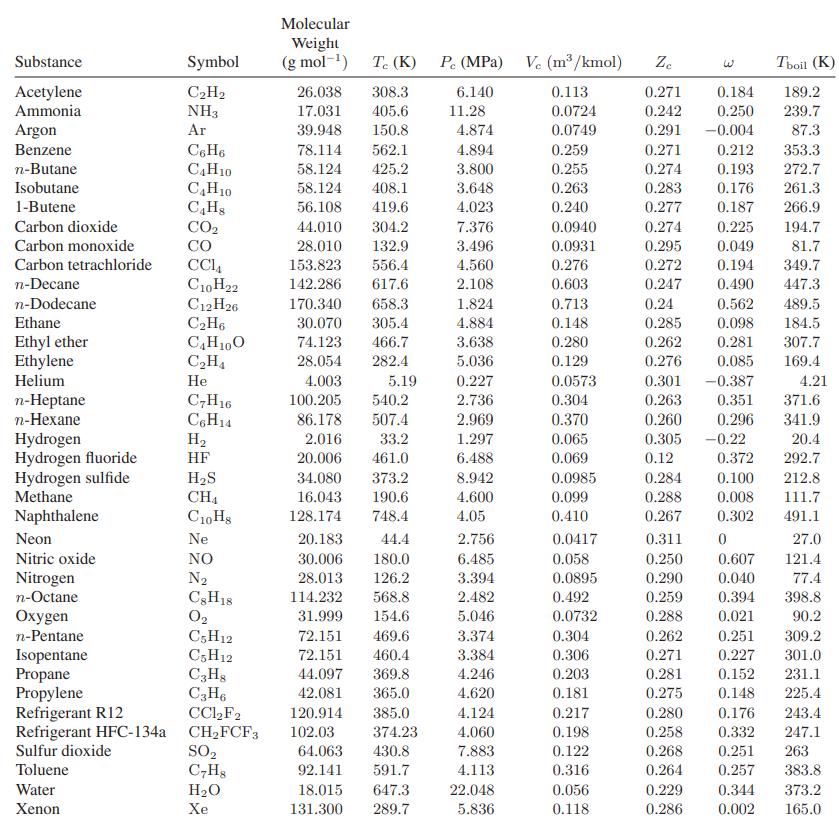
Redo Problem 6.13 using Aspen PlusProblem 6.13Eighteen kilograms of the refrigerant HFC-134a at 150°C is contained in a 0.03-m3 tank. Compare the prediction you can make for the pressure in the tank with that obtained using Fig. 3.3-4. For data, see Table 6.6-1.Fig. 3.3-4.Table 6.6-1. Pressure
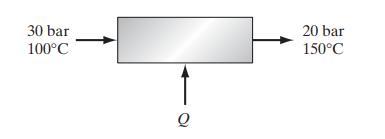
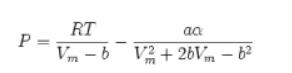
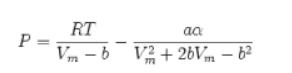
Redo Problem 6.12 using Aspen PlusProblem 6.12Ethylene at 30 bar and 100°C passes through a heaterexpander and emerges at 20 bar and 150°C. There is no flow of work into or out of the heater-expander, but heat is supplied. Assuming that ethylene obeys the Peng-Robinson equation of state, compute
Redo Problem 6.7 using Aspen PlusProblem 6.7One hundred cubic meters of carbon dioxide initially at 150°C and 50 bar is to be isothermally compressed in a frictionless piston-and-cylinder device to a final pressure of 300 bar. Calculatei. The volume of the compressed gasii. The work done to
One kilogram of saturated liquid methane at 160 K is placed in an adiabatic piston-and-cylinder device, and the piston will be moved slowly and reversibly until 25 percent of the liquid has vaporized. Compute the maximum work that can be obtained, assuming that methane is described by the
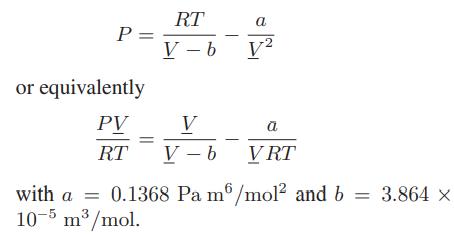
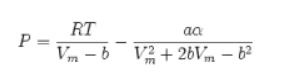
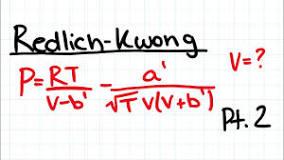
Repeat Illustration 6.7-1 using the Soave–RedlichKwong equation of state.Illustration 6.7-1 Using the Peng-Robinson Equation of State to Solve a Real Gas Problem Rework Illustration 6.5-1 assuming that nitrogen can be described using the Peng-Robinson equation of state.Illustration
Repeat Illustration 6.4-1 using the Soave–RedlichKwong equation of state.Illustration 6.4-1Making of a Thermodynamic Properties Chart As an introduction to the problem of constructing a chart or table of the thermodynamic properties of a real fluid, develop a thermodynamic properties chart for
Ammonia is to be isothermally compressed in a specially designed flow turbine from 1 bar and 100°C to 50 bar. If the compression is done reversibly, compute the heat and work flows needed per mole of ammonia if a. Ammonia obeys the principle of corresponding states of Sec. 6.6. b. Ammonia
The divided tank of the preceding problem is replaced with two interconnected tanks of equal volume; one tank is initially evacuated, and the other contains methane at 500 bar and 20°C. A valve connecting the two tanks is opened only long enough to allow the pressures in the tanks to equilibrate.
A tank is divided into two equal chambers by an internal diaphragm. One chamber contains methane at a pressure of 500 bar and a temperature of 20°C, and the other chamber is evacuated. Suddenly, the diaphragm bursts. Compute the final temperature and pressure of the gas in the tank after
Eighteen kilograms of the refrigerant HFC-134a at 150°C is contained in a 0.03-m3 tank. Compare the prediction you can make for the pressure in the tank with that obtained using Fig. 3.3-4. For data, see Table 6.6-1.Fig. 3.3-4.Table 6.6-1. Pressure
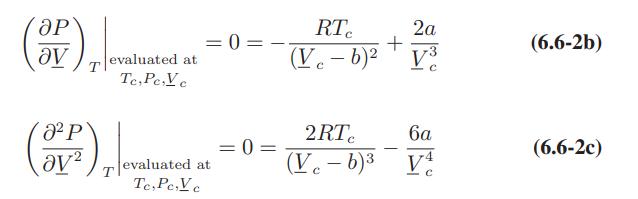
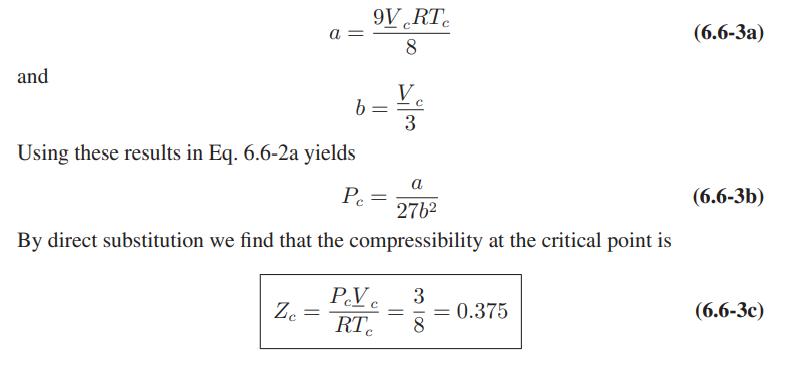
Derive Eqs. 6.6-2 and 6.6-3, and show that Zc|van der Waals = 3/8. Eqs. 6.6-2Eqs. 6.6-3, (OP) 7 / Va T evaluated at Te,Pe,Ve (OVP) evaluas = 0 = evaluated at Te, Pe.Ve = 0 = = 2a RTC (Ve-b)² V3 + 2RTc (Vc-b)³ 6a V (6.6-2b) (6.6-2c)
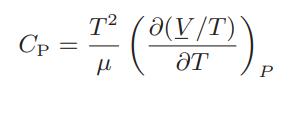
One of the beauties of thermodynamics is that it provides interrelationships between various state variables and their derivatives so that information from one set of experiments can be used to predict the results of a completely different experiment. This is illustrated here. a. Show thatThus, if
Redo Problem 5.25 using Aspen Plus. Problem 5.25Repeat the calculation of problem 5.23 if the compressor has an isentropic efficiency of 87%.Problem 5.23Repeat the calculation of problem 5.22 with the vapor being recycled to the compressorProblem 5.22Isobutane is to be liquefied to make liquid
Redo Problem 5.24 using Aspen Plus.Problem 5.24Repeat the calculation of problem 5.22 if the compressor has an isentropic efficiency of 72%. Problem 5.22Isobutane is to be liquefied to make liquid petroleum gas (LPG). The butane is available at 25°C and 1 bar, it will be compressed to 15 bar,
In a continuous manufacturing process, chlorodifluoromethane (CHClF2) initially at 10 bar and 420 K, passes through an adiabatic pressure reducing valve so that its pressure is 0.1 bar (this last pressure is low enough that CHClF2 can be considered to be an ideal gas). At these operating
The inlet to an adiabatic turbine is steam at 1.3 MPa and 385°C, and the turbine exit pressure is 0.1 MPa. a. Determine the maximum work that can be obtained from each kg of steam and the exit temperature of the steam. b. If the turbine has an isentropic efficiency of 80%, determine the work
Steam enters a turbine 350°C and 0.8 MPa and exits at 0.1 MPa.Compute the work exiting temperature and work obtained if: a. the turbine operates isentropically; and b. the turbine has an isentropic efficiency of 0.8.
From a process, 100 kg of steam is available at 2 MPa and 800°C. a. Determine the maximum amount of shaft work that can be obtained from this steam in a non-flow process if the ambient conditions are 25°C and 1 bar. b. This steam will be used in a work producing nonflow process that reduces its
100 kg of steam is available at 2 MPa and 800◦C. a. Determine the maximum amount of shaft work that can be obtained from this steam in a non-flow process if the ambient conditions are 25°C and 1 bar. b. This steam will be used in a non-flow work producing process that reduces its pressure to
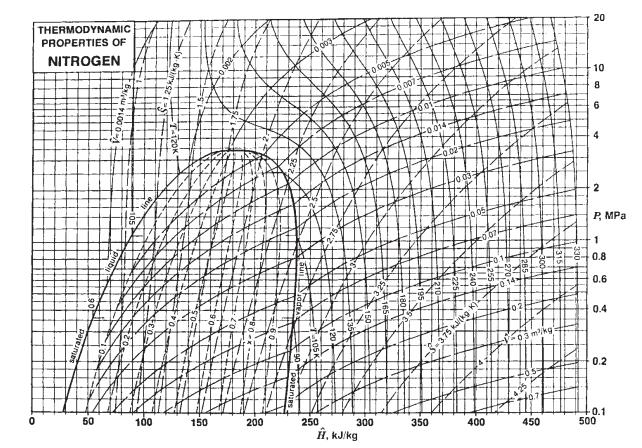
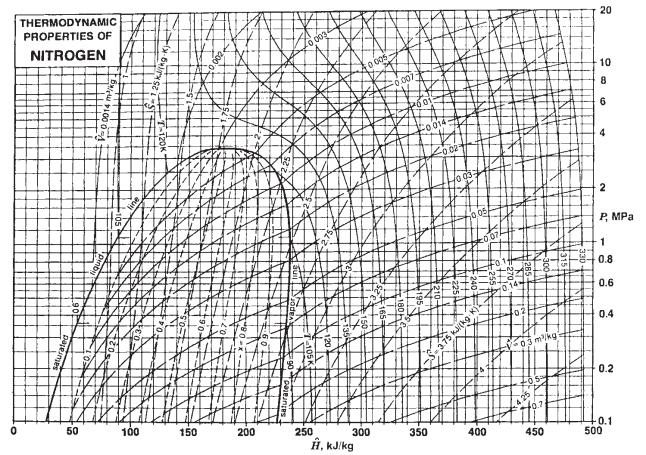
Repeat Problem 3.25, now considering nitrogen to be a real gas with the thermodynamic properties given in Fig. 3.3-3.Problem 3.25A 0.01-m3 cylinder containing nitrogen gas initially at a pressure of 200 bar and 250 K is connected to another cylinder 0.005 m3 in volume, which is initially evacuated.
Redo Problem 3.32 using Aspen Plus.Problem 3.32Nitrogen can be liquefied using a Joule-Thomson expansion process. This is done by rapidly and adiabatically expanding cold nitrogen gas from high pressure to a low pressure. If nitrogen at 135 K and 20 MPa undergoes a Joule-Thomson expansion to 0.4
Repeat the calculation of Problem 3.25, but now assume that sufficient heat transfer occurs between the gas in the two cylinders that both final temperatures and both final pressures are the same.Problem 3.25A 0.01-m3 cylinder containing nitrogen gas initially at a pressure of 200 bar and 250 K is
A 0.01-m3 cylinder containing nitrogen gas initially at a pressure of 200 bar and 250 K is connected to another cylinder 0.005 m3 in volume, which is initially evacuated. A valve between the two cylinders is opened until the pressures in the cylinders equalize. Find the final temperature and
An isolated chamber with rigid walls is divided into two equal compartments, one containing gas and the other evacuated. The partition between the compartments ruptures. After the passage of a sufficiently long period of time, the temperature and pressure are found to be uniform throughout the
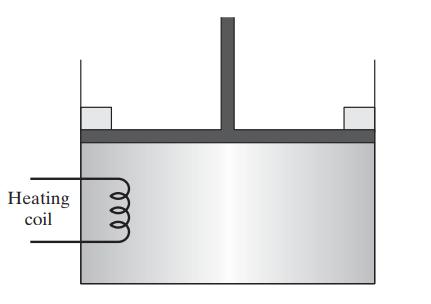
The frictionless piston-and-cylinder system shown here is subjected to 1.013 bar external pressure. The piston mass is 200 kg, it has an area of 0.15 m2, and the initial volume of the entrapped ideal gas is 0.12 m3. The piston and cylinder do not conduct heat, but heat can be added to the gas by a
The voltage drop across an electrical resistor is 10 volts and the current through it is 1 ampere. The total heat capacity of the resistor is 20 J/K, and heat is dissipated from the resistor to the surrounding air according to the relation where Tam is the ambient air temperature, 25°C; T is the
a. A 1-kg iron block is to be accelerated through a process that supplies it with 1 kJ of energy. Assuming all this energy appears as kinetic energy, what is the final velocity of the block? b. If the heat capacity of iron is 25.10 J/(mol K) and the molecular weight of iron is 55.85, how large a
A nonconducting tank of negligible heat capacity and 1 m3 volume is connected to a pipeline containing steam at 5 bar and 370◦C, filled with steam to a pressure of 5 bar, and disconnected from the pipeline.a. If the tank is initially evacuated, how much steam is in the tank at the end of the
Steam at 500 bar and 600°C is to undergo a JouleThomson expansion to atmospheric pressure. What will be the temperature of the steam after the expansion? What would be the downstream temperature if the steam were replaced by an ideal gas?
In Joule’s experiments, the slow lowering of a weight (through a pulley and cable arrangement) turned a stirrer in an insulated container of water. As a result of viscosity, the kinetic energy transferred from the stirrer to the water eventually dissipated. In this process the potential energy of
Water in the Niagara River approaches the falls at a velocity of 8 km/hr. Niagara Falls is approximately 55 m high. Neglecting air resistance, estimate the velocity of the water at the bottom of the falls.
a. A bicyclist is traveling at 20 km/hr when he encounters a hill 70 m in height. Neglecting road and wind resistance (a poor assumption), what is the maximum vertical elevation gain the bicyclist could achieve without pedaling? b. If the hill is a down hill, what speed would the bicyclist achieve
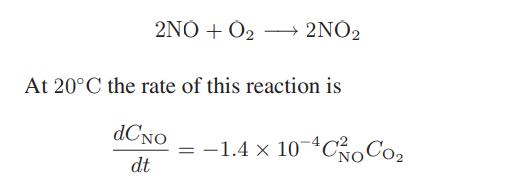
The following reaction occurs in air: for t in seconds and concentrations in kmol/m3. The reaction occurs in a constant-volume, 2-L vessel, and the initial concentration of NO is 1 kmol/m3 and that of O2 is 3 kmol/m3a. If 0.5 mol of NO reacts, how much NO2 is produced? b. Determine how long it
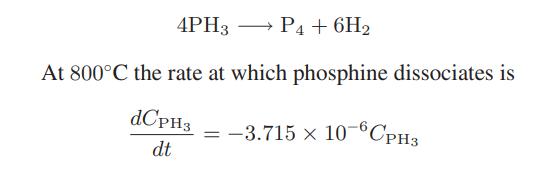
At high temperatures phosphine (PH3) dissociates into phosphorus and hydrogen by the following reaction:for t in seconds. The reaction occurs in a constantvolume, 2-L vessel, and the initial concentration of phosphine is 5 kmol/m3a. If 3 mol of the phosphine reacts, how much phosphorus and hydrogen
The insecticide DDT has a half-life in the human body of approximately 7 years. That is, in 7 years its concentration decreases to half its initial concentration. Although DDT is no longer in general use in the United States, it was estimated that 25 years ago the average farm worker had a body DDT
As a result of a chemical spill, benzene is evaporating at the rate of 1 gram per minute into a room that is 6 m × 6 m × 3 m in size and has a ventilation rate of 10 m3/min.a. Compute the steady-state concentration of benzene in the room. b. Assuming the air in the room is initially free of
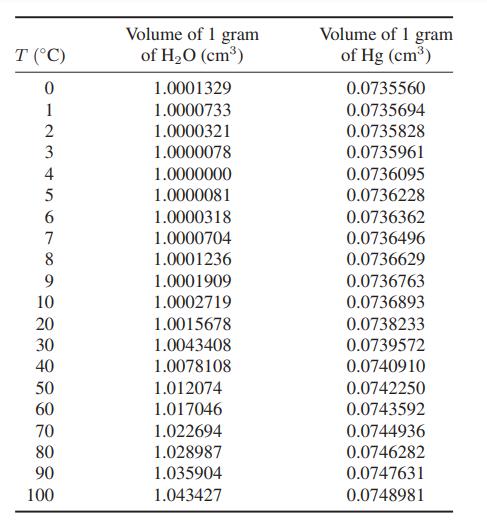
The following table lists the volumes of 1 gram of water and 1 gram of mercury as functions of temperature. a. Discuss why water would not be an appropriate thermometer fluid between 0°C and 10°C. b. Because of the slightly nonlinear temperature dependence of the specific volume of liquid
For each of the cases that follow, list as many properties of the equilibrium state as you can, especially the constraints placed on the equilibrium state of the system by its surroundings and/or its container. a. The system is placed in thermal contact with a thermostatic bath maintained at
It is sometimes necessary to produce saturated steam from superheated steam (steam at a temperature higher than the vapor-liquid coexistence temperature at the given pressure). This change can be accomplished in a desuperheater, a device in which just the right amount of water is sprayed into
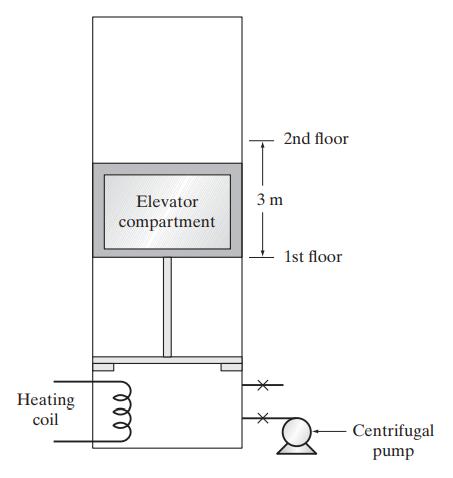
A clever chemical engineer has devised the thermally operated elevator shown in the accompanying diagram. The elevator compartment is made to rise by electrically heating the air contained in the pistonand-cylinder drive mechanism, and the elevator is lowered by opening a valve at the side of the
The elevator in the previous problem is to be designed to ascend and descend at the rate of 0.2 m/s, and to rise a total of 3 m. a. At what rate should heat be added to the cylinder during the ascent? b. How many kilomoles per second of air should be removed from the cylinder during the descent?
Nitrogen gas is being withdrawn at the rate of 4.5 g/s from a 0.15-m3 cylinder, initially containing the gas at a pressure of 10 bar and 320 K. The cylinder does not conduct heat, nor does its temperature change during the emptying process. What will be the temperature and pressure of the gas in
Air in a 0.3-m3 cylinder is initially at a pressure of 10 bar and a temperature of 330 K. The cylinder is to be emptied by opening a valve and letting the pressure drop to that of the atmosphere. What will be the temperature and mass of gas in the cylinder if this is accomplished?a. In a manner
Repeat the calculation in Problem 3.25, but now assume that the second cylinder, instead of being evacuated, is filled with nitrogen gas at 20 bar and 160 K.Problem 3.25A 0.01-m3 cylinder containing nitrogen gas initially at a pressure of 200 bar and 250 K is connected to another cylinder 0.005
A 1.5 kW heater is to be used to heat a room with dimensions 3.5 m × 5.0 m × 3.0 m. There are no heat losses from the room, but the room is not airtight, so the pressure in the room is always atmospheric. Consider the air in the room to be an ideal gas with C∗P = 29 J/(mol K), and its initial
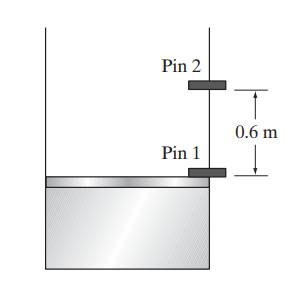
The piston-and-cylinder device shown here contains an ideal gas at 20 bar and 25◦C. The piston has a mass of 300 kg and a cross-sectional area of 0.05 m2. The initial volume of the gas in the cylinder is 0.03 m3, the piston is initially held in place by a pin, and the external pressure on the
A 0.6 m diameter gas pipeline is being used for the long-distance transport of natural gas. Just past a pumping station, the gas is found to be at a temperature of 25◦C and a pressure of 3.0 MPa. The mass flow rate is 125 kg/s, and the gas flow is adiabatic. Forty miles down the pipeline is
Nitrogen can be liquefied using a Joule-Thomson expansion process. This is done by rapidly and adiabatically expanding cold nitrogen gas from high pressure to a low pressure. If nitrogen at 135 K and 20 MPa undergoes a Joule-Thomson expansion to 0.4 MPa, a. Estimate the fraction of vapor and
A very large mass M of hot porous rock equal to 1012 kg is to be utilized to generate electricity by injecting water and using the resulting hot steam to drive a turbine. As a result of heat extraction, the temperature of the rock drops according to Q̇ = −MCP dT /dt, where CP is the specific
The human body generates heat by the metabolism of carbohydrates and other food materials. Metabolism provides energy for all biological activities (e.g., muscle contractions). The metabolic processes also generate heat, and there are special cells in the body whose main function is heat
Water is to be heated from its pipeline temperature of 20°C to 90°C using superheated steam at 450◦C and 2.5 MPa in a steady-state process to produce 10 kg/s of heated water. In each of the processes below, assume there is no heat loss.a. The heating is to be done in a mixing tank by direct
People partially cool themselves by sweating, which releases water that evaporates. If during exercise a human “burns” 1000 kcal (4184 kJ) in one hour of exercise, how many grams of water must evaporate at a body temperature of 37◦C? Assuming only 75 percent of the sweat evaporates (the rest
It is thought that people develop respiratory infections during air travel because much of the airplane cabin air is recirculated. Airlines claim that using only fresh air in the cabins is too costly since at an altitude of 30 000 feet the outside conditions are −50◦C and 0.1 bar, so that the
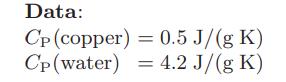
A 5-kg copper ball at 75◦C is dropped into 12 kg of water, initially at 5◦C, in a well-insulated container. a. Find the common temperature of the water and copper ball after the passage of a long period of time. b. What is the entropy change of the water in going from its initial to final
In a foundry, metal castings are cooled by quenching in an oil bath. Typically, a casting weighing 20 kg and at a temperature of 450◦C is cooled by placing it in a 150-kg involatile oil bath initially at 50◦C. If CP of the metal is 0.5 J/(kg K), and CP of the oil 2.6 J/(kg K), determine the
a. Show that the rate at which shaft work is obtained or required for a reversible change of state in a closed system at constant internal energy and volume is equal to the negative of the product of the temperature and the rate of change of the entropy for the system. b. Show that the rate at
Steam at 700 bar and 600◦C is withdrawn from a steam line and adiabatically expanded to 10 bar at a rate of 2 kg/min. What is the temperature of the steam that was expanded, and what is the rate of entropy generation in this process?
Two metal blocks of equal mass M of the same substance, one at an initial temperature Ti1 and the other at an initial temperature Ti2, are placed in a well-insulated (adiabatic) box of constant volume. A device that can produce work from a flow of heat across a temperature difference (i.e., a heat
A block of metal of total heat capacity CP is initially at a temperature of T1, which is higher than the ambient temperature T2. Determine the maximum amount of work that can be obtained on cooling this block to ambient temperature.
Hydrogen has an auto-ignition temperature of 853 K; that is, hydrogen will ignite spontaneously at that temperature if exposed to oxygen. Hydrogen is to be adiabatically and reversibly compressed from 1 bar and 300 K to a high pressure. To avoid accidental explosions in case of a leak, the maximum
One mole of carbon dioxide is to be compressed adiabatically from 1 bar and 25◦C to 10 bar. Because of irreversibilities and poor design of the compressor, the compressor work required is found to be 25 percent greater than that for a well-designed (reversible) compressor. Compute the outlet
If it is necessary to compress hydrogen to a higher pressure than is possible with the single-compression step above, an alternative is to use two compressors (or a two-stage compressor) with intercooling. In such a process the hydrogen is compressed in the first stage of the compressor, then
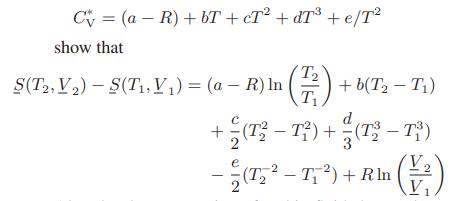
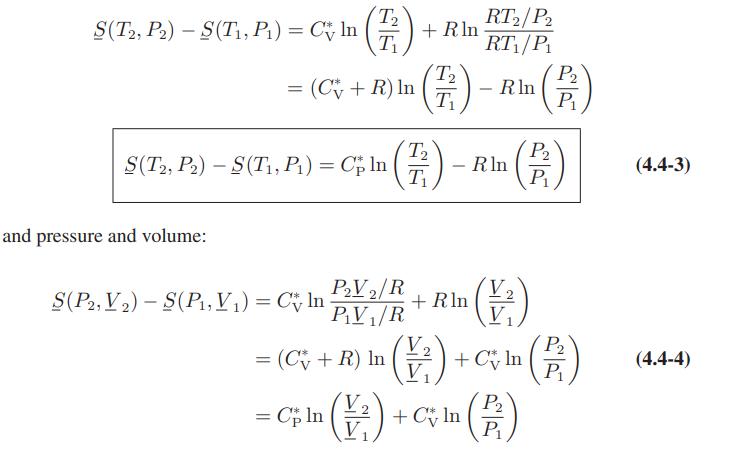
If the heat capacity of an ideal gas is given by Also develop expressions for this fluid that replace Eqs. 4.4-3 and 4.4-4. C = (a-R) +bT+cT²+dT³ + e/T² show that T₂ T₁ S(T2, V₂)-S(T₁, V₁) = (a - R) In + b(T₂ - T1) d +(T²-T²)+(13³-73) - (25²-7₁²) + Rlm (1²)
The Ocean Thermal Energy Conversion (OTEC) project in Hawaii produces electricity from the temperature difference between water near the surface of the ocean (about 27◦C) and the 600 m deep water at 5◦C that surrounds the island. Estimate the maximum net work (total work less the work of
A tank contains 20 percent liquid water and 80 percent steam by volume at 200◦C. Steam is withdrawn from the top of the tank until the fluid remaining in the tank is at a temperature of 150◦C. Assuming the tank is adiabatic and that only vapor is withdrawn, compute a. The pressure in the tank
a. Steam at 35 bar and 600 K enters a throttling valve that reduces the steam pressure to 7 bar. Assuming there is no heat loss from the valve, what is the exit temperature of the steam and its change in entropy? b. If air [assumed to be an ideal gas with C∗P = 29.3 J/(mol K)] entered the valve
Joe Unidel claims to have invented a steady-state flow device in which the inlet is steam at 300°C and 5 bar, he outlet is saturated steam at 100°C and 1 bar, the device is adiabatic and produces approximately 388 kJ per kilogram of steam passed through the device. Should we believe his claim?
Steam at 20 bar and 300◦C is to be continuously expanded to 1 bar. a. Compute the final temperature, the entropy generated, the heat required, and the work obtained per kilogram of steam if this expansion is done by passing the steam through an adiabatic expansion valve. Will the final state be
An isolated chamber with rigid walls is divided into two equal compartments, one containing steam at 10 bar and 370◦C, and the other evacuated. A valve between the compartments is opened to permit steam to pass from one chamber to the other.a. After the pressures (but not the temperatures) in the
In a large refrigeration plant it is necessary to compress a fluid, which we will assume to be an ideal gas with constant heat capacity, from a low pressure P1 to a much higher pressure P2.a. If the compression is done in a single compressor that operates reversibly and adiabatically, obtain an
An adiabatic turbine is operating with an ideal gas working fluid of fixed inlet temperature and pressure, T1 and P1, respectively, and a fixed exit pressure, P2. Show that a. The minimum outlet temperature, T2, occurs when the turbine operates reversibly, that is, when Sgen = 0. b. The maximum
A very simple solar engine absorbs heat through a collector. The collector loses some of the heat it absorbs by convection, and the remainder is passed through a heat engine to produce electricity. The heat engine operates with one-half the Carnot efficiency with its low temperature side at ambient
a. Consider the following statement: “Although the entropy of a given system may increase, decrease, or remain constant, the entropy of the universe cannot decrease.” Is this statement true? Why?b. Consider any two states, labeled 1 and 2. Show that if state 1 is accessible from state 2 by a
A portable engine of nineteenth-century design used a tank of compressed air and an “evacuated” tank as its power source. The first tank had a capacity of 0.3 m3 and was initially filled with air at 14 bar and a temperature of 700◦C. The “evacuated” tank had a capacity of 0.75 m3.
It is necessary to estimate how rapidly a piece of equipment can be evacuated. The equipment, which is 0.7 m3 in volume, initially contains carbon dioxide at 340 K and 1 bar pressure. The equipment will be evacuated by connecting it to a reciprocating constantdisplacement vacuum pump that will pump
a. Compute the maximum useful work that can be obtained when 1 kg of steam undergoes a closed system change of state from 30 bar and 600◦C to 5 bar and 300◦C when the atmospheric conditions are 1.013 bar and 298.15 K. b. Compute the maximum useful work that can be obtained when 1 kg of steam
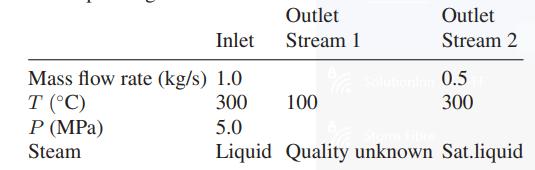
A device is being marketed to your company. The device takes in hot, high-pressure water and generates work by converting it to two outlet streams: steam and low-pressure water. You are asked to evaluate the device to see if your firm should buy it. All you are told is that 10 kW of work is
A 0.2-m3 tank containing helium at 15 bar and 22◦C will be used to supply 4.5 moles per minute of helium at atmospheric pressure using a controlled adiabatic throttling valve. a. If the tank is well insulated, what will be the pressure in the tank and the temperature of the gas stream leaving
An important factor in determining the extent of air pollution in urban areas is whether the atmosphere is stable (poor mixing, accumulation of pollutants) or unstable (good mixing and dispersion of pollutants). Whether the atmosphere is stable or unstable depends on how the temperature profile
Diesel engines differ from gasoline engines in that the fuel is not ignited by a spark plug. Instead, the air in the cylinder is first compressed to a higher pressure than in a gasoline engine, and the resulting high temperature results in the spontaneous ignition of the fuel when it is injected
A rigid, isolated container 300 L in volume is divided into two parts by a partition. One part is 100 L in volume and contains nitrogen at a pressure of 200 kPa and a temperature of 100◦C. The other part, 200 L in volume, contains nitrogen at a pressure of 2 MPa and a temperature of 200◦C. If
In normal operation, a paper mill generates excess steam at 20 bar and 400°C. It is planned to use this steam as the feed to a turbine to generate electricity for the mill. There are 5000 kg/hr of steam available, and it is planned that the exit pressure of the steam will be 2 bar. Assuming that
Atmospheric air is to be compressed and heated as shown in the figure before being fed into a chemical reactor. The ambient air is at 20◦C and 1 bar, and is first compressed to 5 bar and then heated at constant pressure to 400◦C. Assuming air can be treated as a single-component ideal gas with
Redo Problem 4.17 using Aspen Plus.Problem 4.17Hydrogen has an auto-ignition temperature of 853 K; that is, hydrogen will ignite spontaneously at that temperature if exposed to oxygen. Hydrogen is to be adiabatically and reversibly compressed from 1 bar and 300 K to a high pressure. To avoid
One kilogram of saturated liquid methane at 160 K is placed in an adiabatic pistion-and-cylinder device, and the piston will be moved slowly and reversibly until 25 percent of the liquid has vaporized. Compute the maximum work that can be obtained.
A sugar mill in Florida has been disposing of the bagasse (used sugar cane) by open-air burning. You, as a new chemical engineer, determine that by using the dried bagasse as boiler fuel in the mill, you can generate 5000 kg/hr of surplus steam at 20 bar and 600◦C. You propose to your supervisor
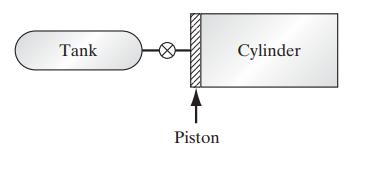
A well-insulated cylinder fitted with a frictionless piston initially contains nitrogen at 15°C and 0.1 MPa. The piston is placed such that the volume to the right of the piston is 0.5 m3, and there is negligible volume to the left of the piston and between the piston and the tank, which is also
Redo Problem 4.18 using Aspen Plus.Problem 4.18If it is necessary to compress hydrogen to a higher pressure than is possible with the single-compression step above, an alternative is to use two compressors (or a two-stage compressor) with intercooling. In such a process the hydrogen is compressed
If the piston in the previous problem is replaced by one that is a perfect conductor, so that after the valve is closed the temperatures of the gas on the two sides of the piston equalize (clearly, the piston will move in this process), a. What will the equalized pressure in the cylinder be, and
A tank of 0.1 m3 volume initially containing nitrogen at 25◦C and 1 bar will be filled with compressed nitrogen at a rate of 20 mol/s. The nitrogen coming from the compressor and into the tank is at an absolute pressure of 110 bar and a temperature of 80◦C. The filling process occurs
A stream of hot water at 85◦C and a rate of 1 kg/s is needed for the pasteurizing unit in a milk-bottling plant. Such a stream is not readily available, and will be produced in a well-insulated mixing tank by directly injecting steam from the boiler plant at 10 bar and 200◦C into city water
Low-density polyethylene is manufactured from ethylene at medium to high pressure in a radical chain polymerization process. The reaction is exothermic, and on occasion, because of cooling system failure or operator error, there are runaway reactions that raise the pressure and temperature in the
Two separate experiments are performed on a gas enclosed in a piston-and-cylinder device, both starting from the same initial state. The result of the first experiment is to be used to predict the outcome of the second. a. In the first experiment, the piston is free to move, with the external
Redo Problem 4.9 using Aspen Plus.Problem 4.9a. A steam turbine in a small electric power plant is designed to accept 4500 kg/hr of steam at 60 bar and 500◦C and exhaust the steam at 10 bar. Assuming that the turbine is adiabatic and has been well designed (so that Ṡgen = 0), compute the exit
Redo Problem 4.4 using Aspen Plus. Problem 4.4Steam at 700 bar and 600◦C is withdrawn from a steam line and adiabatically expanded to 10 bar at a rate of 2 kg/min. What is the temperature of the steam that was expanded, and what is the rate of entropy generation in this process?
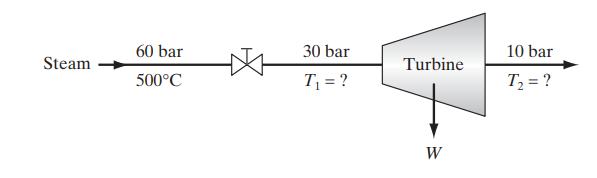
Redo Problem 4.11 using Aspen Plus.Problem 4.11Steam is produced at 70 bar and some unknown temperature. A small amount of steam is bled off just before entering a turbine and goes through an adiabatic throttling valve to atmospheric pressure. The temperature of the steam exiting the throttling
Redo Problem 4.20 using Aspen Plus.Problem 4.20Steam at 20 bar and 300◦C is to be continuously expanded to 1 bar. a. Compute the final temperature, the entropy generated, the heat required, and the work obtained per kilogram of steam if this expansion is done by passing the steam through an
Redo Problem 4.38 using Aspen Plus.Problem 4.38Atmospheric air is to be compressed and heated as shown in the figure before being fed into a chemical reactor. The ambient air is at 20◦C and 1 bar, and is first compressed to 5 bar and then heated at constant pressure to 400◦C. Assuming air can
Redo Problem 4.37 using Aspen Plus.Problem 4.37In normal operation, a paper mill generates excess steam at 20 bar and 400◦C. It is planned to use this steam as the feed to a turbine to generate electricity for the mill. There are 5000 kg/hr of steam available, and it is planned that the exit
Showing 200 - 300
of 619
1
2
3
4
5
6
7
Step by Step Answers

 Get 50% OFF
Claim Now
Get 50% OFF
Claim Now