New Semester
Started
Get
50% OFF
Study Help!
--h --m --s
Claim Now
Question Answers
Textbooks
Find textbooks, questions and answers
Oops, something went wrong!
Change your search query and then try again
S
Books
FREE
Study Help
Expert Questions
Accounting
General Management
Mathematics
Finance
Organizational Behaviour
Law
Physics
Operating System
Management Leadership
Sociology
Programming
Marketing
Database
Computer Network
Economics
Textbooks Solutions
Accounting
Managerial Accounting
Management Leadership
Cost Accounting
Statistics
Business Law
Corporate Finance
Finance
Economics
Auditing
Tutors
Online Tutors
Find a Tutor
Hire a Tutor
Become a Tutor
AI Tutor
AI Study Planner
NEW
Sell Books
Search
Search
Sign In
Register
study help
engineering
chemical biochemical and engineering
Chemical Biochemical And Engineering Thermodynamics 5th Edition Stanley I. Sandler - Solutions
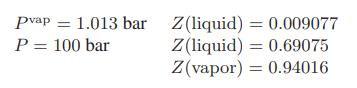
How much entropy is generated per mole of chlorodifluoromethane that passes through the pressurereducing valve of the previous problem?Data From Previous ProbemIn a continuous manufacturing process, chlorodifluoromethane (CHClF2), initially at 10 bar and 420 K, passes through an adiabatic
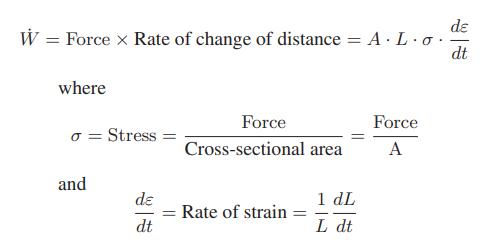
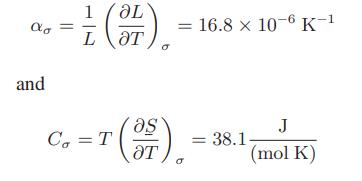
The thermoelastic effect is the temperature change that results from stretching an elastic material or fiber. The work done on the material is given by In the situation being considered here, the thermodynamic properties such as the heat capacity depend on the stress (just as for a gas the heat
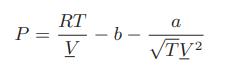
The following equation of state has been proposed for a fluid where B and C are constants. a. Does this fluid exhibit a critcal point? Prove it. b. If you believe the answer to part a. is yes, derive expressions for B and C in terms of the critical temperature and pressure for this fluid.
Nitrogen at 15 bar and 100 K is to be adiabatically flashed to 1 bar. Determine the exiting temperature of nitrogen and the fractions that are vapor and liquid using the Peng-Robinson equation of state.
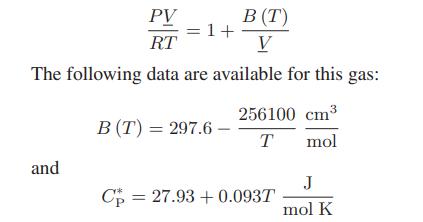
A residual thermodynamic property is defined as the difference between the property of the real fluid and that of an ideal gas at the same temperature and pressure, that isAssuming that a fluid can be described by the viral equation of state with only the second virial coefficient, develop the
A piston-and-cylinder device contains 10 kmols of n-pentane at −35.5°C and 100 bar. Slowly the piston is moved until the vapor pressure of n-pentane is reached, and then further moved until 5 kmols of the n-pentane is evaporated. This complete process takes place at the constant temperature of
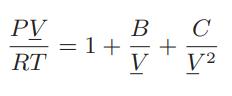
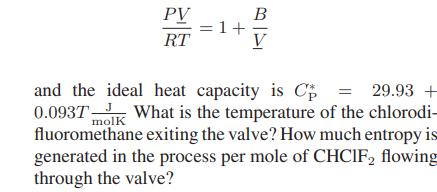
In a continuous manusfacturing process chlorodifluoromethane (CHClF2) initially at 10 bar and 420°C passes through and adiabatic pressure reducing valve so that its pressure is reduced to 0.1 bar (this last pressure is low enough that CHClF2 can be considered an ideal gas. At these operating
A gas is continuously passed through an adiabatic turbine at the rate of 2 mol/s. Its initial temperature is 600 K, its initial pressure is 5 bar and its exiting pressure is 1 bar. Determine the maximum rate at which work can be obtained in this process. The gas is described by an augmented
Use the Estimation tool in Aspen Plus to estimate the physical properties of methyl vinyl ketone (MKK) after entering structure using the Molecular Structure tool.
Methane at 1 atm and 25°C is to be compressed to 5 bar in an adiabatic, isentropic compressor. What is the temperature of the methane stream exiting the compressor? If the flowrate of methane is 60 kmol/hr, how much work needs to be supplied by the compressor?
Nitrogen at 1 atm and 25°C is to be compressed to 5 bar in an adiabatic, isentropic compressor. What is the temperature of the nitrogen stream exiting the compressor? If the flowrate of nitrogen is 100 kmol/hr, how much work needs to be supplied by the compressor?
By doing some simple calculations and plotting several graphs, one can verify some of the statements made in this chapter concerning phase equilibrium and phase transitions. All the calculations should be done using the steam tables. a. Establish, by direct calculation, thatfor steam at 2.5 MPa
a. Show that the condition for equilibrium in a closed system at constant entropy and volume is that the internal energy U achieve a minimum value subject to the constraints. b. Show that the condition for equilibrium in a closed system at constant entropy and pressure is that the enthalpy H
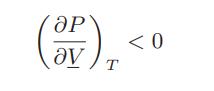
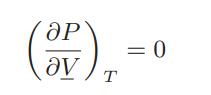
a. Show that the intrinsic stability analysis for fluid equilibrium at constant temperature and volume leads to the single condition that b. Show that intrinsic stability analysis for fluid equilibrium at constant temperature and pressure does not lead to any restrictions on the equation of state.
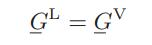
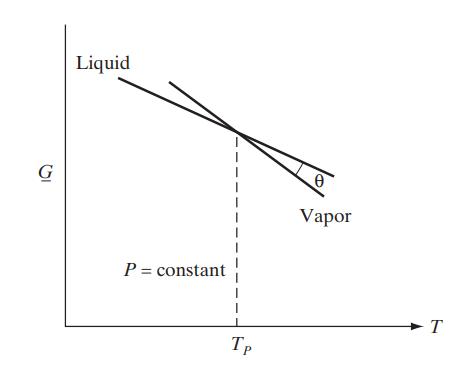
a. Show that the conditions for vapor-liquid equilibrium at constant N , T, and V are GV = GL and PV = PL.b. Show that the condition for vapor-liquid equilibrium at constant N , T, and P is GV = GL.
Prove that CP ≥ CV for any fluid, and identify those conditions for which CP = CV.
The triple point of iodine, I2, occurs at 112.9°C and 11.57 kPa. The heat of fusion at the triple point is 15.27 kJ/mol, and the following vapor pressure data are available for solid iodine:Estimate the normal boiling temperature of molecular iodine. Vapor pressure (kPa) Temperature
The following data are available for water: a. Compute the triple-point temperature and pressure of water. b. Compute the heat of vaporization, the heat of sublimation, and the heat of fusion of water at its triple point. In Psub (ice) In Pvap (water) = 28.89266140.1/T = 26.3026-5432.8/T P in
a. The following data have been reported for the vapor pressure of ethanol as a function of temperature.Use these data to calculate the heat of vaporization of ethanol at 17.33°C.b. Ackermann and Rauh have measured the vapor pressure of liquid plutonium using a clever mass effusion technique. Some
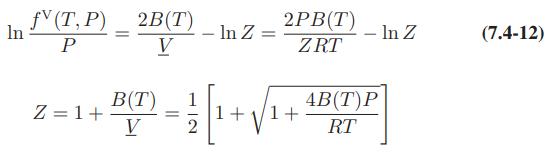
a. Derive Eq. 7.4-8.b. Derive Eq. 7.4-12.c. Obtain an expression for the fugacity of a pure species that obeys the van der Waals equation of state in terms of Z, B = P b/RT, and A = aP/(RT)2 (i.e., derive Eq. 7.4-13).Waals equation.d. Repeat the derivation with the Peng-Robinson equation of state
a. Calculate the fugacity of liquid hydrogen sulfide in contact with its saturated vapor at 25.5°C and 20 bar.The vapor pressure of pure water at 310.6 K is 6.455 kPa. Compute the fugacity of pure liquid water at 310.6 K when it is under a pressure of 100 bar, 500 bar, and 1000 bar.
a. Show that at moderately low pressures and densities the virial equation of state can be written as b. Prove that the fugacity coefficient for this form of the virial equation of state is c. The first two virial coefficients for methyl fluoride at 50°C are B = −0.1663 m3 /kmol and C = 0.012
a. Using only the steam tables, compute the fugacity of steam at 400°C and 2 MPa, and at 400°C and 50 MPa.b. Compute the fugacity of steam at 400°C and 2 MPa using the principle of corresponding states. Repeat the calculation at 400°C and 50 MPa. c. Repeat the calculations using the
The following data are available for carbon tetrachloride:a. Compute the heat of vaporization of carbon tetrachloride at 200°C using only these data. b. Derive the following expression, which can be used to compute the heat of vaporization from the principle of corresponding states:c. Compute the
An article in Chemical and Engineering News (Sept. 28, 1987) describes a hydrothermal autoclave. This device is of constant volume, is evacuated, and then water is added so that a fraction x of the total volume is filled with liquid water and the remainder is filled with water vapor. The autoclave
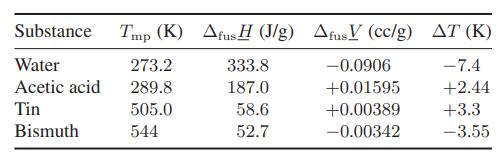
The effect of pressure on the melting temperature of solids depends on the heat of fusion and the volume change on melting. The heat of fusion is always positive (that is, heat must be added to melt the solid), while the volume change on melting will be positive if the solid is a close-packed
a. Quantitatively explain why ice skates slide along the surface of ice. Can it get too cold to ice skate? b. Is it possible to ice skate on other materials, such as frozen carbon dioxide? c. What is the approximate lowest temperature at which a good snowball can be made? Why can’t a snowball
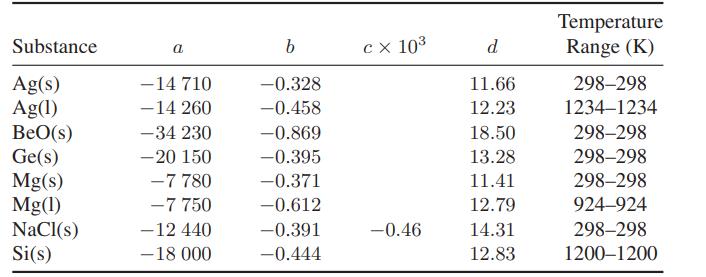
The vapor pressure of some materials can be represented by the equationValues of the constants in this equation are given below. Compute the heats of sublimation of the solids and the heats of vaporization of the liquids above over the temperature range specified. In P (mm Hg): = a T + bln T+ cT +
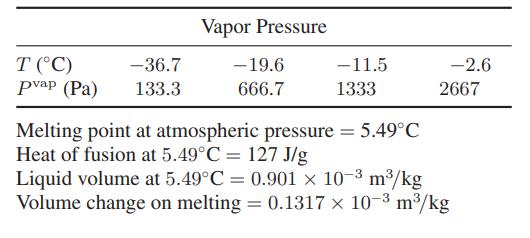
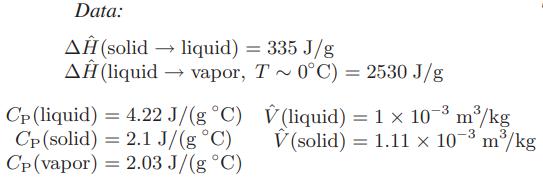
Estimate the triple-point temperature and pressure of benzene. The following data are available: T (°C) pvap (Pa) -36.7 133.3 Vapor Pressure - 19.6 666.7 -11.5 1333 Melting point at atmospheric pressure = 5.49°C Heat of fusion at 5.49°C = 127 J/g -2.6 2667 Liquid volume at 5.49°C = 0.901 x
A thermally insulated (adiabatic) constant-volume bomb has been very carefully prepared so that half its volume is filled with water vapor and half with subcooled liquid water, both at −10°C and 0.2876 kPa (the saturation pressure of the subcooled liquid). Find the temperature, pressure, and
The metal tin undergoes a transition from a gray phase to a white phase at 286 K and ambient pressure. Given that the enthalpy change of this transition is 2090 J/mol and that the volume change of this transition is −4.35 cm3 /mol, compute the temperature at which this transition occurs at 100
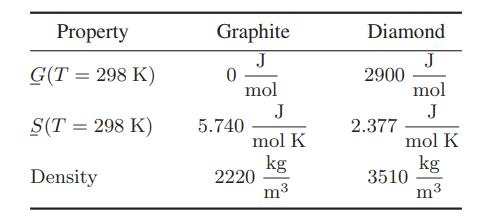
The following data are available for the thermodynamic properties of graphite and diamond: Assuming that the entropies and densities are approximately independent of temperature and pressure, determine the range of conditions for which diamonds can be produced from graphite. (The procedure
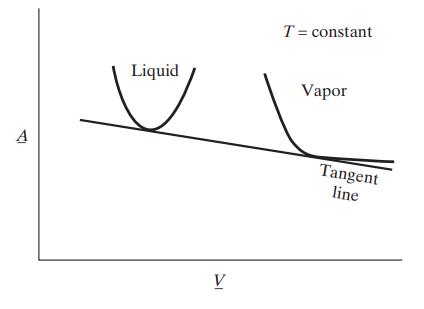
Many thermodynamic and statistical mechanical theories of fluids lead to predictions of the Helmholtz energy A with T and V as the independent variables; that is, the result of the theory is an expression of the form A = A(T,V ). The following figure is a plot of A for one molecular species as a
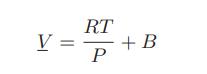
The principle of corresponding states has far greater applicability in thermodynamics than was indicated in the discussion of Sec. 6.6. For example, it is possible to construct corresponding-states relations for both the vapor and liquid densities along the coexistence curve, and for the vapor
One question that arises in phase equilibrium calculations and experiments is how many phases can be in equilibrium simultaneously, since this determines how many phases one should search for. Consider a one-component system. a. If only solid phases in different crystal forms are present, what is
The following vapor-liquid equilibrium data are available for methyl ethyl ketone: Heat of vaporization at 75°C: 31 602 J/mol Molar volume of saturated liquid at 75°C: 9.65×10⁻² m3 /kmolwhere P is the vapor pressure in bar and T is in K. Assuming the saturated vapor obeys the volume
a. Show that it is not possible for a pure fluid to have a quartenary point where the vapor, liquid, and two solid phases are all in equilibrium. b. Show that the specification of the overall molar volume of a one-component, two-phase mixture is not sufficient to identify the thermodynamic state
A well-insulated gas cylinder, containing ethylene at 85 bar and 25°C, is exhausted until the pressure drops to 10 bar. This process occurs fast enough that no heat transfer occurs between the gas and the cylinder walls, but not so rapidly as to produce large velocity or temperature gradients
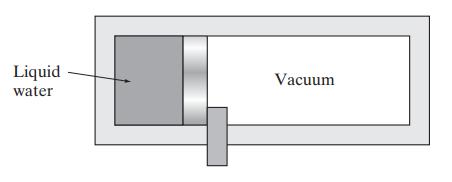
Ten grams of liquid water at 95°C are contained in the insulated container shown. The pin holding the frictionless piston in place breaks, and the volume available to the water increases to 1 × 10⁻³ m3. During the expansion some of the water evaporates, but no heat is transferred to the
The freezing point of n-hexadecane is approximately 18.5°C, where its vapor pressure is very low. By how much would the freezing point of n-hexadecane be depressed if n-hexadecane were under a 200-bar pressure? For simplicity in this calculation you may assume that the change in heat capacity on
At a subcritical temperature, the branch of the PengRobinson equation of state for V > b exhibits a van der Waals loop. However, there is also interesting behavior of the equation in the ranges V < b and V < 0, though these regions do not have any physical meaning. At supercritical temperatures the
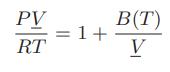
Consider the truncated virial equation of state where B(T) is the second virial coefficient. Obtain the constraint on B(T) if the fluid is to be thermodynamically stable. PV RT = 1+ B(T) V
The van’t Hoff corollary to the third law of thermodynamics is that whenever two solid forms of a substance are known, the one with the greater specific heat will be the more stable one at higher temperatures. Explain why this is so.
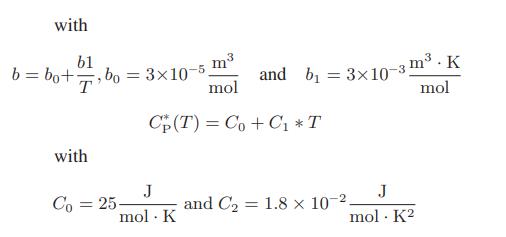
A fluid obeys the Clausius equation of state where b(T) = b0 + b1T. The fluid undergoes a Joule Thomson expansion from T1 = 120.0°C and P1 = 5.0 MPa to a final pressure P2 = 1.0 MPa. Given that CP = 20.97J/(mol K), b0 = 4.28 × 10⁻⁵ m3/mol, and b1 = 1.35 × 10⁻⁷ m3/(mol K), determine the
Show that the requirement for stability of a closed system at constant entropy and pressure leads to the condition that CP > 0 for all stable fluids.
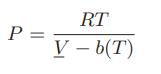
Does a fluid obeying the Clausius equation of state have a vapor-liquid transition?
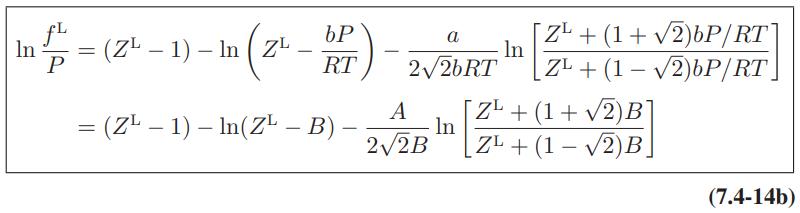
Derive the expression for the fugacity coefficient of a species described by the Soave–Redlich-Kwong equation of state (the analogue of Eq. 7.4-14b). In fL P = (Z¹ - 1) - ln (ZL - bP RT = (Z¹ − 1) - ln(Z¹ – B) - - - a 2√26RT A 2√2B In In [ZL+(1+√2)bP/RT ZL + (1 -√2)bP/RT ZL
Can a fluid obeying the virial equation of state have a vapor-liquid transition?
Using the Redlich-Kwong equation of state, compute and plot (on separate graphs) the pressure and fugacity of nitrogen as a function of specific volume at the two temperatures a. 110 K b. 150 K
The vapor pressure of liquid ethanol at 126°C is 505 kPa, and its second virial coefficient at this temperature is −523 cm3/mol. a. Calculate the fugacity of ethanol at saturation at 126°C assuming ethanol is an ideal gas. b. Calculate the fugacity of ethanol at saturation at 126°C assuming
Redo Illustration 7.4-6 using the Soave–RedlichKwong equation of state.Illustration 7.4-6Calculation of the Fugacity of a Liquid Using the Peng-Robinson Equation of State Compute the fugacity of pure liquid n-pentane and pure liquid benzene at 373.15 K and 50 bar using the Peng-Robinson equation
Adapt the program PR1, or one of the other PengRobinson programs, or develop a program of your own to use the Soave–Redlich-Kwong equation of state rather than the Peng-Robinson equation to calculate the thermodynamic properties of a fluid.
Adapt the program PR1, or one of the other PengRobinson programs, or develop a program of your own using the Peng-Robinson equation of state to do the calculations for a Joule-Thomson expansion of a liquid under pressure to produce a vapor-liquid mixture at ambient pressure. The output results
Adapt the program PR1, or one of the other PengRobinson programs, or develop a program of your own using the Peng-Robinson equation of state to do the calculations for an isentropic expansion of a liquid under pressure to produce a vapor-liquid mixture at ambient pressure. The output results should
Redo Problem 7.54 with the Soave–Redlich-Kwong equation of state.Problem 7.54Adapt the program PR1, or one of the other PengRobinson programs, or develop a program of your own using the Peng-Robinson equation of state to do the calculations for a Joule-Thomson expansion of a liquid under pressure
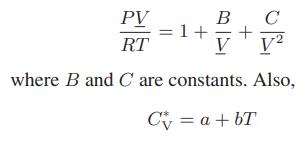
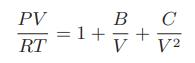
A fluid obeys the equation of state a. For what values of the constants B and C will this fluid undergo a vapor-liquid phase transition? b. What is the molar internal energy change if this fluid is heated at a constant pressure P from T1 to T2, and how does this compare with the molar internal
Redo Problem 7.55 with the Soave–Redlich-Kwong equation of state.Problem 7.55Adapt the program PR1, or one of the other PengRobinson programs, or develop a program of your own using the Peng-Robinson equation of state to do the calculations for an isentropic expansion of a liquid under pressure
It has been suggested that a simple cubic equation of state can also be used to describe a solid. However, since in a solid certain molecular contacts are preferred, compared with a fluid (vapor or liquid) in which molecules interact in random orientations, it has also been suggested that different
Proteins can exist in one of two states, the active, folded state and the inactive, unfolded state. Protein folding is sometimes thought of as a first-order phase transition from folded to unfolded (denaturation) with increasing temperature. (We will revisit this description in Chapter 15.)
Calculate the vapor pressure of n-butane as a function of temperature using the Peng-Robinson equation of state. Compare your results with (a) Literature values (b) Predictions using the Peng-Robinson equation of state in which the temperature-dependent parameter α (T) is set equal to unity at
Calculate the vapor pressure of methane as a function of temperature using the Peng-Robinson equation of state. Compare your results with (a) Literature values (b) Predictions using the Peng-Robinson equation of state in which the temperature-dependent parameter α (T) is set equal to unity at
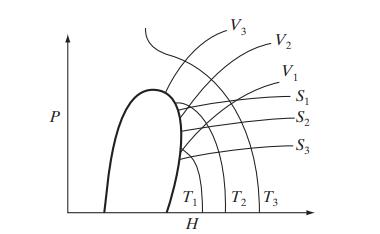
The figure below shows a pressure-enthalpy diagram submitted by Joe Udel as part of a homework assignment. On the diagram isotherms (T1 2 3), isochores (V1 V2 V3), and isentropes (S1 S2 S3) are shown. Is this figure consistent with requirements for a stable equilibrium system?
Calculate the vapor pressure of n-decane as a function of temperature using the Peng-Robinson equation of state. Compare your results with (a) Literature values (b) Predictions using the Peng-Robinson equation of state in which the temperature-dependent parameter α (T) is set equal to unity at
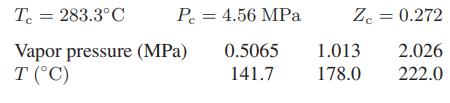
The critical temperature of benzene is 289°C and its critical pressure is 4.89 MPa. At 220°C its vapor pressure is 1.91 MPa.a. Calculate the fugacity of liquid benzene in equilibrium with its pure vapor at 220°C. b. Repeat the calculation for the case in which liquid benzene is under an
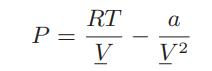
A relatively simple cubic equation of state is where a is a constant. a. Determine the relationship between the a and b parameters in this equation of state and the critical temperature and pressure of the fluid. b. Obtain an expression for the constant-volume heat capacity as a function of
The following equation of state has been proposed for a fluid where B and C are constants. a. Does this fluid exhibit a critical point? Prove it. b. If you believe the answer to part (a) is yes, derive expressions for B and C in terms of the critical temperature and pressure for this fluid.
Determine the boiling temperature of a water droplet at 1.013 bar as a function of the droplet radius.
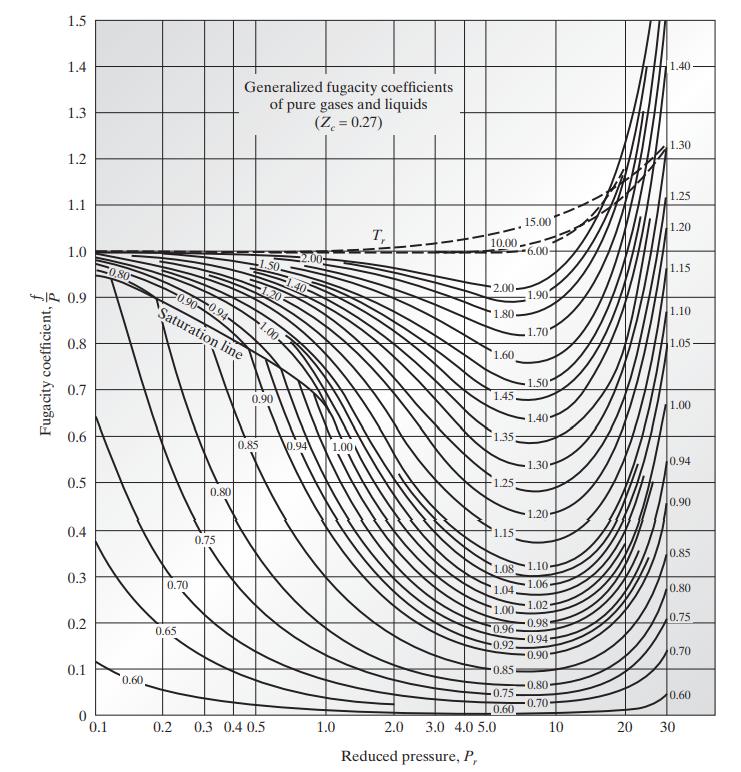
Explain the nonmonotonic behavior of the fugacity coefficent along the T = 1.50 isotherm in Fig. 7.4-1 using the van der Waals equation of state.Fig. 7.4-1 Fugacity coefficient, 1.5 1.4 1.3 1.2 1.1 1.0 0.9 0.8 0.7 0.6 0.5 0.4 0.3 0.2 0.1 0 0.1 0,80 0.60 0.90 0.94 Saturation
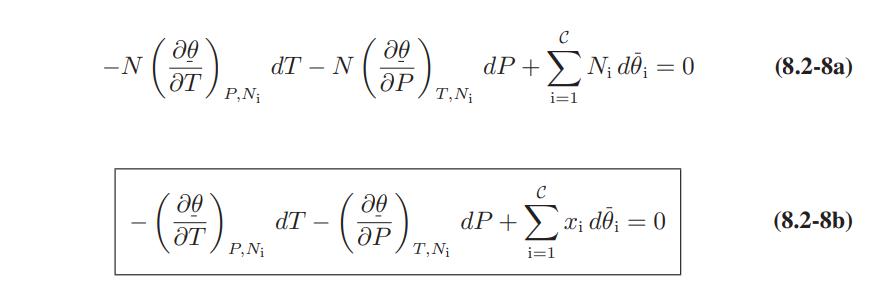
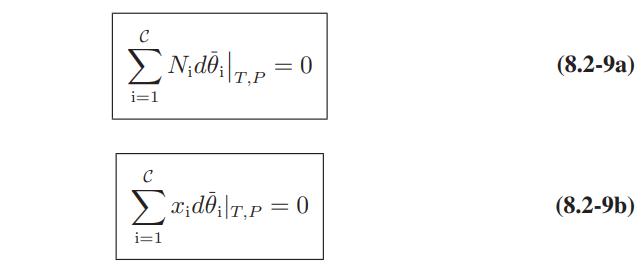
Derive the analogues of the Gibbs-Duhem equations (Eqs. 8.2-8 and 8.2-9) for the constraints ofa.Constant temperature and volume b. Constant internal energy and volume c. Constant entropy and volume -N от P,Ni C v (OP) ₁ dP+ ► N; d0; = 0 T,Ni i=1 dT - N N 20 ( ) ат -
Estimate the vapor pressures of the refrigerants 1,1,1,2-tetrafluoroethane, dichlorodifluoromethane and 2-chloro-1,1,1,2-tetrafluoroethane over the temperature range of −40 to +85°C.
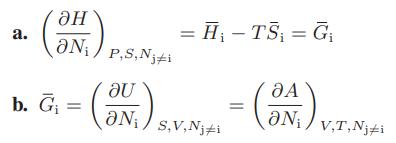
Prove that a. (о), b. G; P,S,Nji - ( ). H - TS = G = (), aU ƏN₁ S,V,Nji V,T,Nji
In Sec. 8.7 we established that the condition for equilibrium between two phases is for closed systems either at constant temperature and pressure or at constant internal energy and volume. Show that this equilibrium condition must also be satisfied for closed systems at a. Constant temperature
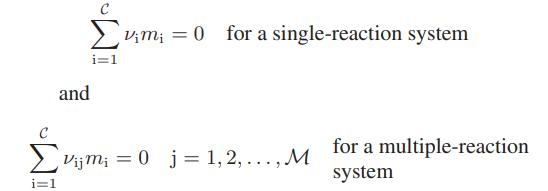
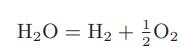
Prove that since total mass is conserved during a chemical reaction, where mi is equal to the molecular weight of species i. Also show, by direct substitution, that the first of these equations is satisfied for the reaction and i=1 v₁m₁ = 0 for a single-reaction system Σvim; = i=1 Vijm; = 0 j
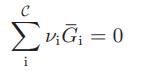
Show that the criterion for chemical equilibrium developed in the text, for a closed system at constant temperature and pressure, is also the equilibrium condition to be satisfied for closed systems subject to the following constraints: a. Constant temperature and volume b. Constant internal
Show that the partial molar volumes computed from Eqs. 8.6-4a and b and the partial molar enthalpies computed from Eqs. 8.6-9a and b must satisfy the Gibbs-Duhem equation. Amix V-1 a(Amix V) дх1 T,P =(√₂-V₂) (8.6-4a)
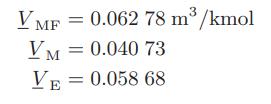
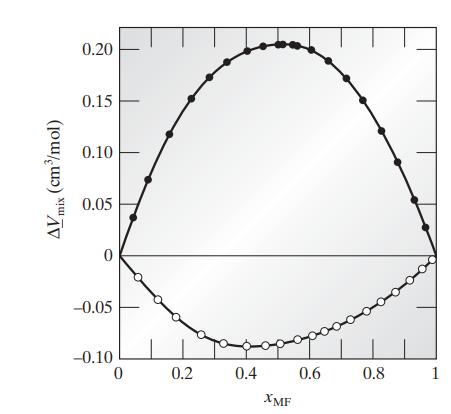
Compute the partial molar volumes of methyl formate in methanol–methyl formate and ethanol–methyl formate mixtures at 298.15 K for various compositions using the experimental data in Fig. 8.1-2a and the following pure-component data:Fig. 8.1-2a VMF = 0.062 78 m³/kmol VM 0.040 73 VE = Ε 0.058
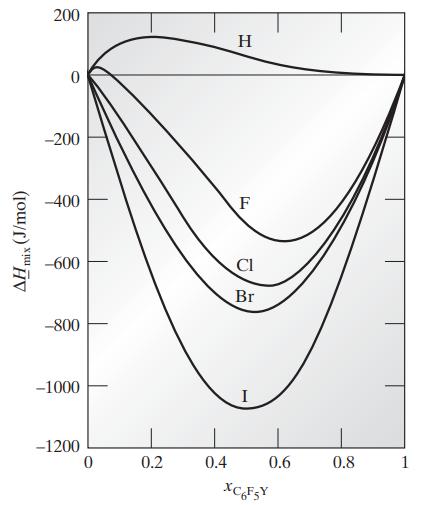
Compute the difference between the pure-component and partial molar enthalpies for both components at 298.15 K and various compositions in each of the following mixtures using the data in Fig. 8.1-2b.a. Benzene–C6F5H b. Benzene–C6F6 c. Benzene–C6F5Cl d. Benzene–C6F5Br e.
a. In vapor-liquid equilibrium in a binary mixture, both components are generally present in both phases. How many degrees of freedom are there for such a system? b. The reaction between nitrogen and hydrogen to form ammonia occurs in the gas phase. How many degrees of freedom are there for this
a. In vapor-liquid equilibrium, mixtures sometimes occur in which the compositions of the coexisting vapor and liquid phases are the same. Such mixtures are called azeotropes. Show that a binary azeotropic mixture has only one degree of freedom. b. In osmotic equilibrium, two mixtures at different
a. What is the maximum number of phases that can coexist for a mixture of two nonreacting components? b. How would the answer in part (a) change if the two components could react to form a third component?
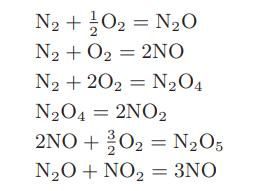
The following set of reactions is thought to occur between nitrogen and oxygen at high temperatures a. Find an independent set of reactions for the nitrogen-oxygen system. b. How many degrees of freedom are there for this system? c. If the starting oxygen-to-nitrogen ratio is fixed (as in air),
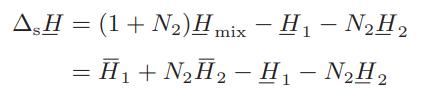
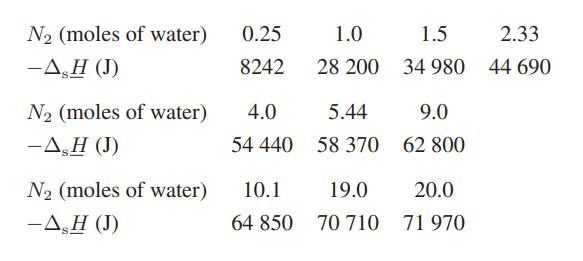
The molar integral heat of solution ΔsH is defined as the change in enthalpy that results when 1 mole of solute (component 1) is isothermally mixed with N2 moles of solvent (component 2) and is given byΔsH is easily measured in an isothermal calorimeter by monitoring the heat evolved or absorbed
Consider a reaction that occurs in a vessel containing a semipermeable membrane that allows only one of the components to pass through it (for example, a small molecule such as hydrogen) but will not allow the passage of large molecules. With such a membrane, the chemical potential of the permeable
The temperature achieved when two fluid streams of differing temperature and/or composition are adiabatically mixed is termed the adiabatic mixing temperature. Compute the adiabatic mixing temperature for the following two cases: a. Equal weights of aqueous solutions containing 10 wt % sulfuric
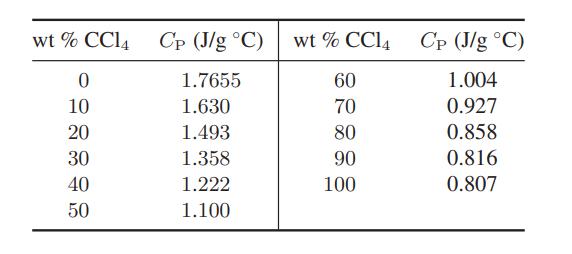
The following data have been reported for the constant-pressure heat capacity of a benzene–carbon tetrachloride mixture at 20°C.On a single graph plot the constant-pressure partial molar heat capacity for both benzene and carbon tetrachloride as a function of composition. wt% CC14 Cp (J/g
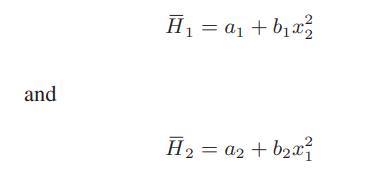
The partial molar enthalpies of species in simple binary mixtures can sometimes be approximated by the following expressions:a. For these expressions show that b1 must equal b2. b. Making use of the fact thatfor any thermodynamic property θ, show that and H₁ = a₁ + b₁x² H₂ = a₂ +
A 20 wt % solution of sulfuric acid in water is to be enriched to a 60 wt % sulfuric acid solution by adding pure sulfuric acid. a. How much pure sulfuric acid should be added?b. If the 20 wt % solution is available at 5°C, and the pure sulfuric acid at 50°C, how much heat will have to be
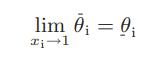
A partial molar property of a component in a mixture may be either greater than or less than the corresponding pure-component molar property. Furthermore, the partial molar property may vary with composition in a complicated way. Show this to be the case by computing (a) the partial molar volumes
Develop a procedure for determining the partial molar properties for each constituent in a three-component (ternary) mixture. In particular, what data would you want, and what would you do with the data? Based on your analysis, do you suppose there is much partial molar property data available for
The volume of a binary mixture has been reported in the following polynomial form: a. What values should be used for b1 and b2?b. Derive, from the equation here, expressions for V̅1,c. Derive, from the equation here, expressions for the partial molar excess volumes of each species at infinite
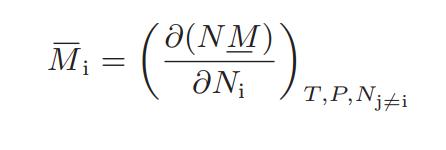
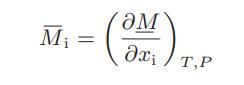
The definition of a partial molar property is It is tempting, but incorrect, to assume that this equation can be written as Prove that the correct result is M₁ = = - (º Ə(NM) ƏN₁ T,P, Nji
Prove the validity of Eqs. 8.7-4. S = maximum for equilibrium at constant M, U, and V A = minimum for equilibrium at constant M, T, and V G = minimum for equilibrium at constant M, T, and P (8.7-4)
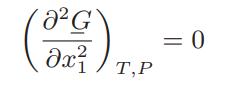
In some cases if pure liquid A and pure liquid B are mixed at constant temperature and pressure, two liquid phases are formed at equilibrium, one rich in species A and the other in species B. We have proved that the equilibrium state at constant T and P is a state of minimum Gibbs energy, and the
Mattingley and Fenby [J. Chem. Thermodyn. 7, 307 (1975)] have reported that the enthalpies of triethylamine-benzene solutions at 298.15 K are given bywhere xB is the mole fraction of benzene and Hmix, HB, and HEA are the molar enthalpies of the mixture, pure benzene, and pure triethylamine,
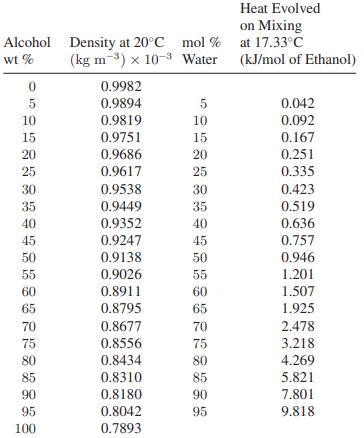
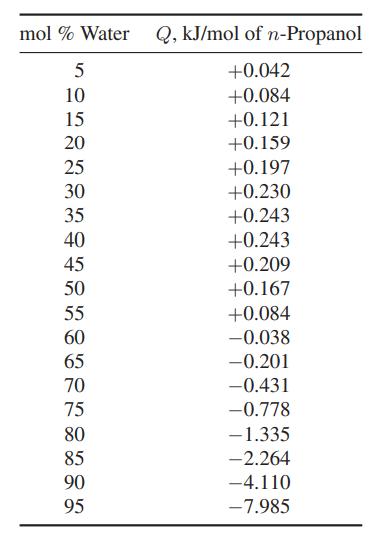
When water and n-propanol are isothermally mixed, heat may be either absorbed (Q > 0) or evolved (Q Plot (H̅W − HW) and (HNP − H̅NP) over the whole composition range. mol % Water Q, kJ/mol of
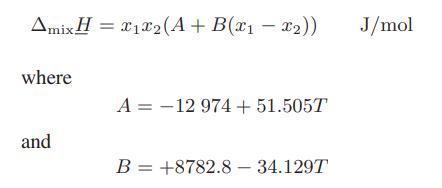
The heat-of-mixing data of Featherstone and Dickinson [J. Chem. Thermodyn., 9, 75 (1977)] for the n-octanol + n-decane liquid mixture at atmospheric pressure is approximately fit bywith T in K and x1 being the n-octanol mole fraction. a. Compute the difference between the partial molar and
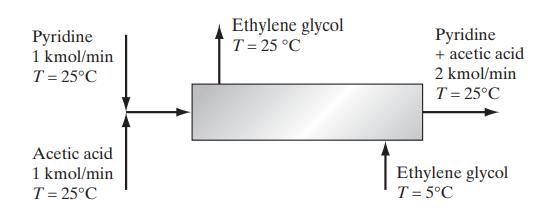
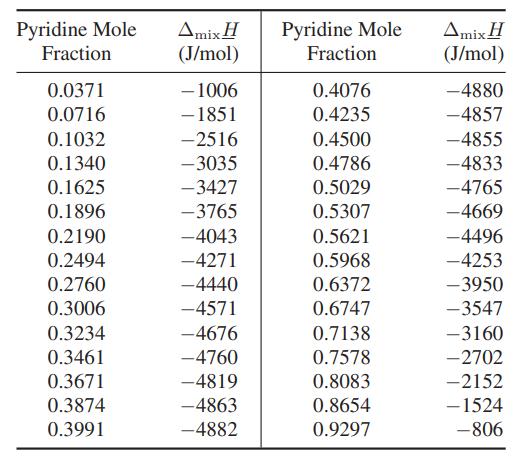
Two streams containing pyridine and acetic acid at 25°C are mixed and fed into a heat exchanger. Due to the heat-of-mixing effect, it is desired to reduce the temperature after mixing to 25°C using a stream of chilled ethylene glycol as indicated in the diagram. Calculate the mass flow rate of
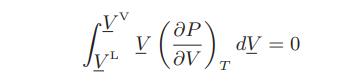
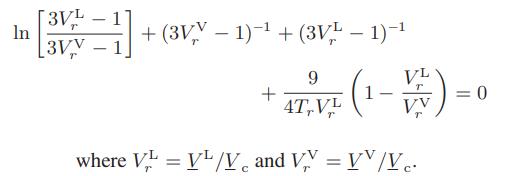
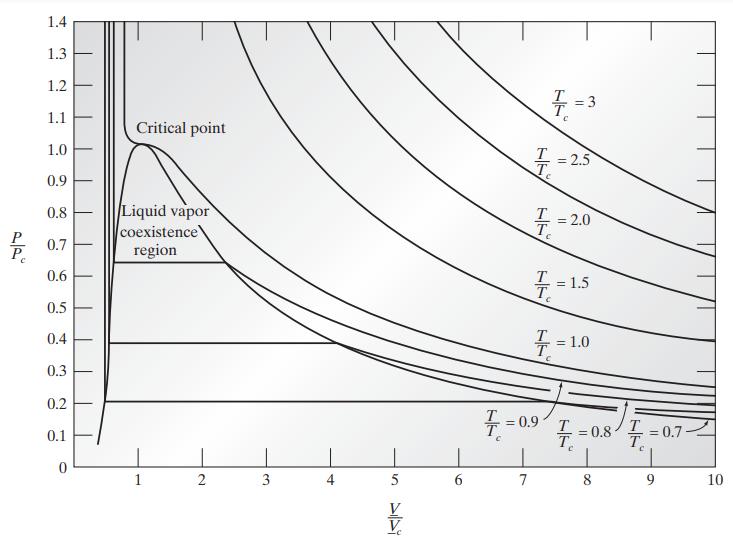
Figure 7.3-4 is the phase diagram for a van der Waals fluid. Within the vapor-liquid coexistence envelope one can draw another envelope representing the limits of supercooling of the vapor and superheating of the liquid that can be observed in the laboratory; along each isotherm these are the
Derive the following two independent equations for a second-order phase transition: These equations, which are analogues of the Clapeyron equation, are sometimes referred to as the Ehrenfest equations. Also, show that these two equations can be derived by applying L’Hopital’s rule to the
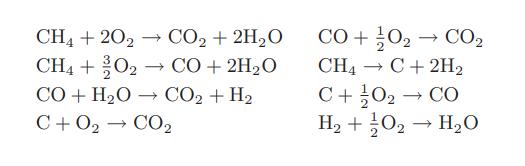
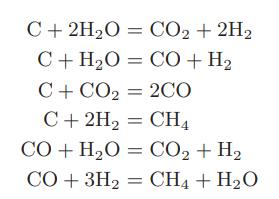
For the study of the oxidation of methane, an engineer devises the following set of possible reactions: How many independent chemical reactions are there in this system? CH4 + 202 CO₂ + 2H₂O CH4 + 02 - → CO + 2H₂O CO+H2O → CO2+H2 C+02 → CO2 CO + 0₂ → CO₂2 CH₁ C+
Showing 400 - 500
of 619
1
2
3
4
5
6
7
Step by Step Answers

 Get 50% OFF
Claim Now
Get 50% OFF
Claim Now








![[P+ 2] . an V CO a = 3.640 L atm / mol V-nb = nRT](https://dsd5zvtm8ll6.cloudfront.net/images/question_images/1700/0/3/0/153655466c90204b1700030022871.jpg)


![H - HIG H HIG [(7) -("7").] Te Te AvapH = Tc sat vap sat liq](https://dsd5zvtm8ll6.cloudfront.net/images/question_images/1700/0/3/1/35465546b7a0c9411700031350139.jpg)










![Hmix - [BHB + (1 - XB)HEA] = XB(1 - XB) {1418 - 482.4(1 - 2X) +187.4(1 - 2xB)}](https://dsd5zvtm8ll6.cloudfront.net/images/question_images/1700/1/1/2/6166555a8e8086fe1700112613280.jpg)
![and T T along phase transition curve along phase transition curve - I T r[(@); - ()"] - P I [(x), P I](https://dsd5zvtm8ll6.cloudfront.net/images/question_images/1700/0/2/8/49765546051b60651700028491537.jpg)