New Semester
Started
Get
50% OFF
Study Help!
--h --m --s
Claim Now
Question Answers
Textbooks
Find textbooks, questions and answers
Oops, something went wrong!
Change your search query and then try again
S
Books
FREE
Study Help
Expert Questions
Accounting
General Management
Mathematics
Finance
Organizational Behaviour
Law
Physics
Operating System
Management Leadership
Sociology
Programming
Marketing
Database
Computer Network
Economics
Textbooks Solutions
Accounting
Managerial Accounting
Management Leadership
Cost Accounting
Statistics
Business Law
Corporate Finance
Finance
Economics
Auditing
Tutors
Online Tutors
Find a Tutor
Hire a Tutor
Become a Tutor
AI Tutor
AI Study Planner
NEW
Sell Books
Search
Search
Sign In
Register
study help
engineering
chemical biochemical and engineering
Chemical Biochemical And Engineering Thermodynamics 5th Edition Stanley I. Sandler - Solutions
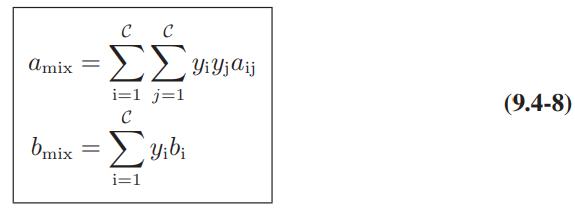
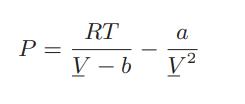
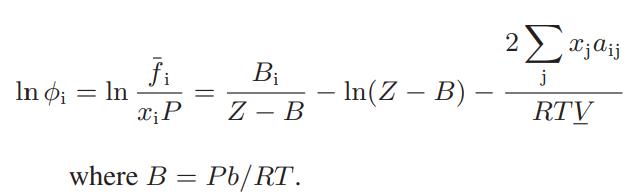
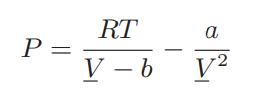
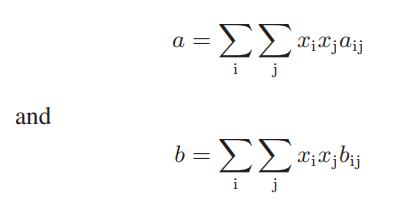
Derive the expression for the fugacity coefficient of the Soave–Redlich-Kwong equation of state (Eq. 4.4-1b) with the van der Waals one-fluid mixing and combining rules of Eqs. 9.4-8 and 9.4-9. amix = C C ΣΣyyaij i=1 j=1 C bmix = Σyibi - i=1 (9.4-8)
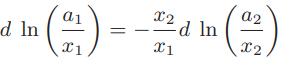
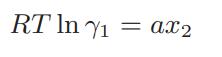
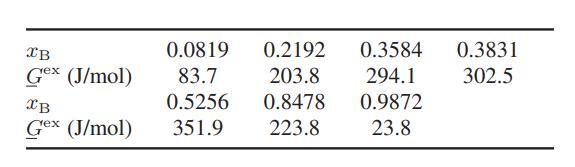
a. Given experimental data either for the excess Gibbs energy, Gex, or for species activity coefficients from which Gex can be computed, it is sometimes difficult to decide whether to fit the data to the two constant Margules or van Laar expressions for Gex and γi. One method of making this
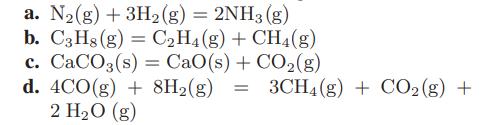
Calculate the standard heats and Gibbs energies of reaction at 25°C for the following reactions: a. N₂(g) + 3H₂(g) = 2NH3 (g) b. C3H8 (g) = C₂H4 (g) + CH4(g) c. CaCO3(s) = CaO(s) + CO₂(g) d. 4CO(g) + 8H2(g) = 3CH4(g) + CO₂(g) + 2 H₂O (g)
Calculate the minimum work required to separate air (79 mole % nitrogen) into pure oxygen and nitrogen assuming an isothermal, steady flow process at 300 K. The inlet air pressure is 10 bar and each stream is to exit at 10 bar and 300 K.
“Duhem’s theorem” states that for any number of components, phases, and chemical reactions in a closed system, if the initial amounts of all the species are specified, the further specification of two independent state variables completely fixes the state of the system. Prove that this
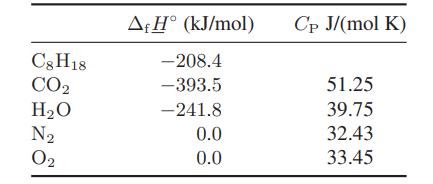
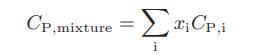
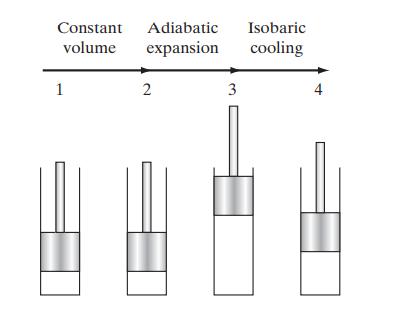
We want to make a simplified estimate of the maximum amount of work that can be obtained from gasoline, which we will assume to be adequately represented by n-octane (C8H18). The processes that occur in the cylinder of an automobile engine are that first the gasoline reacts to form a
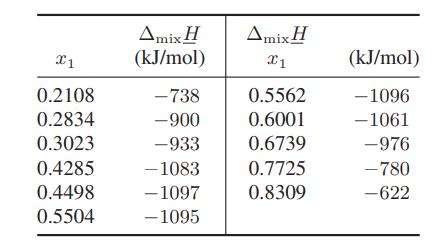
Following are the slightly smoothed heat-of-mixing data of R. P. Rastogi, J. Nath, and J. Misra [J. Chem. Thermodyn., 3, 307 (1971)] for the system trichloromethane (component 1) and 1,2,4-trimethyl benzene at 35°C.a. From the information in this table, calculate the quantity (ΔmixH)/(x1x2) at
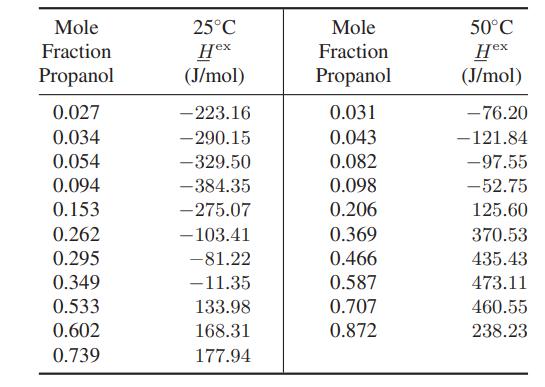
Using the data below, calculate the partial molar enthalpies of 1-propanol and water as a function of composition at both 25°C and 50°C.data: V. P. Belousov, Vent. Leningrad Univ. Fiz., Khim, 16(1), 144 (1961).
An equimolar mixture of nitrogen and acetylene enters a steady-flow reactor at 25°C and 1 bar of pressure. The only reaction occurring isThe product leaves the reactor at 600°C and contains 24.2 percent mole fraction of HCN. How much heat is supplied to the reactor per mole of HCN? N₂(g) +
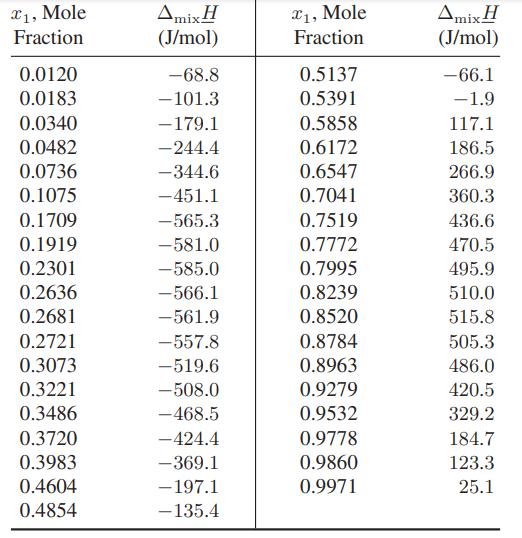
The following data are available for the isothermal heat of mixing of trichloromethane (1) and ethanol (2) at 30°C [reference: J. P. Shatas, M. M. Abbott, and H. C. Van Ness, J. Chem. Eng. Data, 20, 406 (1975)].Compute the partial molar enthalpies of trichloromethane and ethanol in their mixtures
To obtain uranium 235 (U235) for use in nuclear power plants, uranium containing ore containing U238 and U235 is crushed, subjected to a solvent extraction process, and then reacted with fluorine to produce uranium hexafluoride, which is a gas at ambient conditions the U235 is then separated from
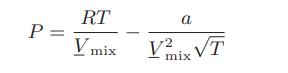
The following is a modified van der Waals equation with an improved temperature dependence The usual van der Waals one-fluid mixing rules are used with this equation of state. Develop an expression for the mixture constant volume heat capacity of a mixure at elevated pressures in terms of the
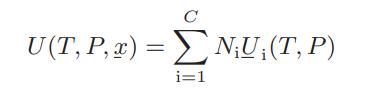
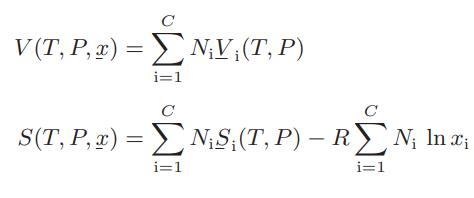
We have the following properties for a certain mixture for mixing at constant temperature and pressure: where Si, the pure-component molar entropy of component i, is given by Here S°i , U°i , and V°i are the molar entropy, internal energy, and volume of pure component i in some reference
The volume change on mixing in cm3/mol for ethanol(1) + methyl butyl ether(2) mixtures at 25°C is given by the following equationGiven that V1 = 58.63 cm3/mol and V2 = 118.46 cm3/mol, calculate the following when 750 cm3 of pure ethanol is mixed with 1500 cm3 of methyl butyl ether at 25°C: a.
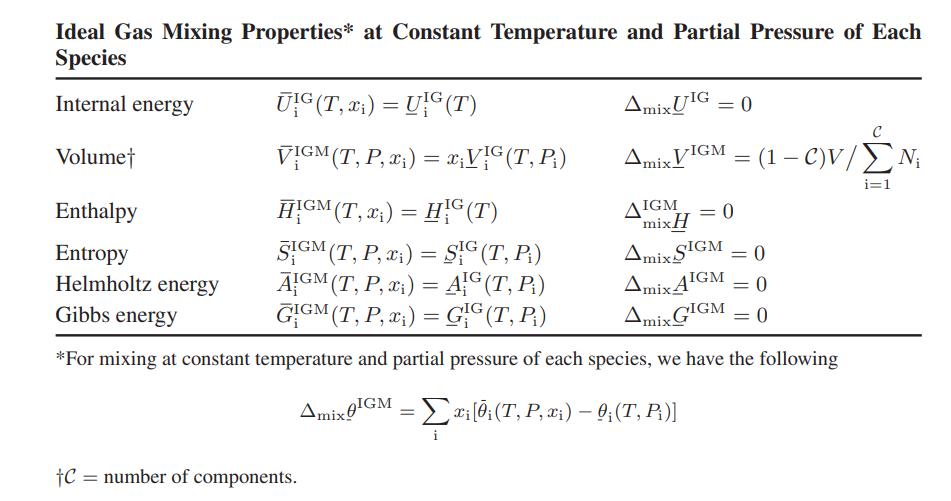
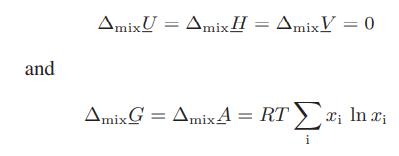
Show that for mixing of ideal gases at constant temperature and pressure to form an ideal gas mixture, and SmixU = SmixH SmixH = ∆mixV = 0 SmixG = SmixA = RT Σ; Invi
Assuming that two pure fluids and their mixture can be described by the van der Waals equation of state, and that for the mixture the van der Waals one-fluid mixing rules applya. Show that the fugacity coefficient for species i in the mixture is b. Derive an expression for the activity
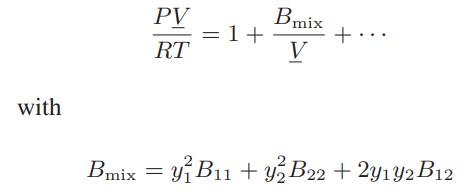
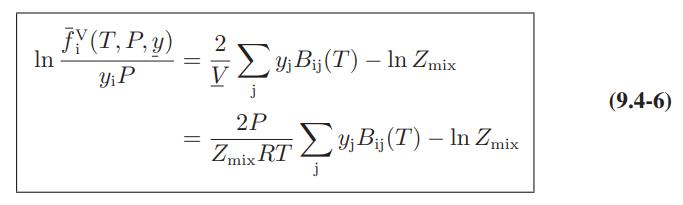
The virial equation for a binary mixture is Here B11 and B22 are the second virial coefficients for pure species 1 and pure species 2, respectively, and B12 is the cross second virial coefficient. For a binary mixturea. Obtain an expression for the fugacity coefficient of a species (Eq. 9.4-6).b.
In Sec. 9.1 we considered the changes in thermodynamic properties on forming an ideal gas mixture from a collection of ideal gases at the same temperature and pressure. A second, less common way of forming an ideal gas mixture is to start with a collection of pure ideal gases, each at the
Assuming that the van der Waals equation of state, is satisfied by two pure fluids and by their mixture, and that the van der Waals one-fluid ruleswith bij = bji apply to the mixture, derive expressions fora. The excess volume change on mixing at constant T and P b. The excess enthalpy and
a. Derive the two-constant Margules equations for the activity coefficients of a binary mixture (Eqs. 9.5-7).b. Derive Eqs. 9.5-9. c. Use the results of part (b) to derive van Laar expressions for the activity coefficients of a ternary mixture (Eq. A9.2-2). RT In ₁ = a₁x² + ₁x² RT In 2 =
Calculate the fugacity for each species in the following gases at 290 K and 800 bar: a. Pure oxygen b. Pure nitrogenc. Oxygen and nitrogen in a 30 mol % O2, 70 mol % N2 mixture using the Lewis-Randall rule d. Oxygen and nitrogen in the mixture in part (c) using the Peng-Robinson equation of state
Develop expressions for γ∗1 and γ□1 using each of the following: the one-constant and two-constant Margules equations, the van Laar equation, regular solution theory, and the UNIFAC model.
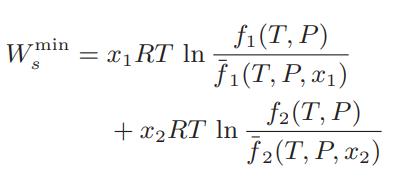
a. Show that the minimum amount of work, Wsmin , necessary to separate 1 mole of a binary mixture into its pure components at constant temperature and pressure isb. Show that this expression reduces to for (i) an ideal liquid mixture and (ii) a gaseous mixture for which the Lewis-Randall rule is
Chemically similar compounds (e.g., ethanol and water or benzene and toluene) generally form mixtures that are close to ideal, as evidenced by activity coefficients that are near unity and by small excess Gibbs energies of mixing. On the other hand, chemically dissimilar species (e.g., benzene and
Develop an expression for the activity coefficient of a species in a mixture from the Peng-Robinson equation of state with the van der Waals one-fluid mixing rules.
There are several possible expressions that can be used for the Gibbs excess energy. One is the Redlich-Kister expansion where B = 0, but A and C are nonzero. Find expressions for the activity coefficients for this excess Gibbs energy model in which γ1 is given solely in terms of x2 and the
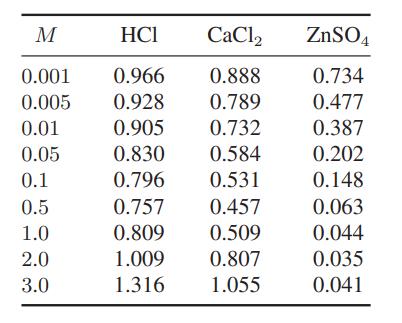
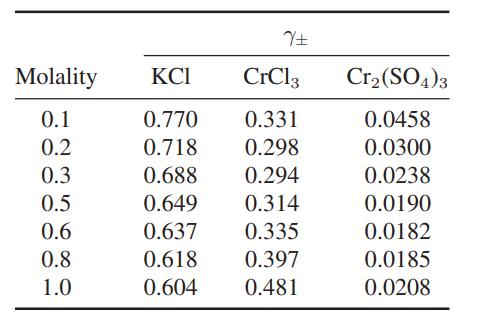
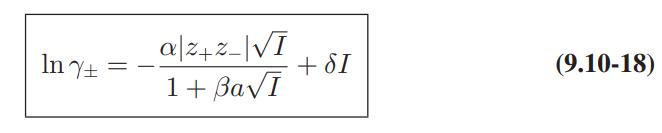
The following data are available for mean activity coefficients of single electrolytes in water at 25°C.Compare these data with the predictions of the DebyeHuckel limiting law, Eq. 9.10-15, and Eq. 9.10-18 with βa = 1 and δ = 0.1|z+z−|. Molality
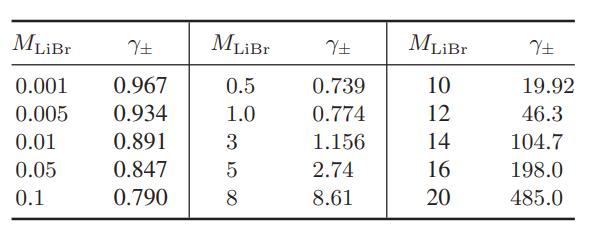
The data below are for the activity coefficients of lithium bromide in aqueous solutions as a function of molality at 25°CCompare the predictions of the Debye-Huckel model (Eqs. 9.10-15 and 9.10-16), and the extended DebyeHuckel models (Eqs. 9.10-17 and 9.10-18) with these data. MLiBr Y+ 0.001
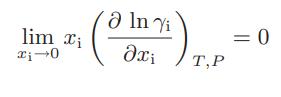
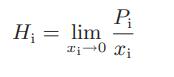
Experimentally it is observed that This equation implies that the activity coefficient γi (or its logarithm) is weakly dependent on mole fraction near the pure component limit. Since we also know that γi → 1 as xi → 1, this equation further implies that the activity coefficient is near unity
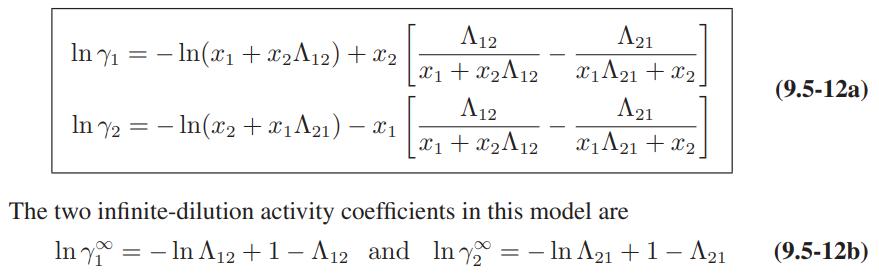
Wilson has proposed that the excess Gibbs energy of a multicomponent system is given by Note that this equation contains only the interaction parameters Λij for binary mixtures. Also, the parameters (λij −λii) appear to be insensitive to temperature. Holmes and van Winkle have tested this
Derive Eq. 9.2-13. In ₁ = In fi(T, P, x) x; P 1 V=ZRT/P RT - TT -ZI TFT -N (ON) F.M.NGAN •√x=00 = V T,V,Nji. RT dV - In Z (9.2-13)
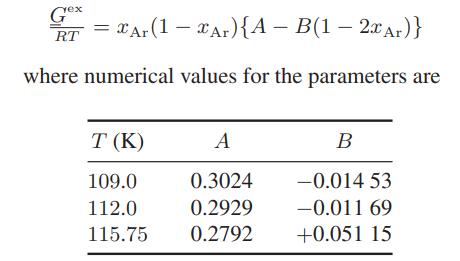
The excess Gibbs energies for liquid argon–methane mixtures have been measured at several temperatures. The results areCompute the following: a. The activity coefficients of argon and methane at 112.0 K and xAr = 0.5 b. The molar isothermal enthalpy change on producing an xAr = 0.5 mixture from
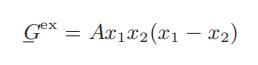
One expression that has been suggested for the excess Gibbs energy of a binary mixture that is asymmetric in composition is a. Find expressions for the activity coefficients in which γ1 is specified in terms of x2 and γ2 in terms of x1. b. Does this excess Gibbs energy model satisfy the
The fugacity of a species in a mixture can have a peculiar dependence on composition at fixed temperature and pressure, especially if there is a change of phase with composition. Show this by developing plots of the fugacity of isobutane and of carbon dioxide in their binary mixture as a function
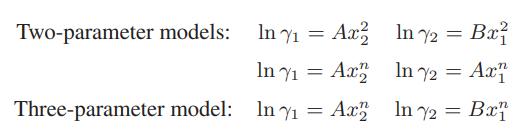
It has been suggested that since the one-parameter Margules expansion is not flexible enough to fit most activity coefficient data, it should be expanded by adding additional constants. In particular, the following have been suggested:In each case the reference states are the pure components at the
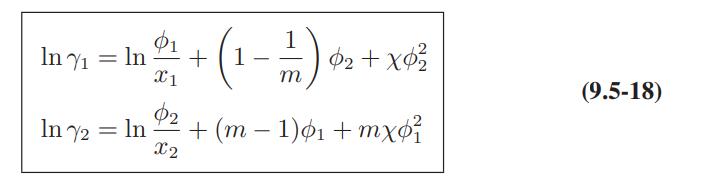
Derive Eqs. 9.5-18 In %₁ = In 1 In %2 = In 72 X1 $2 X2 (1-1) 0 11/12) 02 + X 0²/2 +(m-1)01 +mxo² (9.5-18)
At T = 60°C the vapor pressure of methyl acetate is 1.126 bar, and the vapor pressure of methanol is 0.847 bar. Their mixtures can be described by the oneconstant Margules equationwhere R is the gas constant and T is temperature in K. a. Plot the fugacity of methyl acetate and methanol in their
Derive Eq. 9.9-8. ABOS — [Σ] (* (9.9-8)
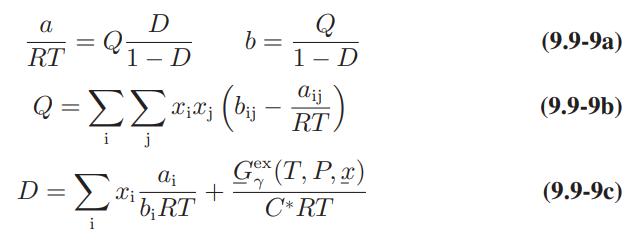
Derive Eqs. 9.9-9. a RT D 1-D D = Σ b = aij e-ΣΣ» (0-44) = bij RT G** (T, P,x) C*RT Xi dj b; RT Q 1-D + (9.9-9a) (9.9-9b) (9.9-9c)
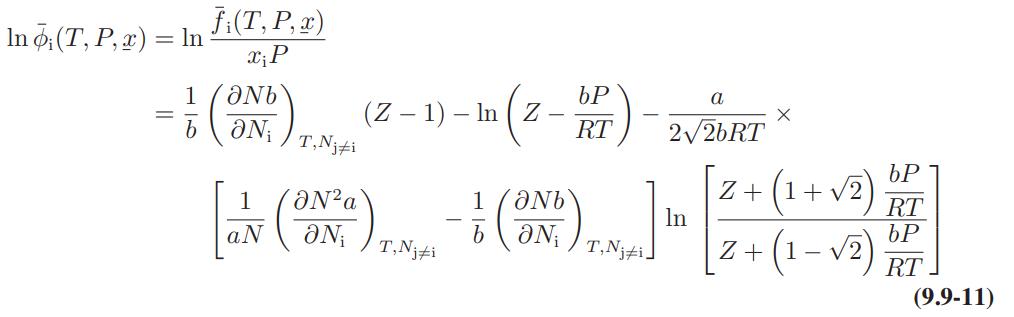
Derive Eqs. 9.9-11 to 9.9-13. In ф;(T, P, x) = In - fi(T, P, x) x;P 1 ƏNь ON; (Z - 1) - In (Z bP RT a 22bRT T,Nji 1 In [IN (N.) TEAM - H (ON) FT.M.] I T,Njzi X Z+(1+√2 2+(1 1-V2 bP RT bP RT (9.9-11)
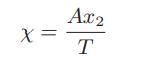
a. A starting point for modeling the thermodynamics of polymers in solution is to use the Flory-Huggins model with the Flory χ parameter assumed to be a constant. For mixtures of polystyrene in toluene, in which VPS = 1000VT, χ = 0.6 is a reasonable estimate of the value for that parameter. Plot
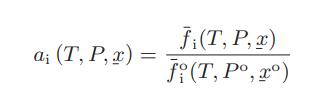
The activity of a substance, which is a function of temperature, pressure and composition, is defined as follows: where f̅oi (T,Po, xo) is the standard-state fugacity of species i at the standard-state pressure Po and standard-state composition xo (which could be the pure component state or one
a. Derive an expression for the minimum amount of work needed to continuously and adiabatically separate two isomers into their pure components at constant temperature and pressure. Explicitly state all assumptions and justify them. b. Calculate the minimum work necessary to separate a 50/50
Air contains approximately 21 mol % oxygen and 79 mol % nitrogen. An engineer claims to have developed a continuous process in which air is first compressed to 2 bar and 25°C, and then isothermally expanded to atmospheric pressure through a secret device that has no moving parts and results in two
A gas stream at 310 K and 14 bar is to be compressed to 345 bar before transmission by underground pipeline. If the compression is carried out adiabatically and reversibly, determine the compressor outlet temperature and the work of compression for the gas stream, which consists of a. Pure
The following data are available for the mean ionic activity coefficients of these salts in water at 25°C.a. Fit these data as best you can using the equations in this chapter for the mean ionic activity coefficient. b. Determine the activity coefficient of water in each of these solutions.
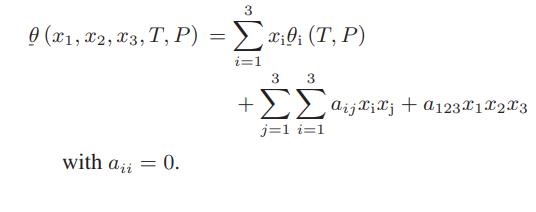
A thermodynamic property of a mixture is given by a. Develop expressions for the partial molar properties θ̅1, θ̅2, and θ̅3 as a function of the pure component molar properties, the mole fractions, and the parameters a12, a13, a12, and a123. b. Obtain expressions for the infinite-dilution
The infinite-dilution heat of solution for solid urea (CH4N2O) in water at 25°C is reported in The Chemical Engineer’s Handbook to be −3609 cal/g. In the same book the heat of formation is reported to be −77.55 kcal/mol for liquid urea and −79.634 kcal/mol for crystalline urea. Compare the
Derive the expression for the partial molar volume of a species in a mixture that obeys the Peng-Robinson equation of state and the van der Waals one-fluid mixing rules.
Derive the expression for the partial molar volume of a species in a mixture that obeys the Peng-Robinson equation of state and the Wong-Sandler mixing rules.
Derive the expression for the activity coefficient of a species in a mixture that obeys the Peng-Robinson equation of state and the van der Waals one-fluid mixing rules.
Derive the expression for the activity coefficient of a species in a mixture that obeys the Peng-Robinson equation of state and the Wong-Sandler mixing rules.
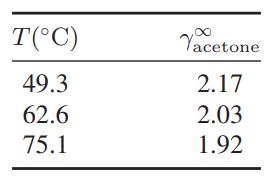
The following data are available for the infinitedilution activity coefficients in actetone in ethanol:a. Compute the excess partial molar enthalpy of acetone in ethanol at 62.6°C. b. Make a thermodynamically based estimate of the value of the infinite-dilution activity coefficient of acetone in
Use the regular solution model to predict the activity coefficients of benzene and 2,2,4-trimethyl pentane in their mixtures at 55°C. What are the predicted values of the infinite-dilution activity coefficients?
Using Gex = ax1x2, show thatall lead to different results. Note that from definition of a partial molar property, only the first of these derivatives is the partial molar excess Gibbs energy. a (NGex) ƏN₁ T,P a (Gex) Əx1 T,P and a (Gex) əx1 T, P,x2
Use the UNIFAC model to predict the activity coefficients of benzene and 2,2,4-trimethyl pentane in their mixtures at 55°C. What are the predicted values of the infinite-dilution activity coefficients?
The following simple expression has been suggested for modeling the activity coefficient of species 1 in a binary mixture: as it has the proper behavior that γ1 → 1 as x1 → 1 (so that x2 → 0). Obtain the expression for γ2, and determine whether or not this model is a reasonable one. RT In
Use the UNIFAC model to predict the activity coefficients of acetone + water in their mixtures at 298 K. What are the predicted values of the two infinitedilution activity coefficients?
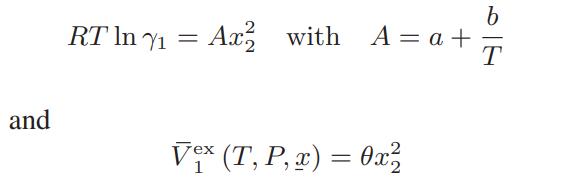
In a binary mixture, the activity coefficient of component 1 has been found to be where a, b, and θ are constants independent of temperature, pressure, and composition. Find expressions for G, S, H, and V in terms of the gas constant R; the temperature T; the parameters a, b, and θ; the
A 50 mol % mixture of two gases A and B at 300 K and 1 bar is to be isothermally and isobarically separated into its pure components. If the gases form an ideal mixture and C∗P,B = 10 J/(mol K) and C∗P,B = 15 J/(mol K), how much Gibbs energy is required to separate the mixture?
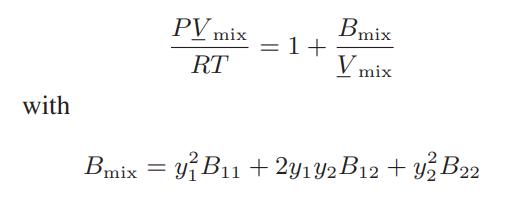
At moderate but not high pressures, the vapor phase of a binary mixture can be described by the following virial equation of state truncated at the second virial coefficient Write the expression for the vapor-phase fugacity of each species in this mixture in a form that contains only the
An oxygen enrichment device is needed for people with impaired respiratory systems. To design such a device, it is necessary to compute the work needed to produce a stream that contains 50 mol % of oxygen from air (21 mol % oxygen) at 300 K and 1 bar. If the exit streams are at the same temperature
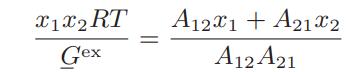
The following two-parameter activity coefficient model has been proposed:Obtain the expressions for the activity coefficients in this model. x1x2 RT Gex A12x1 + A21x2 A12A21
Some liquid mixtures can be described by an equation of state. For example, liquid mixtures of hydrocarbons or other nonpolar species. Derive the expressions for the excess Gibbs energy and the activity coefficients for a mixture that can be described by the Peng-Robinson equation of state with the
Calculate the Flory-Huggins entropy of mixing for a 0.5 mole fraction solution as a function of polymer chain length. Compare this to the entropy of mixing for a 0.5 mole fraction solution of similar size molecules.
Calculate the minimum work required to separate air (79 mole % nitrogen) into essentially pure oxygen and nitrogen assuming an isothermal, steady flow process at 300 K. The inlet air pressure is 10 bar and each stream is to exit at 10 bar and 300 K.
A natural gas stream 90 mol % CH4 (component 1) contaminated with 10 mol % CO2 (component 2). In order to calculate pumping requirements you are asked to perform calculations of properties of the gas mixture at 300 K and 10 bar. To a reasonable first approximation this gas mixture can be
Calculate the Flory-Huggins entropy of mixing as a function of 0.5 mole fraction solution and as a function of polymer chain length. Compare this to the entropy of mixing for a solution of similar molecules.
An equimolar mixture of methane and ethane at 25°C and 1 bar is to be compressed to 5 bar in an isentropic compressor. a. Compute the temperature of the stream leaving the compressor and the amount of compressor work needed. b. The stream leaving the compressor is cooled at constant pressure to
Repeat the calculations of problem 9.65, but with a compressor that has an isentropic efficiency of 0.72.problem 9.65 An equimolar mixture of methane and ethane at 25°C and 1 bar is to be compressed to 5 bar in an isentropic compressor. a. Compute the temperature of the stream leaving the
Redo Problem 9.13 with UNIFAC using Aspen Plus.Problem 9.13Chemically similar compounds (e.g., ethanol and water or benzene and toluene) generally form mixtures that are close to ideal, as evidenced by activity coefficients that are near unity and by small excess Gibbs energies of mixing. On the
Redo Problem 9.49 with UNIFAC using Aspen Plus.Problem 9.49Use the UNIFAC model to predict the activity coefficients of benzene and 2,2,4-trimethyl pentane in their mixtures at 55°C. What are the predicted values of the infinite-dilution activity coefficients?
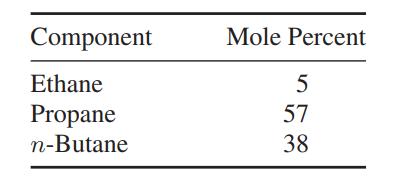
The following mixture of hydrocarbons occurs in petroleum processing. Estimate the bubble point temperature and the composition of the coexisting vapor for this mixture at all pressures above 1 bar. Component Ethane Propane n-Butane Mole Percent 5 57 38
Redo Problem 9.50 with UNIFAC using Aspen Plus.Problem 9.50Use the UNIFAC model to predict the activity coefficients of acetone + water in their mixtures at 298 K. What are the predicted values of the two infinite dilution activity coefficients?
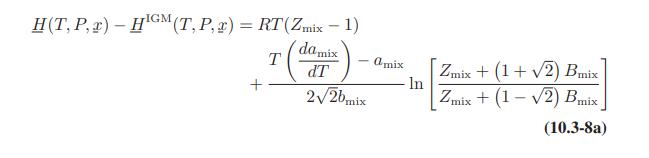
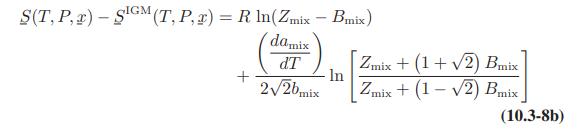
Derive Eqs.10.3-8. H(T, P, 2) - HIGM (T, P,x) = RT (Zmix - 1) da mix T dT 2√/2bmix + amix In Zmix + (1+√2) Bmix Zmix + (1-√2) Bmix (10.3-8a)
Estimate the dew point temperature and the composition of the coexisting liquid for the mixture in the previous problem at all pressures above 1 bar.
A liquid mixture of the composition given in Problem 10.3-1 is to be flashed at P = 20 bar and a collection of temperatures between the bubble point temperature and the dew point temperature. Determine the compositions of the coexisting vapor and liquid, and the vapor-liquid equilibrium split for
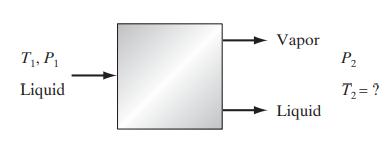
a. For the adiabatic, steady-flow flash process from specified initial conditions of T1 and P1 to a specified final pressure P2 shown here, develop the equilibrium and balance equations to compute the final temperature, the vapor-liquid split, and the compositions of the coexisting phases.b.
a. Develop an algorithm for the equation-of-state prediction of the dew point pressure. b. Develop an algorithm for the equation-of-state prediction of the dew point temperature.
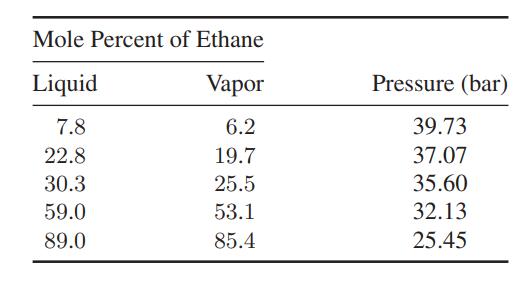
a. Make the best estimate you can of the composition of the vapor in equilibrium with a liquid containing 30.3 mol % ethane and 69.7 mol % ethylene at −0.01°C. Compare your results with the experimental data in the table. b. Repeat the calculation in part (a) at other compositions for which the
Vapor-liquid equilibria in petroleum technology are usually expressed in terms of K factors Ki = yi/xi, where yi and xi are the mole fractions of species i in the vapor and liquid phases, respectively. Estimate the K values for methane and benzene in the benzene-methane system at 300 K and a total
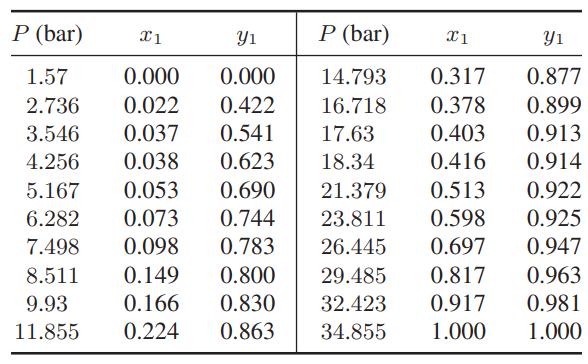
The following vapor-liquid equilibrium data are available for the system carbon dioxide (1) + isobutane (2) at 273.15 K.a. Find the value of the binary interaction parameter in the Peng-Robinson equation of state with the van der Waals one-fluid mixing rules that best fits these data, and plot the
In a petroleum refinery an equimolar stream containing propane and n-butane is fed to a flash separator operating at 40°C. Determine the pressure at which this separator should be operated so that an equal number of moles of liquid and vapor are produced.
Use the Peng-Robinson equation of state for a multicomponent mixture to do the calculations for an isentropic expansion of a liquid under pressure to produce a vapor-liquid mixture at ambient pressure. The output results should include the outlet temperature, the mole fractions of each species in
To evaluate the potential use of carbon dioxide in tertiary oil recovery, it is necessary to estimate the vapor-liquid equilibrium between carbon dioxide and reservoir petroleum, which we will take to be n-hexane, at oil well conditions, typically 140 bar and 75°C. Make this estimate as best you
It is desired to produce a slightly oxygen-enriched stream from air (79 mol % nitrogen, 21 mol % oxygen) by starting with air initially at 100 K and 25 bar and flashing it to 1 bar. What will be the temperature of the exiting vapor and liquid streams, and the composition of each?
A mixture of carbon dioxide (40 mol %), methane (40 mol %) and n-butane (20 mol %) at 300°C and 1 bar is compressed to compressed to 25 bar in a compressor that has an isentropic efficiency of 85%. The exiting stream is then adiabatically expanded through a Joule-Thompson expansion valve to 3
A mixture of n-butane (10 mol %), n-hexane (40 mol %) and n-octane (50 mol %) at 298 K and 1 bar is compressed to compressed to 30 bar in a compressor that has an isentropic efficiency of 85%. The exiting stream is then adiabatically expanded through a Joule-Thompson expansion valve to 2 bar. a.
A gas stream of 70 mol % methane and 30 mol % carbon dioxide is available 15 bar and 200 K. To decrease the concentration of carbon dioxide in the methane, the gas stream will be flashed by flowing through an adiabatic valve to 1 bar. Compute the temperature of the exiting streams and their
A refrigerant stream containing 40 mol% dichlorodifluoromethane (R12), 30 mol% 1,1,2,2 tetrafluoroethane (R134) and 1,1,1,2 tetrafluoroethane (R134a) at 20 bar and 25°C is adiabatically flashed to 1 bar. Compute the temperature of the exiting streams, their compositions and their relative amounts.
A 100°C stream from a chemical reactor at 40 bar contains hydrogen at a flowrate of 405 kmol/hr, methane at 95 kmol/hr, benzene at also at a flowrate of 95 kmol/hr and toluene at 5 kmol/hr. The stream first undergoes an adiabatic flash to 35 bar, and the vapor is separated from the liquid. The
There is a mixture with an overall equimolar composition of methane, propane and n-hexane at 50 bar and 45°C. a. What are the relative amounts of vapor and liquid, and the compositions of each of the phases? b. The liquid part of this mixture is separated from the vapor, and adiabatically
Predict the T-xy diagram for a mixture of carbon dioxide and is opentane at 10 bar over the whole concentration range. Does this mixture have an azeotrope at this pressure?
A methane (70 mol %) + carbon dioxide (30 mol%) mixture at 200 K and 15 bar undergoes a Joule Thompson expansion to 1 bar. Determine the temperature of the streams exiting the valve, the relative amounts of the vapor and liquid, and the compositions of each phase.
An equimolar mixture of methane + and n-butane at 50°C and 1 bar in compressed to 25 bar in a compressor that has an isentropic efficiency of 0.72, is cooled back down to 50°C, and then undergoes a Joule-Thompson expansion to 2 bar. Determine the temperature of the stream leaving the compressor,
Redo Problem 10.3-1 using Aspen Plus.Problem 10.3-1The following mixture of hydrocarbons occurs in petroleum processing. Estimate the bubble point temperature and the composition of the coexisting vapor for this mixture at all pressures above 1 bar. Component Ethane Propane n-Butane Mole
An equimolar mixture of methane and propane at −10°C and 1 bar in compressed to 50 bar in a isentropic compressor, cooled back down to −10°C, and then undergoes a Joule-Thompson expansion to 10 bar. Determine the temperature of the stream leaving the compressor, of the streams exiting the
Redo Problem 10.3-7 using Aspen Plus.Problem 10.3-7a. Make the best estimate you can of the composition of the vapor in equilibrium with a liquid containing 30.3 mol % ethane and 69.7 mol % ethylene at −0.01°C. Compare your results with the experimental data in the table. b. Repeat the
It is desired to remove some of the n-butane from an equimolar mixture of n-butane and ethane, initially at 25°C and 1 bar. The procedure that will be used is to isentropically compress the mixture to 25 bar, cool it to 250 K, and then adiabatically flash the mixture. Determine the temperature of
Redo Problem 10.3-3 using Aspen Plus.Problem 10.3-3A liquid mixture of the composition given in Problem 10.3-1 is to be flashed at P = 20 bar and a collection of temperatures between the bubble point temperature and the dew point temperature. Determine the compositions of the coexisting vapor and
Showing 500 - 600
of 619
1
2
3
4
5
6
7
Step by Step Answers

 Get 50% OFF
Claim Now
Get 50% OFF
Claim Now




![Amix V(x) = x1x2 [-1.026 +0.220(x - x)]](https://dsd5zvtm8ll6.cloudfront.net/images/question_images/1700/1/1/5/5506555b45eea7931700115549405.jpg)











![where Gex == - RT ;; ; 1n ;4;; i=l = (Xij- Aii) ] exp RT](https://dsd5zvtm8ll6.cloudfront.net/images/question_images/1700/1/3/1/0246555f0d0528091700131023749.jpg)



![ABOS [] (* (9.9-8)](https://dsd5zvtm8ll6.cloudfront.net/images/question_images/1700/1/3/2/1386555f52a615071700132137814.jpg)