New Semester
Started
Get
50% OFF
Study Help!
--h --m --s
Claim Now
Question Answers
Textbooks
Find textbooks, questions and answers
Oops, something went wrong!
Change your search query and then try again
S
Books
FREE
Study Help
Expert Questions
Accounting
General Management
Mathematics
Finance
Organizational Behaviour
Law
Physics
Operating System
Management Leadership
Sociology
Programming
Marketing
Database
Computer Network
Economics
Textbooks Solutions
Accounting
Managerial Accounting
Management Leadership
Cost Accounting
Statistics
Business Law
Corporate Finance
Finance
Economics
Auditing
Tutors
Online Tutors
Find a Tutor
Hire a Tutor
Become a Tutor
AI Tutor
AI Study Planner
NEW
Sell Books
Search
Search
Sign In
Register
study help
engineering
engineering fluid mechanics
Munson Young And Okiishi's Fundamentals Of Fluid Mechanics 8th Edition Philip M. Gerhart, Andrew L. Gerhart, John I. Hochstein - Solutions
The Churchill formula for the friction factor is\[ f=8\left[\left(\frac{8}{\operatorname{Re}}\right)^{12}+\frac{1}{(A+B)^{1.5}}\right]^{1 / 12} \]where\[ \begin{aligned} & A=\left\{-2.457 \ln \left[\left(\frac{7}{\operatorname{Re}}\right)^{0.9}+\frac{\varepsilon}{3.7 D}\right]\right\}^{16} \\
Air at standard temperature and pressure flows through a 1 -in.-diameter galvanized iron pipe with an average velocity of \(8 \mathrm{ft} / \mathrm{s}\). What length of pipe produces a head loss equivalent to(a) a flanged \(90^{\circ}\) elbow,(b) a wide-open angle valve, (c) a sharp-edged entrance?
Given \(90^{\circ}\) threaded elbows used in conjunction with copper pipe (drawn tubing) of 0.75-in. diameter, convert the loss for a single elbow to equivalent length of copper pipe for wholly turbulent flow.
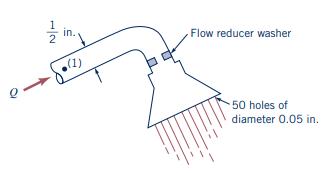
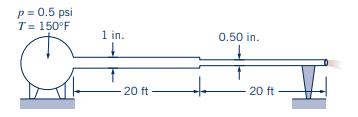
To conserve water and energy, a "flow reducer" is installed in the shower head as shown in Fig. P8.52. If the pressure at point (1) remains constant and all losses except for that in the flow reducer are neglected, determine the value of the loss coefficient (based on the velocity in the pipe) of
Water flows at a rate of \(0.040 \mathrm{~m}^{3} / \mathrm{s}\) in a 0.12-m-diameter pipe that contains a sudden contraction to a \(0.06-\mathrm{m}\)-diameter pipe. Determine the pressure drop across the contraction section. How much of this pressure difference is due to losses and how much is due
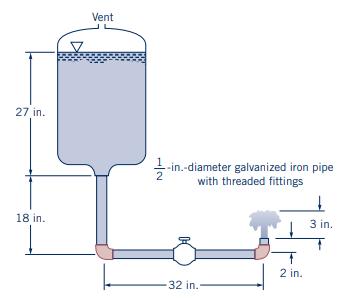
Water flows from the container shown in Fig. P8.54. Determine the loss coefficient needed in the valve if the water is to "bubble up" 3 in. above the outlet pipe. The entrance is slightly rounded.Figure P8.54 27 in. 18 in. Vent -in.-diameter galvanized iron pipe with threaded fittings 2 in. 32 in.
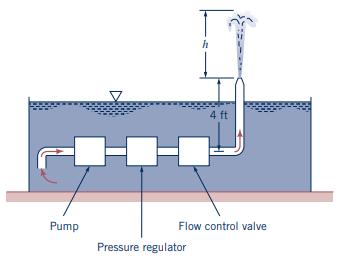
The Wide World of Fluids article titled "New Hi-tech Fountains,". The fountain shown in Fig. P8.55 is designed to provide a stream of water that rises \(h=10 \mathrm{ft}\) to \(h=20 \mathrm{ft}\) above the nozzle exit in a periodic fashion. To do this the water from the pool enters a pump, passes
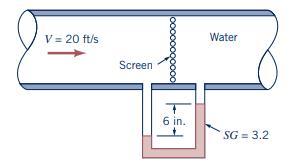
Water flows through the screen in the pipe shown in Fig. P8.56 as indicated. Determine the loss coefficient for the screen.Figure P8.56 V=20ft/s Screen Water 6 in. SG=3.2
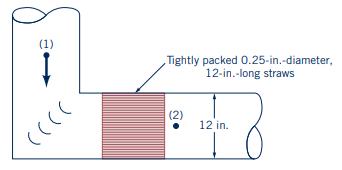
Air flows though the mitered bend shown in Fig. P8.57 at a rate of \(5.0 \mathrm{cfs}\). To help straighten the flow after the bend, a set of 0.25-in.-diameter drinking straws is placed in the pipe as shown. Estimate the extra pressure drop between points (1) and (2) caused by these straws.Figure
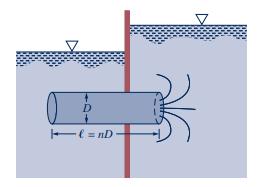
As shown in Fig. P8.58, water flows from one tank to another through a short pipe whose length is \(n\) times the pipe diameter. Head losses occur in the pipe and at the entrance and exit. Determine the maximum value of \(n\) if the major loss is to be no more than \(10 \%\) of the minor loss and
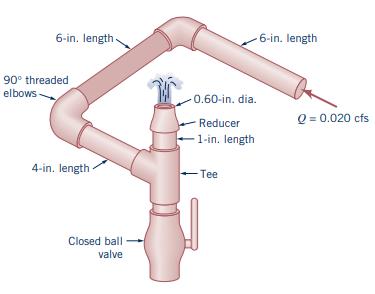
Water flows steadily through the 0.75-in.-diameter galvanized iron pipe system shown in Fig. P8.59 at a rate of \(0.020 \mathrm{cfs}\). Your boss suggests that friction losses in the straight pipe sections are negligible compared to losses in the threaded elbows and fittings of the system. Do you
Given two rectangular ducts with equal cross-sectional area, but different aspect ratios (width/height) of 2 and 4 , which will have the greater frictional losses? Explain your answer.
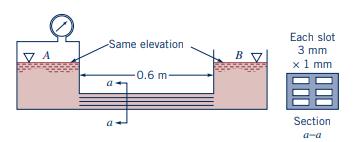
A viscous oil with a specific gravity \(S G=0.85\) and a viscosity of \(0.10 \mathrm{~Pa} \cdot \mathrm{s}\) flows from tank \(A\) to \(\operatorname{tank} B\) through the six rectangular slots indicated in Fig. P8.61. If the total flowrate is \(30 \mathrm{~mm}^{3} / \mathrm{s}\) and minor losses
Air at standard temperature and pressure flows at a rate of 7.0 cfs through a horizontal, galvanized iron duct that has a rectangular cross-sectional shape of 12 in. by 6 in. Estimate the pressure drop per \(200 \mathrm{ft}\) of duct.
Water at \(20{ }^{\circ} \mathrm{C}\) flows through a concentric annulus of inner diameter \(D_{1}=2.0 \mathrm{~cm}\) and outer diameter \(D_{2}=4.0 \mathrm{~cm}\). The surface roughness is \(0.002 \mathrm{~cm}\). Calculate the frictional pressure loss per unit length for a flow rate of \(0.01
Air at standard conditions flows through a horizontal \(1 \mathrm{ft}\) by \(1.5 \mathrm{ft}\) rectangular wooden duct at a rate of \(5000 \mathrm{ft}^{3} / \mathrm{min}\). Determine the head loss, pressure drop, and power supplied by the fan to overcome the flow resistance in \(500 \mathrm{ft}\)
Assume a car's exhaust system can be approximated as \(14 \mathrm{ft}\) of 0.125-ft-diameter cast-iron pipe with the equivalent of six \(90^{\circ}\) flanged elbows and a muffler. The muffler acts as a resistor with a loss coefficient of \(K_{L}=8.5\). Determine the pressure at the beginning of
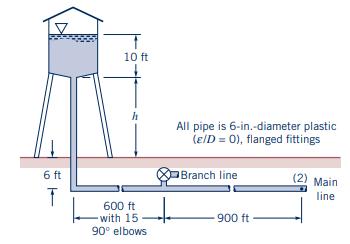
The pressure at section (2) shown in Fig. P8.66 is not to fall below 60 psi when the flowrate from the tank varies from 0 to \(1.0 \mathrm{cfs}\) and the branch line is shut off. Determine the minimum height, \(h\), of the water tank under the assumption that(a) minor losses are negligible,(b)
Repeat Problem 8.66 with the assumption that the branch line is open so that half of the flow from the tank goes into the branch, and half continues in the main line.Problem 8.66The pressure at section (2) shown in Fig. P8.66 is not to fall below 60 psi when the flowrate from the tank varies from 0
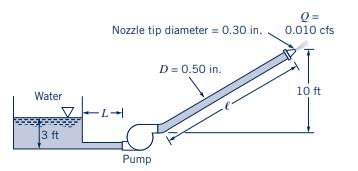
The \(\frac{1}{2}\)-in.-diameter hose shown in Fig. P8.68 can withstand a maximum pressure of \(200 \mathrm{psi}\) without rupturing. Determine the maximum length, \(\ell\), allowed if the friction factor is 0.022 and the flowrate is \(0.010 \mathrm{cfs}\). Neglect minor losses.Figure P8.68 Water 3
The hose shown in Fig. P8.68 will collapse if the pressure within it is lower than 10 psi below atmospheric pressure. Determine the maximum length, \(\ell\), allowed if the friction factor is 0.015 and the flowrate is \(0.010 \mathrm{cfs}\). Neglect minor losses.Fig. P8.68 Water 3 ft Nozzle tip
According to fire regulations in a town, the pressure drop in a commercial steel horizontal pipe must not exceed 1.0 psi per 150 \(\mathrm{ft}\) of pipe for flowrates up to \(500 \mathrm{gal} / \mathrm{min}\). If the water temperature is above \(50{ }^{\circ} \mathrm{F}\), can a 6-in.-diameter pipe
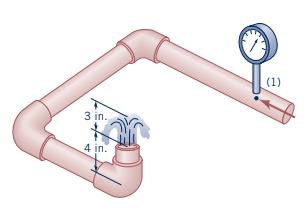
As shown in Fig. P8.71, water "bubbles up" 3 in. above the exit of the vertical pipe attached to three horizontal pipe segments. The total length of the 0.75-in.diameter galvanized iron pipe between point (1) and the exit is 21 in. Determine the pressure needed at point (1) to produce this
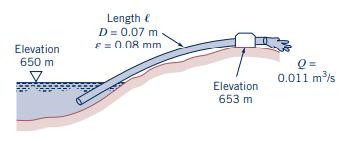
Water at \(10{ }^{\circ} \mathrm{C}\) is pumped from a lake as shown in Fig. P8.72. If the flowrate is \(0.011 \mathrm{~m}^{3} / \mathrm{s}\), what is the maximum length inlet pipe, \(\ell\), that can be used without cavitation occurring?Figure P8.72 Elevation 650 m Length D= 0.07 m = 0.08 mm
At a ski resort, water at \(40{ }^{\circ} \mathrm{F}\) is pumped through a 3-in.diameter, 2000-ft-long steel pipe from a pond at an elevation of \(4286 \mathrm{ft}\) to a snow-making machine at an elevation of \(4623 \mathrm{ft}\) at a rate of \(0.26 \mathrm{ft}^{3} / \mathrm{s}\). If it is
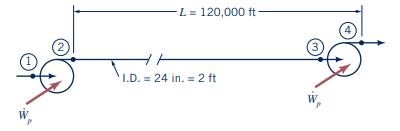
Crude oil having a specific gravity of 0.80 and a viscosity of \(6.0 \times 10^{-5} \mathrm{ft}^{2} / \mathrm{sec}\) flows through a pumping station at a rate of \(10,000 \mathrm{barrels} / \mathrm{hr}\). The oil then flows through 120,000 ft of 24-in. ID, horizontal, commercial steel pipe, enters
A motor-driven centrifugal pump delivers \(15{ }^{\circ} \mathrm{C}\) water at the rate of \(10 \mathrm{~m}^{3} / \mathrm{min}\) from a reservoir, through a \(2500-\mathrm{m}\)-long, \(30-\mathrm{cm}\) I.D. plastic pipe, to a second reservoir. The water level in the second reservoir is \(40
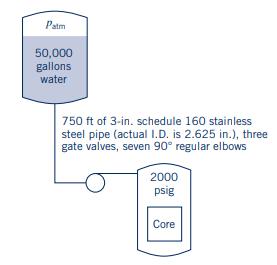
An emergency flooding system for a nuclear reactor core is shown in Fig. P8.76. Find the power input required to flood the core at the rate of \(5000 \mathrm{gal} / \mathrm{min}\). Assume a square-edged entrance, \(60^{\circ} \mathrm{F}\) water, and threaded connections.Figure P8.76 Patm 50,000
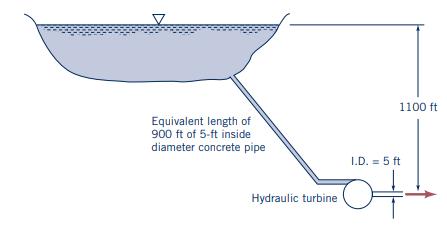
A hydraulic turbine takes water from a lake with the piping system shown in Figure P8.77. Find the head \(h_{t}\) available to the turbine for flow rates of \(0,5000,10,000,15,000\), and \(20,000 \mathrm{ft}^{3} / \mathrm{min}\).Figure P8.77 Equivalent length of 900 ft of 5-ft inside diameter
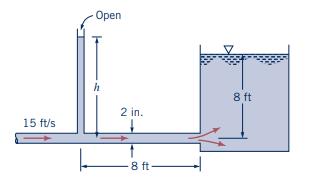
Water flows through a 2-in.-diameter pipe with a velocity of \(15 \mathrm{ft} / \mathrm{s}\) as shown in Fig. P8.78. The relative roughness of the pipe is 0.004, and the loss coefficient for the exit is 1.0. Determine the height, \(h\), to which the water rises in the piezometer tube.Figure P8.78
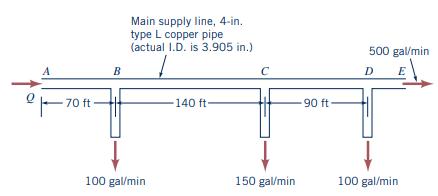
Figure P7.79 shows the \(60{ }^{\circ} \mathrm{F}\) water flow rates from the branches of a main supply line. Find the total pressure drop \(\left(p_{A}-p_{E}\right)\) for soldered copper pipe. Assume that the loss coefficient for each tee is based on the threaded type.Figure P8.79 A -70 ft B Main
Water is pumped through a \(60-\mathrm{m}\)-long, \(0.3-\mathrm{m}\)-diameter pipe from a lower reservoir to a higher reservoir whose surface is \(10 \mathrm{~m}\) above the lower one. The sum of the minor loss coefficient for the system is \(K_{L}=14.5\). When the pump adds \(40 \mathrm{~kW}\) to
Natural gas ( \(ho=0.0044\) slugs \(/ \mathrm{ft}^{3}\) and \(\left.u=5.2 \times 10^{-5} \mathrm{ft}^{2} / \mathrm{s}\right)\) is pumped through a horizontal 6-in.-diameter cast-iron pipe at a rate of \(800 \mathrm{lb} / \mathrm{hr}\). If the pressure at section (1) is \(50
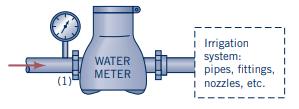
As shown in Fig. P8.82, a standard household water meter is incorporated into a lawn irrigation system to measure the volume of water applied to the lawn. Note that these meters measure volume, not volume flowrate. With an upstream pressure of \(p_{1}=50 \mathrm{psi}\) the meter registered that
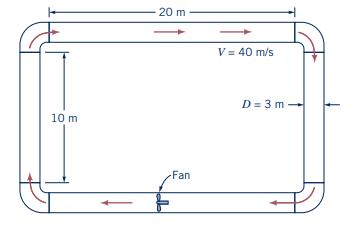
A fan is to produce a constant air speed of \(40 \mathrm{~m} / \mathrm{s}\) throughout the pipe loop shown in Fig. P8.83. The 3-m-diameter pipes are smooth, and each of the four \(90^{\circ}\) elbows has a loss coefficient of 0.30. Determine the power that the fan adds to the air.Figure P8.83 10 m
Air flows in a horizontal 100-ft-long, 24-in. \(\times 24\)-in. duct at the rate of \(5000 \mathrm{ft}^{3} / \mathrm{min}\). The air then flows through an expansion into \(200 \mathrm{ft}\) of 36-in. × 36-in. duct. The expansion has a loss coefficient of 0.80, based on the higher inlet velocity.
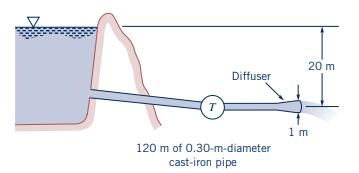
The turbine shown in Fig. P8.85 develops 400 kW. Determine the flowrate if(a) head losses are negligible (b) head loss due to friction in the pipe is considered. Assume \(f=0.02\). There may be more than one solution or there may be no solution to this problem.Figure P8.85 T 20 m Diffuser 120 m of
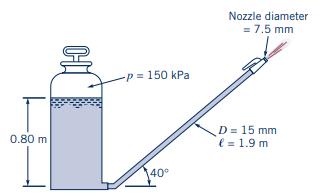
Water flows from the nozzle attached to the spray tank shown in Fig. P8.86. Determine the flowrate if the loss coefficient for the nozzle (based on upstream conditions) is 0.75 and the friction factor for the rough hose is 0.11.Figure P8.86 0.80 m -p=150 kPa 40 Nozzle diameter = 7.5 mm D= 15 mm
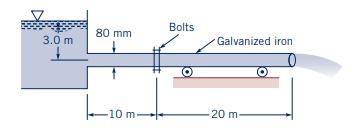
Water flows through the pipe shown in Fig. P8.87. Determine the net tension in the bolts if minor losses are neglected and the wheels on which the pipe rests are frictionless.Figure P8.87 80 mm 3.0 m Bolts Galvanized iron 10 m- 20 m-
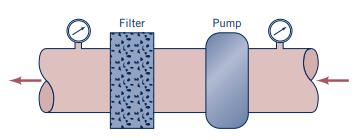
When the pump shown in Fig. P8.88 adds 0.2 horsepower to the flowing water, the pressures indicated by the two gages are equal. Determine the flowrate.Length of pipe between gages \(=60 \mathrm{ft}\)Pipe diameter \(=0.1 \mathrm{ft}\)Pipe friction factor \(=0.03\)Filter loss coefficient
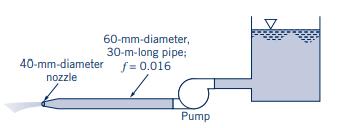
The pump shown in Fig. P8.89 adds \(25 \mathrm{~kW}\) to the water and causes a flowrate of \(0.04 \mathrm{~m}^{3} / \mathrm{s}\). Determine the flowrate expected if the pump is removed from the system. Assume \(f=0.016\) for either case and neglect minor losses.Figure P8.89 40-mm-diameter nozzle
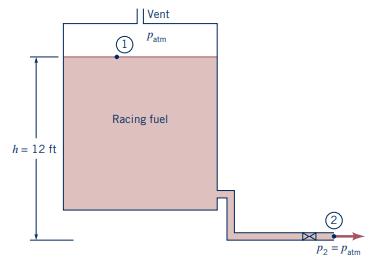
The vented storage tank shown in Fig. P8.90 is used to refuel race cars at a race track. A total of \(40 \mathrm{ft}\) of steel pipe (I.D. \(=0.957 \mathrm{in}\).), two \(90^{\circ}\) regular elbows, and a globe valve make up the system. Calculate the time needed to put \(20 \mathrm{gal}\) of fuel
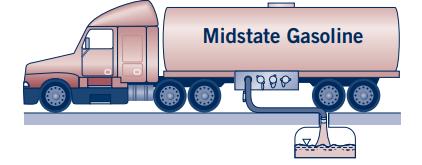
Gasoline is unloaded from the tanker truck shown in Fig. P8.91 through a 4-in.-diameter rough-surfaced hose. This is a "gravity dump" with no pump to enhance the flowrate. It is claimed that the 8800 -gallon capacity truck can be unloaded in 28 minutes. Do you agree with this claim? Support your
Calculate the water flow rate in the system shown in Fig. P8.92. The piping system includes four gate valves, two half-open globe valves, fourteen \(90^{\circ}\) regular elbows, and \(250 \mathrm{ft}\) of 2-in. schedule 40 commercial steel pipe (with an actual inside diameter of 2.067 in.). Assume
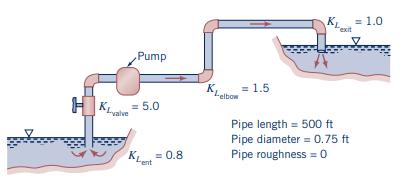
The pump shown in Fig. P8.93 delivers a head of \(250 \mathrm{ft}\) to the water. Determine the power that the pump adds to the water. The difference in elevation of the two ponds is \(200 \mathrm{ft}\).Figure P8.93 HKL Ke Pump = 5.0 KL = 0.8 Fent KL KL Leibow = 1.5 Pipe length 500 ft Pipe diameter
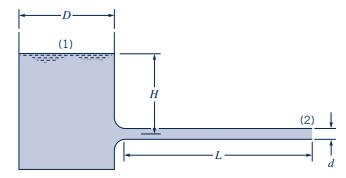
For the standpipe system shown in Fig. P8.94, calculate the flow rate for \(H=4.0 \mathrm{ft}, D=6.77\) in., \(d=0.125\) in., and \(L=48\) in. The fluid is \(70^{\circ} \mathrm{F}\) water. Assume steady flow and neglect the energy loss in the entrance nozzle. The pipe is commercial steel.Figure
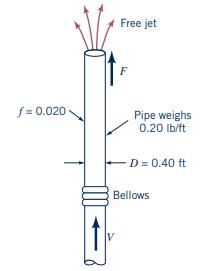
Water flows through two sections of the vertical pipe shown in Fig. P8.95. The bellows connection cannot support any force in the vertical direction. The 0.4-ft-diameter pipe weights \(0.2 \mathrm{lb} / \mathrm{ft}\), and the friction factor is assumed to be 0.02. At what velocity will the force,
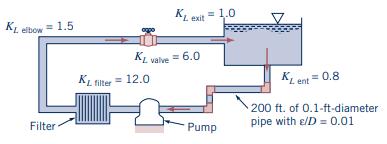
Water is circulated from a large tank, through a filter, and back to the tank as shown in Fig. P8.96. The power added to the water by the pump is \(200 \mathrm{ft} \cdot \mathrm{lb} / \mathrm{s}\). Determine the flowrate through the filter.Figure P8.96 KL elbow = 1.5 Filter KL titer KL exit = 1.0
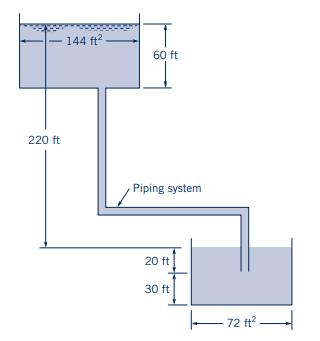
A thief siphoned \(15 \mathrm{gal}\) of gasoline from a gas tank in the middle of the night. The gas tank is \(12 \mathrm{in}\). wide, \(24 \mathrm{in}\). long, and 18 in. high and was full when the thief started. The siphoning plastic tube has an inside diameter of \(0.5 \mathrm{in}\). and a
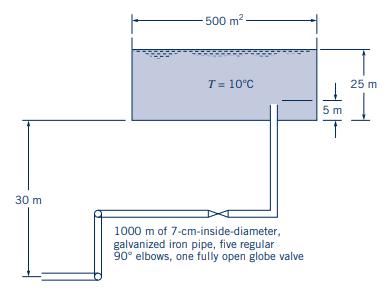
Estimate the time required for the water depth in the reservoir shown in Fig. P8. 98 to drop from a height of \(25 \mathrm{~m}\) to \(5 \mathrm{~m}\). The connections are threaded.Figure P8.98 500 m T = 10C 187 5 m 30 m 1000 m of 7-cm-inside-diameter, galvanized iron pipe, five regular 90 elbows,
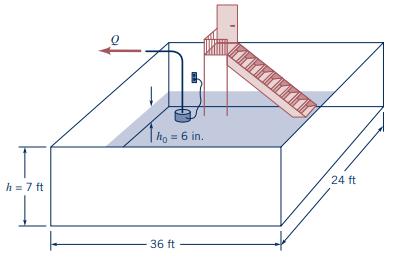
Sheldon and Leonard come home from a long day of studying to discover that their basement is flooded with water. They have a submersible pump for such an emergency and connect the pump discharge to a 12-ft-long garden hose, as shown in Fig. P8.99. The garden hose may be considered a smooth plastic
A company markets ethylene glycol antifreeze in halfgallon bottles. A machine fills and caps the bottles at a rate of 60 per minute. The \(68{ }^{\circ} \mathrm{F}\) ethylene glycol \(\left(ho=69.3 \mathrm{lb} \mathrm{m} / \mathrm{ft}^{3}, v=1.93 \times\right.\) \(10^{-4} \mathrm{ft}^{2} /
A certain process requires \(2.3 \mathrm{cfs}\) of water to be delivered at a pressure of \(30 \mathrm{psi}\). This water comes from a large-diameter supply main in which the pressure remains at \(60 \mathrm{psi}\). If the galvanized iron pipe connecting the two locations is \(200 \mathrm{ft}\)
Water is pumped between two large open reservoirs through \(1.5 \mathrm{~km}\) of smooth pipe. The water surfaces in the two reservoirs are at the same elevation. When the pump adds \(20 \mathrm{~kW}\) to the water, the flowrate is \(1 \mathrm{~m}^{3} / \mathrm{s}\). If minor losses are negligible,
Determine the diameter of a steel pipe that is to carry 2000 \(\mathrm{gal} / \mathrm{min}\) of gasoline with a pressure drop of \(5 \mathrm{psi}\) per \(100 \mathrm{ft}\) of horizontal pipe.
Water is to be moved from a large, closed tank in which the air pressure is \(20 \mathrm{psi}\) into a large, open tank through \(2000 \mathrm{ft}\) of smooth pipe at the rate of \(3 \mathrm{ft}^{3} / \mathrm{s}\). The fluid level in the open tank is \(150 \mathrm{ft}\) below that in the closed
A commercial steel flow channel in a heat exchanger has an equilateral triangle cross section with each side measuring \(5.0 \mathrm{in}\). and a length measuring \(96.0 \mathrm{in}\). Water at \(60^{\circ} \mathrm{F}\) flowing through the channel has a pressure loss of \(0.10 \mathrm{psi}\). Find
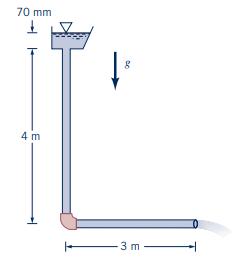
Rainwater flows through the galvanized iron downspout shown in Fig. P8.106 at a rate of \(0.006 \mathrm{~m}^{3} / \mathrm{s}\). Determine the size of the downspout cross section if it is a rectangle with an aspect ratio of 1.7 to 1 and it is completely filled with water. Neglect the velocity of the
Repeat Problem 8.106 if the downspout is circular.Problem 8.106Rainwater flows through the galvanized iron downspout shown in Fig. P8.106 at a rate of \(0.006 \mathrm{~m}^{3} / \mathrm{s}\). Determine the size of the downspout cross section if it is a rectangle with an aspect ratio of 1.7 to 1 and
For a given head loss per unit length, what effect on the flowrate does doubling the pipe diameter have if the flow is(a) laminar,(b) completely turbulent?
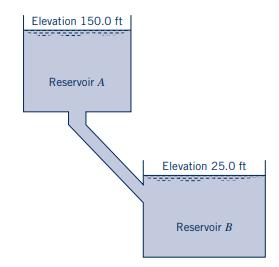
It is necessary to deliver \(270 \mathrm{ft}^{3} / \mathrm{min}\) of water from reservoir \(A\) to reservoir \(B\), as shown in Fig. P8.109. The connecting piping consists of four fully open gate valves, twelve regular \(90^{\circ}\) elbows, one swing check valve, two fully open globe valves, and
A 10-m-long, 5.042-cm I.D. copper pipe has two fully open gate valves, a swing check valve, and a sudden enlargement to a 9.919-cm I.D. copper pipe. The \(9.919 \mathrm{~cm}\) copper pipe is \(5.0 \mathrm{~m}\) long and then has a sudden contraction to another \(5.042-\mathrm{cm}\) copper pipe.
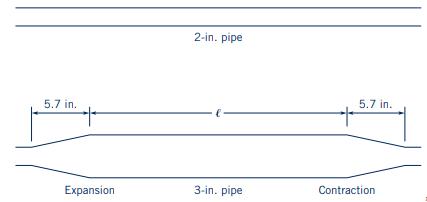
Air, assumed incompressible, flows through the two pipes shown in Fig. P8.111. Determine the flowrate if minor losses are neglected and the friction factor in each pipe is 0.015. Determine the flowrate if the 0.5-in.-diameter pipe were replaced by a 1 -in.diameter pipe. Comment on the assumption of
Repeat Problem 8.111 if the pipes are galvanized iron and the friction factors are not known a priori.Problem 8.111Air, assumed incompressible, flows through the two pipes shown in Fig. P8.111. Determine the flowrate if minor losses are neglected and the friction factor in each pipe is 0.015.
Estimate the power that the human heart must impart to the blood to pump it through the two carotid arteries from the heart to the brain. List all assumptions and show all calculations.
Normal octane at \(68{ }^{\circ} \mathrm{F}\left(u=8.31 \times 10^{-6} \mathrm{ft}^{2} / \mathrm{s}\right)\) is to be delivered at a flow rate of \(3.0 \mathrm{gal} / \mathrm{min}\) through a \(2.0-\) in. schedule 40 commercial steel pipe (with an actual inside diameter of 2.067 in.). Energy
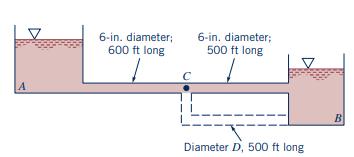
The flowrate between tank \(A\) and tank \(B\) shown in Fig. P8.115 is to be increased by \(30 \%\) (i.e., from \(Q\) to \(1.30 Q\) ) by the addition of a second pipe (indicated by the dotted lines) running from node \(C\) to tank \(B\). If the elevation of the free surface in tank \(A\) is \(25
A 250-ft-high building has a 6.065-in.-diameter steel standpipe and a \(100-\mathrm{ft}\)-long \(2 \frac{9}{16}\)-in. diameter fire hose on each floor. The nearest fireplug is \(100 \mathrm{ft}\) from the standpipe's ground-level connection. Assume that fire-fighters connect a 6-in.-diameter, 50
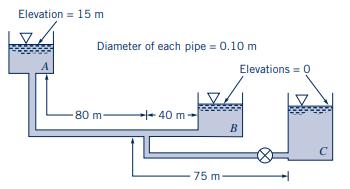
With the valve closed, water flows from \(\operatorname{tank} A\) to \(\operatorname{tank} B\) as shown in Fig. P8.117. What is the flowrate into \(\operatorname{tank} B\) when the valve is opened to allow water to flow into tank \(C\) also? Neglect all minor losses and assume that the friction
Repeat Problem 8.117 if the friction factors are not known, but the pipes are steel pipes.Problem 8.117With the valve closed, water flows from \(\operatorname{tank} A\) to \(\operatorname{tank} B\) as shown in Fig. P8.117. What is the flowrate into \(\operatorname{tank} B\) when the valve is opened
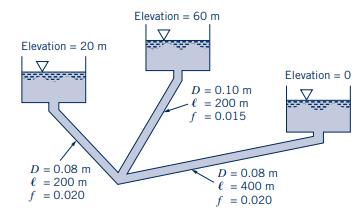
The three water-filled tanks shown in Fig. P8.119 are connected by pipes as indicated. If minor losses are neglected, determine the flowrate in each pipe.Figure P8.119 Elevation = 20 m Elevation = 60 m D= 0.10 m l = 200 m f = 0.015 Elevation = 0 D= 0.08 m l = 200 m f = 0.020 D = 0.08 m ( = 400 m f
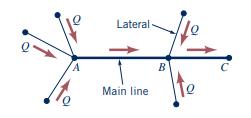
Five oil fields, each producing an output of \(Q\) barrels per day, are connected to the 28 -in.-diameter "mainline pipe" \((A-B-C)\) by 16-in.-diameter "lateral pipes" as shown in Fig. P8.120. The friction factor is the same for each of the pipes and elevation effects are negligible.(a) For
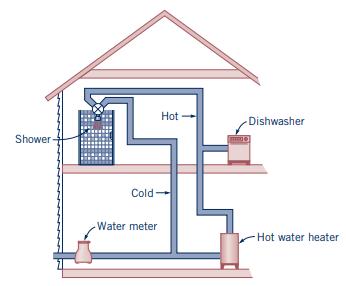
As shown in Fig. P8.121, cold water \(\left(T=50^{\circ} \mathrm{F}\right)\) flows from the water meter to either the shower or the hot water heater. In the hot water heater it is heated to a temperature of \(150{ }^{\circ} \mathrm{F}\). Thus, with equal amounts of hot and cold water, the shower is
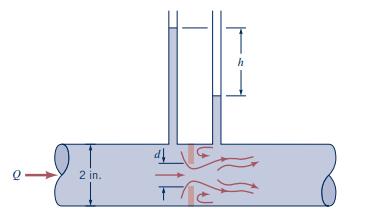
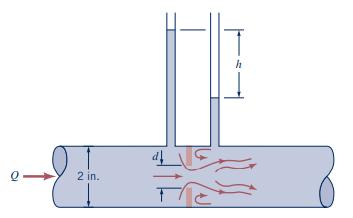
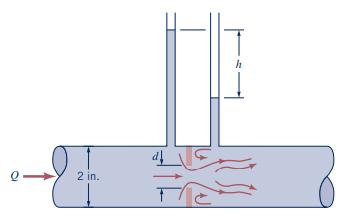
Water flows through the orifice meter shown in Fig. P8.122 at a rate of \(0.10 \mathrm{cfs}\). If \(d=0.1 \mathrm{ft}\), determine the value of \(h\) and the pressure difference associated with this \(h\).Figure P8.122 2 in. 4 h
Water flows through the orifice meter shown in Fig P8.122 such that \(h=1.6 \mathrm{ft}\) with \(d=1.5 \mathrm{in}\). Determine the flowrate.Fig P8.122 0- 2 in. h
Water flows through the orifice meter shown in Fig. P8.122 at a rate of \(0.10 \mathrm{cfs}\). If \(h=3.8 \mathrm{ft}\), determine the value of \(d\).Fig. P8.122 0- 2 in. h
Water flows through a 40 -mm-diameter nozzle meter in a 75 - \(\mathrm{mm}\)-diameter pipe at a rate of \(0.015 \mathrm{~m}^{3} / \mathrm{s}\). Determine the pressure difference across the nozzle if the temperature is(a) \(10{ }^{\circ} \mathrm{C}\), (b) \(80{ }^{\circ} \mathrm{C}\).
Gasoline flows through a \(35-\mathrm{mm}\)-diameter pipe at a rate of \(0.0032 \mathrm{~m}^{3} / \mathrm{s}\). Determine the pressure drop across a flow nozzle placed in the line if the nozzle diameter is \(20 \mathrm{~mm}\).
Air at \(200^{\circ} \mathrm{F}\) and 60 psia flows in a 4-in.-diameter pipe at a rate of \(0.52 \mathrm{lb} / \mathrm{s}\). Determine the pressure at the 2-in.-diameter throat of a Venturi meter placed in the pipe.
A 2.5-in.-diameter flow nozzle meter is installed in a 3.8-in.-diameter pipe that carries water at \(160{ }^{\circ} \mathrm{F}\). If the air-water manometer used to measure the pressure difference across the meter indicates a reading of \(3.1 \mathrm{ft}\), determine the flowrate.
A 0.064-m-diameter nozzle meter is installed in a 0.097-m-diameter pipe that carries water at \(60{ }^{\circ} \mathrm{C}\). If the inverted air-water U-tube manometer used to measure the pressure difference across the meter indicates a reading of \(1 \mathrm{~m}\), determine the flowrate.
A 50-mm-diameter nozzle meter is installed at the end of a 80 -mm-diameter pipe through which air flows. A manometer attached to the static pressure tap just upstream from the nozzle indicates a pressure of \(7.3 \mathrm{~mm}\) of water. Determine the flowrate.
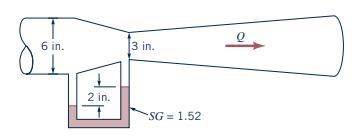
Water flows through the Venturi meter shown in Fig. P8.131. The specific gravity of the manometer fluid is 1.52. Determine the flowrate.Figure P8.131 6 in. 3 in. 2 in. SG 1.52
If the fluid flowing in Problem 8.131 were air, what would the flowrate be? Would compressibility effects be important? Explain.Problem 8.131Water flows through the Venturi meter shown in Fig. P8.131. The specific gravity of the manometer fluid is 1.52. Determine the flowrate.Figure P8.131 6 in. 3
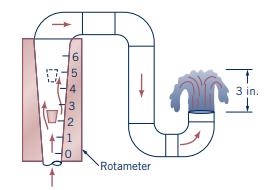
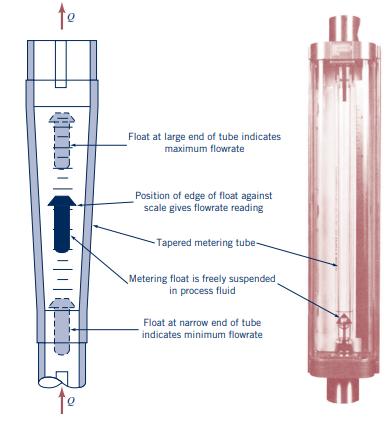
The scale reading on the rotameter shown in Fig. P8.133 (also see Fig. 8.44) is directly proportional to the volumetric flowrate. With a scale reading of 2.6 the water bubbles up approximately 3 in. How far will it bubble up if the scale reading is 5.0?Figure P8.133Fig. 8.44 65 321 Rotameter 3 in.
A mixing basin in a sewage filtration plant is stirred by mechanical agitation (paddlewheel) with a power input \(\dot{W}(\mathrm{ft} \cdot \mathrm{lb} / \mathrm{s})\). The degree of mixing of fluid particles is measured by a "velocity gradient" \(G\) given by\[ G=\sqrt{\frac{\dot{W}}{\mu V}}
An equation used to evaluate vacuum filtration is\[ Q=\frac{\Delta p A^{2}}{\alpha\left(\forall R w+A R_{f}\right)} \]Where \(Q \doteq L^{3} / T\) is the filtrate volume flow rate, \(\Delta p \doteq F / L^{2}\) the vacuum pressure differential, \(A \doteq L^{2}\) the filter area, \(\alpha\) the
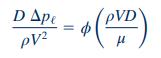
Verify the left-hand side of Eq. 7.2 is dimensionless using the MLT system.Eq. 7.2 D Ape PV2 = (DVD)
The Reynolds number, \(ho V D / \mu\), is a very important parameter in fluid mechanics. Verify that the Reynolds number is dimensionless, using both the FLT system and the MLT system for basic dimensions, and determine its value for ethyl alcohol flowing at a velocity of \(3 \mathrm{~m} /
For the flow of a thin film of a liquid with a depth \(h\) and a free surface, two important dimensionless parameters are the Froude number, \(V / \sqrt{g h}\), and the Weber number, \(ho V^{2} h / \sigma\). Determine the value of these two parameters for glycerin (at \(20^{\circ} \mathrm{C}\) )
The Mach number for a body moving through a fluid with velocity \(V\) is defined as \(V / c\), where \(c\) is the speed of sound in the fluid. This dimensionless parameter is usually considered to be important in fluid dynamics problems when its value exceeds 0.3. What would be the velocity of a
A mixing basin in a sewage filtration plant is stirred by a mechanical agitator with a power input \(\dot{W} \doteq F \cdot L / T\). Other parameters describing the performance of the mixing process are the fluid absolute viscosity \(\mu \doteq F \cdot T / L^{2}\), the basin volume \(\forall \doteq
The excess pressure inside a bubble (discussed in Chapter 1) is known to be dependent on bubble radius and surface tension. After finding the pi terms, determine the variation in excess pressure if we(a) double the radius (b) double the surface tension.
At a sudden contraction in a pipe the diameter changes from \(D_{1}\) to \(D_{2}\). The pressure drop, \(\Delta p\), which develops across the contraction is a function of \(D_{1}\) and \(D_{2}\), as well as the velocity, \(V\), in the larger pipe, and the fluid density, \(ho\), and viscosity,
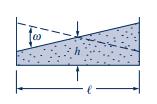
Water sloshes back and forth in a tank as shown in Fig. P7.10. The frequency of sloshing, \(\omega\), is assumed to be a function of the acceleration of gravity, \(g\), the average depth of the water, \(h\), and the length of the tank, \(\ell\). Develop a suitable set of dimensionless parameters
Assume that the flowrate, \(Q\), of a gas from a smokestack is a function of the density of the ambient air, \(ho_{a}\), the density of the gas, \(ho_{g}\), within the stack, the acceleration of gravity, \(g\), and the height and diameter of the stack, \(h\) and \(d\), respectively. Use \(ho_{a},
The pressure rise, \(\Delta p\), across a pump can be expressed as\[ \Delta p=f(D, ho, \omega, Q) \]where \(D\) is the impeller diameter, \(ho\) the fluid density, \(\omega\) the rotational speed, and \(Q\) the flowrate. Determine a suitable set of dimensionless parameters.
A thin elastic wire is placed between rigid supports. A fluid flows past the wire, and it is desired to study the static deflection, \(\delta\), at the center of the wire due to the fluid drag. Assume that\[\delta=f(\ell, d, ho, \mu, V, E)\]where \(\ell\) is the wire length, \(d\) the wire
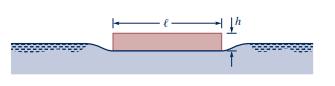
Because of surface tension, it is possible, with care, to support an object heavier than water on the water surface as shown in Fig. P7.14. The maximum thickness, \(h\), of a square of material that can be supported is assumed to be a function of the length of the side of the square, \(\ell\), the
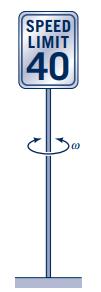
Under certain conditions, wind blowing past a rectangular speed limit sign can cause the sign to oscillate with a frequency \(\omega\). See Fig. P7.15. Assume that \(\omega\) is a function of the sign width, \(b\), sign height, \(h\), wind velocity, \(V\), air density, \(ho\), and an elastic
Showing 400 - 500
of 2369
1
2
3
4
5
6
7
8
9
10
11
12
13
14
15
Last
Step by Step Answers

 Get 50% OFF
Claim Now
Get 50% OFF
Claim Now