New Semester
Started
Get
50% OFF
Study Help!
--h --m --s
Claim Now
Question Answers
Textbooks
Find textbooks, questions and answers
Oops, something went wrong!
Change your search query and then try again
S
Books
FREE
Study Help
Expert Questions
Accounting
General Management
Mathematics
Finance
Organizational Behaviour
Law
Physics
Operating System
Management Leadership
Sociology
Programming
Marketing
Database
Computer Network
Economics
Textbooks Solutions
Accounting
Managerial Accounting
Management Leadership
Cost Accounting
Statistics
Business Law
Corporate Finance
Finance
Economics
Auditing
Tutors
Online Tutors
Find a Tutor
Hire a Tutor
Become a Tutor
AI Tutor
AI Study Planner
NEW
Sell Books
Search
Search
Sign In
Register
study help
engineering
engineering fluid mechanics
Munson Young And Okiishi's Fundamentals Of Fluid Mechanics 8th Edition Philip M. Gerhart, Andrew L. Gerhart, John I. Hochstein - Solutions
Water flows vertically upward in a circular cross-sectional pipe. At section (1), the velocity profile over the cross-sectional area is uniform. At section (2), the velocity profile is\[ \mathbf{V}=w_{c}\left(\frac{R-r}{R}\right)^{1 / 7} \hat{\mathbf{k}} \]where \(\mathbf{V}=\) local velocity
Calculate the kinetic energy correction factor for each of the following velocity profiles for a circular pipe:(a) \(u=u_{\max }\left(1-\frac{r}{R}\right)\)(b) \(u=u_{\max }\left(1-\frac{r^{2}}{R^{2}}\right)\);(c) \(u=u_{\max }\left(1-\frac{r}{R}\right)^{1 / 9}\)\(R\) is the pipe radius and \(r\)
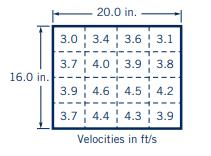
The cross-sectional area of a rectangular duct is divided into 16 equal rectangular areas, as shown in Fig. P5.131. The axial fluid velocity measured in feet per second in each smaller area is shown. Estimate the kinetic energy correction factor.Figure P5.131 20.0 in. 3.0 3.4 3.6 3.1 3.7 4.0 3.9
A small fan moves air at a mass flowrate of \(0.004 \mathrm{lbm} / \mathrm{s}\). Upstream of the fan, the pipe diameter is 2.5 in., the flow is laminar, the velocity distribution is parabolic, and the kinetic energy coefficient, \(\alpha_{1}\), is equal to 2.0. Downstream of the fan, the pipe
Air enters a radial blower with zero angular momentum. It leaves with an absolute tangential velocity, \(V_{\theta}\), of \(200 \mathrm{ft} / \mathrm{s}\). The rotor blade speed at rotor exit is \(170 \mathrm{ft} / \mathrm{s}\). If the stagnation pressure rise across the rotor is \(0.4
Water enters a pump impeller radially. It leaves the impeller with a tangential component of absolute velocity of \(10 \mathrm{~m} / \mathrm{s}\). The impeller exit diameter is \(60 \mathrm{~mm}\), and the impeller speed is \(1800 \mathrm{rpm}\). If the stagnation pressure rise across the impeller
Water enters an axial-flow turbine rotor with an absolute velocity tangential component, \(V_{\theta}\), of \(15 \mathrm{ft} / \mathrm{s}\). The corresponding blade velocity, \(U\), is \(50 \mathrm{ft} / \mathrm{s}\). The water leaves the rotor blade row with no angular momentum. If the stagnation
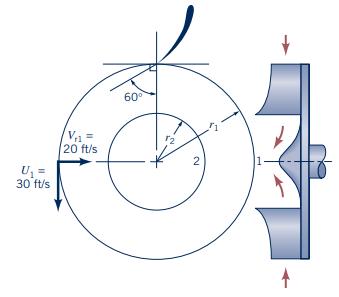
An inward flow radial turbine (see Fig. P5.136) involves a nozzle angle, \(\alpha_{1}\), of \(60^{\circ}\) and an inlet rotor tip speed, \(U_{1}\), of \(30 \mathrm{ft} / \mathrm{s}\). The ratio of rotor inlet to outlet diameters is 2.0. The radial component of velocity remains constant at \(20
The velocity in a certain two-dimensional flow field is given by the equation\[ \mathbf{V}=2 x \hat{\mathbf{i}}-2 y t \hat{\mathbf{j}} \]where the velocity is in \(\mathrm{ft} / \mathrm{s}\) when \(x, y\), and \(t\) are in feet and seconds, respectively. Determine expressions for the local and
The velocity in a certain flow field is given by the equation\[ \mathbf{V}=x \hat{\mathbf{i}}+x^{2} z \hat{\mathbf{j}}+y z \hat{\mathbf{k}} \]Determine the expressions for the three rectangular components of acceleration.
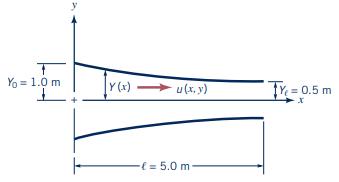
The flow in the plane two-dimensional channel shown in Figure P6.3 has \(x\) - and \(y\)-components of velocity given by\[ \begin{aligned} & u=u_{0}\left(1+\frac{x}{\ell}\right)\left[1-\left(\frac{y}{Y}\right)^{2}\right] \\ & v=u_{0}\left[\frac{y^{3}}{\ell
The three components of velocity in a flow field are given by\[ \begin{aligned} u & =x^{2}+y^{2}+z^{2} \\ v & =x y+y z+z^{2} \\ w & =-3 x z-z^{2} / 2+4 \end{aligned} \](a) Determine the volumetric dilatation rate and interpret the results. (b) Determine an expression for the rotation vector.
Determine an expression for the vorticity of the flow field described by\[ \mathbf{V}=-x y^{3} \hat{\mathbf{i}}+y^{4} \hat{\mathbf{j}} \]Is the flow irrotational?
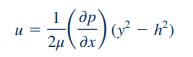
According to Eq. 6.134, the \(x\)-velocity in fully developed laminar flow between parallel plates is given by\[ u=\frac{1}{2 \mu}\left(\frac{\partial p}{\partial x}\right)\left(y^{2}-h^{2}\right) \]The \(y\)-velocity is \(v=0\). Determine the volumetric strain rate, the vorticity, and the rate of
For a certain incompressible, two-dimensional flow field the velocity component in the \(y\) direction is given by the equation\[ v=3 x y+x^{2} y \]Determine the velocity component in the \(x\) direction so that the volumetric dilatation rate is zero.
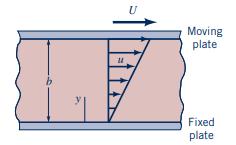
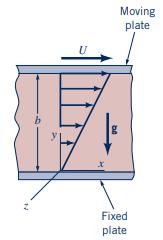
An incompressible viscous fluid is placed between two large parallel plates as shown in Fig. P6.8. The bottom plate is fixed and the upper plate moves with a constant velocity, \(U\). For these conditions the velocity distribution between the plates is linear and can be expressed as\[ u=U
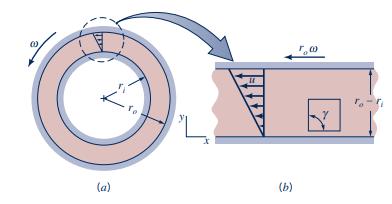
A viscous fluid is contained in the space between concentric cylinders. The inner wall is fixed, and the outer wall rotates with an angular velocity \(\omega\). Fig. P6.9a Assume that the velocity distribution in the gap is linear as illustrated in Fig. P6.9b. For the small rectangular element
Air is delivered through a constant-diameter duct by a fan. The air is inviscid, so the fluid velocity profile is "flat" across each cross section. During the fan start-up, the following velocities were measured at the time \(t\) and axial positions \(x\) :\[ \begin{array}{llll} &
For a certain incompressible flow field it is suggested that the velocity components are given by the equations\[ u=2 x y \quad v=-x^{2} y \quad w=0 \]Is this a physically possible flow field? Explain.
The velocity components of an incompressible, two-dimensional velocity field are given by the equations\[ \begin{aligned} u & =y^{2}-x(1+x) \\ v & =y(2 x+1) \end{aligned} \]Show that the flow is irrotational and satisfies conservation of mass.
Consider the two-dimensional channel flow of Problem 6.3. Show that the given velocities satisfy conservation of mass in both differential and control volume forms.Problem 6.3The flow in the plane two-dimensional channel shown in Figure P6.3 has \(x\) - and \(y\)-components of velocity given by\[
The \(x\)-velocity profile in a certain laminar boundary layer is approximated as follows\[ u=U_{0} \sin \left(\frac{\pi}{2} \frac{y}{0.1 \sqrt{x}}\right) \]Determine the \(y\)-velocity, \(v(x, y)\).
For each of the following stream functions, with units of \(\mathrm{m}^{2} / \mathrm{s}\), determine the magnitude and the angle the velocity vector makes with the \(x\) axis at \(x=1 \mathrm{~m}, y=2 \mathrm{~m}\). Locate any stagnation points in the flow field.(a) \(\psi=x y\)(b) \(\psi=-2
The stream function for an incompressible, two-dimensional flow field is\[ \psi=a y-b y^{3} \]where \(a\) and \(b\) are constants. Is this an irrotational flow? Explain.
For a certain two-dimensional flow field\[ \begin{aligned} & u=0 \\ & v=V \end{aligned} \](a) What are the corresponding radial and tangential velocity components? (b) Determine the corresponding stream function expressed in Cartesian coordinates and in cylindrical polar coordinates.
In a certain steady, two-dimensional flow field the fluid density varies linearly with respect to the coordinate \(x\) : that is, \(ho=A x\) where \(A\) is a constant. If the \(x\) component of velocity \(u\) is given by the equation \(u=y\), determine an expression for \(v\).
In a two-dimensional, incompressible flow field, the \(x\) component of velocity is given by the equation \(u=2 x\). (a) Determine the corresponding equation for the \(y\) component of velocity if \(v=0\) along the \(x\) axis. (b) For this flow field, what is the magnitude of the average velocity
The stream function for an incompressible flow field is given by the equation\[ \psi=3 x^{2} y-y^{3} \]where the stream function has the units of \(\mathrm{m}^{2} / \mathrm{s}\) with \(x\) and \(y\) in meters. (a) Sketch the streamline(s) passing through the origin. (b) Determine the rate of flow
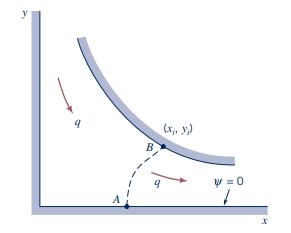
Consider the incompressible, two-dimensional flow of a nonviscous fluid between the boundaries shown in Fig. P6.22. The velocity potential for this flow field is\[ \phi=x^{2}-y^{2} \](a) Determine the corresponding stream function. (b) What is the relationship between the discharge, \(q\) (per
A fluid with a density of \(2000 \mathrm{~kg} / \mathrm{m}^{3}\) flows steadily between two flat plates as shown in Fig. P6.23. The bottom plate is fixed and the top one moves at a constant speed in the \(x\) direction. The velocity is \(\boldsymbol{V}=0.20 y \hat{\mathbf{i}} \mathrm{m} /
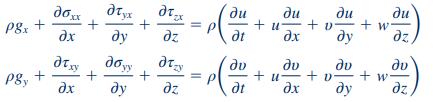
We derived the differential equation(s) of linear momentum by considering the motion of a fluid element. Derive the linear momentum equation(s) by considering a small control volume, like we did for the continuity equation.
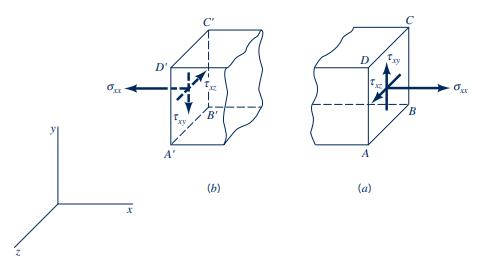
By considering the rotational equilibrium of a fluid mass element, show that \(\tau_{x y}=\tau_{y x}\).
The stream function for a given two-dimensional flow field is\[ \psi=5 x^{2} y-(5 / 3) y^{3} \]Determine the corresponding velocity potential.
A certain flow field is described by the stream function\[ \psi=A \theta+B r \sin \theta \]where \(A\) and \(B\) are positive constants. Determine the corresponding velocity potential and locate any stagnation points in this flow field.
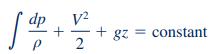
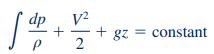
Integrate Bernoulli's equation for compressible flow, Eq. (6.56), for an ideal gas undergoing an isothermal (constant temperature) process along a streamline.Eq. (6.56) 3/2 + P + gz = constant
Integrate Bernoulli's equation for compressible flow, Eq. (6.56), for a fluid whose pressure \(p\) and density \(ho\) obey the expression \(p=C ho^{n}\) along a streamline, where \(C\) and \(n\) are constants.Eq. (6.56) 3/2 + P + gz = constant
The velocity potential for a certain inviscid flow field is\[ \phi=-\left(3 x^{2} y-y^{3}\right) \]where \(\phi\) has the units of \(\mathrm{ft}^{2} / \mathrm{s}\) when \(x\) and \(y\) are in feet. Determine the pressure difference (in psi) between the points \((1,2)\) and \((4,4)\), where the
The stream function for a two-dimensional, nonviscous, incompressible flow field is given by the expression\[ \psi=-2(x-y) \]where the stream function has the units of \(\mathrm{ft}^{2} / \mathrm{s}\) with \(x\) and \(y\) in feet. (a) Is the continuity equation satisfied? (b) Is the flow field
The velocity potential for a certain inviscid, incompressible flow field is given by the equation\[ \phi=2 x^{2} y-\left(\frac{2}{3}\right) y^{3} \]where \(\phi\) has the units of \(\mathrm{m}^{2} / \mathrm{s}\) when \(x\) and \(y\) are in meters. Determine the pressure at the point \(x=2
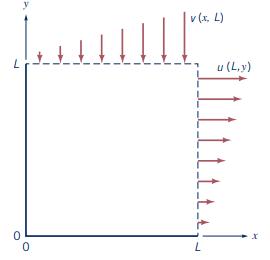
Consider the two-dimensional air flow around the corner, as shown in Fig. P6.33. The \(x\) - and \(y\)-direction velocities are\[ u=\frac{v_{0}}{L} \sin \mathrm{h}\left(\frac{x}{L}\right) \cosh \left(\frac{y}{L}\right) \]and\[ v=-\frac{v_{0}}{L} \cosh \left(\frac{x}{L}\right) \sin
The streamlines for an incompressible, inviscid, two-dimensional flow field are all concentric circles, and the velocity varies directly with the distance from the common center of the streamlines; that is\[ v_{\theta}=K r \]where \(K\) is a constant. (a) For this rotational flow, determine, if
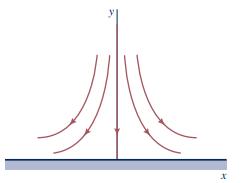
The velocity potential\[ \phi=-k\left(x^{2}-y^{2}\right) \quad(k=\text { constant }) \]may be used to represent the flow against an infinite plane boundary, as illustrated in Fig. P6.35. For flow in the vicinity of a stagnation point, it is frequently assumed that the pressure gradient along the
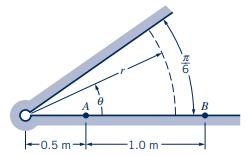
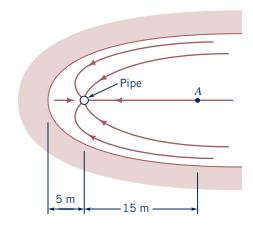
Water is flowing between wedge-shaped walls into a small opening as shown in Fig. P6.36. The velocity potential with units \(\mathrm{m}^{2} / \mathrm{s}\) for this flow is \(\phi=-2 \ln r\) with \(r\) in meters. Determine the pressure differential between points \(A\) and \(B\).Figure P6.36 -0.5 m
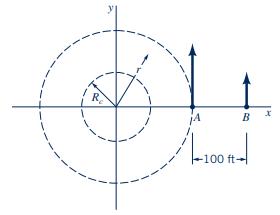
As illustrated in Fig. P6.38, a tornado can be approximated by a free vortex of strength \(\Gamma\) for \(r>R_{c}\), where \(R_{c}\) is the radius of the core. Velocity measurements at points \(A\) and \(B\) indicate that \(V_{A}=125 \mathrm{ft} / \mathrm{s}\) and \(V_{B}=60 \mathrm{ft} /
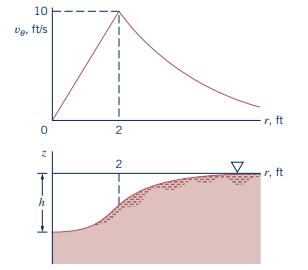
The motion of a liquid in an open tank is that of a combined vortex consisting of a forced vortex for \(0 \leq r \leq 2 \mathrm{ft}\) and a free vortex for \(r>2 \mathrm{ft}\). The velocity profile and the corresponding shape of the free surface are shown in Fig. P6.39. The free surface at the
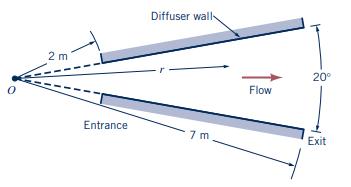
Water flows through a two-dimensional diffuser having a \(20^{\circ}\) expansion angle as shown in Fig. P6.40. Assume that the flow in the diffuser can be treated as a radial flow emanating from a source at the origin \(O\). (a) If the velocity at the entrance is \(20 \mathrm{~m} / \mathrm{s}\),
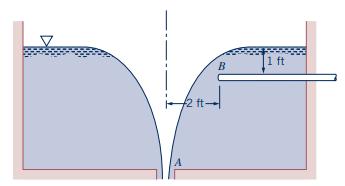
When water discharges from a tank through an opening in its bottom, a vortex may form with a curved surface profile, as shown in Fig. P6.41. Assume that the velocity distribution in the vortex is the same as that for a free vortex. At the same time the water is being discharged from the tank at
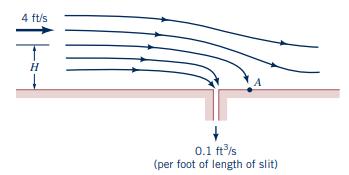
Water flows over a flat surface at \(4 \mathrm{ft} / \mathrm{s}\), as shown in Fig. P6.42. A pump draws off water through a narrow slit at a volume rate of \(0.1 \mathrm{ft}^{3} / \mathrm{s}\) per foot length of the slit. Assume that the fluid is incompressible and inviscid and can be represented
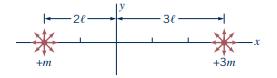
Two sources, one of strength \(m\) and the other with strength \(3 m\), are located on the \(x\) axis as shown in Fig. P6.43. Determine the location of the stagnation point in the flow produced by these sources.Figure P6.43 +m 2e -31- +3m
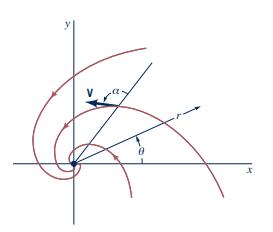
The velocity potential for a spiral vortex flow is given by \(\phi=\) \((\Gamma / 2 \pi) \theta-(m / 2 \pi) \ln r\), where \(\Gamma\) and \(m\) are constants. Show that the angle, \(\alpha\), between the velocity vector and the radial direction is constant throughout the flow field (see Fig.
For a free vortex determine an expression for the pressure gradient(a) along a streamline, (b) normal to a streamline. Assume that the streamline is in a horizontal plane, and express your answer in terms of the circulation.
The Wide World of Fluids article titled "Some Hurricane Facts,". Consider a category five hurricane that has a maximum wind speed of \(160 \mathrm{mph}\) at the eye wall, \(10 \mathrm{mi}\) from the center of the hurricane. If the flow in the hurricane outside of the hurricane's eye is approximated
Consider the flow of a liquid of viscosity \(\mu\) and density \(ho\) down an inclined plate making an angle \(\theta\) with the horizontal. The film thickness is \(t\) and is constant. The fluid velocity parallel to the plate is given by\[ V_{x}=\frac{ho t^{2} g \cos \theta}{2
A horizontal oil-hearing stratum is \(3 \mathrm{~m}\) high and, after hydraulic fracturing ("fracking"), provides a volume flow rate of \(Q=1000 \mathrm{~m}^{3} / \mathrm{hr}\). The flow moves radially inward and is collected by a vertical porous pipe having an outer radius of \(1.0 \mathrm{~m}\).
Show that the circulation of a free vortex for any closed path that does not enclose the origin is zero.
Show that the circulation of a free vortex for any closed path that encloses the origin is \(\Gamma\).
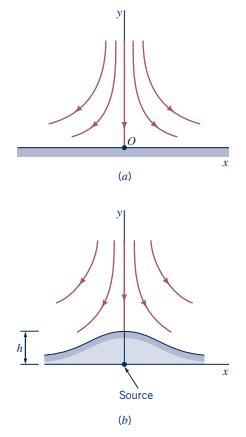
Potential flow against a flat plate (Fig. P6.51a) can be described with the stream function\[ \psi=A x y \]where \(A\) is a constant. This type of flow is commonly called a stagnation point flow since it can be used to describe the flow in the vicinity of the stagnation point at \(O\). By adding
The combination of a uniform flow and a source can be used to describe flow around a streamlined body called a halfbody. Assume that a certain body has the shape of a half-body with a thickness of \(0.5 \mathrm{~m}\). If this body is placed in an airstream moving at \(15 \mathrm{~m} / \mathrm{s}\),
Show that if \(\Phi_{1}\) and \(\Phi_{2}\) are both solutions of Laplace's equation, the sum \(\left(\Phi_{1}+\Phi_{2}\right)\) is also a solution.
The flow in the impeller of a centrifugal pump is modeled by the superposition of a source and a free vortex. The impeller has an outer diameter of \(0.5 \mathrm{~m}\) and an inner diameter of \(0.3 \mathrm{~m}\). At the outlet from the impeller, the flowing water has the following velocity
One end of a pond has a shoreline that resembles a halfbody as shown in Fig. P6.55. A vertical porous pipe is located near the end of the pond so that water can be pumped out. When water is pumped at the rate of \(0.08 \mathrm{~m}^{3} / \mathrm{s}\) through a \(3-\mathrm{m}\)-long pipe, what will
A Rankine oval is formed by combining a source-sink pair, each having a strength of \(36 \mathrm{ft}^{2} / \mathrm{s}\) and separated by a distance of \(12 \mathrm{ft}\) along the \(x\) axis, with a uniform velocity of \(10 \mathrm{ft} / \mathrm{s}\) (in the positive \(x\) direction). Determine the
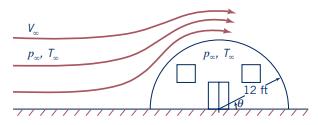
A 15-mph wind flows over a Quonset hut having a radius of \(12 \mathrm{ft}\) and a length of \(60 \mathrm{ft}\), as shown in Fig. P6.57. The upstream pressure and temperature are equal to those inside the Quonset hut: \(14.696 \mathrm{psia}\) and \(70{ }^{\circ} \mathrm{F}\). Estimate the upward
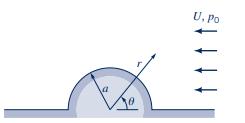
An ideal fluid flows past an infinitely long, semicircular "hump" located along a plane boundary, as shown in Fig. P6.58. Far from the hump the velocity field is uniform, and the pressure is \(p_{0}\). (a) Determine expressions for the maximum and minimum values of the pressure along the hump, and
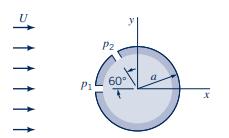
Assume that the flow around the long circular cylinder of Fig. P6.59 is nonviscous and incompressible. Two pressures, \(p_{1}\) and \(p_{2}\), are measured on the surface of the cylinder, as illustrated. It is proposed that the free-stream velocity, \(U\), can be related to the pressure difference
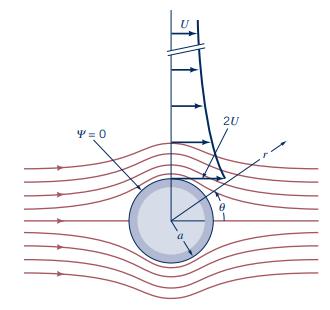
Consider the steady potential flow around the circular cylinder shown in Fig. 6.26. On a plot show the variation of the magnitude of the dimensionless fluid velocity, \(V / U\), along the positive \(y\) axis. At what distance, \(y / a\) (along the \(y\) axis), is the velocity within \(1 \%\) of the
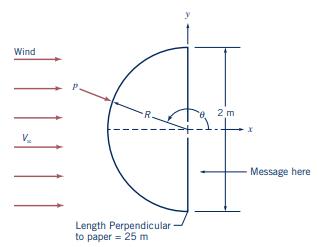
A highway sign has the shape of a half-cylinder with radius \(1.0 \mathrm{~m}\) and length \(25.0 \mathrm{~m}\). A rearward \(10-\mathrm{km} / \mathrm{hr}\) wind is blowing over the sign as shown in Fig. P6.61.Figure P6.61The pressure on the flat face is constant and equal to the pressure at the
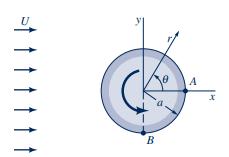
Air at \(25^{\circ} \mathrm{C}\) flows normal to the axis of an infinitely long cylinder of \(1.0-\mathrm{m}\) radius. The cylinder is rotating at \(10 \mathrm{rad} / \mathrm{s}\), and the approach velocity is \(100 \mathrm{~km} / \mathrm{hr}\). Find the maximum and minimum pressures on the
The velocity potential for a cylinder (Fig. P6.63) rotating in a uniform stream of fluid is\[ \phi=U r\left(1+\frac{a^{2}}{r^{2}}\right) \cos \theta+\frac{\Gamma}{2 \pi} \theta \]where \(\Gamma\) is the circulation. For what value of the circulation will the stagnation point be located at: (a)
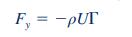
The Wide World of Fluids article titled "A Sailing Ship without Sails,". Determine the magnitude of the total force developed by the two rotating cylinders on the Flettner "rotor-ship" due to the Magnus effect. Assume a wind-speed relative to the ship of(a) \(10 \mathrm{mph}\)(b) \(30
Consider the possibility of using two rotating cylinders to replace the conventional wings on an airplane for lift. Consider an airplane flying at \(700 \mathrm{~km} / \mathrm{hr}\) through the Standard Atmosphere at \(10,000 \mathrm{~m}\). Each "wing cylinder" has a 3.0-m radius. The surface
Air at \(25^{\circ} \mathrm{C}\) flows normal to the axis of an infinitely long cylinder of \(1.0-\mathrm{m}\) radius. The approach velocity is \(100 \mathrm{~km} / \mathrm{hr}\). Find the rotational velocity of the cylinder so that a single stagnation point occurs on the lower-most part of the
Determine the shearing stress for an incompressible Newtonian fluid with a velocity distribution of \(\mathbf{V}=\left(3 x y^{2}-4 x^{3}\right) \mathbf{i}+\) \(\left(12 x^{2} y-y^{3}\right) \mathbf{j}\).
The two-dimensional velocity field for an incompressible Newtonian fluid is described by the relationship\[ \mathbf{V}=\left(12 x y^{2}-6 x^{3}\right) \hat{\mathbf{i}}+\left(18 x^{2} y-4 y^{3}\right) \hat{\mathbf{j}} \]where the velocity has units of \(\mathrm{m} / \mathrm{s}\) when \(x\) and
The velocity of a fluid particle moving along a horizontal streamline that coincides with the \(x\) axis in a plane, two-dimensional, incompressible flow field was experimentally found to be described by the equation \(u=x^{2}\). Along this streamline determine an expression for(a) the rate of
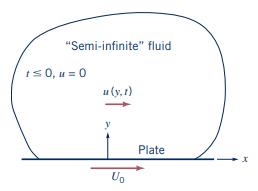
"Stokes's first problem" involves the instantaneous acceleration at time \(t=0\) of a flat plate to a constant velocity \(U_{0}\) while in contact with a "semi-infinite," static fluid as shown in Fig. P6.70. For a constant fluid density and viscosity, the simplified NavierStokes equation is\[
Oil (SAE 30) at \(15.6{ }^{\circ} \mathrm{C}\) flows steadily between fixed, horizontal, parallel plates. The pressure drop per unit length along the channel is \(30 \mathrm{kPa} / \mathrm{m}\), and the distance between the plates is \(4 \mathrm{~mm}\). The flow is laminar. Determine:(a) the volume
Two fixed, horizontal, parallel plates are spaced 0.4 in. apart. A viscous liquid \(\left(\mu=8 \times 10^{-3} \mathrm{lb} \cdot \mathrm{s} / \mathrm{ft}^{2}, S G=0.9\right)\) flows between the plates with a mean velocity of \(0.5 \mathrm{ft} / \mathrm{s}\). The flow is laminar. Determine the
A liquid of constant density \(ho\) and constant viscosity \(\mu\) flows down a wide, long inclined flat plate. The plate makes an angle \(\theta\) with the horizontal. The velocity components do not change in the direction of the plate, and the fluid depth, \(h\), normal to the plate is constant.
We will see in Chapter 8 that the pressure drop in fully developed pipe flow is sometimes computed with the aid of a friction factor, defined by\[ f=\frac{\Delta p}{\frac{1}{2} ho V^{2}} \frac{D}{\ell} \]where \(V\) is the average velocity and \(\ell\) is the length of pipe over which \(\Delta
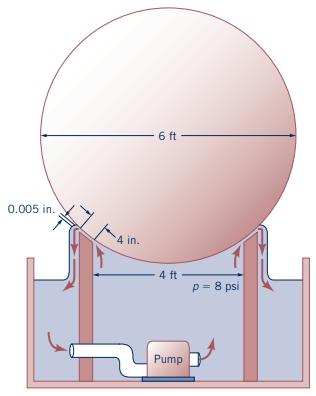
The Wide World of Fluids article titled "10 Tons on 8 psi,". A massive, precisely machined, 6-ft-diameter granite sphere rests on a 4-ft-diameter cylindrical pedestal as shown in Fig. P6.75. When the pump is turned on and the water pressure within the pedestal reaches 8 psi, the sphere rises off
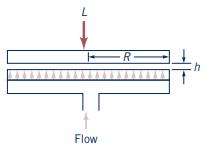
The bearing shown in Fig. P6.76 consists of two parallel discs of radius \(R\) separated from each other by a small distance \(h(h)\), and angular symmetry exists \((\partial / \partial \theta=0)\).Figure P6.76 L Flow -R- h
A Bingham plastic is a fluid in which the stress \(\tau\) is related to the rate of strain \(d u / d y\) by\[ \tau=\tau_{0}+\mu\left(\frac{d u}{d y}\right) \]where \(\tau_{0}\) and \(\mu\) are constants. Consider the flow of a Bingham plastic between two fixed, horizontal, infinitely wide, flat
Two horizontal, infinite, parallel plates are spaced a distance \(b\) apart. A viscous liquid is contained between the plates. The bottom plate is fixed, and the upper plate moves parallel to the bottom plate with a velocity \(U\). Because of the no-slip boundary condition, the liquid motion is
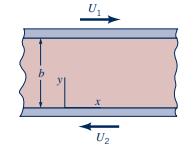
An incompressible, viscous fluid is placed between horizontal, infinite, parallel plates as is shown in Fig. P6.79. The two plates move in opposite directions with constant velocities, \(U_{1}\) and \(U_{2}\), as shown. The pressure gradient in the \(x\) direction is zero, and the only body force
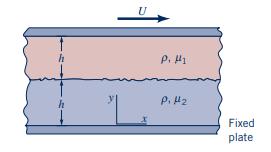
Two immiscible, incompressible, viscous fluids having the same densities but different viscosities are contained between two infinite, horizontal, parallel plates (Fig. P6.80). The bottom plate is fixed, and the upper plate moves with a constant velocity \(U\). Determine the velocity at the
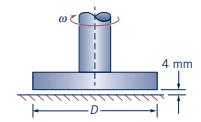
The disc shown in Fig. P6.81 has a diameter \(D\) of \(1 \mathrm{~m}\) and a rotational speed of \(1800 \mathrm{rpm}\). It is positioned \(4 \mathrm{~mm}\) from a solid boundary. The gap is filled with \(15{ }^{\circ} \mathrm{C} \mathrm{SAE} 10 \mathrm{~W}\) oil. Find the torque required to
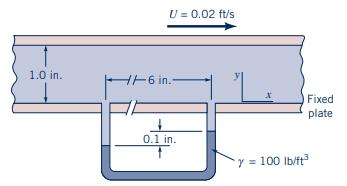
A viscous fluid (specific weight \(=80 \mathrm{lb} / \mathrm{ft}^{3}\); viscosity \(=\) \(0.03 \mathrm{lb} \cdot \mathrm{s} / \mathrm{ft}^{2}\) ) is contained between two infinite, horizontal parallel plates as shown in Fig. P6.82. The fluid moves between the plates under the action of a pressure
A flat block is pulled along a horizontal flat surface by a horizontal rope perpendicular to one of the sides. The block measures \(1.0 \mathrm{~m} \times 1.0 \mathrm{~m}\), has a mass of \(100 \mathrm{~kg}\) and a constant velocity of \(1.0 \mathrm{~m} / \mathrm{s}\), and is separated from the
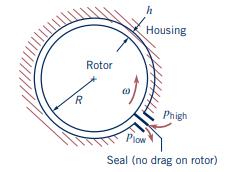
A viscosity motor/pump is shown in Fig. P6.84. The rotor is concentric within a stationary housing. The clearance \(h\) between the housing and the rotor is small compared to the width \(w\) and radius \(R\) of the rotor. A seal divides the clearance space as shown. When the device is operated as a
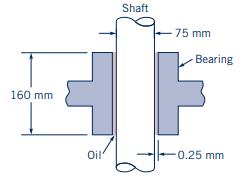
A vertical shaft passes through a bearing and is lubricated with an oil having a viscosity of \(0.2 \mathrm{~N} \cdot \mathrm{s} / \mathrm{m}^{2}\) as shown in Fig. P6.85. Assume that the flow characteristics in the gap between the shaft and bearing are the same as those for laminar flow between
A viscous fluid is contained between two long concentric cylinders. The geometry of the system is such that the flow between the cylinders is approximately the same as the laminar flow between two infinite parallel plates.(a) Determine an expression for the torque required to rotate the outer
Verify that the momentum correction factor \(\beta\) for fully developed, laminar flow in a circular tube is \(4 / 3\).
Verify that the kinetic energy correction factor \(\alpha\) for fully developed, laminar flow in a circular tube is 2.0.
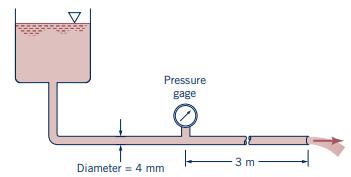
A simple flow system to be used for steady-flow tests consists of a constant head tank connected to a length of 4-mm-diameter tubing as shown in Fig. P6.89. The liquid has a viscosity of \(0.015 \mathrm{~N} \cdot \mathrm{s} / \mathrm{m}^{2}\), a density of \(1200 \mathrm{~kg} / \mathrm{m}^{3}\),
(a) Show that for Poiseuille flow in a tube of radius \(R\) the magnitude of the wall shearing stress, \(\tau_{r z}\), can be obtained from the relationship\[ \left|\left(\tau_{r z}\right)_{\text {wall }}\right|=\frac{4 \mu Q}{\pi R^{3}} \]for a Newtonian fluid of viscosity \(\mu\). The volume
An infinitely long, solid, vertical cylinder of radius \(R\) is located in an infinite mass of an incompressible fluid. Start with the Navier-Stokes equation in the \(\theta\) direction and derive an expression for the velocity distribution for the steady-flow case in which the cylinder is rotating
We will see in Chapter 8 that the pressure drop in fully developed pipe flow is sometimes computed with the aid of a friction factor, defined by\[ f=\frac{\Delta p}{\frac{1}{2} ho V^{2}} \frac{D}{\ell} \]where \(V\) is the average velocity, \(D\) is the pipe diameter, and \(\ell\) is the length
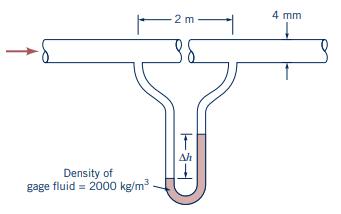
A liquid (viscosity \(=0.002 \mathrm{~N} \cdot \mathrm{s} / \mathrm{m}^{2}\); density \(=1000 \mathrm{~kg} / \mathrm{m}^{3}\) ) is forced through the circular tube shown in Fig. P6.93. A differential manometer is connected to the tube as shown to measure the pressure drop along the tube. When the
Fluid with kinematic viscosity \(u\) flows down an inclined circular pipe of length \(\ell\) and diameter \(D\) with flow rate \(Q\). Find the vertical drop per unit length of the pipe so that the pressure drop \(\left(p_{1}-p_{2}\right)\) is zero for laminar flow.
Showing 700 - 800
of 2369
1
2
3
4
5
6
7
8
9
10
11
12
13
14
15
Last
Step by Step Answers

 Get 50% OFF
Claim Now
Get 50% OFF
Claim Now