New Semester
Started
Get
50% OFF
Study Help!
--h --m --s
Claim Now
Question Answers
Textbooks
Find textbooks, questions and answers
Oops, something went wrong!
Change your search query and then try again
S
Books
FREE
Study Help
Expert Questions
Accounting
General Management
Mathematics
Finance
Organizational Behaviour
Law
Physics
Operating System
Management Leadership
Sociology
Programming
Marketing
Database
Computer Network
Economics
Textbooks Solutions
Accounting
Managerial Accounting
Management Leadership
Cost Accounting
Statistics
Business Law
Corporate Finance
Finance
Economics
Auditing
Tutors
Online Tutors
Find a Tutor
Hire a Tutor
Become a Tutor
AI Tutor
AI Study Planner
NEW
Sell Books
Search
Search
Sign In
Register
study help
engineering
engineering fluid mechanics
Munson Young And Okiishi's Fundamentals Of Fluid Mechanics 8th Edition Philip M. Gerhart, Andrew L. Gerhart, John I. Hochstein - Solutions
A uniform flow of \(110,000 \mathrm{ft}^{3} / \mathrm{s}\) is measured in a natural channel that is approximately rectangular in shape with a \(2650-\mathrm{ft}\) width and \(17.5-\mathrm{ft}\) depth. The water-surface elevation drops \(0.37 \mathrm{ft}\) per mile. Based on the computed Manning
A 2-m-diameter pipe made of finished concrete lies on a slope of 1-m elevation change per \(1000-\mathrm{m}\) horizontal distance. Determine the flowrate when the pipe is half full.
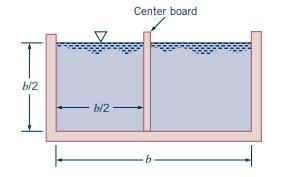
By what percent is the flowrate reduced in the rectangular channel shown in Fig. P10.37 because of the addition of the thin center board? All surfaces are of the same material.Figure P10.37 b/2 b/2- Center board b
A large trapezoidal channel cut through stone has side slopes of 1:1 and a bed width of \(291 \mathrm{ft}\). Find the uniform flow in the channel when the flow depth is \(30.4 \mathrm{ft}\) and the bed slopes \(1 \mathrm{ft}\) per mile.
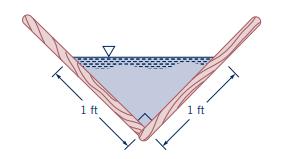
The great Kings River flume in Fresno County, California, was used from 1890 to 1923 to carry logs from an elevation of \(4500 \mathrm{ft}\) where trees were cut to an elevation of \(300 \mathrm{ft}\) at the railhead. The flume was 54 miles long, constructed of wood, and had a V-cross section as
An unfinished concrete rectangular channel is \(5 \mathrm{~m}\) wide and has a slope of \(0.50^{\circ}\). The water is \(0.5 \mathrm{~m}\) deep. Find the discharge rate for uniform flow.
A trapezoidal channel with a bottom width of \(3.0 \mathrm{~m}\) and sides with a slope of 2:1 (horizontal:vertical) is lined with fine gravel \((n=0.020)\) and is to carry \(10 \mathrm{~m}^{3} / \mathrm{s}\). Can this channel be built with a slope of \(S_{0}=0.00010\) if it is necessary to keep
Water flows in a 2-m-diameter finished concrete pipe so that it is completely full and the pressure is constant all along the pipe. If the slope is \(S_{0}=0.005\), determine the flowrate by using open-channel flow methods. Compare this result with that obtained by using pipe flow methods of
A round concrete storm sewer pipe used to carry rainfall runoff from a parking lot is designed to be half full when the rainfall rate is a steady \(1 \mathrm{in}\)./hr. Will this pipe be able to handle the flow from a 2 -in./hr rainfall without water backing up into the parking lot? Support your
Find the discharge per unit width for a wide channel having a bottom slope of 0.00015 . The normal depth is \(0.003 \mathrm{~m}\). Assume laminar flow and justify the assumption. The fluid is \(20^{\circ} \mathrm{C}\) water.
Water flows down a wide rectangular channel having Manning's \(n=0.015\) and bottom slope \(=0.0015\). Find the rate of discharge and normal depth for critical flow conditions.
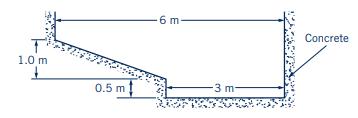
The smooth, concrete-lined channel shown in Fig. P10.46 is built on a slope of \(2 \mathrm{~m} / \mathrm{km}\). Determine the flowrate if the depth is \(y=1.5 \mathrm{~m}\).Figure P10.46 -6 m- 1.0 m 0.5 m 3 m Concrete
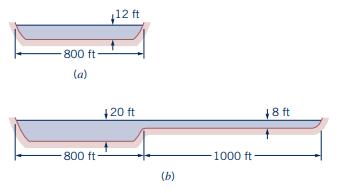
At a given location, under normal conditions a river flows with a Manning coefficient of 0.030 , and a cross section as indicated in Fig. P10.47a. During flood conditions at this location, the river has a Manning coefficient of 0.040 (because of trees and brush in the floodplain) and a cross
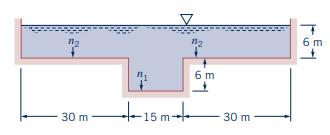
The channel in Fig. P10.48 has two floodplains as shown. Find the discharge if the center channel is lined with brick and the two floodplains are lined with cobblestones. The slope \(S_{0}\) is 0.00025Figure P10.48 112 112 T 6m 30m 6m -15ml 30m
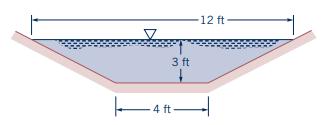
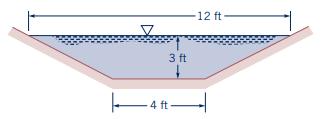
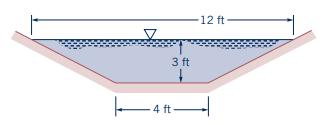
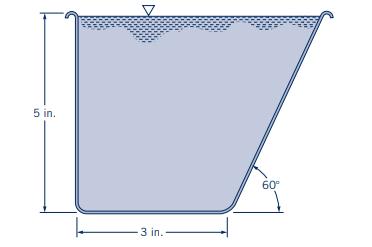
Determine the flowrate for the symmetrical channel shown in Fig. P10.66 if the bottom is smooth concrete and the sides are weedy. The bottom slope is \(S_{0}=0.001\).Fig. P10.66 4 ft 3 ft. 12 ft-
The Wide World of Fluids article titled "Done without GPS or Lasers,". Determine the number of gallons of water delivered per day by a rubble masonry, \(1.2-\mathrm{m}\)-wide aqueduct laid on an average slope of \(14.6 \mathrm{~m}\) per \(50 \mathrm{~km}\) if the water depth is \(1.8 \mathrm{~m}\).
An old, rough-surfaced, 2-m-diameter concrete pipe with a Manning coefficient of 0.025 carries water at a rate of \(5.0 \mathrm{~m}^{3} / \mathrm{s}\) when it is half full. It is to be replaced by a new pipe with a Manning coefficient of 0.012 that is also to flow half full at the same flowrate.
Four sewer pipes of \(0.5-\mathrm{m}\) diameter join to form one pipe of diameter \(D\). If the Manning coefficient, \(n\), and the slope are the same for all of the pipes, and if each pipe flows half full, determine \(D\).
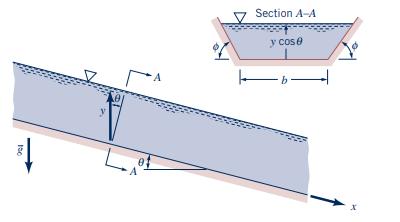
The spillway of a dam is \(20.0 \mathrm{ft}\) wide and has a flow rate of \(5000 \mathrm{ft}^{3} / \mathrm{s}\). The spillway makes an angle of \(30^{\circ}\) with the horizontal. Find the vertical water depth down the spillway. See Problem 10.72.Problem 10.72Consider the flow down a prismatic
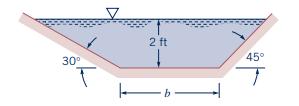
The flowrate in the clay-lined channel \((n=0.025)\) shown in Fig. P10.54 is to be \(300 \mathrm{ft}^{3} / \mathrm{s}\). To prevent erosion of the sides, the velocity must not exceed \(5 \mathrm{ft} / \mathrm{s}\). For this maximum velocity, determine the width of the bottom, \(b\), and the slope,
The flowrate in the clay-lined channel \((n=0.025)\) shown in Fig. P10.54 is to be \(300 \mathrm{ft}^{3} / \mathrm{s}\). To prevent erosion of the sides, the velocity must not exceed \(5 \mathrm{ft} / \mathrm{s}\). For this maximum velocity, determine the width of the bottom, \(b\), and the slope,
A rectangular, unfinished concrete channel of \(28-\mathrm{ft}\) width is laid on a slope of \(8 \mathrm{ft} / \mathrm{mi}\). Determine the flow depth and Froude number of the flow if the flowrate is \(400 \mathrm{ft}^{3} / \mathrm{s}\).
An engineer is to design a channel lined with planed wood to carry water at a flowrate of \(2 \mathrm{~m}^{3} / \mathrm{s}\) on a slope of \(10 \mathrm{~m} / 800 \mathrm{~m}\). The channel cross section can be either a \(90^{\circ}\) triangle or a rectangle with a cross section twice as wide as its
Find the diameter required for reinforced concrete pipe laid at a slope of 0.001 and required to carry a uniform flow of \(19.3 \mathrm{ft}^{3} / \mathrm{sec}\) when the depth is \(75 \%\) of the diameter.
A major river is divided into three parts or courses-the upper course, the middle course, and the lower course. The slope is \(70 \mathrm{ft}\) per mile in the upper course, \(10 \mathrm{ft}\) per mile in the middle course, and \(1.0 \mathrm{ft}\) per mile in the lower course. All three courses
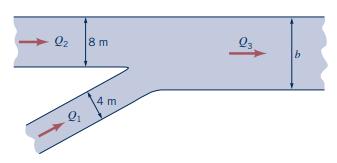
Two canals join to form a larger canal as shown in Video V10.6 and Fig. P10.62. Each of the three rectangular canals is lined with the same material and has the same bottom slope. The water depth in each is to be \(2 \mathrm{~m}\). Determine the width of the merged canal, \(b\). Explain physically
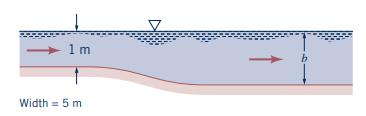
Water flows uniformly at a depth of \(1 \mathrm{~m}\) in a channel that is \(5 \mathrm{~m}\) wide as shown in Fig. P10.63. Further downstream, the channel cross section changes to that of a square of width and height \(b\). Determine the value of \(b\) if the two portions of this channel are made
Water flows \(1 \mathrm{~m}\) deep in a 2 -m-wide finished concrete channel. Determine the slope if the flowrate is \(3 \mathrm{~m}^{3} / \mathrm{s}\).
Uniform flow in a sluggish channel having a nearly rectangular cross section that is \(498 \mathrm{ft}\) wide and \(16.5 \mathrm{ft}\) deep carries a flow of \(8,250 \mathrm{ft}^{3} / \mathrm{s}\). Approximately how much does the water surface elevation drop along a river mile?
To prevent weeds from growing in a clean earthen-lined canal, it is recommended that the velocity be no less than \(2.5 \mathrm{ft} / \mathrm{s}\). For the symmetrical canal shown in Fig. P10.66, determine the minimum slope needed.Figure P10.66 4 ft. 3 ft 12 ft
The symmetrical channel shown in Fig. P10.66 is dug in sandy loam soil with \(n=0.020\). For such surface material it is recommended that to prevent scouring of the surface the average velocity be no more than \(1.75 \mathrm{ft} / \mathrm{s}\). Determine the maximum slope allowed.Fig. P10.66 4 ft 3
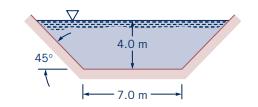
Figure P10.68 shows a cross section of an aqueduct that carries water at \(50 \mathrm{~m}^{3} / \mathrm{s}\). The value of Manning's \(n\) is 0.015 . Find the bottom slope.Figure P10.68 45 4.0 m -7.0m
The depth downstream of a sluice gate in a rectangular wooden channel of width \(5 \mathrm{~m}\) is \(0.60 \mathrm{~m}\). If the flowrate is \(18 \mathrm{~m}^{3} / \mathrm{s}\), determine the channel slope needed to maintain this depth. Will the depth increase or decrease in the flow direction if
A 50-ft-long aluminum gutter (Manning coefficient \(n=0.011\) ) on a section of a roof is to handle a flowrate of \(0.15 \mathrm{ft}^{3} / \mathrm{s}\) during a heavy rainstorm. The cross section of the gutter is shown in Fig. P10.70. Determine the vertical distance that this gutter must be pitched
Consider the flow down a prismatic channel having a trapezoidal cross section of base width \(b\) and top width \(b+2 y\) \(\cos \theta \cot \phi\). The channel bottom makes an angle \(\theta\) with the horizontal, and \(y\) is the vertical fluid depth. (See Fig. P11.71.) Show that\[ \frac{d y}{d
Consider the flow down a prismatic channel having a rectangular cross section of width \(b\). The channel bottom makes an angle \(\theta\) with the horizontal. Show that\[ \frac{d y}{d x}=\frac{\tan \theta-\left(n^{2} Q^{2}\right) /\left(A^{2} R_{h}^{4 / 3} \kappa^{2}\right)}{1-Q^{2} /\left(A^{2} g
Water flows at \(150 \mathrm{ft}^{3} / \mathrm{s}\) in a 3 - \(\mathrm{ft}\)-wide rectangular cleanearth irrigation canal. The canal slope is \(0.275^{\circ}\). At one point, the water depth is \(3 \mathrm{ft}\).(a) Accurately compute the water depth at a location \(200 \mathrm{ft}\) downstream.(b)
Water flows upstream of a hydraulic jump with a depth of \(0.5 \mathrm{~m}\) and a velocity of \(6 \mathrm{~m} / \mathrm{s}\). Determine the depth of the water downstream of the jump.
A \(5.0-\mathrm{m}\)-wide channel has a slope of 0.004 , a \(8.0-\mathrm{m}^{3} / \mathrm{s}\). water flow rate, and a water depth \(1.5 \mathrm{~m}\) after a hydraulic jump. Find the water depth before the jump.
The water depths upstream and downstream of a hydraulic jump are 0.3 and \(1.2 \mathrm{~m}\), respectively. Determine the upstream velocity and the power dissipated if the channel is \(50 \mathrm{~m}\) wide.
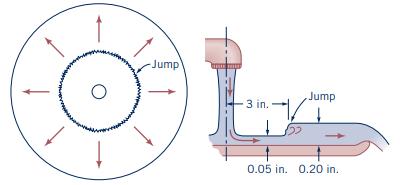
Under appropriate conditions, water flowing from a faucet, onto a flat plate, and over the edge of the plate can produce a circular hydraulic jump as shown in Fig. P10.77 and Video V10.12. Consider a situation where a jump forms \(3.0 \mathrm{in}\). from the center of the plate with depths upstream
At a given location in a 12-ft-wide rectangular channel the flowrate is \(900 \mathrm{ft}^{3} / \mathrm{s}\) and the depth is \(4 \mathrm{ft}\). Is this location upstream or downstream of the hydraulic jump that occurs in this channel? Explain.
A rectangular channel \(3.0 \mathrm{~m}\) wide has a flow rate of 5.0 \(\mathrm{m}^{3} / \mathrm{s}\) with a normal depth of \(0.50 \mathrm{~m}\). The flow then encounters a dam that rises \(0.25 \mathrm{~m}\) above the channel bottom. Will a hydraulic jump occur? Justify your answer.
A \(90^{\circ}\) triangular flume has sides \(2.0 \mathrm{~m}\) wide, a water flow rate of \(1.0 \mathrm{~m}^{3} / \mathrm{s}\), and a depth of \(0.50 \mathrm{~m}\). Find the depth after a hydraulic jump and the power loss in the jump.
Water flows in a rectangular channel with velocity \(V=6 \mathrm{~m} / \mathrm{s}\). A gate at the end of the channel is suddenly closed so that a wave (a moving hydraulic jump) travels upstream with velocity \(V_{w}=2 \mathrm{~m} / \mathrm{s}\). Determine the depths ahead of and behind the wave.
A hydraulic engineer wants to analyze steady flow in a rectangular channel featuring a hydraulic jump immediately downstream from a sluice gate that is open to a vertical clearance of \(3 \mathrm{ft}\). The flow depth upstream from the sluice gate \(8.7 \mathrm{ft}\), and the flow velocity beyond
The Wide World of Fluids article titled "Grand Canyon Rapids Building.". During the flood of 1983, a large hydraulic jump formed at "Crystal Rapid" on the Colorado River. People rafting the river at that time report "entering the rapid at almost \(30 \mathrm{mph}\), hitting a 20 -ft-tall wall of
A rectangular sharp-crested weir is used to measure the flowrate in a channel of width \(10 \mathrm{ft}\). It is desired to have the upstream channel flow depth be \(6 \mathrm{ft}\) when the flowrate is \(50 \mathrm{cfs}\). Determine the height, \(P_{w}\), of the weir plate.
Water flows over a sharp-crested triangular weir with \(\theta=90^{\circ}\). The head range covered is \(0.20 \leq H \leq 1.0 \mathrm{ft}\) and the accuracy in the measurement of the head, \(H\), is \(\delta H= \pm 0.01 \mathrm{ft}\). Plot a graph of the percent error expected in \(Q\) as a
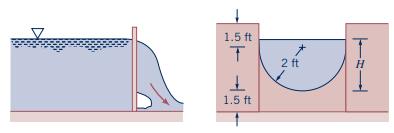
Water flows over the sharp-crested weir shown in Fig. P10.86. The weir plate cross section consists of a semicircle and a rectangle. Plot a graph of the estimated flowrate, \(Q\), as a function of head, \(H\). List all assumptions and show all calculations.Figure P10.86 1.5 ft T 2 ft 1.5 ft H |||
Water flows over a broad-crested weir that has a width of \(4 \mathrm{~m}\) and a height of \(P_{w}=1.5 \mathrm{~m}\). The free-surface well upstream of the weir is at a height of \(0.5 \mathrm{~m}\) above the surface of the weir. Determine the flowrate in the channel and the minimum depth of the
An engineering laboratory experiment uses a triangular weir in an open channel to measure flow rate. The nominal weir angle is \(90^{\circ}\). In a certain test, the head of water above the weir was 4 in. The uncertainty in the weir angle is \(\pm 2^{\circ}\) and the uncertainty in the depth
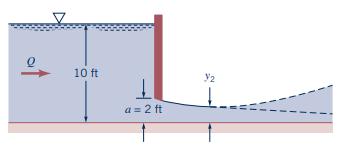
Water flows under a sluice gate in a 60 -ft-wide finished concrete channel as is shown in Fig. P10.89. Determine the flowrate. If the slope of the channel is \(2.5 \mathrm{ft} / 200 \mathrm{ft}\), will the water depth increase or decrease downstream of the gate? Assume \(C_{c}=\) \(y_{2} /
Water flows under a sluice gate in a channel of 10 -ft width. If the upstream depth remains constant at \(5 \mathrm{ft}\), plot a graph of flowrate as a function of the distance between the gate and the channel bottom as the gate is slowly opened. Assume free outflow.
A flow of \(873 \mathrm{ft}^{3} / \mathrm{s}\) passes under a sluice gate in a rectangular channel having a gradual contraction in width from \(80 \mathrm{ft}\) to \(52 \mathrm{ft}\). The channel bed has scoured to a level that is 6 in. below the upstream channel bed, owing to the increased
Under normal circumstances is the airflow though your trachea (your windpipe) laminar or turbulent? List all assumptions and show all calculations.
Rainwater runoff from a parking lot flows through a 3 -ft-diameter pipe, completely filling it. Whether flow in a pipe is laminar or turbulent depends on the value of the Reynolds number. Would you expect the flow to be laminar or turbulent? Support your answer with appropriate calculations.
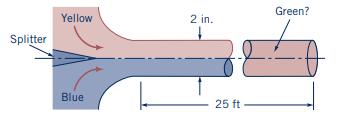
Blue and yellow streams of paint at \(60^{\circ} \mathrm{F}\) (each with a density of \(1.6 \mathrm{slugs} / \mathrm{ft}^{3}\) and a viscosity 1000 times greater than water) enter a pipe with an average velocity of \(4 \mathrm{ft} / \mathrm{s}\) as shown in Fig. P8.3. Would you expect the paint to
Air at \(200^{\circ} \mathrm{F}\) flows at standard atmospheric pressure in a pipe at a rate of \(0.08 \mathrm{lb} / \mathrm{s}\). Determine the minimum diameter allowed if the flow is to be laminar.
To cool a given room it is necessary to supply \(4 \mathrm{ft}^{3} / \mathrm{s}\) of air through an 8-in.-diameter pipe. Approximately how long is the entrance length in this pipe?
The flow of water in a 3-mm-diameter pipe is to remain laminar. Plot a graph of the maximum flowrate allowed as a function of temperature for \(0
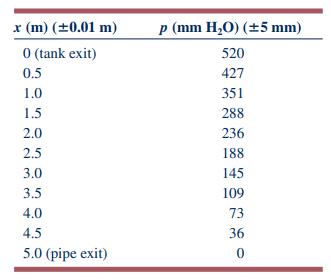
The pressure distribution measured along a straight, horizontal portion of a 50-mm-diameter pipe attached to a tank is shown in the table below. Approximately how long is the entrance length? In the fully developed portion of the flow, what is the value of the wall shear stress? x (m) (0.01 m) P
The Wide World of Fluids article titled "Nanoscale Flows,".(a) Water flows in a tube that has a diameter of \(D=0.1 \mathrm{~m}\). Determine the Reynolds number if the average velocity is 10 diameters per second.(b) Repeat the calculations if the tube is a nanoscale tube with a diameter of \(D=100
For fully developed laminar pipe flow in a circular pipe, the velocity profile is given by \(u(r)=2\left(1-r^{2} / R^{2}\right)\) in \(\mathrm{m} / \mathrm{s}\), where \(R\) is the inner radius of the pipe. Assuming that the pipe diameter is \(4 \mathrm{~cm}\), find the maximum and average
A viscous fluid flows in a \(0.10-\mathrm{m}\)-diameter pipe such that its velocity measured \(0.012 \mathrm{~m}\) away from the pipe wall is \(0.8 \mathrm{~m} / \mathrm{s}\). If the flow is laminar, determine the centerline velocity and the flowrate.
The wall shear stress in a fully developed flow portion of a 12 -in.-diameter pipe carrying water is \(1.85 \mathrm{lb} / \mathrm{ft}^{2}\). Determine the pressure gradient, \(\partial p / \partial x\), where \(x\) is in the flow direction, if the pipe is(a) horizontal,(b) vertical with flow
The pressure drop needed to force water through a horizontal 1-in.-diameter pipe is \(0.60 \mathrm{psi}\) for every 12 -ft length of pipe. Determine the shear stress on the pipe wall. Determine the shear stress at distances 0.3 and 0.5 in. away from the pipe wall.
Repeat Problem 8.12 if the pipe is on a \(20^{\circ}\) hill. Is the flow up or down the hill? Explain.
Water flows in a constant-diameter pipe with the following conditions measured: At section(a) \(p_{a}=32.4 \mathrm{psi}\) and \(z_{a}=56.8 \mathrm{ft}\); at section(b) \(p_{b}=29.7 \mathrm{psi}\) and \(z_{b}=68.2 \mathrm{ft}\). Is the flow from (a) to (b) or from (b) to (a)? Explain.
Glycerin at \(20^{\circ} \mathrm{C}\) flows upward in a vertical 75 -mm-diameter pipe with a centerline velocity of \(1.0 \mathrm{~m} / \mathrm{s}\). Determine the head loss and pressure drop in a 10-m length of the pipe.
Water at \(60{ }^{\circ} \mathrm{F}\) flows at a rate of \(4.0 \mathrm{gal} / \mathrm{min}\) through a 6 -in. I.D. plastic pipe. The pipe is \(500 \mathrm{ft}\) long and rises a vertical height of \(40 \mathrm{ft}\) over the \(500 \mathrm{ft}\). Find the pressure drop.
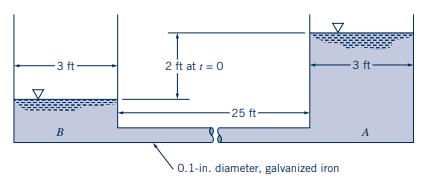
At time \(t=0\) the level of water in tank \(A\) shown in Fig. P8.18 is \(2 \mathrm{ft}\) above that in \(\operatorname{tank} B\). Plot the elevation of the water in tank \(A\) as a function of time until the free surfaces in both tanks are at the same elevation. Assume quasisteady conditionsthat
A fluid flows through a horizontal 0.1-in.-diameter pipe. When the Reynolds number is 1500 , the head loss over a \(20-\mathrm{ft}\) length of the pipe is \(6.4 \mathrm{ft}\). Determine the fluid velocity.
Asphalt at \(120^{\circ} \mathrm{F}\), considered to be a Newtonian fluid with a viscosity 80,000 times that of water and a specific gravity of 1.09, flows through a pipe of diameter \(2.0 \mathrm{in}\). If the pressure gradient is \(1.6 \mathrm{psi} / \mathrm{ft}\) determine the flowrate assuming
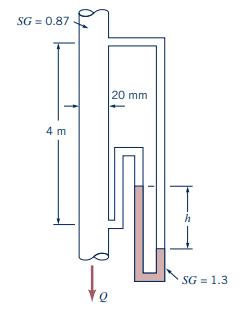
Oil of \(S G=0.87\) and a kinematic viscosity \(u=2.2 \times 10^{-4}\) \(\mathrm{m}^{2} / \mathrm{s}\) flows through the vertical pipe shown in Fig. P8.21 at a rate of \(4 \times 10^{-4} \mathrm{~m}^{3} / \mathrm{s}\). Determine the manometer reading, \(h\).Figure P8.21 SG= 0.87 4 m 20 mm 21 h SG =
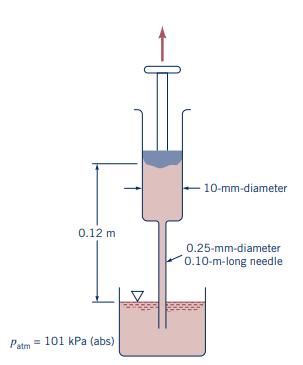
A liquid with \(S G=0.96, \mu=9.2 \times 10^{-4} \mathrm{~N} \cdot \mathrm{s} / \mathrm{m}^{2}\), and vapor pressure \(p_{u}=1.2 \times 10^{4} \mathrm{~N} / \mathrm{m}^{2}\) (abs) is drawn into the syringe as is indicated in Fig P8.22. What is the maximum flowrate if cavitation is not to occur in
A 3-in. schedule 40 commercial steel pipe (with an actual inside diameter of 3.068 in.) carries \(210^{\circ} \mathrm{F}\) SAE 40 crankcase oil at the rate of \(6.0 \mathrm{gal} / \mathrm{min}\). The oil specific gravity is 0.89, and the absolute viscosity is \(6.6 \times 10^{-7} \mathrm{lb} \cdot
A 3-in. schedule 40 commercial steel pipe (with an actual inside diameter of 3.068 in.) carries \(210^{\circ} \mathrm{F}\) SAE 40 crankcase oil at the rate of \(6.0 \mathrm{gal} / \mathrm{min}\). The oil specific gravity is 0.89, and the absolute viscosity is \(6.6 \times 10^{-7} 1 \mathrm{~b}
Water at \(20{ }^{\circ} \mathrm{C}\) flows down a vertical pipe with no pressure drop. Find the range of pipe diameters \(D\) (if any) for which the flow is definitely laminar.
A person is donating blood. The pint bag in which the blood is collected is initially flat and is at atmospheric pressure. Neglect the initial mass of air in the 1/8-in. I.D., \(4 \mathrm{ft}\)-long plastic tube carrying blood to the bag. The average blood pressure in the vein is \(40 \mathrm{~mm}
For oil \(\left(S G=0.86, \mu=0.025 \mathrm{Ns} / \mathrm{m}^{2}\right.\) ) flow of \(0.2 \mathrm{~m}^{3} / \mathrm{s}\) through a round pipe with diameter of \(500 \mathrm{~mm}\), determine the Reynolds number. Is the flow laminar or turbulent?
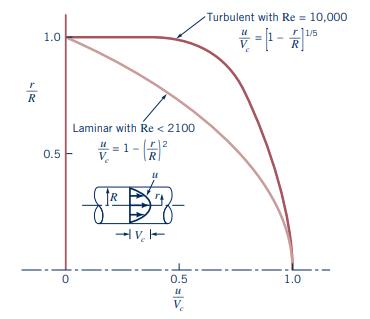
As shown in Fig. P8.28, the velocity profile for laminar flow in a pipe is quite different from that for turbulent flow. With laminar flow the velocity profile is parabolic; with turbulent flow at \(\operatorname{Re}=10,000\) the velocity profile can be approximated by the power-law profile shown
Water at \(10{ }^{\circ} \mathrm{C}\) flows through a smooth \(60-\mathrm{mm}\)-diameter pipe with an average velocity of \(8 \mathrm{~m} / \mathrm{s}\). Would a layer of rust of height \(0.005 \mathrm{~mm}\) on the pipe wall protrude through the viscous sublayer? Justify your answer with
When soup is stirred in a bowl, there is considerable turbulence in the resulting motion. From a very simplistic standpoint, this turbulence consists of numerous intertwined swirls, each involving a characteristic diameter and velocity. As time goes by, the smaller swirls (the fine scale structure)
Water at \(60^{\circ} \mathrm{F}\) flows through a 6-in.-diameter pipe with an average velocity of \(15 \mathrm{ft} / \mathrm{s}\). Approximately what is the height of the largest roughness element allowed if this pipe is to be classified as smooth?
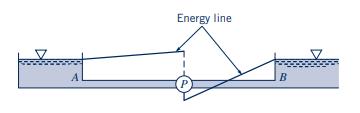
Water is pumped between two tanks as shown in Fig. P8.32. The energy line is as indicated. Is the fluid being pumped from \(A\) to \(B\) or \(B\) to \(A\) ? Explain. Which pipe has the larger diameter: \(\mathrm{A}\) to the pump or B to the pump? Explain.Figure P8.32 Energy line A P B
A person with no experience in fluid mechanics wants to estimate the friction factor for 1-in.-diameter galvanized iron pipe at a Reynolds number of 8,000 . The person stumbles across the simple equation of \(f=64 / \mathrm{Re}\) and uses this to calculate the friction factor. Explain the problem
Water flows through a horizontal plastic pipe with a diameter of \(0.2 \mathrm{~m}\) at a velocity of \(10 \mathrm{~cm} / \mathrm{s}\). Determine the pressure drop per meter of pipe and the power lost to the friction per meter of pipe.
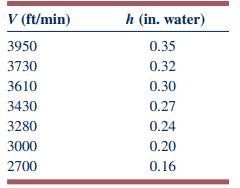
Air at standard conditions flows through an 8-in.-diameter, 14.6-ft-long, straight duct with the velocity versus head loss data indicated in the following table. Determine the average friction factor over this range of data. V (ft/min) h (in. water) 3950 0.35 3730 0.32 3610 0.30 3430 0.27 3280 0.24
Water flows through a horizontal 60-mm-diameter galvanized iron pipe at a rate of \(0.02 \mathrm{~m}^{3} / \mathrm{s}\). If the pressure drop is \(135 \mathrm{kPa}\) per \(10 \mathrm{~m}\) of pipe, do you think this pipe is(a) a new pipe,(b) an old pipe with a somewhat increased roughness due to
Water flows at a rate of 10 gallons per minute in a new horizontal 0.75-in.-diameter galvanized iron pipe. Determine the pressure gradient, \(\Delta p / \ell\), along the pipe.
Carbon dioxide at a temperature of \(0{ }^{\circ} \mathrm{C}\) and a pressure of \(600 \mathrm{kPa}\) (abs) flows through a horizontal 40-mm-diameter pipe with an average velocity of \(2 \mathrm{~m} / \mathrm{s}\). Determine the friction factor if the pressure drop is \(235 \mathrm{~N} /
Blood (assume \(\mu=4.5 \times 10^{-5} \mathrm{lb} \cdot \mathrm{s} / \mathrm{ft}^{2}, S G=1.0\) ) flows through an artery in the neck of a giraffe from its heart to its head at a rate of \(2.5 \times 10^{-4} \mathrm{ft}^{3} / \mathrm{s}\). Assume the length is \(10 \mathrm{ft}\) and the diameter
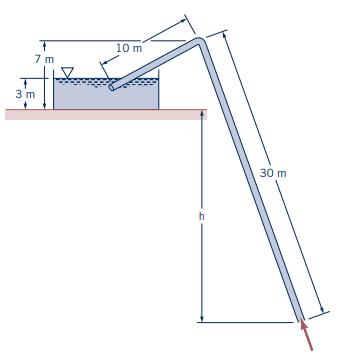
A 40-m-long, 12-mm-diameter pipe with a friction factor of 0.020 is used to siphon \(30{ }^{\circ} \mathrm{C}\) water from a tank as shown in Fig. P8.42. Determine the maximum value of \(h\) allowed if there is to be no cavitation within the hose. Neglect minor losses.Figure P8.42 3 m 7 m 10 m h 30
Gasoline flows in a smooth pipe of \(40-\mathrm{mm}\) diameter at a rate of \(0.001 \mathrm{~m}^{3} / \mathrm{s}\). If it were possible to prevent turbulence from occurring, what would be the ratio of the head loss for the actual turbulent flow compared to that if it were laminar flow?
A 3-ft-diameter duct is used to carry ventilating air into a vehicular tunnel at a rate of \(9000 \mathrm{ft}^{3} / \mathrm{min}\). Tests show that the pressure drop is \(1.5 \mathrm{in}\). of water per \(1500 \mathrm{ft}\) of duct. What is the value of the friction factor for this duct and the
H. Blasius correlated data on turbulent friction factor in smooth pipes. His equation \(f_{\text {smooth }} \approx 0.3164 \mathrm{Re}^{-1 / 4}\) is reasonably accurate for Reynolds numbers between 4000 and \(10^{5}\). Use this information for the following scenario. Water at \(20{ }^{\circ}
Von Karman suggested that the wholly turbulent friction factor be expressed by the equation\[ f=\frac{1}{4[0.57-\log (\varepsilon / D)]^{2}} \]where \(\varepsilon\) is the absolute roughness of the pipe. Compare the values predicted by this equation and those indicated on the Moody chart.
The Swamee and Jain formula for the friction factor is\[ f=\frac{0.25}{\left[\log \left(\varepsilon / 3.7 D+5.74 / \mathrm{Re}^{0.9}\right)\right]^{2}} \]Compare this equation for \(\varepsilon / D=0.00001,0.0001,0.001\), and 0.01 and Reynolds numbers of \(10^{4}, 10^{5}, 10^{6}\), and \(10^{7}\)
The Haaland formula for the friction factor is\[ f=\frac{0.3086}{\left\{\log \left[6.9 / \operatorname{Re}+(\varepsilon / 3.7 D)^{1.11}\right]\right\}^{2}} \]Compare this equation for \(f\) for \(\varepsilon / D=0.00001,0.0001,0.001\), and 0.01 and Reynolds numbers of \(10^{4}, 10^{5}, 10^{6}\),
Showing 300 - 400
of 2369
1
2
3
4
5
6
7
8
9
10
11
12
13
14
15
Last
Step by Step Answers

 Get 50% OFF
Claim Now
Get 50% OFF
Claim Now