New Semester
Started
Get
50% OFF
Study Help!
--h --m --s
Claim Now
Question Answers
Textbooks
Find textbooks, questions and answers
Oops, something went wrong!
Change your search query and then try again
S
Books
FREE
Study Help
Expert Questions
Accounting
General Management
Mathematics
Finance
Organizational Behaviour
Law
Physics
Operating System
Management Leadership
Sociology
Programming
Marketing
Database
Computer Network
Economics
Textbooks Solutions
Accounting
Managerial Accounting
Management Leadership
Cost Accounting
Statistics
Business Law
Corporate Finance
Finance
Economics
Auditing
Tutors
Online Tutors
Find a Tutor
Hire a Tutor
Become a Tutor
AI Tutor
AI Study Planner
NEW
Sell Books
Search
Search
Sign In
Register
study help
engineering
engineering fluid mechanics
Munson Young And Okiishi's Fundamentals Of Fluid Mechanics 8th Edition Philip M. Gerhart, Andrew L. Gerhart, John I. Hochstein - Solutions
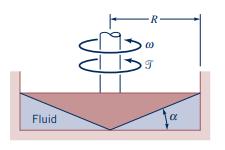
A cone and plate viscometer consists of a cone with a very small angle \(\alpha\) that rotates above a flat surface as shown in Fig. P7.16. The torque, \(\mathscr{T}\), required to rotate the cone at an angular velocity \(\omega\) is a function of the radius, \(R\), the cone angle, \(\alpha\), and
The pressure drop, \(\Delta p\), along a straight pipe of diameter \(D\) has been experimentally studied, and it is observed that for laminar flow of a given fluid and pipe, the pressure drop varies directly with the distance, \(\ell\), between pressure taps. Assume that \(\Delta p\) is a function
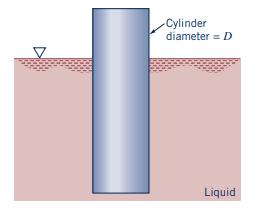
A cylinder with a diameter \(D\) floats upright in a liquid as shown in Fig. P7.18. When the cylinder is displaced slightly along its vertical axis it will oscillate about its equilibrium position with a frequency, \(\omega\). Assume that this frequency is a function of the diameter, \(D\), the
Consider a typical situation involving the flow of a fluid that you encounter almost every day. List what you think are the important physical variables involved in this flow and determine an appropriate set of pi terms for this situation.
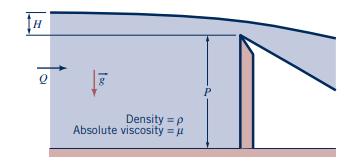
The weir shown in Fig. P7.20 is used to measure the volume flowrate \(Q\). The height \(H\) is a measure of this flowrate. The weir has length \(L\) (perpendicular to the paper). Select and include relevant fluid properties and find the appropriate dimensionless parameters.Figure P7.20 H 8
Experiments are conducted on a washing machine agitator. The relevant dimensional parameters are the driving torque, \(\mathscr{T}\), the oscillation frequency, \(f\), the angular velocity, \(\omega\), the number of paddles, \(N\), the paddle height, \(H\), and the paddle width, \(w\). Specify the
The input power, \(\dot{W}\), to a large industrial fan depends on the fan impeller diameter \(D\), fluid viscosity \(\mu\), fluid density \(ho\), volumetric flow \(Q\), and blade rotational speed \(\omega\). What are the appropriate dimensionless parameters?
Develop the appropriate dimensionless parameters for the period \(\tau\) of transverse vibration of a turbine rotor of mass \(m\) connected to a shaft of stiffness \(k \doteq F / L\) and length \(\ell \doteq L\). Other relevant dimensional parameters are the eccentricity \(\varepsilon \doteq L\) of
A vapor bubble rises in a liquid. The relevant dimensional parameters are the liquid specific weight, \(\gamma_{\ell}\), the vapor specific weight, \(\gamma_{u}\), bubble velocity, \(V\), bubble diameter, \(d\), surface tension, \(\sigma\), and liquid viscosity, \(\mu\). Find appropriate
The speed of deep ocean waves depends on the wave length and gravitational acceleration. What are the appropriate dimensionless parameters?
A coach has been trying to evaluate the accuracy of a baseball pitcher. After two years of studying, he proposes a function that can be presented as the accuracy of any pitcher:\[\mathrm{Acc}=f(V, a, m, ho, p, z)\]where Acc is the dimensionless accuracy, \(V\) is the velocity of the ball, \(a\) is
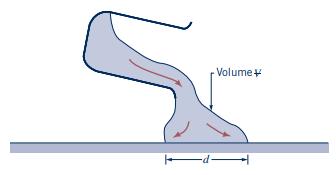
A viscous fluid is poured onto a horizontal plate as shown in Fig. P7.27. Assume that the time, \(t\), required for the fluid to flow a certain distance, \(d\), along the plate is a function of the volume of fluid poured, \(\forall\), acceleration of gravity, \(g\), fluid density, \(ho\), and fluid
The velocity, \(c\), at which pressure pulses travel through arteries (pulse-wave velocity) is a function of the artery diameter, \(D\), and wall thickness, \(h\), the density of blood, \(ho\), and the modulus of elasticity, \(E\), of the arterial wall. Determine a set of nondimensional parameters
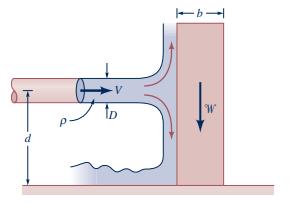
As shown in Fig. P7.29, a jet of liquid directed against a block can tip over the block. Assume that the velocity, \(V\), needed to tip over the block is a function of the fluid density, \(ho\), the diameter of the jet, \(D\), the weight of the block, \(\mathscr{W}\), the width of the block, \(b\),
By inspection, arrange the following dimensional parameters into dimensionless parameters:(a) kinematic viscosity, \(v\), length, \(\ell\), and time, \(t\); (b) volume flow rate, \(Q\), pump diameter, \(D\), and pump impeller rotation speed, \(N\).
A screw propeller has the following relevant dimensional parameters: axial thrust, \(F\), propeller diameter, \(D\), fluid kinematic viscosity, \(v\), fluid density, \(ho\), gravitational acceleration, \(g\), advance velocity, \(V\), and rotational speed, \(N\). Find appropriate dimensionless
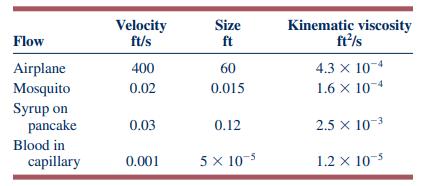
Shown in the following table are several flow situations and the associated characteristic velocity, size, and fluid kinematic viscosity. Determine the Reynolds number for each of the flows and indicate for which ones the inertial effects are small relative to viscous effects. Velocity Size
Develop the Weber number by starting with estimates for the inertia and surface tension forces.
Develop the Froude number by starting with estimates of the fluid kinetic energy and fluid potential energy.
The following dimensionless groups are often used to present data on centrifugal pumps: flow coefficient \(\varphi=\frac{Q}{\omega D^{3}}\), head coefficient \(\psi=\frac{g H}{\omega^{2} D^{2}}\), power coefficient \(\xi=\frac{\dot{W}}{\omega^{3} D^{5}}\), efficiency \(\eta=\) \(\frac{ho g Q
The dimensional parameters used to describe the operation of a ship or airplane propeller (sometimes called a screw propeller) are rotational speed, \(\omega\), diameter, \(D\), fluid density, \(ho\), speed of the propeller relative to the fluid, \(V\), and thrust developed, \(T\). The common
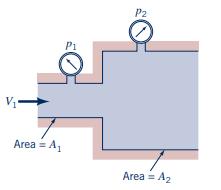
The pressure rise, \(\Delta p=p_{2}-p_{1}\), across the abrupt expansion of Fig. P7.38 through which a liquid is flowing can be expressed as\[ \Delta p=f\left(A_{1}, A_{2}, ho, V_{1}\right) \]where \(A_{1}\) and \(A_{2}\) are the upstream and downstream cross-sectional areas, respectively, \(ho\)
The pressure drop, \(\Delta p\), over a certain length of horizontal pipe is assumed to be a function of the velocity, \(V\), of the fluid in the pipe, the pipe diameter, \(D\), and the fluid density and viscosity, \(ho\) and \(\mu\). (a) Show that this flow can be described in dimensionless form
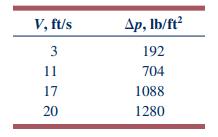
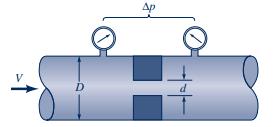
The pressure drop across a short hollowed plug placed in a circular tube through which a liquid is flowing (see Fig. P7.40) can be expressed as\[ \Delta p=f(ho, V, D, d) \]where \(ho\) is the fluid density, and \(V\) is the mean velocity in the tube. Some experimental data obtained with \(D=0.2
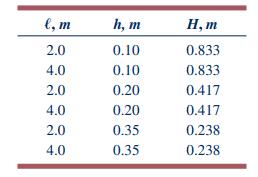
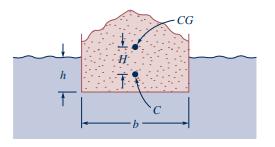
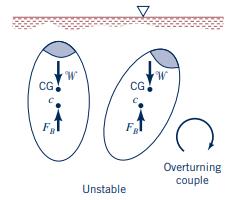
As shown in Fig. 2.26. Fig. P7.41, a rectangular barge floats in a stable configuration provided the distance between the center of gravity, \(C G\), of the object (boat and load) and the center of buoyancy, \(C\), is less than a certain amount, \(H\). If this distance is greater than \(H\), the
The time, \(t\), it takes to pour a certain volume of liquid from a cylindrical container depends on several factors, including the viscosity of the liquid. Assume that for very viscous liquids the time it takes to pour out two-thirds of the initial volume depends on the initial liquid depth,
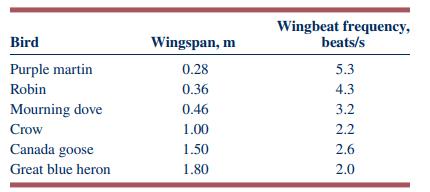
In order to maintain uniform flight, smaller birds must beat their wings faster than larger birds. It is suggested that the relationship between the wingbeat frequency, \(\omega\), beats per second, and the bird's wingspan, \(\ell\), is given by a power law relationship, \(\omega \sim \ell^{n}\).
A \(250-\mathrm{m}\)-long ship has a wetted area of \(8000 \mathrm{~m}^{2}\). A \(\frac{1}{100}\)-scale model is tested in a towing tank with the prototype fluid, and the results are:Calculate the prototype drag at \(7.5 \mathrm{~m} / \mathrm{s}\) and \(12.0 \mathrm{~m} / \mathrm{s}\). Model
A student is interested in the aerodynamic drag on spheres. She conducts a series of wind tunnel tests on a \(10-\mathrm{cm}\)-diameter sphere. The air in the wind tunnel is at \(50{ }^{\circ} \mathrm{C}\) and \(101.3 \mathrm{kPa}\). She presents the results of her tests in the form of a
Air at \(80^{\circ} \mathrm{F}\) is to flow through a 2 - \(\mathrm{ft}\) pipe at an average velocity of \(6 \mathrm{ft} / \mathrm{s}\). What size pipe should be used to move water at \(60^{\circ} \mathrm{F}\) and average velocity of \(3 \mathrm{ft} / \mathrm{s}\) if Reynolds number similarity is
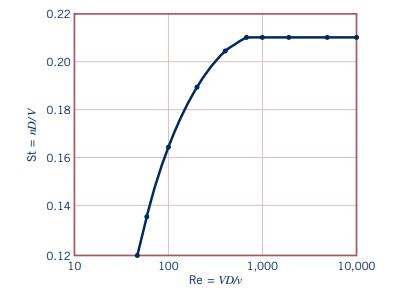
You are to conduct wind tunnel testing of a new football design that has a smaller lace height than previous designs. It is known that you will need to maintain Re and St similarity for the testing. Based on standard college quarterbacks, the prototype parameters are set at \(V=40 \mathrm{mph}\)
A model of a submarine, \(1: 15\) scale, is to be tested at \(180 \mathrm{ft} / \mathrm{s}\) in a wind tunnel with standard sea-level air, while the prototype will be operated in seawater. Determine the speed of the prototype to ensure Reynolds number similarity.
The drag characteristics of a torpedo are to be studied in a water tunnel using a 1:5 scale model. The tunnel operates with fresh water at \(20{ }^{\circ} \mathrm{C}\), whereas the prototype torpedo is to be used in seawater at \(15.6^{\circ} \mathrm{C}\). To correctly simulate the behavior of the
For a certain fluid flow problem it is known that both the Froude number and the Weber number are important dimensionless parameters. If the problem is to be studied by using a 1:15 scale model, determine the required surface tension scale if the density scale is equal to 1. The model and prototype
The fluid dynamic characteristics of an airplane flying \(240 \mathrm{mph}\) at \(10,000 \mathrm{ft}\) are to be investigated with the aid of a 1:20 scale model. If the model tests are to be performed in a wind tunnel using standard air, what is the required air velocity in the wind tunnel? Is this
If an airplane travels at a speed of \(1120 \mathrm{~km} / \mathrm{hr}\) at an altitude of \(15 \mathrm{~km}\), what is the required speed at an altitude of \(8 \mathrm{~km}\) to satisfy Mach number similarity? Assume the air properties correspond to those for the U.S. standard atmosphere.
The Wide World of Fluids article "Modeling Parachutes in a Water Tunnel,". Flow characteristics for a 30-ftdiameter prototype parachute are to be determined by tests of a 1 -ft-diameter model parachute in a water tunnel. Some data collected with the model parachute indicate a drag of \(17
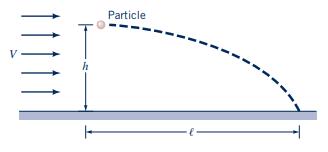
When small particles of diameter \(d\) are transported by a moving fluid having a velocity \(V\), they settle to the ground at some distance \(\ell\) after starting from a height \(h\) as shown in Fig. P7.54. The variation in \(\ell\) with various factors is to be studied with a model having a
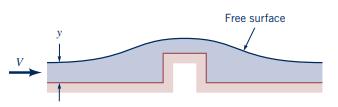
A thin layer of an incompressible fluid flows steadily over a horizontal smooth plate as shown in Fig. P7.55. The fluid surface is open to the atmosphere, and an obstruction having a square cross section is placed on the plate as shown. A model with a length scale of \(\frac{1}{4}\) and a fluid
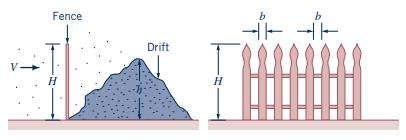
During a storm, a snow drift is formed behind a snow fence as shown in Fig. P7.56. Assume that the height of the drift, \(h\), is a function of the number of inches of snow deposited by the storm, \(d\), height of the fence, \(H\), width of slats in the fence, \(b\), wind speed, \(V\), acceleration
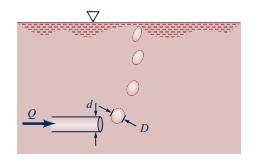
Air bubbles discharge from the end of a submerged tube as shown in Fig. P7.57. The bubble diameter, \(D\), is assumed to be a function of the air flowrate, \(Q\), the tube diameter, \(d\), the acceleration of gravity, \(g\), the density of the liquid, \(ho\), and the surface tension of the liquid,
For a certain model study involving a 1:5 scale model it is known that Froude number similarity must be maintained. The possibility of cavitation is also to be investigated, and it is assumed that the cavitation number must be the same for model and prototype. The prototype fluid is water at
A model hydrofoil is to be tested. Is it practical to satisfy both the Reynolds number and the Froude number for the hydrofoil when it is operating near the water surface? Support your decision.
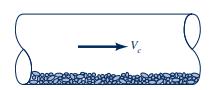
A thin layer of particles rests on the bottom of a horizontal tube as shown in Fig. P7.60. When an incompressible fluid flows through the tube, it is observed that at some critical velocity the particles will rise and be transported along the tube. A model is to be used to determine this critical
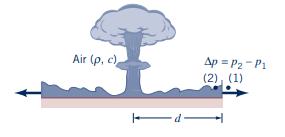
The pressure rise, \(\Delta p\), across a blast wave, as shown in Fig. P7.61, is assumed to be a function of the amount of energy released in the explosion, \(E\), the air density, \(ho\), the speed of sound, \(c\), and the distance from the blast, \(d\).(a) Put this relationship in dimensionless
An incompressible fluid oscillates harmonically \(\left(V=V_{0}\right.\) \(\sin \omega t\), where \(V\) is the velocity) with a frequency of \(10 \mathrm{rad} / \mathrm{s}\) in a 4-in.-diameter pipe. A \(\frac{1}{4}\) scale model is to be used to determine the pressure difference per unit length,
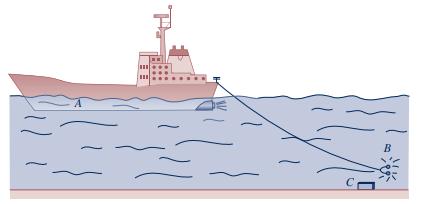
As shown in Fig. P7.63, a "noisemaker" B is towed behind a minesweeper A to set off enemy acoustic mines such as at \(\mathrm{C}\). The drag force of the noisemaker is to be studied in a water tunnel at a \(\frac{1}{4}\) scale model (model \(1 / 4\) the size of the prototype). The drag force is
The drag characteristics for a newly designed automobile having a maximum characteristic length of \(20 \mathrm{ft}\) are to be determined through a model study. The characteristics at both low speed (approximately \(20 \mathrm{mph}\) ) and high speed ( \(90 \mathrm{mph}\) ) are of interest. For a
The drag characteristics of an airplane are to be determined by model tests in a wind tunnel operated at an absolute pressure of \(1300 \mathrm{kPa}\). If the prototype is to cruise in standard air at 385 \(\mathrm{km} / \mathrm{hr}\), and the corresponding speed of the model is not to differ by
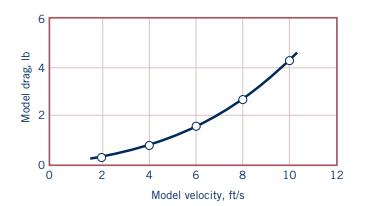
The drag on a sphere moving in a fluid is known to be a function of the sphere diameter, the velocity, and the fluid viscosity and density. Laboratory tests on a 4-in.-diameter sphere were performed in a water tunnel and some model data are plotted in Fig. P7.66.For these tests the viscosity of the
A dam spillway is \(40 \mathrm{ft}\) long and has fluid velocity of \(10 \mathrm{ft} / \mathrm{s}\). Considering Weber number effects as minor, calculate the corresponding model fluid velocity for a model length of \(5 \mathrm{ft}\).
A flagpole has a diameter of \(1.0 \mathrm{ft}\) and is \(45 \mathrm{ft}\). long. The manufacturer wants to find the bending moment at the base of the pole for a wind speed of \(60 \mathrm{mph}\). To do so, a scale model of the flagpole is built with a diameter of \(1.0 \mathrm{in}\). and a length
A very small needle valve is used to control the flow of air in a \(\frac{1}{8}\)-in. air line. The valve has a pressure drop of \(4.0 \mathrm{psi}\) at a flow rate of \(0.005 \mathrm{ft}^{3} / \mathrm{s}\) of \(60{ }^{\circ} \mathrm{F}\) air. Tests are performed on a large, geometrically similar
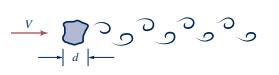
In low-speed external flow over a bluff object, vortices are shed from the object (as shown in Fig. P7.70). The frequency of vortex shedding, \(f \doteq 1 / \mathrm{T}\), depends on \(ho, \mu, V\), and \(d\). Make a dimensional analysis of this phenomenon. Transform the dimensionless parameters
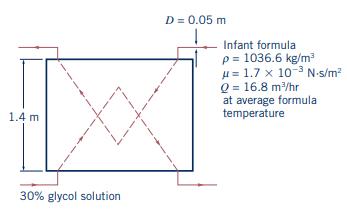
In a nutritional products plant, a plate heat exchanger cools infant formula by approximately \(25{ }^{\circ} \mathrm{C}\) from an inlet temperature of \(68{ }^{\circ} \mathrm{C}\) as it flows through the plates shown in Fig. P7.71. The process engineer would like to be able to cool the infant
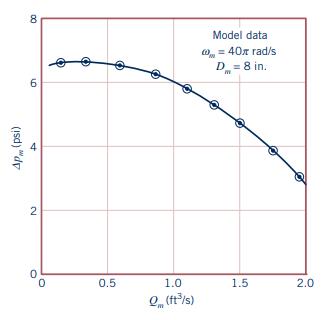
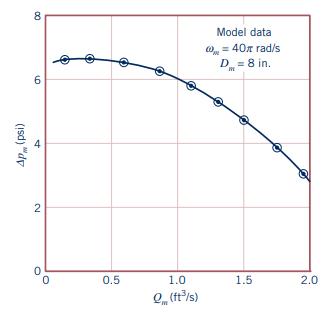
The pressure rise, \(\Delta p\), across a centrifugal pump of a given shape can be expressed as\[ \Delta p=f(D, \omega, ho, Q) \]where \(D\) is the impeller diameter, \(\omega\) the angular velocity of the impeller, \(ho\) the fluid density, and \(Q\) the volume rate of flow through the pump. A
At a large fish hatchery the fish are reared in open, water-filled tanks. Each tank is approximately square in shape with curved corners, and the walls are smooth. To create motion in the tanks, water is supplied through a pipe at the edge of the tank. The water is drained from the tank through an
The Wide World of Fluids article titled "Galloping Gertie,". The Tacoma Narrows Bridge failure is a dramatic example of the possible serious effects of wind-induced vibrations. As a fluid flows around a body, vortices may be created that are shed periodically, creating an oscillating force on the
The Wide World of Fluids article titled "Ice Engineering,". A model study is to be developed to determine the force exerted on bridge piers due to floating chunks of ice in a river. The piers of interest have square cross sections. Assume that the force, \(R\), is a function of the pier width,
As illustrated, models are commonly used to study the dispersion of a gaseous pollutant from an exhaust stack located near a building complex. Similarity requirements for the pollutant source involve the following independent variables: the stack gas speed, \(V\), the wind speed, \(U\), the density
As winds blow past buildings, complex flow patterns can develop due to various factors such as flow separation and interactions between adjacent buildings. Assume that the local gage pressure, \(p\), at a particular location on a building is a function of the air density, \(ho\), the wind speed,
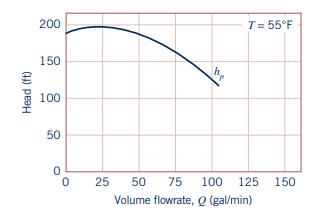
Assume that the pump performance characteristics shown in Fig. P7.78 are for a pump running at \(1200 \mathrm{rpm}\). Assuming that the pump head, \(h_{p}\), the pump impeller diameter, \(D\), and the flowrate, \(Q\), through the pump are the other relevant parameters, calculate the pump
A stream of atmospheric air is used to keep a ping-pong ball aloft by blowing the air upward over the ball. The ping-pong ball has a mass of \(2.5 \mathrm{~g}\) and a diameter \(D_{1}=3.8 \mathrm{~cm}\), and the air stream has an upward velocity of \(V_{1}=0.942 \mathrm{~m} / \mathrm{s}\). This
\(\mathrm{A} \frac{1}{10}\)-scale model of an airplane is tested in a wind tunnel at \(70^{\circ} \mathrm{F}\) and 14.40 psia. The model test results are:Find the corresponding airplane velocities and drags if only fluid compressibility is important and the airplane is flying in the U.S. Standard
A company manufactures geometrically similar airplane propellers up to \(4.0 \mathrm{~m}\) in diameter. Wind tunnel tests are run on geometrically similar propellers up to \(0.33 \mathrm{~m}\) in diameter. In the test of a \(0.33-\mathrm{m}\) model of a \(4.0-\mathrm{m}\) propeller, the air
A breakwater is a wall built around a harbor so the incoming waves dissipate their energy against it. The significant dimensionless parameters are the Froude number Fr and the Reynolds number Re. A particular breakwater measuring \(450 \mathrm{~m}\) long and \(20 \mathrm{~m}\) deep is hit by waves
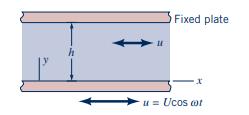
A viscous fluid is contained between wide, parallel plates spaced a distance \(h\) apart as shown in Fig. P7.83. The upper plate is fixed, and the bottom plate oscillates harmonically with a velocity amplitude \(U\) and frequency \(\omega\). The differential equation for the velocity distribution
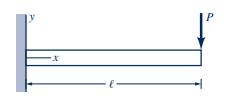
The deflection of the cantilever beam of Fig. P7.84 is governed by the differential equation.\[ E I \frac{d^{2} y}{d x^{2}}=P(x-\ell) \]where \(E\) is the modulus of elasticity and \(I\) is the moment of inertia of the beam cross section. The boundary conditions are \(y=0\) at \(x=0\) and \(d y /
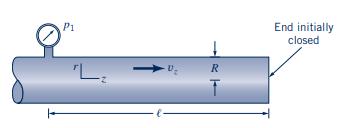
A liquid is contained in a pipe that is closed at one end as shown in Fig. P7.85. Initially the liquid is at rest, but if the end is suddenly opened the liquid starts to move. Assume the pressure \(p_{1}\) remains constant. The differential equation that describes the resulting motion of the liquid
A student drops two spherical balls of different diameters and different densities. She has a stroboscopic photograph showing the positions of each ball as a function of time. However, she wants to express the velocity of each as a function of time in dimensionless form. Develop the dimensionless
The basic equation that describes the motion of the fluid above a large oscillating flat plate is\[ \frac{\partial u}{\partial t}=v \frac{\partial^{2} u}{\partial y^{2}} \]where \(u\) is the fluid velocity component parallel to the plate, \(t\) is time, \(y\) is the spatial coordinate
The dimensionless parameters for a ball released and falling from rest in a fluid are\[ \mathrm{C}_{\mathbf{D}}, \quad \frac{g t^{2}}{D}, \quad \frac{ho}{ho_{b}}, \quad \text { and } \quad \frac{V t}{D} \]where \(C_{\mathrm{D}}\) is a drag coefficient (assumed to be constant at 0.4), \(g\) is the
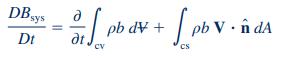
Use the Reynolds transport theorem (Eq. 4.19) with \(B=\) volume and, therefore, \(b=\) volume/mass \(=1 /\) density to obtain the continuity equation for steady or unsteady incompressible flow through a fixed control volume: \(\int_{\mathrm{cv}} \mathbf{V} \cdot \hat{\mathbf{n}} d A=0\).Eq. 4.19
An incompressible fluid flows horizontally in the \(x-y\) plane with a velocity given by\[ u=30\left(1-e^{-4 \frac{y}{\hbar}}\right) \mathrm{m} / \mathrm{s}, v=0 \]where \(y\) and \(h\) are in meters and \(h\) is a constant. Determine the average velocity for the portion of the flow between
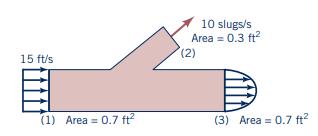
Water flows steadily through the horizontal piping system shown in Fig. P5.3. The velocity is uniform at section (1), the mass flowrate is 10 slugs/s at section (2), and the velocity is nonuniform at section (3).(a) Determine the value of the quantity \(\frac{D}{D t} \int_{\text {sys }} ho d
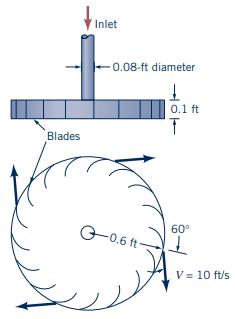
Water flows out through a set of thin, closely spaced blades as shown in Fig. P5.4 with a speed of \(V=10 \mathrm{ft} / \mathrm{s}\) around the entire circumference of the outlet. Determine the mass flowrate through the inlet pipe.Figure P5.4 Blades Inlet -0.08-ft diameter 1 0.1 ft T 60 0.6 ft- V =
Estimate the rate (in gal/hr) that your car uses gasoline when it is being driven on an interstate highway. Determine how long it would take to empty a 12-oz soft-drink container at this flowrate. List all assumptions and show calculations.
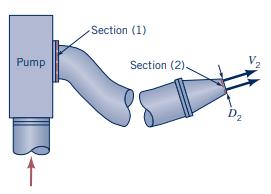
The pump shown in Fig. P5.6 produces a steady flow of \(10 \mathrm{gal} / \mathrm{s}\) through the nozzle. Determine the nozzle exit diameter, \(D_{2}\), if the exit velocity is to be \(V_{2}=100 \mathrm{ft} / \mathrm{s}\).Figure P5.6 Pump Section (1) Section (2). V Dz 2
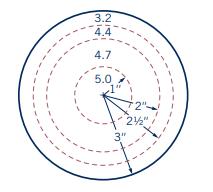
The fluid axial velocities shown in Fig. P5.7 are the average velocities measured in \(\mathrm{ft} / \mathrm{s}\) in each annular area of a duct. Find the volume flowrate for the flowing fluid.Figure P5.7 3.2 4.4 4.7 5.0 1" 3" 72" 2"
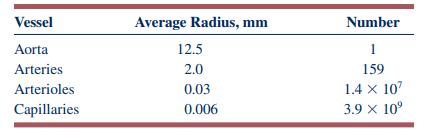
The human circulatory system consists of a complex branching pipe network ranging in diameter from the aorta (largest) to the capillaries (smallest). The average radii and the number of these vessels are shown in the table. Does the average blood velocity increase, decrease, or remain constant as
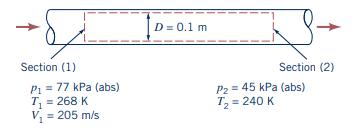
Air flows steadily between two cross sections in a long, straight section of \(0.1-\mathrm{m}\)-inside-diameter pipe. The static temperature and pressure at each section are indicated in Fig. P5.9. If the average air velocity at section (1) is \(205 \mathrm{~m} / \mathrm{s}\), determine the average
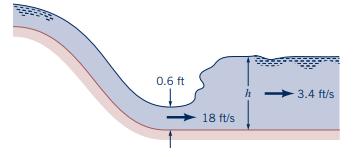
A hydraulic jump (see Video V10.11) is in place downstream from a spillway as indicated in Fig. P5.10. Upstream of the jump, the depth of the stream is \(0.6 \mathrm{ft}\) and the average stream velocity is \(18 \mathrm{ft} / \mathrm{s}\). Just downstream of the jump, the average stream velocity is
A woman is emptying her aquarium at a steady rate with a small pump. The water pumped to a 12 -in.-diameter cylindrical bucket, and its depth is increasing at the rate of 4.0 in. per minute. Find the rate at which the aquarium water level is dropping if the aquarium measures 24 in. (wide) \(\times
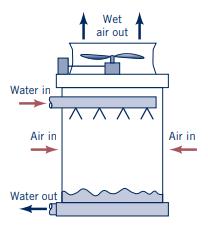
An evaporative cooling tower (see Fig. P5.12) is used to cool water from 110 to \(80^{\circ} \mathrm{F}\). Water enters the tower at a rate of \(250,000 \mathrm{lbm} / \mathrm{hr}\). Dry air (no water vapor) flows into the tower at a rate of \(151,000 \mathrm{lbm} / \mathrm{hr}\). If the rate of
At cruise conditions, air flows into a jet engine at a steady rate of \(65 \mathrm{lbm} / \mathrm{s}\). Fuel enters the engine at a steady rate of \(0.60 \mathrm{lbm} / \mathrm{s}\). The average velocity of the exhaust gases is \(1500 \mathrm{ft} / \mathrm{s}\) relative to the engine. If the engine
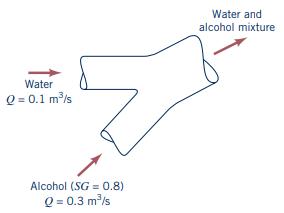
Water at \(0.1 \mathrm{~m}^{3} / \mathrm{s}\) and alcohol \((S G=0.8)\) at \(0.3 \mathrm{~m}^{3} / \mathrm{s}\) are mixed in a \(y\)-duct as shown in Fig. 5.14. What is the average density of the mixture of alcohol and water?Figure P5.14 Water Q = 0.1 m/s Alcohol (SG = 0.8) Q=0.3 m/s Water and
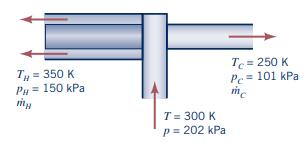
In the vortex tube shown in Fig. P5.15, air enters at \(202 \mathrm{kPa}\) absolute and \(300 \mathrm{~K}\). Hot air leaves at \(150 \mathrm{kPa}\) absolute and \(350 \mathrm{~K}\), whereas cold air leaves at \(101 \mathrm{kPa}\) absolute and \(250 \mathrm{~K}\). The hot air mass flow rate,
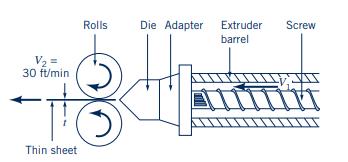
Molten plastic at a temperature of \(510^{\circ} \mathrm{F}\) is augered through an extruder barrel by a screw occupying \(\frac{3}{5}\) of the barrel's volume (Fig. P5.16). The extruder is \(16 \mathrm{ft}\) long and has an inner diameter of 8 in. The barrel is connected to an adapter having a
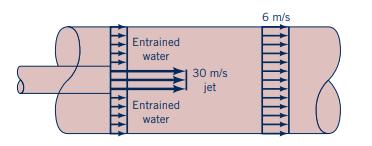
A water jet pump (see Fig. P5.17) involves a jet cross-sectional area of \(0.01 \mathrm{~m}^{2}\), and a jet velocity of \(30 \mathrm{~m} / \mathrm{s}\). The jet is surrounded by entrained water. The total cross-sectional area associated with the jet and entrained streams is \(0.075
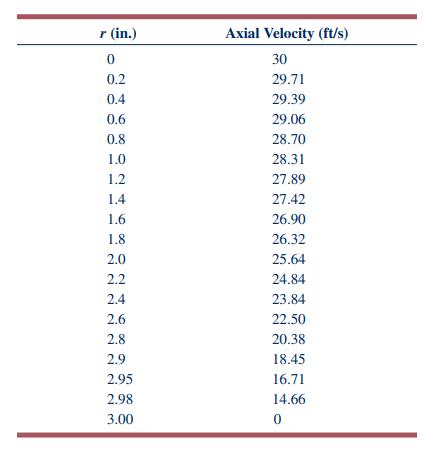
To measure the mass flowrate of air through a 6-in.-insidediameter pipe, local velocity data are collected at different radii from the pipe axis (see Table). Determine the mass flowrate corresponding to the data listed in the following table. Plot the velocity profile and comment. r (in.) Axial
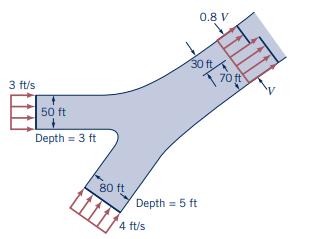
Two rivers merge to form a larger river as shown in Fig. P5.19. At a location downstream from the junction (before the two streams completely merge), the nonuniform velocity profile is as shown and the depth is \(6 \mathrm{ft}\). Determine the value of \(V\).Figure P5.19 3 ft/s 50 ft Depth = 3 ft
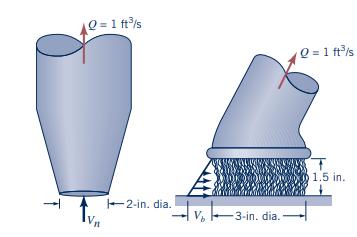
Various types of attachments can be used with the shop vac shown in Video V5.2. Two such attachments are shown in Fig. P5.20-a nozzle and a brush. The flowrate is \(1 \mathrm{ft}^{3} / \mathrm{s}\). (a) Determine the average velocity through the nozzle entrance, \(V_{n}\). (b) Assume the air enters
An appropriate turbulent pipe flow velocity profile is\[ \mathbf{V}=u_{c}\left(\frac{R-r}{R}\right)^{1 / n} \hat{\mathbf{i}} \]where \(u_{c}=\) centerline velocity, \(r=\) local radius, \(R=\) pipe radius, and \(\hat{\mathbf{i}}=\) unit vector along pipe centerline. Determine the ratio of average
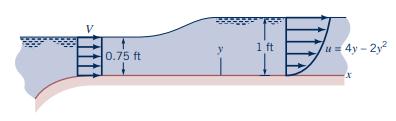
As shown in Fig. P5.22, at the entrance to a 3 -ft-wide channel the velocity distribution is uniform with a velocity \(V\). Further downstream the velocity profile is given by \(u=4 y-2 y^{2}\), where \(u\) is in \(\mathrm{ft} / \mathrm{s}\) and \(y\) is in \(\mathrm{ft}\). Determine the value of
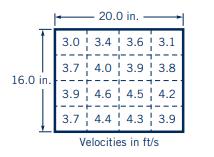
The cross-sectional area of a rectangular duct is divided into 16 equal rectangular areas, as shown in Fig. P5.23. The axial fluid velocity measured in feet per second in each smaller area is given in the figure. Estimate the volume flowrate and average axial velocity.Figure P5.23 16.0 in. 1 20.0
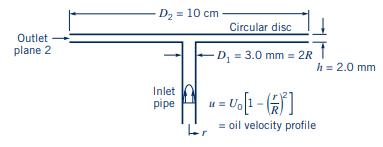
Oil for lubricating the thrust bearing shown in Fig. P5.24 flows into the space between the bearing surfaces through a circular inlet pipe with velocity\[ u=U_{0}\left[1-\left(\frac{r}{R}\right)^{2}\right] \]where \(R=1.5 \mathrm{~mm}\). The oil has a specific gravity \(S=0.86\) and flows in the
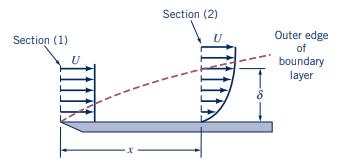
Flow of a viscous fluid over a flat plate surface results in the development of a region of reduced velocity adjacent to the wetted surface as depicted in Fig. P5.25. This region of reduced flow is called a boundary layer. At the leading edge of the plate, the velocity profile may be considered
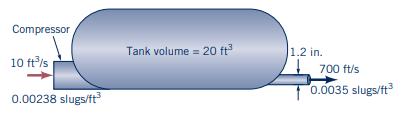
Air at standard conditions enters the compressor shown in Fig. P5.26 at a rate of \(10 \mathrm{ft}^{3} / \mathrm{s}\). It leaves the tank through a 1.2-in.-diameter pipe with a density of \(0.0035 \mathrm{slugs} / \mathrm{ft}^{3}\) and a uniform speed of \(700 \mathrm{ft} / \mathrm{s}\). (a)
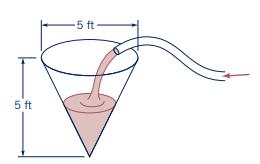
Estimate the time required to fill with water a cone-shaped container (see Fig. P5.27) \(5 \mathrm{ft}\) high and \(5 \mathrm{ft}\) across at the top if the filling rate is \(20 \mathrm{gal} / \mathrm{min}\).Figure P5.27 5 ft -5 ft-
For an automobile moving along a highway, describe the control volume you would use to estimate the flowrate of air across the radiator. Explain how you would estimate the velocity of that air.
Showing 500 - 600
of 2369
1
2
3
4
5
6
7
8
9
10
11
12
13
14
15
Last
Step by Step Answers

 Get 50% OFF
Claim Now
Get 50% OFF
Claim Now