New Semester
Started
Get
50% OFF
Study Help!
--h --m --s
Claim Now
Question Answers
Textbooks
Find textbooks, questions and answers
Oops, something went wrong!
Change your search query and then try again
S
Books
FREE
Study Help
Expert Questions
Accounting
General Management
Mathematics
Finance
Organizational Behaviour
Law
Physics
Operating System
Management Leadership
Sociology
Programming
Marketing
Database
Computer Network
Economics
Textbooks Solutions
Accounting
Managerial Accounting
Management Leadership
Cost Accounting
Statistics
Business Law
Corporate Finance
Finance
Economics
Auditing
Tutors
Online Tutors
Find a Tutor
Hire a Tutor
Become a Tutor
AI Tutor
AI Study Planner
NEW
Sell Books
Search
Search
Sign In
Register
study help
engineering
fluid mechanics
Fluid Mechanics Fundamentals And Applications 3rd Edition Yunus Cengel, John Cimbala - Solutions
Summarize the eight steps involved in a typical CFD analysis of a steady, laminar flow field.
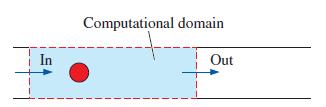
Suppose you are using CFD to simulate flow through a duct in which there is a circular cylinder as in Fig. P15–7C. The duct is long, but to save computer resources you choose a computational domain in the vicinity of the cylinder only. Explain why the downstream edge of the computational domain
What is the standard method to test for adequate grid resolution when using CFD?
What is the difference between a pressure inlet and a velocity inlet boundary condition? Explain why you cannot specify both pressure and velocity at a velocity inlet boundary condition or at a pressure inlet boundary condition.
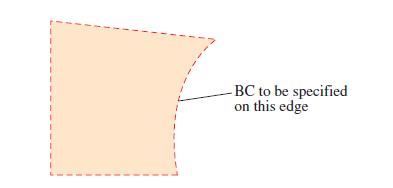
Of the boundary conditions discussed in this chapter, list all the boundary conditions that may be applied to the right edge of the two-dimensional computational domain sketched in Fig. P15–10C. Why can’t the other boundary conditions be applied to this edge?FIGURE P15–10C 1 ( BC to be
Briefly discuss how each of the following is used by CFD codes to speed up the iteration process: (a) Multigridding(b) Artificial time.
Write a brief (a few sentences) discussion about the significance of each of the following in regards to an iterative CFD solution: (a) Initial conditions, (b) Residual, (c) Iteration,(d) Postprocessing.
Repeat Prob. 15–35, except create a three-dimensional room, with an air supply and an air return in the ceiling. Compare the two-dimensional results of Prob. 15–35 with the more realistic three-dimensional results of this problem. Discuss.Data from Problem 15-35Choose one of the room geometries
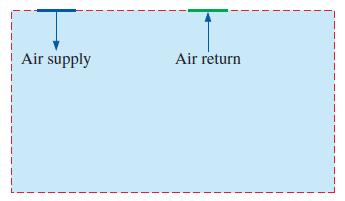
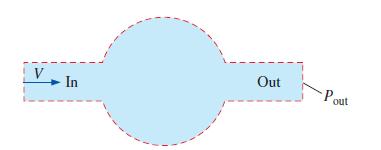
Repeat Prob. 15–32, except move the supply and/or return vents to various locations in the ceiling. Compare and discuss.Data from Problem 15–32Generate a computational domain to study ventilation in a room (Fig. P15–32). Specifically, generate a rectangular room with a velocity inlet in the
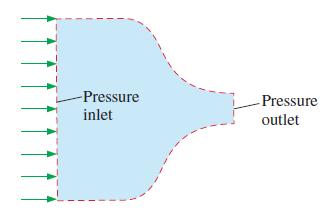
Generate a computational domain to study compressible flow of air through a converging nozzle with atmospheric pressure at the nozzle exit (Fig. P15–37). The nozzle walls may be approximated as inviscid (zero shear stress). Run several cases with various values of inlet pressure. How much inlet
Repeat Prob. 15–37, except remove the inviscid flow approximation. Instead, let the flow be turbulent, with smooth, no-slip walls. Compare your results to those of Prob. 15–37. What is the major effect of friction in this problem? Discuss.Data from Problem 15-37.Generate a computational domain
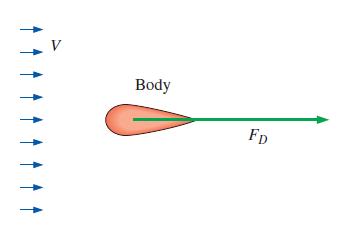
Generate a computational domain to study incompressible, laminar flow over a two-dimensional streamlined body (Fig. P15–39). Generate various body shapes, and calculate the drag coefficient for each shape. What is the smallest value of CD that you can achieve?FIGURE P15–39 Body FD
For each statement, choose whether the statement is true or false, and discuss your answer briefly:(a) The physical validity of a CFD solution always improves as the grid is refined.(b) The x-component of the Navier–Stokes equation is an example of a transport equation.(c) For the same number of
In Prob. 15–19 we take advantage of top–bottom symmetry when constructing our computational domain and grid. Why can’t we also take advantage of the right–left symmetry in this exercise? Repeat the discussion for the case of potential flow.Data from Problem 15-19An incompressible CFD code
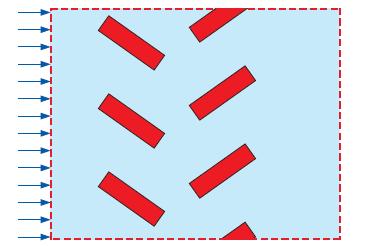
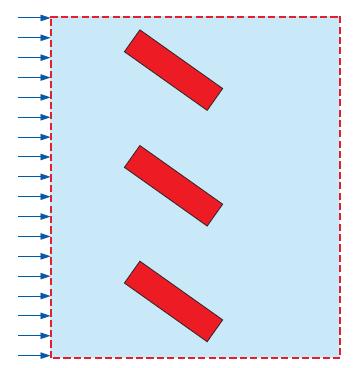
Generate a computational domain and grid, and calculate flow through the two-stage heat exchanger of Prob. 15–25, with the heating elements of the first stage set at a 45° angle of attack with respect to horizontal, and those of the second stage set to an angle of attack of –45°. Set the
Suppose you have a fairly complex geometry and a CFD code that can handle unstructured grids with triangular cells. Your grid generation code can create an unstructured grid very quickly. Give some reasons why it might be wiser to take the time to create a multiblock structured grid instead. In
What is the difference between multigridding and multiblocking? Discuss how each may be used to speed up a CFD calculation. Can these two be applied together?
Think about modern high-speed, large-memory computer systems. What feature of such computers lends itself nicely to the solution of CFD problems using a multiblock grid with approximately equal numbers of cells in each individual block? Discuss.
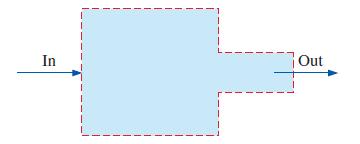
Gerry creates the computational domain sketched in Fig. P15–46C to simulate flow through a sudden contraction in a two-dimensional duct. He is interested in the time averaged pressure drop and the minor loss coefficient created by the sudden contraction. Gerry generates a grid and calculates the
Generate a computational domain and grid, and calculate flow through the single-stage heat exchanger of Prob. 15–22, with the heating elements set at a 45° angle of attack with respect to horizontal. Set the inlet air temperature to 20°C, and the wall temperature of the heating elements to
Repeat the calculations of Prob. 15–50 for several angles of attack of the heating elements, from 0 (horizontal) to 90° (vertical). Use identical inlet conditions and wall conditions for each case. Which angle of attack provides the most heat transfer to the air? Specifically, which angle of
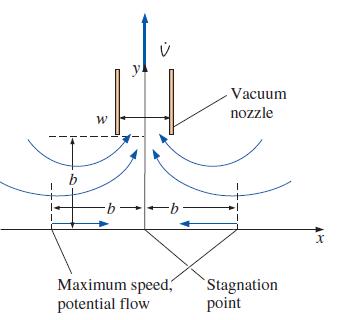
Generate a computational domain and grid, and calculate the flow of air into a two-dimensional vacuum cleaner inlet (Fig. P15–58), using the inviscid flow approximation in the CFD code. Compare your results with those predicted in Chap. 10 for potential flow. Discuss.FIGURE P15–58
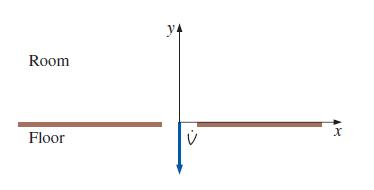
For the slot flow of Prob. 15–56, change to laminar flow instead of inviscid flow, and recompute the flow field. Compare your results to the inviscid flow case and to the potential flow case of Chap. 10. Plot contours of vorticity. Where is the irrotational flow approximation appropriate?
Consider the flow of air into a two-dimensional slot along the floor of a large room, where the floor is coincident with the x-axis (Fig. P15–56). Generate an appropriate computational domain and grid. Using the inviscid flow approximation in the CFD code, calculate vertical velocity component v
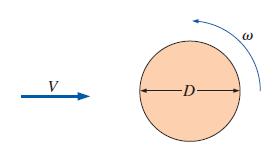
For the spinning cylinder of Fig. P15–54, generate a dimensionless parameter for rotational speed relative to freestream speed (combine variables ω, D, and V into a non dimensional Pi group). Repeat the calculations of Prob. 15–54 for several values of angular velocity ω. Use identical inlet
Generate a computational domain and grid, and calculate stationary turbulent flow over a spinning circular cylinder (Fig. P15–54). In which direction is the side force on the body—up or down? Explain. Plot streamlines in the flow. Where is the upstream stagnation point?FIGURE P15–54 V -D-
For the vacuum cleaner of Prob. 15–58, change to laminar flow instead of inviscid flow, and recompute the flow field. Compare your results to the inviscid flow case and to the potential flow case of Chap. 10. Discuss.Data from Problem 15-58Generate a computational domain and grid, and calculate
What is the driving force for flow in an open channel? How is the flow rate in an open channel established?
What is the most significant danger associated with an approximate solution of the Navier–Stokes equation? Give an example that is different than the ones given?
What is normal depth? Explain how it is established in open channels.
How does the pressure change along the free surface in an open-channel flow?
Consider steady fully developed flow in an open channel of rectangular cross section with a constant slope of 5° for the bottom surface. Will the slope of the free surface also be 5°? Explain.
What causes the flow in an open channel to be varied (or nonuniform)? How does rapidly varied flow differ from gradually varied flow?
How does uniform flow differ from nonuniform flow in open channels? In what kind of channels is uniform flow observed?
Given the average flow velocity and the flow depth, explain how you would determine if the flow in open channels is tranquil, critical, or rapid.
The flow in an open channel is observed to have undergone a hydraulic jump. Is the flow upstream from the jump necessarily supercritical? Is the flow downstream from the jump necessarily subcritical?
What is critical depth in open-channel flow? For a given average flow velocity, how is it determined?
What is the Froude number? How is it defined? What is its physical significance?
A single wave is initiated in a sea by a strong jolt during an earthquake. Taking the average water depth to be 2 km and the density of seawater to be 1.030 kg/m3, determine the speed of propagation of this wave.
Consider the flow of water in a wide channel. Determine the speed of a small disturbance in the flow if the flow depth is (a) 25 cm (b) 80 cm. What would your answer be if the fluid were oil?
Water at 15°C is flowing uniformly in a 2-m-wide rectangular channel at an average velocity of 1.5 m/s. If the water depth is 24 cm, determine whether the flow is subcritical or supercritical.
After heavy rain, water flows on a concrete surface at an average velocity of 1.3 m/s. If the water depth is 2 cm, determine whether the flow is subcritical or supercritical.
Water at 70°F is flowing uniformly in a wide rectangular channel at an average velocity of 6 ft/s. If the water depth is 0.5 ft, determine (a) Whether the flow is laminar or turbulent (b) Whether the flow is subcritical or supercritical.
Water at 20°C is flowing uniformly in a wide rectangular channel at an average velocity of 1.5 m/s. If the water depth is 0.16 m, determine (a) Whether the flow is laminar or turbulent (b) Whether the flow is subcritical or supercritical.
Water at 10°C flows in a 3-m-diameter circular channel half-full at an average velocity of 2.5 m/s. Determine the hydraulic radius, the Reynolds number, and the flow regime (laminar or turbulent).
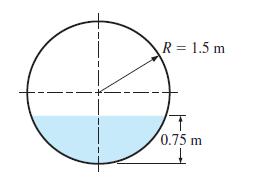
Water at 20°C flows in a partially full 3-m-diameter circular channel at an average velocity of 2 m/s. If the maximum water depth is 0.75 m, determine the hydraulic radius, the Reynolds number, and the flow regime.FIGURE P13–19 B R = 1.5 m 0.75 m
Repeat Prob. 13–17 for a channel diameter of 2 m.Data from Problem 13–17Water at 10°C flows in a 3-m-diameter circular channel half-full at an average velocity of 2.5 m/s. Determine the hydraulic radius, the Reynolds number, and the flow regime (laminar or turbulent).
Consider steady flow of water through two identical open rectangular channels at identical flow rates. If the flow in one channel is subcritical and in the other supercritical, can the specific energies of the water in these two channels be identical? Explain.
How is the specific energy of a fluid flowing in an open channel defined in terms of heads?
Consider steady flow of a liquid through a wide rectangular channel. It is claimed that the energy line of flow is parallel to the channel bottom when the frictional losses are negligible. Do you agree?
Consider steady one-dimensional flow through a wide rectangular channel. Someone claims that the total mechanical energy of the fluid at the free surface of a cross section is equal to that of the fluid at the channel bottom of the same cross section. Do you agree? Explain.
How is the total mechanical energy of a fluid during steady one-dimensional flow through a wide rectangular channel expressed in terms of heads? How is it related to the specific energy of the fluid?
For a given flow rate through an open channel, the variation of specific energy with flow depth is studied. One person claims that the specific energy of the fluid will be minimum when the flow is critical, but another person claims that the specific energy will be minimum when the flow is
Consider steady supercritical flow of water through an open rectangular channel at a constant flow rate. Someone claims that the larger is the flow depth, the larger the specific energy of water. Do you agree? Explain.
During steady and uniform flow through an open channel of rectangular cross section, a person claims that the specific energy of the fluid remains constant. A second person claims that the specific energy decreases along the flow because of the frictional effects and thus head loss. With which
How is the friction slope defined? Under what conditions is it equal to the bottom slope of an open channel?
Water at 15°C flows at a depth of 0.4 m with an average velocity of 6 m/s in a rectangular channel. Determine (a) The critical depth, (b) The alternate depth, (c) The minimum specific energy
Water at 10°C flows in a 6-m-wide rectangular channel at a depth of 0.55 m and a flow rate of 12 m3/s. Determine(a) The critical depth, (b) Whether the flow is subcritical or supercritical,(c) The alternate depth.
Water at 65°F flows at a depth of 1.4 ft with an average velocity of 20 ft/s in a wide rectangular channel. Determine (a) The Froude number, (b) The critical depth, (c) Whether the flow is subcritical or supercritical. What would your response be if the flow depth were 0.2 ft?
Repeat Prob. 13–32E for an average velocity of 10 ft/s.Data from Problem 13–32EWater at 65°F flows at a depth of 1.4 ft with an average velocity of 20 ft/s in a wide rectangular channel. Determine The Froude number, The critical depth, Whether the flow is subcritical or supercritical. What
Water flows steadily in a 1.4-m-wide rectangular channel at a rate of 0.7 m3/s. If the flow depth is 0.40 m, determine the flow velocity and if the flow is subcritical or supercritical. Also determine the alternate flow depth if the character of flow were to change.
Water at 20°C flows at a depth of 0.4 m with an average velocity of 4 m/s in a rectangular channel. Determine the specific energy of the water and whether the flow is subcritical or supercritical.
Water flows half-full through a hexagonal channel of bottom width 2 m at a rate of 60 m3/s. Determine (a) The average velocity(b) Whether the flow is subcritical and supercritical.
Repeat Prob. 13–36 for a flow rate of 30 m3/s.Data from Problem 13-36Water flows half-full through a hexagonal channel of bottom width 2 m at a rate of 60 m3/s. Determine a. The average velocity a. Whether the flow is subcritical and supercritical.
Water flows half-full through a 50-cm-diameter steel channel at an average velocity of 2.8 m/s. Determine the volume flow rate and whether the flow is subcritical or supercritical.
Water flows through a 2-m-wide rectangular channel with an average velocity of 5 m/s. If the flow is critical, determine the flow rate of water.
When is the flow in an open channel said to be uniform? Under what conditions will the flow in an open channel remain uniform?
Which is a better hydraulic cross section for an open channel: one with a small or a large hydraulic radius?
Which is the best hydraulic cross section for an open channel: (a) Circular, (b) Rectangular, (c) Trapezoidal,(d) Triangular
The best hydraulic cross section for a rectangular open channel is one whose fluid height is (a) Half, (b) Twice,(c) Equal to, (d) One-third the channel width.
The best hydraulic cross section for a trapezoidal channel of base width b is one for which the length of the side edge of the flow section is (a) b, (b) b/2, (c) 2b, (d) √3b.
During uniform flow in an open channel, someone claims that the head loss can be determined by simply multiplying the bottom slope by the channel length. Can it be this simple? Explain.
Consider uniform flow through a wide rectangular channel. If the bottom slope is increased, the flow depth will(a) Increase, (b) Decrease, (c) Remain constant.
Consider uniform flow through an open channel lined with bricks with a Manning coefficient of n = 0.015. If the Manning coefficient doubles (n = 0.030) as a result of some algae growth on surfaces while the flow cross section remains constant, the flow rate will (a) Double, (b) Decrease by a
Water flows uniformly half-full in a 2-m-diameter circular channel that is laid on a grade of 1.5 m/km. If the channel is made of finished concrete, determine the flow rate of the water.
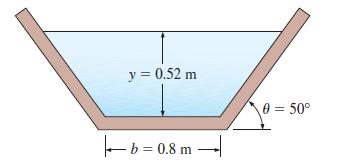
Water is flowing uniformly in a finished-concrete channel of trapezoidal cross section with a bottom width of 0.8 m, trapezoid angle of 50°, and a bottom angle of 0.48. If the flow depth is measured to be 0.52 m, determine the flow rate of water through the channel.FIGURE P13–49 y = 0.52 m |
A 3-ft-diameter semicircular channel made of unfinished concrete is to transport water to a distance of 1 mi uniformly. If the flow rate is to reach 90 ft3/s when the channel is full, determine the minimum elevation difference across the channel.
During uniform flow in open channels, the flow velocity and the flow rate can be determined from the Manning equations expressed asWhat is the value and dimension of the constant a in these equations in SI units? Also, explain how the Manning coefficient n can be determined when the friction factor
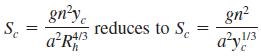
Show that for uniform critical flow, the general critical slope relationfor film flow with b ≫ yc. Sc gn²y a²R13 h reduces to S gn² ,1/3 C
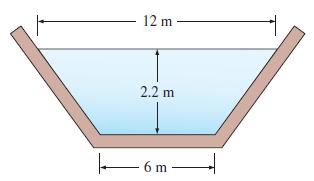
A trapezoidal channel with a bottom width of 6 m, free surface width of 12 m, and flow depth of 2.2 m discharges water at a rate of 120 m3/s. If the surfaces of the channel are lined with asphalt (n = 0.016), determine the elevation drop of the channel per km.FIGURE P13–53 12 m 2.2 m 6 m
In practice, the V-notch is commonly used to measure flow rate in open channels. Using the idealized Torricelli’s equationfor velocity, develop a relation for the flow rate through the V-notch in terms of the angle θ. Also, show the variation of the flow rate with θ by evaluating the flow rate
Water flows uniformly half-full in a 3.2-m-diameter circular channel laid with a slope of 0.004. If the flow rate of water is measured to be 4.5 m3/s, determine the Manning coefficient of the channel and the Froude number.
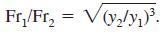
Consider water flow through a wide rectangular channel undergoing a hydraulic jump. Show that the ratio of the Froude numbers before and after the jump can be expressed in terms of flow depths y1 and y2 before and after the jump, respectively, as Fr₁/Fr₂ = (y₂/y₁)³.
A sluice gate with free outflow is used to control the discharge rate of water through a channel. Determine the flow rate per unit width when the gate is raised to yield a gap of 50 cm and the upstream flow depth is measured to be 2.8 m. Also determine the flow depth and the velocity downstream.
Water flowing in a wide channel at a flow depth of 45 cm and an average velocity of 8 m/s undergoes a hydraulic jump. Determine the fraction of the mechanical energy of the fluid dissipated during this jump.
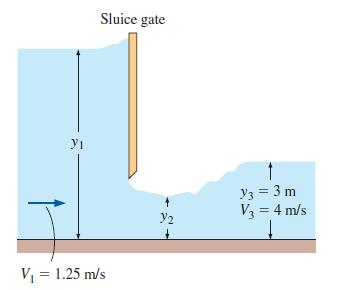
Water flowing through a sluice gate undergoes a hydraulic jump, as shown in Fig. P13–144. The velocity of the water is 1.25 m/s before reaching the gate and 4 m/s after the jump. Determine the flow rate of water through the gate per meter of width, the flow depths y1 and y2, and the energy
Repeat Prob. 13–144 for a velocity of 3.2 m/s after the hydraulic jump.Data from Problem 13–144Water flowing through a sluice gate undergoes a hydraulic jump, as shown in Fig. P13–144. The velocity of the water is 1.25 m/s before reaching the gate and 4 m/s after the jump. Determine the flow
Water is discharged from a 5-m-deep lake into a finished concrete channel with a bottom slope of 0.004 through a sluice gate with a 0.5-m-high opening at the bottom. Shortly after supercritical uniform-flow conditions are established, the water undergoes a hydraulic jump. Determine the flow depth,
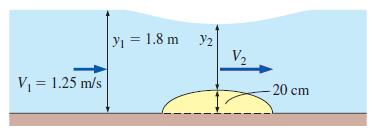
Water flowing in a wide horizontal channel approaches a 20-cm-high bump with a velocity of 1.25 m/s and a flow depth of 1.8 m. Determine the velocity, flow depth, and Froude number over the bump.FIGURE P13–148 V₁ = 1.25 m/s y₁ = 1.8 m ₂ V₂ -20 cm
Water is discharged from a dam into a wide spillway to avoid overflow and to reduce the risk of flooding. A large fraction of the destructive power of the water is dissipated by a hydraulic jump during which the water depth rises from 0.70 to 5.0 m. Determine the velocities of water before and
Reconsider Prob. 13–148. Determine the bump height for which the flow over the bump is critical (Fr = 1).Data from Problem 13–148Water flowing in a wide horizontal channel approaches a 20-cm-high bump with a velocity of 1.25 m/s and a flow depth of 1.8 m. Determine the velocity, flow depth, and
Which choices are examples of open-channel flow?I. Flow of water in riversII. Draining of rainwater off highwaysIII. Upward draft of rain and snowIV. Sewer lines(a) I and II (b) I and III(c) II and III(d) I, II, and IV (e) I, II, III, and IV
If the flow depth remains constant in an open-channel flow, the flow is called(a) Uniform flow (b) Steady flow (c) Varied flow(d) Unsteady flow (e) Laminar flow
Consider water flow in a rectangular open channel of height 2 m and width 5 m containing water of depth 1.5 m. The hydraulic radius for this flow is(a) 0.47 m (b) 0.94 m (c) 1.5 m (d) 3.8 m (e) 5 m
Water flows in a rectangular open channel of width 5 m at a rate of 7.5 m3/s. The critical depth for this flow is(a) 5 m (b) 2.5 m (c) 1.5 m (d) 0.96 m (e) 0.61 m
Water flows in a rectangular open channel of width 0.6 m at a rate of 0.25 m3/s. If the flow depth is 0.2 m, what is the alternate flow depth if the character of flow were to change?(a) 0.2 m (b) 0.26 m(c) 0.35 m (d) 0.6 m (e) 0.8 m
Water flows in a 6-m-wide rectangular open channel at a rate of 55 m3/s. If the flow depth is 2.4 m, the Froude number is(a) 0.531 (b) 0.787 (c) 1.0 (d) 1.72 (e) 2.65
Water flows in a clean and straight natural channel of rectangular cross section with a bottom width of 0.75 m and a bottom slope angle of 0.68. If the flow depth is 0.15 m, the flow rate of water through the channel is(a) 0.0317 m3/s (b) 0.05 m3/s (c) 0.0674 m3/s(d) 0.0866 m3/s (e) 1.14 m3/s
Water is to be transported in a finished-concrete rectangular channel with a bottom width of 1.2 m at a rate of 5 m3/s. The channel bottom drops 1 m per 500 m length. The minimum height of the channel under uniform-flow conditions is(a) 1.9 m (b) 1.5 m (c) 1.2 m (d) 0.92 m (e) 0.60 m
Water is to be transported in a 4-m-wide rectangular open channel. The flow depth to maximize the flow rate is(a) 1 m (b) 2 m (c) 4 m (d) 6 m (e) 8 m
Showing 300 - 400
of 1457
1
2
3
4
5
6
7
8
9
10
11
12
13
14
15
Step by Step Answers

 Get 50% OFF
Claim Now
Get 50% OFF
Claim Now