New Semester
Started
Get
50% OFF
Study Help!
--h --m --s
Claim Now
Question Answers
Textbooks
Find textbooks, questions and answers
Oops, something went wrong!
Change your search query and then try again
S
Books
FREE
Study Help
Expert Questions
Accounting
General Management
Mathematics
Finance
Organizational Behaviour
Law
Physics
Operating System
Management Leadership
Sociology
Programming
Marketing
Database
Computer Network
Economics
Textbooks Solutions
Accounting
Managerial Accounting
Management Leadership
Cost Accounting
Statistics
Business Law
Corporate Finance
Finance
Economics
Auditing
Tutors
Online Tutors
Find a Tutor
Hire a Tutor
Become a Tutor
AI Tutor
AI Study Planner
NEW
Sell Books
Search
Search
Sign In
Register
study help
engineering
fluid mechanics
Fluid Mechanics Fundamentals And Applications 3rd Edition Yunus Cengel, John Cimbala - Solutions
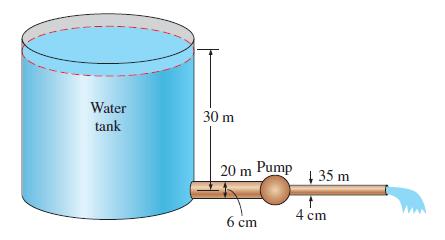
Reconsider Prob. 8–144. Using EES (or other) software, investigate the effect of the second pipe diameter on the required pumping head to maintain the indicated flow rate. Let the diameter vary from 1 to 10 cm in increments of 1 cm. Tabulate and plot the results.Data from Problem 8–144Water at
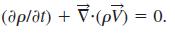
The compressible form of the continuity equation isExpand this equation as far as possible in Cartesian coordinates (x, y, z) and (u, v, w). (aplat) + (pv) = 0.
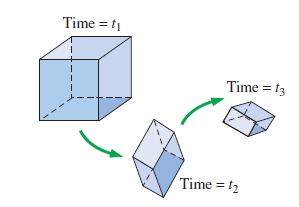
In Example 9–6 we derive the equation for volumetric strain rate,Write this as a word equation and discuss what happens to the volume of a fluid element as it moves around in a compressible fluid flow field (Fig. P9–25).Fig. P9–25Data from Example 6Recall the volumetric strain rate, defined
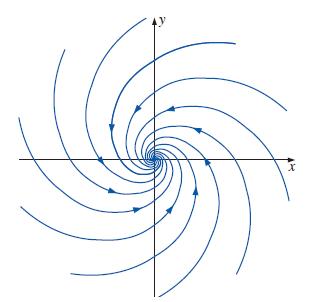
Verify that the spiraling line vortex/sink flow in the rθ-plane of Prob. 9–17 satisfies the two-dimensional incompressible continuity equation. What happens to conservation of mass at the origin? Discuss.Data from Problem 17Consider a spiraling line vortex/sink flow in the xy-or rθ-plane as
Verify that the steady, two-dimensional, incompressible velocity field of Prob. 9–16 satisfies the continuity equation. Stay in Cartesian coordinates and show all your work.Data from Problem 16A steady, two-dimensional, incompressible velocity field has Cartesian velocity components u = Cy/(x2 +
Consider the steady, two-dimensional velocity field given byVerify that this flow field is incompressible. V = (u, v) = (1.6 + 1.8x) + (1.5 - 1.8y)].
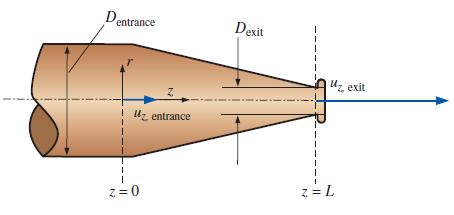
Consider steady flow of water through an axisymmetric garden hose nozzle (Fig. P9–29). The axial component of velocity increases linearly from uz, entrance to uz, exit as sketched. Between z = 0 and z = L, the axial velocity component is given by uz = uz,entrance + [(uz,exit – uz,entrance)/L]z.
Consider the following steady, three-dimensional velocity field in Cartesian coordinates:where a, b, c, and d are constants. Under what conditions is this flow field incompressible? V = (u, v, w) (axy2 b)-2cy³7 + dxyk,
Consider the following steady, three-dimensional velocity field in Cartesian coordinates:where a, b, c, and d are constants. Under what conditions is this flow field incompressible? V= (u, v, w) = (ax²y + b)i + cxy²7+ dx²yk
The flow rate of water at 20°C (ρ = 998 kg/m3 and μ = 1.002 × 10⁻³ kg/m·s) through a 60-cm-diameter pipe is measured with an orifice meter with a 30-cm-diameter opening to be 400 L/s. Determine the pressure difference indicated by the orifice meter and the head loss.
What is the operating principle of variable-area flowmeters (rotameters)? How do they compare to other types of flowmeters with respect to cost, head loss, and reliability?
In CFD lingo, the stream function is often called a non-primitive variable, while velocity and pressure are called primitive variables. Why do you suppose this is the case?
Consider two-dimensional flow in the xy-plane. What is the significance of the difference in value of stream function ψ from one streamline to another?
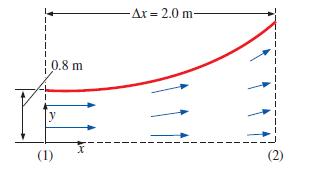
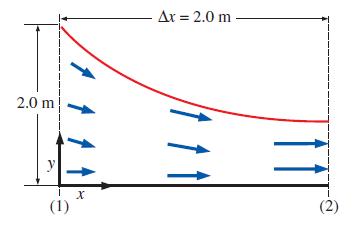
A two-dimensional diverging duct is being designed to diffuse the high-speed air exiting a wind tunnel. The x-axis is the centerline of the duct (it is symmetric about the x-axis), and the top and bottom walls are to be curved in such a way that the axial wind speed u decreases approximately
Two velocity components of a steady, incompressible flow field are known: u = 2ax + bxy + cy2 and v = axz – byz2, where a, b, and c are constants. Velocity component w is missing. Generate an expression for w as a function of x, y, and z.
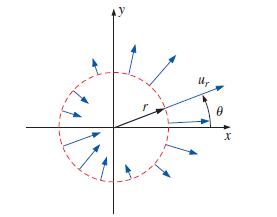
Imagine a steady, two-dimensional, incompressible flow that is purely radial in the xy- or rθ-plane. In other words, velocity component ur is nonzero, but uθ is zero everywhere (Fig. P9–36). What is the most general form of velocity component ur that does not violate conservation of mass?FIGURE
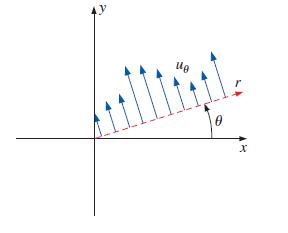
Imagine a steady, two-dimensional, incompressible flow that is purely circular in the xy- or rθ-plane. In other words, velocity component uθ is nonzero, but ur is zero everywhere (Fig. P9–33). What is the most general form of velocity component uθ that does not violate conservation of
The u velocity component of a steady, two-dimensional, incompressible flow field is u = ax + by, where a and b are constants. Velocity component v is unknown. Generate an expression for v as a function of x and y.
The u velocity component of a steady, two-dimensional, incompressible flow field is u = 3ax2 – 2bxy, where a and b are constants. Velocity component ν is unknown. Generate an expression for ν as a function of x and y.
The u velocity component of a steady, two-dimensional, incompressible flow field is u = ax + b, where a and b are constants. Velocity component ν is unknown. Generate an expression for ν as a function of x and y.
What restrictions or conditions are imposed on stream function ψ so that it exactly satisfies the two-dimensional incompressible continuity equation by definition? Why are these restrictions necessary?
What is significant about curves of constant stream function? Explain why the stream function is useful in fluid mechanics.
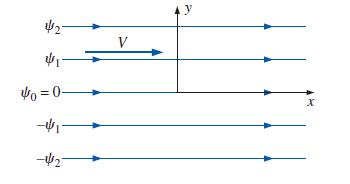
Consider a steady, two-dimensional, incompressible flow field called a uniform stream. The fluid speed is V everywhere, and the flow is aligned with the x-axis (Fig. P9–43). The Cartesian velocity components are u = V and v = 0. Generate an expression for the stream function for this flow.
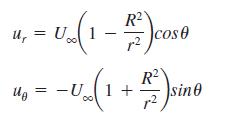
A common flow encountered in practice is the crossflow of a fluid approaching a long cylinder of radius R at a free stream speed of U∞. For incompressible inviscid flow, the velocity field of the flow is given asShow that the velocity field satisfies the continuity equation, and determine the
The stream function of an unsteady two-dimensional flow field is given bySketch a few streamlines for the given flow on the x-y plane, and derive expressions for the velocity components u(x, y, t) and v(x, y, t). Also determine the path lines at t = 0. U 4x y²
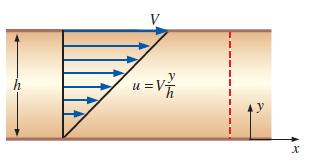
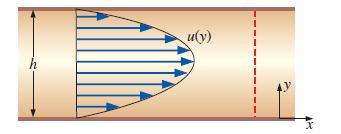
Consider fully developed Couette flow—flow between two infinite parallel plates separated by distance h, with the top plate moving and the bottom plate stationary as illustrated in Fig. P9–46. The flow is steady, incompressible, and two-dimensional in the xy-plane. The velocity field is given
As a follow-up to Prob. 9–46, calculate the volume flow rate per unit width into the page of Fig. P9–46 from first principles (integration of the velocity field). Compare your result to that obtained directly from the stream function. Discuss.Data from Problem 46Consider fully developed Couette
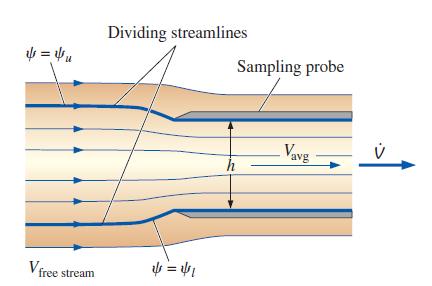
In the field of air pollution control, one often needs to sample the quality of a moving airstream. In such measurements a sampling probe is aligned with the flow as sketched in Fig. P9–52. A suction pump draws air through the probe at volume flow rate V̇ as sketched. For accurate sampling, the
As a follow-up to Prob. 9–49, calculate the volume flow rate per unit width into the page of Fig. P9–49 from first principles (integration of the velocity field). Compare your result to that obtained directly from the stream function. Discuss.Data from Problem 49Consider fully developed,
Consider the Couette flow of Fig. P9–46. For the case in which V = 10.0 ft/s and h = 1.20 in, plot several streamlines using evenly spaced values of stream function. Are the streamlines themselves equally spaced? Discuss why or why not.Data from Problem 46Consider fully developed Couette
Consider the channel flow of Fig. P9–49. The fluid is water at 20°C. For the case in which dP/dx = –20,000 N/m3 and h = 1.20 mm, plot several streamlines using evenly spaced values of stream function. Are the streamlines themselves equally spaced? Discuss why or why not.FIGURE P9–49
Consider fully developed, two-dimensional channel flow—flow between two infinite parallel plates separated by distance h, with both the top plate and bottom plate stationary, and a forced pressure gradient dP/dx driving the flow as illustrated in Fig. P9–49. (dP/dx is constant and negative.)
Suppose the suction applied to the sampling probe of Prob. 9–52 were too weak instead of too strong. Sketch what the streamlines would look like in that case. What would you call this kind of sampling? Label the lower and upper dividing streamlines.Data from Problem 52.In the field of air
Consider the air sampling probe of Prob. 9–52. If the upper and lower streamlines are 6.24 mm apart in the airstream far upstream of the probe, estimate the free stream speed Vfree stream.Data from Problem 52.In the field of air pollution control, one often needs to sample the quality of a moving
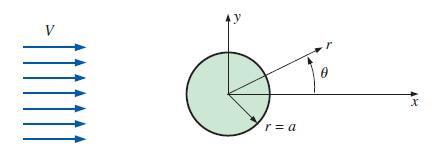
There are numerous occasions in which a fairly uniform free-stream flow of speed V in the x-direction encounters a long circular cylinder of radius a aligned normal to the flow (Fig. P9–55). Examples include air flowing around a car antenna, wind blowing against a flag pole or telephone pole,
Consider steady, incompressible, axisymmetric flow (r, z) and (ur, uz) for which the stream function is defined asVerify that ψ so defined satisfies the continuity equation. What conditions or restrictions are required on ψ? U₁ -(1/r)(au/az) and u₂ = (1/r)(au/ar).
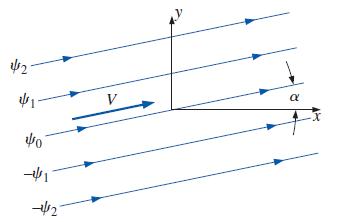
A uniform stream of speed V is inclined at angle α from the x-axis (Fig. P9–57). The flow is steady, two-dimensional, and incompressible. The Cartesian velocity components are u = V cos α and v = V sin α. Generate an expression for the stream function for this flow.FIGURE P9–57
A steady, two-dimensional, incompressible flow field in the xy-plane has the following stream function: ψ = ax2 + bxy + cy2, where a, b, and c are constants. (a) Obtain expressions for velocity components u and v. (b) Verify that the flow field satisfies the incompressible continuity equation.
For the velocity field of Prob. 9–58, plot streamlines ψ = 0, 1, 2, 3, 4, 5, and 6 m2/s. Let constants a, b, and c have the following values: a = 0.50 s–1, b = –1.3 s–1, and c = 0.50 s–1. For consistency, plot streamlines between x = –2 and 2 m, and y = –4 and 4 m. Indicate the
A steady, two-dimensional, incompressible flow field in the xy-plane has a stream function given by ψ = ax2 – by2 + cx + dxy, where a, b, c, and d are constants.(a) Obtain expressions for velocity components u and v.(b) Verify that the flow field satisfies the incompressible continuity equation.
Repeat Prob. 9–60, except make up your own stream function. You may create any function ψ(x, y) that you desire, as long as it contains at least three terms and is not the same as an example or problem in this text. Discuss.Data from Problem 9–60A steady, two-dimensional, incompressible flow
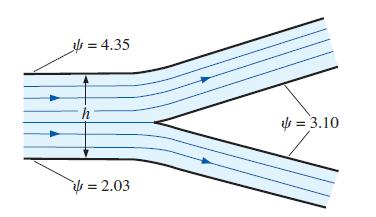
A steady, incompressible, two-dimensional CFD calculation of flow through an asymmetric two-dimensional branching duct reveals the streamline pattern sketched in Fig. P9–62, where the values of ψ are in units of m2/s, and W is the width of the duct into the page. The values of stream function ψ
If the average velocity in the main branch of the duct of Prob. 9–62 is 13.4 m/s, calculate duct height h in units of cm. Obtain your result in two ways, showing all your work. You may use the results of Prob. 9–62 in only one of the methods.Data from Problem 9–62A steady, incompressible,
Consider the garden hose nozzle of Prob. 9–29. Generate an expression for the stream function corresponding to this flow field.Data from Problem 9–29Consider steady flow of water through an axisymmetric garden hose nozzle (Fig. P9–29). The axial component of velocity increases linearly from
Consider the garden hose nozzle of Probs. 9–29 and 9–65. Let the entrance and exit nozzle diameters be 0.50 and 0.14 in, respectively, and let the nozzle length be 2.0 in. The volume flow rate through the nozzle is 2.0 gal/min. (a) Calculate the axial speeds (ft/s) at the nozzle entrance and
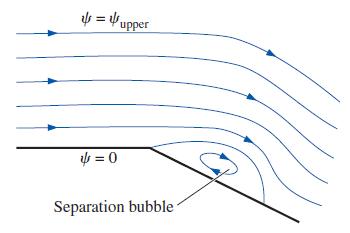
Flow separates at a sharp corner along a wall and forms a recirculating separation bubble as sketched in Fig. P9–67 (streamlines are shown). The value of the stream function at the wall is zero, and that of the uppermost streamline shown is some positive value ψupper. Discuss the value of the
Consider a steady, two-dimensional, incompressible flow field for which the u velocity component is u = ax2 – bxy, where a = 0.45 (ft·s)–1, and b = 0.75 (ft·s)–1. Let v = 0 for all values of x when y = 0 (that is, v = 0 along the x-axis). Generate an expression for the stream function and
A graduate student is running a CFD code for his MS research project and generates a plot of flow streamlines (contours of constant stream function). The contours are of equally spaced values of stream function. Professor I. C. Flows looks at the plot and immediately points to a region of the
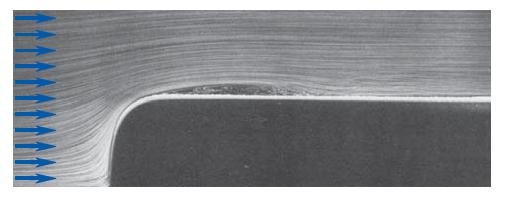
Streaklines are shown in Fig. P9–69 for flow of water over the front portion of a blunt, axisymmetric cylinder aligned with the flow. Streaklines are generated by introducing air bubbles at evenly spaced points upstream of the field of view. Only the top half is shown since the flow is symmetric
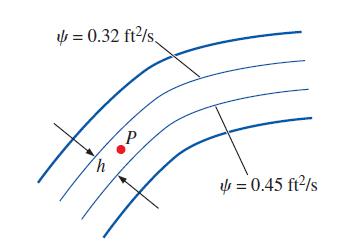
A sketch of flow streamlines (contours of constant stream function) is shown in Fig. P9–70E for steady, incompressible, two-dimensional flow of air in a curved duct.(a) Draw arrows on the streamlines to indicate the direction of flow. (b) If h = 1.58 in, what is the approximate speed of the air
In Example 9–2, we provide expressions for u, v, and ρ for flow through a compressible converging duct. Generate an expression for the compressible stream function ψρ that describes this flow field. For consistency, set ψρ = 0 along the x-axis.Data from Example 9-2.A two-dimensional
In Prob. 9–38 we developed expressions for u, v, and ρ for flow through the compressible, two dimensional, diverging duct of a high-speed wind tunnel. Generate an expression for the compressible stream function ψρ that describes this flow field. For consistency, set ψρ = 0 along the x-axis.
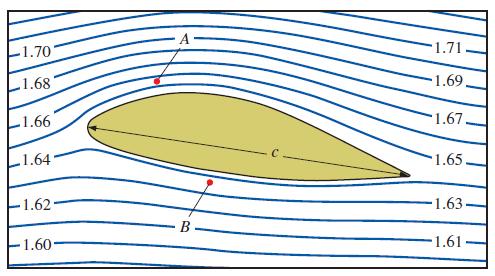
Steady, incompressible, two-dimensional flow over a newly designed small hydrofoil of chord length c = 9.0 mm is modeled with a commercial computational fluid dynamics (CFD) code. A close-up view of flow streamlines (contours of constant stream function) is shown in Fig. P9–74. Values of the
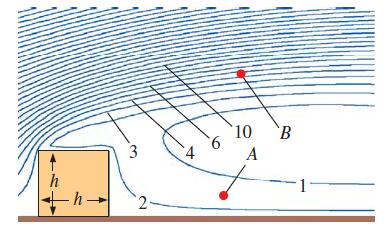
Time-averaged, turbulent, incompressible, two-dimensional flow over a square block of dimension h = 1 m sitting on the ground is modeled with a computational fluid dynamics (CFD) code. A close-up view of flow streamlines (contours of constant stream function) is shown in Fig. P9–75. The fluid is
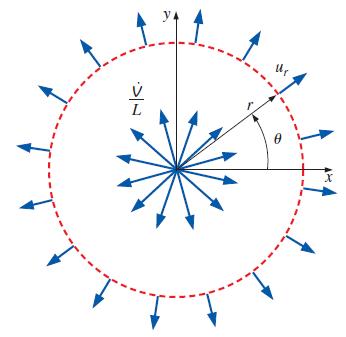
Consider steady, incompressible, two-dimensional flow due to a line source at the origin (Fig. P9–76). Fluid is created at the origin and spreads out radially in all directions in the xy-plane. The net volume flow rate of created fluid per unit width is V̇/L (into the page of Fig. P9–76),
Repeat Prob. 9–76 for the case of a line sink instead of a line source. Let V̇/L be a positive value, but the flow is everywhere in the opposite direction.Data from Problem 9–76Consider steady, incompressible, two-dimensional flow due to a line source at the origin (Fig. P9–76). Fluid is
What is mechanical pressure Pm, and how is it used in an incompressible flow solution?
What are constitutive equations, and to which fluid mechanics equation are they applied?
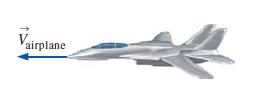
An airplane flies at constant velocity Vairplane(vector) (Fig. P9–80C). Discuss the velocity boundary conditions on the air adjacent to the surface of the airplane from two frames of reference: (a) Standing on the ground, (b) Moving with the airplane. Likewise, what are the far-field velocity
What is the main distinction between a Newtonian fluid and a non-Newtonian fluid? Name at least three Newtonian fluids and three non-Newtonian fluids.
If a fluid flow is both incompressible and isothermal, which property is not expected to be constant?(a) Temperature (b) Density (c) Dynamic viscosity(d) Kinematic viscosity (e) Specific heat
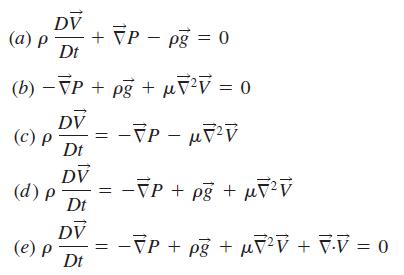
Which choice is the incompressible Navier-Stokes equation with constant viscosity? (a) p + P - pg = 0 DV Dt (b)-FP+ pg + μ7² = 0 DV Dt DV (c) p (d) p (e) p Dt DV Dt - ² · = -√² + pĝ + µ√² -FP pg -P+pg +μ√²+ =
Which choice is not correct regarding the Navier-Stokes equation?(a) Nonlinear equation (b) Unsteady equation(c) Second-order equation(d) Partial differential equation(e) None of these
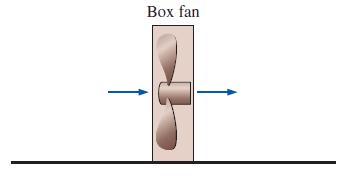
A box fan sits on the floor of a very large room (Fig. P10–2C). Label regions of the flow field that may be approximated as static. Label regions in which the irrotational approximation is likely to be appropriate. Label regions where the boundary layer approximation may be appropriate. Finally,
In fluid flow analyses, which boundary condition can be expressed as Vfluid(vector) = Vwall(vector)(a) No-slip (b) Interface (c) Free-surface(d) Symmetry (e) Inlet
Discuss how nondimensionalization of the Navier–Stokes equation is helpful in obtaining approximate solutions. Give an example.
Explain the difference between an “exact” solution of the Navier–Stokes equation and an approximate solution.
Which non-dimensional parameter in the nondimensionalized Navier–Stokes equation is eliminated by use of modified pressure instead of actual pressure? Explain.
What criteria can you use to determine whether an approximation of the Navier–Stokes equation is appropriate or not? Explain.
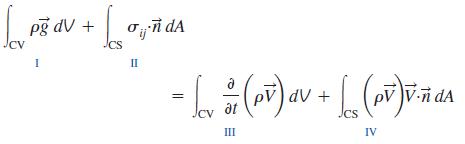
The general control volume form of the linear momentum equation isDiscuss the meaning of each term in this equation. The terms are labeled for convenience. Write the equation as a word equation. [PROV + [van pg dv da CV JCS 1 II = √ & (pv) av + [₂ (pv)vñda at CS III IV
In the nondimensionalized incompressible Navier–Stokes equation (Eq. 10–6), there are four non-dimensional parameters. Name each one, explain its physical significance (e.g., the ratio of pressure forces to viscous forces), and discuss what it means physically when the parameter is very small
Define or describe each type of fluid: (a) Viscoelastic fluid, (b) Pseudoplastic fluid, (c) Dilatant fluid, (d) Bingham plastic fluid.
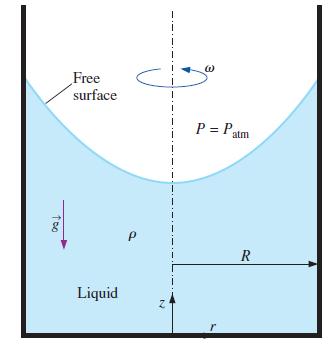
Consider liquid in a cylindrical tank. Both the tank and the liquid rotate as a rigid body (Fig. P9–84). The free surface of the liquid is exposed to room air. Surface tension effects are negligible. Discuss the boundary conditions required to solve this problem. Specifically, what are the
Consider the steady, two-dimensional, incompressible velocity field,where a, b, and c are constants. Calculate the pressure as a function of x and y. V = (u, v) = (ax + b)i + (-ay + c)],
The rθ-component of the viscous stress tensor in cylindrical coordinates isSome authors write this component instead asAre these the same? In other words is Eq. 2 equivalent to Eq. 1, or do these other authors define their viscous stress tensor differently? Show all your work. Тю - ² ₁ - μ
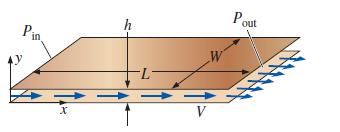
Engine oil at T = 60°C is forced to flow between two very large, stationary, parallel flat plates separated by a thin gap height h = 3.60 mm (Fig. P9–86). The plate dimensions are L = 1.25 m and W = 0.550 m. The outlet pressure is atmospheric, and the inlet pressure is 1 atm gage pressure.
Consider the following steady, two-dimensional, incompressible velocity field:where a, b, and c are constants. Calculate the pressure as a function of x and y. V = (u, v) = (ax + b)i + (-ay + cx²) j
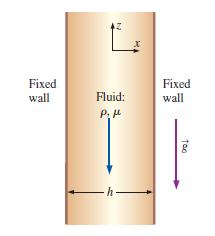
Consider steady, incompressible, parallel, laminar flow of a viscous fluid falling between two infinite vertical walls (Fig. P9–91). The distance between the walls is h, and gravity acts in the negative z-direction (downward in the figure). There is no applied (forced) pressure driving the
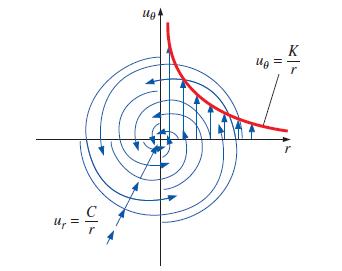
Consider steady, two-dimensional, incompressible flow due to a spiraling line vortex/sink flow centered on the z-axis. Streamlines and velocity components are shown in Fig. P9–89. The velocity field is ur = C/r and uθ = K/r, where C and K are constants. Calculate the pressure as a function of r
Consider the following steady, two-dimensional, incompressible velocity field:where a is a constant. Calculate the pressure as a function of x and y. V= (u, v) = (-ax²)i + (2axy)],
For the fluid falling between two parallel vertical walls (Prob. 9–91), generate an expression for the volume flow rate per unit width (V̇/L) as a function of ρ, μ, h, and g. Compare your result to that of the same fluid falling along one vertical wall with a free surface replacing the second
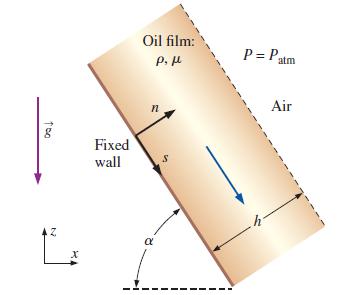
Repeat Example 9–17, except for the case in which the wall is inclined at angle α (Fig. P9–93). Generate expressions for both the pressure and velocity fields. As a check, make sure that your result agrees with that of Example 9–17 when α = 90°. [It is most convenient to use the (s, y, n)
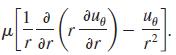
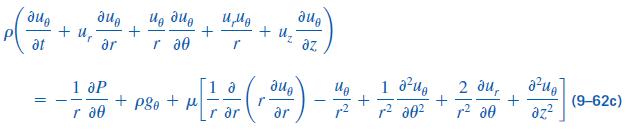
The first two viscous terms in the u-component of the Navier–Stokes equation (Eq. 9–62c) areExpand this expression as far as possible using the product rule, yielding three terms. Now combine all three terms into one term.Eq. 9–62c н а ( rar әлә ər И
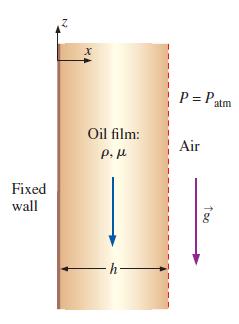
For the falling oil film of Prob. 9–93, generate an expression for the volume flow rate per unit width of oil falling down the wall (V̇/L) as a function of ρ, μ, h, and g. Calculate (V̇/L) for an oil film of thickness 5.0 mm with r = 888 kg/m3 and μ = 0.80 kg/m · s.Data from Problem
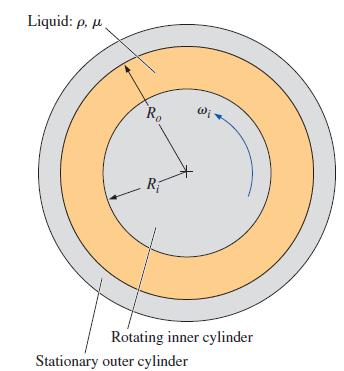
An incompressible Newtonian liquid is confined between two concentric circular cylinders of infinite length— a solid inner cylinder of radius Ri and a hollow, stationary outer cylinder of radius Ro (Fig. P9–96; the z-axis is out of the page). The inner cylinder rotates at angular velocity ωi.
Repeat Prob. 9–96, but let the inner cylinder be stationary and the outer cylinder rotate at angular velocity ωo. Generate an exact solution for uθ(r) using the step-by-step procedure discussed in this chapter.Data from Problem 96An incompressible Newtonian liquid is confined between two
Repeat Prob. 9–96 for the more general case. Namely, let the inner cylinder rotate at angular velocity ωi and let the outer cylinder rotate at angular velocity ωo. All else is the same as Prob. 9–96. Generate an exact expression for velocity component uθ as a function of radius r and the
Analyze and discuss two limiting cases of Prob. 9–96:(a) The gap is very small. Show that the velocity profile, approaches linear from the outer cylinder wall to the inner cylinder wall. In other words, for a very tiny gap the velocity profile reduces to that of simple two-dimensional Couette
Analyze and discuss a limiting case of Prob. 9–99 in which there is no inner cylinder (Ri = ωi = 0). Generate an expression for uθ as a function of r. What kind of flow is this? Describe how this flow could be set up experimentally.Data from Problem 99Repeat Prob. 9–96 for the more general
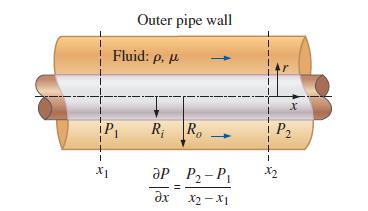
Consider steady, incompressible, laminar flow of a Newtonian fluid in an infinitely long round pipe annulus of inner radius Ri and outer radius Ro (Fig. P9–101). Ignore the effects of gravity. A constant negative pressure gradient ∂P/∂x is applied in the x-direction,where x1 and x2 are two
Consider again the pipe annulus sketched in Fig. P9–101. Assume that the pressure is constant everywhere (there is no forced pressure gradient driving the flow). However, let the inner cylinder be moving at steady velocity V to the right. The outer cylinder is stationary. (This is a kind of
Repeat Prob. 9–102 except swap the stationary and moving cylinder. In particular, let the inner cylinder be stationary, and let the outer cylinder be moving at steady velocity V to the right, all else being equal. Generate an expression for the x-component of velocity u as a function of r and the
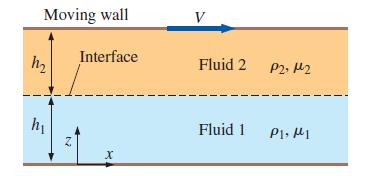
Consider a modified form of Couette flow in which there are two immiscible fluids sandwiched between two infinitely long and wide, parallel flat plates (Fig. P9–104). The flow is steady, incompressible, parallel, and laminar. The top plate moves at velocity V to the right, and the bottom plate is
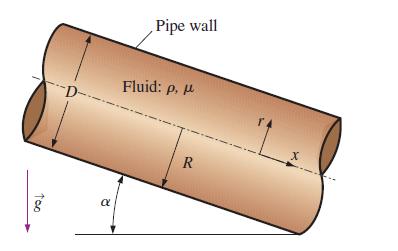
Consider steady, incompressible, laminar flow of a Newtonian fluid in an infinitely long round pipe of diameter D or radius R = D/2 inclined at angle α (Fig. P9–105). There is no applied pressure gradient (∂P/∂x = 0). Instead, the fluid flows down the pipe due to gravity alone. We adopt the
Repeat Prob. 9–106, but from a frame of reference rotating with the stirrer blades at angular velocity v.Data from Problem 106A stirrer mixes liquid chemicals in a large tank (Fig. P9–106). The free surface of the liquid is exposed to room air. Surface tension effects are negligible. Discuss
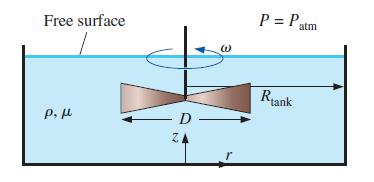
A stirrer mixes liquid chemicals in a large tank (Fig. P9–106). The free surface of the liquid is exposed to room air. Surface tension effects are negligible. Discuss the boundary conditions required to solve this problem. Specifically, what are the velocity boundary conditions in terms of
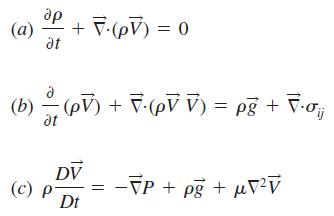
For each part, write the official name for the differential equation, discuss its restrictions, and describe what the equation represents physically. (a) + F.(pv) = 0 ap at (b) — (PV) + √.(pVV) = µg + √·ơij (c) p DV Dt -P+pg + ²
List the six steps used to solve the Navier–Stokes and continuity equations for incompressible flow with constant fluid properties.
Discuss the relationship between volumetric strain rate and the continuity equation. Base your discussion on fundamental definitions.
For each statement, choose whether the statement is true or false and discuss your answer briefly. For each statement it is assumed that the proper boundary conditions and fluid properties are known.(a) A general incompressible flow problem with constant fluid properties has four unknowns.(b) A
Showing 800 - 900
of 1457
1
2
3
4
5
6
7
8
9
10
11
12
13
14
15
Step by Step Answers

 Get 50% OFF
Claim Now
Get 50% OFF
Claim Now