New Semester
Started
Get
50% OFF
Study Help!
--h --m --s
Claim Now
Question Answers
Textbooks
Find textbooks, questions and answers
Oops, something went wrong!
Change your search query and then try again
S
Books
FREE
Study Help
Expert Questions
Accounting
General Management
Mathematics
Finance
Organizational Behaviour
Law
Physics
Operating System
Management Leadership
Sociology
Programming
Marketing
Database
Computer Network
Economics
Textbooks Solutions
Accounting
Managerial Accounting
Management Leadership
Cost Accounting
Statistics
Business Law
Corporate Finance
Finance
Economics
Auditing
Tutors
Online Tutors
Find a Tutor
Hire a Tutor
Become a Tutor
AI Tutor
AI Study Planner
NEW
Sell Books
Search
Search
Sign In
Register
study help
engineering
fluid mechanics
Fluid Mechanics Fundamentals And Applications 3rd Edition Yunus Cengel, John Cimbala - Solutions
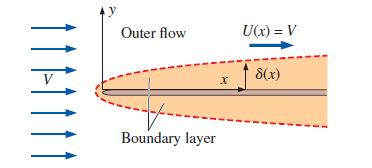
For each statement, choose whether the statement is true or false and discuss your answer briefly. These statements concern a laminar boundary layer on a flat plate (Fig. P10–73C).(a) At a given x-location, if the Reynolds number were to increase, the boundary layer thickness would also
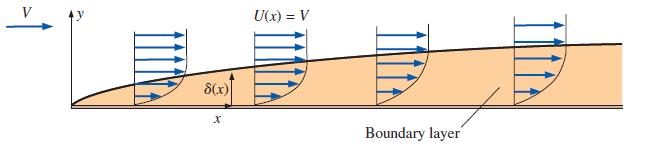
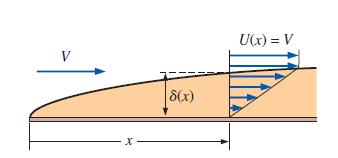
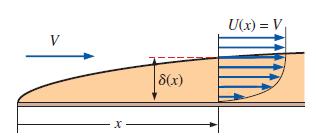
A laminar boundary layer growing along a flat plate is sketched in Fig. P10–75C. Several velocity profiles and the boundary layer thickness δ(x) are also shown. Sketch several streamlines in this flow field. Is the curve representing δ(x) a streamline?FIGURE P10–75C 8(x) X U(x) = V Boundary
What is a trip wire, and what is its purpose?
Discuss the implication of an inflection point in a boundary layer profile. Specifically, does the existence of an inflection point infer a favorable or adverse pressure gradient? Explain.
Compare flow separation for a laminar versus turbulent boundary layer. Specifically, which case is more resistant to flow separation? Why? Based on your answer, explain why golf balls have dimples.
In your own words, summarize the five steps of the boundary layer procedure.
In your own words, list at least three “red flags” to look out for when performing laminar boundary layer calculations.
Two definitions of displacement thickness are given in this chapter. Write both definitions in your own words. For the laminar boundary layer growing on a flat plate, which is larger—boundary layer thickness δ or displacement thickness δ*? Discuss.
Explain the difference between a favorable and an adverse pressure gradient in a boundary layer. In which case does the pressure increase downstream? Why?
On a hot day (T = 30°C), a truck moves along the highway at 29.1 m/s. The flat side of the truck is treated as a simple, smooth flat–plate boundary layer, to first approximation. Estimate the x-location along the plate where the boundary layer begins to transition to turbulence. How far
A boat moves through water (T = 40°F), at 26.0 mi/h. A flat portion of the boat hull is 2.4 ft long, and is treated as a simple smooth flat plate boundary layer, to first approximation. Is the boundary layer on this flat part of the hull laminar, transitional, or turbulent? Discuss.
Air flows parallel to a speed limit sign along the highway at speed V = 8.5 m/s. The temperature of the air is 25°C, and the width W of the sign parallel to the flow direction (i.e., its length) is 0.45 m. Is the boundary layer on the sign laminar or turbulent or transitional?
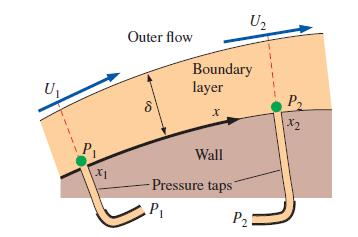
Static pressure P is measured at two locations along the wall of a laminar boundary layer (Fig. P10–87). The measured pressures are P1 and P2, and the distance between the taps is small compared to the characteristic body dimension (Δx = x2 – x1 ≪ L). The outer flow velocity above the
Consider two pressure taps along the wall of a laminar boundary layer as in Fig. P10–87. The fluid is air at 25°C, U1 = 10.3 m/s, and the static pressure P1 is 2.44 Pa greater than static pressure P2, as measured by a very sensitive differential pressure transducer. Is outer flow velocity U2
Air flows through the test section of a small wind tunnel at speed V = 7.5 ft/s. The temperature of the air is 80°F, and the length of the wind tunnel test section is 1.5 ft. Assume that the boundary layer thickness is negligible prior to the start of the test section. Is the boundary layer along
Consider the Blasius solution for a laminar flat plate boundary layer. The non dimensional slope at the wall is given by Eq. 8 of Example 10–10. Transform this result to physical variables, and show that Eq. 9 of Example 10–10 is correct.Example 10-10.A uniform free stream of speed V flows
For the small wind tunnel of Prob. 10–86E, assume the flow remains laminar, and estimate the boundary layer thickness, the displacement thickness, and the momentum thickness of the boundary layer at the end of the test section. Give your answers in inches, compare the three results, and
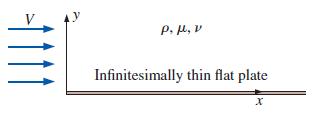
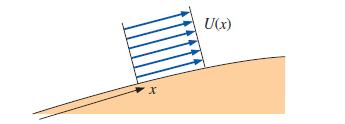
Calculate the value of shape factor H for the limiting case of a boundary layer that is infinitesimally thin (Fig. P10–91). This value of H is the minimum possible value.FIGURE P10–91 U(x)
A laminar flow wind tunnel has a test section that is 30 cm in diameter and 80 cm in length. The air is at 20°C. At a uniform air speed of 2.0 m/s at the test section inlet, by how much will the centerline air speed accelerate by the end of the test section?
Repeat the calculation of Prob. 10–92, except for a test section of square rather than round cross section, with a 30 cm × 30 cm cross section and a length of 80 cm. Compare the result to that of Prob. 10–92 and discuss.Data from Problem 92A laminar flow wind tunnel has a test section that is
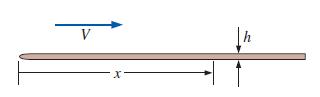
Air at 20°C flows at V = 8.5 m/s parallel to a flat plate (Fig. P10–94). The front of the plate is well rounded, and the plate is 40 cm long. The plate thickness is h = 0.75 cm, but because of boundary layer displacement effects, the flow outside the boundary layer “sees” a plate that has
A small, axisymmetric, low-speed wind tunnel is built to calibrate hot wires. The diameter of the test section is 6.68 in, and its length is 10.0 in. The air is at 70°F. At a uniform air speed of 5.0 ft/s at the test section inlet, by how much will the centerline air speed accelerate by the end of
Air at 70°F flows parallel to a smooth, thin, flat plate at 15.5 ft/s. The plate is 10.6 ft long. Determine whether the boundary layer on the plate is most likely laminar, turbulent, or somewhere in between (transitional). Compare the boundary layer thickness at the end of the plate for two
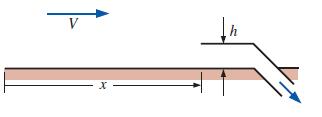
In order to avoid boundary layer interference, engineers design a “boundary layer scoop” to skim off the boundary layer in a large wind tunnel (Fig. P10–97). The scoop is constructed of thin sheet metal. The air is at 20°C, and flows at V = 45.0 m/s. How high (dimension h) should the scoop
Air at 20°C flows at V = 80.0 m/s over a smooth flat plate of length L = 17.5 m. Plot the turbulent boundary layer profile in physical variables (u as a function of y) at x = L. Compare the profile generated by the one-seventh-power law, the log law, and Spalding’s law of the wall, assuming that
The streamwise velocity component of a steady, incompressible, laminar, flat plate boundary layer of boundary layer thickness δ is approximated by the simple linear expression, u = Uy/δ for y < δ, and u = U for y > δ (Fig. P10–99). Generate expressions for displacement thickness and momentum
For the linear approximation of Prob. 10–99, use the definition of local skin friction coefficient and the Kármán integral equation to generate an expression for δ/x. Compare your result to the Blasius expression for δ/x.Data from problem 99The streamwise velocity component of a steady,
Compare shape factor H (defined in Eq. 10–95) for a laminar versus a turbulent boundary layer on a flat plate, assuming that the turbulent boundary layer is turbulent from the beginning of the plate. Discuss. Specifically, why do you suppose H is called a “shape factor”? d dx dU (U²0) + U.
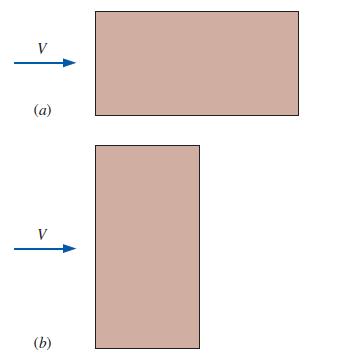
One dimension of a rectangular flat plate is twice the other. Air at uniform speed flows parallel to the plate, and a laminar boundary layer forms on both sides of the plate. Which orientation—long dimension parallel to the wind (Fig. P10–102a) or short dimension parallel to the wind (Fig.
Integrate Eq. 5 to obtain Eq. 6 of Example 10–14, showing all your work.Eq. 5 and eq. 6 d8 dx 72 Cf.x 14 72 14 -0.027(Re)-¹/7 (5)
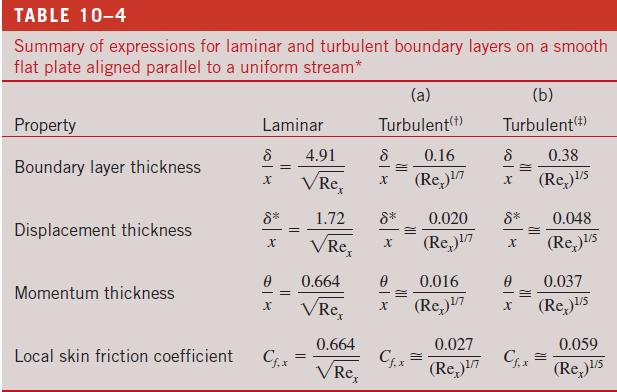
Consider a turbulent boundary layer on a flat plate. Suppose only two things are known: Cf, x ≅ 0.059 · (Rex)–1/5 and θ ≅ 0.097δ. Use the Kármán integral equation to generate an expression for d/x, and compare your result to column (b) of Table 10–4. TABLE 10-4 Summary of expressions
Air at 30°C flows at a uniform speed of 35.0 m/s along a smooth flat plate. Calculate the approximate x-location along the plate where the boundary layer begins the transition process toward turbulence. At approximately what x-location along the plate is the boundary layer likely to be fully
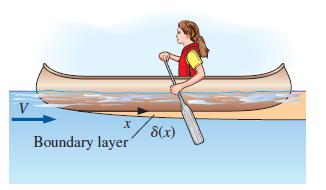
An aluminum canoe moves horizontally along the surface of a lake at 3.5 mi/h (Fig. P10–106E). The temperature of the lake water is 50°F. The bottom of the canoe is 20 ft long and is flat. Is the boundary layer on the canoe bottom laminar or turbulent?FIGURE P10–106E X Boundary layer" 8(x)
For each statement, choose whether the statement is true or false, and discuss your answer briefly.(a) The velocity potential function can be defined for three dimensional flows.(b) The vorticity must be zero in order for the stream function to be defined.(c) The vorticity must be zero in order for
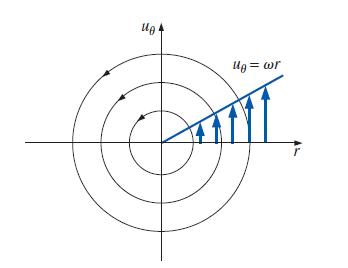
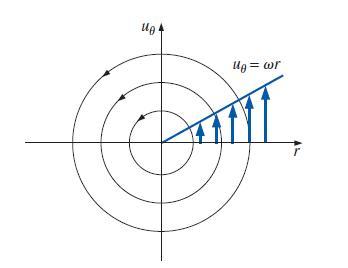
In this chapter, we discuss solid body rotation (Fig. P10–108) as an example of an inviscid flow that is also rotational. The velocity components are ur = 0, uθ = ωr, and uz = 0. Compute the viscous term of the θ-component of the Navier–Stokes equation, and discuss. Verify that this velocity
Calculate the nine components of the viscous stress tensor in cylindrical coordinates (see Chap. 9) for the velocity field of Prob. 10–108. Discuss your results.Data from Problem 108In this chapter, we discuss solid body rotation (Fig. P10–108) as an example of an inviscid flow that is also
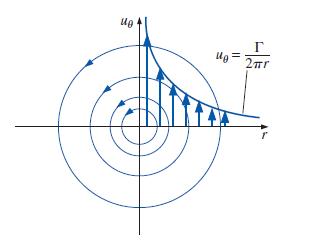
In this chapter, we discuss the line vortex (Fig. P10–110) as an example of an irrotational flow field. The velocity components are ur = 0, uθ = Γ/(2πr), and uz = 0. Compute the viscous term of the u-component of the Navier–Stokes equation, and discuss. Verify that this velocity field is
Calculate the nine components of the viscous stress tensor in cylindrical coordinates (see Chap. 9) for the velocity field of Prob. 10–110. Discuss.Data from Problem 110In this chapter, we discuss the line vortex (Fig. P10–110) as an example of an irrotational flow field. The velocity
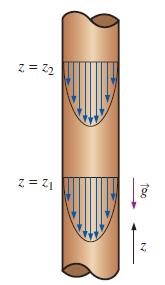
Water falls down a vertical pipe by gravity alone. The flow between vertical locations z1 and z2 is fully developed, and velocity profiles at these two locations are sketched in Fig. P10–112. Since there is no forced pressure gradient, pressure P is constant everywhere in the flow (P = Patm).
Suppose the vertical pipe of Prob. 10–112 is now horizontal instead. In order to achieve the same volume flow rate as that of Prob. 10–112, we must supply a forced pressure gradient. Calculate the required pressure drop between two axial locations in the pipe that are the same distance apart as
The Blasius boundary layer profile is an exact solution of the boundary layer equations for flow over a flat plate. However, the results are somewhat cumbersome to use, since the data appear in tabular form (the solution is numerical). Thus, a simple sine wave approximation (Fig. P10–114) is
The stream wise velocity component of a steady, incompressible, laminar, flat plate boundary layer of boundary layer thickness δ is approximated by the sine wave profile of Prob. 10–114. Generate expressions for displacement thickness and momentum thickness as functions of δ, based on this sine
For the sine wave approximation of Prob. 10–114, use the definition of local skin friction coefficient and the Kármán integral equation to generate an expression for δ/x. Compare your result to the Blasius expression for δ/x.Data from problem 114.The Blasius boundary layer profile is an exact
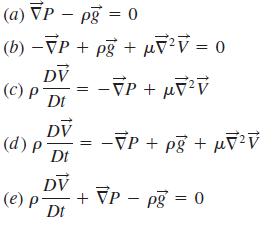
If the fluid velocity is zero in a flow field, the Navier-Stokes equation becomes (a) VP- pg = 0 (b)P DV Dt (c) p DV (d) p = -√²+p+μ² Dt DV (e) p- + pg + μ²=0 - +² Dt + VP - pg = 0
Which choice is not a scaling parameter used to nondimensionalize the equations of motion?(a) Characteristic length, L (b) Characteristic speed, V(c) Characteristic viscosity, μ (d) Characteristic frequency, f(e) Gravitational acceleration, g
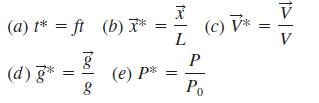
Which choice is not a non-dimensional variable defined to nondimensionalize the equations of motion? (a) t = ft (b) x* (d) g* tool 8 (e) p* 7 L P Po (c) V* 11: V
Which dimensionless parameter does not appear in the nondimensionalized Navier-Stokes equation?(a) Reynolds number (b) Prandtl number(c) Strouhal number (d) Euler number (e) Froude number
Which dimensionless parameter is zero in the nondimensionalized Navier-Stokes equation when the flow is quasi-steady?(a) Euler number (b) Prandtl number (c) Froude number(d) Strouhal number (e) Reynolds number
If pressure P is replaced by modified pressure P´= P + ρgz in the nondimensionalized Navier-Stokes equation, which dimensionless parameter drops out?(a) Froude number (b) Reynolds number(c) Strouhal number (d) Euler number(e) Prandtl number
In creeping flow, the value of Reynolds number is typically(a) Re < 1 (b) Re ≪ 1 (c) Re > 1(d) Re ≫ 1 (e) Re = 0
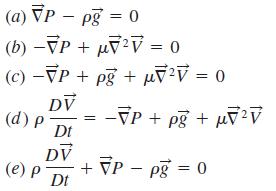
Which equation is the proper approximate Navier- Stokes equation in dimensional form for creeping flow? (a) VP- pg = 0 (b)P + μ7² = 0 (c) -VP+ pg + ² = 0 DV (d) p Dt DV (e) p Dt +² + VP - pg = 0
For creeping flow over a three-dimensional object, the aerodynamic drag on the object does not depend on(a) Velocity, V (b) Fluid viscosity, μ (c) Characteristic length, L (d) Fluid density, ρ(e) None of these
Consider a spherical ash particle of diameter 65 μm, falling from a volcano at a high elevation in air whose temperature is –50°C and whose pressure is 55 kPa. The density of air is 0.8588 kg/m3 and its viscosity is 1.474 × 10⁻⁵ kg/m·s. The density of the particle is 1240 kg/m3. The drag
Which statement is not correct regarding inviscid regions of flow?(a) Inertial forces are not negligible.(b) Pressure forces are not negligible.(c) Reynolds number is large.(d) Not valid in boundary layers and wakes.(e) Solid body rotation of a fluid is an example.
For which regions of flow is the Laplace equationapplicable?(a) Irrotational (b) Inviscid (c) Boundary layer(d) Wake (e) Creeping 0 = ФД
A very thin region of flow near a solid wall where viscous forces and rotationality cannot be ignored is called(a) Inviscid region of flow (b) Irrotational flow(c) Boundary layer (d) Outer flow region(e) Creeping flow
Which one of the following is not a flow region where the boundary layer approximation may be appropriate?(a) Jet (b) Inviscid region (c) Wake (d) Mixing layer(e) Thin region near a solid wall
Which statement is not correct regarding the boundary layer approximation?(a) The higher the Reynolds number, the thinner the boundary layer.(b) The boundary layer approximation may be appropriate for free shear layers.(c) The boundary layer equations are approximations of the Navier-Stokes
For a laminar boundary layer growing on a horizontal flat plate, the boundary layer thickness δ is not a function of(a) Velocity, V (b) Distance from the leading edge, x(c) Fluid density, ρ (d) Fluid viscosity, μ(e) Gravitational acceleration, g
For flow along a flat plate with x being the distance from the leading edge, the boundary layer thickness grows like(a) x (b) √x (c) x2 (d) 1/x (e) 1/x2
Air flows at 25°C with a velocity of 3 m/s in a wind tunnel whose test section is 25 cm long. The displacement thickness at the end of the test section is (the kinematic viscosity of air is 1.562 × 10⁻⁵ m2/s).(a) 0.955 mm (b) 1.18 mm (c) 1.33 mm(d) 1.70 mm (e) 1.96 mm
Air flows at 25°C with a velocity of 6 m/s over a flat plate whose length is 40 cm. The momentum thickness at the center of the plate is (the kinematic viscosity of air is 1.562 × 10⁻⁵ m2/s).(a) 0.479 mm (b) 0.678 mm (c) 0.832 mm(d) 1.08 mm (e) 1.34 mm
Water flows at 20°C with a velocity of 1.1 m/s over a flat plate whose length is 15 cm. The boundary layer thickness at the end of the plate is (the density and viscosity of water are 998 kg/m3 and 1.002 × 10³ kg/m.s, respectively).(a) 1.14 mm (b) 1.35 mm (c) 1.56 mm(d) 1.82 mm (e) 2.09 mm
Air flows at 15°C with a velocity of 12 m/s over a flat plate whose length is 80 cm. Using one-seventh power law of the turbulent flow, what is the boundary layer thickness at the end of the plate? (The kinematic viscosity of air is 1.470 × 10⁻⁵ m2/s.)(a) 1.54 cm (b) 1.89 cm (c) 2.16 cm(d)
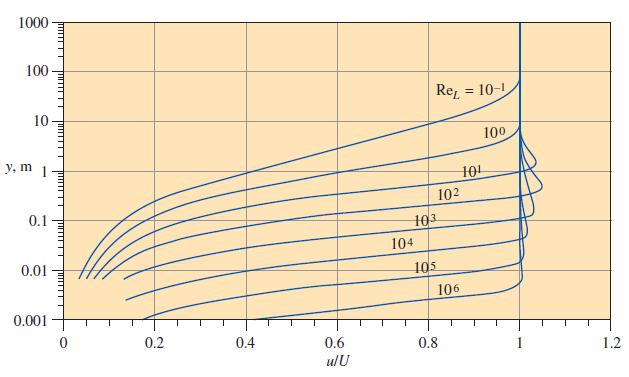
Explain why there is a significant velocity overshoot for the midrange values of the Reynolds number in the velocity profiles of Fig. 10–136, but not for the very small values of Re or for the very large values of Re.FIGURE 10–136 1000 100 10 y, m1 0.1 0.01 0.001 0.2 0.4 0.6 u/U Rey =
Air at 15°C flows at 10 m/s over a flat plate of length 2 m. Using one-seventh power law of the turbulent flow, what is the ratio of local skin friction coefficient for the turbulent and laminar flow cases? (The kinematic viscosity of air is 1.470 × 10⁻⁵ m2/s.)(a) 1.25 (b) 3.72 (c) 6.31(d)
Fairings are attached to the front and back of a cylindrical body to make it look more streamlined. What is the effect of this modification on the (a) Friction drag, (b) Pressure drag,(c) Total drag? Assume the Reynolds number is high enough so that the flow is turbulent for both cases.
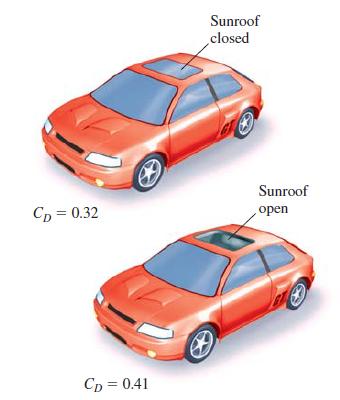
The drag coefficient of a vehicle increases when its windows are rolled down or its sunroof is opened. A sports car has a frontal area of 18 ft2 and a drag coefficient of 0.32 when the windows and sunroof are closed. The drag coefficient increases to 0.41 when the sunroof is open. Determine the
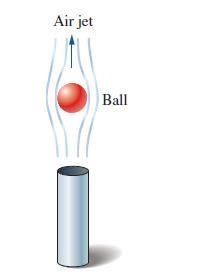
One of the popular demonstrations in science museums involves the suspension of a ping-pong ball by an upward air jet. Children are amused by the ball always coming back to the center when it is pushed by a finger to the side of the jet. Explain this phenomenon using the Bernoulli equation. Also
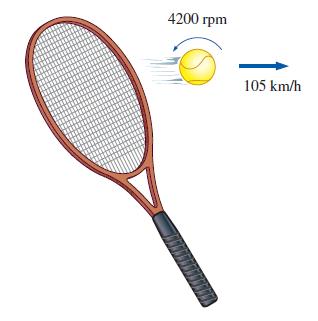
A tennis ball with a mass of 57 g and a diameter of 6.4 cm is hit with an initial velocity of 105 km/h and a backspin of 4200 rpm. Determine if the ball falls or rises under the combined effect of gravity and lift due to spinning shortly after hitting. Assume air is at 1 atm and 25°C.FIGURE
Calculate the thickness of the boundary layer during flow over a 2.5-m-long flat plate at intervals of 25 cm and plot the boundary layer over the plate for the flow of (a) Air,(b) Water,(c) Engine oil at 1 atm and 20°C at an upstream velocity of 3 m/s.
A small aluminum ball with D = 2 mm and ρs = 2700 kg/m3 is dropped into a large container filled with oil at 40°C (ρf = 876 kg/m3 and μ = 0.2177 kg/m·s). The Reynolds number is expected to be low and thus Stokes law for drag force FD = 3πμDV to be applicable. Show that the variation of
Which quantities are physical phenomena associated with fluid flow over bodies?I. Drag force acting on automobilesII. The lift developed by airplane wingsIII. Upward draft of rain and snowIV. Power generated by wind turbines(a) I and II (b) I and III (c) II and III(d) I, II, and III (e) I, II,
The sum of the components of the pressure and wall shear forces in the direction normal to the flow is called(a) Drag (b) Friction(c) Lift (d) Bluff (e) Blunt
A car is moving at a speed of 70 km/h in air at 20°C. The frontal area of the car is 2.4 m2. If the drag force acting on the car in the flow direction is 205 N, the drag coefficient of the car is(a) 0.312 (b) 0.337 (c) 0.354 (d) 0.375 (e) 0.391
A person is driving his motorcycle at a speed of 110 km/h in air at 20°C. The frontal area of the motorcycle and driver is 0.75 m2. If the drag coefficient under these conditions is estimated to be 0.90, the drag force acting on the car in the flow direction is(a) 379 N (b) 220 N (c) 283 N (d)
The manufacturer of a car reduces the drag coefficient of the car from 0.38 to 0.33 as a result of some modifications in its shape and design. If, on average, the aerodynamic drag accounts for 20 percent of the fuel consumption, the percent reduction in the fuel consumption of the car due to
The region of flow trailing the body where the effects of the body are felt is called(a) Wake (b) Separated region (c) Stall(d) Vortice (e) Irrotational
The turbulent boundary layer can be considered to consist of four regions. Which choice is not one of them?(a) Buffer layer (b) Overlap layer (c) Transition layer(d) Viscous layer (e) Turbulent layer
Water at 10°C flows over a 1.1-m-long flat plate with a velocity of 0.55 m/s. If the width of the plate is 2.5 m, calculate the drag force acting on the top side of the plate. (Water properties at 10°C are: ρ = 999.7 kg/m3, μ × 1.307 × 10⁻³ kg/m·s.)(a) 0.46 N (b) 0.81 N (c) 2.75 N (d)
Water at 10°C flows over a 3.75-m-long flat plate with a velocity of 1.15 m/s. If the width of the plate is 6.5 m, calculate the average friction coefficient over the entire plate. (Water properties at 10°C are: ρ = 999.7 kg/m3, μ = 1.307 × 10⁻³ kg/m·s.)(a) 0.00508 (b) 0.00447 (c)
Air at 308C flows over a 3.0-cm-outer-diameter, 45-m-long pipe with a velocity of 6 m/s. Calculate the drag force exerted on the pipe by the air. (Air properties at 30°C are: ρ = 1.164 kg/m3, ν = 1.608 × 10⁻⁵ m2/s.)(a) 19.3 N (b) 36.8 N (c) 49.3 N (d) 53.9 N (e) 60.1 N
A 0.8-m-outer-diameter spherical tank is completely submerged in a flowing water stream at a velocity of 2.5 m/s. Calculate the drag force acting on the tank. (Water properties are: ρ = 998.0 kg/m3, μ = 1.002 × 10⁻³ kg/m·s.)(a) 878 N (b) 627 N (c) 545 N (d) 356 N (e) 220 N
An airplane has a total mass of 18,000 kg and a wing planform area of 35 m2. The density of air at the ground is 1.2 kg/m3. The maximum lift coefficient is 3.48. The minimum safe speed for takeoff and landing while extending the flaps is(a) 305 km/h (b) 173 km/h (c) 194 km/h(d) 212 km/h (e) 246
An airplane has a total mass of 35,000 kg and a wing planform area of 65 m2. The airplane is cruising at 10,000 m altitude with a velocity of 1100 km/h. The density of air on cruising altitude is 0.414 kg/m3. The lift coefficient of this airplane at the cruising altitude is(a) 0.273 (b) 0.290 (c)
An airplane is cruising at a velocity of 800 km/h in air whose density is 0.526 kg/m3. The airplane has a wing planform area of 90 m2. The lift and drag coefficients on cruising conditions are estimated to be 2.0 and 0.06, respectively. The power that needs to be supplied to provide enough trust to
Write a report on the history of the reduction of the drag coefficients of cars and obtain the drag coefficient data for some recent car models from the catalogs of car manufacturers or from the Internet.
Is it possible to accelerate a gas to a supersonic velocity in a converging nozzle? Explain.
What is the effect of friction on flow velocity in subsonic Fanno flow? Answer the same question for supersonic Fanno flow.
On a T-s diagram of Fanno flow, what do the points on the Fanno line represent?
What is the effect of friction on the entropy of the fluid during Fanno flow?
Consider supersonic Fanno flow that is decelerated to sonic velocity (Ma = 1) at the duct exit as a result of frictional effects. If the duct length is increased further, will the flow at the duct exit be supersonic, subsonic, or remain sonic? Will the mass flow rate of the fluid increase,
Consider supersonic Fanno flow of air with an inlet Mach number of 1.8. If the Mach number decreases to 1.2 at the duct exit as a result of friction, does the (a) Stagnation temperature T0, (b) Stagnation pressure P0, (c) Entropy s of the fluid increase, decrease, or remain constant during this
What is the characteristic aspect of Fanno flow? What are the main approximations associated with Fanno flow?
Consider subsonic Fanno flow accelerated to sonic velocity (Ma = 1) at the duct exit as a result of frictional effects. If the duct length is increased further, will the flow at the duct exit be supersonic, subsonic, or remain sonic? Will the mass flow rate of the fluid increase, decrease, or
Consider subsonic Fanno flow of air with an inlet Mach number of 0.70. If the Mach number increases to 0.90 at the duct exit as a result of friction, will the (a) Stagnation temperature T0, (b) Stagnation pressure P0,(c) Entropy s of the fluid increase, decrease, or remain constant during this
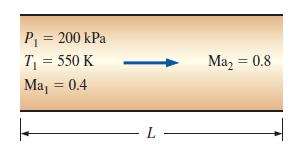
Air enters a 12-cm-diameter adiabatic duct at Ma1 = 0.4, T1 = 550 K, and P1 = 200 kPa. The average friction factor for the duct is estimated to be 0.021. If the Mach number at the duct exit is 0.8, determine the duct length, temperature, pressure, and velocity at the duct exit.FIGURE P12–105 P₁
Air enters a 15-m-long, 4-cm-diameter adiabatic duct at V1 = 70 m/s, T1 = 500 K, and P1 = 300 kPa. The average friction factor for the duct is estimated to be 0.023. Determine the Mach number at the duct exit, the exit velocity, and the mass flow rate of air.
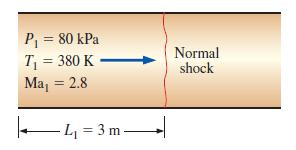
Air enters a 5-cm-diameter, 4-m-long adiabatic duct with inlet conditions of Ma1 = 2.8, T1 = 380 K, and P1 = 80 kPa. It is observed that a normal shock occurs at a location 3 m from the inlet. Taking the average friction factor to be 0.007, determine the velocity, temperature, and pressure at the
Helium gas with k = 1.667 enters a 6-in-diameter duct at Ma1 = 0.2, P1 = 60 psia, and T1 = 600 R. For an average friction factor of 0.025, determine the maximum duct length that will not cause the mass flow rate of helium to be reduced.
Showing 600 - 700
of 1457
1
2
3
4
5
6
7
8
9
10
11
12
13
14
15
Step by Step Answers

 Get 50% OFF
Claim Now
Get 50% OFF
Claim Now