New Semester
Started
Get
50% OFF
Study Help!
--h --m --s
Claim Now
Question Answers
Textbooks
Find textbooks, questions and answers
Oops, something went wrong!
Change your search query and then try again
S
Books
FREE
Study Help
Expert Questions
Accounting
General Management
Mathematics
Finance
Organizational Behaviour
Law
Physics
Operating System
Management Leadership
Sociology
Programming
Marketing
Database
Computer Network
Economics
Textbooks Solutions
Accounting
Managerial Accounting
Management Leadership
Cost Accounting
Statistics
Business Law
Corporate Finance
Finance
Economics
Auditing
Tutors
Online Tutors
Find a Tutor
Hire a Tutor
Become a Tutor
AI Tutor
AI Study Planner
NEW
Sell Books
Search
Search
Sign In
Register
study help
engineering
fluid mechanics
Fluid Mechanics Fundamentals And Applications 3rd Edition Yunus Cengel, John Cimbala - Solutions
Water is to be transported in a clay tile lined rectangular channel at a rate of 0.8 m3/s. The channel bottom slope is 0.0015. The width of the channel for the best cross section is(a) 0.68 m (b) 1.33 m (c) 1.63 m(d) 0.98 m (e) 1.15 m
Water is to be transported in a clay tile lined trapezoidal channel at a rate of 0.8 m3/s. The channel bottom slope is 0.0015. The width of the channel for the best cross section is(a) 0.48 m(b) 0.70 m (c) 0.84 m(d) 0.95 m (e) 1.22 m
Water flows uniformly in a finished-concrete rectangular channel with a bottom width of 0.85 m. The flow depth is 0.4 m and the bottom slope is 0.003. The channel should be classified as(a) Steep (b) Critical (c) Mild (d) Horizontal(e) Adverse
Water discharges into a rectangular horizontal channel from a sluice gate and undergoes a hydraulic jump. The channel is 25-m-wide and the flow depth and velocity before the jump are 2 m and 9 m/s, respectively. The flow depth after the jump is(a) 1.26 m (b) 2 m (c) 3.61 m (d) 4.83 m(e) 6.55 m
Water discharges into a rectangular horizontal channel from a sluice gate and undergoes a hydraulic jump. The flow depth and velocity before the jump are 1.25 m and 6 m/s, respectively. The percentage available head loss due to the hydraulic jump is(a) 4.7% (b) 6.2% (c) 8.5% (d) 13.9% (e) 17.4%
Water discharges into a 7-m-wide rectangular horizontal channel from a sluice gate and undergoes a hydraulic jump. The flow depth and velocity before the jump are 0.65 m and 5 m/s, respectively. The wasted power potential due to the hydraulic jump is(a) 158 kW (b) 112 kW (c) 67.3 kW(d) 50.4
Water is released from a 0.8-m-deep reservoir into a 4-m-wide open channel through a sluice gate with a 0.1-m-high opening at the channel bottom. The flow depth after all turbulence subsides is 0.5 m. The rate of discharge is(a) 0.92 m3/s (b) 0.79 m3/s (c) 0.66 m3/s(d) 0.47 m3/s (e) 0.34 m3/s
The flow rate of water in a 3-m-wide horizontal open channel is being measured with a 0.4-m-high sharp-crested rectangular weir of equal width. If the water depth upstream is 0.9 m, the flow rate of water is(a) 1.37 m3/s (b) 2.22 m3/s (c) 3.06 m3/s(d) 4.68 m3/s (e) 5.11 m3/s
Using catalogs or websites, obtain information from three different weir manufacturers. Compare the different weir designs, and discuss the advantages and disadvantages of each design. Indicate the applications for which each design is best suited.
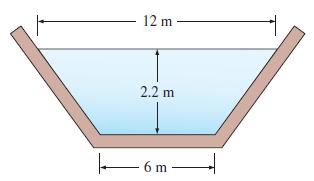
Reconsider Prob. 13–53. If the maximum flow height the channel can accommodate is 3.2 m, determine the maximum flow rate through the channel.Data from Problem 13–53A trapezoidal channel with a bottom width of 6 m, free surface width of 12 m, and flow depth of 2.2 m discharges water at a rate of
Consider water flow in the range of 10 to 15 m3/s through a horizontal section of a 5-m-wide rectangular channel. A rectangular or triangular thin-plate weir is to be installed to measure the flow rate. If the water depth is to remain under 2 m at all times, specify the type and dimensions of an
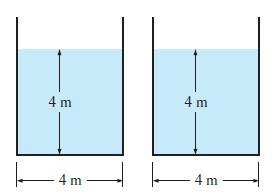
Consider water flow through two identical channels with square flow sections of 4 m × 4 m. Now the two channels are combined, forming a 8-m-wide channel. The flow rate is adjusted so that the flow depth remains constant at 4 m. Determine the percent increase in flow rate as a result of combining
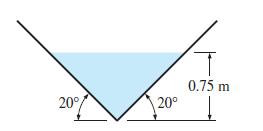
A cast iron V-shaped water channel shown in Fig. P13–56 has a bottom slope of 0.5°. For a flow depth of 0.75 m at the center, determine the discharge rate in uniform flow.FIGURE P13–56 20% 20⁰ T 0.75 m
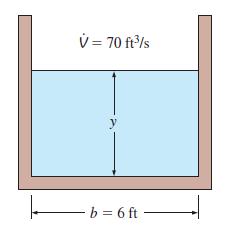
Water is to be transported in a cast iron rectangular channel with a bottom width of 6 ft at a rate of 70 ft3/s. The terrain is such that the channel bottom drops 1.5 ft per 1000 ft length. Determine the minimum height of the channel under uniform-flow conditions.FIGURE P13–57E V = 70 ft³/s y b
A clean-earth trapezoidal channel with a bottom width of 1.8 m and a side surface slope of 1:1 is to drain water uniformly at a rate of 8 m3/s to a distance of 1 km. If the flow depth is not to exceed 1.2 m, determine the required elevation drop.
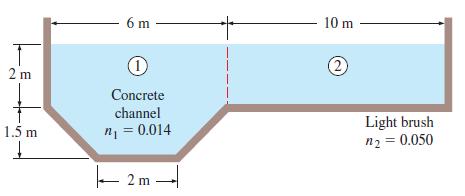
Water flows in a channel whose bottom slope is 0.002 and whose cross section is as shown in Fig. P13–60. The dimensions and the Manning coefficients for the surfaces of different subsections are also given on the figure. Determine the flow rate through the channel and the effective Manning
A water draining system with a constant slope of 0.0025 is to be built of three circular channels made of finished concrete. Two of the channels have a diameter of 1.8 m and drain into the third channel. If all channels are to run half-full and the losses at the junction are negligible, determine
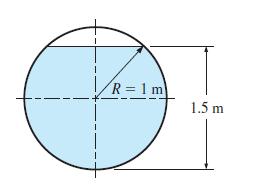
A 2-m-internal-diameter circular steel storm drain (n = 0.012) is to discharge water uniformly at a rate of 12 m3/s to a distance of 1 km. If the maximum depth is to be 1.5 m, determine the required elevation drop.FIGURE P13–61 R=1m 1.5 m
Water is to be transported at a rate of 10 m3/s in uniform flow in an open channel whose surfaces are asphalt lined. The bottom slope is 0.0015. Determine the dimensions of the best cross section if the shape of the channel is(a) Circular of diameter D, (b) Rectangular of bottom width b, (c)
Consider uniform flow in an asphalt-lined rectangular channel with a flow area of 2 m2 and a bottom slope of 0.0003. By varying the depth-to-width ratio y/b from 0.1 to 2.0, calculate and plot the flow rate, and confirm that the best flow cross section occurs when the flow depth-to-width ratio is
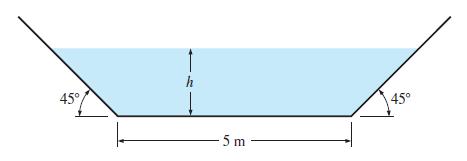
A trapezoidal channel made of unfinished concrete has a bottom slope of 1°, base width of 5 m, and a side surface slope of 1:1, as shown in Fig. P13–55. For a flow rate of 25 m3/s, determine the normal depth h.FIGURE P13–66 45° h -5m 45°
A rectangular channel with a bottom slope of 0.0004 is to be built to transport water at a rate of 750 ft3/s. Determine the best dimensions of the channel if it is to be made of (a) Unfinished concrete (b) Finished concrete.
Repeat Prob. 13–64E for a flow rate of 650 ft3/s.Data from Problem 13–64EA rectangular channel with a bottom slope of 0.0004 is to be built to transport water at a rate of 750 ft3/s. Determine the best dimensions of the channel if it is to be made of a. Unfinished concrete b. Finished concrete.
Consider steady flow of water in a horizontal channel of rectangular cross section. If the flow is subcritical, the flow depth will (a) Increase, (b) Remain constant, (c) Decrease in the flow direction.
Why is the hydraulic jump sometimes used to dissipate mechanical energy? How is the energy dissipation ratio for a hydraulic jump defined?
Is it possible for subcritical flow to undergo a -hydraulic jump? Explain.
Consider steady flow of water in an upward-sloped channel of rectangular cross section. If the flow is supercritical, the flow depth will (a) Increase, (b) Remain constant,(c) Decrease in the flow direction.
Someone claims that frictional losses associated with wall shear on surfaces can be neglected in the analysis of rapidly varied flow, but should be considered in the analysis of gradually varied flow. Do you agree with this claim? Justify your answer.
How does nonuniform or varied flow differ from uniform flow?
How does gradually varied flow (GVF) differ from rapidly varied flow (RVF)?
Repeat Prob. 13–66 for a weedy excavated earth channel with n = 0.030.Data from Problem 66A trapezoidal channel made of unfinished concrete has a bottom slope of 1°, base width of 5 m, and a side surface slope of 1:1, as shown in Fig. P13–55. For a flow rate of 25 m3/s, determine the normal
For sluice gates, how is the discharge coefficient Cd defined? What are typical values of Cd for sluice gates with free outflow? What is the value of Cd for the idealized frictionless flow through the gate?
What is the basic principle of operation of a broad-crested weir used to measure flow rate through an open channel?
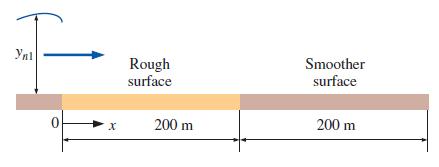
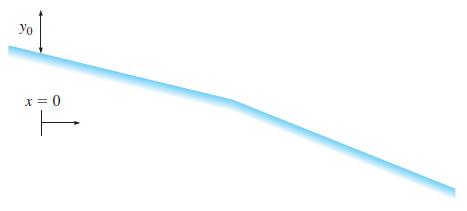
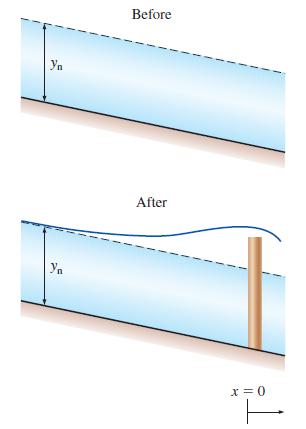
Consider gradually varied flow of water in a wide rectangular irrigation channel with a per-unit- width flow rate of 5m3/s·m, a slope of 0.01, and a Manning coefficient of 0.02. The flow is initially at uniform depth. At a given location, x = 0, the flow enters a 200m length of channel where lack
What is a sharp-crested weir? On what basis are the sharp-crested weirs classified?
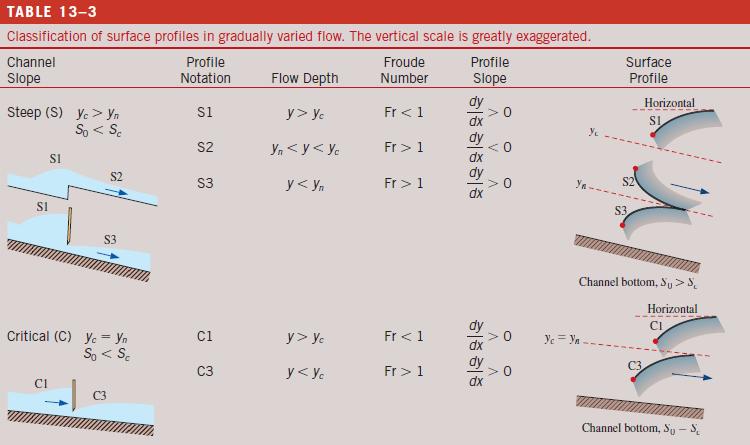
Consider gradually varied flow of water in a 20-ft wide rectangular channel with a flow rate of 300 ft3/s and a Manning coefficient of 0.008. The slope of the channel is 0.01, and at the location x = 0, the mean flow speed is measured to be 5.2 ft/s. Determine the classification of the water
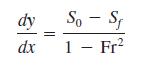
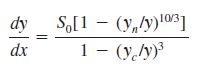
Consider the gradually varied flow equation,For the case of a wide rectangular channel, show that this can be reduced to the following form, which explicitly shows the importance of the relationship between y, yn, and yc: dy dx So S 1 - Fr²
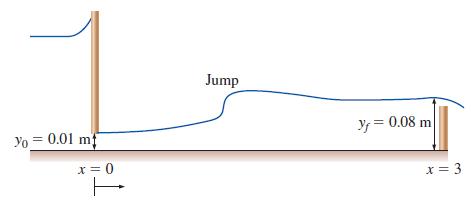
While the GVF equation cannot be used to predict a hydraulic jump directly, it can be coupled with the ideal hydraulic jump depth ratio equation in order to help locate the position at which a jump will occur in a channel. Consider a jump created in a wide (Rh ≈ y) horizontal (S0 = 0) laboratory
Repeat Problem 13–90 for the case of an initial water depth of 0.75 m instead of 1.25 m.Data from Problem 13–90Consider a wide rectangular water channel with a per-unit-width flow rate of 5m3/s·m and a Manning coefficient of n = 0.02. The channel is comprised of a 100 m length having a slope
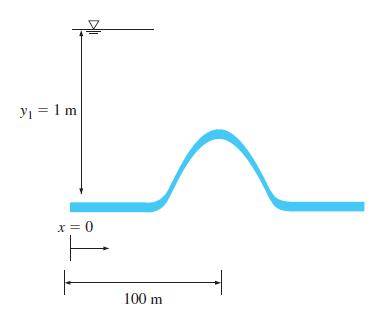
Consider gradually varied flow over a bump in a wide channel, as shown in Fig. P13–89. FIGURE P13–89The initial flow velocity is 0.75 m/s, the initial flow depth is 1 m, the Manning parameter is 0.02, and the elevation of the channel bottom is prescribed to bewhere the maximum bump height Δzb
Consider a wide rectangular water channel with a per-unit-width flow rate of 5m3/s·m and a Manning coefficient of n = 0.02. The channel is comprised of a 100 m length having a slope of S01 = 0.01 followed by a 100 m length having a slope of S02 = 0.02.(a) Calculate the normal and critical depths
During a hydraulic jump in a wide channel, the flow depth increases from 0.6 to 3 m. Determine the velocities and Froude numbers before and after the jump, and the energy dissipation ratio.
Consider uniform flow of water in a wide rectangular channel with a per-unit-width flow rate of 1.5 m3/s·m and a Manning coefficient of 0.03. The slope of the channel is 0.0005. (a) Calculate the normal and critical depths of the flow and determine if the uniform flow is subcritical or
Water flowing in a wide horizontal channel at a flow depth of 56 cm and an average velocity of 9 m/s undergoes a hydraulic jump. Determine the head loss associated with the hydraulic jump.
Water flowing in a wide channel at a depth of 2 ft and a velocity of 40 ft/s undergoes a hydraulic jump. Determine the flow depth, velocity, and Froude number after the jump, and the head loss associated with the jump.
The flow depth and velocity of water after undergoing a hydraulic jump are measured to be 1.1 m and 1.75 m/s, respectively. Determine the flow depth and velocity before the jump, and the fraction of mechanical energy dissipated.
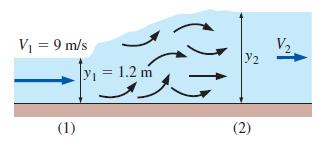
Water discharging into an 8-m-wide rectangular horizontal channel from a sluice gate is observed to have undergone a hydraulic jump. The flow depth and velocity before the jump are 1.2 m and 9 m/s, respectively. Determine (a) The flow depth and the Froude number after the jump, (b) The head loss
Consider the flow of water in a 10-m-wide channel at a rate of 70 m3/s and a flow depth of 0.50 m. The water now undergoes a hydraulic jump, and the flow depth after the jump is measured to be 4 m. Determine the mechanical power wasted during this jump.
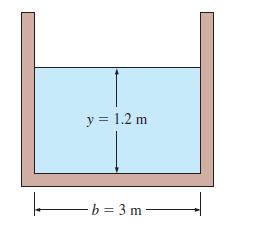
Water flows uniformly in a rectangular channel with finished-concrete surfaces. The channel width is 3 m, the flow depth is 1.2 m, and the bottom slope is 0.002. Determine if the channel should be classified as mild, critical, or steep for this flow.FIGURE P13–81 y = 1.2 m b=3m
Consider the flow of water through a 12-ft-wide unfinished-concrete rectangular channel with a bottom slope of 0.5°. If the flow rate is 300 ft3/s, determine if the slope of this channel is mild, critical, or steep. Also, for a flow depth of 3 ft, classify the surface profile while the flow
Consider uniform water flow in a wide brick channel of slope 0.48. Determine the range of flow depth for which the channel is classified as being steep.
Water is flowing in a 90° V-shaped cast iron channel with a bottom slope of 0.002 at a rate of 3 m3/s. Determine if the slope of this channel should be classified as mild, critical, or steep for this flow.
Consider steady flow of water in a downward sloped channel of rectangular cross section. If the flow is subcritical and the flow depth is less than the normal depth (y < yn), the flow depth will (a) Increase, (b) Remain constant, (c) Decrease in the flow direction.
Consider steady flow of water in a horizontal channel of rectangular cross section. If the flow is supercritical, the flow depth will (a) Increase, (b) Remain constant, (c) Decrease in the flow direction.
Consider steady flow of water in a downward sloped channel of rectangular cross section. If the flow is subcritical and the flow depth is greater than the normal depth (y > yn), the flow depth will (a) Increase, (b) Remain constant, (c) Decrease in the flow direction.
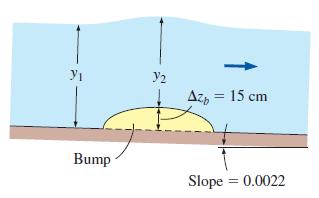
Consider uniform water flow in a wide rectangular channel with a depth of 2 m made of unfinished concrete laid on a slope of 0.0022. Determine the flow rate of water per m width of channel. Now water flows over a 15-cm-high bump. If the water surface over the bump remains flat (no rise or drop),
Draw a flow depth-specific energy diagram for flow through underwater gates, and indicate the flow through the gate for cases of (a) Frictionless gate, (b) Sluice gate with free outflow, (c) Sluice gate with drowned outflow(including the hydraulic jump back to subcritical flow).
Consider the flow of a liquid over a bump during subcritical flow in an open channel. The specific energy and the flow depth decrease over the bump as the bump height is increased. What will the character of flow be when the specific energy reaches its minimum value? Will the flow become
Consider steady frictionless flow over a bump of height Δz in a horizontal channel of constant width b. Will the flow depth y increase, decrease, or remain constant as the fluid flows over the bump? Assume the flow to be subcritical.
Water flowing in a wide channel encounters a 22-cm-high bump at the bottom of the channel. If the flow depth is 1.2 m and the velocity is 2.5 m/s before the bump, determine if the flow is choked over the bump, and discuss.
Consider the uniform flow of water in a wide channel with a velocity of 8 m/s and flow depth of 0.8 m. Now water flows over a 30-cm-high bump. Determine the change (increase or decrease) in the water surface level over the bump. Also determine if the flow over the bump is sub- or supercritical.
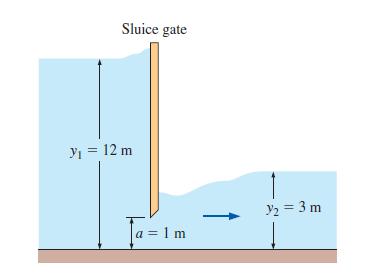
Water is released from a 12-m-deep reservoir into a 6-m-wide open channel through a sluice gate with a 1-m-high opening at the channel bottom. If the flow depth downstream from the gate is measured to be 3 m, determine the rate of discharge through the gate.FIGURE P13–105 Sluice gate Y₁ = 12
A full-width sharp-crested weir is to be used to measure the flow rate of water in a 7-ft-wide rectangular channel. The maximum flow rate through the channel is 180 ft3/s, and the flow depth upstream from the weir is not to exceed 3 ft. Determine the appropriate height of the weir.
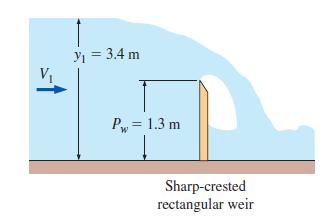
The flow rate of water in a 10-m-wide horizontal channel is being measured using a 1.3-m-high sharp-crested rectangular weir that spans across the channel. If the water depth upstream is 3.4 m, determine the flow rate of water.FIGURE P13–107 =↑ Y₁ = 3.4 m Pw = 1.3 m Sharp-crested rectangular
Repeat Prob. 13–107 for the case of a weir height of 1.6 m.Data from Prob. 13–107.The flow rate of water in a 10-m-wide horizontal channel is being measured using a 1.3-m-high sharp-crested rectangular weir that spans across the channel. If the water depth upstream is 3.4 m, determine the flow
Water flows over a 2-m-high sharp-crested rectangular weir. The flow depth upstream of the weir is 3 m, and water is discharged from the weir into an unfinished-concrete channel of equal width where uniform-flow conditions are established. If no hydraulic jump is to occur in the downstream flow,
Water flows through a sluice gate with a 1.1-fthigh opening and is discharged with free outflow. If the upstream flow depth is 5 ft, determine the flow rate per unit width and the Froude number downstream the gate.
Repeat Prob. 13–110E for the case of a drowned gate with a downstream flow depth of 3.3 ft.Data from Problem 13–110EWater flows through a sluice gate with a 1.1-fthigh opening and is discharged with free outflow. If the upstream flow depth is 5 ft, determine the flow rate per unit width and the
Water is to be discharged from an 8-m-deep lake into a channel through a sluice gate with a 5-m wide and 0.6-m-high opening at the bottom. If the flow depth downstream from the gate is measured to be 4 m, determine the rate of discharge through the gate.
Consider water flow through a wide channel at a flow depth of 8 ft. Now water flows through a sluice gate with a 1-ft-high opening, and the freely discharged outflow subsequently undergoes a hydraulic jump. Disregarding any losses associated with the sluice gate itself, determine the flow depth and
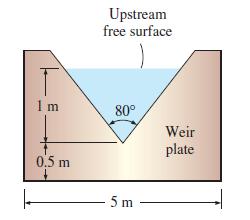
The flow rate of water flowing in a 5-m-wide channel is to be measured with a sharp-crested triangular weir 0.5 m above the channel bottom with a notch angle of 80°. If the flow depth upstream from the weir is 1.5 m, determine the flow rate of water through the channel. Take the weir discharge
Repeat Prob. 13–114 for an upstream flow depth of 0.90 m.Data from Problem 13-114The flow rate of water flowing in a 5-m-wide channel is to be measured with a sharp-crested triangular weir 0.5 m above the channel bottom with a notch angle of 80°. If the flow depth upstream from the weir is 1.5
A sharp-crested triangular weir with a notch angle of 100° is used to measure the discharge rate of water from a large lake into a spillway. If a weir with half the notch angle (θ = 50°) is used instead, determine the percent reduction in the flow rate. Assume the water depth in the lake and the
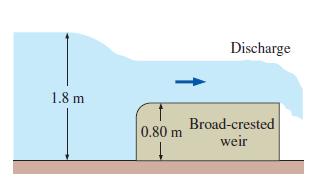
A 0.80-m-high broad-crested weir is used to measure the flow rate of water in a 5-m-wide rectangular channel. The flow depth well upstream from the weir is 1.8 m. Determine the flow rate through the channel and the minimum flow depth above the weir.FIGURE P13–117 1.8 m 0.80
Repeat Prob. 13–117 for an upstream flow depth of 1.4 m.Data from Problem 13–117 A 0.80-m-high broad-crested weir is used to measure the flow rate of water in a 5-m-wide rectangular channel. The flow depth well upstream from the weir is 1.8 m. Determine the flow rate through the channel and
Consider uniform water flow in a wide channel made of unfinished concrete laid on a slope of 0.0022. Now water flows over a 15-cm-high bump. If the flow over the bump is exactly critical (Fr = 1), determine the flow rate and the flow depth over the bump per m width.FIGURE P13–119
Consider water flow over a 0.80-m-high sufficiently long broad-crested weir. If the minimum flow depth above the weir is measured to be 0.50 m, determine the flow rate per meter width of channel and the flow depth upstream of the weir.
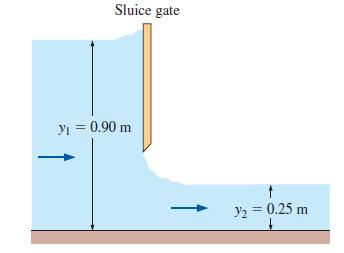
The flow rate of water through a 8-m-wide (into the paper) channel is controlled by a sluice gate. If the flow depths are measured to be 0.9 and 0.25 m upstream and downstream from the gates, respectively, determine the flow rate and the Froude number downstream from the gate.FIGURE P13–121
Water flows in a canal at an average velocity of 4 m/s. Determine if the flow is subcritical or supercritical for flow depths of (a) 0.2 m, (b) 2 m, (c) 1.63 m.
A trapezoidal channel with a bottom width of 4 m and a side slope of 45° discharges water at a rate of 18 m3/s. If the flow depth is 0.6 m, determine if the flow is subcritical or supercritical.
A 5-m-wide rectangular channel lined with finished concrete is to be designed to transport water to a distance of 1 km at a rate of 12 m3/s. Using EES (or other) software, investigate the effect of bottom slope on flow depth (and thus on the required channel height). Let the bottom angle vary from
Repeat Prob. 13–124 for a trapezoidal channel that has a base width of 5 m and a side surface angle of 45°.Data from Problem 124A 5-m-wide rectangular channel lined with finished concrete is to be designed to transport water to a distance of 1 km at a rate of 12 m3/s. Using EES (or other)
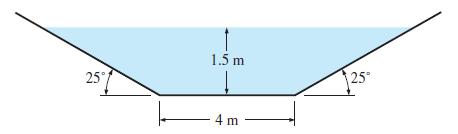
A trapezoidal channel with brick lining has a bottom slope of 0.001 and a base width of 4 m, and the side surfaces are angled 25° from the horizontal, as shown in Fig. P13–126. If the normal depth is measured to be 1.5 m, estimate the flow rate of water through the channel.FIGURE P13–126
Water flows through a 2.2-m-wide rectangular channel with a Manning coefficient of n = 0.012. If the water is 0.9 m deep and the bottom slope of the channel is 0.6°, determine the rate of discharge of the channel in uniform flow.
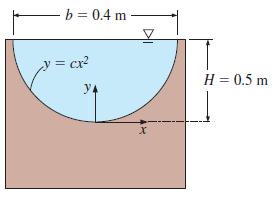
Consider the flow of water through a parabolic notch shown in Fig. P13–131. Develop a relation for the flow rate, and calculate its numerical value for the ideal case in which the flow velocity is given by Torricelli’s equationFIGURE P13–131 V = √2g(H - y).
Reconsider Prob. 13–129. By varying the flow depth-to-radius ratio y/R from 0.1 to 1.9 while holding the flow area constant and evaluating the flow rate, show that the best cross section for flow through a circular channel occurs when the channel is half-full. Tabulate and plot your results.Data
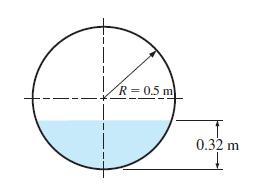
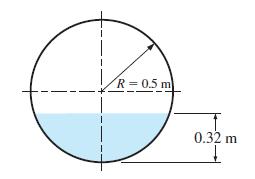
Consider a 1-m-internal-diameter water channel made of finished concrete (n = 0.012). The channel slope is 0.002. For a flow depth of 0.32 m at the center, determine the flow rate of water through the channel.FIGURE P13–129 R = 0.5 m 0.32 m
A rectangular channel with a bottom width of 7 m discharges water at a rate of 45 m3/s. Determine the flow depth below which the flow is supercritical.
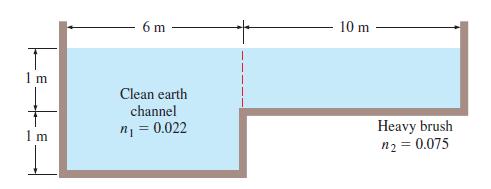
Water flows in a channel whose bottom slope is 0.5° and whose cross section is as shown in Fig. P13–132. The dimensions and the Manning coefficients for the surfaces of different subsections are also given on the figure. Determine the flow rate through the channel and the effective Manning
Consider two identical channels, one rectangular of bottom width b and one circular of diameter D, with identical flow rates, bottom slopes, and surface linings. If the flow height in the rectangular channel is also b and the circular channel is flowing half-full, determine the relation between b
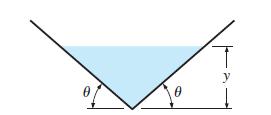
Consider water flow through a V-shaped channel. Determine the angle θ the channel makes from the horizontal for which the flow is most efficient.FIGURE P13–134 Ө y
The flow rate of water in a 6-m-wide rectangular channel is to be measured using a 1.1-m-high sharp-crested rectangular weir that spans across the channel. If the head above the weir crest is 0.60 m upstream from the weir, determine the flow rate of water.
A rectangular channel with unfinished concrete surfaces is to be built to discharge water uniformly at a rate of 200 ft3/s. For the case of best cross section, determine the bottom width of the channel if the available vertical drop is(a) 5 (b) 10 ft per mile.
Repeat Prob. 13–136E for the case of a trapezoidal channel of best cross section.Data Prob. 13–136EA rectangular channel with unfinished concrete surfaces is to be built to discharge water uniformly at a rate of 200 ft3/s. For the case of best cross section, determine the bottom width of the
Consider two identical 15-ft-wide rectangular channels each equipped with a 3-ft-high full-width weir, except that the weir is sharp-crested in one channel and broad-crested in the other. For a flow depth of 5 ft in both channels, determine the flow rate through each channel.
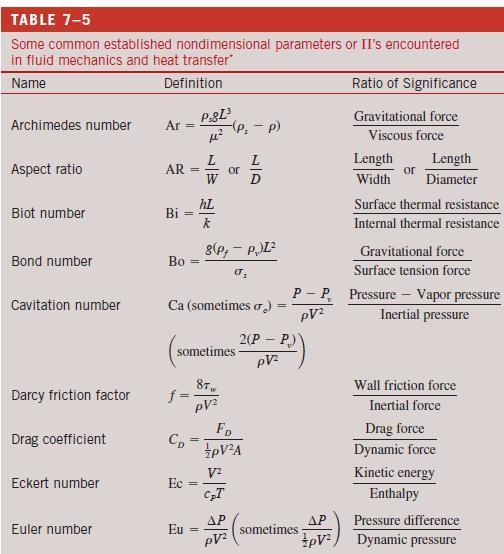
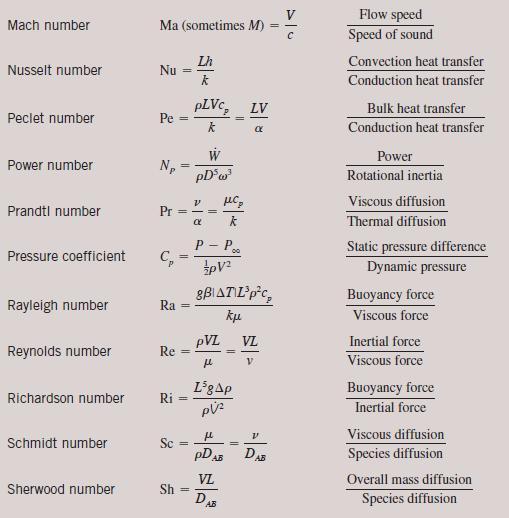
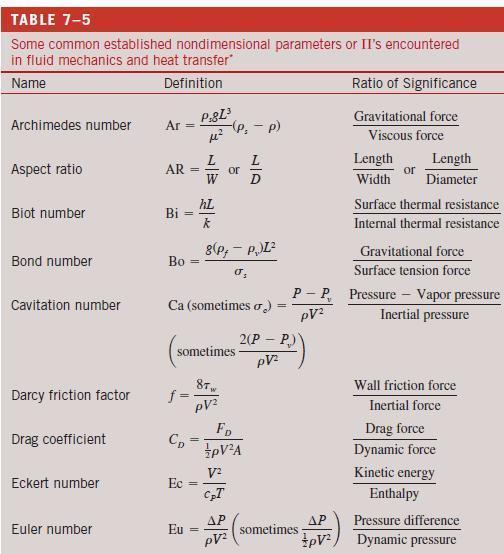
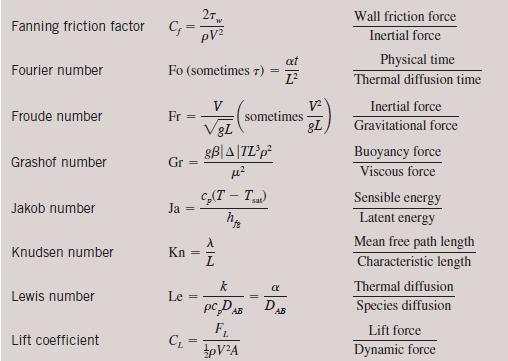
The Archimedes number listed in Table 7–5 is appropriate for buoyant particles in a fluid. Do a literature search or an Internet search and find an alternative definition of the Archimedes number that is appropriate for buoyant fluids (e.g., buoyant jets and buoyant plumes, heating and air
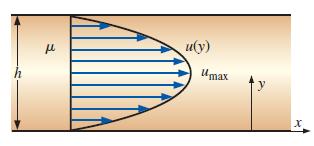
Consider steady, laminar, fully developed, two dimensional Poiseuille flow—flow between two infinite parallel plates separated by distance h, with both the top plate and bottom plate stationary, and a forced pressure gradient dP/dx driving the flow as illustrated in Fig. P7–95. (dP/dx is
Consider the steady, laminar, fully developed, two dimensional Poiseuille flow of Prob. 7–95. The maximum velocity umax occurs at the center of the channel. (a) Generate a dimensionless relationship for umax as a function of distance between plates h, pressure gradient dP/dx, and fluid
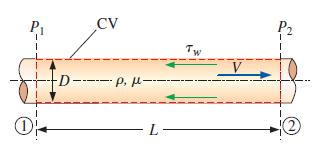
The pressure drop ΔP = P1 – P2 through a long section of round pipe can be written in terms of the shear stress τw along the wall. Shown in Fig. P7–97 is the shear stress acting by the wall on the fluid. The shaded region is a control volume composed of the fluid in the pipe between axial
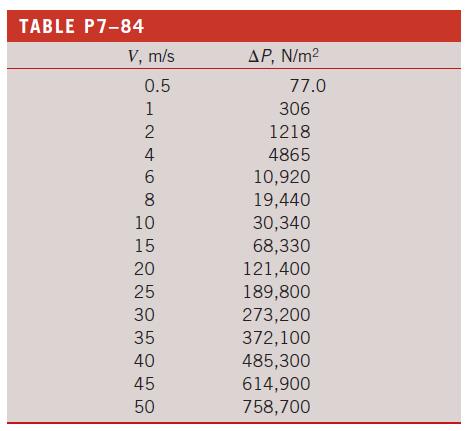
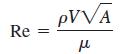
Oftentimes it is desirable to work with an established dimensionless parameter, but the characteristic scales available do not match those used to define the parameter. In such cases, we create the needed characteristic scales based on dimensional reasoning (usually by inspection). Suppose for
Showing 400 - 500
of 1457
1
2
3
4
5
6
7
8
9
10
11
12
13
14
15
Step by Step Answers

 Get 50% OFF
Claim Now
Get 50% OFF
Claim Now