New Semester
Started
Get
50% OFF
Study Help!
--h --m --s
Claim Now
Question Answers
Textbooks
Find textbooks, questions and answers
Oops, something went wrong!
Change your search query and then try again
S
Books
FREE
Study Help
Expert Questions
Accounting
General Management
Mathematics
Finance
Organizational Behaviour
Law
Physics
Operating System
Management Leadership
Sociology
Programming
Marketing
Database
Computer Network
Economics
Textbooks Solutions
Accounting
Managerial Accounting
Management Leadership
Cost Accounting
Statistics
Business Law
Corporate Finance
Finance
Economics
Auditing
Tutors
Online Tutors
Find a Tutor
Hire a Tutor
Become a Tutor
AI Tutor
AI Study Planner
NEW
Sell Books
Search
Search
Sign In
Register
study help
engineering
fluid mechanics
Fluid Mechanics Fundamentals And Applications 3rd Edition Yunus Cengel, John Cimbala - Solutions
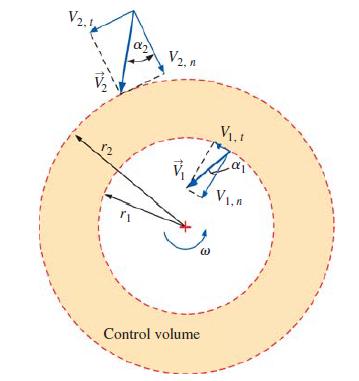
Suppose the pump of Prob. 14–67 has some reverse swirl at the inlet such that α1 = –10° instead of 0°. Calculate the net head and required horsepower and compare to Prob. 14–67. Discuss. In particular, is the angle at which the fluid impinges on the impeller blade a critical parameter in
Two water pumps are arranged in series. The performance data for both pumps follow the parabolic curve fit Havailable = H0 – aV̇2. For pump 1, H0 = 6.33 m and coefficient a = 0.0633 m/Lpm2; for pump 2, H0 = 9.25 m and coefficient a = 0.0472 m/Lpm2. In either case, the units of net pump head H
The same two water pumps of Prob. 14–71 are arranged in parallel. Calculate the shutoff head and free delivery of the two pumps working together in parallel. At what combined net head should pump 1 be shut off and bypassed? Explain.Data from Problem 71Two water pumps are arranged in series. The
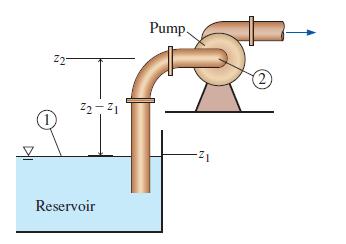
A self-priming centrifugal pump is used to pump water at 25°C from a reservoir whose surface is 2.2 m above the centerline of the pump inlet (Fig. P14–60). The pipe is PVC pipe with an ID of 24.0 mm and negligible average inner roughness height. The pipe length from the submerged pipe inlet to
Repeat Prob. 14–58E, but at a water temperature of 113°F. Discuss.Data from Prob. 14–58A centrifugal pump is used to pump water at 77°F from a reservoir whose surface is 20.0 ft above the centerline of the pump inlet (Fig. P14–58E). The piping system consists of 67.5 ft of PVC pipe with an
A centrifugal pump is used to pump water at 77°F from a reservoir whose surface is 20.0 ft above the centerline of the pump inlet (Fig. P14–58E). The piping system consists of 67.5 ft of PVC pipe with an ID of 1.2 in and negligible average inner roughness height. The length of pipe from the
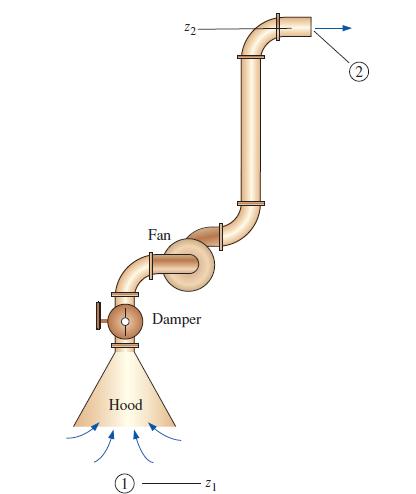
For the duct system and fan of Prob. 14–55E, partially closing the damper would decrease the flow rate. All else being unchanged, estimate the minor loss coefficient of the damper required to decrease the volume flow rate by a factor of 3.Data from Problem 14–55EA local ventilation system (a
Repeat Prob. 14–55E, ignoring all minor losses. How important are the minor losses in this problem? Discuss.Data from Problem 14–55EA local ventilation system (a hood and duct system) is used to remove air and contaminants produced by a welding operation (Fig. P14–55E). The inner diameter
A local ventilation system (a hood and duct system) is used to remove air and contaminants produced by a welding operation (Fig. P14–55E). The inner diameter (ID) of the duct is D = 9.06 in, its average roughness is 0.0059 in, and its total length is L = 34.0 ft. There are three elbows along the
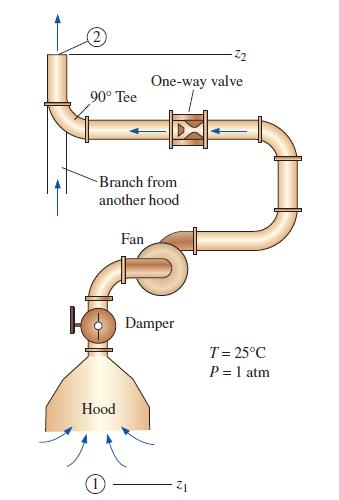
Suppose the one-way valve of Fig. P14–51 malfunctions due to corrosion and is stuck in its fully closed position (no air can get through). The fan is on, and all other conditions are identical to those of Prob. 14–51. Calculate the gage pressure (in pascals and in mm of water column) at a point
Repeat Prob. 14–51, ignoring all minor losses. How important are the minor losses in this problem? Discuss.Data from Problem 14–51A local ventilation system (a hood and duct system) is used to remove air and contaminants from a pharmaceutical lab (Fig. P14–51). The inner diameter (ID) of the
For the duct system of Prob. 14–51, plot required fan head Hrequired (mm of water column) as a function of volume flow rate V̇(Lpm). On the same plot, compare available fan head Havailable versus V̇, and mark the operating point. Discuss.Data from Problem 14–51A local ventilation system (a
A local ventilation system (a hood and duct system) is used to remove air and contaminants from a pharmaceutical lab (Fig. P14–51). The inner diameter (ID) of the duct is D = 150 mm, its average roughness is 0.15 mm, and its total length is L = 24.5 m. There are three elbows along the duct, each
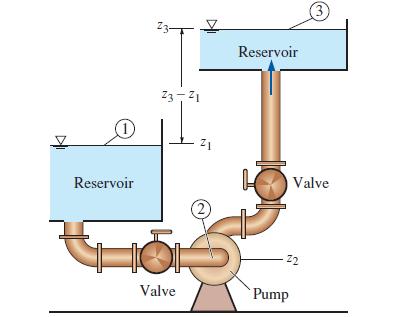
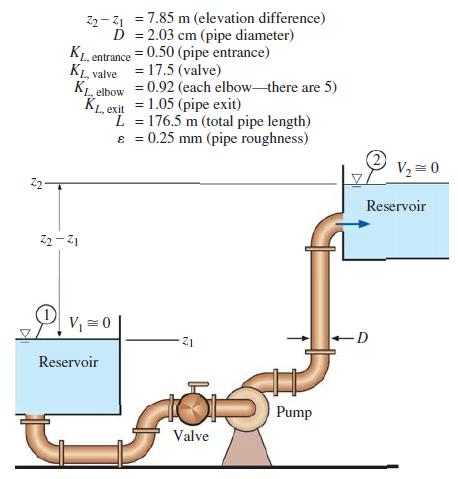
Consider the pump and piping system of Prob. 14–43. Suppose that the lower reservoir is huge, and its surface does not change elevation, but the upper reservoir is not so big, and its surface rises slowly as the reservoir fills. Generate a curve of volume flow rate V̇(Lpm) as a function of z2
Repeat Prob. 14–43, but neglect all minor losses. Compare the volume flow rate with that of Prob. 14–43. Are minor losses important in this problem? Discuss.Data from Problem 14–43A water pump is used to pump water from one large reservoir to another large reservoir that is at a higher
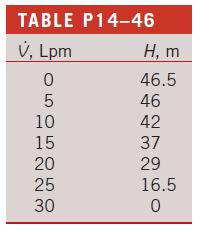
April’s supervisor asks her to find a replacement pump that will increase the flow rate through the piping system of Prob. 14–43 by a factor of 2 or greater. April looks through some online brochures, and finds a pump with the performance data shown in Table P14–46. All dimensions and
Calculate the volume flow rate between the reservoirs of Prob. 14–43 for the case in which the pipe diameter is doubled, all else remaining the same. Discuss.Data from Problem 14–43A water pump is used to pump water from one large reservoir to another large reservoir that is at a higher
What is a draft tube, and what is its purpose? Describe what would happen if turbomachinery designers did not pay attention to the design of the draft tube.
Name and briefly describe the differences between the two basic types of dynamic turbine.
Discuss the meaning of reverse swirl in reaction hydroturbines, and explain why some reverse swirl may be desirable. Use an equation to support your answer. Why is it not wise to have too much reverse swirl?
Give at least two reasons why turbines often have greater efficiencies than do pumps.
Briefly discuss the main difference in the way that dynamic pumps and reaction turbines are classified as centrifugal (radial), mixed flow, or axial.
A hydroelectric plant has 14 identical Francis turbines, a gross head of 284 m, and a volume flow rate of 13.6 m3/s through each turbine. The water is at 25°C. The efficiencies are ηturbine = 95.9%, ηgenerator 5 94.2%, and ηother 5 95.6%, where ηother accounts for all other mechanical energy
A Pelton wheel is used to produce hydroelectric power. The average radius of the wheel is 1.83 m, and the jet velocity is 102 m/s from a nozzle of exit diameter equal to 10.0 cm. The turning angle of the buckets is β = 165°.(a) Calculate the volume flow rate through the turbine in m3/s. (b) What
Some engineers are evaluating potential sites for a small hydroelectric dam. At one such site, the gross head is 340 m, and they estimate that the volume flow rate of water through each turbine would be 0.95 m3/s. Estimate the ideal power production per turbine in MW.
Reconsider Prob. 14–83. Using EES (or other) software, investigate the effect of the runner outlet angle α1 on the required net head and the output power. Let the outlet angle vary from –20° to 20° in increments of 1°, and plot your results. Determine the minimum possible value of α1 such
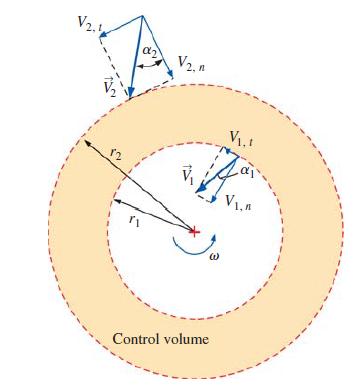
A Francis radial-flow hydro turbine is being designed with the following dimensions: r2 = 2.00 m, r1 =1.42 m, b2 = 0.731 m, and b1 = 2.20 m. The runner rotates at ṅ = 180 rpm. The wicket gates turn the flow by angle α2 = 30° from radial at the runner inlet, and the flow at the runner outlet is
Prove that for a given jet speed, volume flow rate, turning angle, and wheel radius, the maximum shaft power produced by a Pelton wheel occurs when the turbine bucket moves at half the jet speed.
Wind (ρ = 1.204 kg/m3) blows through a HAWT wind turbine. The turbine diameter is 45.0 m. The combined efficiency of the gearbox and generator is 88 percent. (a) For a realistic power coefficient of 0.42, estimate the electrical power production when the wind blows at 7.8 m/s. (b) Repeat and
A Francis radial-flow hydroturbine has the following dimensions, where location 2 is the inlet and location 1 is the outlet: r2 = 6.60 ft, r1 = 4.40 ft, b2 = 2.60 ft, and b1 = 7.20 ft. The runner blade angles are β2 = 82° and β1 = 46° at the turbine inlet and outlet, respectively. The runner
Using EES or other software, adjust the runner blade trailing edge angle β1 of Prob. 14–86E, keeping all other parameters the same, such that there is no swirl at the turbine outlet. Report β1 and the corresponding shaft power.Data from Prob. 14–86EA Francis radial-flow hydroturbine has the
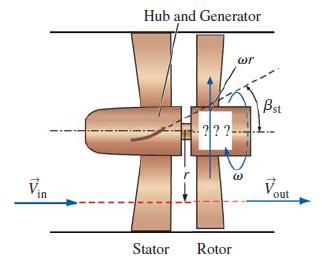
A simple single-stage axial turbine is being designed to produce power from water flowing through a tube as in Fig. P14–88. We approximate both the stator and rotor as thin (bent sheet metal). The 16 stator (upstream) blades have bsl = 0° and bst = 50.3°, where subscripts “sl” and “st”
A hydroelectric power plant is being designed. The gross head from the reservoir to the tailrace is 859 ft, and the volume flow rate of water through each turbine is 189,400 gpm at 50°F. There are 10 identical parallel turbines, each with an efficiency of 96.3 percent, and all other mechanical
The average wind speed at a proposed HAWT wind farm site is 12.5 m/s. The power coefficient of each wind turbine is predicted to be 0.41, and the combined efficiency of the gearbox and generator is 92 percent. Each wind turbine must produce 2.5 MW of electrical power when the wind blows at 12.5
Pump specific speed and turbine specific speed are “extra” parameters that are not necessary in the scaling laws for pumps and turbines. Explain, then, their purpose.
Consider the fan of Prob. 14–51. The fan diameter is 30.0 cm, and it operates at ṅ= 600 rpm. Nondimensionalize the fan performance curve, i.e., plot CH versus CQ. Show sample calculations of CH and CQ at V̇ = 13,600 Lpm.Data from Problem 14–51A local ventilation system (a hood and duct
For each statement, choose whether the statement is true or false, and discuss your answer briefly:(a) If the rpm of a pump is doubled, all else staying the same, the capacity of the pump goes up by a factor of about 2.(b) If the rpm of a pump is doubled, all else staying the same, the net head of
Discuss which dimensionless pump performance parameter is typically used as the independent parameter. Repeat for turbines instead of pumps. Explain.
Calculate the pump specific speed of the pump of Example 14–11 at its best efficiency point. Provide answers in both dimensionless form and in customary U.S. units. What kind of pump is it?Data from Example 14-11After graduation, you work for a pump manufacturing company. One of your company’s
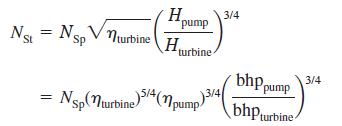
Verify that turbine specific speed and pump specific speed are related as follows: St Nsp Vn turbine =
Consider a pump–turbine that operates both as a pump and as a turbine. Under conditions in which the rotational speed ω and the volume flow rate V̇ are the same for the pump and the turbine, verify that turbine specific speed and pump specific speed are related as Nst =
Len is asked to design a small water pump for an aquarium. The pump should deliver 14.0 Lpm of water at a net head of 1.5 m at its best efficiency point. A motor that spins at 1200 rpm is available. What kind of pump (centrifugal, mixed, or axial) should Len design? Show all your calculations and
Consider the pump of Prob. 14–99. Suppose the pump is modified by attaching a different motor, for which the rpm is 1800 rpm. If the pumps operate at homologous points (namely, at the BEP) for both cases, predict the volume flow rate and net head of the modified pump. Calculate the pump specific
A large water pump is being designed for a nuclear reactor. The pump should deliver 2500 gpm of water at a net head of 45 ft at its best efficiency point. A motor that spins at 300 rpm is available. What kind of pump (centrifugal, mixed, or axial) should be designed? Show all your calculations and
Apply the necessary conversion factors to prove the relationship between dimensionless turbine specific speed and conventional U.S. turbine specific speed, NSt = 43.46NSt, US. Note that we assume water as the fluid and standard earth gravity.
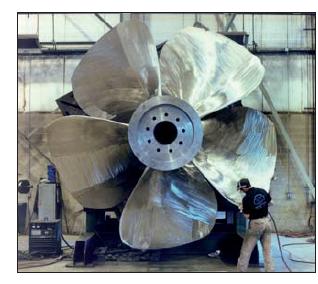
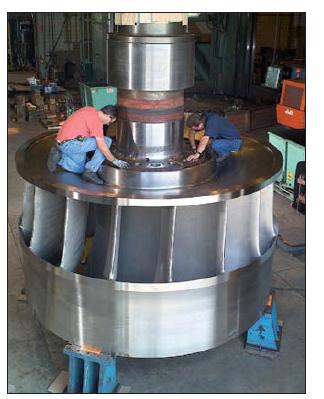
Calculate the turbine specific speed of the Warwick hydroturbine of Fig 14–91. Does it fall within the range of NSt appropriate for that type of turbine?Figure 14-91
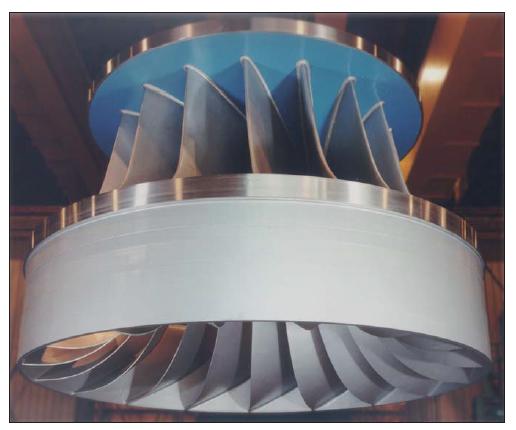
Calculate the turbine specific speed of the Smith Mountain hydroturbine of Fig 14–90. Does it fall within the range of NSt appropriate for that type of turbine?Figure 14-90
Calculate the turbine specific speed of the turbine in Prob. 14–83. Provide answers in both dimensionless form and in customary U.S. units. Is it in the normal range for a Francis turbine? If not, what type of turbine would be more appropriate?Data from Problem 14–83.A Francis radial-flow hydro
Calculate the turbine specific speed of the turbine of Example 14–13 for the case where α1 = 10°. Provide answers in both dimensionless form and in customary U.S. units. Is it in the normal range for a Francis turbine? If not, what type of turbine would be more appropriate?Data from Example
Calculate the turbine specific speed of the Round Butte hydroturbine of Fig 14–89. Does it fall within the range of NSt appropriate for that type of turbine?Data from Fig 14–89.
A one-fifth scale model of a water turbine is tested in a laboratory at T = 20°C. The diameter of the model is 8.0 cm, its volume flow rate is 25.5 m3/h, it spins at 1500 rpm, and it operates with a net head of 15.0 m. At its best efficiency point, it delivers 720 W of shaft power. Calculate the
What is a pump–turbine? Discuss an application where a pump–turbine is useful.
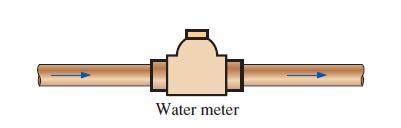
The common water meter found in most homes can be thought of as a type of turbine, since it extracts energy from the flowing water to rotate the shaft connected to the volume-counting mechanism (Fig. P14–119C). From the point of view of a piping system, however (Chap. 8), what kind of device is a
For each statement, choose whether the statement is true or false, and discuss your answer briefly:(a) A gear pump is a type of positive-displacement pump.(b) A rotary pump is a type of positive-displacement pump.(c) The pump performance curve (net head versus capacity) of a positive-displacement
For two dynamically similar pumps, manipulate the dimensionless pump parameters to show thatDoes the same relationship apply to two dynamically similar turbines? DB DA(HA/HB)¹4(VB/V¹/2
For two dynamically similar turbines, manipulate the dimensionless turbine parameters to show thatDoes the same relationship apply to two dynamically similar pumps? DB = DA(HA/HB) 3/4 (PA/PB)¹/2(bhpg/bhpA) ¹/2.
A group of engineers is designing a new hydroturbine by scaling up an existing one. The existing turbine (turbine A) has diameter DA = 1.50 m, and spins at ṅA = 150 rpm. At its best efficiency point, V̇A = 162 m3/s, HA = 90.0 m of water, and bhpA = 132 MW. The new turbine (turbine B) will spin
Calculate and compare the efficiency of the two turbines of Prob. 14–123. They should be the same since we are assuming dynamic similarity. However, the larger turbine will actually be slightly more efficient than the smaller turbine. Use the Moody efficiency correction equation to predict the
Calculate and compare the turbine specific speed for both the small (A) and large (B) Turbines of Prob. 14–123. What kind of turbine are these most likely to be?Data from Prob. 14–123.A group of engineers is designing a new hydroturbine by scaling up an existing one. The existing turbine
Which turbomachine is designed to deliver a very high pressure rise, typically at low to moderate flow rates?(a) Compressor (b) Blower (c) Turbine (d) Pump(e) Fan
In the turbomachinery industry, capacity refers to(a) Power (b) Mass flow rate (c) Volume flow rate(d) Net head (e) Energy grade line
A pump increases the pressure of water from 100 kPa to 3 MPa at a rate of 0.5 m3/min. The inlet and outlet diameters are identical and there is no change in elevation across the pump. If the efficiency of the pump is 77 percent, the power supplied to the pump is(a) 18.5 kW (b) 21.8 kW(c) 24.2
A pump increases the pressure of water from 100 kPa to 900 kPa to an elevation of 35 m. The inlet and outlet diameters are identical. The net head of the pump is(a) 143 m (b) 117 m (c) 91 m (d) 70 m (e) 35 m
The brake horsepower and water horsepower of a pump are determined to be 15 kW and 12 kW, respectively. If the flow rate of water to the pump under these conditions is 0.05 m3/s, the total head loss of the pump is(a) 11.5 m (b) 9.3 m (c) 7.7 m (d) 6.1 m (e) 4.9 m
In the pump performance curve, the point at which the net head is zero is called(a) Best efficiency point (b) Free delivery (c) Shutoff head(d) Operating point (e) Duty point
A power plant requires 940 L/min of water. The required net head is 5 m at this flow rate. An examination of pump performance curves indicates that two centrifugal pumps with different impeller diameters can deliver this flow rate. The pump with an impeller diameter of 203 mm has a pump efficiency
Water enters the pump of a steam power plant at 20 kPa and 50°C at a rate of 0.15 m3/s. The diameter of the pipe at the pump inlet is 0.25 m. What is the net positive suction head (NPSH) at the pump inlet?(a) 2.14 m (b) 1.89 m (c) 1.66 m (d) 1.42 m (e) 1.26 m
Which quantities are added when two pumps are connected in series and parallel?(a) Series: Pressure change. Parallel: Net head(b) Series: Net head. Parallel: Pressure change(c) Series: Net head. Parallel: Flow rate(d) Series: Flow rate. Parallel: Net head(e) Series: Flow rate. Parallel: Pressure
Three pumps are connected in series. According to pump performance curves, the free delivery of each pump is as follows:If the flow rate for this pump system is 2500 L/min, which pump(s) should be shut off?(a) Pump 1 (b) Pump 2 (c) Pump 3 (d) Pumps 1 and 2(e) Pumps 2 and 3 Pump 1: 1600 L/min
Three pumps are connected in parallel. According to pump performance curves, the shutoff head of each pump is as follows:Pump 1: 7 m Pump 2: 10 m Pump 3: 15 mIf the net head for this pump system is 9 m, which pump(s) should be shut off?(a) Pump 1 (b) Pump 2 (c) Pump 3 (d) Pumps 1 and 2(e) Pumps
A two-lobe rotary positive-displacement pump moves 0.60 cm3 of motor oil in each lobe volume. For every 90° of rotation of the shaft, one lobe volume is pumped. If the rotation rate is 550 rpm, the volume flow rate of oil is(a) 330 cm3/min (b) 660 cm3/min (c) 1320 cm3/min(d) 2640 cm3/min (e)
The snail-shaped casing of centrifugal pumps is called(a) Rotor (b) Scroll (c) Volute (d) Impeller (e) Shroud
A centrifugal blower rotates at 1400 rpm. Air enters the impeller normal to the blades (α1 = 0°) and exits at an angle of 25° (α2 = 25°). The inlet radius is r1 = 6.5 cm, and the inlet blade width b1 = 8.5 cm. The outlet radius and blade width are r2 = 12 cm and b2 = 4.5 cm, respectively. The
A pump is designed to deliver 9500 L/min of water at a required head of 8 m. The pump shaft rotates at 1500 rpm. The pump specific speed in non-dimensional form is(a) 0.377 (b) 0.540 (c) 1.13 (d) 1.48 (e) 1.84
The net head delivered by a pump at a rotational speed of 1000 rpm is 10 m. If the rotational speed is doubled, the net head delivered will be(a) 5 m (b) 10 m (c) 20 m (d) 40 m (e) 80 m
The rotating part of a turbine is called(a) Propeller (b) Scroll (c) Blade ro (d) Impeller(e) Runner
Which choice is correct for the comparison of the operation of impulse and reaction turbines?(a) Impulse: Higher flow rate(b) Impulse: Higher head (c) Reaction: Higher head(d) Reaction: Smaller flow rate(e) None of these
Which turbine type is an impulse turbine?(a) Kaplan (b) Francis (c) Pelton(d) Propeller (e) Centrifugal
A turbine is placed at the bottom of a 20-m-high water body. Water flows through the turbine at a rate of 30 m3/s. If the shaft power delivered by the turbine is 5 MW, the turbine efficiency is(a) 85% (b) 79% (c) 88% (d) 74% (e) 82%
A hydroelectric power plant is to be built at a dam with a gross head of 200 m. The head losses in the head gate and penstock are estimated to be 6 m. The flow rate through the turbine is 18,000 L/min. The efficiencies of the turbine and the generator are 88 percent and 96 percent, respectively.
In a hydroelectric power plant, water flows through a large tube through the dam. This tube is called a(a) Tailrace(b) Draft tube (c) Runner (d) Penstock(e) Propeller
In wind turbines, the minimum wind speed at which useful power can be generated is called the(a) Rated speed (b) Cut-in speed(c) Cut-out speed(d) Available speed (e) Betz speed
A wind turbine is installed in a location where the wind blows at 8 m/s. The air temperature is 10°C and the diameter of turbine blade is 30 m. If the overall turbine generator efficiency is 35 percent, the electrical power production is(a) 79 kW (b) 109 kW (c) 142 kW (d) 154 kW(e) 225 kW
The available power from a wind turbine is calculated to be 50 kW when the wind speed is 5 m/s. If the wind velocity is doubled, the available wind power becomes(a) 50 kW (b) 100 kW (c) 200 kW (d) 400 kW(e) 800 kW
A new hydraulic turbine is to be designed to be similar to an existing turbine with following parameters at its best efficiency point: DA = 3 m, ṅA = 90 rpm, V̇A = 200 m3/s, HA = 55 m, bhpA = 100 MW. The new turbine will have a speed of 110 rpm and the net head will be 40 m. What is the bhp of
Develop a general-purpose computer application (using EES or other software) that employs the affinity laws to design a new pump (B) that is dynamically similar to a given pump (A). The inputs for pump A are diameter, net head, capacity, density, rotational speed, and pump efficiency. The inputs
Experiments on an existing pump (A) yield the following BEP data: DA = 10.0 cm, HA = 210 cm, V̇A = 1350 cm3/s, ρA = 998.0 kg/m3, ṅA = 1500 rpm, ηpump, A = 87 percent. You are to design a new pump (B) that has the following requirements: ρB = 998.0 kg/m3, HB = 570 cm, and V̇B = 3670 cm3/s.
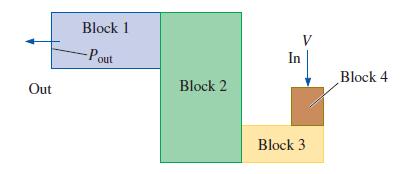
An incompressible CFD code is used to simulate the flow of air through a two-dimensional rectangular channel (Fig. P15–13C). The computational domain consists of four blocks, as indicated. Flow enters block 4 from the upper right and exits block 1 to the left as shown. Inlet velocity V is known
Consider Prob. 15–13C again, except let the boundary condition on the common edge between blocks 1 and 2 be a fan with a specified pressure rise from right to left across the fan. Suppose an incompressible CFD code is run for both cases (with and without the fan). All else being equal, will the
List six boundary conditions that are used with CFD to solve incompressible fluid flow problems. For each one, provide a brief description and give an example of how that boundary condition is used.
Repeat Prob. 15–32, except use an unstructured triangular grid, keeping everything else the same. Do you get the same results as those of Prob. 15–32? Compare and discuss.Data from Problem 15–32Generate a computational domain to study ventilation in a room (Fig. P15–32). Specifically,
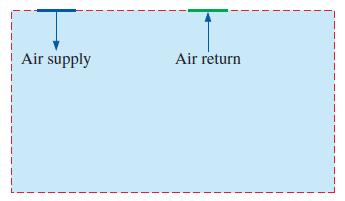
Generate a computational domain to study ventilation in a room (Fig. P15–32). Specifically, generate a rectangular room with a velocity inlet in the ceiling to model the supply air, and a pressure outlet in the ceiling to model the return air. You may make a two-dimensional approximation for
Repeat Prob. 15–30, except for a turbulent boundary layer at Re = 106. Discuss.Data fromProb. 15–30.Generate a computational domain to study the laminar boundary layer growing on a flat plate at Re = 10,000. Generate a very coarse mesh, and then continually refine the mesh until the solution
Generate a computational domain to study the laminar boundary layer growing on a flat plate at Re = 10,000. Generate a very coarse mesh, and then continually refine the mesh until the solution becomes grid independent. Discuss.
A CFD code is used to solve a two-dimensional (x and y), incompressible, laminar flow without free surfaces. The fluid is Newtonian. Appropriate boundary conditions are used. List the variables (unknowns) in the problem, and list the corresponding equations to be solved by the computer.
Develop a general-purpose computer application (using EES or other software) that employs the affinity laws to design a new turbine (B) that is dynamically similar to a given turbine (A). The inputs for turbine A are diameter, net head, capacity, density, rotational speed, and brake horsepower. The
Write a brief (a few sentences) definition and description of each of the following, and provide example(s) if helpful: (a) Computational domain, (b) Mesh, (c) Transport equation, (d) Coupled equations.
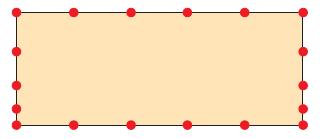
What is the difference between a node and an interval and how are they related to cells? In Fig. P15–3C, how many nodes and how many intervals are on each edge?FIGURE P15–3C
For the two-dimensional computational domain of Fig. P15–3C, with the given node distribution, sketch a simple structured grid using four-sided cells and sketch a simple unstructured grid using three-sided cells. How many cells are in each? Discuss.FIGURE P15–3C
For the two-dimensional computational domain of Fig. P15–3C, with the given node distribution, sketch a simple structured grid using four-sided cells and sketch a simple unstructured polyhedral grid using at least one of each: 3-sided, 4-sided, and 5-sided cells. Try to avoid large skewness.
Showing 200 - 300
of 1457
1
2
3
4
5
6
7
8
9
10
11
12
13
14
15
Step by Step Answers

 Get 50% OFF
Claim Now
Get 50% OFF
Claim Now