New Semester
Started
Get
50% OFF
Study Help!
--h --m --s
Claim Now
Question Answers
Textbooks
Find textbooks, questions and answers
Oops, something went wrong!
Change your search query and then try again
S
Books
FREE
Study Help
Expert Questions
Accounting
General Management
Mathematics
Finance
Organizational Behaviour
Law
Physics
Operating System
Management Leadership
Sociology
Programming
Marketing
Database
Computer Network
Economics
Textbooks Solutions
Accounting
Managerial Accounting
Management Leadership
Cost Accounting
Statistics
Business Law
Corporate Finance
Finance
Economics
Auditing
Tutors
Online Tutors
Find a Tutor
Hire a Tutor
Become a Tutor
AI Tutor
AI Study Planner
NEW
Sell Books
Search
Search
Sign In
Register
study help
engineering
fluid mechanics
Fluid Mechanics Fundamentals And Applications 3rd Edition Yunus Cengel, John Cimbala - Solutions
An ideal gas flows in a pipe at 20°C. The density of the gas is 1.9 kg/m3 and its molar mass is 44 kg/kmol. The pressure of the gas is(a) 7 kPa (b) 72 kPa (c) 105 kPa (d) 460 kPa (e) 4630 kPa
A gas mixture consists of 3 kmol oxygen, 2 kmol nitrogen, and 0.5 kmol water vapor. The total pressure of the gas mixture is 100 kPa. The partial pressure of water vapor in this gas mixture is(a) 5 kPa (b) 9.1 kPa(c) 10 kPa (d) 22.7 kPa (e) 100 kPa
Liquid water vaporizes into water vapor as it flows in the piping of a boiler. If the temperature of water in the pipe is 180°C, the vapor pressure of the water in the pipe is(a) 1002 kPa (b) 180 kPa (c) 101.3 kPa (d) 18 kPa (e) 100 kPa
In a water distribution system, the pressure of water can be as low as 1.4 psia. The maximum temperature of water allowed in the piping to avoid cavitation is(a) 50°F (b) 77°F (c) 100°F (d) 113°F (e) 140°F
The thermal energy of a system refers to(a) Sensible energy (b) Latent energy(c) Sensible 1 latent energies (d) Enthalpy (e) Internal energy
The difference between the energies of a flowing and stationary fluid per unit mass of the fluid is equal to(a) Enthalpy (b) Flow energy (c) Sensible energy(d ) Kinetic energy (e) Internal energy
The pressure at the exit of an air compressor is 150 psia. What is this pressure in kPa?
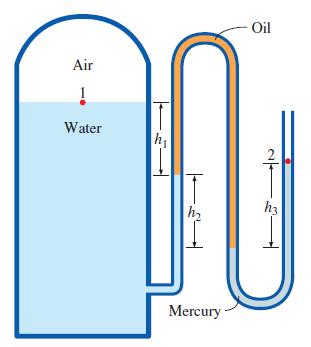
The water in a tank is pressurized by air, and the pressure is measured by a multifluid manometer as shown in Fig. P3–12. Determine the gage pressure of air in the tank if h1 = 0.4 m, h2 = 0.6 m, and h3 = 0.8 m. Take the densities of water, oil, and mercury to be 1000 kg/m3, 850 kg/m3, and 13,600
Determine the atmospheric pressure at a location where the barometric reading is 735 mmHg. Take the density of mercury to be 13,600 kg/m3.
The gage pressure in a liquid at a depth of 3 m is read to be 28 kPa. Determine the gage pressure in the same liquid at a depth of 12 m.
The absolute pressure in water at a depth of 8 m is read to be 175 kPa. Determine (a) The local atmospheric pressure,(b) The absolute pressure at a depth of 8 m in a liquid whose specific gravity is 0.78 at the same location.
Consider a 55-kg woman who has a total foot imprint area of 400 cm2. She wishes to walk on the snow, but the snow cannot withstand pressures greater than 0.5 kPa. Determine the minimum size of the snowshoes needed (imprint area per shoe) to enable her to walk on the snow without sinking.
A vacuum gage connected to a tank reads 45 kPa at a location where the barometric reading is 755 mmHg. Determine the absolute pressure in the tank. Take ρHg = 13,590 kg/m3.
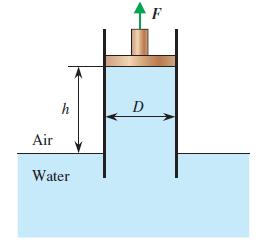
Water from a reservoir is raised in a vertical tube of internal diameter D = 30 cm under the influence of the pulling force F of a piston. Determine the force needed to raise the water to a height of h = 1.5 m above the free surface. What would your response be for h = 3 m? Also, taking the
The barometer of a mountain hiker reads 980 mbars at the beginning of a hiking trip and 790 mbars at the end. Neglecting the effect of altitude on local gravitational acceleration, determine the vertical distance climbed. Assume an average air density of 1.20 kg/m3.
Determine the pressure exerted on a diver at 20 m below the free surface of the sea. Assume a barometric pressure of 101 kPa and a specific gravity of 1.03 for seawater.
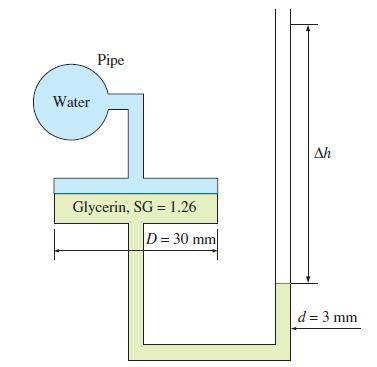
The system shown in the figure is used to accurately measure the pressure changes when the pressure is increased by ΔP in the water pipe. When Δh = 70 mm, what is the change in the pipe pressure? Water Pipe Glycerin, SG = 1.26 D= 30 mm Ah d = 3 mm
Determine the pressure exerted on the surface of a submarine cruising 225 ft below the free surface of the sea. Assume that the barometric pressure is 14.7 psia and the specific gravity of seawater is 1.03.
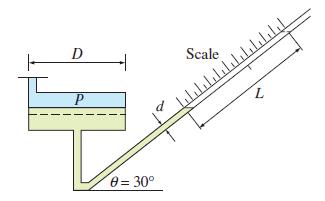
The manometer shown in the figure is designed to measure pressures of up to a maximum of 100 Pa. If the reading error is estimated to be ±0.5 mm, what should the ratio of d/D be in order for the error associated with pressure measurement not to exceed 2.5% of the full scale. D P 0 = 30° Scale L
A manometer containing oil (ρ = 850 kg/m3) is attached to a tank filled with air. If the oil-level difference between the two columns is 150 cm and the atmospheric pressure is 98 kPa, determine the absolute pressure of the air in the tank.
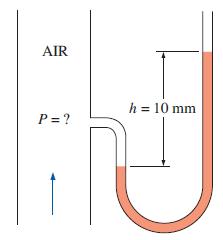
A mercury manometer (ρ = 13,600 kg/m3) is connected to an air duct to measure the pressure inside. The difference in the manometer levels is 10 mm, and the atmospheric pressure is 100 kPa. (a) Judging from Fig. P3–38, determine if the pressure in the duct is above or below the atmospheric
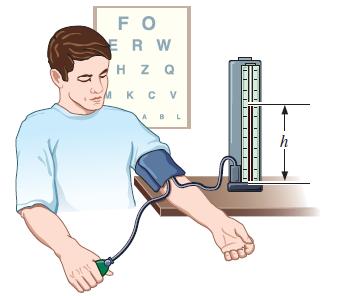
The maximum blood pressure in the upper arm of a healthy person is about 120 mmHg. If a vertical tube open to the atmosphere is connected to the vein in the arm of the person, determine how high the blood will rise in the tube. Take the density of the blood to be 1040 kg/m3. V www FO ERW HZ Q KC
Consider a 1.73-m-tall man standing vertically in water and completely submerged in a pool. Determine the difference between the pressures acting at the head and at the toes of this man, in kPa.
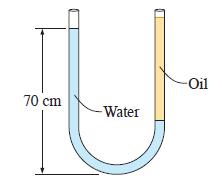
Consider a U-tube whose arms are open to the atmosphere. Now water is poured into the U-tube from one arm, and light oil (ρ = 790 kg/m3) from the other. One arm contains 70-cm-high water, while the other arm contains both fluids with an oil-to-water height ratio of 6. Determine the height of each
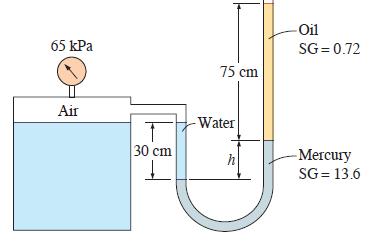
The gage pressure of the air in the tank shown in Fig. P3–49 is measured to be 65 kPa. Determine the differential height h of the mercury column.FIGURE P3–49 65 kPa Air 30 cm I 75 cm Water h -Oil SG=0.72 -Mercury SG = 13.6
The hydraulic lift in a car repair shop has an output diameter of 40 cm and is to lift cars up to 1800 kg. Determine the fluid gage pressure that must be maintained in the reservoir.
Repeat Prob. 3–49 for a gage pressure of 45 kPa.Data from Problem 49The gage pressure of the air in the tank shown in Fig. P3–49 is measured to be 65 kPa. Determine the differential height h of the mercury column.FIGURE P3–49 65 kPa Air 30 cm I 75 cm Water h -Oil SG=0.72 -Mercury SG = 13.6
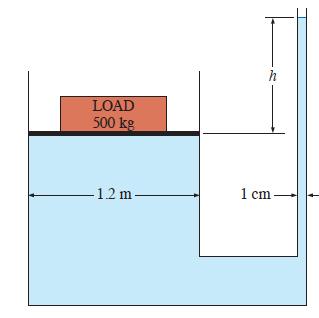
The 500-kg load on the hydraulic lift shown in Fig. P3–51 is to be raised by pouring oil (ρ = 780 kg/m3) into a thin tube. Determine how high h should be in order to begin to raise the weight.FIGURE P3–51 LOAD 500 kg 1.2 m h 1 cm
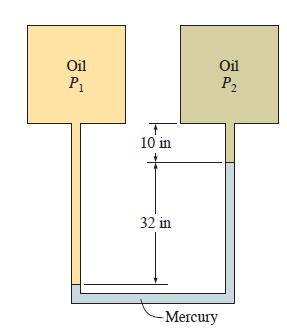
Two oil tanks are connected to each other through a manometer. If the difference between the mercury levels in the two arms is 32 in, determine the pressure difference between the two tanks. The densities of oil and mercury are 45 lbm/ft3 and 848 lbm/ft3, respectively. Oil P₁ 10 in 32
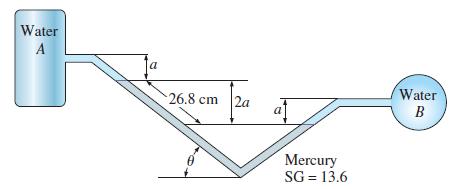
Two water tanks are connected to each other through a mercury manometer with inclined tubes, as shown in Fig. P3–58. If the pressure difference between the two tanks is 20 kPa, calculate a and θ.FIGURE P3–58 Water A a 26.8 cm 2a a Mercury SG = 13.6 Water B
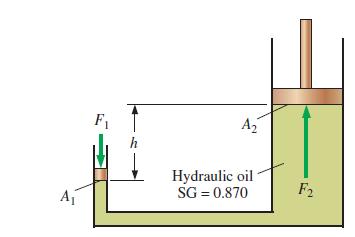
Consider a hydraulic jack being used in a car repair shop, as in Fig. P3–59. The pistons have an area of A1 = 0.8 cm2 and A2 = 0.04 m2. Hydraulic oil with a specific gravity of 0.870 is pumped in as the small piston on the left side is pushed up and down, slowly raising the larger piston on the
A retaining wall against a mud slide is to be constructed by placing 1.2-m-high and 0.25-m-wide rectangular concrete blocks (ρ = 2700 kg/m3) side by side, as shown in Fig. P3–86. The friction coefficient between the ground and the concrete blocks is f = 0.4, and the density of the mud is about
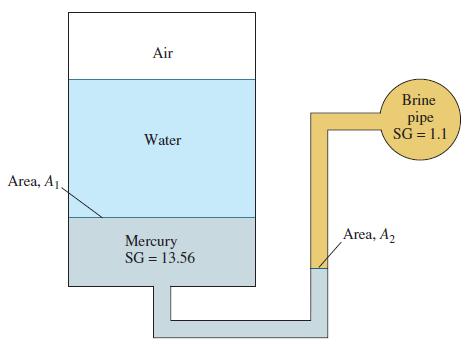
Consider the system shown in Fig. P3–57. If a change of 0.9 kPa in the pressure of air causes the brine-mercury interface in the right column to drop by 5 mm in the brine level in the right column while the pressure in the brine pipe remains constant, determine the ratio of A2/A1.FIGURE P3–57
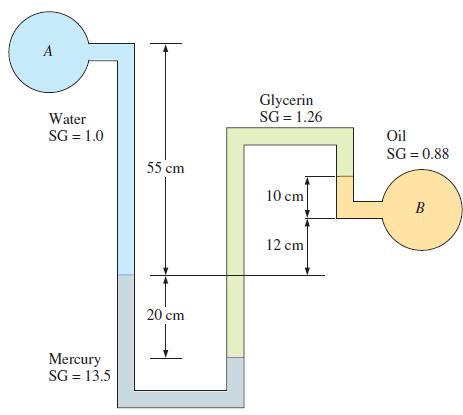
The pressure difference between an oil pipe and water pipe is measured by a double-fluid manometer, as shown in Fig. P3–56. For the given fluid heights and specific gravities, calculate the pressure difference ΔP = PB – PA. A Water SG = 1.0 Mercury SG = 13.5 55 cm 20 cm Glycerin SG = 1.26 10
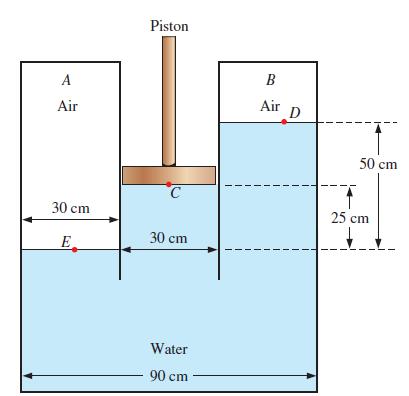
Two chambers with the same fluid at their base are separated by a 30-cm-diameter piston whose weight is 25 N, as shown in Fig. P3–54. Calculate the gage pressures in chambers A and B.FIGURE P3–54 A Air 30 cm E Piston C 30 cm Water 90 cm B Air D 50 cm 25 cm
Pressure is often given in terms of a liquid column and is expressed as “pressure head.” Express the standard atmospheric pressure in terms of (a) Mercury (SG = 13.6),(b) Water (SG = 1.0), (c) Glycerin (SG = 1.26) columns. Explain why we usually use mercury in manometers.
Repeat Prob. 3–86 for 0.4-m-wide concrete blocks.Data from Problem 86A retaining wall against a mud slide is to be constructed by placing 1.2-m-high and 0.25-m-wide rectangular concrete blocks (ρ = 2700 kg/m3) side by side, as shown in Fig. P3–86. The friction coefficient between the ground
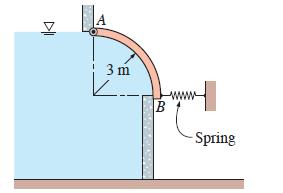
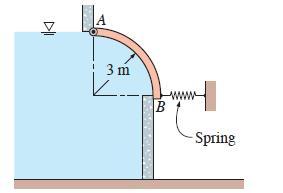
A 4-m-long quarter-circular gate of radius 3 m and of negligible weight is hinged about its upper edge A, as shown in Fig. P3–88. The gate controls the flow of water over the ledge at B, where the gate is pressed by a spring. Determine the minimum spring force required to keep the gate closed
Repeat Prob. 3–88 for a radius of 4 m for the gate.Data from Problem 88A 4-m-long quarter-circular gate of radius 3 m and of negligible weight is hinged about its upper edge A, as shown in Fig. P3–88. The gate controls the flow of water over the ledge at B, where the gate is pressed by a
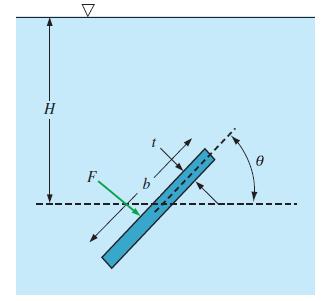
Consider a flat plate of thickness t, width w into the page, and length b submerged in water, as in Fig. P3–90. The depth of water from the surface to the center of the plate is H, and angle θ is defined relative to the center of the plate.(a) Generate an equation for the force F on the upper
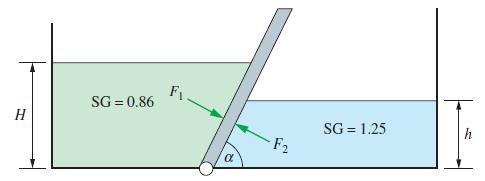
The weight of the gate separating the two fluids is such that the system shown in Fig. P3–91 is at static equilibrium. If it is known that F1/F2 = 1.70, determine h/H.FIGURE P3–91 H SG=0.86 F₁ α F₂ SG = 1.25
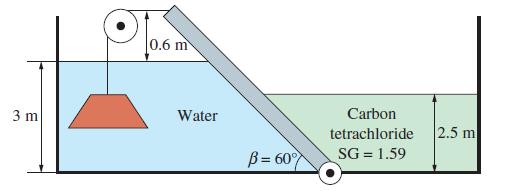
Consider a 1-m wide inclined gate of negligible weight that separates water from another fluid. What would be the volume of the concrete block (SG = 2.4) immersed in water to keep the gate at the position shown? Disregard any frictional effects. 3 m 0.6 m Water B= 60% Carbon tetrachloride SG =
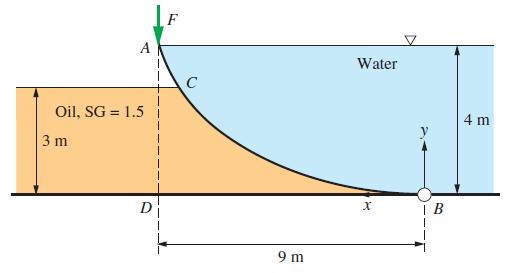
The parabolic shaped gate with a width of 2 m shown in Fig. P3–93 is hinged at point B. Determine the force F needed to keep the gate stationary. Oil, SG = 1.5 3m D F C 9 m Water x | B 4 m
Under what conditions can a moving body of fluid be treated as a rigid body?
Consider a glass of water. Compare the water pressures at the bottom surface for the following cases: the glass is (a) Stationary, (b) Moving up at constant velocity, (c) Moving down at constant velocity, (d) Moving horizontally at constant velocity.
Consider two identical glasses of water, one stationary and the other moving on a horizontal plane with constant acceleration. Assuming no splashing or spilling occurs, which glass will have a higher pressure at the (a) Front, (b) Midpoint, (c) Back of the bottom surface?
Consider a vertical cylindrical container partially filled with water. Now the cylinder is rotated about its axis at a specified angular velocity, and rigid-body motion is established. Discuss how the pressure will be affected at the midpoint and at the edges of the bottom surface due to rotation.
A water tank is being towed by a truck on a level road, and the angle the free surface makes with the horizontal is measured to be 12°. Determine the acceleration of the truck.
Consider two water tanks filled with water. The first tank is 8 m high and is stationary, while the second tank is 2 m high and is moving upward with an acceleration of 5 m/s2. Which tank will have a higher pressure at the bottom?
A water tank is being towed on an uphill road that makes 14° with the horizontal with a constant acceleration of 3.5 m/s2 in the direction of motion. Determine the angle the free surface of water makes with the horizontal. What would your answer be if the direction of motion were downward on the
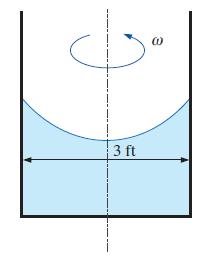
A 3-ft-diameter vertical cylindrical tank open to the atmosphere contains 1-ft-high water. The tank is now rotated about the centerline, and the water level drops at the center while it rises at the edges. Determine the angular velocity at which the bottom of the tank will first be exposed. Also
A 60-cm-high, 40-cm-diameter cylindrical water tank is being transported on a level road. The highest acceleration anticipated is 4 m/s2. Determine the allowable initial water height in the tank if no water is to spill out during acceleration.
A 30-cm-diameter, 90-cm-high vertical cylindrical container is partially filled with 60-cm-high water. Now the cylinder is rotated at a constant angular speed of 180 rpm. Determine how much the liquid level at the center of the cylinder will drop as a result of this rotational motion.
A fish tank that contains 60-cm-high water is moved in the cabin of an elevator. Determine the pressure at the bottom of the tank when the elevator is (a) Stationary, (b) Moving up with an upward acceleration of 3 m/s2, (c) Moving down with a downward acceleration of 3 m/s2.
A 3-m-diameter vertical cylindrical milk tank rotates at a constant rate of 12 rpm. If the pressure at the center of the bottom surface is 130 kPa, determine the pressure at the edge of the bottom surface of the tank. Take the density of the milk to be 1030 kg/m3.
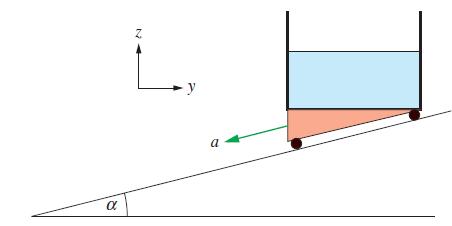
Consider a tank of rectangular cross-section partially filled with a liquid placed on an inclined surface, as shown in the figure. When frictional effects are negligible, show that the slope of the liquid surface will be the same as the slope of the inclined surface when the tank is released. What
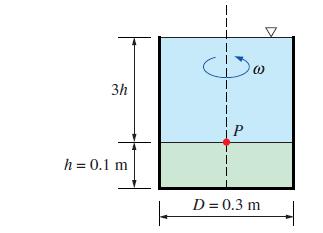
The bottom quarter of a vertical cylindrical tank of total height 0.4 m and diameter 0.3 m is filled with a liquid (SG > 1, like glycerin) and the rest with water, as shown in the figure. The tank is now rotated about its vertical axis at a constant angular speed of ω. Determine (a) The value of
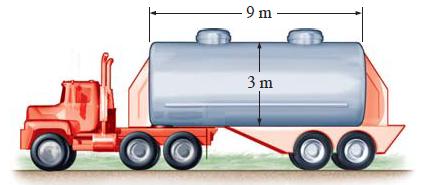
Milk with a density of 1020 kg/m3 is transported on a level road in a 9-m-long, 3-m-diameter cylindrical tanker. The tanker is completely filled with milk (no air space), and it accelerates at 4 m/s2. If the minimum pressure in the tanker is 100 kPa, determine the maximum pressure difference and
Repeat Prob. 3–123 for a deceleration of 2.5 m/s2.Data from Problem 123Milk with a density of 1020 kg/m3 is transported on a level road in a 9-m-long, 3-m-diameter cylindrical tanker. The tanker is completely filled with milk (no air space), and it accelerates at 4 m/s2. If the minimum pressure
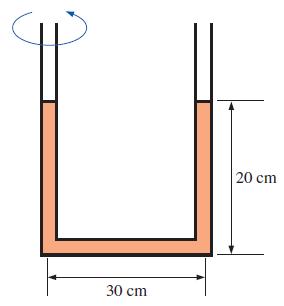
The distance between the centers of the two arms of a U-tube open to the atmosphere is 30 cm, and the U-tube contains 20-cm-high alcohol in both arms. Now the U-tube is rotated about the left arm at 4.2 rad/s. Determine the elevation difference between the fluid surfaces in the two arms. 7 30 cm 20
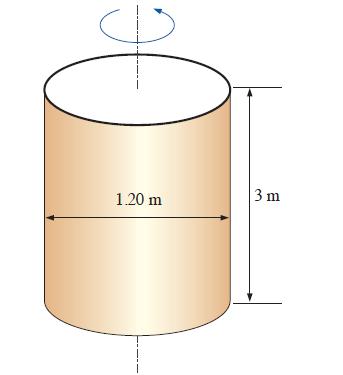
A 1.2-m-diameter, 3-m-high sealed vertical cylinder is completely filled with gasoline whose density is 740 kg/m3. The tank is now rotated about its vertical axis at a rate of 70 rpm. Determine (a) The difference between the pressures at the centers of the bottom and top surfaces (b) The
Reconsider Prob. 3–126. Using EES (or other) software, investigate the effect of rotational speed on the pressure difference between the center and the edge of the bottom surface of the cylinder. Let the rotational speed vary from 0 rpm to 500 rpm in increments of 50 rpm. Tabulate and plot your
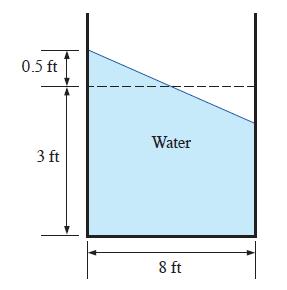
An 8-ft-long tank open to the atmosphere initially contains 3-ft-high water. It is being towed by a truck on a level road. The truck driver applies the brakes and the water level at the front rises 0.5 ft above the initial level. Determine the deceleration of the truck. 0.5 ft 3 ft Water 8 ft
A 15-ft-long, 6-ft-high rectangular tank open to the atmosphere is towed by a truck on a level road. The tank is filled with water to a depth of 5 ft. Determine the maximum acceleration or deceleration allowed if no water is to spill during towing.
A 3-m-diameter, 7-m-long cylindrical tank is completely filled with water. The tank is pulled by a truck on a level road with the 7-m-long axis being horizontal. Determine the pressure difference between the front and back ends of the tank along a horizontal line when the truck (a) Accelerates at
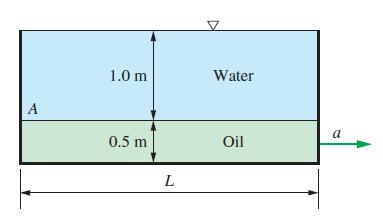
The rectangular tank is filled with heavy oil (like glycerin) at the bottom and water at the top, as shown in the figure. The tank is now moved to the right horizontally with a constant acceleration and ¼ of water is spilled out as a result from the back. Using geometrical considerations,
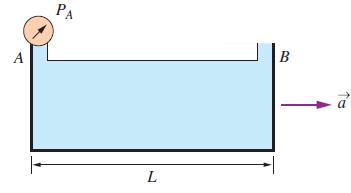
A sealed box filled with a liquid shown in the figure can be used to measure the acceleration of vehicles by measuring the pressure at top point A at back of the box while point B is kept at atmospheric pressure. Obtain a relation between the pressure PA and the acceleration a. A PA L B
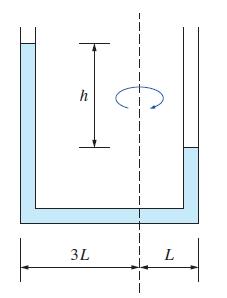
A U-tube is rotating at a constant angular velocity of v. The liquid (glycerin) rises to the levels shown in Fig. P3–134. Obtain a relation for ω in terms of g, h, and L.FIGURE P3–134 h 3L L
A centrifugal pump consists simply of a shaft and a few blades attached normally to the shaft. If the shaft is rotated at a constant rate of 2400 rpm, what would the theoretical pump head due to this rotation be? Take the impeller diameter to be 35 cm and neglect the blade tip effects.
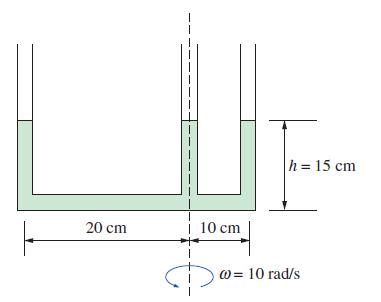
If the rate of rotational speed of the 3-tube system shown in Fig. P3–137 is ω = 10 rad/s, determine the water heights in each tube leg. At what rotational speed will the middle tube be completely empty?Figure P3–137 20 cm 10 cm h = 15 cm @= 10 rad/s
A 30-cm-diameter vertical cylindrical vessel is rotated about its vertical axis at a constant angular velocity of 100 rad/s. If the pressure at the midpoint of the inner top surface is atmospheric pressure like the outer surface, determine the total upward force acting upon the entire top surface
The pressure in a steam boiler is given to be 90 kgf/cm2. Express this pressure in psi, kPa, atm, and bars.
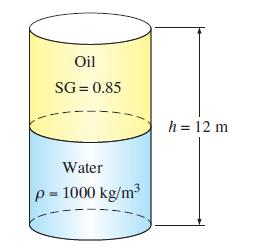
The lower half of a 12-m-high cylindrical container is filled with water (ρ = 1000 kg/m3) and the upper half with oil that has a specific gravity of 0.85. Determine the pressure difference between the top and bottom of the cylinder Oil SG= 0.85 Water p= 1000 kg/m³ h = 12 m
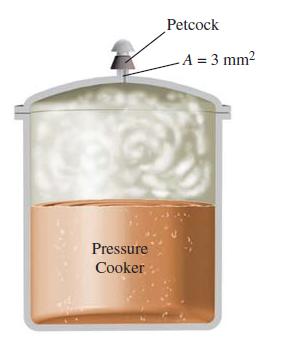
A pressure cooker cooks a lot faster than an ordinary pan by maintaining a higher pressure and temperature inside. The lid of a pressure cooker is well sealed, and steam can escape only through an opening in the middle of the lid. A separate metal piece, the petcock, sits on top of this opening and
A vertical, frictionless piston–cylinder device contains a gas at 500 kPa. The atmospheric pressure outside is 100 kPa, and the piston area is 30 cm2. Determine the mass of the piston.
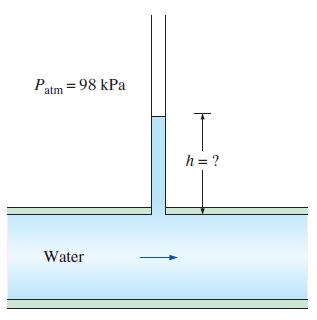
A glass tube is attached to a water pipe, as shown in Fig. P3–147. If the water pressure at the bottom of the tube is 115 kPa and the local atmospheric pressure is 98 kPa, determine how high the water will rise in the tube, in m. Assume g = 9.8 m/s2 at that location and take the density of water
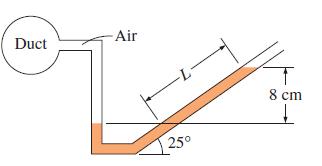
When measuring small pressure differences with a manometer, often one arm of the manometer is inclined to improve the accuracy of the reading. (The pressure difference is still proportional to the vertical distance and not the actual length of the fluid along the tube.) The air pressure in a
Consider a U-tube whose arms are open to the atmosphere. Now equal volumes of water and light oil (ρ = 49.3 lbm/ft3) are poured from different arms. A person blows from the oil side of the U-tube until the contact surface of the two fluids moves to the bottom of the U-tube, and thus the liquid
A gasoline line is connected to a pressure gage through a double-U manometer, as shown in Fig. P3–153. If the reading of the pressure gage is 260 kPa, determine the gage pressure of the gasoline line. P gage Air- = 260 kPa 45 cm 50 cm -Water -Oil SG= 0.79 Gasoline SG= 0.70 22 cm Pipe 10
Repeat Prob. 3–153 for a pressure gage reading of 330 kPa.Data from Problem 153A gasoline line is connected to a pressure gage through a double-U manometer, as shown in Fig. P3–153. If the reading of the pressure gage is 260 kPa, determine the gage pressure of the gasoline line. P gage Air- =
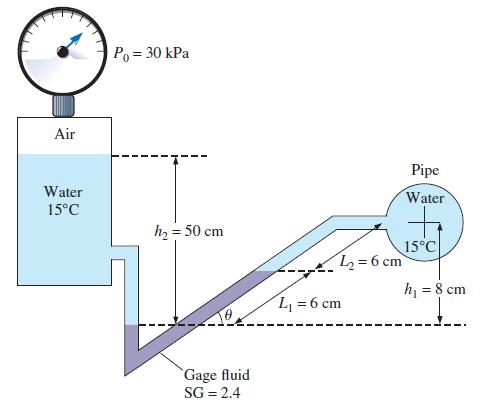
The pressure of water flowing through a pipe is measured by the arrangement shown in Fig. P3–156. For the values given, calculate the pressure in the pipe. Air Water 15°C Po = 30 kPa h₂ = 50 cm Gage fluid SG = 2.4 L₂= 6 cm L₁ = 6 cm Pipe Water 15°C h₁ = 8 cm
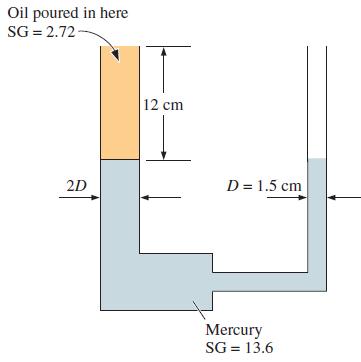
Consider a U-tube filled with mercury as shown in Fig. P3–157. The diameter of the right arm of the U-tube is D = 1.5 cm, and the diameter of the left arm is twice that. Heavy oil with a specific gravity of 2.72 is poured into the left arm, forcing some mercury from the left arm into the right
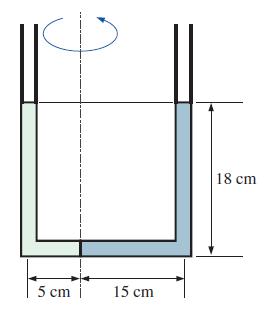
A U-tube contains water in the right arm, and another liquid in the left arm. It is observed that when the U-tube rotates at 50 rpm about an axis that is 15 cm from the right arm and 5 cm from the left arm, the liquid levels in both arms become the same, and the fluids meet at the axis of rotation.
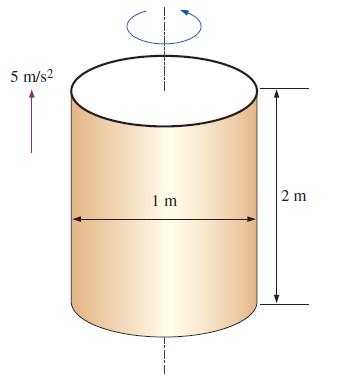
A 1-m-diameter, 2-m-high vertical cylinder is completely filled with gasoline whose density is 740 kg/m3. The tank is now rotated about its vertical axis at a rate of 130 rpm, while being accelerated upward at 5 m/s2. Determine (a) The difference between the pressures at the centers of the bottom
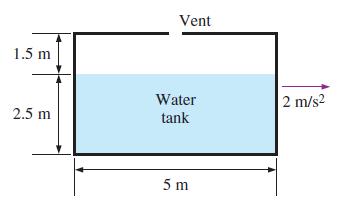
A 5-m-long, 4-m-high tank contains 2.5-m-deep water when not in motion and is open to the atmosphere through a vent in the middle. The tank is now accelerated to the right on a level surface at 2 m/s2. Determine the maximum pressure in the tank relative to the atmospheric pressure. 1.5 m 2.5
Reconsider Prob. 3–167. Using EES (or other) software, investigate the effect of acceleration on the slope of the free surface of water in the tank. Let the acceleration vary from 0 m/s2 to 15 m/s2 in increments of 1 m/s2. Tabulate and plot your results.Data from Exercises 167.A 5-m-long,
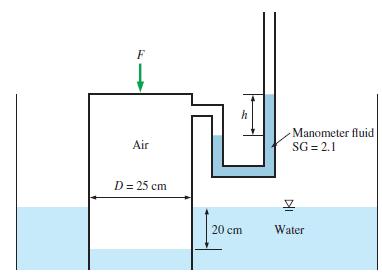
A cylindrical container whose weight is 65 N is inverted and pressed into the water, as shown in Fig. P3–169. Determine the differential height h of the manometer and the force F needed to hold the container at the position shown. F Air D = 25 cm 20 cm Manometer fluid SG = 2.1 프 Water
The absolute pressure in a tank is measured to be 35 kPa. If the atmospheric pressure is 100 kPa, the vacuum pressure in the tank is(a) 35 kPa (b) 100 kPa (c) 135 psi(d) 0 kPa (e) 65 kPa
The pressure difference between the top and bottom of a water body with a depth of 10 m is (Take the density of water to be 1000 kg/m3.)(a) 98,100 kPa (b) 98.1 kPa (c) 100 kPa(d) 10 kPa (e) 1.9 kPa
The gage pressure in a pipe is measured by a manometer containing mercury (ρ = 13,600 kg/m3). The top of the mercury is open to the atmosphere and the atmospheric pressure is 100 kPa. If the mercury column height is 24 cm, the gage pressure in the pipe is(a) 32 kPa (b) 24 kPa (c) 76 kPa(d) 124
Consider a hydraulic car jack with a piston diameter ratio of 9. A person can lift a 2000-kg car by applying a force of(a) 2000 N (b) 200 N (c) 19,620 N(d) 19.6 N (e) 18,000 N
The atmospheric pressure in a location is measured by a mercury (ρ = 13,600 kg/m3) barometer. If the height of the mercury column is 715 mm, the atmospheric pressure at that location is(a) 85.6 kPa (b) 93.7 kPa(c) 95.4 kPa(d) 100 kPa (e) 101 kPa
A manometer is used to measure the pressure of a gas in a tank. The manometer fluid is water (ρ = 1000 kg/m3) and the manometer column height is 1.8 m. If the local atmospheric pressure is 100 kPa, the absolute pressure within the tank is(a) 17,760 kPa (b) 100 kPa (c) 180 kPa(d) 101 kPa (e) 118
Consider the vertical rectangular wall of a water tank with a width of 5 m and a height of 8 m. The other side of the wall is open to the atmosphere. The resultant hydrostatic force on this wall is(a) 1570 kN (b) 2380 kN (c) 2505 kN(d) 1410 kN (e) 404 kN
A vertical rectangular wall with a width of 20 m and a height of 12 m is holding a 7-m-deep water body. The resultant hydrostatic force acting on this wall is(a) 1370 kN (b) 4807 kN (c) 8240 kN(d) 9740 kN (e) 11,670 kN
A vertical rectangular wall with a width of 20 m and a height of 12 m is holding a 7-m-deep water body. The line of action yp for the resultant hydrostatic force on this wall is (disregard the atmospheric pressure)(a) 5 m (b) 4.0 m (c) 4.67 m (d) 9.67 m (e) 2.33 m
A rectangular plate with a width of 16 m and a height of 12 m is located 4 m below a water surface. The plate is tilted and makes a 35° angle with the horizontal. The resultant hydrostatic force acting on the top surface of this plate is(a) 10,800 kN (b) 9745 kN (c) 8470 kN(d) 6400 kN (e) 5190
A 2-m-long and 3-m-wide horizontal rectangular plate is submerged in water. The distance of the top surface from the free surface is 5 m. The atmospheric pressure is 95 kPa. Considering atmospheric pressure, the hydrostatic force acting on the top surface of this plate is(a) 307 kN (b) 688 kN (c)
A 1.8-m-diameter and 3.6-m-long cylindrical container contains a fluid with a specific gravity of 0.73. The container is positioned vertically and is full of the fluid. Disregarding atmospheric pressure, the hydrostatic force acting on the top and bottom surfaces of this container, respectively,
Consider a 6-m-diameter spherical gate holding a body of water whose height is equal to the diameter of the gate. Atmospheric pressure acts on both sides of the gate. The horizontal component of the hydrostatic force acting on this curved surface is(a) 709 kN (b) 832 kN (c) 848 kN(d) 972 kN (e)
Showing 1300 - 1400
of 1457
1
2
3
4
5
6
7
8
9
10
11
12
13
14
15
Step by Step Answers

 Get 50% OFF
Claim Now
Get 50% OFF
Claim Now