New Semester
Started
Get
50% OFF
Study Help!
--h --m --s
Claim Now
Question Answers
Textbooks
Find textbooks, questions and answers
Oops, something went wrong!
Change your search query and then try again
S
Books
FREE
Study Help
Expert Questions
Accounting
General Management
Mathematics
Finance
Organizational Behaviour
Law
Physics
Operating System
Management Leadership
Sociology
Programming
Marketing
Database
Computer Network
Economics
Textbooks Solutions
Accounting
Managerial Accounting
Management Leadership
Cost Accounting
Statistics
Business Law
Corporate Finance
Finance
Economics
Auditing
Tutors
Online Tutors
Find a Tutor
Hire a Tutor
Become a Tutor
AI Tutor
AI Study Planner
NEW
Sell Books
Search
Search
Sign In
Register
study help
engineering
fluid mechanics
Fluid Mechanics Fundamentals And Applications 3rd Edition Yunus Cengel, John Cimbala - Solutions
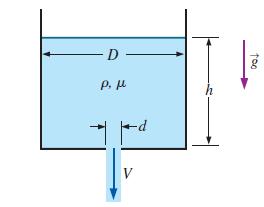
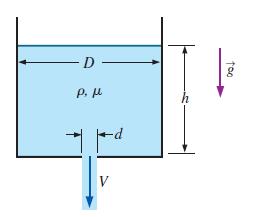
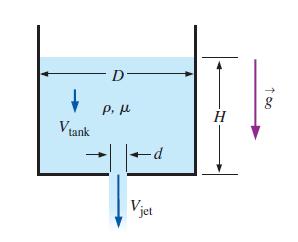
A liquid of density ρ and viscosity μ flows by gravity through a hole of diameter d in the bottom of a tank of diameter D (Fig. P7–99). At the start of the experiment, the liquid surface is at height h above the bottom of the tank, as sketched. The liquid exits the tank as a jet with average
Repeat Prob. 7–99 except for a different dependent parameter, namely, the time required to empty the tank tempty. Generate a dimensionless relationship for tempty as a function of the following independent parameters: hole diameter d, tank diameter D, density ρ, viscosity μ, initial liquid
A liquid delivery system is being designed such that ethylene glycol flows out of a hole in the bottom of a large tank, as in Fig. P7–99. The designers need to predict how long it will take for the ethylene glycol to completely drain. Since it would be very expensive to run tests with a
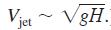
Liquid flows out of a hole in the bottom of a tank as in Fig. P7–99. Consider the case in which the hole is very small compared to the tank (d ≪ D). Experiments reveal that average jet velocity V is nearly independent of d, D, ρ, or μ. In fact, for a wide range of these parameters, it turns
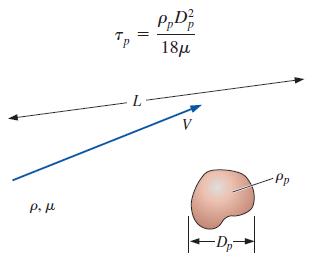
An aerosol particle of characteristic size Dp moves in an airflow of characteristic length L and characteristic velocity V. The characteristic time required for the particle to adjust to a sudden change in air speed is called the particle relaxation time τp, Verify that the primary dimensions of
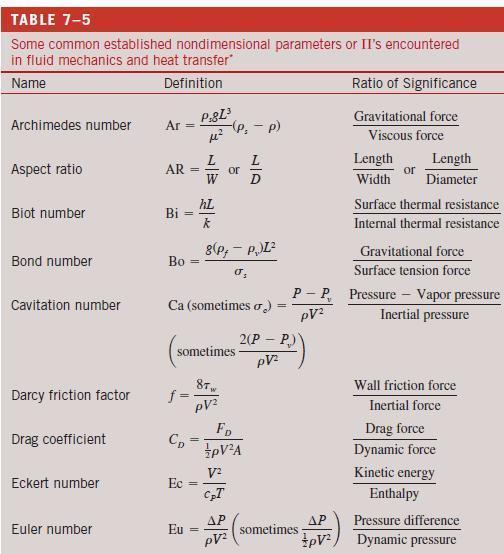
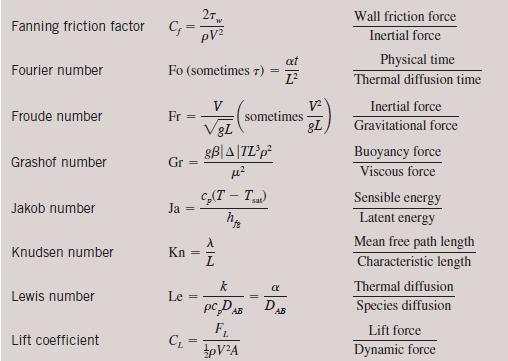
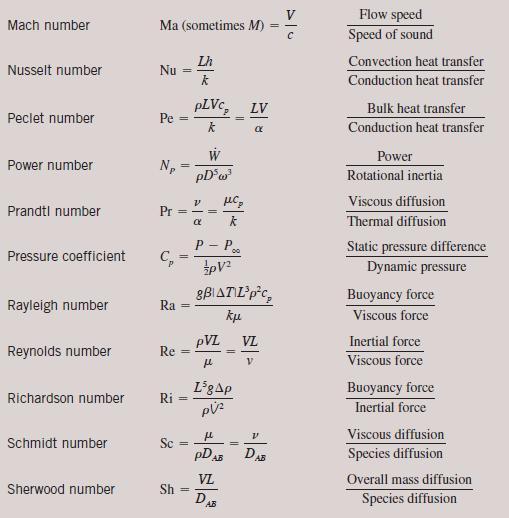
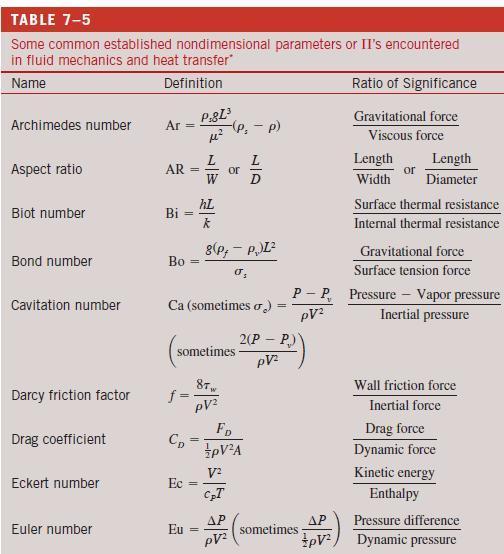
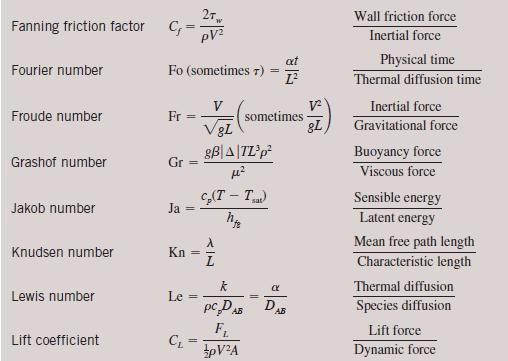
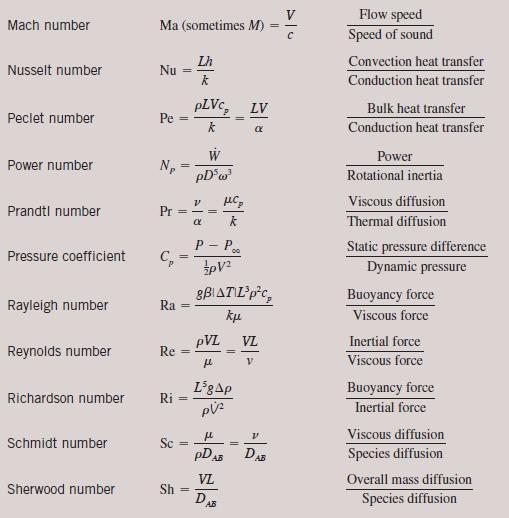
The Stanton number is listed as a named, established non dimensional parameter in Table 7–5. However, careful analysis reveals that it can actually be formed by a combination of the Reynolds number, Nusselt number, and Prandtl number. Find the relationship between these four dimensionless groups,
Compare the primary dimensions of each of the following properties in the mass-based primary dimension system (m, L, t, T, I, C, N) to those in the force-based primary dimension system (F, L, t, T, I, C, N): (a) Pressure or stress;(b) Moment or torque; (c) Work or energy. Based on your results,
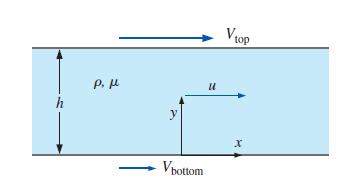
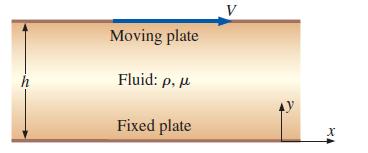
Consider a variation of the fully developed Couette flow problem of Prob. 7–55—flow between two infinite parallel plates separated by distance h, with the top plate moving at speed Vtop and the bottom plate moving at speed Vbottom as illustrated in Fig. P7–106. The flow is steady,
What are the primary dimensions of electric charge q, the units of which are coulombs (C)?
What are the primary dimensions of electrical capacitance C, the units of which are farads?
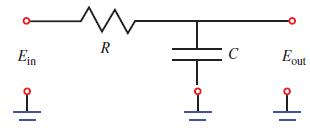
In many electronic circuits in which some kind of time scale is involved, such as filters and time-delay circuits (Fig. P7–109—a low-pass filter), you often see a resistor (R) and a capacitor (C) in series. In fact, the product of R and C is called the electrical time constant, RC. Showing all
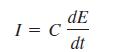
From fundamental electronics, the current flowing through a capacitor at any instant of time is equal to the capacitance times the rate of change of voltage (electromotive force) across the capacitor,Write the primary dimensions of both sides of this equation, and verify that the equation is
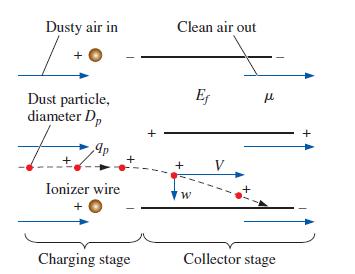
An electrostatic precipitator (ESP) is a device used in various applications to clean particle-laden air. First, the dusty air passes through the charging stage of the ESP, where dust particles are given a positive charge qp (coulombs) by charged ionizer wires (Fig. P7–111). The dusty air then
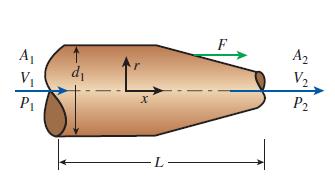
Experiments are being designed to measure the horizontal force F on a fireman’s nozzle, as shown in Fig. P7–112. Force F is a function of velocity V1, pressure drop ΔP = P1 – P2, density r, viscosity μ, inlet area A1, outlet area A2, and length L. Perform a dimensional analysis for F = f
Repeat part (a) of Prob. 7–113, except instead of height h, find a functional relationship for the time scale trise needed for the liquid to climb up to its final height in the capillary tube.Data from Problem 7–113When a capillary tube of small diameter D is inserted into a container of
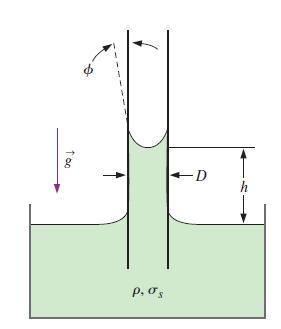
When a capillary tube of small diameter D is inserted into a container of liquid, the liquid rises to height h inside the tube (Fig. P7–113). h is a function of liquid density ρ, tube diameter D, gravitational constant g, contact angle Ф, and the surface tension σs of the liquid. (a) Generate
Sound intensity I is defined as the acoustic power per unit area emanating from a sound source. We know that I is a function of sound pressure level P (dimensions of pressure) and fluid properties ρ (density) and speed of sound c.(a) Use the method of repeating variables in mass-based primary
Repeat Prob. 7–115, but with the distance r from the sound source as an additional independent parameter.Data from Problem 115Sound intensity I is defined as the acoustic power per unit area emanating from a sound source. We know that I is a function of sound pressure level P (dimensions of
Many of the established nondimensional parameters listed in Table 7–5 can be formed by the product or ratio of two other established nondimensional parameters. For each pair of nondimensional parameters listed, find a third established nondimensional parameter that is formed by some manipulation
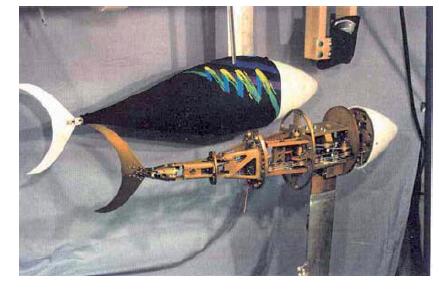
Engineers at MIT have developed a mechanical of a tuna fish to study its locomotion. The “Robotuna” shown in Fig. P7–117 is 1.0 m long and swims at speeds up to 2.0 m/s. Real bluefin tuna can exceed 3.0 m in length and have been clocked at speeds greater than 13 m/s. How fast would the 1.0-m
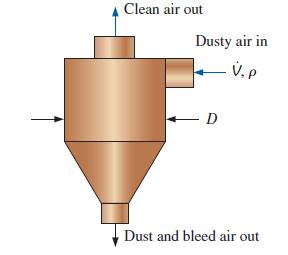
A common device used in various applications to clean particle-laden air is the reverse-flow cyclone (Fig. P7–120). Dusty air (volume flow rate V̇ and density ρ) enters tangentially through an opening in the side of the cyclone and swirls around in the tank. Dust particles are flung outward and
Which one is not a primary dimension?(a) Velocity (b) Time (c) Electric current(d) Temperature (e) Mass
The primary dimensions of kinematic viscosity are(a) m·L/t2 (b) m/L·t (c) L2/t (d) L2/m·t (e) L/m·t2
The thermal conductivity of a substance may be defined as the rate of heat transfer per unit length per unit temperature difference. The primary dimensions of thermal conductivity are(a) m2·L/t2·T (b) m2·L2/t·T (c) L2/m·t2·T(d) m·L/t3·T (e) m·L2/t3·T
The primary dimensions of the gas constant over the universal gas constant R/Ru are(a) L2/t2·T (b) m·L/N (c) m/t·N·T(d) m/L3 (e) N/m
The drag coefficient CD is a nondimensional parameter and is a function of drag force FD, density ρ, velocity V, and area A. The drag coefficient is expressed as a) F₁V² 2pA (b) 2FD pVA (c) PVA² FD FDA (d) PV (e) 2FD pV²A
The primary dimensions of the universal gas constant Ru are(a) m·L/t2·T (b) m2·L/N (c) m·L2/t2·N·T(d) L2/t2·T (e) N/m·t
Which similarity condition is related to force-scale equivalence?(a) Geometric (b) Kinematic (c) Dynamic(d) Kinematic and dynamic (e) Geometric and kinematic
There are four additive terms in an equation, and their units are given below. Which one is not consistent with this equation?(a) J (b) W/m (c) kg·m2/s2 (d) Pa·m3 (e) N·m
The heat transfer coefficient is a nondimensional parameter which is a function of viscosity μ, specific heat cp (kJ/kg·K), and thermal conductivity k (W/m·K). This nondimensional parameter is expressed as(a) cp/μk (b) k/μcp (c) μ/cpk (d) μcp/k (e) cpk/μ
The nondimensional heat transfer coefficient is a function of convection coefficient h (W/m2·K), thermal conductivity k (W/m·K), and characteristic length L. This nondimensional parameter is expressed as(a) hL/k (b) h/kL (c) L/hk (d) hk/L (e) kL/h
A one-third scale model of a car is to be tested in a wind tunnel. The conditions of the actual car are V = 75 km/h and T = 0°C and the air temperature in the wind tunnel is 20°C. The properties of air at 1 atm and 0°C: ρ = 1.292 kg/m3, ν = 1.338 × 10⁻⁵ m2/s.The properties of air at 1 atm
We briefly mention the compressible stream function ψρ in this chapter, defined in Cartesian coordinates as ρu = (−ψρ/−y) and ρv = –(−ψρ/−x). What are the primary dimensions of ψρ? Write the units of ψρ in primary SI units and in primary English units.
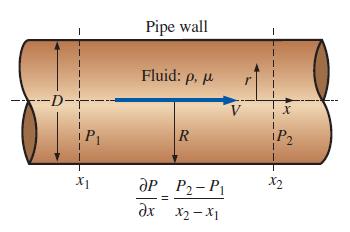
Consider the planar Poiseuille flow of Prob. 10–10. Discuss how modified pressure varies with downstream distance x. In other words, does modified pressure increase, stay the same, or decrease with x? If P´ increases or decreases with x, how does it do so (e.g., linearly, quadratically,
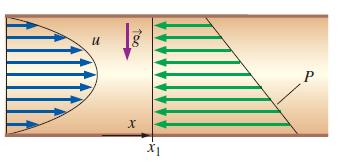
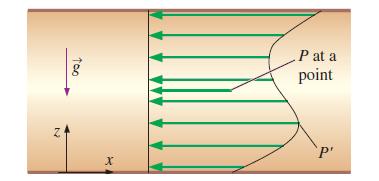
Consider steady, incompressible, laminar, fully developed, planar Poiseuille flow between two parallel, horizontal plates (velocity and pressure profiles are shown in Fig. P10–10). At some horizontal location x = x1, the pressure varies linearly with vertical distance z, as sketched. Choose an
A steady, two-dimensional, incompressible flow field in the xy-plane has a stream function given by ψ = ax2 + by2 + cy, where a, b, and c are constants. The expression for the velocity component u is(a) 2ax (b) 2by + c (c) –2ax(d) −2by – c (e) 2ax + 2by + c
Write out the three components of the Navier–Stokes equation in Cartesian coordinates in terms of modified pressure. Insert the definition of modified pressure and show that the x-, y-, and z-components are identical to those in terms of regular pressure. What is the advantage of using modified
A steady, two-dimensional, incompressible flow field in the xy-plane has a stream function given by ψ = ax2 + by2 + cy, where a, b, and c are constants. The expression for the velocity component v is(a) 2ax (b) 2by + c (c) –2ax (d) –2by – c(e) 2ax + 2by + c
What is the most important criterion for use of the modified pressure P´ rather than the thermodynamic pressure P in a solution of the Navier–Stokes equation?
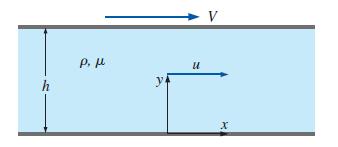
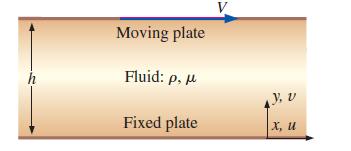
In Chap. 9 (Example 9–15), we generated an “exact” solution of the Navier–Stokes equation for fully developed Couette flow between two horizontal flat plates (Fig. P10–12), with gravity acting in the negative z-direction (into the page of Fig. P10–12). We used the actual pressure in
Consider flow of water through a small hole in the bottom of a large cylindrical tank (Fig. P10–13). The flow is laminar everywhere. Jet diameter d is much smaller than tank diameter D, but D is of the same order of magnitude as tank height H. Carrie reasons that she can use the fluid statics
A flow field is simulated by a computational fluid dynamics code that uses the modified pressure in its calculations. A profile of modified pressure along a vertical slice through the flow is sketched in Fig. P10–14. The actual pressure at a point midway through the slice is known, as indicated
In Example 9–18 we solved the Navier–Stokes equation for steady, fully developed, laminar flow in a round pipe (Poiseuille flow), neglecting gravity. Now, add back the effect of gravity by re-solving that same problem, but use modified pressure P´ instead of actual pressure P. Specifically,
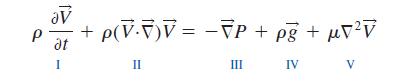
Write a one-word description of each of the five terms in the incompressible Navier–Stokes equation,When the creeping flow approximation is made, only two of the five terms remain. Which two terms remain, and why is this significant? P ƏV at I P(V.)V = P + pg + μV²V II III V IV
Discuss why fluid density has negligible influence on the aerodynamic drag on a particle moving in the creeping flow regime.
A person drops 3 aluminum balls of diameters 2 mm, 4 mm, and 10 mm into a tank filled with glycerin at 22°C (μ = 1 kg·m/s), and measured the terminal velocities to be 3.2 mm/s, 12.8 mm/s, and 60.4 mm/s, respectively. The measurements are to be compared with theory using Stokes law for drag force
Repeat Prob. 10–18 by considering the general form of the Stokes law expressed as Data from problem 18A person drops 3 aluminum balls of diameters 2 mm, 4 mm, and 10 mm into a tank filled with glycerin at 22°C (μ = 1 kg·m/s), and measured the terminal velocities to be 3.2 mm/s, 12.8 mm/s, and
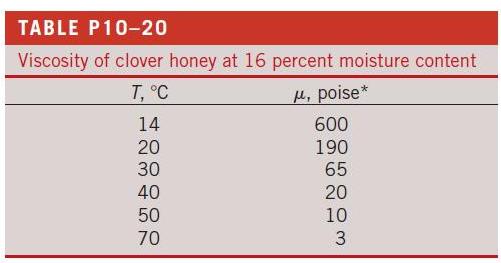
The viscosity of clover honey is listed as a function of temperature in Table P10–20. The specific gravity of the honey is about 1.42 and is not a strong function of temperature. The honey is squeezed through a small hole of diameter D = 6.0 mm in the lid of an inverted honey jar. The room and
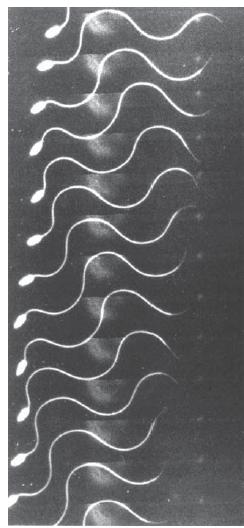
A good swimmer can swim 100 m in about a minute. If a swimmer’s body is 1.85 m long, how many body lengths does he swim per second? Repeat the calculation for the sperm of Fig. 10–10. In other words, how many body lengths does the sperm swim per second? Use the sperm’s whole body length, not
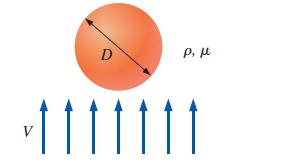
A drop of water in a rain cloud has diameter D = 42.5 μm (Fig. P10–22). The air temperature is 25°C, and its pressure is standard atmospheric pressure. How fast does the air have to move vertically so that the drop will remain suspended in the air?FIGURE P10–22 D P, H
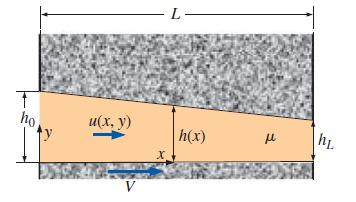
A slipper-pad bearing (Fig. P10–23) is often encountered in lubrication problems. Oil flows between two blocks; the upper one is stationary, and the lower one is moving in this case. The drawing is not to scale; in actuality, h ≪ L. The thin gap between the blocks converges with increasing x.
Consider the slipper-pad bearing of Prob. 10–23.(a) Generate a characteristic scale for v, the y-component of velocity. (b) Perform an order-of-magnitude analysis to compare the inertial terms to the pressure and viscous terms in the x-momentum equation. Show that when the gap is small (h0 ≪
Consider again the slipper-pad bearing of Prob. 10–23. Perform an order-of-magnitude analysis on the y-momentum equation, and write the final form of the y-momentum equation.Data from Problem 23A slipper-pad bearing (Fig. P10–23) is often encountered in lubrication problems. Oil flows between
Consider again the slipper-pad bearing of Prob. 10–23.(a) List appropriate boundary conditions on u. (b) Solve the creeping flow approximation of the x-momentum equation to obtain an expression for u as a function of y (and indirectly as a function of x through h and dP/dx, which are functions
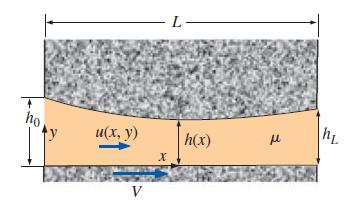
Consider the slipper-pad bearing of Fig. P10–27. The drawing is not to scale; in actuality, h ≪ L. This case differs from that of Prob. 10–23 in that h(x) is not linear; rather h is some known, arbitrary function of x. Write an expression for axial velocity component u as a function of y, h,
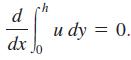
For the slipper-pad bearing of Prob. 10–23, use the continuity equation, appropriate boundary conditions, and the one-dimensional Leibniz theorem (see Chap. 4) to show thatData from Problem 23A slipper-pad bearing (Fig. P10–23) is often encountered in lubrication problems. Oil flows between two
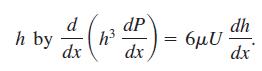
Combine the results of Probs. 10–26 and 10–28 to show that for a two-dimensional slipper-pad bearing, pressure gradient dP/dx is related to gap heightThis is the steady, two-dimensional form of the more general Reynolds equation for lubrication (Panton, 2005).Data from Problem 28For the
Consider flow through a two-dimensional slipperpad bearing with linearly decreasing gap height from h0 to hL (Fig. P10–23), namely, h = h0 + αx, where a is the nondimensional convergence of the gap, α = (hL – h0)/L. We note that tan α ≅ α for very small values of α. Thus, α is
A slipper-pad bearing with linearly decreasing gap height (Fig. P10–23) is being designed for an amusement park ride. Its dimensions are h0 = 1/1000 inand L = 1.0 in (0.0254 m). The lower plate moves at speed V = 10.0 ft/s (3.048 m/s) relative to the upper plate. The oil is engine oil at 40°C.
Discuss what happens when the oil temperature increases significantly as the slipper-pad bearing of Prob. 10–31E is subjected to constant use at the amusement park. In particular, would the load-carrying capacity increase or decrease? Why?Data from Problem 31A slipper-pad bearing with linearly
Is the slipper-pad flow of Prob. 10–31E in the creeping flow regime? Discuss. Are the results reasonable?Data from Problem 31A slipper-pad bearing with linearly decreasing gap height (Fig. P10–23) is being designed for an amusement park ride. Its dimensions are h0 = 1/1000 inand L = 1.0 in
We saw in Prob. 10–31E that a slipper-pad bearing can support a large load. If the load were to increase, the gap height would decrease, thereby increasing the pressure in the gap. In this sense, the slipper-pad bearing is “self-adjusting” to varying loads. If the load increases by a factor
For each case, calculate an appropriate Reynolds number and indicate whether the flow can be approximated by the creeping flow equations. (a) A microorganism of diameter 5.0 μm swims in room temperature water at a speed of 0.25 mm/s. (b) Engine oil at 140°C flows in the small gap of a
Estimate the speed at which you would need to swim in room temperature water to be in the creeping flow regime. (An order-of-magnitude estimate will suffice.) Discuss.
Estimate the speed and Reynolds number of the sperm shown in Fig. 10–10. Is this microorganism swimming under creeping flow conditions? Assume it is swimming in room-temperature water.Figure 10-10 2
What is the main difference between the steady, incompressible Bernoulli equation for irrotational regions of flow, and the steady incompressible Bernoulli equation for rotational but inviscid regions of flow?
In what way is the Euler equation an approximation of the Navier–Stokes equation? Where in a flow field is the Euler equation an appropriate approximation?
In a certain region of steady, two-dimensional, incompressible flow, the velocity field is given byShow that this region of flow can be considered inviscid. V = (u, v) = (ax + b)i + (-ay + cx).
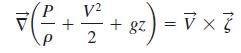
In the derivation of the Bernoulli equation for regions of inviscid flow, we rewrite the steady, incompressible Euler equation into a form showing that the gradient of three scalar terms is equal to the velocity vector crossed with the vorticity vector, noting that z is vertically upward,We then
Repeat Prob. 10–44, except let the rotating fluid be engine oil at 60°C. Discuss.Data from problem 44Water at T = 20°C rotates as a rigid body about the z-axis in a spinning cylindrical container (Fig. P10–44). There are no viscous stresses since the water moves as a solid body; thus the
In the derivation of the Bernoulli equation for regions of inviscid flow, we use the vector identityShow that this vector identity is satisfied for the case of velocity vector V̇ in Cartesian coordinates, i.e.,For full credit, expand each term as far as possible and show all your work. (V-V)V =
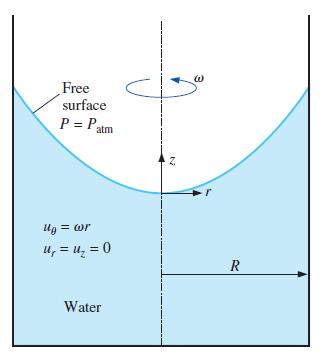
Water at T = 20°C rotates as a rigid body about the z-axis in a spinning cylindrical container (Fig. P10–44). There are no viscous stresses since the water moves as a solid body; thus the Euler equation is appropriate. (We neglect viscous stresses caused by air acting on the water surface.)
Using the results of Prob. 10–44, calculate the Bernoulli constant as a function of radial coordinate r.Data from problem 44Water at T = 20°C rotates as a rigid body about the z-axis in a spinning cylindrical container (Fig. P10–44). There are no viscous stresses since the water moves as a
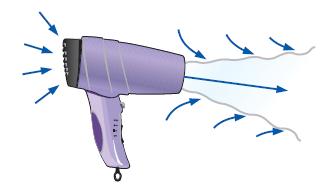
Consider the flow field produced by a hair dryer (Fig. P10–50C). Identify regions of this flow field that can be approximated as irrotational, and those for which the irrotational flow approximation would not be appropriate (rotational flow regions).FIGURE P10–50C
Write out the components of the Euler equation as far as possible in Cartesian coordinates (x, y, z) and (u, v, w). Assume gravity acts in some arbitrary direction.
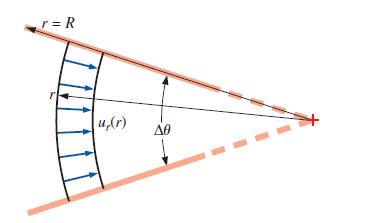
Consider steady, incompressible, two-dimensional flow of fluid into a converging duct with straight walls (Fig. P10–47). The volume flow rate is V̇, and the velocity is in the radial direction only, with ur a function of r only. Let b be the width into the page. At the inlet into the converging
Write out the components of the Euler equation as far as possible in cylindrical coordinates (r, θ, z) and (ur, uθ, uz). Assume gravity acts in some arbitrary direction.
What is D’Alembert’s paradox? Why is it a paradox?
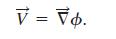
In an irrotational region of flow, the velocity field can be calculated without need of the momentum equation by solving the Laplace equation for velocity potential function Φ and then solving for the components of V(vector) from the definition of Φ, namely,Discuss the role of the momentum
A subtle point, often missed by students of fluid mechanics (and even their professors!), is that an inviscid region of flow is not the same as an irratational (potential) region of flow (Fig. P10–52C). Discuss the differences and similarities between these two approximations. Give an example of
What flow property determines whether a region of flow is rotational or irrotational? Discuss.
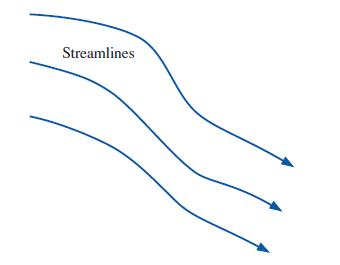
Streamlines in a steady, two-dimensional, incompressible flow field are sketched in Fig. P10–55. The flow in the region shown is also approximated as irrotational. Sketch what a few equipotential curves (curves of constant potential function) might look like in this flow field. Explain how you
Write the Bernoulli equation, and discuss how it differs between an inviscid, rotational region of flow and a viscous, irrotational region of flow. Which case is more restrictive (in regards to the Bernoulli equation)?
Consider the following steady, two-dimensional, incompressible velocity field:Is this flow field irrotational? If so, generate an expression for the velocity potential function. V = (u, v) = (ax + b)i + (-ay + c)].
Consider the following steady, two-dimensional, incompressible velocity field:Is this flow field irrotational? If so, generate an expression for the velocity potential function. V = (u, v) = (ay2 + b)i + (axy + c)j.
Consider an irrotational line source of strength V̇/L in the xy- or rθ-plane. The velocity components arestarted with the equation for uθ to generate expressions for the velocity potential function and the stream function for the line source. Repeat the analysis, except start with the equation
Consider a steady, two-dimensional, incompressible, irrotational velocity field specified by its velocity potential function,(a) Calculate velocity components u and v. (b) Verify that the velocity field is irrotational in the region in which Φ applies.(c) Generate an expression for the stream
Consider a steady, two-dimensional, incompressible, irrotational velocity field specified by its velocity potential function,(a) Calculate velocity components u and v. (b) Verify that the velocity field is irrotational in the region in which ψ applies. (c) Generate an expression for the stream
Consider a planar irrotational region of flow in the rθ-plane. Show that stream function ψ satisfies the Laplace equation in cylindrical coordinates.
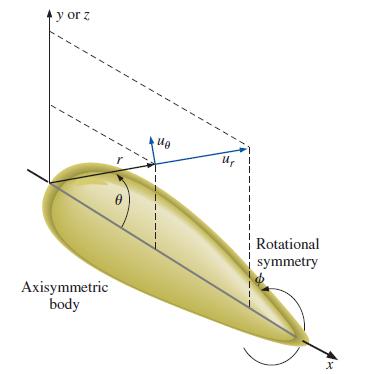
In this chapter, we describe axisymmetric irrotational flow in terms of cylindrical coordinates r and z and velocity components ur and uz. An alternative description of axisymmetric flow arises if we use spherical polar coordinates and set the x-axis as the axis of symmetry. The two relevant
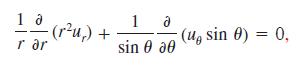
Show that the incompressible continuity equation for axisymmetric flow in spherical polar coordinatesis identically satisfied by a stream function defined asso long as ψ is a smooth function of r and θ. 1 ə rar (r²u,) + 10 sin Ꮎ ᎧᎾ (u, sin 0) = 0,
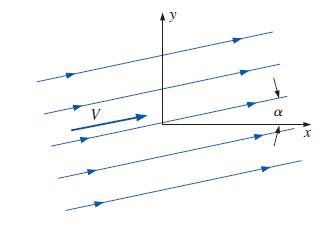
Consider a uniform stream of magnitude V inclined at angle α (Fig. P10–64). Assuming incompressible planar irrotational flow, find the velocity potential function and the stream function. Show all your work.FIGURE P10–64 V y α X
Consider the following steady, two-dimensional, incompressible velocity field:Is this flow field irrotational? If so, generate an expression for the velocity potential function. V = (u, v) = (ay² + b)i + (axy² + c)].
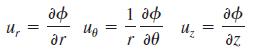
In an irrotational region of flow, we write the velocity vector as the gradient of the scalar velocity potential function,V(vector) in cylindrical coordinates, (r, u, z) and (ur, uθ, uz), areFrom Chap. 9, we also write the components of the vorticity vector in cylindrical coordinates asSubstitute
Consider an irrotational line vortex of strength Γ in the xy-or rθ-plane. The velocity components areGenerate expressions for the velocity potential function and the stream function for the line vortex, showing all your work. , Ꭳ ar 1 Ꭷ " ᎧᎾ = 0 and up 1 Ꭳ ↑ Ꮎ ᏧᏓ ar r 21
Substitute the components of the velocity vector given in Prob. 10–66 into the Laplace equation in cylindrical coordinates. Showing all your algebra, verify that the Laplace equation is valid in an irrotational region of flow.Data from Problem 66In an irrotational region of flow, we write the
Water at atmospheric pressure and temperature (ρ = 998.2 kg/m3, and μ = 1.003 × 10⁻³ kg/m·s) at free stream velocity V = 0.100481 m/s flows over a two-dimensional circular cylinder of diameter d = 1.00 m. Approximate the flow as potential flow. (a) Calculate the Reynolds number, based on
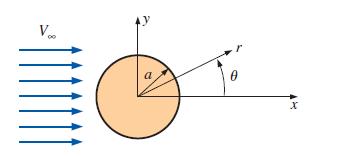
The stream function for steady, incompressible, two dimensional flow over a circular cylinder of radius a and freestream velocity V∞ is ψ = V∞ sinθ(r – a2/r) for the case in which the flow field is approximated as irrotational (Fig. P10–70). Generate an expression for the velocity
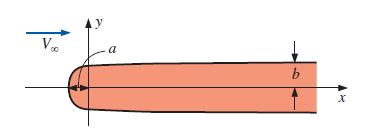
Superpose a uniform stream of velocity V∞ and a line source of strength V̇/L at the origin. This generates potential flow over a two-dimensional half-body called the Rankine half-body (Fig. P10–71). One unique streamline is the dividing streamline that forms a dividing line between free-stream
We usually think of boundary layers as occurring along solid walls. However, there are other flow situations in which the boundary layer approximation is also appropriate. Name three such flows, and explain why the boundary layer approximation is appropriate.
Showing 500 - 600
of 1457
1
2
3
4
5
6
7
8
9
10
11
12
13
14
15
Step by Step Answers

 Get 50% OFF
Claim Now
Get 50% OFF
Claim Now