New Semester
Started
Get
50% OFF
Study Help!
--h --m --s
Claim Now
Question Answers
Textbooks
Find textbooks, questions and answers
Oops, something went wrong!
Change your search query and then try again
S
Books
FREE
Study Help
Expert Questions
Accounting
General Management
Mathematics
Finance
Organizational Behaviour
Law
Physics
Operating System
Management Leadership
Sociology
Programming
Marketing
Database
Computer Network
Economics
Textbooks Solutions
Accounting
Managerial Accounting
Management Leadership
Cost Accounting
Statistics
Business Law
Corporate Finance
Finance
Economics
Auditing
Tutors
Online Tutors
Find a Tutor
Hire a Tutor
Become a Tutor
AI Tutor
AI Study Planner
NEW
Sell Books
Search
Search
Sign In
Register
study help
engineering
fluid mechanics
Fluid Mechanics Fundamentals And Applications 3rd Edition Yunus Cengel, John Cimbala - Solutions
Air enters a 15-cm-diameter adiabatic duct with inlet conditions of V1 = 150 m/s, T1 = 500 K, and P1 = 200 kPa. For an average friction factor of 0.014, determine the duct length from the inlet where the inlet velocity doubles. Also determine the pressure drop along that section of the duct.
Air flows through a 6-in-diameter, 50-ft-long adiabatic duct with inlet conditions of V1 = 500 ft/s, T01 = 650 R, and P1 = 50 psia. For an average friction factor of 0.02, determine the velocity, temperature, and pressure at the exit of the duct.
Consider subsonic airflow through a 20-cmdiameter adiabatic duct with inlet conditions of T1 = 330 K, P1 = 180 kPa, and Ma1 = 0.1. Taking the average friction factor to be 0.02, determine the duct length required to accelerate the flow to a Mach number of unity. Also, calculate the duct length at
Argon gas with k = 1.667, cp = 0.5203 kJ/kg·K, and R = 0.2081 kJ/kg·K enters an 8-cmdiameter adiabatic duct with V1 = 70 m/s, T1 = 520 K, and P1 = 350 kPa. Taking the average friction factor to be 0.005 and letting the exit temperature T2 vary from 540 K to 400 K, evaluate the entropy change at
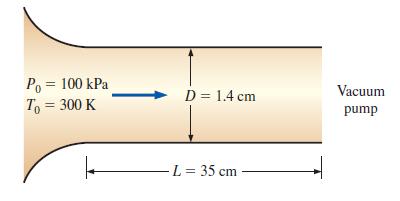
Air in a room at T0 = 300 K and P0 = 100 kPa is drawn steadily by a vacuum pump through a 1.4-cm-diameter, 35-cm-long adiabatic tube equipped with a converging nozzle at the inlet. The flow in the nozzle section can be approximated as isentropic, and the average friction factor for the duct can be
Repeat Prob. 12–114 for a friction factor of 0.025 and a tube length of 1 m.Data from Prob. 12–114Air in a room at T0 = 300 K and P0 = 100 kPa is drawn steadily by a vacuum pump through a 1.4-cm-diameter, 35-cm-long adiabatic tube equipped with a converging nozzle at the inlet. The flow in the
Air in a room at T0 = 290 K and P0 = 90 kPa is to be drawn by a vacuum pump through a 3-cm-diameter, 2-m-long adiabatic tube equipped with a converging nozzle at the inlet. The flow in the nozzle section can be approximated as isentropic. The static pressure is measured to be 87 kPa at the tube
Air enters a 5.5-cm-diameter adiabatic duct with inlet conditions of Ma1 = 2.2, T1 = 250 K, and P1 = 70 kPa, and exits at a Mach number of Ma2 = 1.8. Taking the average friction factor to be 0.03, determine the velocity, temperature, and pressure at the exit.
Consider supersonic airflow through a 12-cmdiameter adiabatic duct with inlet conditions of T1 = 500 K, P1 = 80 kPa, and Ma1 = 3. Taking the average friction factor to be 0.03, determine the duct length required to decelerate the flow to a Mach number of unity. Also, calculate the duct length at
Combustion gases with an average specific heat ratio of k = 1.33 and a gas constant of R = 0.280 kJ/kg·K enter a 10-cm-diameter adiabatic duct with inlet conditions of Ma1 = 2, T1 = 510 K, and P1 = 180 kPa. If a normal shock occurs at a location 2 m from the inlet, determine the velocity,
Air is flowing through a 6-cm-diameter adiabatic duct with inlet conditions of V1 = 120 m/s, T1 = 400 K, and P1 5 100 kPa and an exit Mach number of Ma2 = 1. To study the effect of duct length on the mass flow rate and the inlet velocity, the duct is now extended until its length is doubled while
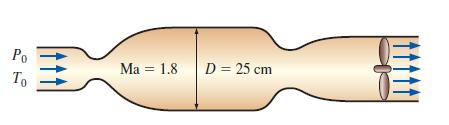
Design a 1-m-long cylindrical wind tunnel whose diameter is 25 cm operating at a Mach number of 1.8. Atmospheric air enters the wind tunnel through a converging–diverging nozzle where it is accelerated to supersonic velocities. Air leaves the tunnel through a converging–diverging diffuser where
A one-third scale model of an airplane is to be tested in water. The airplane has a velocity of 900 km/h in air at –50°C. The water temperature in the test section is 10°C.The properties of air at 1 atm and –50°C: ρ = 1.582 kg/m3, μ = 1.474 × 10⁻⁵ kg/m·s.The properties of water at 1
A one-fourth scale model of an airplane is to be tested in water. The airplane has a velocity of 700 km/h in air at −50°C. The water temperature in the test section is 10°C.In order to achieve similarity between the model and the prototype, the test is done at a water velocity of 393 km/h.The
A one-fourth scale model of a car is to be tested in a wind tunnel. The conditions of the actual car are V = 45 km/h and T = 0°C and the air temperature in the wind tunnel is 20°C. In order to achieve similarity between the model and the prototype, the wind tunnel is run at 204 km/h.The
Consider the flow of oil with ρ = 894 kg/m3 and μ = 2.33 kg/m·s in a 28-cm-diameter pipeline at an average velocity of 0.5 m/s. A 330-m-long section of the pipeline passes through the icy waters of a lake. Disregarding the entrance effects, determine the pumping power required to overcome the
What is the generally accepted value of the Reynolds number above which the flow in smooth pipes is turbulent?
Consider a boundary layer growing along a thin flat plate. This problem involves the following parameters: boundary layer thickness δ, downstream distance x, freestream velocity V, fluid density ρ, and fluid viscosity μ. The dependent parameter is δ. If we choose three repeating parameters as
Consider a boundary layer growing along a thin flat plate. This problem involves the following parameters: boundary layer thickness δ, downstream distance x, free-stream velocity V, fluid density ρ, and fluid viscosity μ. The number of primary dimensions represented in this problem is(a) 1 (b)
Consider unsteady fully developed Coutte flow-flow between two infinite parallel plates. This problem involves the following parameters: velocity component u, distance between the plates h, vertical distance y, top plate speed V, fluid density ρ, fluid viscosity μ, and time t. The number of
Consider a boundary layer growing along a thin flat plate. This problem involves the following parameters: boundary layer thickness δ, downstream distance x, freestream velocity V, fluid density ρ, and fluid viscosity μ. The number of expected nondimensional parameters Πs for this problem is(a)
What is the difference between the operating principles of thermal and laser Doppler anemometers?
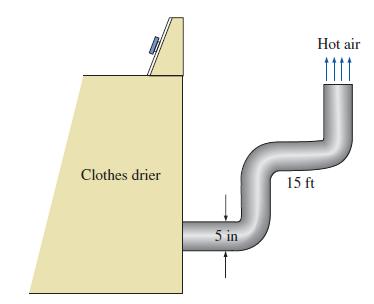
A clothes dryer discharges air at 1 atm and 120°F at a rate of 1.2 ft3/s when its 5-in-diameter, well-rounded vent with negligible loss is not connected to any duct. Determine the flow rate when the vent is connected to a 15-ft-long, 5-in-diameter duct made of galvanized iron, with three 90°
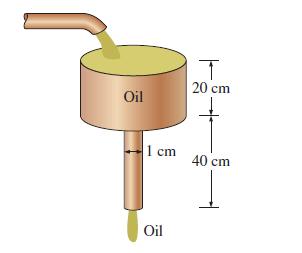
Oil at 20°C is flowing through a vertical glass funnel that consists of a 20-cm-high cylindrical reservoir and a 1-cm-diameter, 40-cm-high pipe. The funnel is always maintained full by the addition of oil from a tank. Assuming the entrance effects to be negligible, determine the flow rate of oil
Repeat Prob. 8–84 assuming (a) The diameter of the pipe is tripled (b) The length of the pipe is tripled while the diameter is maintained the same.Data from Problem 8–84Oil at 20°C is flowing through a vertical glass funnel that consists of a 20-cm-high cylindrical reservoir and a
What is the difference between laser Doppler velocimetry (LDV) and particle image velocimetry (PIV)?
What are the primary considerations when selecting a flowmeter to measure the flow rate of a fluid?
Explain how flow rate is measured with a Pitotstatic tube, and discuss its advantages and disadvantages with respect to cost, pressure drop, reliability, and accuracy.
Explain how flow rate is measured with obstruction- type flowmeters. Compare orifice meters, flow nozzles, and Venturi meters with respect to cost, size, head loss, and accuracy.
How do positive displacement flowmeters operate? Why are they commonly used to meter gasoline, water, and natural gas?
Explain how flow rate is measured with a turbine flowmeter, and discuss how they compare to other types of flowmeters with respect to cost, head loss, and accuracy.
The head loss for a certain circular pipe is given by where f is the friction factor (dimensionless), L is the pipe length, V̇ is the volumetric flow rate, and D is the pipe diameter. Determine if the 0.0826 is a dimensional or dimensionless constant. Is this equation dimensionally homogeneous as
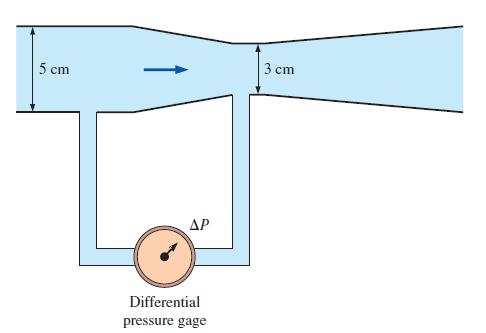
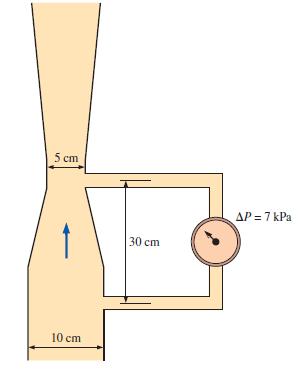
A Venturi meter equipped with a differential pressure gage is used to measure the flow rate of water at 15°C (ρ = 999.1 kg/m3) through a 5-cm-diameter horizontal pipe. The diameter of the Venturi neck is 3 cm, and the measured pressure drop is 5 kPa. Taking the discharge coefficient to be 0.98,
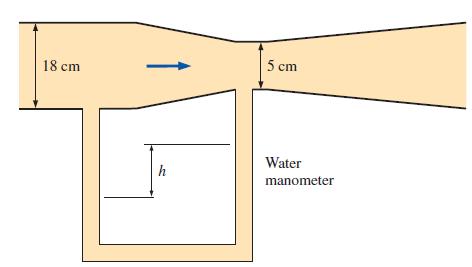
The mass flow rate of air at 20°C (ρ = 1.204 kg/m3) through a 18-cm-diameter duct is measured with a Venturi meter equipped with a water manometer. The Venturi neck has a diameter of 5 cm, and the manometer has a maximum differential height of 40 cm. Taking the discharge coefficient to be 0.98,
A flow nozzle equipped with a differential pressure gage is used to measure the flow rate of water at 10°C (ρ = 999.7 kg/m3 and μ = 1.307 × 10⁻³ kg/m·s) through a 3-cm-diameter horizontal pipe. The nozzle exit diameter is 1.5 cm, and the measured pressure drop is 3 kPa. Determine the volume
A 22-L kerosene tank (ρ = 820 kg/m3) is filled with a 2-cm-diameter hose equipped with a 1.5-cm-diameter nozzle meter. If it takes 20 s to fill the tank, determine the pressure difference indicated by the nozzle meter.
The flow rate of ammonia at 10°C (ρ = 624.6 kg/m3 and μ = 1.697 × 10⁻⁴ kg/m·s) through a 2-cm-diameter pipe is to be measured with a 1.5-cm-diameter flow nozzle equipped with a differential pressure gage. If the gage reads a pressure differential of 4 kPa, determine the flow rate of ammonia
Consider flow from a reservoir through a horizontal pipe of length L and diameter D that penetrates into the side wall at a vertical distance H from the free surface. The flow rate through an actual pipe with a reentrant section (KL = 0.8) is considerably less than the flow rate through the hole
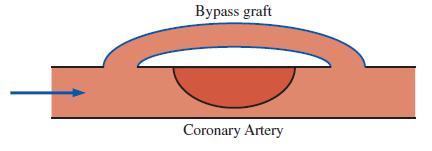
An elderly woman is rushed to the hospital because she is having a heart attack. The emergency room doctor informs her that she needs immediate coronary artery (a vessel that wraps around the heart) bypass surgery because one coronary artery has 75 percent blockage (caused by atherosclerotic
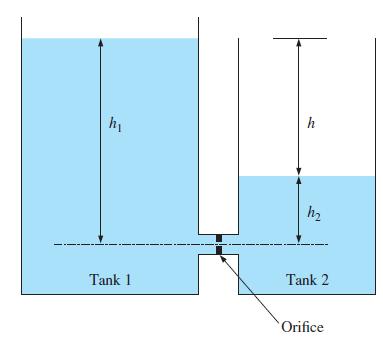
A system that consists of two interconnected cylindrical tanks with D1 = 30 cm and D2 = 12 cm is to be used to determine the discharge coefficient of a short D0 = 5 mm diameter orifice. At the beginning (t = 0 s), the fluid heights in the tanks are h1 = 50 cm and h2 = 15 cm, as shown in Fig.
Reconsider Prob. 8–150. In order to reduce the head losses in the piping and thus the power wasted, someone suggests doubling the diameter of the 83-m-long compressed air pipes. Calculating the reduction in wasted power, and determine if this is a worthwhile idea. Considering the cost of
The compressed air requirements of a textile factory are met by a large compressor that draws in 0.6 m3/s air at atmospheric conditions of 20°C and 1 bar (100 kPa) and consumes 300 kW electric power when operating. Air is compressed to a gage pressure of 8 bar (absolute pressure of 900 kPa), and
The average velocity for fully developed laminar pipe flow is(a) Vmax/2 (b) Vmax/3 (c) Vmax(d) 2Vmax/3 (e) 3Vmax/4
The Reynolds number is not a function of(a) Fluid velocity (b) Fluid density(c) Characteristic length (d) Surface roughness(e) Fluid viscosity
Air flows in a 5 cm by 8 cm cross section rectangular duct at a velocity of 4 m/s at 1 atm and 15°C. The Reynolds number for this flow is(a) 13,605 (b) 16,745 (c) 17,690 (d) 21,770(e) 23,235
Engine oil at 40°C (ρ = 876 kg/m3, μ = 0.2177 kg/m∙s) flows in a 20-cm-diameter pipe at a velocity of 1.2 m/s. The pressure drop of oil for a pipe length of 20 m is(a) 4180 Pa (b) 5044 Pa (c) 6236 Pa (d) 7419 Pa(e) 8615 Pa
Consider laminar flow of water in a 0.8-cm-diameter pipe at a rate of 1.15 L/min. The velocity of water halfway between the surface and the center of the pipe is(a) 0.381 m/s (b) 0.762 m/s (c) 1.15 m/s(d) 0.874 m/s (e) 0.572 m/s
Air at 1 atm and 208C flows in a 4-cm-diameter tube. The maximum velocity of air to keep the flow laminar is(a) 0.872 m/s (b) 1.52 m/s (c) 2.14 m/s(d) 3.11 m/s (e) 3.79 m/s
Consider laminar flow of water at 158C in a 0.7-cmdiameter pipe at a velocity of 0.4 m/s. The pressure drop of water for a pipe length of 50 m is(a) 6.8 kPa (b) 8.7 kPa (c) 11.5 kPa (d) 14.9 kPa(e) 17.3 kPa
A fluid flows in a 25-cm-diameter pipe at a velocity of 4.5 m/s. If the pressure drop along the pipe is estimated to be 6400 Pa, the required pumping power to overcome this pressure drop is(a) 452 W (b) 640 W (c) 923 W (d) 1235 W(e) 1508 W
Water flows in a 15-cm-diameter pipe at a velocity of 1.8 m/s. If the head loss along the pipe is estimated to be 16 m, the required pumping power to overcome this head loss is(a) 3.22 kW (b) 3.77 kW (c) 4.45 kW (d) 4.99 kW(e) 5.54 kW
Air at 1 atm and 40°C flows in a 8-cm-diameter pipe at a rate of 2500 L/min. The friction factor is determined from the Moody chart to be 0.027. The required power input to overcome the pressure drop for a pipe length of 150 m is(a) 310 W (b) 188 W (c) 132 W (d) 81.7 W(e) 35.9 W
Air at 1 atm and 258C (v = 1.562 × 10⁻⁵ m2/s) flows in a 9-cm-diameter cast iron pipe at a velocity of 5 m/s. The roughness of the pipe is 0.26 mm. The head loss for a pipe length of 24 m is(a) 8.1 m (b) 10.2 m (c) 12.9 m (d) 15.5 m (e) 23.7 m
Consider air flow in a 10-cm-diameter pipe at a high velocity so that the Reynolds number is very large. The roughness of the pipe is 0.002 mm. The friction factor for this flow is(a) 0.0311 (b) 0.0290 (c) 0.0247 (d) 0.0206 (e) 0.0163
The pressure drop for a given flow is determined to be 100 Pa. For the same flow rate, if we reduce the diameter of the pipe by half, the pressure drop will be(a) 25 Pa (b) 50 Pa (c) 200 Pa (d) 400 Pa (e) 1600 Pa
Water at 10°C (ρ = 999.7 kg/m3, μ = 1.307 × 10⁻³ kg/m∙s) is to be transported in a 5-cm-diamater, 30-m-long circular pipe. The roughness of the pipe is 0.22 mm. If the pressure drop in the pipe is not to exceed 19 kPa, the maximum flow rate of water is(a) 324 L/min (b) 281 L/min (c) 243
The valve in a piping system causes a 3.1 m head loss. If the velocity of the flow is 6 m/s, the loss coefficient of this valve is(a) 0.87 (b) 1.69 (c) 1.25 (d) 0.54 (e) 2.03
A water flow system involves a 180° return bend (threaded) and a 90° miter bend (without vanes). The velocity of water is 1.2 m/s. The minor losses due to these bends are equivalent to a pressure loss of(a) 648 Pa (b) 933 Pa (c) 1255 Pa (d) 1872 Pa(e) 2600 Pa
Consider a sharp-edged pipe exit for fully developed laminar flow of a fluid. The velocity of the flow is 4 m/s. This minor loss is equivalent to a head loss of(a) 0.72 m (b) 1.16 m (c) 1.63 m (d) 2.0 m (e) 4.0 m
A constant-diameter piping system involves multiple flow restrictions with a total loss coefficient of 4.4. The friction factor of piping is 0.025 and the diameter of the pipe is 7 cm. These minor losses are equivalent to the losses in a pipe of length(a) 12.3 m (b) 9.1 m (c) 7.0 m (d) 4.4
Air flows in an 8-cm-diameter, 33-m-long pipe at a velocity of 5.5 m/s. The piping system involves multiple flow restrictions with a total minor loss coefficient of 2.6. The friction factor of pipe is obtained from the Moody chart to be 0.025. The total head loss of this piping system is(a) 13.5
Consider a pipe that branches out into two parallel pipes and then rejoins at a junction downstream. The two parallel pipes have the same lengths and friction factors. The diameters of the pipes are 2 cm and 4 cm. If the flow rate in one pipe is 10 L/min, the flow rate in the other pipe is(a) 10
Consider a pipe that branches out into two parallel pipes and then rejoins at a junction downstream. The two parallel pipes have the same lengths and friction factors. The diameters of the pipes are 2 cm and 4 cm. If the head loss in one pipe is 0.5 m, the head loss in the other pipe is(a) 0.5
A pump moves water from a reservoir to another reservoir through a piping system at a rate of 0.15 m3/min. Both reservoirs are open to the atmosphere. The elevation difference between the two reservoirs is 35 m and the total head loss is estimated to be 4 m. If the efficiency of the motor pump unit
Consider a pipe that branches out into three parallel pipes and then rejoins at a junction downstream. All three pipes have the same diameters (D = 3 cm) and friction factors (f = 0.018). The lengths of pipe 1 and pipe 2 are 5 m and 8 m, respectively while the velocities of the fluid in pipe 2 and
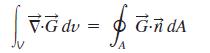
The divergence theorem iswhere G(vector) is a vector, V is a volume, and A is the surface area that encloses and defines the volume. Express the divergence theorem in words. JV F-G dv du = & G-ñ da dA A
Explain the fundamental differences between a flow domain and a control volume.
What does it mean when we say that two or more differential equations are coupled?
For a three-dimensional, unsteady, incompressible flow field in which temperature variations are insignificant, how many unknowns are there? List the equations required to solve for these unknowns.
For an unsteady, compressible flow field that is two-dimensional in the x-y plane and in which temperature and density variations are significant, how many unknowns are there? List the equations required to solve for these unknowns.
For an unsteady, incompressible flow field that is two-dimensional in the x-y plane and in which temperature variations are insignificant, how many unknowns are there? List the equations required to solve for these unknowns.
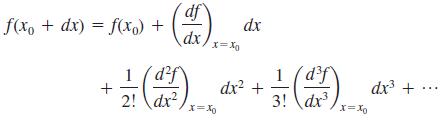
A Taylor series expansion of function f(x) about some x-location x0 is given asConsider the function f(x) = exp(x) = ex. Suppose we know the value of f(x) at x = x0, i.e., we know the value of f(x0), and we want to estimate the value of this function at some x location near x0. Generate the first
Transform the position x(vector) = (2, 4, –1) from Cartesian (x, y, z) coordinates to cylindrical (r, θ, z) coordinates, including units. The values of x(vector) are in units of meters.
Transform the position x(vector) = (5 m, π/3 radians, 1.27 m) from cylindrical (r, θ, z) coordinates to Cartesian (x, y, z) coordinates, including units. Write all three components of x(vector) in units of meters.
Let vector G(vector) be given byCalculate the divergence of G(vector), and simplify as much as possible. Is there anything special about your result? G = 2xzi - x²j-zk.
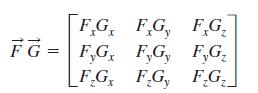
The outer product of two vectors is a second-order tensor with nine components. In Cartesian coordinates, it isThe product rule applied to the divergence of the product of two vectors F(vector) and G(vector) is written asExpand both sides of this equation in Cartesian coordinates and verify that it
Use the product rule of Prob. 9–11 to show thatData from Problem 11The outer product of two vectors is a second-order tensor with nine components. In Cartesian coordinates, it isThe product rule applied to the divergence of the product of two vectors F(vector) and G(vector) is written asExpand
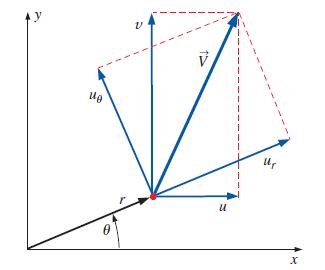
On many occasions we need to transform a velocity from Cartesian (x, y, z) coordinates to cylindrical (r, θ, z) coordinates (or vice versa). Using Fig. P9–13 as a guide, transform cylindrical velocity components (ur, uθ, uz) into Carte sian velocity components (u, v, w).FIGURE P9–13
Using Fig. P9–13 as a guide, transform Cartesian velocity components (u, v, w) into cylindrical velocity components (ur, uθ, uz).FIGURE P9–13 y up V u 1 1 U₁
Beth is studying a rotating flow in a wind tunnel. She measures the u and v components of velocity using a hot-wire anemometer. At x = 0.40 m and y = 0.20 m, u = 10.3 m/s and v = –5.6 m/s. Unfortunately, the data analysis program requires input in cylindrical coordinates (r, θ) and (ur, uθ).
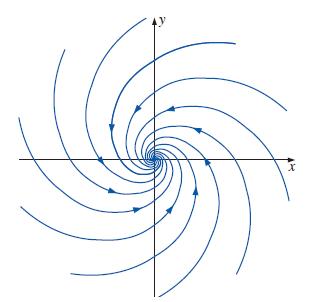
Consider a spiraling line vortex/sink flow in the xy-or rθ-plane as sketched in Fig. P9–17. The two-dimensional cylindrical velocity components (ur, uθ) for this flow field are ur = C/2πr and uθ = Γ/2pr, where C and G are constants (m is negative and Γ is positive). Transform these
A steady, two-dimensional, incompressible velocity field has Cartesian velocity components u = Cy/(x2 + y2) and v = –Cx/(x2 + y2), where C is a constant. Transform these Cartesian velocity components into cylindrical velocity components ur and uθ, simplifying as much as possible. You should
Alex is measuring the time-averaged velocity components in a pump using a laser Doppler velocimeter (LDV). Since the laser beams are aligned with the radial and tangential directions of the pump, he measures the ur and uθ components of velocity. At r = 5.20 in and θ = 30.0°, ur = 2.06 ft/s and
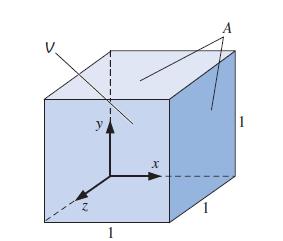
Let vector G(vector) be given byand let V be the volume of a cube of unit length with its corner at the origin, bounded by x = 0 to 1, y = 0 to 1, and z = 0 to 1 (Fig. P9–19). Area A is the surface area of the cube. Perform both integrals of the divergence theorem and verify that they are equal.
The product rule can be applied to the divergence of scalar f times vectorExpand both sides of this equation in Cartesian coordinates and verify that it is correct. Gas: V.(fG) = GVƒ+ ƒV. G.
In this chapter we derive the continuity equation in two ways: by using the divergence theorem and by summing mass flow rates through each face of an infinitesimal control volume. Explain why the former is so much less involved than the latter.
If a flow field is compressible, what can we say about the material derivative of density? What about if the flow field is incompressible?
A Pitot-static probe is mounted in a 2.5-cm-inner diameter pipe at a location where the local velocity is approximately equal to the average velocity. The oil in the pipe has density ρ = 860 kg/m3 and viscosity μ = 0.0103 kg/m·s. The pressure difference is measured to be 95.8 Pa. Calculate the
Calculate the Reynolds number of the flow of Prob. 8–114. Is it laminar or turbulent?Data from Problem 8–114A Pitot-static probe is mounted in a 2.5-cm-inner diameter pipe at a location where the local velocity is approximately equal to the average velocity. The oil in the pipe has density ρ =
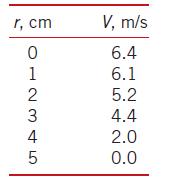
The flow rate of water through a 10-cm-diameter pipe is to be determined by measuring the water velocity at several locations along a cross section. For the set of measurements given in the table, determine the flow rate. r, cm 0 12345 V, m/s 6.4 6.1 5.2 4.4 2.0 0.0
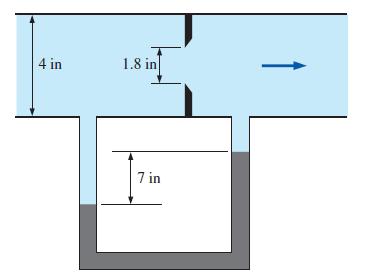
An orifice with a 1.8-in-diameter opening is used to measure the mass flow rate of water at 60°F (ρ = 62.36 lbm/ft3 and μ = 7.536 × 10⁻⁴ lbm/ft·s) through a horizontal 4-in-diameter pipe. A mercury manometer is used to measure the pressure difference across the orifice. If the differential
Repeat Prob. 8–118E for a differential height of 10 in.Data from Problem 8–118EAn orifice with a 1.8-in-diameter opening is used to measure the mass flow rate of water at 60°F (ρ = 62.36 lbm/ft3 and μ = 7.536 × 10⁻⁴ lbm/ft·s) through a horizontal 4-in-diameter pipe. A mercury manometer
Air (ρ = 1.225 kg/m3 and μ = 1.789 × 10⁻⁵ kg/m·s) flows in a wind tunnel, and the wind tunnel speed is measured with a Pitot-static probe. For a certain run, the stagnation pressure is measured to be 472.6 Pa gage and the static pressure is 15.43 Pa gage. Calculate the wind-tunnel speed.
Reconsider Prob. 8–121. Letting the pressure drop vary from 1 kPa to 10 kPa, evaluate the flow rate at intervals of 1 kPa, and plot it against the pressure drop.Data from Problem 8–121A Venturi meter equipped with a differential pressure gage is used to measure the flow rate of water at 15°C
Repeat Prob. 8–123 for a Venturi neck diameter of 6 cm.Data from Problem 8–123The mass flow rate of air at 20°C (ρ = 1.204 kg/m3) through a 18-cm-diameter duct is measured with a Venturi meter equipped with a water manometer. The Venturi neck has a diameter of 5 cm, and the manometer has a
A vertical Venturi meter equipped with a differential pressure gage shown in Fig. P8–125 is used to measure the flow rate of liquid propane at 10°C (ρ = 514.7 kg/m3) through an 10-cm-diameter vertical pipe. For a discharge coefficient of 0.98, determine the volume flow rate of propane through
The volume flow rate of liquid refrigerant-134a at 10°F (ρ = 83.31 lbm/ft3) is to be measured with a horizontal Venturi meter with a diameter of 5 in at the inlet and 2 in at the throat. If a differential pressure meter indicates a pressure drop of 6.4 psi, determine the flow rate of the
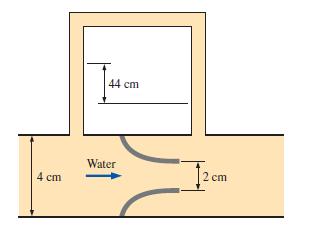
The flow rate of water at 20°C (ρ = 998 kg/m3 and μ = 1.002 × 10⁻³ kg/m · s) through a 4-cm-diameter pipe is measured with a 2-cm-diameter nozzle meter equipped with an inverted air–water manometer. If the manometer indicates a differential water height of 44 cm, determine the volume flow
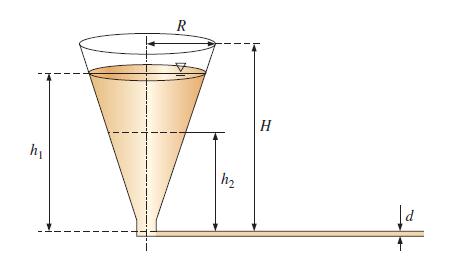
The conical container with a thin horizontal tube attached at the bottom, shown in Fig. P8–131, is to be used to measure the viscosity of an oil. The flow through the tube is laminar. The discharge time needed for the oil level to drop from h1 to h2 is to be measured by a stopwatch. Develop an
Oil at 20°C is flowing steadily through a 5-cmdiameter 40-m-long pipe. The pressures at the pipe inlet and outlet are measured to be 745 and 97.0 kPa, respectively, and the flow is expected to be laminar. Determine the flow rate of oil through the pipe, assuming fully developed flow and that the
Showing 700 - 800
of 1457
1
2
3
4
5
6
7
8
9
10
11
12
13
14
15
Step by Step Answers

 Get 50% OFF
Claim Now
Get 50% OFF
Claim Now