New Semester
Started
Get
50% OFF
Study Help!
--h --m --s
Claim Now
Question Answers
Textbooks
Find textbooks, questions and answers
Oops, something went wrong!
Change your search query and then try again
S
Books
FREE
Study Help
Expert Questions
Accounting
General Management
Mathematics
Finance
Organizational Behaviour
Law
Physics
Operating System
Management Leadership
Sociology
Programming
Marketing
Database
Computer Network
Economics
Textbooks Solutions
Accounting
Managerial Accounting
Management Leadership
Cost Accounting
Statistics
Business Law
Corporate Finance
Finance
Economics
Auditing
Tutors
Online Tutors
Find a Tutor
Hire a Tutor
Become a Tutor
AI Tutor
AI Study Planner
NEW
Sell Books
Search
Search
Sign In
Register
study help
engineering
fluid mechanics
Fluid Mechanics Fundamentals And Applications 4th Edition Yunus Cengel, John Cimbala - Solutions
Explain why the incompressible flow approximation and the constant temperature approximation usually go hand in hand.
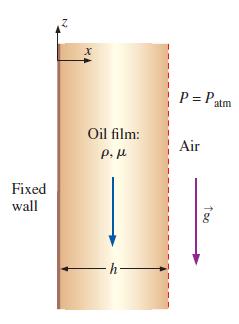
For the falling oil film of Prob. 9–113, calculate the volume flow rate per unit width of oil falling down the wall (V̇/L) as a function of wall speed V and the other parameters in the problem. Calculate the wall speed required such that there is no net volume flow of oil either up or down. Give
Repeat Example 9–17, except for the case in which the wall is moving upward at speed V. As a check, make sure that your result agrees with that of Example 9–17 when V = 0. Nondimensionalize your velocity profile equation using the same normalization as in Example 9–17, and show that a Froude
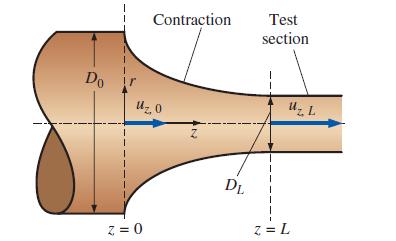
A group of students is designing a small, round (axisymmetric), low-speed wind tunnel for their senior design project (Fig. P9–115E). Their design calls for the axial component of velocity to increase linearly in the contraction section from uz, 0 to uz, L. The air speed through the test section
Consider the following steady, three-dimensional velocity field in Cartesian coordinates:where a, b, c, d, and e are constants. Under what conditions is this flow field incompressible? What are the primary dimensions of constants a, b, c, d, and e? V = (u, v, w) = (axz² - by)i + cxyz + (dz³ +
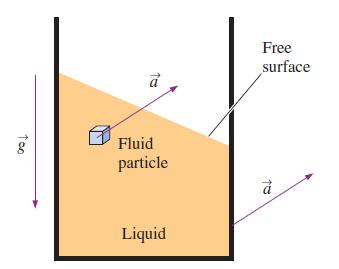
Simplify the Navier–Stokes equation as much as possible for the case of an incompressible liquid being accelerated as a rigid body in an arbitrary direction (Fig. P9–117). Gravity acts in the –z-direction. Begin with the incompressible vector form of the Navier–Stokes equation, explain how
Simplify the Navier–Stokes equation as much as possible for the case of incompressible hydrostatics, with gravity acting in the negative z-direction. Begin with the incompressible vector form of the Navier–Stokes equation, explain how and why some terms can be simplified, and give your final
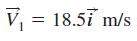
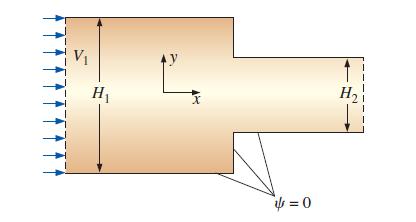
Bob uses a computational fluid dynamics code to model steady flow of an incompressible fluid through a two dimensional sudden contraction as sketched in Fig. P9–119. Channel height changes from H1 = 12.0 cm to H2 = 4.6 cm. Uniform velocityis to be specified on the left boundary of the
For each of the listed equations, write down the equation in vector form and decide if it is linear or nonlinear. If it is nonlinear, which term(s) make it so? (a) Incompressible continuity equation, (b) Compressible continuity equation, (c) Incompressible Navier–Stokes equation.
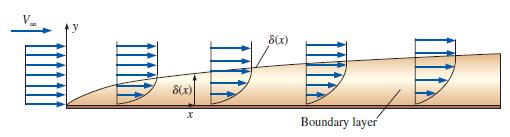
A boundary layer is a thin region near a wall in which viscous (frictional) forces are very important due to the no-slip boundary condition. The steady, incompressible, two-dimensional, boundary layer developing along a flat plate aligned with the free-stream flow is sketched in Fig. P9–121. The
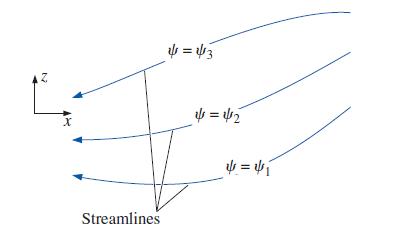
Consider steady, two-dimensional, incompressible flow in the xz-plane rather than in the xy-plane. Curves of constant stream function are shown in Fig. P9–122. The nonzero velocity components are (u, w). Define a stream function such that flow is from right to left in the xz-plane when ψ
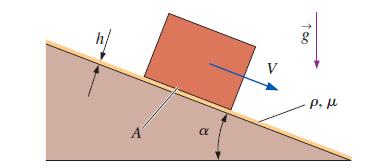
A block slides down a long, straight, inclined wall at speed V, riding on a thin film of oil of thickness h (Fig. P9–123). The weight of the block is W, and its surface area in contact with the oil film is A. Suppose V is measured, and W, A, angle α, and viscosity μ are also known. Oil film
Look up the definition of Poisson’s equation in one of your math textbooks or on the Internet. Write Poisson’s equation in standard form. How is Poisson’s equation similar to Laplace’s equation? How do these two equations differ?
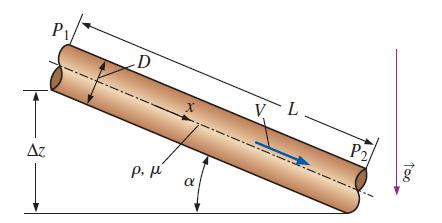
Water flows down a long, straight, inclined pipe of diameter D and length L (Fig. P9–125). There is no forced pressure gradient between points 1 and 2; in other words, the water flows through the pipe by gravity alone, and P1 = P2 = Patm. The flow is steady, fully developed, and laminar. We adopt
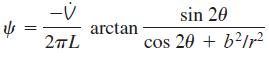
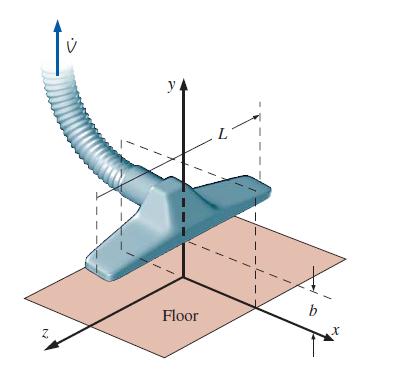
We approximate the flow of air into a vacuum cleaner’s floor attachment by the stream functionin the center plane (the xy-plane) in cylindrical coordinates, where L is the length of the attachment, b is the height of the attachment above the floor, and V̇ is the volume flow rate of air being
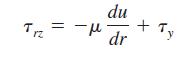
Taking all the Poiseuille flow approximations except that the fluid is Newtonian, determine the velocity profile and flow rate assuming blood is a Bingham plastic fluid based on the shear stress relationship below. Plot the velocity profile of a Newtonian fluid, a pseudoplastic fluid, and a Bingham
The Navier-Stokes equation is also known as(a) Newton’s first law (b) Newton’s second law(c) Newton’s third law (d) Continuity equation(e) Energy equation
The continuity equation is also known as(a) Conservation of mass (b) Conservation of energy(c) Conservation of momentum (d) Newton’s second law(e) Cauchy’s equation
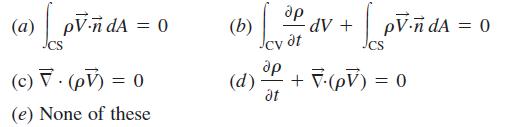
Which choice is the general differential equation form of the continuity equation for a control volume? (a) _pV-ñ dA= (c) (pv) = 0 (e) None of these 0 ap (b) dv + pv-n dA = 0 • Lovet (d) + F.(pv) = 0 ap at
A steady velocity field is given bywhere a, b, and c are constants. Under what conditions is this flow field incompressible?(a) a = b (b) a = –b (c) 2a = –3b(d) 3a = 2b (e) a = 2b V = (u, v, w) = 2axyi+ 3bxy + cyk,
Which choice is the differential, incompressible, two-dimensional continuity equation in Cartesian coordinates? (a) pV.ñ dA = 0 (c) F-(pv) = 0 Əv dy (e) ne xe + = 0 (b) (ru) 1 r ər 0 = A·A(P) + (ºn)e I r 30 = 0
Consider the common situation in which a researcher is trying to match the Reynolds number of a large prototype vehicle with that of a small-scale model in a wind tunnel. Is it better for the air in the wind tunnel to be cold or hot? Why? Support your argument by comparing wind tunnel air at 10°C
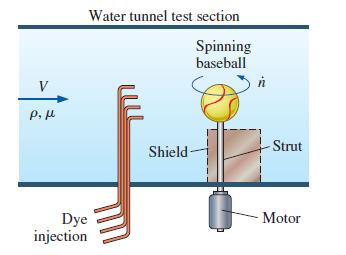
Some students want to visualize flow over a spinning baseball. Their fluids laboratory has a nice water tunnel into which they can inject multicolored dye streaklines, so they decide to test a spinning baseball in the water tunnel (Fig. P7–45E). Similarity requires that they match both the Rey n
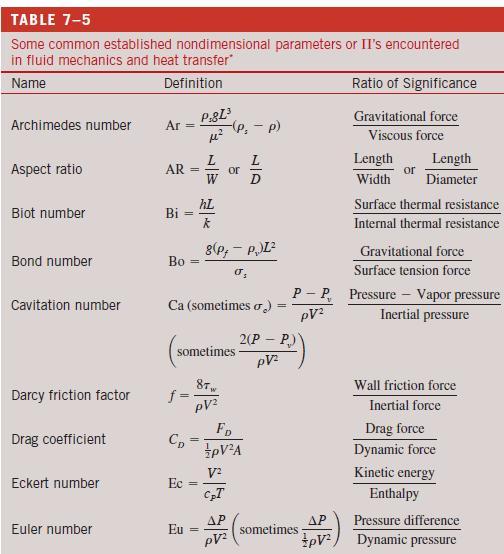
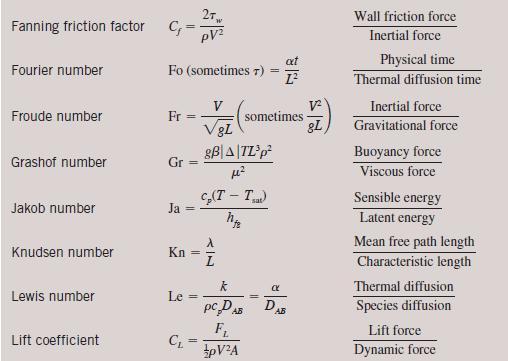
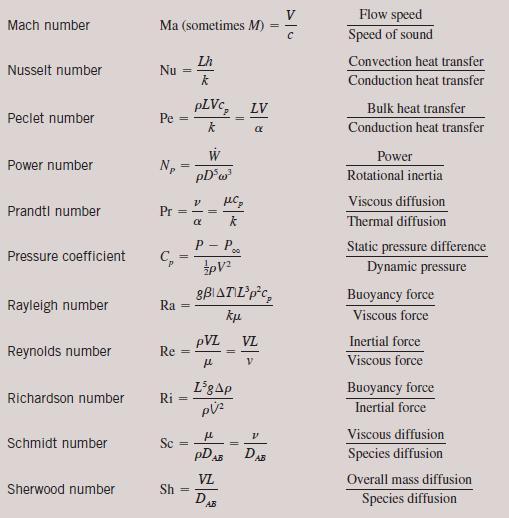
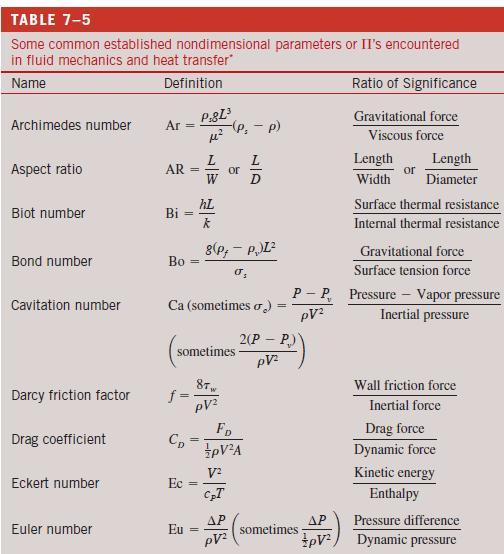
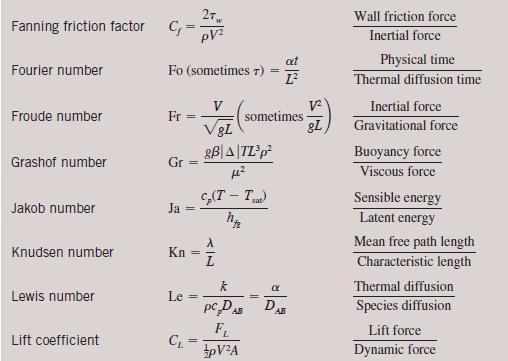
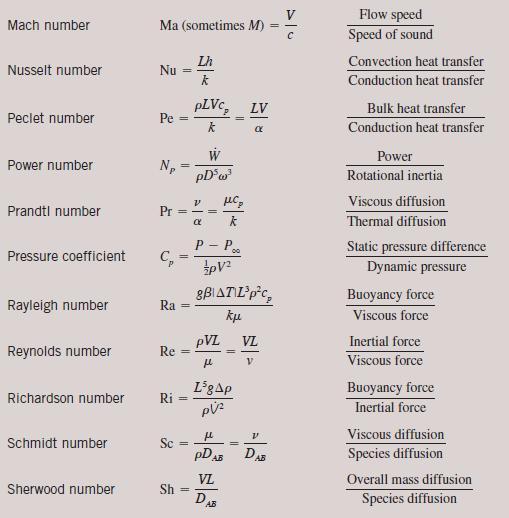
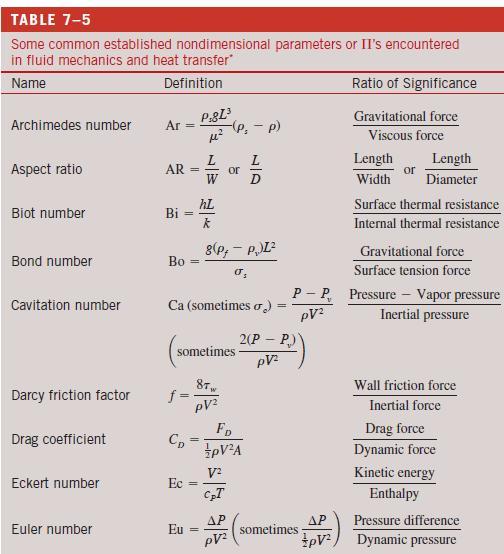
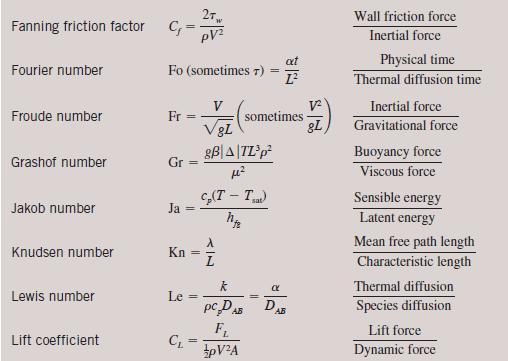
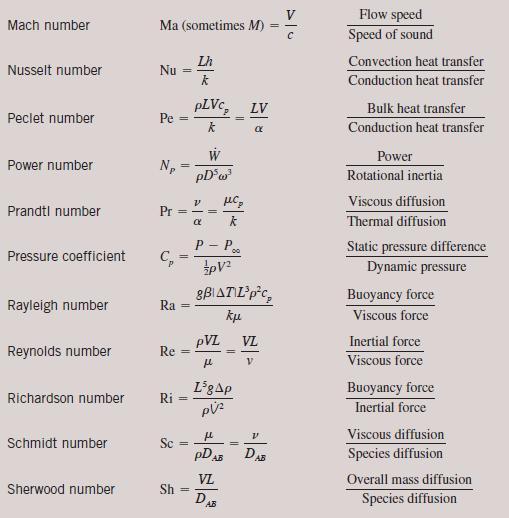
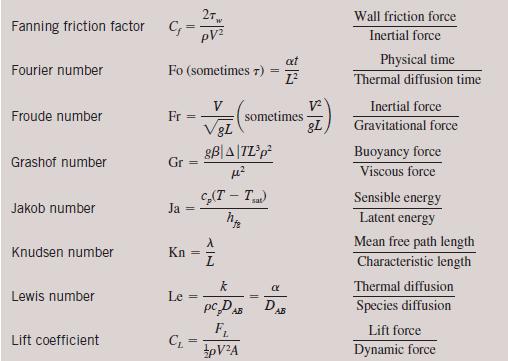
Using primary dimensions, verify that the Archimedes number (Table 7–5) is indeed dimensionless.Data from Table 7-5 TABLE 7-5 Some common established nondimensional parameters or II's encountered in fluid mechanics and heat transfer* Name Definition Archimedes number Aspect ratio Biot number Bond
Using primary dimensions, verify that the Grashof number (Table 7–5) is indeed dimensionless.Data from Table 7-5 TABLE 7-5 Some common established nondimensional parameters or II's encountered in fluid mechanics and heat transfer* Name Definition Archimedes number Aspect ratio Biot number Bond
Using primary dimensions, verify that the Rayleigh number (Table 7–5) is indeed dimensionless. What other established non-dimensional parameter is formed by the ratio of Ra and Gr?Data from Table 7-5 TABLE 7-5 Some common established nondimensional parameters or II's encountered in fluid
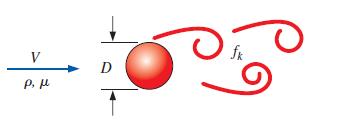
A periodic Kármán vortex street is formed when a uniform stream flows over a circular cylinder (Fig. P7–49). Use the method of repeating variables to generate a dimensionless relationship for Kármán vortex shedding frequency fk as a function of free-stream speed V, fluid density ρ, fluid
Repeat Prob. 7–49, but with an additional independent parameter included, namely, the speed of sound c in the fluid. Use the method of repeating variables to generate a dimensionless relationship for Kármán vortex shedding frequency fk as a function of free-stream speed V, fluid density ρ,
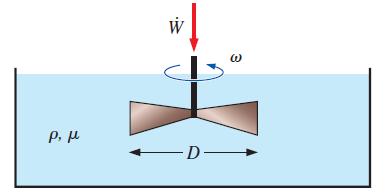
A stirrer is used to mix chemicals in a large tank (Fig. P7–51). The shaft power Ẇ supplied to the stirrer blades is a function of stirrer diameter D, liquid density r, liquid viscosity μ, and the angular velocity ω of the spinning blades. Use the method of repeating variables to generate a
Repeat Prob. 7–51 except do not assume that the tank is large. Instead, let tank diameter Dtank and average liquid depth htank be additional relevant parameters.Data from Exercises 51A stirrer is used to mix chemicals in a large tank (Fig. P7–51). The shaft power Ẇ supplied to the stirrer
Albert Einstein is pondering how to write his (soon-to-be-famous) equation. He knows that energy E is a function of mass m and the speed of light c, but he doesn't know the functional relationship (E = m2c? E = mc4?). Pretend that Albert knows nothing about dimensional analysis, but since you are
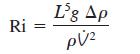
The Richardson number is defined asMiguel is working on a problem that has a characteristic length scale L, a characteristic velocity V, a characteristic density difference Δρ, a characteristic (average) density ρ, and of course the gravitational constant g, which is always available. He wants
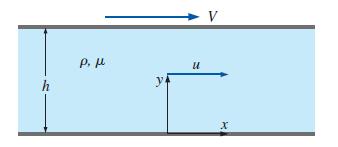
Consider fully developed Couette flow—flow between two infinite parallel plates separated by distance h, with the top plate moving and the bottom plate stationary as illustrated in Fig. P7–55. The flow is steady, incompressible, and two-dimensional in the xy-plane. Use the method of repeating
Consider developing Couette flow—the same flow as Prob. 7–55 except that the flow is not yet steady-state, but is developing with time. In other words, time t is an additional parameter in the problem. Generate a dimensionless relationship between all the variables.Data from Problem
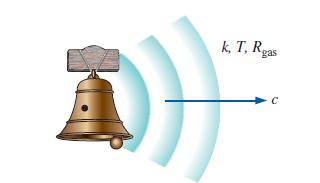
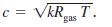
The speed of sound c in an ideal gas is known to be a function of the ratio of specific heats k, absolute temperature T, and specific ideal gas constant Rgas (Fig. P7–57). Showing all your work, use dimensional analysis to find the functional relationship between these parameters.Fig. P7–57 k,
Repeat Prob. 7–57, except let the speed of sound c in an ideal gas be a function of absolute temperature T, universal ideal gas constant Ru, molar mass (molecular weight) M of the gas, and ratio of specific heats k. Showing all your work, use dimensional analysis to find the functional
Repeat Prob. 7–57, except let the speed of sound c in an ideal gas be a function only of absolute temperature T and specific ideal gas constant Rgas. Showing all your work, use dimensional analysis to find the functional relationship between these parameters.Data from Problem 7-57The speed of
Repeat Prob. 7–57, except let speed of sound c in an ideal gas be a function only of pressure P and gas density ρ. Showing all your work, use dimensional analysis to find the functional relationship between these parameters. Verify that your results are consistent with the equation for speed of
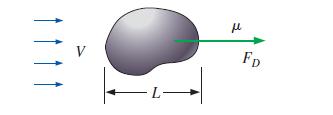
When small aerosol particles or microorganisms move through air or water, the Reynolds number is very small (Re ≪ 1). Such flows are called creeping flows. The aerodynamic drag on an object in creeping flow is a function only of its speed V, some characteristic length scale L of the object, and
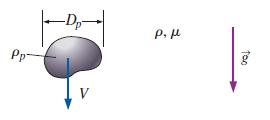
A tiny aerosol particle of density ρp and characteristic diameter Dp falls in air of density ρ and viscosity μ (Fig. P7–62). If the particle is small enough, the creeping flow approximation is valid, and the terminal settling speed of the particle V depends only on Dp, μ, gravitational
Combine the results of Probs. 7–61 and 7–62 to generate an equation for the settling speed V of an aerosol particle falling in air (Fig. P7–62). Verify that your result is consistent with the functional relationship obtained in Prob. 7–62. For consistency, use the notation of Prob.
You will need the results of Prob. 7–63 to do this problem. A tiny aerosol particle falls at steady settling speed V. The Reynolds number is small enough that the creeping flow approximation is valid. If the particle size is doubled, all else being equal, by what factor will the settling speed go
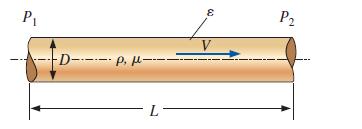
An incompressible fluid of density ρ and viscosity μ flows at average speed V through a long, horizontal section of round pipe of length L, inner diameter D, and inner wall roughness height ε (Fig. P7–65). The pipe is long enough that the flow is fully developed, meaning that the velocity
Consider laminar flow through a long section of pipe, as in Fig. P7–65. For laminar flow it turns out that wall roughness is not a relevant parameter unless ε is very large. The volume flow rate V̇ through the pipe is a function of pipe diameter D, fluid viscosity m, and axial pressure gradient
One of the first things you learn in physics class is the law of universal gravitation,where F is the attractive force between two bodies, m1 and m2 are the masses of the two bodies, r is the distance between the two bodies, and G is the universal gravitational constant equal to (6.67428 ±
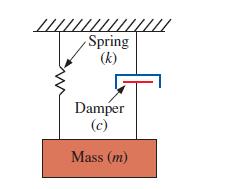
Jen is working on a spring–mass–damper system, as shown in Fig. P7–68. She remembers from her dynamic systems class that the damping ratio ζ is a nondimensional property of such systems and that ζ is a function of spring constant k, mass m, and damping coefficient c. Unfortunately, she does
Bill is working on an electrical circuit problem. He remembers from his electrical engineering class that voltage drop ΔE is a function of electrical current I and electrical resistance R. Unfortunately, he does not recall the exact form of the equation for ΔE. However, he is taking a fluid
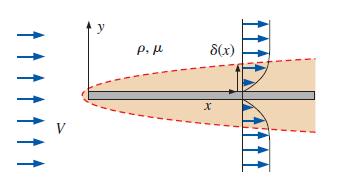
A boundary layer is a thin region (usually along a wall) in which viscous forces are significant and within which the flow is rotational. Consider a boundary layer growing along a thin flat plate (Fig. P7–70). The flow is steady. The boundary layer thickness δ at any downstream distance x is a
A liquid of density ρ and viscosity μ is pumped at volume flow rate V̇ through a pump of diameter D. The blades of the pump rotate at angular velocity v. The pump supplies a pressure rise DP to the liquid. Using dimensional analysis, generate a dimensionless relationship for ΔP as a function of
A propeller of diameter D rotates at angular velocity ω in a liquid of density ρ and viscosity μ. The required torque T is determined to be a function of D, ω, ρ, and μ. Using dimensional analysis, generate a dimensionless relationship. Identify any established nondimensional parameters that
Repeat Prob. 7–72 for the case in which the propeller operates in a compressible gas instead of a liquid.Data from Problem 72A propeller of diameter D rotates at angular velocity ω in a liquid of density ρ and viscosity μ. The required torque T is determined to be a function of D, ω, ρ, and
In the study of turbulent flow, turbulent viscous dissipation rate ε (rate of energy loss per unit mass) is known to be a function of length scale l and velocity scale u´ of the large-scale turbulent eddies. Using dimensional analysis (Buckingham pi and the method of repeating variables) and
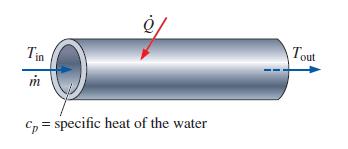
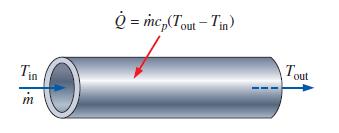
The rate of heat transfer to water flowing in a pipe was analyzed in Prob. 7–27. Let us approach that same problem, but now with dimensional analysis. Cold water enters a pipe, where it is heated by an external heat source (Fig. P7–75). The inlet and outlet water temperatures are Tin and Tout,
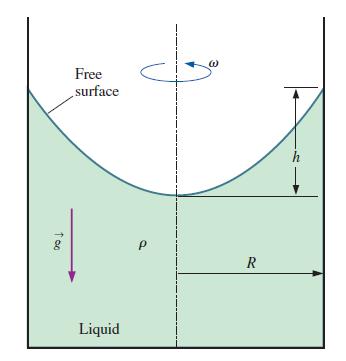
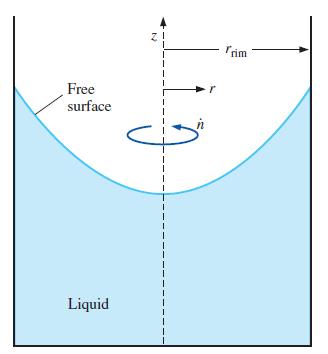
Consider a liquid in a cylindrical container in which both the container and the liquid are rotating as a rigid body (solid-body rotation). The elevation difference h between the center of the liquid surface and the rim of the liquid surface is a function of angular velocity ω, fluid density ρ,
Consider the case in which the container and liquid of Prob. 7–76 are initially at rest. At t = 0 the container begins to rotate. It takes some time for the liquid to rotate as a rigid body, and we expect that the liquid’s viscosity is an additional relevant parameter in the unsteady problem.
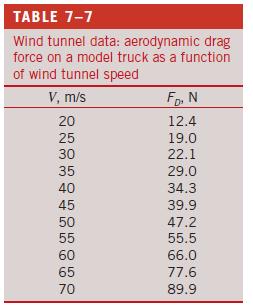
Consider again the model truck example, except that the maximum speed of the wind tunnel is only 50 m/s. Aerodynamic force data are taken for wind tunnel speeds between V = 20 and 50 m/s—assume the same data for these speeds as those listed in Table 7–7. Based on these data alone, can the
Although we usually think of a model as being smaller than the prototype, describe at least three situations in which it is better for the model to be larger than the prototype.
Discuss the purpose of a moving ground belt in wind tunnel tests of flow over model automobiles. Think of an alternative if a moving ground belt is unavailable.
Define wind tunnel blockage. What is the rule of thumb about the maximum acceptable blockage for a wind tunnel test? Explain why there would be measurement errors if the blockage were significantly higher than this value.
What is the rule of thumb about the Mach number limit in order that the incompressible flow approximation is reasonable? Explain why wind tunnel results would be incorrect if this rule of thumb were violated.
A one-sixteenth scale model of a new sports car is tested in a wind tunnel. The prototype car is 4.37 m long, 1.30 m tall, and 1.69 m wide. During the tests, the moving ground belt speed is adjusted so as to always match the speed of the air moving through the test section. Aerodynamic drag force
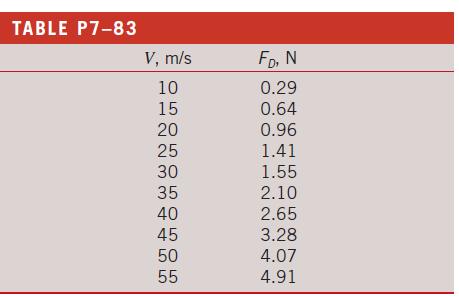
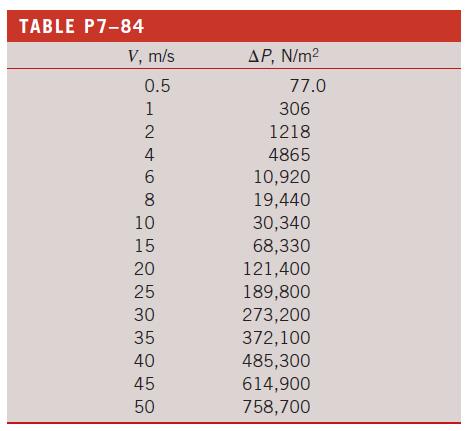
Water at 20°C flows through a long, straight pipe. The pressure drop is measured along a section of the pipe of length L = 1.3 m as a function of average velocity V through the pipe (Table P7–84). The inner diameter of the pipe is D = 10.4 cm. (a) Nondimensionalize the data and plot the Euler
In the model truck example discussed, the wind tunnel test section is 3.5 m long, 0.85 m tall, and 0.90 m wide. The one-sixteenth scale model truck is 0.991 m long, 0.257 m tall, and 0.159 m wide. What is the wind tunnel blockage of this model truck? Is it within acceptable limits according to the
A small wind tunnel in a university’s undergraduate fluid flow laboratory has a test section that is 20 by 20 in in cross section and is 4.0 ft long. Its maximum speed is 145 ft/s. Some students wish to build a model 18-wheeler to study how aerodynamic drag is affected by rounding off the back of
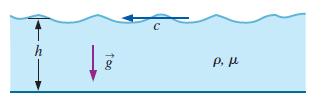
Use dimensional analysis to show that in a problem involving shallow water waves (Fig. P7–87), both the Froude number and the Reynolds number are relevant dimensionless parameters. The wave speed c of waves on the surface of a liquid is a function of depth h, gravitational acceleration g, fluid
There are many established nondimensional parameters besides those listed in Table 7–5. Do a literature search or an Internet search and find at least three established, named nondimensional parameters that are not listed in Table 7–5. For each one, provide its definition and its ratio of
Think about and describe a prototype flow and a corresponding model flow that have geometric similarity, but not kinematic similarity, even though the Reynolds numbers match. Explain.
For each statement, choose whether the statement is true or false and discuss your answer briefly.(a) Kinematic similarity is a necessary and sufficient condition for dynamic similarity.(b) Geometric similarity is a necessary condition for dynamic similarity.(c) Geometric similarity is a necessary
Write the primary dimensions of each of the following variables from the field of solid mechanics, showing all your work: (a) Moment of inertia I; (b) Modulus of elasticity E, also called Young’s modulus; (c) Strain ε; (d) Stress σ.(e) Finally, show that the relationship between stress and
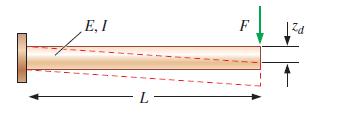
Force F is applied at the tip of a cantilever beam of length L and moment of inertia I (Fig. P7–92). The modulus of elasticity of the beam material is E. When the force is applied, the tip deflection of the beam is zd. Use dimensional analysis to generate a relationship for zd as a function of
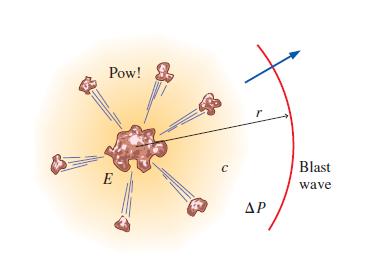
An explosion occurs in the atmosphere when an antiaircraft missile meets its target (Fig. P7–93). A shock wave (also called a blast wave) spreads out radially from the explosion. The pressure difference across the blast wave ΔP and its radial distance r from the center are functions of time t,
A cylindrical tank of water rotates about its vertical axis (Fig. P4–73). A PIV system is used to measure the vorticity field of the flow. The measured value of vorticity in the z-direction is –45.4 rad/s and is constant to within 60.5 percent everywhere that it is measured. Calculate the
Water is flowing in a 3-cm-diameter garden hose at a rate of 30 L/min. A 20-cm nozzle is attached to the hose which decreases the diameter to 1.2 cm. The magnitude of the acceleration of a fluid particle moving down the centerline of the nozzle is(a) 9.81 m/s2 (b) 14.5 m/s2 (c) 25.4 m/s2 (d)
The pressure of water is increased from 100 kPa to 1200 kPa by a pump. The temperature of water also increases by 0.15°C. The density of water is 1 kg/L and its specific heat is cp = 4.18 kJ/kg·°C. The enthalpy change of the water during this process is(a) 1100 kJ/kg (b) 0.63 kJ/kg (c) 1.1
The coefficient of compressibility of a truly incompressible substance is(a) 0 (b) 0.5 (c) 1 (d) 100 (e) Infinity
The pressure of water at atmospheric pressure must be raised to 210 atm to compress it by 1 percent. Then, the coefficient of compressibility value of water is(a) 209 atm (b) 20,900 atm (c) 21 atm (d) 0.21 atm(e) 210,000 atm
When a liquid in a piping network encounters an abrupt flow restriction (such as a closing valve), it is locally compressed. The resulting acoustic waves that are produced strike the pipe surfaces, bends, and valves as they propagate and reflect along the pipe, causing the pipe to vibrate and
The density of a fluid decreases by 5 percent at constant pressure when its temperature increases by 10°C. The coefficient of volume expansion of this fluid is(a) 0.01 K–1 (b) 0.005 K–1 (c) 0.1 K–1 (d) 0.5 K–1 (e) 5 K–1
The speed of a spacecraft is given to be 1250 km/h in atmospheric air at –40°C. The Mach number of this flow is(a) 35 .9 (b) 0.85 (c) 1.0 (d) 1.13 (e) 2.74
The dynamic viscosity of air at 20°C and 200 kPa is 1.83 × 10⁻⁵ kg/m·s. The kinematic viscosity of air at this state is(a) 0.525 × 10⁻⁵ m2/s (b) 0.77 × 10⁻⁵ m2/s(c) 1.47 × 10⁻⁵ m2/s (d) 1.83 × 10⁻⁵ m2/s(e) 0.380 × 10⁻⁵ m2/s
A viscometer constructed of two 30-cm-long concentric cylinders is used to measure the viscosity of a fluid. The outer diameter of the inner cylinder is 9 cm, and the gap between the two cylinders is 0.18 cm. The inner cylinder is rotated at 250 rpm, and the torque is measured to be 1.4 N·m. The
Which one is not a surface tension or surface energy (per unit area) unit?(a) lbf/ft (b) N·m/m2 (c) lbf/ft2(d) J/m2(e) Btu/ft2
The surface tension of soap water at 20°C is σs = 0.025 N/m. The gage pressure inside a soap bubble of diameter 2 cm at 20°C is(a) 10 Pa (b) 5 Pa (c) 20 Pa (d) 40 Pa (e) 0.5 Pa
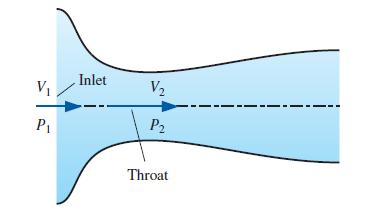
Consider the flow of water through a clear tube. It is sometimes possible to observe cavitation in the throat created by pinching off the tube to a very small diameter as sketched. We assume incompressible flow with negligible gravitational effects and negligible irreversibility's. You will learn
A 0.4-mm-diameter glass tube is inserted into water at 20°C in a cup. The surface tension of water at 20°C is σs = 0.073 N/m. The contact angle can be taken as zero degrees. The capillary rise of water in the tube is(a) 2.9 cm (b) 7.4 cm (c) 5.1 cm(d) 9.3 cm (e) 14.0 cm
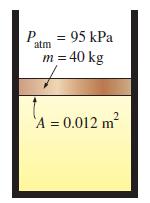
The piston of a vertical piston-cylinder device containing a gas has a mass of 40 kg and a cross-sectional area of 0.012 m2 (Fig P3–7). The local atmospheric pressure is 95 kPa, and the gravitational acceleration is 9.81 m/s2. (a) Determine the pressure inside the cylinder. (b) If some heat is
A vacuum gage connected to a chamber reads 36 kPa at a location where the atmospheric pressure is 92 kPa. Determine the absolute pressure in the chamber.
Explain the relationship between vorticity and rotationality.
Name and briefly describe the four fundamental types of motion or deformation of fluid particles.
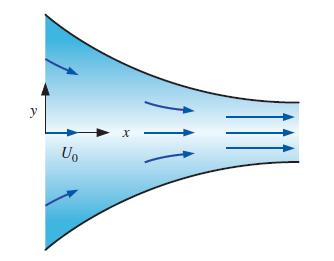
Converging duct flow (Fig. P4–17) is modeled by the steady, two-dimensional velocity field of Prob. 4–17. Is this flow field rotational or irrotational? Show all your work.Data from Problem 17.Consider steady, incompressible, two-dimensional flow through a converging duct (Fig. P4–17). A
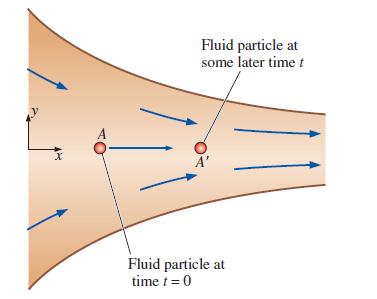
Converging duct flow is modeled by the steady, two dimensional velocity field of Prob. 4–17. A fluid particle (A) is located on the x-axis at x = xA at time t = 0 (Fig. P4–51).At some later time t, the fluid particle has moved downstream with the flow to some new location x = xA´, as shown in
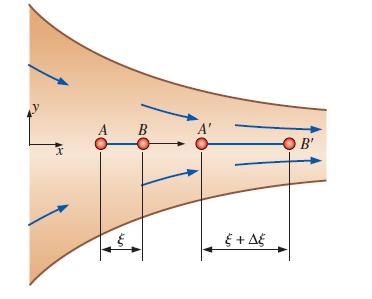
Converging duct flow is modeled by the steady, two-dimensional velocity field of Prob. 4–17. Since the flow is symmetric about the x-axis, line segment AB along the x-axis remains on the axis, but stretches from length ξ to length + 1 Δξ as it flows along the channel centerline (Fig. P4–52).
Using the results from Prob. 4–52 and the fundamental definition of linear strain rate (the rate of increase in length per unit length), develop an expression for the linear strain rate in the x-direction (εxx) of fluid particles located on the centerline of the channel. Compare your result to
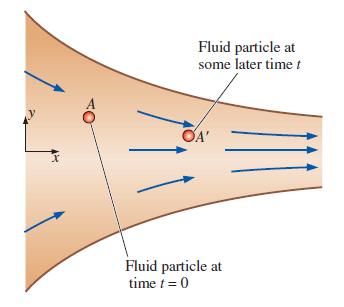
Converging duct flow is modeled by the steady, two dimensional velocity field of Prob. 4–17. A fluid particle (A) is located at x = xA and y = yA at time t = 0 (Fig. P4–54). At some later time t, the fluid particle has moved downstream with the flow to some new location x = xA´, y = yA´, as
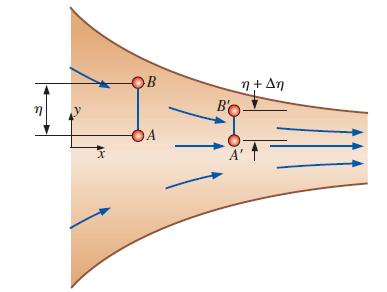
Converging duct flow is modeled by the steady, two dimensional velocity field of Prob. 4–17. As vertical line segment AB moves downstream it shrinks from length η to length η + Δη as sketched in Fig. P4–55. Generate an analytical expression for the change in length of the line segment,
Using the results of Prob. 4–55 and the fundamental definition of linear strain rate (the rate of increase in length per unit length), develop an expression for the linear strain rate in the y-direction (εyy) of fluid particles moving down the channel. Compare your result to the general
Converging duct flow is modeled by the steady, two-dimensional velocity field of Prob. 4–17. Use the equation for volumetric strain rate to verify that this flow field is incompressible.Data from Problem 4-17.Consider steady, incompressible, two-dimensional flow through a converging duct (Fig.
A general equation for a steady, two-dimensional velocity field that is linear in both spatial directions (x and y) iswhere U and V and the coefficients are constants. Their dimensions are assumed to be appropriately defined. Calculate the x- and y-components of the acceleration field. V = (u, v) =
For the velocity field of Prob. 4–58, what relationship must exist between the coefficients to ensure that the flow field is incompressible?Data from Problem 4-58A general equation for a steady, two-dimensional velocity field that is linear in both spatial directions (x and y) iswhere U and V and
For the velocity field of Prob. 4–58, calculate the linear strain rates in the x- and y-directions.Data from Problem 4-58A general equation for a steady, two-dimensional velocity field that is linear in both spatial directions (x and y) iswhere U and V and the coefficients are constants. Their
Showing 900 - 1000
of 1457
1
2
3
4
5
6
7
8
9
10
11
12
13
14
15
Step by Step Answers

 Get 50% OFF
Claim Now
Get 50% OFF
Claim Now