New Semester
Started
Get
50% OFF
Study Help!
--h --m --s
Claim Now
Question Answers
Textbooks
Find textbooks, questions and answers
Oops, something went wrong!
Change your search query and then try again
S
Books
FREE
Study Help
Expert Questions
Accounting
General Management
Mathematics
Finance
Organizational Behaviour
Law
Physics
Operating System
Management Leadership
Sociology
Programming
Marketing
Database
Computer Network
Economics
Textbooks Solutions
Accounting
Managerial Accounting
Management Leadership
Cost Accounting
Statistics
Business Law
Corporate Finance
Finance
Economics
Auditing
Tutors
Online Tutors
Find a Tutor
Hire a Tutor
Become a Tutor
AI Tutor
AI Study Planner
NEW
Sell Books
Search
Search
Sign In
Register
study help
engineering
introduction to chemical engineering thermodynamics
Introduction To Chemical Engineering Thermodynamics 8th Edition J.M. Smith, Hendrick Van Ness, Michael Abbott, Mark Swihart - Solutions
Suppose that the adsorbate equation of state is given by z = (1 − bn)−1 , where b is a constant. Find the implied adsorption isotherm, and show under what conditions it reduces to the Langmuir isotherm.
Suppose that the adsorbate equation of state is given by z = 1 + βn , where β is a function of T only. Find the implied adsorption isotherm, and show under what conditions it reduces to the Langmuir isotherm.
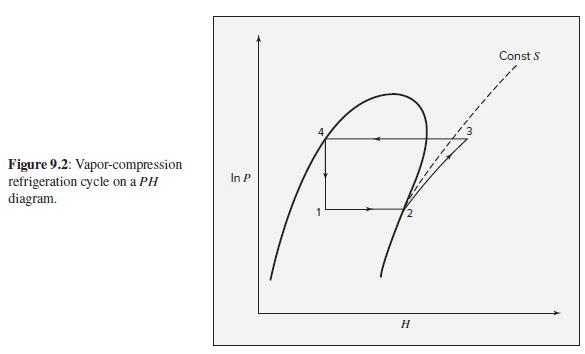
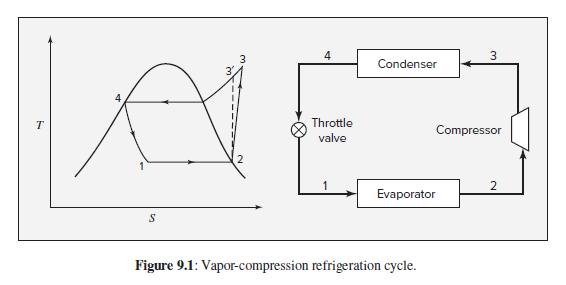
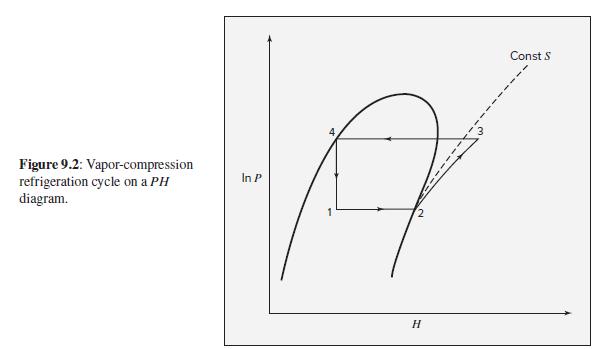
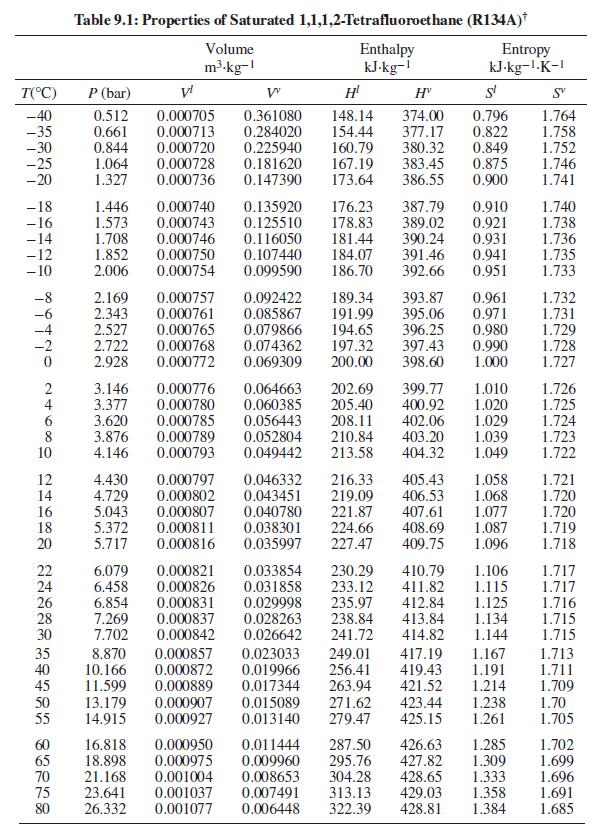
Make a thermodynamic analysis of the refrigeration cycle of Ex. 9.1(b).Ex. 9.1(b)(b) Calculate ω and m ∙ for a vapor-compression cycle (Fig. 9.2) if the compressor efficiency is 0.80.(Fig. 9.2) Const S Figure 9.2: Vapor-compression refrigeration cycle on a PH diagram. In P H
Two special models of liquid-solution behavior are the regular solution, for which SE = 0 everywhere, and the a thermal solution, for which HE = 0 everywhere.(a) Ignoring the P-dependence of GE, show that for a regular solution,(b) Ignoring the P-dependence of GE, show that for an athermal
Make a thermodynamic analysis of the refrigeration cycle described in one of the parts of Prob. 9.9. Assume that the refrigeration effect maintains a heat reservoir at a temperature 5°C above the evaporation temperature and that Tσ is 5°C below the condensation temperature.Prob. 9.9A
A binary liquid mixture is only partially miscible at 298 K. If the mixture is to be made homogeneous by increasing the temperature, what must be the sign of HE?
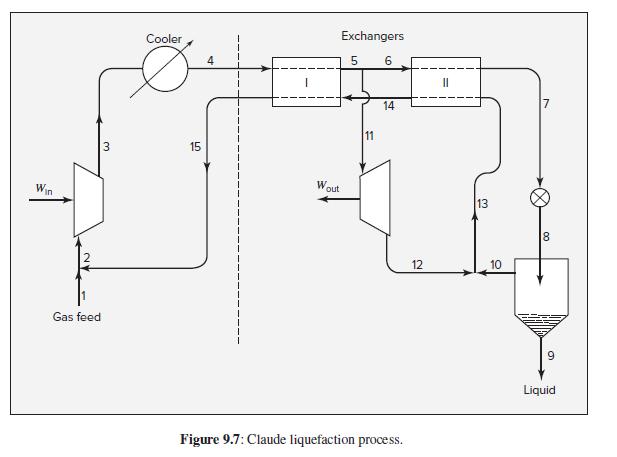
Make a thermodynamic analysis of the process described in Ex. 9.3. Tσ = 295 K.Ex. 9.3Natural gas, assumed here to be pure methane, is liquefied in a Claude process. Compression is to 60 bar and precooling is to 300 K. The expander and throttle exhaust to a pressure of 1 bar. Recycle methane at
A colloidal solution enters a single-effect evaporator at 100°C. Water is vaporized from the solution, producing a more concentrated solution and 0.5 kg·s−1 of steam at 100°C. This steam is compressed and sent to the heating coils of the evaporator to supply the heat required for its
With reference to Ex. 10.4(a) Apply Eq. (10.7) to Eq. (A) to verify Eqs. (B) and (C).(b) Show that Eqs. (B) and (C) combine in accord with Eq. (10.11) to regenerate Eq. (A).Eq. (10.11)(c) Show that Eqs. (B) and (C) satisfy Eq. (10.14), the Gibbs/Duhem equation.(d) Show that at constant T and
If LiCl⋅2H2O(s) and H2O(l) are mixed isothermally at 25°C to form a solution containing 10 mol of water for each mole of LiCl, what is the heat effect per mole of solution?
If a liquid solution of HCl in water, containing 1 mol of HCl and 4.5 mol of H2O, absorbs an additional 1 mol of HCl(g) at a constant temperature of 25°C, what is the heat effect?
What is the heat effect when 20 kg of LiCl(s) is added to 125 kg of an aqueous solution containing 10-wt-% LiCl in an isothermal process at 25°C?
An LiCl/H2O solution at 25°C is made by adiabatically mixing cool water at 10°C with a 20-mol-% LiCl/H2O solution at 25°C. What is the composition of the solution formed?
A 20-mol-% LiCl/H2O solution at 25°C is made by mixing a 25-mol-% LiCl/H2O solution at 25°C with chilled water at 5°C. What is the heat effect in joules per mole of final solution?
A 20-mol-% LiCl/H2O solution is made by six different mixing processes:(a) Mix LiCl(s) with H2O(l).(b) Mix H2O(l) with a 25-mol-% LiCl/H2O solution.(c) Mix LiCl ⋅H2O(s) with H2O(l).(d) Mix LiCl(s) with a 10-mol-% LiCl/H2O solution.(e) Mix a 25-mol-% LiCl/H2O solution with a 10-mol-% LiCl/H2O
A stream of 12 kg·s−1 of Cu(NO3)2⋅6H2O and a stream of 15 kg·s−1 of water, both at 25°C, are fed to a tank where mixing takes place. The resulting solution passes through a heat exchanger that adjusts its temperature to 25°C. What is the rate of heat transfer in the exchanger?∙ For Cu
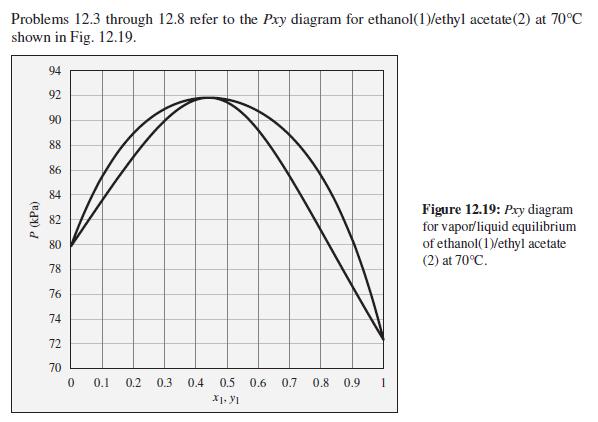
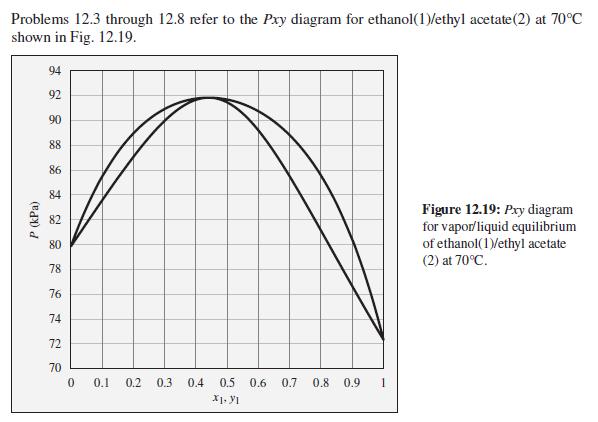
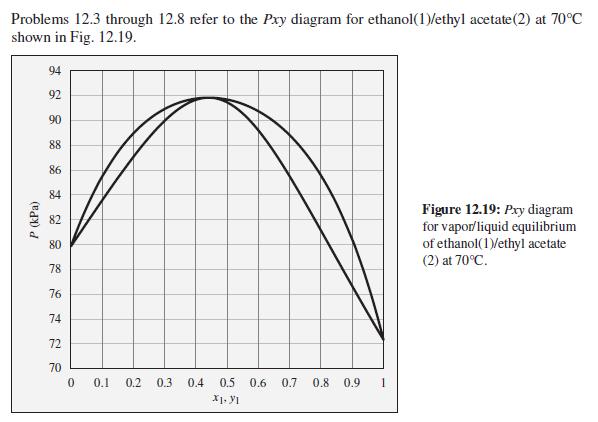
The pressure above a mixture of ethanol and ethyl acetate at 70°C is measured to be 86 kPa. What are the possible compositions of the liquid and vapor phases? Problems 12.3 through 12.8 refer to the Pxy diagram for ethanol(1)/ethyl acetate(2) at 70°C shown in Fig. 12.19. 94 92 90 88 86 84 Figure
Of the following binary liquid/vapor systems, which can be approximately modeled by Raoult’s law? For those that cannot, why not? Table B.1 (App. B) may be useful.(a) Benzene/toluene at 1(atm).(b) n-Hexane/n-heptane at 25 bar.(c) Hydrogen/propane at 200 K.(d) Iso-octane/n-octane at 100°C.(e)
The pressure above a mixture of ethanol and ethyl acetate at 70°C is measured to be 78 kPa. What are the possible compositions of the liquid and vapor phases? Problems 12.3 through 12.8 refer to the Pxy diagram for ethanol(1)/ethyl acetate(2) at 70°C shown in Fig. 12.19. 94 92 90 88 86 84 Figure
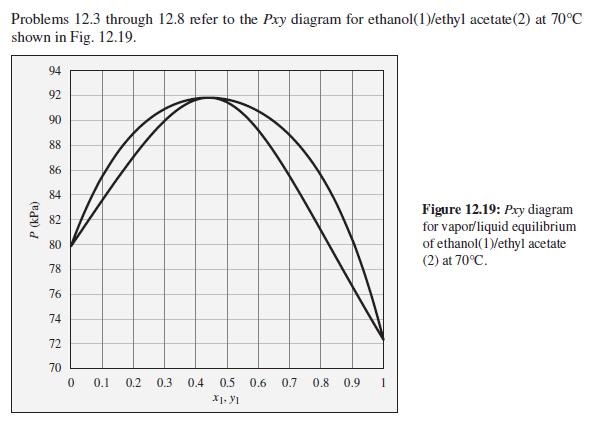
Consider an ethanol(1)/ethyl acetate(2) mixture with x1 = 0.70, initially at 70°C and 100 kPa. Describe the evolution of phases and phase compositions as the pressure is gradually reduced to 70 kPa. Problems 12.3 through 12.8 refer to the Pxy diagram for ethanol(1)/ethyl acetate(2) at 70°C shown
What is the composition of the azeotrope for the ethanol(1)/ethyl acetate(2) system? Would this be called a high-boiling or low-boiling azeotrope? Problems 12.3 through 12.8 refer to the Pxy diagram for ethanol(1)/ethyl acetate(2) at 70°C shown in Fig. 12.19. 94 92 90 88 86 84 Figure 12.19: Pry
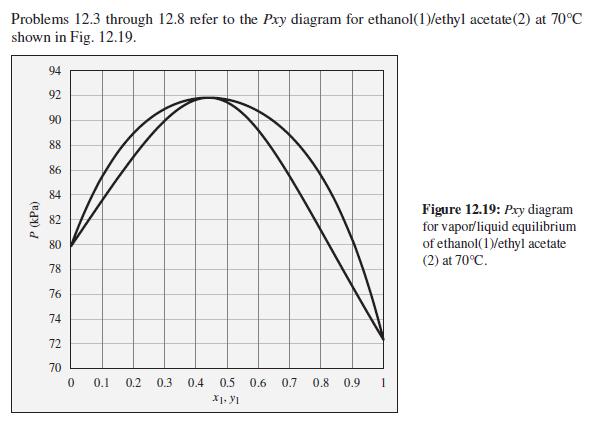
Consider an ethanol(1)/ethyl acetate(2) mixture with x1 = 0.80, initially at 70°C and 80 kPa. Describe the evolution of phases and phase compositions as the pressure is gradually increased to 100 kPa. Problems 12.3 through 12.8 refer to the Pxy diagram for ethanol(1)/ethyl acetate(2) at
Consider a closed vessel initially containing 1 mol of pure ethyl acetate at 70°C and 86 kPa. Imagine that pure ethanol is slowly added at constant temperature and pressure until the vessel contains 1 mol ethyl acetate and 9 mol ethanol. Describe the evolution of phases and phase compositions
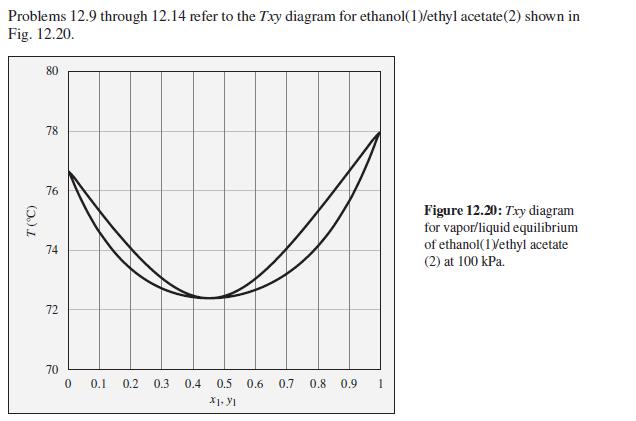
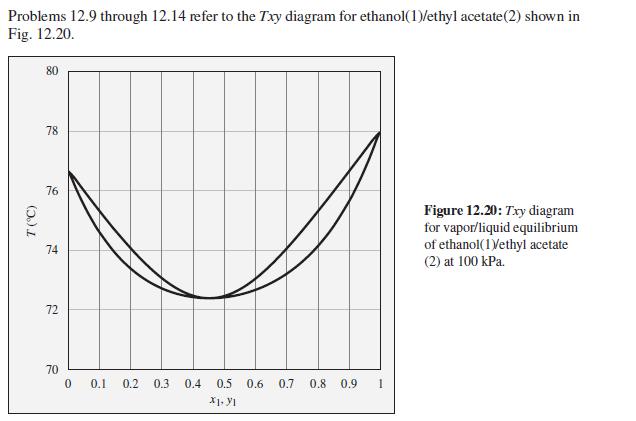
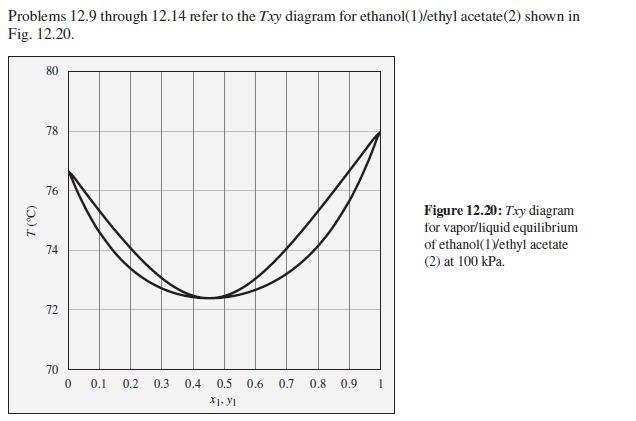
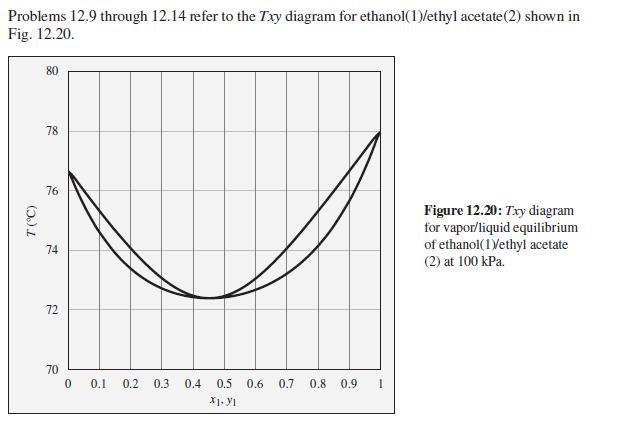
Consider an ethanol(1)/ethyl acetate(2) mixture with x1 = 0.70, initially at 70°C and 100 kPa. Describe the evolution of phases and phase compositions as the temperature is gradually increased to 80°C. Problems 12.9 through 12.14 refer to the Txy diagram for ethanol(1)/ethyl acetate(2) shown
A mixture of ethanol and ethyl acetate is heated in a closed system at 100 kPa to a temperature of 77°C, and two phases are observed to be present. What are the possible compositions of the liquid and vapor phases? Problems 12.9 through 12.14 refer to the Txy diagram for ethanol(1)/ethyl
A mixture of ethanol and ethyl acetate is heated in a closed system at 100 kPa to a temperature of 74°C, and two phases are observed to be present. What are the possible compositions of the liquid and vapor phases? Problems 12.9 through 12.14 refer to the Txy diagram for ethanol(1)/ethyl
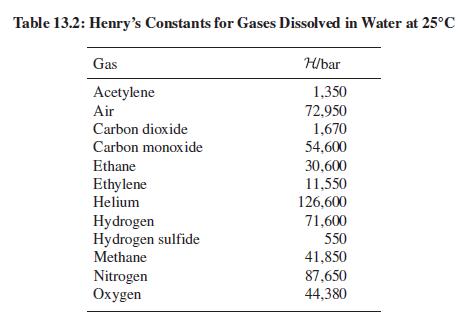
Air, even more than carbon dioxide, is inexpensive and nontoxic. Why is it not the gas of choice for making soda water and (cheap) champagne effervescent? Table 13.2 may provide useful data.Table 13.2 Table 13.2: Henry's Constants for Gases Dissolved in Water at
Consider an ethanol(1)/ethyl acetate(2) mixture with x1 = 0.20, initially at 70°C and 100 kPa. Describe the evolution of phases and phase compositions as the temperature is gradually increased to 80°C. Problems 12.9 through 12.14 refer to the Txy diagram for ethanol(1)/ethyl acetate(2) shown
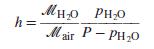
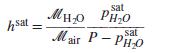
Humidity, relating to the quantity of moisture in atmospheric air, is accurately given by equations derived from the ideal-gas law and Raoult’s law for H2O.(a) The absolute humidity h is defined as the mass of water vapor in a unit mass of dry air. Show that it is given by:where ℳ represents a
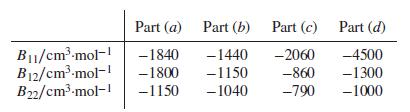
A single-stage liquid/vapor separation for the benzene(1)/ethylbenzene(2) system must produce phases of the following equilibrium compositions. For one of these sets, determine T and P in the separator. What additional information is needed to compute the relative amounts of liquid and vapor
Do all four parts of Prob. 13.7, and compare the results. The required temperatures and pressures vary significantly. Discuss possible processing implications of the various temperature and pressure levels.Problem 13.7A single-stage liquid/vapor separation for the benzene(1)/ethylbenzene(2) system
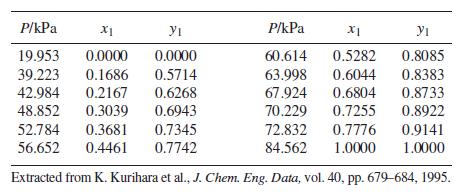
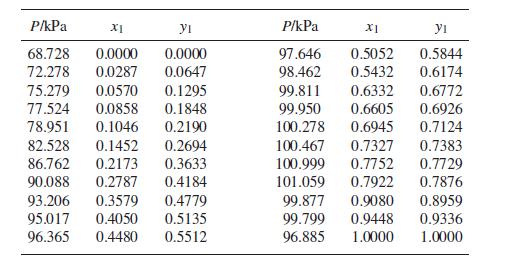
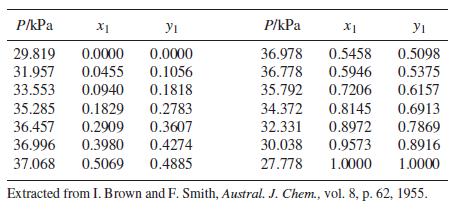
The following is a set of VLE data for the system methanol(1)/water(2) at 333.15 K:(a) Basing calculations on Eq. (13.24), find parameter values for the Margules equation that provide the best fit of GE∕RT to the data, and prepare a Pxy diagram that compares the experimental points with curves
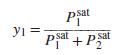
The following is a rule of thumb: For a binary system in VLE at low pressure, the equilibrium vapor-phase mole fraction y1 corresponding to an equimolar liquid mixture is approximatelywhere Psati is a pure-species vapor pressure. Clearly, this equation is valid if Raoult’s law applies. Prove that
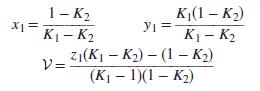
Flash calculations are simpler for binary systems than for the general multicomponent case because the equilibrium compositions for a binary are independent of the overall composition. Show that, for a binary system in VLE 1- K2 K1- K2 z1(KI – K2) – (1 – K2) K(1 – K2) Yi = K1- K2 ソ= (K1
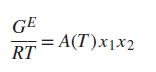
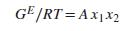
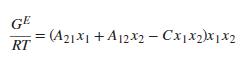
The excess Gibbs energy for binary systems consisting of liquids not too dissimilar in chemical nature is represented to a reasonable approximation by the equation:where A is a function of temperature only. For such systems, it is often observed that the ratio of the vapor pressures of the pure
The following is a set of VLE data for the system acetone(1)/methanol(2) at 55°C:(a) Basing calculations on Eq. (13.24), find parameter values for the Margules equation that provide the best fit of GE∕RT to the data, and prepare a Pxy diagram that compares the experimental points with curves
If Eq. (13.24) is valid for isothermal VLE in a binary system, show that:Eq (13.24) (2). dP dP 2-Psat sat X=1 0= Ix (1xp
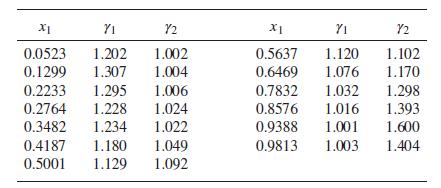
The following is a set of activity-coefficient data for a binary liquid system as determined from VLE data:Inspection of these experimental values suggests that they are noisy, but the question is whether they are consistent, and therefore possibly on average correct.(a) Find experimental values
VLE data for methyl tert-butyl ether(1)/dichloromethane(2) at 308.15 K are as follows:The data are well correlated by the three-parameter Margules equation [an extension of Eq. (13.39)]:Implied by this equation are the expressions:(a) Basing calculations on Eq. (13.24), find the values of
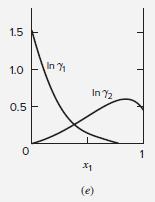
For the ethanol(1)/chloroform(2) system at 50°C, the activity coefficients show interior extrema with respect to composition [see Fig. 13.4(e)].(a) Prove that the van Laar equation cannot represent such behavior.(b) The two-parameter Margules equation can represent this behavior, but only for
Following are VLE data for the system acetonitrile(1)/benzene(2) at 45°C:The data are well correlated by the three-parameter Margules equation (see Prob. 13.37).(a) Basing calculations on Eq. (13.24), find the values of parameters A12, A21, and C that provide the best fit of GE∕RT to the
Equations analogous to Eqs. (10.15) and (10.16) apply for excess properties. Because ln γi is a partial property with respect to GE∕RT, these analogous equations can be written for ln γ1 and ln γ2 in a binary system.(a) Write these equations, and apply them to Eq. (13.42) to show that Eqs.
An unusual type of low-pressure VLE behavior is that of double azeotropy, in which the dew and bubble curves are S-shaped, thus yielding at different compositions both a minimum-pressure and a maximum-pressure azeotrope. Assuming that Eq. (13.57) applies, determine under what circumstances double
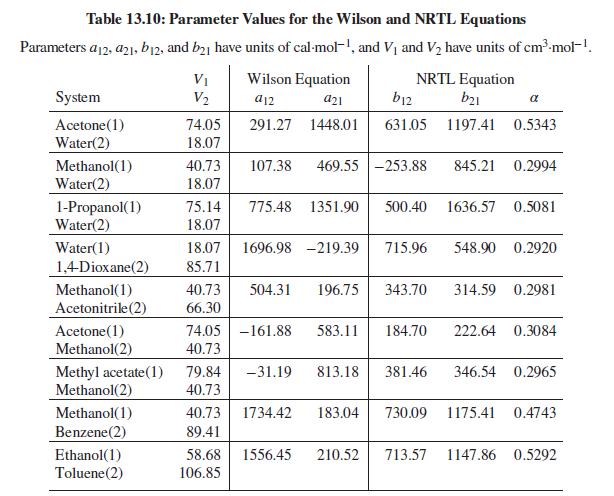
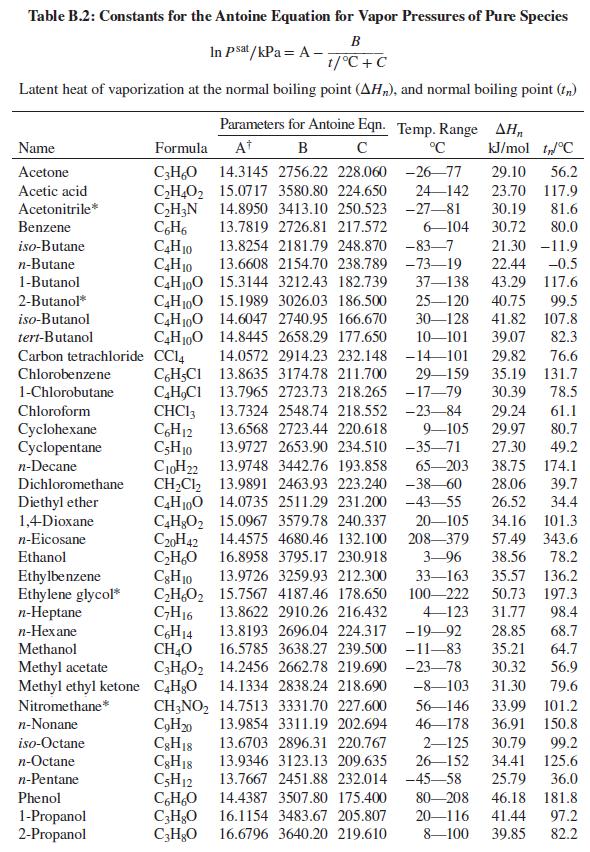
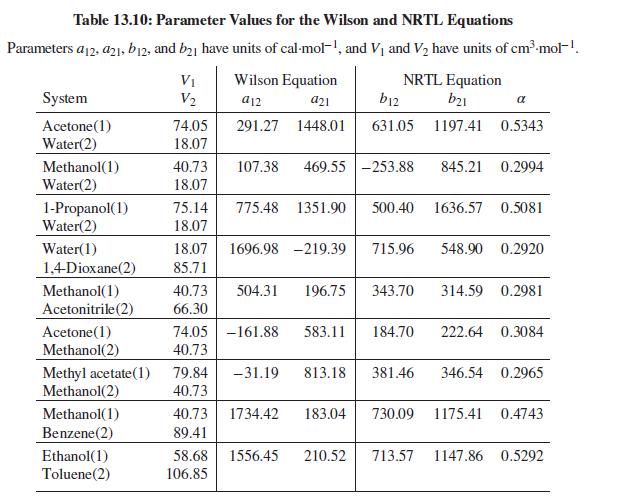
For one of the binary systems listed in Table 13.10, based on Eq. (13.19) and the Wilson equation, prepare a Pxy diagram for t = 60°C.Problems 13.43 through 13.54 require parameter values for the Wilson or NRTL equation for liquid-phase activity coefficients. Table 13.10 gives parameter values for
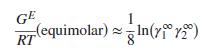
Rationalize the following rule of thumb, appropriate for an equimolar binary liquid mixture: GE (equimolar) RT 1
For one of the binary systems listed in Table 13.10, based on Eq. (13.19) and the Wilson equation, prepare a txy diagram for P = 101.33 kPa.Problems 13.43 through 13.54 require parameter values for the Wilson or NRTL equation for liquid-phase activity coefficients. Table 13.10 gives parameter
For one of the binary systems listed in Table 13.10, based on Eq. (13.19) and the NRTL equation, prepare a Pxy diagram for t = 60°C.Problems 13.43 through 13.54 require parameter values for the Wilson or NRTL equation for liquid-phase activity coefficients. Table 13.10 gives parameter values for
For one of the binary systems listed in Table 13.10, based on Eq. (13.19) and the NRTL equation, prepare a txy diagram for P = 101.33 kPa.Problems 13.43 through 13.54 require parameter values for the Wilson or NRTL equation for liquid-phase activity coefficients. Table 13.10 gives parameter values
For one of the binary systems listed in Table 13.10, based on Eq. (13.19) and the Wilson equation, make the following calculations:(a) BUBL P : t = 60°C, x1 = 0.3.(b) DEW P : t = 60°C, y1 = 0.3.(c) P, T − flash: t = 60°C, P = ½ (Pbubble + Pdew), z1 = 0.3.(d) If an azeotrope exists at t = 60°
For one of the binary systems listed in Table 13.10, based on Eq. (13.19) and the Wilson equation, make the following calculations:(a) BUBL T : P = 101.33 kPa, x1 = 0.3.(b) DEW T : P = 101.33 kPa, y1 = 0.3.(c) P, T − flash: P = 101.33 kPa, T = ½ (Tbubble + Tdew), z1 = 0.3.(d) If an azeotrope
Work Prob. 13.49 for the NRTL equation.Prob. 13.49For one of the binary systems listed in Table 13.10, based on Eq. (13.19) and the Wilson equation, make the following calculations:(a) BUBL T : P = 101.33 kPa, x1 = 0.3.(b) DEW T : P = 101.33 kPa, y1 = 0.3.(c) P, T − flash: P = 101.33 kPa, T = ½
For the acetone(1)/methanol(2)/water(3) system, based on Eq. (13.19) and the Wilson equation, make the following calculations:(a) BUBL P : t = 65°C, x1 = 0.3, x2 = 0.4.(b) DEW P : t = 65°C, y1 = 0.3, y2 = 0.4.(c) P, T − flash : t = 65°C, P = ½ (Pbubble + Pdew), z1 = 0.3, z2 = 0.4.Problems
Work Prob. 13.51 for the NRTL equation.Prob. 13.51For the acetone(1)/methanol(2)/water(3) system, based on Eq. (13.19) and the Wilson equation, make the following calculations:(a) BUBL P : t = 65°C, x1 = 0.3, x2 = 0.4.(b) DEW P : t = 65°C, y1 = 0.3, y2 = 0.4.(c) P, T − flash : t = 65°C, P = ½
Work Prob. 13.53 for the NRTL equation.Prob. 13.53For the acetone(1)/methanol(2)/water(3) system, based on Eq. (13.19) and the Wilson equation, make the following calculations:(a) BUBL T : P = 101.33 kPa, x1 = 0.3, x2 = 0.4.(b) DEW T : P = 101.33 kPa, y1 = 0.3, y2 = 0.4.(c) P, T − flash : P =
For the acetone(1)/methanol(2)/water(3) system, based on Eq. (13.19) and the Wilson equation, make the following calculations:(a) BUBL T : P = 101.33 kPa, x1 = 0.3, x2 = 0.4.(b) DEW T : P = 101.33 kPa, y1 = 0.3, y2 = 0.4.(c) P, T − flash : P = 101.33 kPa, T = ½ (Tbubble + Tdew), z1 = 0.3, z2 =
Possible correlating equations for ln γ1 in a binary liquid system are given here. For one of these cases, determine by integration of the Gibbs/Duhem equation [Eq. (13.11)] the corresponding equation for ln γ2. What is the corresponding equation for GE∕RT? Note that by its definition, γi = 1
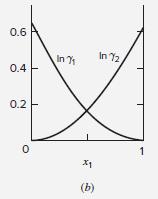
Table 13.10 gives values of parameters for the Wilson equation for the acetone(1)/methanol(2) system. Estimate values of ln γ∞1 and ln γ∞2 at 50°C. Compare with the values suggested by Fig. 13.4(b). Repeat the exercise with the NRTL equation.Table 13.10Fig. 13.4(b) Table 13.10: Parameter
Consider the following model for GE∕RT of a binary mixture:This equation in fact represents a family of two-parameter expressions for GE∕RT; specification of k leaves A12 and A21 as the free parameters.(a) Find general expressions for ln γ1 and ln γ2, for any k.(b) Show that ln γ∞1 =
The following expressions have been reported for the activity coefficients of species 1 and 2 in a binary liquid mixture at given T and P:ln γ1 = x22 (0.273 + 0.096 x1) ln γ2 = x21 (0.273 − 0.096 x2)(a) Determine the implied expression for GE∕RT.(b) Generate expressions for ln γ1 and ln γ2
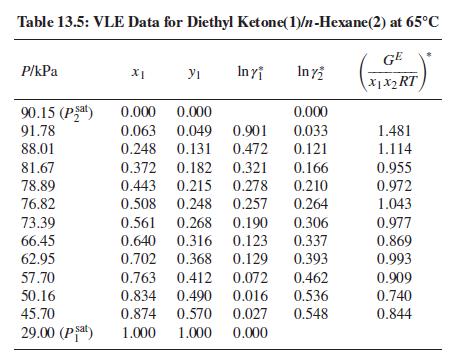
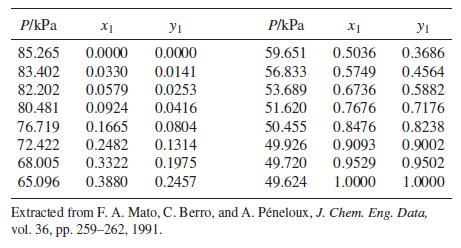
Use Eq. (13.13) to reduce one of the following isothermal data sets, and compare the result with that obtained by application of Eq. (13.19). Recall that reduction means developing a numerical expression for GE∕RT as a function of composition.(a) Methylethylketone(1)/toluene(2) at 50°C: Table
A storage tank contains a heavy organic liquid. Chemical analysis shows the liquid to contain 600 ppm (molar basis) of water. It is proposed to reduce the water concentration to 50 ppm by boiling the contents of the tank at constant atmospheric pressure. Because the water is lighter than the
A single P-x1-y1 data point is available for a binary system at 25°C. Estimate from the data:(a) The total pressure and vapor-phase composition at 25°C for an equimolar liquid mixture.(b) Whether azeotropy is likely at 25°C.Data: At 25°C, Psat1 = 183.4 and Psat2 = 96.7 kPaFor x1 = 0.253,
Departures from Raoult’s law are primarily from liquid-phase nonidealities (γi ≠ 1). But vapor-phase nonidealities (ϕ i ≠ 1) also contribute. Consider the special case where the liquid phase is an ideal solution, and the vapor phase a nonideal gas mixture described by Eq. (3.36). Show that
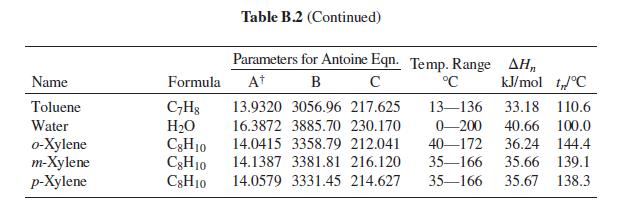
For one of the following substances, determine Psat∕bar from the Redlich/Kwong equation at two temperatures: T = Tn (the normal boiling point), and T = 0.85Tc. For the second temperature, compare your result with a value from the literature (e.g.,Perry’s Chemical Engineers’ Handbook). Discuss
Work Prob. 13.69 for one of the following: (a) The Soave/Redlich/Kwong equation; (b) the Peng/Robinson equation.Prob. 13.69For one of the following substances, determine Psat∕bar from the Redlich/Kwong equation at two temperatures: T = Tn (the normal boiling point), and T = 0.85Tc. For the second
The relative volatility α12 is commonly used in applications involving binary VLE. In particular (see Ex. 13.1), it serves as a basis for assessing the possibility of binary azeotropy. (a) Develop an expression for α12 based on Eqs. (13.13) and (13.14). (b) Specialize the expression to the
Generate P-x1-y1 diagrams at 100°C for one of the systems identified below. Base activity coefficients on the Wilson equation, Eqs. (13.45) to (13.47). Use two procedures: (i) modified Raoult’s law, Eq. (13.19), and (ii) the gamma/phi approach, Eq. (13.13), with Φi given by Eq. (13.14). Plot
Peter, Paul, and Mary, members of a thermodynamics class, are asked to find the equilibrium composition at a particular T and P and for given initial amounts of reactants for the following gas-phase reaction:2NH3 + 3NO → 3 H2O + N2 (A)Each solves the problem
Develop expressions for the mole fractions of reacting species as functions of the reaction coordinate for:(a) A system initially containing 2 mol NH3 and 5 mol O2 and undergoing the reaction:4NH3(g) + 5O2(g) → 4NO(g) + 6Η2Ο(g)(b) A system initially containing 3 mol H2S and 5 mol
A system initially containing 2 mol C2H4 and 3 mol O2 undergoes the reactions:C2H4(g) + ½O2(g) → ⟨(CH2)2⟩O(g)C2H4(g) + 3O2(g) → 2CO2(g) + 2H2O(g)Develop expressions for the mole fractions of the reacting species as functions of the reaction coordinates for the two
Ethylene is produced by the dehydrogenation of ethane. If the feed includes 0.5 mol of steam (an inert diluent) per mole of ethane and if the reaction reaches equilibrium at 1100 K and 1 bar, what is the composition of the product gas on a water-free basis?
A chemically reactive system contains the following species in the gas phase: NH3, NO, NO2, O2, and H2O. Determine a complete set of independent reactions for this system. How many degrees of freedom does the system have?
Consider the gas-phase isomerization reaction: A→B.(a) Assuming ideal gases, develop from Eq. (14.28) the chemical-reaction equilibrium equation for the system.(b) The result of part (a) should suggest that there is one degree of freedom for the equilibrium state. Upon verifying that the phase
Consider the gas-phase oxidation of ethylene to ethylene oxide at a pressure of 1 bar with 25% excess air. If the reactants enter the process at 25°C, if the reaction proceeds adiabatically to equilibrium, and if there are no side reactions, determine the composition and temperature of the product
Hydrogen gas can be produced by the reaction of steam with “water gas,” an equimolar mixture of H2 and CO obtained by the reaction of steam with coal. A stream of “water gas” mixed with steam is passed over a catalyst to convert CO to CO2 by the reaction:H2O(g) + CO(g) → H2(g)
The feed gas to a methanol synthesis reactor is composed of 75-mol-% H2, 15-mol-% CO, 5-mol-% CO2, and 5-mol-% N2. The system comes to equilibrium at 550 K and 100 bar with respect to the reactions:2H2 (g) + CO(g) → CH3 OH(g) H2(g) + CO2(g) → CO(g) +
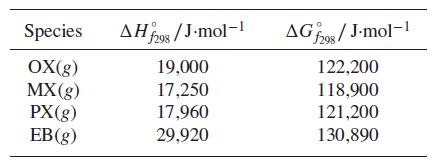
Reaction-equilibrium calculations may be useful for estimation of the compositions of hydrocarbon feedstocks. A particular feedstock, available as a low-pressure gas at 500 K, is identified as “aromatic C8.” It could in principle contain the C8H10 isomers: o-xylene (OX), m-xylene (MX), p-xylene
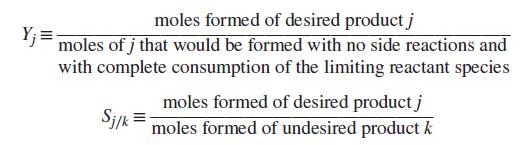
In chemical-reaction engineering, special measures of product distribution are sometimes used when multiple reactions occur. Two of these are yield Yj and selectivity Sj∕k. We adopt the following definitions:For any particular application, yield and selectivity can be related to component rates
“Synthesis gas” can be produced by the catalytic re-forming of methane with steam. The reactions are:CH4(g) + H2O(g) → CO(g) + 3H2g) CO(g) + H2O(g) → CO2(g) + H2(g)Assume equilibrium is attained for both reactions at 1 bar and 1300
A low-pressure, gas-phase isomerization reaction, A→B, occurs at conditions such that vapor and liquid phases are present.(a) Prove that the equilibrium state is univariant.(b) Suppose T is specified. Show how to calculate xA, yA, and P. State carefully, and justify, any assumptions.
The following problems involving chemical-reaction stoichiometry are to be solved through the use of reaction coordinates.(a) Feed to a gas-phase reactor comprises 50 kmol·h−1 of species A, and 50 kmol·h−1 of species B. Two independent reactions occur:A + B → C (I) A + C → D
The following is an industrial-safety rule of thumb: compounds with large positive ΔG f° must be handled and stored carefully. Explain.
Two important classes of reactions are oxidation reactions and cracking reactions. One class is invariably endothermic; the other, exothermic. Which is which? For which class of reactions (oxidation or cracking) does equilibrium conversion increase with increasing T ?
Equilibrium at 425 K and 15 bar is established for the gas-phase isomerization reactionn-C4H10(g) → iso-C4Η10(g)Estimate the composition of the equilibrium mixture by two procedures:(a) Assume an ideal-gas mixture.(b) Assume an ideal solution with the equation of state given by Eq.
The standard heat of reaction ΔH° for gas-phase reactions is independent of the choice of standard-state pressure P°. (Why?) However, the numerical value of ΔG° for such reactions does depend on P°. Two choices of P° are conventional: 1 bar (the basis adopted in this text), and 1.01325 bar.
Ethanol is produced from ethylene via the gas-phase reactionC2H4(g) + H2O(g) → C2H5OH(g)Reaction conditions are 400 K and 2 bar.(a) Determine a numerical value for the equilibrium constant K for this reaction at 298.15 K.(b) Determine a numerical value for K for this reaction at 400
Reagent-grade, liquid-phase chemicals often contain as impurities isomers of the nominal compound, with a consequent effect on the vapor pressure. This can be quantified by phase-equilibrium/reaction-equilibrium analysis. Consider a system containing isomers A and B in vapor/liquid equilibrium, and
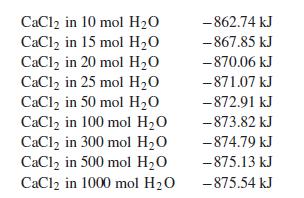
Data from the Bureau of Standards (J. Phys. Chem. Ref. Data, vol. 11, suppl. 2, 1982) include the following heats of formation for 1 mol of CaCl2 in water at 25°C:From these data prepare a plot of Δ̃H̃, the heat of solution at 25°C of CaCl2 in water, vs. ñ, the mole ratio of water to CaCl2.
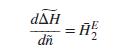
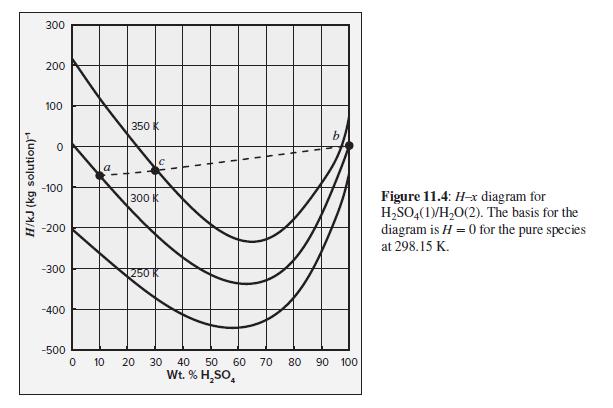
Consider a plot of Δ̃H̃, the heat of solution based on 1 mol of solute (species 1), vs. ñ, the moles of solvent per mole of solute, at constant T and P. Figure 11.4 is an example of such a plot, except that the plot considered here has a linear rather than logarithmic scale along the abscissa.
A liquid solution of LiCl in water at 25°C contains 1 mol of LiCl and 7 mol of water. If 1 mol of LiCl⋅3H2O(s) is dissolved isothermally in this solution, what is the heat effect?
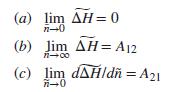
Suppose that ΔH for a particular solute(1)/solvent(2) system is represented by the equation:ΔH = x1x2 ( A21x1 + A12x2 ) (A)Relate the behavior of a plot of Δ̃H̃ vs. ñ to the features of this equation. Specifically, rewrite Eq. (A) in the form Δ̃H̃ (ñ) , and then show that: (a) lim
You need to produce an aqueous LiCl solution by mixing LiCl⋅2H2O(s) with water. The mixing occurs both adiabatically and without change in temperature at 25°C. Determine the mole fraction of LiCl in the final solution.
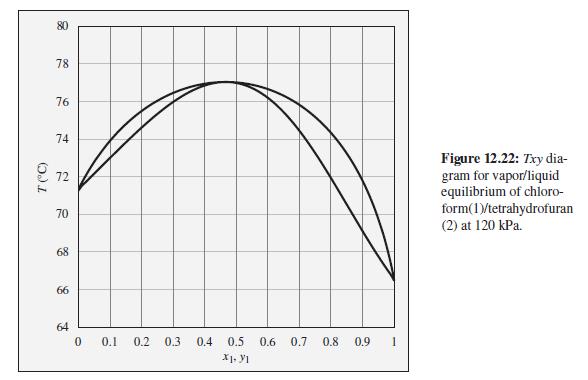
Consider a closed vessel initially containing 1 mol of pure tetrahydrofuran at 74°C and 120 kPa. Imagine that pure chloroform is slowly added at constant temperature and pressure until the vessel contains 1 mol tetrahydrofuran and 9 mol chloroform. Describe the evolution of phases and phase
For a 50-wt-% aqueous solution of H2SO4 at 350 K, what is the excess enthalpy HE in kJ·kg−1?
Saturated steam at 3 bar is throttled to 1 bar and mixed adiabatically with (and condensed by) 45-wt-% sulfuric acid at 300 K in a flow process that raises the temperature of the acid to 350 K. How much steam is required for each pound mass of entering acid, and what is the concentration of the hot
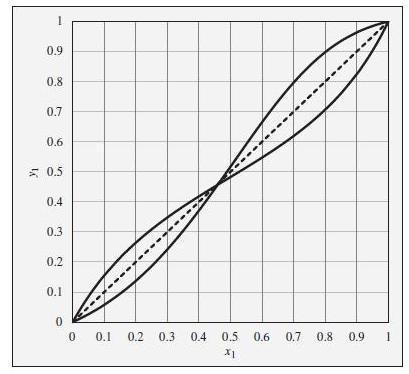
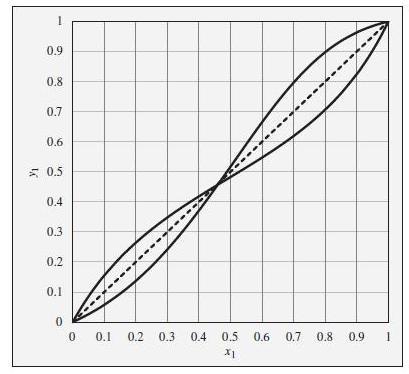
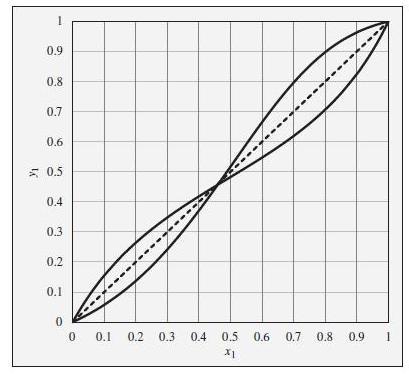
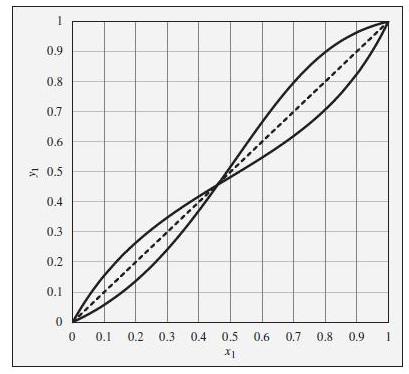
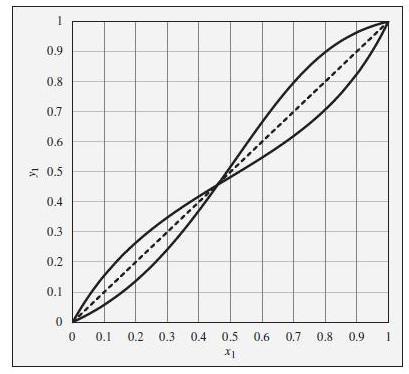
What is the composition of the vapor phase in equilibrium with a liquid phase ethanol(1)/ethyl acetate(2) mixture of the following compositions at P = 1 bar?(a) x1 = 0.1(b) x1 = 0.2(c) x1 = 0.3(d) x1 = 0.45(e) x1 = 0.6(f) x1 = 0.8(g) x1 = 0.9To the xy diagram provided in Fig. 12.23. This diagram
What is the composition of the liquid phase in equilibrium with a vapor phase ethanol(1)/ethyl acetate(2) mixture of the following compositions at P = 1 bar?(a) y1 = 0.1(b) y1 = 0.2(c) y1 = 0.3(d) y1 = 0.45(e) y1 = 0.6(f) y1 = 0.8(g) y1 = 0.9To the xy diagram provided in Fig. 12.23. This diagram
What is the composition of the vapor phase in equilibrium with a liquid phase chloroform(1)/tetrahydrofuran(2) mixture of the following compositions at P = 1 bar?(a) x1 = 0.1(b) x1 = 0.2(c) x1 = 0.3(d) x1 = 0.45(e) x1 = 0.6(f) x1 = 0.8(g) x1 = 0.9To the xy diagram provided in Fig. 12.23. This
What is the composition of the liquid phase in equilibrium with a vapor phase chloroform(1)/tetrahydrofuran(2) mixture of the following compositions at P = 1 bar?(a) y1 = 0.1(b) y1 = 0.2(c) y1 = 0.3(d) y1 = 0.45(e) y1 = 0.6(f) y1 = 0.8(g) y1 = 0.9To the xy diagram provided in Fig. 12.23. This
Consider a binary liquid mixture for which the excess Gibbs energy is given by GE/RT = Ax1x2. What is the minimum value of A for which liquid/liquid equilibrium is possible?To the xy diagram provided in Fig. 12.23. This diagram shows xy curves both for ethanol(1)/ethyl acetate(2) and for
Showing 1800 - 1900
of 2105
First
8
9
10
11
12
13
14
15
16
17
18
19
20
21
22
Step by Step Answers

 Get 50% OFF
Claim Now
Get 50% OFF
Claim Now