New Semester
Started
Get
50% OFF
Study Help!
--h --m --s
Claim Now
Question Answers
Textbooks
Find textbooks, questions and answers
Oops, something went wrong!
Change your search query and then try again
S
Books
FREE
Study Help
Expert Questions
Accounting
General Management
Mathematics
Finance
Organizational Behaviour
Law
Physics
Operating System
Management Leadership
Sociology
Programming
Marketing
Database
Computer Network
Economics
Textbooks Solutions
Accounting
Managerial Accounting
Management Leadership
Cost Accounting
Statistics
Business Law
Corporate Finance
Finance
Economics
Auditing
Tutors
Online Tutors
Find a Tutor
Hire a Tutor
Become a Tutor
AI Tutor
AI Study Planner
NEW
Sell Books
Search
Search
Sign In
Register
study help
engineering
introduction to chemical engineering thermodynamics
Introductory Chemical Engineering Thermodynamics 2nd Edition J. Elliott, Carl Lira - Solutions
A 1 m3 isolated chamber with rigid walls is divided into two compartments of equal volume. The partition permits transfer of heat. One side contains a nonideal gas at 5 MPa and 300 K and the other side contains a perfect vacuum. The partition is ruptured, and after sufficient time for the system to
Using the Peng-Robinson equation, estimate the change in entropy (J/mole-K) for raising butane from a saturated liquid at 271 K and 1 bar to a vapor at 352 K and 10 bar. What fraction of this total change is given by the departure function at 271 K? What fraction of this change is given by the
Suppose we would like to establish limits for the rule T2 = T1(P2/P1)R/CP by asserting that the estimated T2 should be within 5% of the one calculated using the departure functions. For ω = 0 and Tr =[1, 10] at state 1, determine the values of Pr where this assertion holds valid by using the
N.B. Vargaftik3 (1975) lists the experimental values in the following table for the enthalpy departure of isobutane at 175°C. Compute theoretical values and their percent deviations from experiment by the following(a) The generalized charts(b) The Peng-Robinson equation P
A piston contains 2 moles of propane vapor at 425 K and 8.5 MPa. The piston is taken through several state changes along a pathway where the total work done by the gas is 2 kJ. The final state of the gas is 444 K and 3.4 MPa. What is the change, ΔH, for the gas predicted by the Peng-Robinson
n-pentane is to be heated from liquid at 298 K and 0.01013 MPa to vapor at 360 K and 0.3 MPa. Compute the change in enthalpy using the Peng-Robinson equation of state. If a reference state is desired, use vapor at 310 K, 0.103 MPa, and provide the enthalpy departure at the reference state.
For each of the fluid state changes below, perform the following calculations using the Peng-Robinson equation: (a) Prepare a table and summarize the molar volume, enthalpy, and entropy for the initial and final states; (b) calculate ΔH and ΔS for the process; and (c) compare with ΔH and ΔS
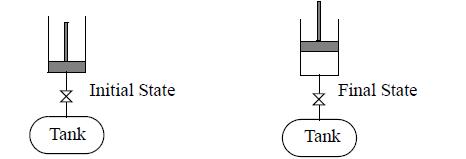
Solve problem 8.24 using n-pentane.Data from Problem 8.24Consider problem 3.11 using benzene as the fluid rather than air and eliminating the ideal gas assumption. Use the Peng-Robinson equation. For the same initial state,(a) The final tank temperature will not be 499.6 K. What will the
A tank is divided into two equal halves by an internal diaphragm. One half contains argon at a pressure of 700 bar and a temperature of 298 K, and the other chamber is completely evacuated. Suddenly, the diaphragm bursts. Compute the final temperature and pressure of the gas in the tank after
The diaphragm of the preceding problem develops a small leak instead of bursting. If there is no heat transfer between the gas and tank, what is the temperature and pressure of the gas in each tank after the flow stops? Assume that argon obeys the Peng-Robinson equation.
A practical application closely related to the above problem is the use of a compressed fluid in a small can to reinflate a flat tire. Let’s refer to this product as “Fix-a-flat.” Suppose we wanted to design a fix-a-flat system based on propane. Let the can be 500 cm3 and the tire be 40,000
Ethylene at 30 bar and 100°C passes through a throttling valve and heat exchanger and emerges at 20 bar and 150°C. Assuming that ethylene obeys the Peng-Robinson equation, compute the flow of heat into the heat exchanger per mole of ethylene.
In the final stage of a multistage, adiabatic compression, methane is to be compressed from -75°C and 2 MPa to 6 MPa. If the compressor is 76% efficient, how much work must be furnished per mole of methane, and what is the exit temperature? How does the exit temperature compare with that which
(a) Ethane at 280 K and 1 bar is continuously compressed to 310 K and 75 bar. Compute the change in enthalpy per mole of ethane using the Peng Robinson equation.(b) Ethane is expanded through an adiabatic, reversible expander from 75 bar and 310 K to 1 bar. Estimate the temperature of the stream
Our space program requires a portable engine to generate electricity for a space station. It is proposed to use sodium (Tc = 2300 K; Pc = 195 bar; ω = 0; CP/R 2.5) as the working fluid in a customized form of a “Rankine” cycle. The high-temperature stream is not superheated before
Find the minimum shaft work (in kW) necessary to liquefy n-butane in a steady-state flow process at 0.1 MPa pressure. The saturation temperature at 0.1 MPa is 271.7 K. Butane is to enter at 12 mol/min and 0.1 MPa and 290 K and to leave at 0.1 MPa and 265 K. The surroundings are at 298 K and 0.1 MPa.
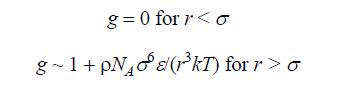
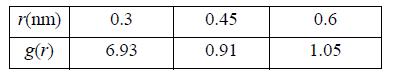
An alternative to the pressure equation route from the molecular scale to the macroscopic scale is through the energy equation (Eqn. 7.50). The treatment is similar to the analysis for the pressure equation, but the expression for the radial distribution function must now be integrated over the
The enthalpy of normal liquids changes nearly linearly with temperature. Therefore, in a single-pass countercurrent heat exchanger for two normal liquids, the temperature profiles of both fluids are nearly linear. However, the enthalpy of a high-pressure gas can be nonlinearly related to
Evaluate the internal energy departure function at ρNAσ3 = 0.6 and ε/kT = 1 by performing the appropriate derivatives and integrations of the equation of state obtained by applyingat all temperatures and densities:(a) The square-well potential with λsw = 1.5(b) The Sutherland potential(c)
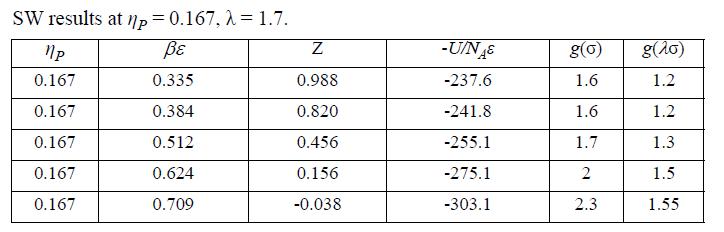
Molecular simulation can be used to explore the accuracy and significance of individual contributions to an equation of state. Use the DMD module at Etomica.org to explore Xe’s energy departure.(a) The simulation results below have been tabulated at ηP = 0.167, λ = 1.7. Plot U/NAε versus
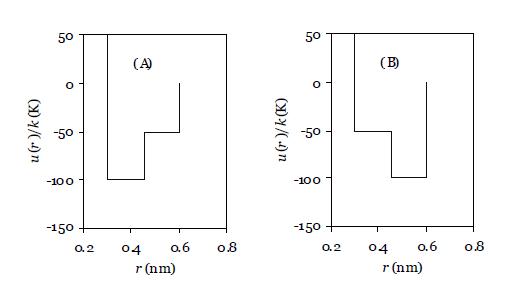
Suppose two molecules had similar potential functions, but they were mirror images of one another as shown in the figure below. Which one (A or B) would have the larger internal energy departure? You may assume that the radial distribution function is the same for both potential models.(a) Reason
Carbon dioxide (CP = 38 J/mol-K) at 1.5 MPa and 25°C is expanded to 0.1 MPa through a throttle valve. Determine the temperature of the expanded gas. Work the problem as follows:(a) Assuming the ideal gas law(b) Using the Peng-Robinson equation(c) Using a CO2 chart, noting that the triple point of
The heat of fusion for the ice-water phase transition is 335 kJ/kg at 0°C and 1 bar. The density of water is 1g/cm3 at these conditions and that of ice is 0.915 g/cm3. Develop an expression for the change of the melting temperature of ice as a function of pressure. Quantitatively explain why ice
Consider a stream of pure carbon monoxide at 300 bar and 150 K. We would like to liquefy as great a fraction as possible at 1 bar. One suggestion has been to expand this highpressure fluid across a Joule-Thompson valve and take what liquid is formed. What would be the fraction liquefied for this
Thermodynamics tables and charts may be used when both H and S are tabulated. Since G = H - TS, at constant temperature, ΔG = RT ln(f2/f1) = ΔH - TΔS. If state 1 is at low pressure where the gas is ideal, then f1 = P1, RT ln(f2/P1) = ΔH - TΔS, where the subscripts indicate states. Use this
Consider problem 3.11 using benzene as the fluid rather than air and eliminating the ideal gas assumption. Use the Peng-Robinson equation. For the same initial state,(a) The final tank temperature will not be 499.6 K. What will the temperature be?(b) What is the number of moles left in the tank at
Solve problem 8.22 for an adiabatic compression.Data from problem 8.221 m3 of CO2 initially at 150°C and 50 bar is to be isothermally compressed in a frictionless piston/cylinder device to a final pressure of 300 bar. Calculate the volume of the compressed gas, ΔU, the work done to compress the
An alternative suggestion for the liquefaction of CO discussed above is to use a 90% efficient adiabatic turbine in place of the Joule-Thomson valve. What would be the fraction liquefied in that case?
This problem reinforces the concepts of phase equilibria for pure substances.(a) Use steam table data to calculate the Gibbs energy of 1 kg saturated steam at 150°C, relative to steam at 150°C and 50 kPa (the reference state). Perform the calculation by plotting the volume data and graphically
Calculate the fugacity of ethane at 320 K and 70 bar using:(a) Generalized charts(b) The Peng-Robinson equation
CO2 is compressed at 35°C to a molar volume of 200 cm3/gmole. Use the Peng-Robinson equation to obtain the fugacity in MPa.
Use the generalized charts to obtain the fugacity of CO2 at 125°C and 220 bar.
Calculate the fugacity of pure n-octane vapor as given by the virial equation at 580 K and 0.8 MPa.
Estimate the fugacity of pure n-pentane (C5H12) at 97°C and 7 bar by utilizing the virial equation.
Develop tables for H, S, and Z for N2 over the range Pr = [0.5, 1.5] and Tr = [Trsat, 300 K] according to the Peng-Robinson equation. Use the saturated liquid at 1 bar as your reference condition for H = 0 and S = 0.
Develop a P-H chart for saturated liquid and vapor butane in the range T = [260, 340] using the Peng-Robinson equation. Show constant S lines emanating from saturated vapor at 260 K, 300 K, and 340 K. For an ordinary vapor compression cycle, what would be the temperature and state leaving an
Compare the Antoine and shortcut vapor-pressure equations for temperatures from 298 K to 500 K. For the comparison, use a plot of log10Psat versus 1/T except provide a separate plot of Psat versus T for vapor pressures less than 0.1 MPa.(a) n-Hexane(b) Acetone(c) Methanol(d) 2-propanol(e) Water
For the compound(s) specified by your instructor in problem 9.13, use the virial equation to predict the virial coefficient for saturated vapor and the fugacity of saturated liquid. Compare the values of fugacity to the vapor pressure.Data from problem 9.13Compare the Antoine and shortcut
Compare the Peng-Robinson vapor pressures to the experimental vapor pressures (represented by the Antoine constants) for the species listed in problem 9.13.Data from problem 9.13Compare the Antoine and shortcut vapor-pressure equations for temperatures from 298 K to 500 K. (Note in your solution
Carbon dioxide can be separated from other gases by preferential absorption into an amine solution. The carbon dioxide can be recovered by heating at atmospheric pressure. Suppose pure CO2 vapor is available from such a process at 80 °C and 1 bar. Suppose the CO2 is liquefied and marketed in 43-L
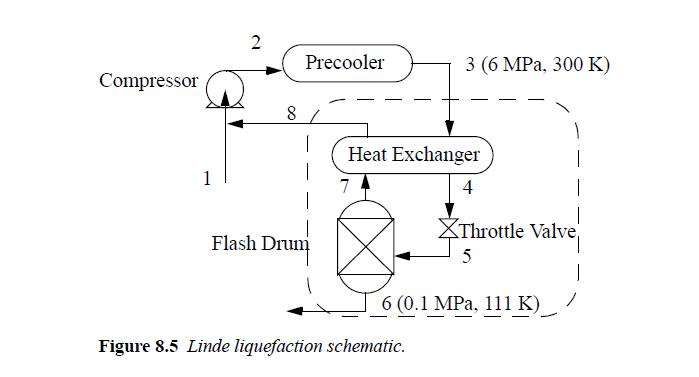
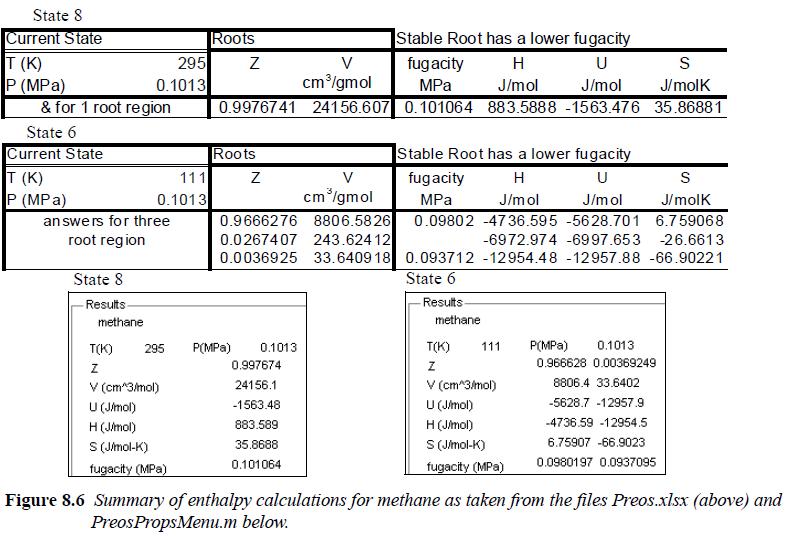
At the head of a methane gas well in western Pennsylvania, the pressure is 250 bar, and the temperature is roughly 300 K. This gas stream is similar to the high-pressure stream exiting the precooler in the Linde process. A perfect heat exchanger (approach temperature of zero) is available for
Use the result of problem 9.4 to calculate the fugacity of ethane at 320 K and at a molar volume of 150 cm3/mole. Also calculate the pressure in bar.Data from problem 9.4Derive the formula for fugacity according to the van der Waals equation.
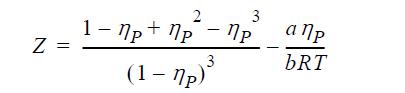
Derive the formula for fugacity according to the van der Waals equation.
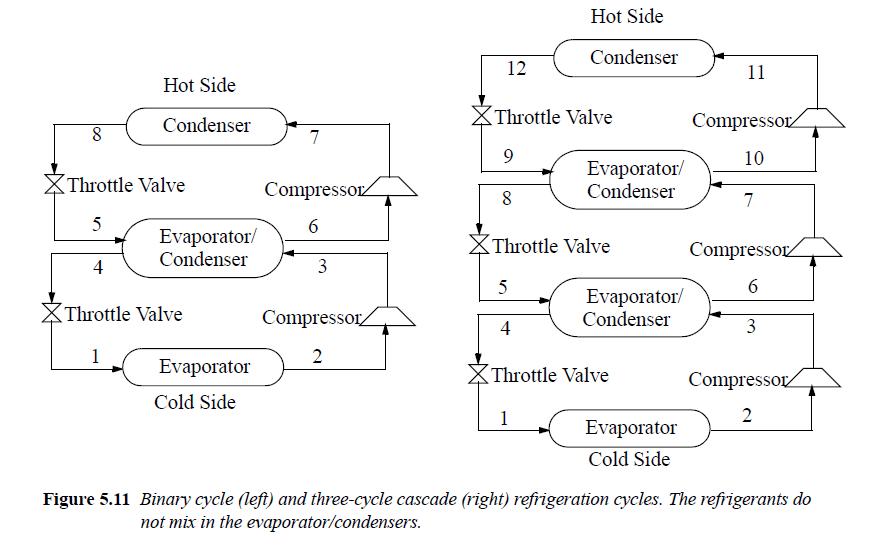
A three-cycle cascade refrigeration unit is to use methane (cycle 1), ethylene (cycle 2), and ammonia (cycle 3). The evaporators are to operate at: cycle 1, 115.6 K; cycle 2, 180 K; cycle 3, 250 K. The outlets of the compressors are to be: cycle 1, 4 MPa; cycle 2, 2.6 MPa; cycle 3, 1.4 MPa. Use the
Work problem 7.18, then obtain an expression for the fugacity. Determine the value of c (+/- 0.5) that best represents the vapor pressure of the specified compound below. Use the shortcut vapor pressure equation to estimate the experimental vapor pressure for the purposes of this problem.(a) CO2(b)
The stream from a gas well consists of 90 mol% methane, 5 mol% ethane, 3 mol% propane, and 2 mol% n-butane. This stream is flashed isothermally at 233 K and 70 bar. Use the shortcut K-ratio method to estimate the L/F fraction and liquid and vapor compositions.
For a separations process it is necessary to determine the VLE compositions of a mixture of ethyl bromide and n-heptane at 30°C. At this temperature the vapor pressure of pure ethyl bromide is 0.7569 bar, and the vapor pressure of pure n-heptane is 0.0773 bar. Calculate the bubble pressure and the
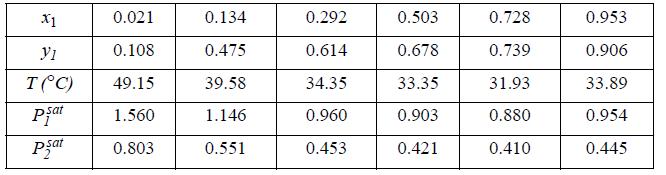
Benzene and ethanol (e) form azeotropic mixtures. Prepare a y-x and a P-x-y diagram for the benzene-ethanol system at 45°C assuming the mixture is ideal. Compare the results with the experimental data tabulated below of Brown and Smith, Austral. J. Chem. 264 (1954). (P in the data table is in
An equimolar mixture of n-butane and n-hexane at pressure P is isothermally flashed at 373 K. The liquid-to-feed ratio is 0.35. Use the shortcut K-ratio method to estimate the pressure and liquid and vapor compositions.
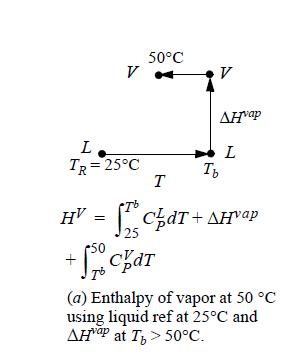
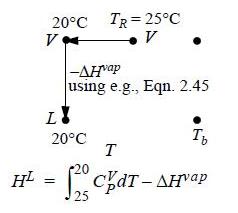
An mixture of 55 mol% ethanol in n-propanol is at 0.2MPa and 80°C at 70 mol/s. The stream is fed to a adiabatic flash drum. Calculate the outlet stream flow rates, temperatures, and compositions.(a) Use the path of Fig. 2.6(a).(b) Use the path of Fig. 2.6(c).(c) Enthalpy of liquid at 20°C using
A mixture of 25 mol% n-pentane, 45 mol% n-hexane, and 30 mol% n heptane is flashed isothermally at 365.9 K and 2 bar. Use the shortcut K-ratio method to estimate the L /F fraction and liquid and vapor compositions.
The following mixture of hydrocarbons is obtained as one stream in a petroleum refinery on a mole basis: 5% ethane, 10% propane, 40% n-butane, 45% isobutane. Assuming the shortcut K-ratio model: (a) Compute the bubble point of the mixture at 5 bar; (b) Compute the dew point of the mixture at 5
A mixture containing 15 mol% ethane, 35 mol% propane, and 50 mole% n-butane is isothermally flashed at 9 bar and temperature T. The liquid-to-feed ratio is 0.35. Use the shortcut K-ratio method to estimate the pressure and liquid and vapor compositions
Consider a mixture of 50 mol% n-pentane and 50 mol% n-butane at 14 bar.(a) What is the dew-point temperature? What is the composition of the first drop of liquid?(b) At what temperature is the vapor completely condensed if the pressure is maintained at 14 bar? What is the composition of the last
A 50 mol% mixture of propane(1) and n-butane(2) enters an isothermal flash drum at 37°C. If the flash drum is maintained at 0.6 MPa, what fraction of the feed exits as liquid? What are the compositions of the phases exiting the flash drum? Work the problem in the following two ways.(a) Use
An equimolar ternary mixture of acetone, n-butane, and ammonia at 1 MPa is to be flashed. List the known variables, unknown variables, and constraining equations to solve each of the cases below. Assume ideal solution thermodynamics and write the flash equations in terms of K-ratios, with the
Tank A is rapidly half-filled with volatile hydrocarbon. Tank B is 10 times as large and rapidly half-filled with the same hydrocarbon. Initially the gas space can be considered to be free of volatile organic and at the same pressure. The tanks are then closed. The tanks warm 20°C and the pressure
Above a solvent’s flash point temperature, the vapor concentration in the headspace is sufficient that a spark will initiate combustion; therefore, extreme care must be exercised to avoid ignition sources. Calculate the vapor phase mole fraction for the following liquid solvents using flash
Solvent vessels must be purged before maintenance personnel enter in order to ensure that: (1) Sufficient oxygen is available for breathing; (2) Vapor concentrations are below the flash point; (3) Vapor concentrations are below the Occupational Safety and Health Administration (OSHA) limits if
A pharmaceutical product is crystallized and washed with absolute ethanol. A 100 kg batch of product containing 10% ethanol by weight is to be dried to 0.1% ethanol by weight by passing 0.2 m3/min of 50C nitrogen through the dryer. Estimate the rate (mol/min) that ethanol is removed from the
Benzyl chloride is manufactured by the thermal or photochemical chlorination of toluene. The chlorination is usually carried out to no more than 50% toluene conversion to minimize the benzyl chloride formed. Suppose reactor effluent emissions can be modeled ignoring by-products, and the effluent is
The volume change on mixing for the liquid methyl formate(1) + liquid ethanol(2) system at 298.15 K may be approximately represented by J. Polack, Lu, B.C.-Y. 1972. J. Chem Thermodynamics, 4:469:(a) Using this correlation, and the data V1 = 67.28 cm3/mol, V2 = 58.68 cm3/mol, determine the molar
Use Raoult’s law to estimate the flash point temperature for the following equimolar liquid mixtures in an air atmosphere at 750 mmHg total pressure:(a) Pentane (LFL = 1.5%) and hexane (LFL = 1.2%)(b) Methanol (LFL = 7.3%) and ethanol (LFL = 4.3%)(c) Benzene (LFL = 1.3%) and toluene (LFL = 1.27%)
In vapor-liquid equilibria the relative volatility αij is defined by Eqn. 10.32.(a) Provide a simple proof that the relative volatility is independent of liquid and vapor composition if a system follows Raoult’s law.(b) In approximation to a distillation calculation for a nonideal system,
Go to www.csb.gov and watch a video assigned by your instructor. For the substance involved, look up the LFL. Use Raoult’s law to estimate the flash point temperature and compare it with a literature value. For the scenario in the video, offer an explanation of how easy or difficult is was to
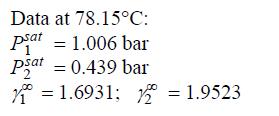
After fitting the two-parameter Margules equation to the data below, generate a P-x-y diagram at 78.15 °C. Data at 78.15°C: psat = 1.006 bar 1 psat = 0.439 bar = 1.6931; 2 = 1.9523
Derive the expression for the activity coefficient of the Redlich-Kister expansion.
A stream containing equimolar methanol + benzene at 350 K and 1500 mmHg is to be adiabatically flashed to atmospheric pressure. Assume the Scatchard-Hildebrand model is to be applied. Express all flash equations in terms of Ki values and Ki values in terms of Modified Raoult’s law.(a) List all
In the system A + B, activity coefficients can be expressed by the one-parameter Margules equation with A = 0.5. The vapor pressures of A and B at 80C are PAsat = 900 mmHg, PBsat = 600 mmHg. Is there an azeotrope in this system at 80C, and if so, what is the azeotrope pressure and composition?
The system acetone(1) + methanol(2) is well represented by the one-parameter Margules equation using A = 0.605 at 50°C.(a) What is the bubble pressure for an equimolar mixture at 30°C?(b) What is the dew pressure for an equimolar mixture at 30°C?(c) What is the bubble temperature for an
(a) The acetone(1) + chloroform(2) system can be represented by the Margules twoparameter equation using A12 = 1.149, A21 = -0.862 at 35.17°C. Use bubble-pressure calculations to generate a P-x-y and y-x diagram and compare it with the selected values from the measurements of Zawidzki, Z. Phys.
The excess Gibbs energy for a liquid mixture of n-hexane(1) + benzene(2) at 30 °C is represented by GE = 1089 x1x2 J/mol.(a) What is the bubble pressure for an equimolar mixture at 30°C?(b) What is the dew pressure for an equimolar mixture at 30°C?(c) What is the bubble temperature for an
The liquid phase activity coefficients of the ethanol(1) + toluene(2) system at 55°C are given by the two-parameter Margules equation, where A12 = 1.869 and A21 = 1.654.(a) Show that the pure saturation fugacity coefficient is approximately 1 for both components.(b) Calculate the fugacity for each
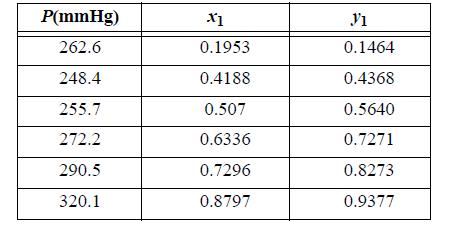
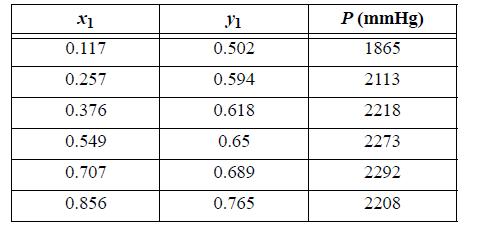
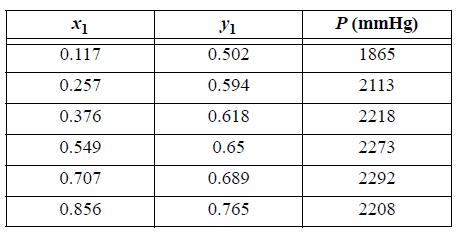
(a) Fit the Margules two-parameter equation to the methanol(1) + benzene(2) system P-x-y data below at 90°C (Jost, W., Roek, H, Schroeder, W., Sieg, L., Wagner, H.G. 1957. Z. Phys. Chem. 10:133) by fitting to x1=0.549. Plot the resultant fit together with the original data for both phases.(b)
For a particular binary system, data are available:(a) Fit the one-parameter Margules equation(b) Fit the two-parameter Margules equation T= 45°C P= 37 kPa x₁ = 0.398 V₁ = 0.428 In addition, Pat = 27.78 kPa and Pat = 29.82 kPa. From these data,
(a) Fit the Margules two-parameter equation to the n-pentane(1) + acetone(2) system P-x-y data below at 1 bar (Lo et al. 1962. J. Chem. Eng. Data 7:32) by fitting to x1 = 0.503. Plot the resultant fit together with the original data for both phases.(b) Compare the data with the predictions of the
The compositions of coexisting phases of ethanol(1) + toluene(2) at 55°C are x1 = 0.7186, and y1 = 0.7431 at P = 307.81 mmHg, as reported by Kretschmer and Wiebe, J. Amer. Chem. Soc., 71, 1793(1949). Estimate the bubble pressure at 55°C and x1 = 0.1, using(a) The one-parameter Margules
A vapor/liquid experiment for the carbon disulfide(1) + chloroform(2) system has provided the following data at 298 K: P1sat = 46.85 kPa, P2sat = 27.3 kPa, x1 = 0.2, y1 = 0.363, P = 34.98 kPa. Estimate the dew pressure at 298 K and y1 = 0.6, using(a) The one-parameter Margules equation(b) The
Ethanol(1) + benzene(2) form an azeotropic mixture. Compare the specified model to the experimental data of Brown and Smith cited in problem 10.2.(a) Prepare a y-x and P-x-y diagram for the system at 45°C assuming the MAB model.(b) Prepare a y-x and P-x-y diagram for the system at 45°C assuming
The (1) + (2) system forms an azeotrope at x1 = 0.75 and 80°C. At 80°C, P1sat = 600 mmHg, P2sat = 900 mmHg. The liquid phase can be modeled by the one-parameter Margules equation.(a) Estimate the activity coefficient of component 1 at x1 = 0.75 and 80 °C.(b) Qualitatively sketch the P-x-y and
For the Margules two-parameter model estimate the total pressure and composition of the vapor in equilibrium with a 20 mol% ethanol(1) solution in water(2) at 78.15 °C using data at 78.15°C: psat = 1 1.006 bar: Pat = 0.439 bar; = 1.6931; 12 = 1.9523
The acetone + chloroform system exhibits an azeotrope at 64.7°C, 760 mmHg, and 20 wt% acetone.(a) Use the MAB model to predict the T-x-y diagram at 1 bar.(b) Use the Margules one-parameter model to estimate the T-x-y diagram at 1 bar.
Using the data from problem 11.18, fit the two-parameter Margules equation, and then generate a P-x-y diagram at 78.15°C.Data from problem 11.18For the Margules two-parameter model estimate the total pressure and composition of the vapor in equilibrium with a 20 mol% ethanol(1) solution in
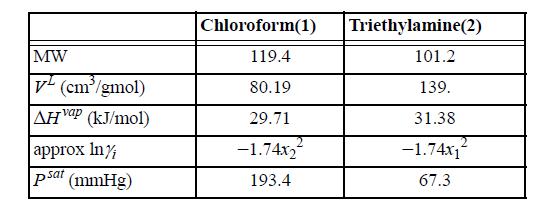
Suppose a vessel contains an equimolar mixture of chloroform(1) and triethylamine(2) at 25°C. The following data are available at 25°C:(a) If the pressure in the vessel is 90 mmHg, is the mixture a liquid, a vapor, or both liquid and vapor? Justify your answer.(b) Provide your best estimate of
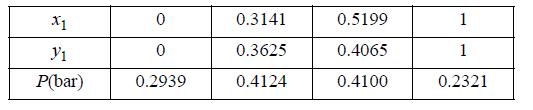
A liquid mixture of 50 mol% chloroform(1) and 50% 1,4-dioxane(2) at 0.1013 MPa is metered into a flash drum through a valve. The mixture flashes into two phases inside the drum where the pressure and temperature are maintained at 24.95 kPa and 50°C. The compositions of the exiting phases are x1 =
Ethanol(1) + benzene(2) form azeotropic mixtures.(a) From the limited data below at 45 °C, it is desired to estimate the constant A for the one-term Margules equation, GE/RT = Ax1x2. Use all of the experimental data to give your best estimate.(b) From your value, what are the bubble pressure and
Fit the data from problem 11.11 to the following model by regression over all points, and compare with the experimental data on the same plot, using:(a) One-parameter Margules equation(b) Two-parameter Margules equationData from problem 11.11(a) Fit the Margules two-parameter equation to the
Fit the specified model to the methanol(1) + benzene(2) system P-x-y data at 90°C by minimizing the sum of squares of the pressure residual. Plot the resultant fit together with the original data for both phases (data are in problem 11.10), using(a) One-parameter Margules equation(b) Two-parameter
An equimolar ternary mixture of acetone, n-butane, and ammonia at 1 MPa is to be flashed. List the known variables, unknown variables, and constraining equations to solve each of the cases below. Assume MAB solution thermodynamics and write the flash equations in terms of K-ratios, with the
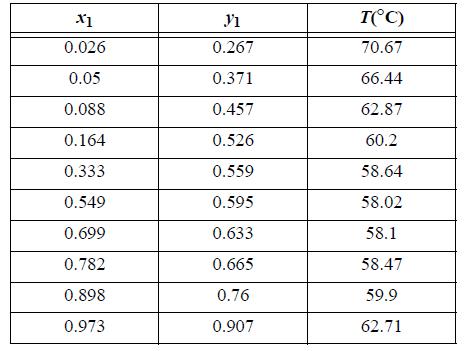
Fit the specified model to the methanol(1) + benzene(2) system T-x-y data at 760 mmHg by minimizing the sum of squares of the pressure residual. Plot the resultant fit together with the original data for both phases (Hudson, J.W., Van Winkle, M. 1969. J. Chem. Eng. Data 14:310), using(a)
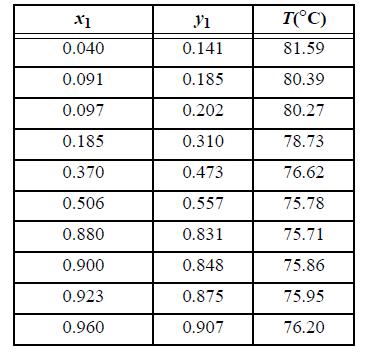
VLE data for the system carbon tetrachloride(1) and 1,2- dichloroethane(2) are given below at 760 mmHg, as taken from the literature.(a) Fit the data to the one-parameter Margules equation.(b) Fit the data to the two-parameter Margules equation.(c) Plot the P-x-y diagram at 80°C, based on one of
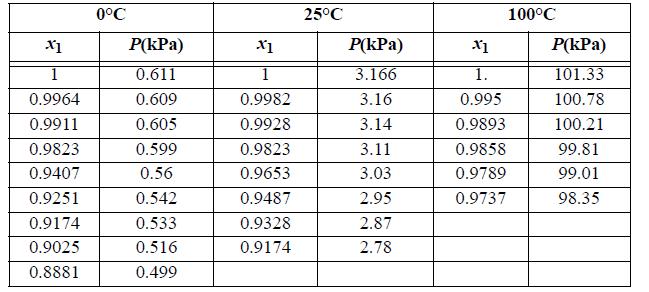
When only one component of a binary mixture is volatile, the pressure over the mixture is determined entirely by the volatile component. The activity coefficient for the volatile component can be determined using modified Raoult’s law and an activity coefficient model can be fitted. The model
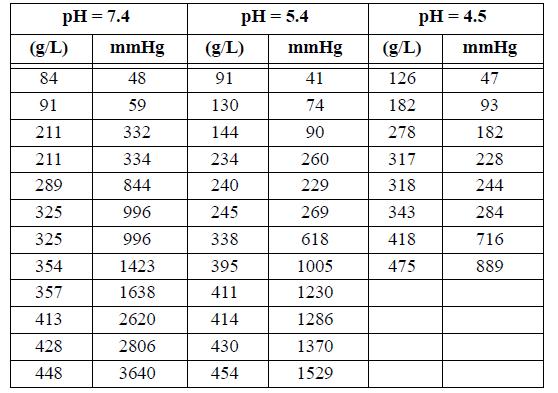
Osmotic pressure of bovine serum albumin (BSA) has been measured at 298.15 K and various pH values by Vilker, V.L., Colton, C.K., Smith, K.A. 1981. J. Colloid Int. Sci. 79:548, as summarized in the table below. The investigators report the BSA molecular weight in their sample as 69,000.(a)
Red blood cells have a concentration of hemoglobin (Mw ~ 68000) at 0.3 M. The osmotic pressure a body temperature (37°C) is 0.83 MPa. Water can permeate the cells walls, but not hemoglobin.(a) Using only the second osmotic coefficient, determine the coefficient value (L/g), and determine the
Boric acid is a common supplement to make ophthalmic solutions isotonic. It is entirely undissociated at normal ophthalmic conditions.(a) Estimate the concentration (wt%) of boric acid to prepare a solution that is isotonic with human blood.(b) Estimate the concentration (wt%) of boric acid that
An ordinary vapor compression refrigeration cycle using R134a is to operate with a condenser at 45°C and an evaporator at -10°C. The compressor is 80% efficient.(a) Determine the amount of cooling per kg of R134a circulated.(b) Determine the amount of heat rejected per kg of R134a circulated.(c)
An ordinary vapor compression cycle is to be operated on methane to cool a chamber to -260°F. Heat will be rejected to liquid ethylene at -165oF. The temperatures in the condenser and evaporator are -160°F and -280°F. Compute the coefficient of performance.
Estimate the average speed (mph) of hydrogen molecules at 200 K and 3 bars.
In each of the following, sketch your estimates of the intermolecular potentials between the given molecules and their mixture on the same pair of axes.(a) Chloroform is about 20% larger than acetone and about 10% stickier, but chloroform and acetone stick to one another much more strongly than
Estimate the entropy (J/g-K) of steam at 27.5MPa and 425C.
Showing 1500 - 1600
of 2105
First
8
9
10
11
12
13
14
15
16
17
18
19
20
21
22
Step by Step Answers

 Get 50% OFF
Claim Now
Get 50% OFF
Claim Now