New Semester
Started
Get
50% OFF
Study Help!
--h --m --s
Claim Now
Question Answers
Textbooks
Find textbooks, questions and answers
Oops, something went wrong!
Change your search query and then try again
S
Books
FREE
Study Help
Expert Questions
Accounting
General Management
Mathematics
Finance
Organizational Behaviour
Law
Physics
Operating System
Management Leadership
Sociology
Programming
Marketing
Database
Computer Network
Economics
Textbooks Solutions
Accounting
Managerial Accounting
Management Leadership
Cost Accounting
Statistics
Business Law
Corporate Finance
Finance
Economics
Auditing
Tutors
Online Tutors
Find a Tutor
Hire a Tutor
Become a Tutor
AI Tutor
AI Study Planner
NEW
Sell Books
Search
Search
Sign In
Register
study help
engineering
introduction to chemical engineering thermodynamics
Introductory Chemical Engineering Thermodynamics 2nd Edition J. Elliott, Carl Lira - Solutions
For each of the states below, calculate the number of moles of ideal gas held in a three liter container.(a) T = 673 K, P = 2 MPa(b) T = 500 K, P = 0.7 MPa(c) T = 450 K, P = 1.5 MPa
A 5 m3 outdoor gas storage tank warms from 10°C to 40°C on a sunny day. If the initial pressure was 0.12 MPa at 10°C, what is the pressure at 40°C, and how many moles of gas are in the tank? Use the ideal gas law.
An automobile tire has a pressure of 255 kPa (gauge) in the summer when the tire temperature after driving is 50°C. What is the wintertime pressure of the same tire at 0°C if the volume of the tire is considered the same and there are no leaks in the tire?
A 5 m3 gas storage tank contains methane. The initial temperature and pressure are P = 1 bar, T = 18°C. Using the ideal gas law, calculate the P following each of the successive steps.(a) 1 m3 (at standard conditions) is withdrawn isothermally.(b) The sun warms the tank to 40°C.(c) 1.2 m3 (at
Calculate the mass density of the following gases at 298 K and 1 bar.(a) Nitrogen(b) Oxygen(c) Air (use average molecular weight)(d) CO2(e) Argon
Calculate the mass of air (in kg) that is contained in a classroom that is 12m x 7m x 3m at 293 K and 0.1 MPa.
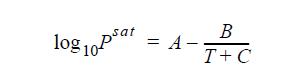
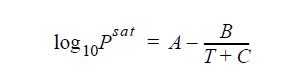
Five grams of the specified pure solvent is placed in a variable volume piston. What is the volume of the pure system when 50% and 75% have been evaporated at: (i) 30°C, (ii) 50°C? Use the Antoine equation (Appendix E) to relate the saturation temperature and saturation pressure. Use the ideal
A gasoline spill is approximately 4 liters of liquid. What volume of vapor is created at 1 bar and 293 K when the liquid evaporates? The density of regular gasoline can be estimated by treating it as pure isooctane (2,2,4-trimethylpentane ρL = 0.692 g/cm3) at 298 K and 1 bar.
The gross lifting force of a balloon is given by (ρair – ρgas)Vballoon. What is the gross lifting force (in kg) of a hot air balloon of volume 1.5E6 L, if the balloon contains gas at 100°C and 1 atm? The hot gas is assumed to have an average molecular weight of 32 due to carbon dioxide from
LPG is a useful fuel in rural locations without natural gas pipelines. A leak during the filling of a tank can be extremely dangerous because the vapor is denser than air and drifts to low elevations before dispersing, creating an explosion hazard. What volume of vapor is created by a leak of 40L
The gas phase reaction A → 2R is conducted in a 0.1 m3 spherical tank. The initial temperature and pressure in the tank are 0.05 MPa and 400 K. After species A is 50% reacted, the temperature has fallen to 350 K. What is the pressure in the vessel?
A gas stream entering an absorber is 20 mol% CO2 and 80 mol% air. The flowrate is 1 m3/min at 1 bar and 360 K. When the gas stream exits the absorber, 98% of the incoming CO2 has been absorbed into a flowing liquid amine stream.(a) What are the gas stream mass flowrates on the inlet and outlets in
A permeation membrane separates an inlet air stream, F, (79 mol% N2, 21 mol% O2), into a permeate stream, M, and a reject stream, J. The inlet stream conditions are 293 K, 0.5 MPa, and 2 mol/min; the conditions for both outlet streams are 293 K and 0.1 MPa. If the permeate stream is 50 mol% O2, and
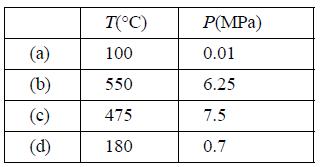
For water at each of the following states, determine the internal energy and enthalpy using the steam tables. (a) (b) (c) | 0 T(C) 100 550 475 180 P(MPa) 0.01 6.25 7.5 0.7
(a) What size vessel holds 2 kg water at 80°C such that 70% is vapor? What are the pressure and internal energy?(b) A 1.6 m3 vessel holds 2 kg water at 0.2 MPa. What are the quality, temperature, and internal energy?
Determine the temperature, volume, and quality for one kg water under the following conditions:(a) U = 3000 kJ/kg, P = 0.3 MPa(b) U = 2900 kJ/kg, P = 1.7 MPa(c) U = 2500 kJ/kg, P = 0.3 MPa(d) U = 350 kJ/kg, P = 0.03 MPa
Two kg of water exist initially as a vapor and liquid at 90°C in a rigid container of volume 2.42 m3.(a) At what pressure is the system?(b) What is the quality of the system?(c) The temperature of the container is raised to 100°C. What is the quality of the system, and what is the pressure? What
Three kg of saturated liquid water are to be evaporated at 60°C.(a) At what pressure will this occur at equilibrium?(b) What is the initial volume?(c) What is the system volume when 2 kg have been evaporated? At this point, what is ΔU relative to the initial state?(d) What are ΔH and ΔU
The energy balance can be developed for just about any process. Since our goal is to learn how to develop model equations as well as to simply apply them, it is valuable practice to obtain the appropriate energy balance for a broad range of odd applications. If you can deduce these energy balances,
Three moles of an ideal gas (with temperature-independent CP = (7/ 2)R, CV = (5/2)R) is contained in a horizontal piston/cylinder arrangement. The piston has an area of 0.1 m2 and mass of 500 g. The initial pressure in the piston is 101 kPa. Determine the heat that must be extracted to cool the gas
The energy balance can be developed for just about any process. Since our goal is to learn how to develop model equations as well as to simply apply them, it is valuable practice to obtain the appropriate energy balance for a broad range of odd applications. If you can deduce these energy balances,
One mole of an ideal gas (Cp = 7R/2) in a closed piston/cylinder is compressed from Ti = 100 K, Pi = 0.1 MPa to Pf = 0.7 MPa by the following pathways. For each pathway, calculate ΔU, ΔH, Q, and WEC: (a) Isothermal; (b) Constant volume; (c) Adiabatic.
The energy balance can be developed for just about any process. Since our goal is to learn how to develop model equations as well as to simply apply them, it is valuable practice to obtain the appropriate energy balance for a broad range of odd applications. If you can deduce these energy balances,
One mole of an ideal gas (Cp = 5R/2) in a closed piston/cylinder is compressed from Ti = 298 K, Pi = 0.1 MPa to Pf = 0.25 MPa by the following pathways. For each pathway, calculate ΔU, ΔH, Q, and WEC: (a) Isothermal; (b) Constant volume; (c) Adiabatic.
The energy balance can be developed for just about any process. Since our goal is to learn how to develop model equations as well as to simply apply them, it is valuable practice to obtain the appropriate energy balance for a broad range of odd applications. If you can deduce these energy balances,
One mole of an ideal gas (Cp=7R/2) in a closed piston/cylinder is expanded from Ti = 700 K, Pi = 0.75 MPa to Pf = 0.1 MPa by the following pathways. For each pathway, calculate ΔU, ΔH, Q, and WEC: (a) Isothermal; (b) Constant volume; (c) Adiabatic.
The energy balance can be developed for just about any process. Since our goal is to learn how to develop model equations as well as to simply apply them, it is valuable practice to obtain the appropriate energy balance for a broad range of odd applications. If you can deduce these energy balances,
One mole of an ideal gas (Cp = 5R/2) in a closed piston/cylinder is expanded from Ti = 500 K, Pi = 0.6 MPa to Pf = 0.1 MPa by the following pathways. For each pathway, calculate ΔU, ΔH, Q, and WEC: (a) Isothermal; (b) Constant volume; (c) Adiabatic.
The energy balance can be developed for just about any process. Since our goal is to learn how to develop model equations as well as to simply apply them, it is valuable practice to obtain the appropriate energy balance for a broad range of odd applications. If you can deduce these energy balances,
(a) What is the enthalpy change needed to change 3 kg of liquid water at 0°C to steam at 0.1 MPa and 150°C?(b) What is the enthalpy change needed to heat 3 kg of water from 0.4 MPa and 0°C to steam at 0.1 MPa and 150°C?(c) What is the enthalpy change needed to heat 1 kg of water at 0.4 MPa and
The energy balance can be developed for just about any process. Since our goal is to learn how to develop model equations as well as to simply apply them, it is valuable practice to obtain the appropriate energy balance for a broad range of odd applications. If you can deduce these energy balances,
Steam undergoes a state change from 450°C and 3.5 MPa to 150°C and 0.3 MPa. Determine ΔH and ΔU using the following:(a) Steam table data.(b) Ideal gas assumptions. (Be sure to use the ideal gas heat capacity for water.)
The energy balance can be developed for just about any process. Since our goal is to learn how to develop model equations as well as to simply apply them, it is valuable practice to obtain the appropriate energy balance for a broad range of odd applications. If you can deduce these energy balances,
Five grams of the specified pure solvent is placed in a variable volume piston. What are the molar enthalpy and total enthalpy of the pure system when 50% and 75% have been evaporated at: (i) 30°C, (ii) 50°C? Use liquid at 25°C as a reference state.(a) Benzene (ρL = 0.88 g/cm3).(b) Ethanol
Create a table of T, U, H for the specified solvent using a reference state of H = 0 for liquid at 25°C and 1 bar. Calculate the table for: (i) Liquid at 25°C and 1 bar; (ii) Saturated liquid at 1 bar; saturated vapor at 1 bar; (iii) Vapor at 110°C and 1 bar. Use the Antoine equation
Consider a block of concrete weighing 1 kg.(a) How far must it fall to change its potential energy by 1 kJ?(b) What would be the value of its velocity at that stage?
A block of copper weighing 0.2 kg with an initial temperature of 400 K is dropped into 4 kg of water initially at 300 K contained in a perfectly insulated tank. The tank is also made of copper and weighs 0.5 kg. Solve for the change in internal energy of both the water and the block given CV =
One kg of methane is contained in a piston/cylinder device at 0.8 MPa and 250°C. It undergoes a reversible isothermal expansion to 0.3 MPa. Methane can be considered an ideal gas under these conditions. How much heat is transferred?
In the preceding problem, suppose that the copper block is dropped into the water from a height of 50 m. Assuming no loss of water from the tank, what is the change in internal energy of the block?
One kg of steam in a piston/cylinder device undergoes the following changes of state. Calculate Q and W for each step.(a) Initially at 350 kPa and 250°C, it is cooled at constant pressure to 150°C.(b) Initially at 350 kPa and 250°C, it is cooled at constant volume to 150°C.
In the following take CV = 5 and CP = 7 cal/mol-K for nitrogen gas:(a) Five moles of nitrogen at 100 °C is contained in a rigid vessel. How much heat must be added to the system to raise its temperature to 300 °C if the vessel has a negligible heat capacity? If the vessel weighs 80 g and has a
In one stroke of a reciprocating compressor, helium is isothermally and reversibly compressed in a piston + cylinder from 298 K and 20 bars to 200 bars. Compute the heat removal and work required.
A rigid cylinder of gaseous hydrogen is heated from 300 K and 1 bar to 400 K. How much heat is added to the gas?
Air at 30°C and 2MPa flows at steady state in a horizontal pipeline with a velocity of 25 m/s. It passes through a throttle valve where the pressure is reduced to 0.3 MPa. The pipe is the same diameter upstream and downstream of the valve. What is the outlet temperature and velocity of the gas?
Saturated steam at 660 °F is adiabatically throttled through a valve to atmospheric pressure in a steady-state flow process. Estimate the outlet quality of the steam.
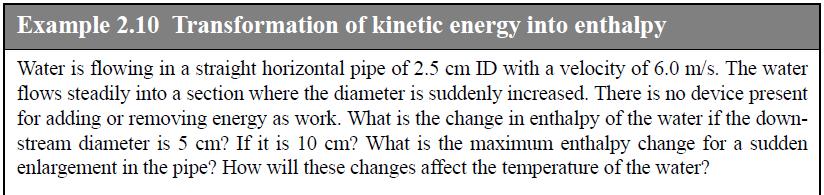
Refer to Example 2.10 about transformation of kinetic energy to enthalpy. Instead of water, suppose N2 at 1 bar and 298 K was flowing in the pipe. How would that change the answers? In particular, how would the temperature rise change? Example 2.10 Transformation of kinetic energy into enthalpy
Argon at 400 K and 50 bar is adiabatically and reversibly expanded to 1 bar through a turbine in a steady process. Compute the outlet temperature and work derived per mole.
Steam at 500 bar and 500°C undergoes a throttling expansion to 1 bar. What will be the temperature of the steam after the expansion? What would be the downstream temperature if the steam were replaced by an ideal gas, CP /R = 7/2?
Steam at 150 bars and 600°C passes through process equipment and emerges at 100 bars and 700°C. There is no flow of work into or out of the equipment, but heat is transferred.(a) Using the steam tables, compute the flow of heat into the process equipment per kg of steam.(b) Compute the value of
An adiabatic turbine expands steam from 500°C and 3.5 MPa to 200°C and 0.3 MPa. If the turbine generates 750 kW, what is the flow rate of steam through the turbine?
A 700 kg piston is initially held in place by a removable latch above a vertical cylinder. The cylinder has an area of 0.1 m2; the volume of the gas within the cylinder initially is 0.1 m3 at a pressure of 10 bar. The working fluid may be assumed to obey the ideal gas equation of state. The
A steam turbine operates between 500°C and 3.5 MPa to 200°C and 0.3 MPa. If the turbine generates 750 kW and the heat loss is 100 kW, what is the flow rate of steam through the turbine?
A tennis ball machine fires tennis balls at 40 mph. The cylinder of the machine is 1 m long; the installed compressor can reach about 50 psig in a reasonable amount of time. The tennis ball is about 3 inches in diameter and weighs about 0.125 lbm. Estimate the initial volume required in the
Valves on steam lines are commonly encountered and you should know how they work. For most valves, the change in velocity of the fluid flow is negligible. Apply this principle to solve the following problems.(a) A pressure gauge on a high-pressure steam line reads 80 bar absolute, but temperature
A 700 kg piston is initially held in place by a removable latch inside a horizontal cylinder. The totally frictionless cylinder (assume no viscous dissipation from the gas also) has an area of 0.1 m2; the volume of the gas on the left of the piston is initially 0.1 m3 at a pressure of 8 bars. The
An overall balance around part of a plant involves three inlets and two outlets which only contain water. All streams are flowing at steady state. The inlets are: 1) liquid at 1MPa, 25°C, ṁ = 54 kg/ min; 2) steam at 1 MPa, 250°C ṁ = 35 kg/min; 3) wet steam at 0.15 MPa, 90% quality, ṁ = 30
Steam at 550 kPa and 200°C is throttled through a valve at a flow rate of 15 kg/min to a pressure of 200 kPa. What is the temperature of the steam in the outlet state, and what is the change in specific internal energy across the value, (Uout – Uin)?
A 0.1 m3 cylinder containing an ideal gas (CP /R = 3.5) is initially at a pressure of 10 bar and a temperature of 300 K. The cylinder is emptied by opening a valve and letting pressure drop to 1 bar. What will be the temperature and moles of gas in the cylinder if this is accomplished in the
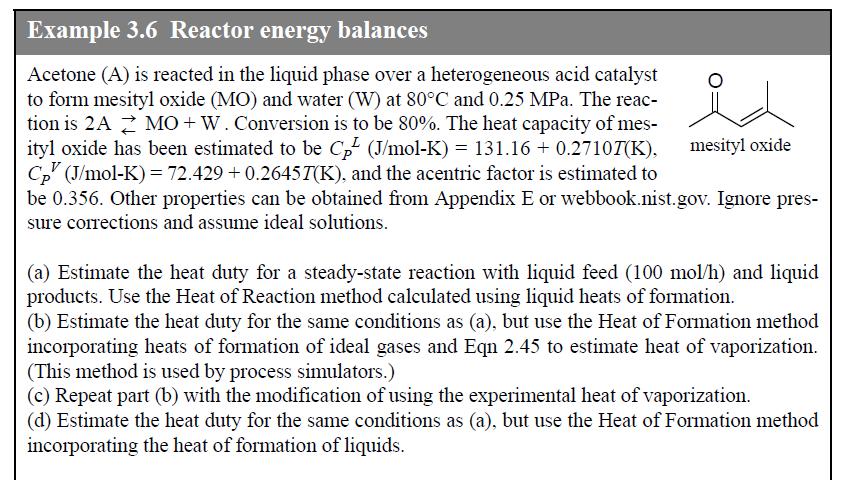
Dimethyl ether (DME) synthesis provides a simple prototype of many petrochemical processes. Ten tonnes (10,000 kg) per hour of methanol are fed at 25°C. The entire process operates at roughly 10 bar. It is 50% converted to DME and water at 250°C. The reactor effluent is cooled to 75°C and sent
As part of a supercritical extraction of coal, an initially evacuated cylinder is fed with steam from a line available at 20 MPa and 400°C. What is the temperature in the cylinder immediately after filling?
A large air supply line at 350 K and 0.5 MPa is connected to the inlet of a well-insulated 0.002 m3 tank. The tank has mass flow controllers on the inlet and outlet. The tank is at 300 K and 0.1 MPa. Both valves are rapidly and simultaneously switched open to a flow of 0.1 mol/min. Model air as an
Two moles of nitrogen are initially at 10 bar and 600 K (state 1) in a horizontal piston/cylinder device. They are expanded adiabatically to 1 bar (state 2). They are then heated at constant volume to 600 K (state 3). Finally, they are isothermally returned to state 1. Assume that N2 is an ideal
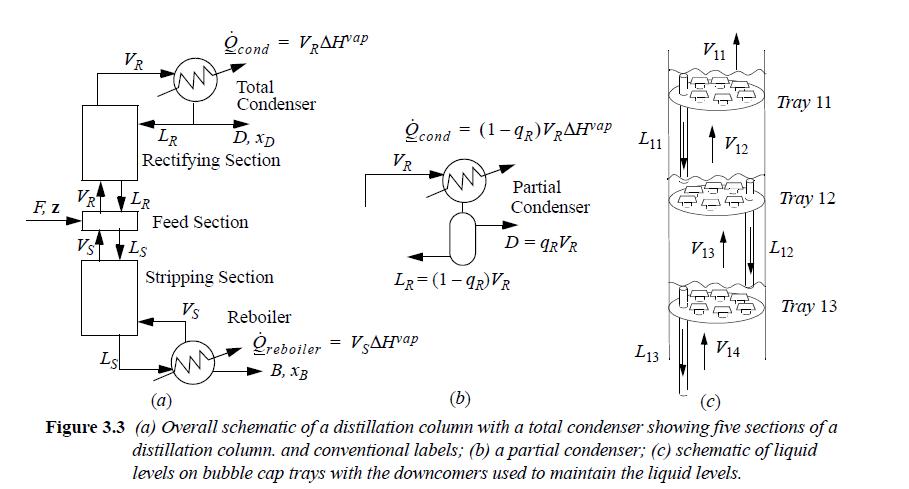
A distillation column with a total condenser is shown in Fig. 3.3. The system to be studied in this problem has an average enthalpy of vaporization of 32 kJ/mol, an average CPL of 146 J/mol°-C, and an average CPV of 93 J/mol°-C. Variable names for the various stream flow rates and the heat flow
The Arrhenius model of global warming constitutes a very large composite system. It assumes that a layer of gases in the atmosphere (A) absorbs infrared radiation from the Earth's surface and re-emits it, with equal amounts going off into space or back to the Earth's surface; 240 W/m2 of the solar
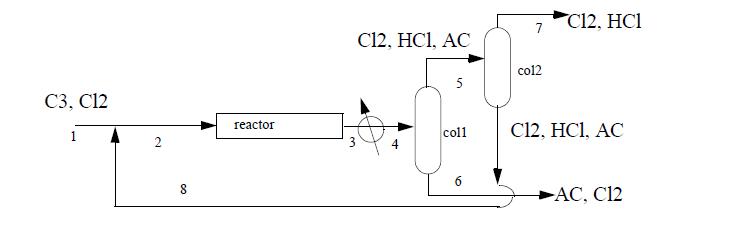
Allyl chloride (AC) synthesis provides a simple prototype of many petrochemical processes. 869 kg per hour of propylene (C3) are fed with a 1% excess of chlorine (Cl2) at 25°C. The entire process operates at roughly 10 bar. Cl2 is recycled to achieve a 50% excess of Cl2 at the reactor inlet. The
Chlorobenzene(l) is produced by reacting benzene(l) initially at 30°C with Cl2(g) initially at 30°C in a batch reactor using AlCl3 as a catalyst. HCl(g) is a by-product. During the course of the reaction, the temperature increases to 50°C. To avoid dichlorobenzenes, conversion of benzene is
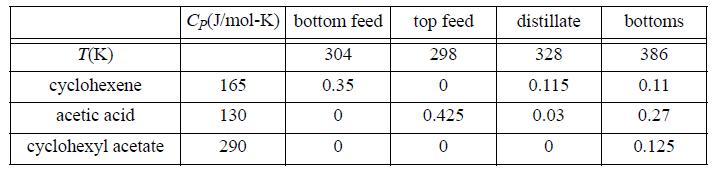
In the process of reactive distillation, a reaction occurs in a distillation column simultaneously with distillation, offering process intensification. Consider a reactive distillation including the reaction: cyclohexene(l) + acetic acid(l) ⇆ cyclohexyl acetate(l). In a reactive distillation two
Benzene and benzyl chloride produced from the reaction described in problem 3.6 are separated by distillation at 1 bar. The chlorine and HCl are removed easily and this problem concerns only a binary mixture. Suppose the liquid flow to the reboiler is 90 mol% chlorobenzene and 10 mol% benzene at
This problem considers oxidation of glucose as a model carbohydrate.(a) In the human body glucose is typically metabolized in aqueous solution. Ignoring the enthalpy change due to dissolving glucose in the aqueous solution, calculate the standard heat of reaction for Eqn. 3.56.(b) Using the
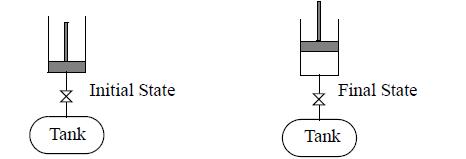
Compressed air at room temperature (295 K) is contained in a 20-L tank at 2 bar. The valve is opened and the tank pressure falls slowly and isothermally to 1.5 bar. The frictionless piston-cylinder is isothermal and isobaric (P = 1.5 bar) during the movement. The surroundings are at 1 bar. The
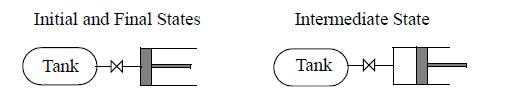
A well-insulated tank contains 1 mole of air at 2 MPa and 673 K. It is connected via a closed valve to an insulated piston/cylinder device that is initially empty. The piston may be assumed to be frictionless. The volumes of the piping and valve are negligible. The weight of the piston and
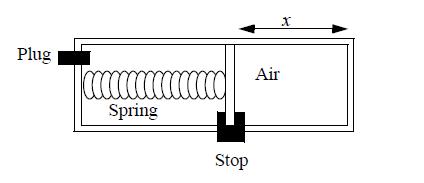
A piston/cylinder has two chambers and includes a spring as illustrated below. The righthand side contains air at 20°C and 0.2 MPa. The spring exerts a force to the right of F = 5500x N where x is the distance indicated in the diagram, and xi = 0.3 m. The piston has a cross-sectional area of 0.1
We wish to determine the final state for the gas in an inflated balloon. Initially, the balloon has a volume of Vi at rest. The volume of the balloon is related to the internal pressure by V = a·P + b, where a and b are constants. The balloon is to be inflated by air from our lungs at Plung and
Call placement of a particle in box A, “heads” and placement in box B, “tails.” Given one particle, there are two ways of arranging it, H or T. For two particles, there are four ways of arranging them, {HH,HT,TH,TT}.We can treat the microstates by considering each particle in order. For
CO2 is given a lot of credit for global warming because it has vibrational frequencies in the infrared (IR) region that can absorb radiation reflected from the Earth and degrade it into thermal energy. The vibration at ε/k = 290K (903cm–1) is particularly important.(a) Plot Cvig/R versus T for
Twenty molecules are contained in a piston + cylinder at low pressure. The piston moves such that the volume is expanded by a factor of 4 with no work produced of any kind. Compute ΔS/k.
An ideal gas, with temperature-independent CP = (7/2)R, at 15°C and having an initial volume of 60 m3, is heated at constant pressure (P = 0.1013 MPa) to 30°C by transfer of heat from a reservoir at 50°C. Calculate ΔSgas, ΔSheat reservoir, ΔSuniverse. What is the irreversible feature of this
Fifteen molecules are distributed as 9:4:2 between equal-sized boxes A:B:C, respectively. The partitions between the boxes are removed, and the molecules distribute themselves evenly between the boxes. Compute ΔS/ k.
Steam undergoes a state change from 450°C and 3.5 MPa to 150°C and 0.3 MPa. Determine ΔH and ΔS using the following:(a) Steam table data(b) Ideal gas assumptions (be sure to use the ideal gas heat capacity for water)
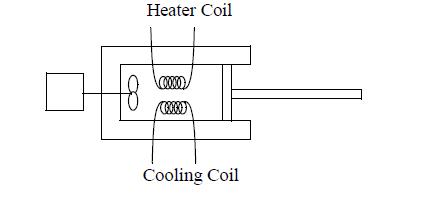
The following problems involve one mole of an ideal monatomic gas, CP = 5R/2, in a variable volume piston/cylinder with a stirring paddle, an electric heater, and a cooling coil through which refrigerant can flow (see figure). The piston is perfectly insulated. The piston contains 1 gmole of gas.
Rolling two die (six-sided cubes with numbers between 1 and 6 on each side) is like putting two particles in six boxes. Compute ΔS /k for going from double sixes to a four and three.
Estimate the change in entropy when one mole of nitrogen is compressed by a piston in a cylinder from 300 K and 23 liters/mol to 400 K and 460 liters/mol. (CP = 7/2R)
When a compressed gas storage tank fails, the resultant explosion occurs so rapidly that the gas cloud can be considered adiabatic and assumed to not mix appreciably with the surrounding atmosphere. Consider the failure of a 2.5-m3 air storage tank initially at 15 bar. Atmospheric pressure is 1
Steam at 400°C and 10 bar is left in an insulated 10 m3 cylinder. The cylinder has a small leak, however. Compute the conditions of the steam after the pressure has dropped to 1 bar. What is the change in the specific entropy of the steam in the cylinder? Is this a reversible process? The mass of
Work problem 4.5 but consider a steam boiler that fails. The boiler is 250 L in size, operating at 4 MPa, and half full of liquid.Data from problem 4.5When a compressed gas storage tank fails, the resultant explosion occurs so rapidly that the gas cloud can be considered adiabatic and assumed to
A mixture of 1CO:2H2 is adiabatically and continuously compressed from 5 atm and 100°F to 100 atm and 1100°F. For this mixture, CP = x1CP1 + x2CP2.(a) Estimate the work of compressing 1 ton/h of the gas. (CP = 7/2R)(b) Determine the efficiency of the compressor.
An isolated chamber with rigid walls is divided into two equal compartments, one containing gas at 600 K and 1 MPa and the other evacuated. The partition between the two compartments ruptures. Compute the final T, P, and ΔS for the following:(a) An ideal gas with CP /R = 7/ 2(b) Steam.
An adiabatic compressor is used to continuously compress nitrogen (CP /R = 7/2) from 2 bar and 300 K to 15 bar. The compressed nitrogen is found to have an outlet temperature of 625 K. How much work is required (kJ/kg)? What is the efficiency of the compressor?
An isolated chamber is divided into two equal compartments, one containing gas and the other evacuated. The partition between the two compartments ruptures. At the end of the process, the temperature and pressure are uniform throughout the chamber.(a) If the filled compartment initially contains an
An adiabatic compressor is used to continuously compress low-pressure steam from 0.8 MPa and 200°C to 4.0 MPa and 500°C in a steady-state process. What is the work required per kg of steam through this compressor? Compute the efficiency of the compressor.
Airplanes are launched from aircraft carriers by means of a steam catapult. The catapult is a well-insulated cylinder that contains steam, and is fitted with a frictionless piston. The piston is connected to the airplane by a cable. As the steam expands, the movement of the piston causes movement
An adiabatic turbine is supplied with steam at 2.0 MPa and 600°C and the steam exhausts at 98% quality and 24°C. Compute the work output per kg of steam. Compute the efficiency of the turbine.
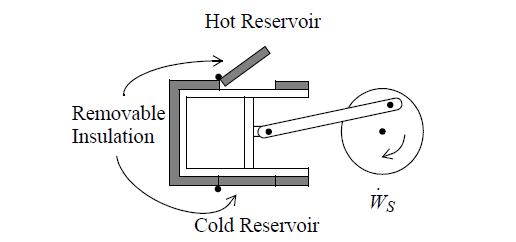
We have considered heat and work to be path-dependent. However, if all heat transfer with surroundings is performed using a reversible heat transfer device (some type of reversible Carnot-type device), work can be performed by the heat transfer device during heat transfer to the surroundings. The
An adiabatic compressor has been designed to continuously compress 1 kg/s of saturated vapor steam from 1 bar to 100 bar and 1100°C. Estimate the power requirement of this compressor in horsepower. Determine the efficiency of the compressor.
Consider the wintertime heating of a house with a furnace compared to addition of Carnot heat engines/pumps. To compensate for heat losses to the surroundings, the house is maintained at a constant temperature Thouse by a constant rate of heat transfer, Q̇house. The furnace operates at a constant
Ethylene gas is to be continuously compressed from an initial state of 1 bar and 20°C to a final pressure of 18 bar in an adiabatic compressor. If compression is 70% efficient compared with an isentropic process, what will be the work requirement and what will be the final temperature of the
An ideal gas enters a valve at 500 K and 3 MPa at a steady-state rate of 3 mol/min. It is throttled to 0.5 MPa. What is the rate of entropy generation? Is the process irreversible?
Operating a wind tunnel for aircraft experiments begins with adiabatically and reversibly compressing atmospheric air (300 K) into long cylinders comprising a total volume of 20 m3 at 200 bars. The cylinders are initially at 1 bar. Estimate the minimal amount of work required (MJ) to perform the
SO2 vapor enters a heat exchanger at 100°C and at a flowrate of 45 mole/h. If heat is transferred to the SO2 at a rate of 1,300 kJ/h, what is the rate of entropy transport in the gas at the outlet relative to the inlet in kJ/K/h given by (Sout - Sin) ṅ?
As part of a refrigeration cycle, Freon 134a is adiabatically compressed from the saturated vapor at –60°C (note the negative sign on temperature) to 1017 kPa and 100°C.(a) How much work is required in kJ/kg?(b) Estimate the efficiency of the compressor.
Showing 1600 - 1700
of 2105
First
8
9
10
11
12
13
14
15
16
17
18
19
20
21
22
Step by Step Answers

 Get 50% OFF
Claim Now
Get 50% OFF
Claim Now