New Semester
Started
Get
50% OFF
Study Help!
--h --m --s
Claim Now
Question Answers
Textbooks
Find textbooks, questions and answers
Oops, something went wrong!
Change your search query and then try again
S
Books
FREE
Study Help
Expert Questions
Accounting
General Management
Mathematics
Finance
Organizational Behaviour
Law
Physics
Operating System
Management Leadership
Sociology
Programming
Marketing
Database
Computer Network
Economics
Textbooks Solutions
Accounting
Managerial Accounting
Management Leadership
Cost Accounting
Statistics
Business Law
Corporate Finance
Finance
Economics
Auditing
Tutors
Online Tutors
Find a Tutor
Hire a Tutor
Become a Tutor
AI Tutor
AI Study Planner
NEW
Sell Books
Search
Search
Sign In
Register
study help
engineering
mechanical vibration analysis
Mechanical Vibrations 6th Edition Singiresu S Rao - Solutions
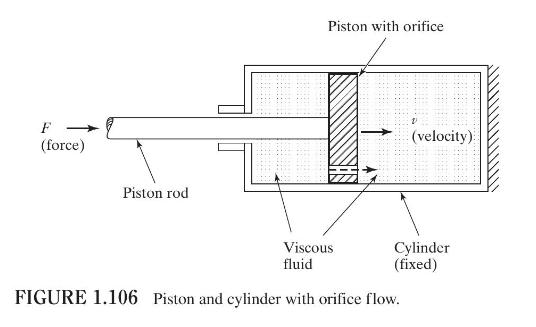
Design a piston-cylinder-type viscous damper to achieve a damping constant of \(175 \mathrm{~N}-\mathrm{s} / \mathrm{m}\) using a fluid of viscosity \(35 \times 10^{-3} \mathrm{~N}-\mathrm{s} / \mathrm{m}^{2}\).
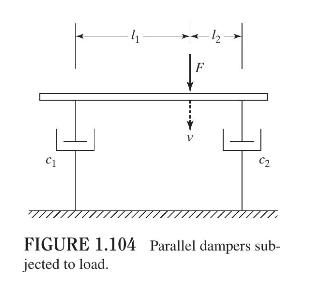
Design a shock absorber (piston-cylinder-type dashpot) to obtain a damping constant of \(1.8 \times 10^{7} \mathrm{~N}\)-s \(/ \mathrm{m}\) using SAE 30 oil at \(21^{\circ} \mathrm{C}\). The diameter of the piston has to be less than \(6.5 \mathrm{~cm}\). C 41 F FIGURE 1.104 Parallel dampers sub-
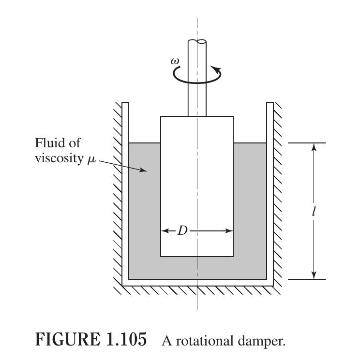
Develop an expression for the damping constant of the rotational damper shown in Fig. 1.105 in terms of \(D,d, l, h, \omega\), and \(\mu\), where \(\omega\) denotes the constant angular velocity of the inner cylinder, and \(d\) and \(h\) represent the radial and axial clearances between the inner
Consider two nonlinear dampers with the same force-velocity relationship given by \(F=1000 v+400 v^{2}+20 v^{3}\) with \(F\) in newton and \(v\) in meters/second. Find the linearized damping constant of the dampers at an operating velocity of \(10 \mathrm{~m} / \mathrm{s}\).
If the linearized dampers of Problem 1.60 are connected in parallel, determine the resulting equivalent damping constant.Data From Problem 1.60:-Consider two nonlinear dampers with the same force-velocity relationship given by \(F=1000 v+400 v^{2}+20 v^{3}\) with \(F\) in newton and \(v\) in
If the linearized dampers of Problem 1.60 are connected in series, determine the resulting equivalent damping constant.Data From Problem 1.60:-Consider two nonlinear dampers with the same force-velocity relationship given by \(F=1000 v+400 v^{2}+20 v^{3}\) with \(F\) in newton and \(v\) in
The force-velocity relationship of a nonlinear damper is given by \(F=500 v+100 v^{2}+50 v^{3}\), where \(F\) is in newton and \(v\) is in meters/second. Find the linearized damping constant of the damper at an operating velocity of \(5 \mathrm{~m} / \mathrm{s}\). If the resulting linearized
The experimental determination of damping force corresponding to several values of the velocity of the damper yielded the following results:Determine the damping constant of the damper. Damping force (N) 80 150 250 350 500 600 Velocity of damper (m/s) 0.025 0.045 0.075 0.110 0.155 0.185
A flat plate with a surface area of \(0.25 \mathrm{~m}^{2}\) moves above a parallel flat surface with a lubricant film of thickness \(1.5 \mathrm{~mm}\) in between the two parallel surfaces. If the viscosity of the lubricant is \(0.5 \mathrm{~Pa}\)-s, determine the following:a. Damping constant.b.
Find the torsional damping constant of a journal bearing for the following data: Viscosity of the lubricant \((\mu): 0.35\) Pa-s, Diameter of the journal or shaft \((2 R): 0.05\mathrm{~m}\), Length of the bearing \((l): 0.075\mathrm{~m}\), Bearing clearance \((d): 0.005\mathrm{~m}\). If the journal
If each of the parameters \((\mu, R, l, d\), and \(N\) ) of the journal bearing described in Problem 1.66 is subjected to a \(\pm 5 \%\) variation about the corresponding value given, determine the percentage fluctuation in the values of the torsional damping constant and the damping torque
The force \((F)\)-velocity \((\dot{x})\) relationship of a nonlinear damper is given by\[F=a \dot{x}+b \dot{x}^{2}\]where \(a\) and \(b\) are constants. Find the equivalent linear damping constant when the relative velocity is \(5 \mathrm{~m} / \mathrm{s}\) with \(a=5 \mathrm{~N}-\mathrm{s} /
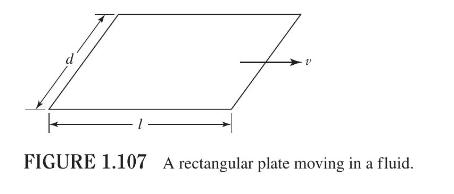
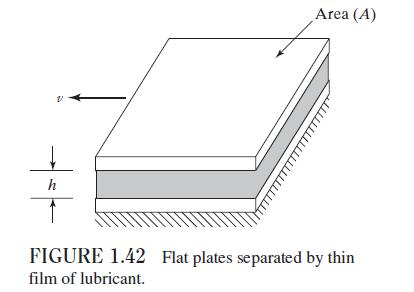
The damping constant (c) due to skin-friction drag of a rectangular plate moving in a fluid of viscosity \(\mu\) is given by (see Fig. 1.107):\[c=100 \mu l^{2} d\]Design a plate-type damper (shown in Fig. 1.42) that provides an identical damping constant for the same fluid. FIGURE 1.107 A
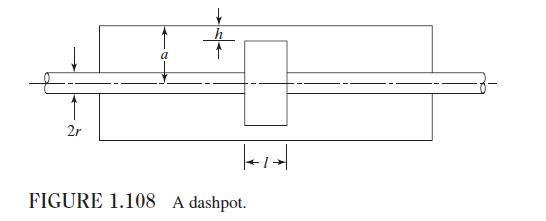
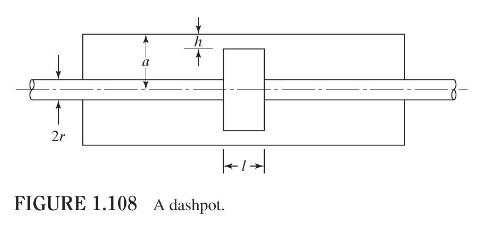
The damping constant \((c)\) of the dashpot shown in Fig. 1.108 is given by [1.27]:\[c=\frac{6 \pi \mu l}{h^{3}}\left[\left(a-\frac{h}{2}\right)^{2}-r^{2}\right]\left[\frac{a^{2}-r^{2}}{a-\frac{h}{2}}-h\right]\]Determine the damping constant of the dashpot for the following data: \(\mu=0.3445\)
In Problem 1.71, using the given data as reference, find the variation of the damping constant \(c\) whena. \(r\) is varied from \(0.5 \mathrm{~cm}\) to \(1.0 \mathrm{~cm}\).b. \(h\) is varied from \(0.05 \mathrm{~cm}\) to \(0.10 \mathrm{~cm}\).c. \(a\) is varied from \(2 \mathrm{~cm}\) to \(4
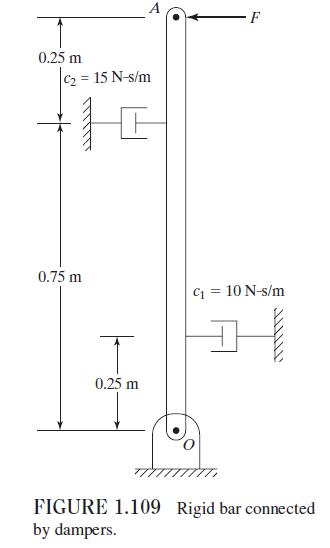
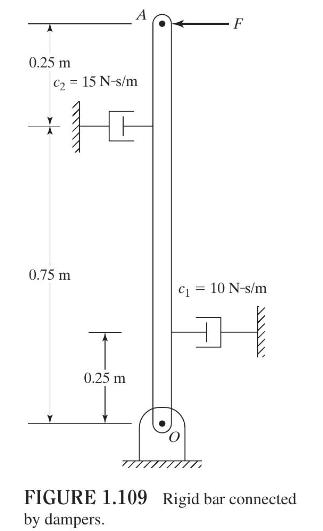
A massless bar of length \(1 \mathrm{~m}\) is pivoted at one end and subjected to a force \(F\) at the other end. Two translational dampers, with damping constants \(c_{1}=10 \mathrm{~N}-\mathrm{s} / \mathrm{m}\) and \(c_{2}=15 \mathrm{~N}-\mathrm{s} / \mathrm{m}\) are connected to the bar as shown
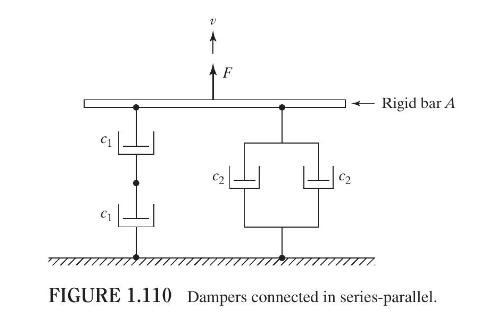
Find an expression for the equivalent translational damping constant of the system shown in Fig. 1.110 so that the force \(F\) can be expressed as \(F=c_{\text {eq }} v\), where \(v\) is the velocity of the rigid bar \(A\). 0.25 m C = 15 N-s/m H 0.75 m F I 0.25 m c = 10 N-s/m FIGURE 1.109 Rigid bar
Express the complex number \(5+2 i\) in the exponential form \(A e^{i \theta}\).
Add the two complex numbers \((1+2 i)\) and \((3-4 i)\) and express the result in the form \(A e^{i \theta}\).
Subtract the complex number \((1+2 i)\) from \((3-4 i)\) and express the result in the form \(A e^{i \theta}\).
Find the product of the complex numbers \(z_{1}=(1+2 i)\) and \(z_{2}=(3-4 i)\) and express the result in the form \(A e^{i \theta}\).
Find the quotient, \(z_{1} / z_{2}\), of the complex numbers \(z_{1}=(1+2 i)\) and \(z_{2}=(3-4 i)\) and express the result in the form \(A e^{i \theta}\).
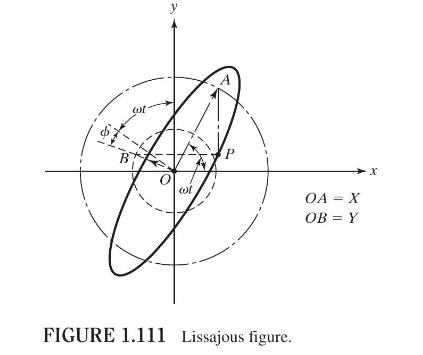
The foundation of a reciprocating engine is subjected to harmonic motions in \(x\) and \(y\) directions:\[\begin{aligned}& x(t)=X \cos \omega t \\& y(t)=Y \cos (\omega t+\phi)\end{aligned}\]where \(X\) and \(Y\) are the amplitudes, \(\omega\) is the angular velocity, and \(\phi\) is the
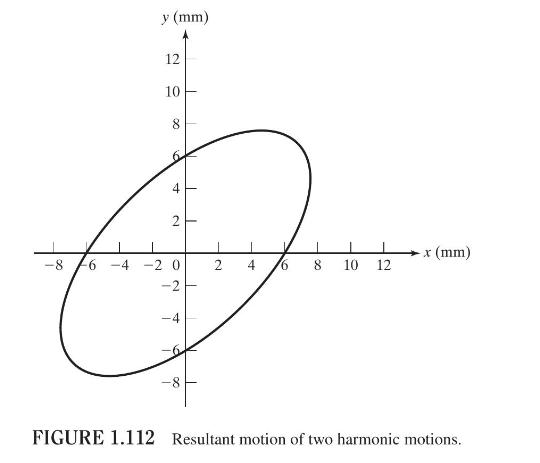
The foundation of an air compressor is subjected to harmonic motions (with the same frequency) in two perpendicular directions. The resultant motion, displayed on an oscilloscope, appears as shown in Fig. 1.112. Find the amplitudes of vibration in the two directions and the phase difference between
A machine is subjected to the motion \(x(t)=A \cos (50 t+\alpha) \mathrm{mm}\). The initial conditions are given by \(x(0)=3 \mathrm{~mm}\) and \(\dot{x}(0)=1.0 \mathrm{~m} / \mathrm{s}\).a. Find the constants \(A\) and \(\alpha\).b. Express the motion in the form \(x(t)=A_{1} \cos \omega t+A_{2}
Show that any linear combination of \(\sin \omega t\) and \(\cos \omega t\) such that \(x(t)=A_{1} \cos \omega t+A_{2}\) \(\sin \omega t\left(A_{1}, A_{2}=\right.\) constants) represents a simple harmonic motion.
Find the sum of the two harmonic motions \(x_{1}(t)=5 \cos (3 t+1)\) and \(x_{2}(t)=10 \cos (3 t+2)\). Use:a. Trigonometric relationsb. Vector additionc. Complex-number representation
If one of the components of the harmonic motion \(x(t)=10 \sin \left(\omega t+60^{\circ}\right)\) is \(x_{1}(t)=5 \sin\) \(\left(\omega t+30^{\circ}\right)\), find the other component.
Consider the two harmonic motions \(x_{1}(t)=\frac{1}{2} \cos \frac{\pi}{2} t\) and \(x_{2}(t)=\sin \pi t\). Is the sum \(x_{1}(t)+x_{2}(t)\) a periodic motion? If so, what is its period?
Consider two harmonic motions of different frequencies: \(x_{1}(t)=2 \cos 2 t\) and \(x_{2}(t)=\cos 3 t\). Is the sum \(x_{1}(t)+x_{2}(t)\) a harmonic motion? If so, what is its period?
Consider the two harmonic motions \(x_{1}(t)=\frac{1}{2} \cos \frac{\pi}{2} t\) and \(x_{2}(t)=\cos \pi t\). Is the difference \(x(t)=x_{1}(t)-x_{2}(t)\) a harmonic motion? If so, what is its period?
Find the maximum and minimum amplitudes of the combined motion \(x(t)=x_{1}(t)+x_{2}(t)\) when \(x_{1}(t)=3 \sin 30 t\) and \(x_{2}(t)=3 \sin 29 t\). Also find the frequency of beats corresponding to \(x(t)\).
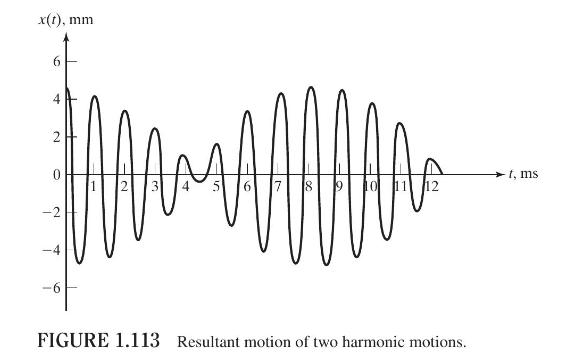
A machine is subjected to two harmonic motions, and the resultant motion, as displayed by an oscilloscope, is shown in Fig. 1.113. Find the amplitudes and frequencies of the two motions.
A harmonic motion has an amplitude of \(0.05 \mathrm{~m}\) and a frequency of \(10 \mathrm{~Hz}\). Find its period, maximum velocity, and maximum acceleration.
An accelerometer mounted on a building frame indicates that the frame is vibrating harmonically at \(15 \mathrm{cps}\), with a maximum acceleration of \(0.5 \mathrm{~g}\). Determine the amplitude and the maximum velocity of the building frame.
The maximum amplitude and the maximum acceleration of the foundation of a centrifugal pump were found to be \(x_{\max }=0.25 \mathrm{~mm}\) and \(\ddot{x}_{\max }=0.4 \mathrm{~g}\), respectively. Find the operating speed of the pump.
An exponential function is expressed as \(x(t)=A e^{-\alpha t}\) with the values of \(x(t)\) known at \(t=1\) and \(t=2\) as \(x(1)=0.752985\) and \(x(2)=0.226795\), respectively. Determine the values of \(A\) and \(\alpha\). x(t), mm 6 4 2 t, ms 2 6 7 8 9 10 11 FIGURE 1.113 Resultant motion of two
When the displacement of a machine is given by \(x(t)=18 \cos 8 t\), where \(x\) is measured in millimeters and \(t\) in seconds, find (a) the period of the machine in s, and (b) the frequency of oscillation of the machine in rad/s as well as in \(\mathrm{Hz}\).
If the motion of a machine is described as \(8 \sin (5 t+1)=A \sin 5 t+B \cos 5 t\), determine the values of \(A\) and \(B\).
Express the vibration of a machine given by \(x(t)=-3.0 \sin 5 t-2.0 \cos 5 t\) in the form \(x(t)=A \cos (5 t+\phi)\).
If the displacement of a machine is given by \(x(t)=0.2 \sin (5 t+3)\), where \(x\) is in meters and \(t\) is in seconds, find the variations of the velocity and acceleration of the machine. Also find the amplitudes of displacement, velocity, and acceleration of the machine.
If the displacement of a machine is described as \(x(t)=0.4 \sin 4 t+5.0 \cos 4 t\), where \(x\) is in centimetres and \(t\) is in seconds, find the expressions for the velocity and acceleration of the machine. Also find the amplitudes of displacement, velocity, and acceleration of the machine.
The displacement of a machine is expressed as \(x(t)=0.05 \sin (6 t+\phi)\), where \(x\) is in meters and \(t\) is in seconds. If the displacement of the machine at \(t=0\) is known to be \(0.04 \mathrm{~m}\), determine the value of the phase angle \(\phi\).
The displacement of a machine is expressed as \(x(t)=A \sin (6 t+\phi)\), where \(x\) is in meters and \(t\) is in seconds. If the displacement and the velocity of the machine at \(t=0\) are known to be \(0.05 \mathrm{~m}\) and \(0.005 \mathrm{~m} / \mathrm{s}\), respectively, determine the values
A machine is found to vibrate with simple harmonic motion at a frequency of \(20 \mathrm{~Hz}\) and an amplitude of acceleration of \(0.5 \mathrm{~g}\). Determine the displacement and velocity of the machine. Use the value of \(g\) as \(9.81 \mathrm{~m} / \mathrm{s}^{2}\).
The amplitudes of displacement and acceleration of an unbalanced turbine rotor are found to be \(0.5 \mathrm{~mm}\) and \(0.5 \mathrm{~g}\), respectively. Find the rotational speed of the rotor using the value of \(g\) as \(9.81 \mathrm{~m} / \mathrm{s}^{2}\).
The root mean square (rms) value of a function, \(x(t)\), is defined as the square root of the average of the squared value of \(x(t)\) over a time period \(\tau\) :\[x_{\mathrm{rms}}=\sqrt{\frac{1}{\tau} \int_{0}^{\tau}[x(t)]^{2} d t}\]Using this definition, find the rms value of the
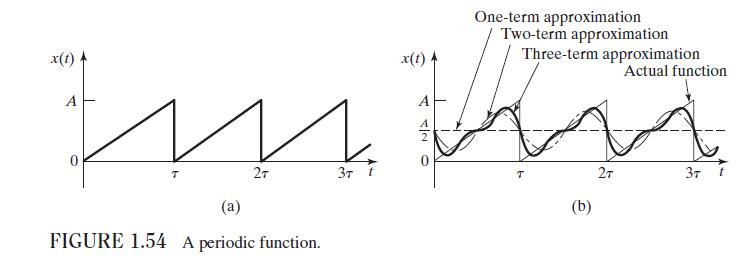
Using the definition given in Problem 1.104, find the rms value of the function shown in Fig. 1.54(a).Data From Problem 1.104:-The root mean square (rms) value of a function, \(x(t)\), is defined as the square root of the average of the squared value of \(x(t)\) over a time period \(\tau\)
Prove that the sine Fourier components \(\left(b_{n}\right)\) are zero for even functions-that is, when \(x(-t)=x(t)\). Also prove that the cosine Fourier components \(\left(a_{0}\right.\) and \(\left.a_{n}\right)\) are zero for odd functions-that is, when \(x(-t)=-x(t)\).
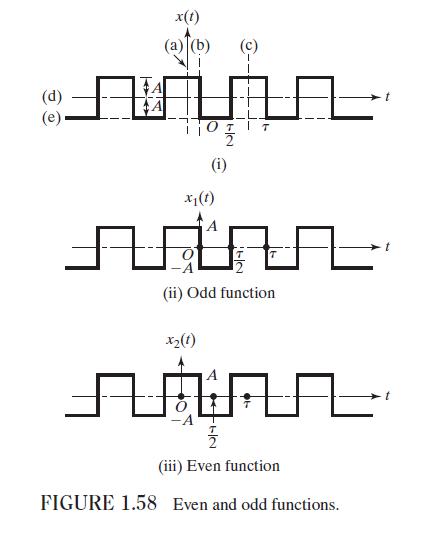
Find the Fourier series expansions of the functions shown in Figs. 1.58(ii) and (iii). Also, find their Fourier series expansions when the time axis is shifted down by a distance \(A\). (d) (e) x(t) (a) (b) x(t) (i) A (ii) Odd function x2(t) (iii) Even function FIGURE 1.58 Even and odd functions.
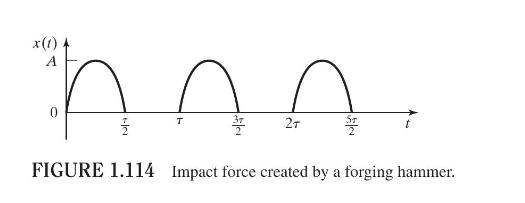
The impact force created by a forging hammer can be modeled as shown in Fig. 1.114. Determine the Fourier series expansion of the impact force. x(1) T 2T FIGURE 1.114 Impact force created by a forging hammer.
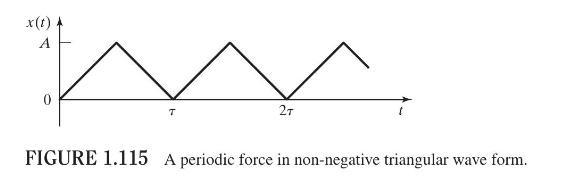
Find the Fourier series expansion of the periodic function shown in Fig. 1.115. Also plot the corresponding frequency spectrum. x(t) A 2T FIGURE 1.115 A periodic force in non-negative triangular wave form.
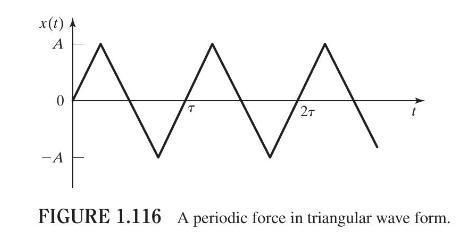
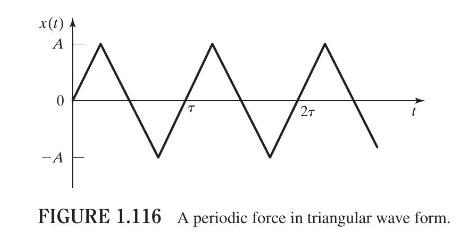
Find the Fourier series expansion of the periodic function shown in Fig. 1.116. Also plot the corresponding frequency spectrum. x(t) A 0 -A 2T FIGURE 1.116 A periodic force in triangular wave form.
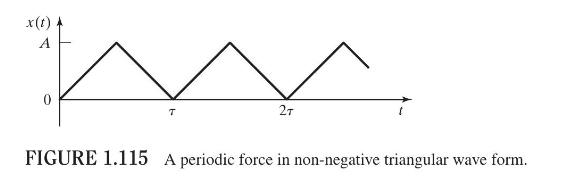
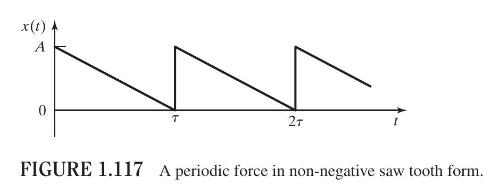
Find the Fourier series expansion of the periodic function shown in Fig. 1.117. Also plot the corresponding frequency spectrum. x(t) A 2T FIGURE 1.115 A periodic force in non-negative triangular wave form.
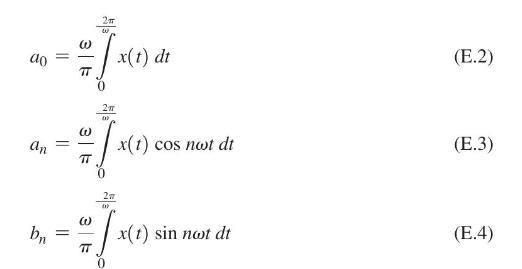
The Fourier series of a periodic function, \(x(t)\), is an infinite series given bywhere\(\omega\) is the circular frequency and \(2 \pi / \omega\) is the time period. Instead of including the infinite number of terms in Eq. (E.1), it is often truncated by retaining only \(k\) terms asso that the
Conduct a harmonic analysis, including the first three harmonics, of the function given below: ti 0.02 0.04 0.06 0.08 0.10 0.12 0.14 0.16 0.18 Xi 9 13 17 29 43 59 63 57 49 ti 0.20 0.22 0.24 0.26 0.28 0.30 0.32 Xi 35 35 41 47 41 13 7
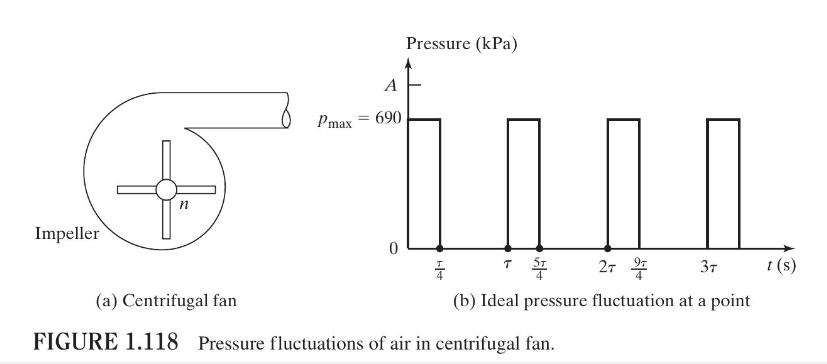
In a centrifugal fan (Fig. 1.118(a)), the air at any point is subjected to an impulse each time a blade passes the point, as shown in Fig. 1.118(b). The frequency of these impulses is determined by the speed of rotation of the impeller \(n\) and the number of blades, \(N\), in the impeller. For
Solve Problem 1.114 by using the values of \(n\) and \(N\) as \(200 \mathrm{rpm}\) and 6 instead of \(100 \mathrm{rpm}\) and 4 , respectively.Data From Problem 1.114:-In a centrifugal fan (Fig. 1.118(a)), the air at any point is subjected to an impulse each time a blade passes the point, as shown
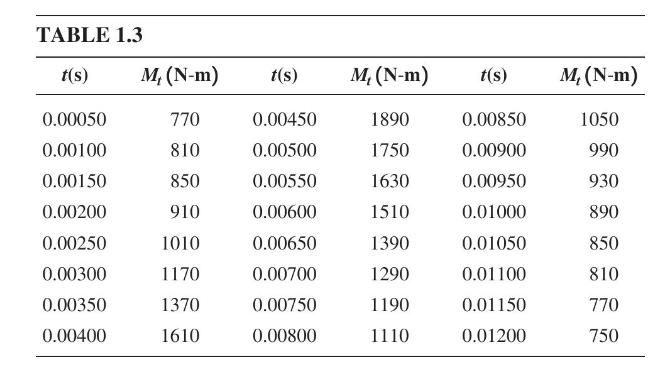
The torque \(\left(M_{t}\right)\) variation with time, of an internal combustion engine, is given in Table 1.3. Make a harmonic analysis of the torque. Find the amplitudes of the first three harmonics. TABLE 1.3 t(s) M, (N-m) t(s) M (N-m) t(s) M, (N-m) 0.00050 770 0.00450 1890 0.00850 1050 0.00100
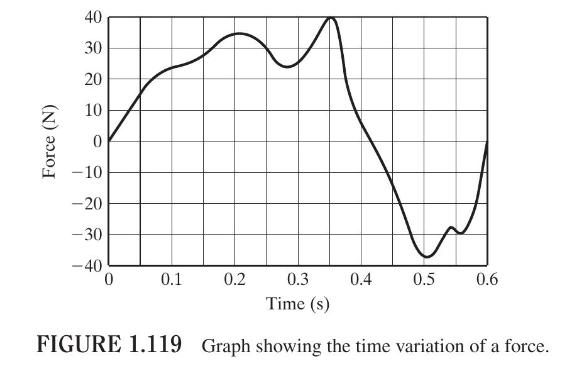
Make a harmonic analysis of the function shown in Fig. 1.119 including the first three harmonics. Force (N) 40 30 20 10 0 -10 -20 -30 -40 0 0.1 0.2 0.3 Time (s) 0.4 0.5 0.6 FIGURE 1.119 Graph showing the time variation of a force.
Plot the Fourier series expansion of the function \(x(t)\) given in Problem 1.113 using MATLAB.Data From Problem 1.113:-Conduct a harmonic analysis, including the first three harmonics, of the function given below: ti 0.02 0.04 0.06 0.08 0.10 0.12 0.14 0.16 0.18 Xi 9 13 17 29 43 59 63 57 49 ti 0.20
Use MATLAB to plot the variation of the force with time using the Fourier series expansion determined in Problem 1.117.Data From Problem 1.117:-Make a harmonic analysis of the function shown in Fig. 1.119 including the first three harmonics. Force (N) 40 30 20 10 0 -10 -20 -30 -40 0 0.1 0.2 0.3
Use MATLAB to plot the variations of the damping constant \(c\) with respect to \(r, h\), and \(a\) as determined in Problem 1.72.Data From Problem 1.72:-In Problem 1.71, using the given data as reference, find the variation of the damping constant \(c\) whena. \(r\) is varied from \(0.5
Use MATLAB to plot the variation of spring stiffness \((k)\) with deformation \((x)\) given by the relations:a. \(k=1000 x-100 x^{2} ; 0 \leq x \leq 4\).b. \(k=500+500 x^{2} ; 0 \leq x \leq 4\).
A mass is subjected to two harmonic motions given by \(x_{1}(t)=3 \sin 30 t\) and \(x_{2}(t)=3 \sin 29 t\). Plot the resultant motion of the mass using MATLAB and identify the beat frequency and the beat period.
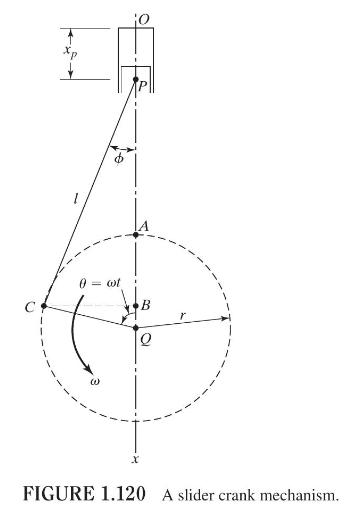
A slider-crank mechanism is shown in Fig. 1.120. Derive an expression for the motion of the piston \(P\) in terms of the crank length \(r\), the connecting-rod length \(l\), and the constant angular velocity of the crank \(\omega\).a. Discuss the feasibility of using the mechanism for the
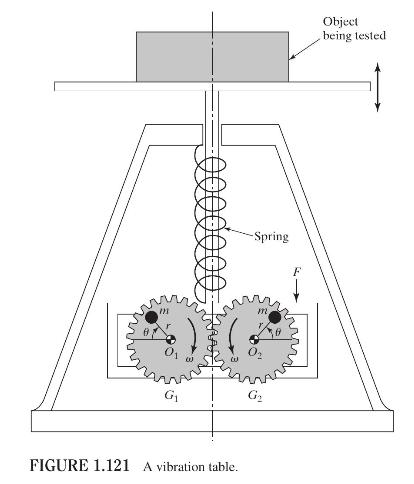
The vibration table shown in Fig. 1.121 is used to test certain electronic components for vibration. It consists of two identical mating gears \(G_{1}\) and \(G_{2}\) that rotate about the axes \(O_{1}\) and \(O_{2}\) attached to the frame \(F\). Two equal masses, \(m\) each, are placed
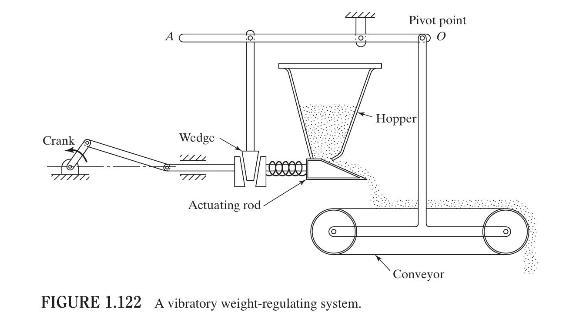
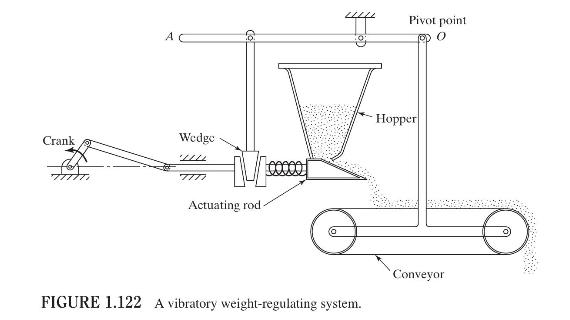
The arrangement shown in Fig. 1.122 is used to regulate the weight of material fed from a hopper to a conveyor [1.44]. The crank imparts a reciprocating motion to the actuating rod through the wedge. The amplitude of motion imparted to the actuating rod can be varied by moving the wedge up or down.
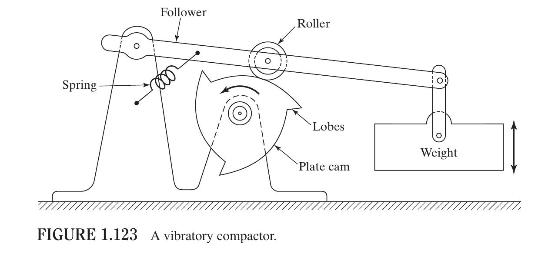
Figure 1.123 shows a vibratory compactor. It consists of a plate cam with three profiled lobes and an oscillating roller follower. As the cam rotates, the roller drops after each rise. Correspondingly, the weight attached at the end of the follower also rises and drops. Thecontact between the
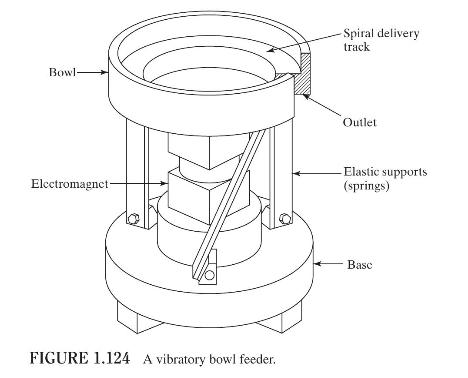
Vibratory bowl feeders are widely used in automated processes where a high volume of identical parts are to be oriented and delivered at a steady rate to a workstation for further tooling \([1.45,1.46]\). Basically, a vibratory bowl feeder is separated from the base by a set of inclined elastic
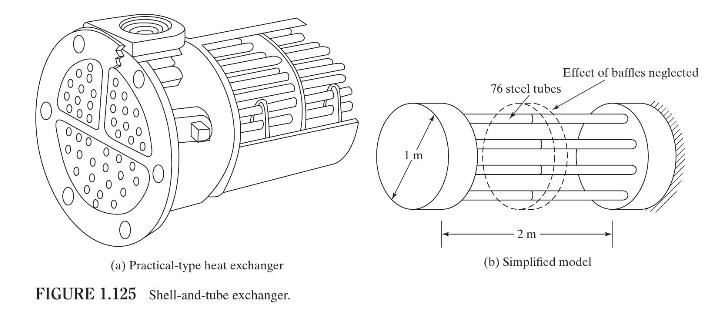
The shell-and-tube exchanger shown in Fig. 1.125(a) can be modeled as shown in Fig. 1.125(b) for a simplified vibration analysis. Find the cross-sectional area of the tubes so that the total stiffness of the heat exchanger exceeds a value of \(200 \times 10^{6} \mathrm{~N} / \mathrm{m}\) in the
Give two examples each of the bad and the good effects of vibration.
What are the three elementary parts of a vibrating system?
Define the number of degrees of freedom of a vibrating system.
What is the difference between a discrete and a continuous system? Is it possible to solve any vibration problem as a discrete one?
In vibration analysis, can damping always be disregarded?
Can a nonlinear vibration problem be identified by looking at its governing differential equation?
What is the difference between deterministic and random vibration? Give two practical examples of each.
What methods are available for solving the governing equations of a vibration problem?
How do you connect several springs to increase the overall stiffness?
Define spring stiffness and damping constant.
What are the common types of damping?
State three different ways of expressing a periodic function in terms of its harmonics.
Define these terms: cycle, amplitude, phase angle, linear frequency, period, and natural frequency.
How are \(\tau, \omega\), and \(f\) related to each other?
How can we obtain the frequency, phase, and amplitude of a harmonic motion from the corresponding rotating vector?
How do you add two harmonic motions having different frequencies?
What are beats?
Define the terms decibel and octave.
Explain Gibbs' phenomenon.
What are half-range expansions?
True or False.If energy is lost in any way during vibration, the system can be considered to be damped.
True or False.The superposition principle is valid for both linear and nonlinear systems.
True or False.The frequency with which an initially disturbed system vibrates on its own is known as natural frequency.
True or False.Any periodic function can be expanded into a Fourier series.
True or False.A harmonic motion is a periodic motion.
True or False.The equivalent mass of several masses at different locations can be found using the equivalence of kinetic energy.
True or False.The generalized coordinates are not necessarily Cartesian coordinates.
True or False.Discrete systems are same as lumped parameter systems.
True or False.Consider the sum of harmonic motions, \(x(t)=x_{1}(t)+x_{2}(t)=A \cos (\omega t+\alpha)\), with \(x_{1}(t)=15 \cos \omega t\) and \(x_{2}(t)=20 \cos (\omega t+1)\). The amplitude \(A\) is given by 30.8088 .
Showing 2500 - 2600
of 2655
First
13
14
15
16
17
18
19
20
21
22
23
24
25
26
27
Step by Step Answers

 Get 50% OFF
Claim Now
Get 50% OFF
Claim Now