New Semester
Started
Get
50% OFF
Study Help!
--h --m --s
Claim Now
Question Answers
Textbooks
Find textbooks, questions and answers
Oops, something went wrong!
Change your search query and then try again
S
Books
FREE
Study Help
Expert Questions
Accounting
General Management
Mathematics
Finance
Organizational Behaviour
Law
Physics
Operating System
Management Leadership
Sociology
Programming
Marketing
Database
Computer Network
Economics
Textbooks Solutions
Accounting
Managerial Accounting
Management Leadership
Cost Accounting
Statistics
Business Law
Corporate Finance
Finance
Economics
Auditing
Tutors
Online Tutors
Find a Tutor
Hire a Tutor
Become a Tutor
AI Tutor
AI Study Planner
NEW
Sell Books
Search
Search
Sign In
Register
study help
mathematics
advanced engineering mathematics
Advanced Engineering Mathematics 10th edition Erwin Kreyszig - Solutions
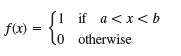
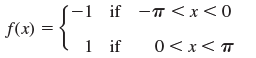
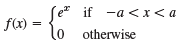
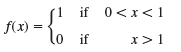
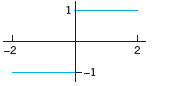
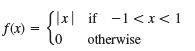
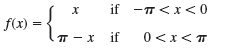
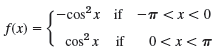
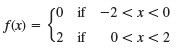
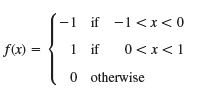
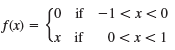
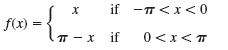
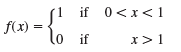
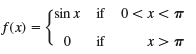
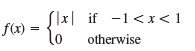
Find the Fourier transform of (without using Table III in Sec. 11.10). Show details.
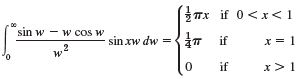
Show that the integral represents the indicated function. Use (5), (10), or (11); the integral tells you which one, and its value tells you what function to consider. Show your work in detail.
Showing the details, develop1 - x4
Show that if the functions y0(x), y1(x), · · · form an orthogonal set on an interval α ≤ x ≤ b (with r(x) = 1), then the functions y0(ct + k), y1(ct + k), · · ·, c > 0, form an orthogonal set on the interval (α - k)/c ≤ t ≤ (b - k)/c.
Can a discontinuous function have a Fourier series? A Taylor series? Why are such functions of interest to the engineer?
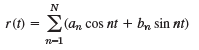
Find the trigonometric polynomial F(x) of the form (2) for which the square error with respect to the given f(x) on the interval -π < x < π is minimum Compute the minimum value for N = 1, 2, · · ·, 5 (or also for larger values if you have a CAS).f (x) = x2 (-π < x < π)
Some of the An in Example 1 are positive, some negative. All Bn are positive. Is this physically understandable?
Show that the functions Pn(cos θ), n = 0, 1, · · ·, from an orthogonal set on the interval 0 ≤ θ ≤ π with respect to the weight function sin θ.
Are the following functions even or odd or neither even nor odd?Absolute values of odd functions
What do you know about convergence of a Fourier series? About the Gibbs phenomenon?
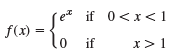
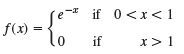
Find f̂c(w) for f(x) = x2 if 0 < x < 1, f(x) = 0 if x > 1.
Find the trigonometric polynomial F(x) of the form (2) for which the square error with respect to the given f(x) on the interval -π
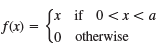
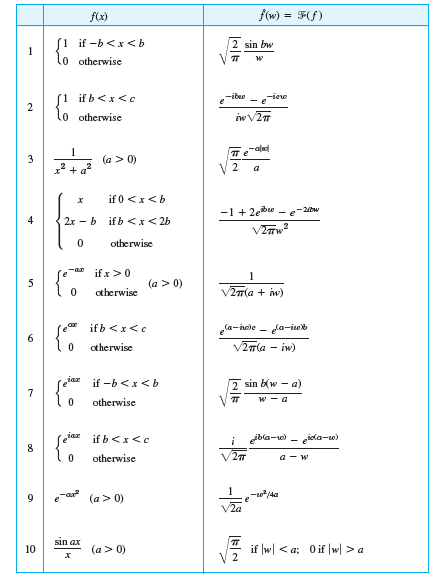
Find the Fourier transform of (without using Table III in Sec. 11.10). Show details.
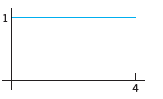
Show that f = const is periodic with any period but has no fundamental period.
Show that the integral represents the indicated function. Use (5), (10), or (11); the integral tells you which one, and its value tells you what function to consider. Show your work in detail.
Showing the details, developProve that if f(x) is even (is odd, respectively), its Fourier–Legendre series contains only Pm(x) with even m (only Pm(x) with odd m, respectively). Give examples.
Find a general solution of the ODE y" + ω2y = r(t) with r(t) as given. Show the details of your work.r (t) = sin αt + sin βt, ω2 ≠ α2, β2
The output of an ODE can oscillate several times as fast as the input. How come?
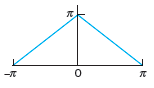
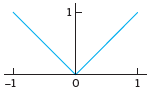
Sketch or graph f(x) which for -π < x < π is given as follows.f(x) = |x|
Find a general solution of the ODE y" + ω2y = r(t) with r(t) as given. Show the details of your work.r (t) = sin t, ω = 0.5, 0.9, 1.1, 1.5, 10
Find the eigenvalues and eigenfunctions. Verify orthogonality. Start by writing the ODE in the form (1), using Prob. 6. Show details of your work.y" + λy = 0, y(0) = 0, y(10) = 0Data from Prob. 6Show that y" + fy' + (g + λh) y = 0 takes the form (1) if you set p = exp (∫f dx), q = pg, r = hp.
Are the following functions even or odd or neither even nor odd?Find all functions that are both even and odd.
What is approximation by trigonometric polynomials? What is the minimum square error?
Does the Fourier cosine transform of x-1 sin x (0 < x < ∞) exist? Of x-1 cos x? Give reasons.
Find the Fourier transform of (without using Table III in Sec. 11.10). Show details.
Sketch or graph f(x) which for -π < x < π is given as follows.f(x) = |sin x|, f (x) = sin |x|
Represent f(x) as an integral (10).
Showing the details, developWhat happens to the Fourier–Legendre series of a polynomial f(x) if you change a coefficient of f(x)? Experiment. Try to prove your answer.
What is a Fourier integral? A Fourier sine integral? Give simple examples.
Sketch or graph f(x) which for -π < x < π is given as follows.f(x) = e-|x|, f(x) = |e-x|
Find a general solution of the ODE y" + ω2y = r(t) with r(t) as given. Show the details of your work.What kind of solution is excluded in Prob. 8 by |ω| ≠ 0, 2, 4, · · ·?Data from Prob. 8r (t) = π/4 |cos t| if -π < t < π and r(t + 2π) = r(t), |ω| ≠ 0, 2, 4, · · ·
Find the eigenvalues and eigenfunctions. Verify orthogonality. Start by writing the ODE in the form (1), using Prob. 6. Show details of your work.y" + λy = 0, y(0) = 0, y'(L) = 0Data from Prob. 6Show that y" + fy' + (g + λh) y = 0 takes the form (1) if you set p = exp (∫f dx), q = pg, r = hp.
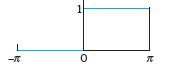
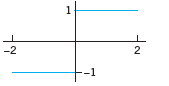
Is the given function even or odd or neither even nor odd? Find its Fourier series. Show details of your work.
Find Fs(e-αx), α > 0, by integration.
Find and graph (on common axes) the partial sums up to Sm0 whose graph practically coincides with that of f(x) within graphical accuracy. State m0. On what does the size of m0 seem to depend?f (x) = sin 2πx
Show that the minimum square error (6) is a monotone decreasing function of N. How can you use this in practice?
Find the Fourier transform of (without using Table III in Sec. 11.10). Show details.
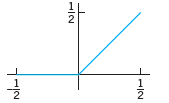
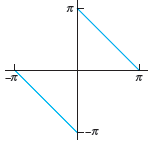
Sketch or graph f(x) which for -π
Find a general solution of the ODE y" + ω2y = r(t) with r(t) as given. Show the details of your work.r (t) = π/4 |sin t| if 0 < t < 2π and r(t + 2π) = r(t), |ω| ≠ 0, 2, 4, · · ·
What are Sturm–Liouville problems? By what idea are they related to Fourier series?
Sketch or graph f(x) which for -π
Find a general solution of the ODE y" + ω2y = r(t) with r(t) as given. Show the details of your work.
Find and graph (on common axes) the partial sums up to Sm0 whose graph practically coincides with that of f(x) within graphical accuracy. State m0. On what does the size of m0 seem to depend?f(x) = (1 + x2)-1
Find the eigenvalues and eigenfunctions. Verify orthogonality. Start by writing the ODE in the form (1), using Prob. 6. Show details of your work.(y'/x)' + (λ + 1)y/x3 = 0, y(1) = 0, y(eπ) = 0. (Set x = et.)Data from Prob. 6Show that y" + fy' + (g + λh) y = 0 takes the form (1) if you set p =
Is the given function even or odd or neither even nor odd? Find its Fourier series. Show details of your work.f (x) = x2 (-1 < x < 1), p = 2
Find fs (w) for f(x) = x2 if 0 < x < 1, f(x) = 0 if x > 1.
Find the Fourier series of as given over one period and sketch and partial sums.
Using (8), prove that the series has the indicated sum. Compute the first few partial sums to see that the convergence is rapid.
Find the Fourier transform of (without using Table III in Sec. 11.10). Show details.
Review integration techniques for integrals as they are likely to arise from the Euler formulas, for instance, definite integrals of x cos nx, x2 sin nx, e-2x cos nx, etc.
Write a program for solving the ODE just considered and for jointly graphing input and output of an initial value problem involving that ODE. Apply the program to Probs. 7 and 11 with initial values of your choice. Data from Prob. 7 Find a general solution of the ODE y" + ω2y = r(t) with r(t) as
Using (8), prove that the series has the indicated sum. Compute the first few partial sums to see that the convergence is rapid.
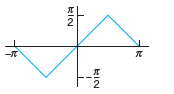
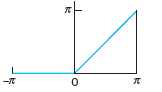
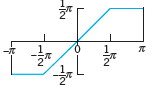
Find the Fourier series of the given function f(x), which is assumed to have the period 2π. Show the details of your work. Sketch or graph the partial sums up to that including cos 5x and sin 5x.f(x) in prob. 6Data from Prob. 6Sketch or graph f(x) which for -π < x < π is given as
Find and graph (on common axes) the partial sums up to Sm0 whose graph practically coincides with that of f(x) within graphical accuracy. State m0. On what does the size of m0 seem to depend?f (x) = J0(α0,2 x), α0,2 = the second positive zero J0(x)
Find the steady-state oscillations of y" + cy' + y = r(t) with c > 0 and r(t) as given. Note that the spring constant is k = 1. Show the details. In Probs. 14–16 sketch r(t).
Find the eigenvalues and eigenfunctions. Verify orthogonality. Start by writing the ODE in the form (1), using Prob. 6. Show details of your work.y" + 8y' + (λ + 16)y = 0, y(0) = 0, y(π) = 0Data from Prob. 6Show that y" + fy' + (g + λh) y = 0 takes the form (1) if you set p = exp (∫f dx), q =
Is the given function even or odd or neither even nor odd? Find its Fourier series. Show details of your work.
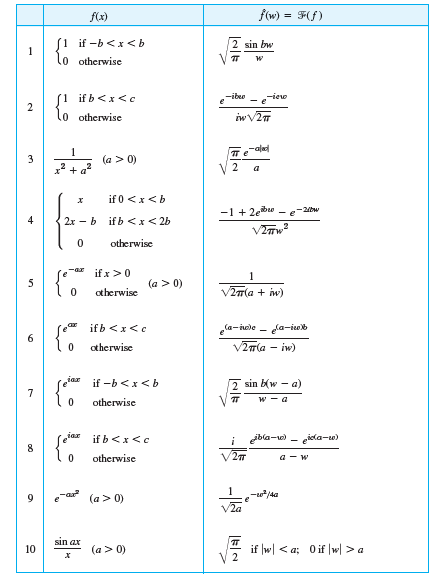
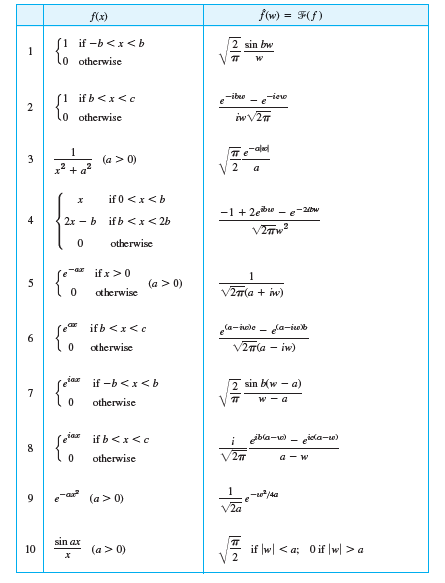
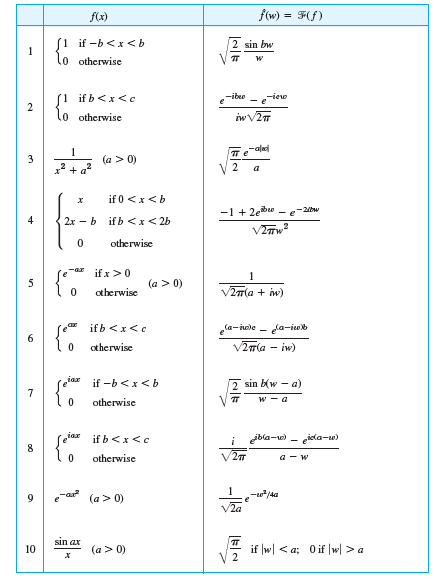
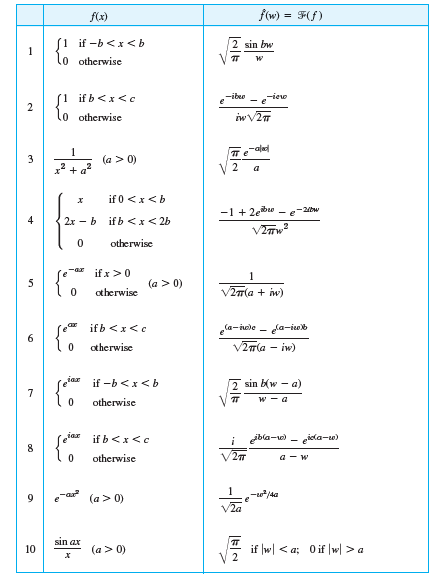
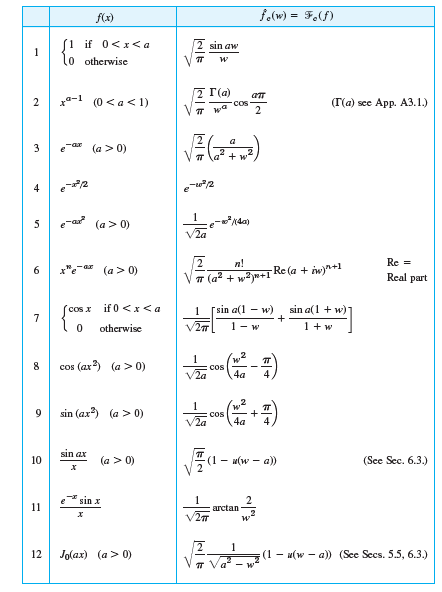
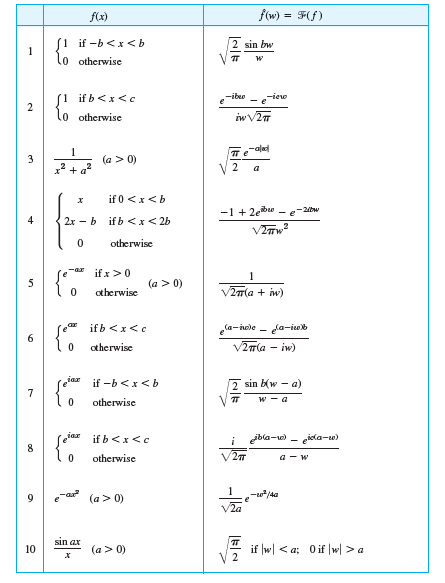
Find from (4a) and formula 3 of Table I in Sec. 11.10. 2 3 + 5 7 8 00 9 10 11 12 f(x) [1 if 0 0) if 0 0) (a > 0) sin x X Jo(ax) (a> 0) T -w/2 sin aw W 2a COS - 1/(40) |E|N 2 n! # (a + wx+1 Re(a + iw)n+1 W 1 [sin a(w) 2T 1-w Cos 1 W 2 cos (2-7) 4a 4 fe(w) = Fe(f) 4a att :anctan 277 2 1 T 4 + + (1
Find the Fourier series of as given over one period and sketch and partial sums.
Using (8), prove that the series has the indicated sum. Compute the first few partial sums to see that the convergence is rapid.
Find the Fourier series of the given function f(x), which is assumed to have the period 2π. Show the details of your work. Sketch or graph the partial sums up to that including cos 5x and sin 5x. f(x) in prob. 9 Data from Prob. 9 Sketch or graph f(x) which for -π
Graph the integrals in Prob. 7, 9, and 11 as functions of x. Graph approximations obtained by replacing ∞ with finite upper limits of your choice. Compare the quality of the approximations. Write a short report on your empirical results and observations. Data from Prob. 7 Represent f(x) as an
Find the Fourier series of the given function f(x), which is assumed to have the period 2π. Show the details of your work. Sketch or graph the partial sums up to that including cos 5x and sin 5x.f (x) = x2 (-π < x < π)
Find the steady-state oscillations of y" + cy' + y = r(t) with c > 0 and r(t) as given. Note that the spring constant is k = 1. Show the details. In Probs. 14–16 sketch r(t).
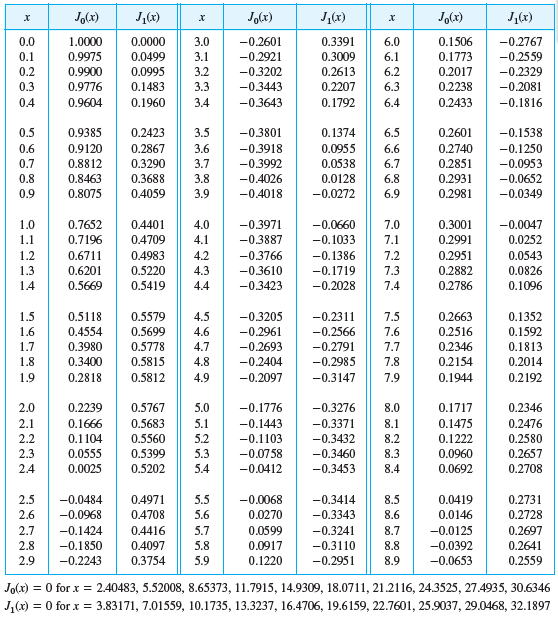
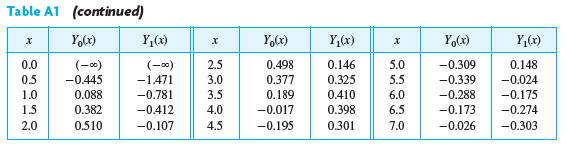
Use Example 2 and R = 1, so that you get the seriesWith the zeros α0,1, α0,2 · · · from your CAS (see also Table A1 in App. 5).(a) Graph the terms J0(α0,1x), · · ·, J0(α0,10x) for 0 ≤ x ≤ 1 on common axes.(b) Write a program for calculating partial sums of (25). Find out for what f
Is the given function even or odd or neither even nor odd? Find its Fourier series. Show details of your work.
Write a short report on ways of obtaining these transforms, with illustrations by examples of your own.
What function do the series of the cosine terms and the series of the sine terms in the Fourier series of ex (-5 < x < 5)represent?
Using (8), prove that the series has the indicated sum. Compute the first few partial sums to see that the convergence is rapid.
Find the Fourier series of the given function f(x), which is assumed to have the period 2π. Show the details of your work. Sketch or graph the partial sums up to that including cos 5x and sin 5x.f (x) = x2 (0 < x < 2π)
Plot Si(u) for positive u. Does the sequence of the maximum and minimum values give the impression that it converges and has the limit π/2? Investigate the Gibbs phenomenon graphically.
Find the Fourier series of as given over one period and sketch and partial sums.
Find the Fourier series of the given function f(x), which is assumed to have the period 2π. Show the details of your work. Sketch or graph the partial sums up to that including cos 5x and sin 5x.
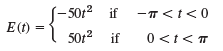
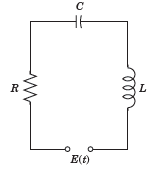
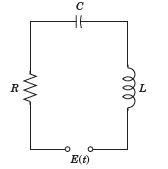
Find the steady-state current I(t) in the RLC-circuit in Fig. 275, where R = 10 Ω, L = 1 H, C = 10-1 F and with E(t) V as follows and periodic with period 2π. Graph or sketch the first four partial sums. Note that the coefficients of the solution decrease rapidly. Remember that the ODE contains
Is the given function even or odd or neither even nor odd? Find its Fourier series. Show details of your work.
Find a Fourier series from which you can conclude that
Find the Fourier series of the given function f(x), which is assumed to have the period 2π. Show the details of your work. Sketch or graph the partial sums up to that including cos 5x and sin 5x. 0
What could give you the idea to solve Prob. 11 by using the solution of Prob. 9 and formula (9) in the text? Would this work?Data from Prob. 9Find the Fourier transform of (without using Table III in Sec. 11.10). Show details. f(x) = fx if 1
What function and series do you obtain in Prob. 16 by (term wise) differentiation? Data from Prob. 16 Find the Fourier series of as given over one period and sketch and partial sums.
Find the Fourier series of the given function f(x), which is assumed to have the period 2π. Show the details of your work. Sketch or graph the partial sums up to that including cos 5x and sin 5x.
Find the steady-state current I (t) in the RLC-circuit in Fig. 275, where R = 10 Ω, L = 1 H, C = 10-1 F and with E(t) V as follows and periodic with period 2π. Graph or sketch the first four partial sums. Note that the coefficients of the solution decrease rapidly. Remember that the ODE contains
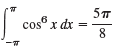
Show that the familiar identities cos3 x = 3/4 cos x + 1/4 cos 3x and sin3 x = 3/4 sin x -1/4 sin 3x can be interpreted as Fourier series expansions. Develop cos4 x.
Find the half-range expansions of f(x) = x (0 < x < 1).
Find the Fourier series of the given function f(x), which is assumed to have the period 2π. Show the details of your work. Sketch or graph the partial sums up to that including cos 5x and sin 5x.
Represent f (x) as an integral (11).
Find the Fourier series of as given over one period and sketch and partial sums.
Find the Fourier series of the given function f(x), which is assumed to have the period 2π. Show the details of your work. Sketch or graph the partial sums up to that including cos 5x and sin 5x.
Represent f (x) as an integral (11).
(a) Write a program for obtaining partial sums of a Fourier series (5).(b) Apply the program to Probs. 8–11, graphing the first few partial sums of each of the four series on common axes. Choose the first five or more partial sums until they approximate the given function reasonably well. Compare
Solve, y" + ω2y = r(t), where |ω| ≠ 0, 1, 2, · · ·, r(t) is 2π-periodic and
Find the Fourier series of the given function f(x), which is assumed to have the period 2π. Show the details of your work. Sketch or graph the partial sums up to that including cos 5x and sin 5x.
Find the transform (the frequency spectrum) of a general signal of two values [f1 f2]T.
Solve, y" + ω2y = r(t), where |ω| ≠ 0, 1, 2, · · ·, r(t) is 2π-periodic and
Recreate the given signal in Prob. 21 from the frequency spectrum obtained.Data from Prob. 21Find the transform (the frequency spectrum) of a general signal of two values [f1 f2]T.
Find (a) The Fourier cosine series(b) The Fourier sine series. Sketch f(x) and its two periodic extensions. Show the details. 4
Compute the minimum square error for f(x) = x/π (-π < x < π) and trigonometric polynomials of degree N = 1, · · ·, 5.
Verify the last statement in Theorem 2 for the discontinuities of f(x) in Prob. 21. Data from Prob. 21 Find the Fourier series of the given function f(x), which is assumed to have the period 2π. Show the details of your work. Sketch or graph the partial sums up to that including cos 5x and sin 5x.
Show that for a signal of eight sample values, w = e-i/4 = (1 - i)/√2. Check by squaring.
Find(a) The Fourier cosine series(b) The Fourier sine series. Sketch f(x) and its two periodic extensions. Show the details.
Same task as in Prob. 23, for f(x) = |x| /π (-π < x π). Why is E* now much smaller (by a factor 100, approximately!)?Data from Prob. 23Compute the minimum square error for f(x) = x/π (-π < x < π) and trigonometric polynomials of degree N = 1, · · ·, 5.
Showing 1100 - 1200
of 3937
First
5
6
7
8
9
10
11
12
13
14
15
16
17
18
19
Last
Step by Step Answers

 Get 50% OFF
Claim Now
Get 50% OFF
Claim Now