New Semester
Started
Get
50% OFF
Study Help!
--h --m --s
Claim Now
Question Answers
Textbooks
Find textbooks, questions and answers
Oops, something went wrong!
Change your search query and then try again
S
Books
FREE
Study Help
Expert Questions
Accounting
General Management
Mathematics
Finance
Organizational Behaviour
Law
Physics
Operating System
Management Leadership
Sociology
Programming
Marketing
Database
Computer Network
Economics
Textbooks Solutions
Accounting
Managerial Accounting
Management Leadership
Cost Accounting
Statistics
Business Law
Corporate Finance
Finance
Economics
Auditing
Tutors
Online Tutors
Find a Tutor
Hire a Tutor
Become a Tutor
AI Tutor
AI Study Planner
NEW
Sell Books
Search
Search
Sign In
Register
study help
mathematics
advanced engineering mathematics
Advanced Engineering Mathematics 10th edition Erwin Kreyszig - Solutions
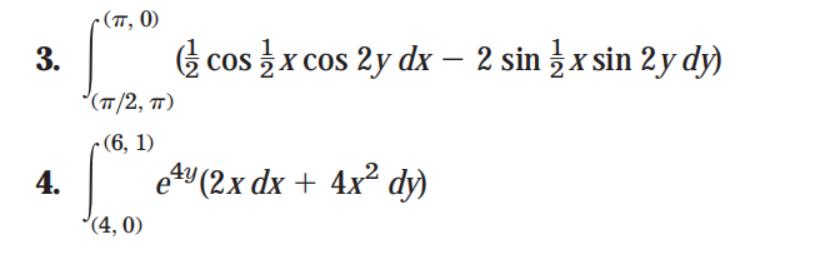
Show that the form under the integral sign is exact in the plane (Probs. 3–4) or in space (Probs. 5–9) and evaluate the integral. Show the details of your work.
Evaluate ∫C F(r) • dr counterclockwise around the boundary C of the region R by Green’s theorem, whereF = [x2ey, y2ex], R the rectangle with vertices (0, 0), (2, 0), (2, 3), (0, 3)
Find the total mass of a mass distribution of density σ in a region T in space.σ = xyz, T the box 0 ≤ x ≤ α, 0 ≤ y ≤ b, 0 ≤ z ≤ c
What is path independence of a line integral? What is its physical meaning and importance?
What is path independence of a line integral? What is its physical meaning and importance?
Find the total mass of a mass distribution of density σ in a region T in space.σ = x2 + y2 + z2, T the box |x| ≤ 4, |y| ≤ 1, 0 ≤ z ≤ 2
State from memory how to evaluate a line integral. A surface integral.
Familiarize yourself with parametric representations of important surfaces by deriving a representation (1), by finding the parameter curves (curves u = const and v = const) of the surface and a normal vector N = ru x rv of the surface. Show the details of your work.xy-plane r(u, v) = (u,
Write a short report (1–2 pages) with examples on line integrals as generalizations of definite integrals. The latter give the area under a curve. Explain the corresponding geometric interpretation of a line integral.
Evaluate the integral for the given data. Describe the kind of surface. Show the details of your work.F = [-x2, y2, 0], S: r = [u, v, 3u - 2v], 0 ≤ u ≤ 1.5, -2 ≤ v ≤ 2
Make a list of the main ideas and facts on path independence and dependence in this section. Then work this list into a report. Explain the definitions and the practical usefulness of the theorems, with illustrative examples of your own. No proofs.
Evaluate the surface integral ∫s∫ (curl F) • n dA directly for the given F and S.F = [z2, -x2, 0], S the rectangle with vertices (0, 0, 0), (1, 0, 0), (0, 4, 4), (1, 4, 4)
Evaluate ∫C F(r) • dr counterclockwise around the boundary C of the region R by Green’s theorem, whereF = [ y, -x], C the circle x2 + y2 = 1/4
Obtain κ and τ in Prob. 52 from (22*) and (23***) and the original representation in Prob. 54 with parameter t. Data from Prob. 52 Show that the helix [α cos t, α sin t, ct] can be represented by [α cos (s/K), α sin (s/K), cs/K], where K = √α2 + c2 and s is the arc length. Show that it has
Find the torsion of C: r(t) = [t, t2, t3], which looks similar to the curve in Fig. 212.
Using (22*), show that for a curve y = f(x),
Show that a circle of radius α has curvature 1/α.
Find the speed of an artificial Earth satellite traveling at an altitude of 80 miles above Earth’s surface, where g = 31 ft/sec2. (The radius of the Earth is 3960 miles.)
Find the acceleration of the Earth toward the sun from (19) and the fact that Earth revolves about the sun in a nearly circular orbit with an almost constant speed of 30 km/s.
The use of a CAS may greatly facilitate the investigation of more complicated paths, as they occur in gear transmissions and other constructions. To grasp the idea, using a CAS, graph the path and find velocity, speed, and tangential and normal acceleration.r(t) = [cos t, sin 2t, cos 2t]
Find the component of a in the direction of b. Make a sketch.When will the component (the projection) of a in the direction of b be equal to the component (the projection) of b in the direction of a? First guess.
Let f = xy - yz, v = [2y, 2z, 4x + z], and w = [3z2, x2 - y2, y2]. FindDwf at P: (3, 0, 2)
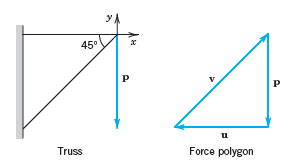
Find the forces in the system of two rods (truss) in the figure, where |p| = 1000 nt. Forces in equilibrium form a polygon, the force polygon.
Find the component of a in the direction of b. Make a sketch.a = [3, 4, 0], b = [4, -3, 2]
Let f = xy - yz, v = [2y, 2z, 4x + z], and w = [3z2, x2 - y2, y2]. Findgrad (div w)
Find the component of a in the direction of b. Make a sketch.a = [1, 1, 1], b = [2, 1, 3]
Orthogonality is particularly important, mainly because of orthogonal coordinates, such as Cartesian coordinates, whose natural basis consists of three orthogonal unit vectors.When will the diagonals be orthogonal? Give a proof.
Let f = xy - yz, v = [2y, 2z, 4x + z], and w = [3z2, x2 - y2, y2]. Finddiv (grad f), ∇2f, ∇2(xyf)
Summarize the most important applications we have discussed in this section and give a few simple examples. No proofs.
Same question as in Prob. 32 if |p| = 9, |q| = 6, |u| = 3.Data from Prob. 32If |p| = 6 and |q| = 4, what can you say about the magnitude and direction of the resultant? Can you think of an application to robotics?
Orthogonality is particularly important, mainly because of orthogonal coordinates, such as Cartesian coordinates, whose natural basis consists of three orthogonal unit vectors.Find all unit vectors a = [α1, α2] in the plane orthogonal to [4, 3].
Let f = xy - yz, v = [2y, 2z, 4x + z], and w = [3z2, x2 - y2, y2]. Finddiv v, div w
Find the volume if the vertices are (1, 1, 1), (5, -7, 3), (7, 4, 8), and (10, 7, 4).
Show that Eq. (10) implies ℓ = ∫bα √1 + y'2 dx for the length of a plane curve C: y = f(x), z = 0, and α = x = b.
Find the volume if the edge vectors are i + j, -2i + 2k, and -2i - 3k. Make a sketch.
For what k is the resultant of [2, 0, -7], [1, 2, -3], and [0, 3, k] parallel to the xy-plane?
Orthogonality is particularly important, mainly because of orthogonal coordinates, such as Cartesian coordinates, whose natural basis consists of three orthogonal unit vectors.For what values of α1 are [α1, 4, 3] and [3, -2, 12] orthogonal?
Find the volume if the vertices are (0, 0, 0), (3, 1, 2), (2, 4, 0), (5, 4, 0).
Find the plane through (1, 3, 4), (1, -2, 6), and (4, 0, 7).
Find the length and sketch the curve.r(t) = [α cos t, α sin t] from (α, 0) to (0, α)
Find all v such that the resultant of v, p, q, u with p, q, u as in Prob. 21 is parallel to the xy-plane.Data from Prob. 21Find the resultant in terms of components and its magnitude.p = [2, 3, 0], q = [0, 6, 1], u = [2, 0, -4]
Let a = [1, 1, 0], b = [3, 2, 1], and c = [1, 0, 2]. Find the angle between:Find the angles if the vertices are (0, 0), (6, 0), (8, 3), and (2, 3).
A force p = [4, 2, 0] is acting in a line through (2, 3, 0). Find its moment vector about the center (5, 1, 0) of a wheel.
Find the area if the vertices are (0, 0, 1), (2, 0, 5), and (2, 3, 4).
Find the length and sketch the curve.catenary r(t) = [t, cosh t] from t = 0 to t = 1.
What does it mean if |∇f(P)| > |∇f(Q)|at two points P and Q in a scalar field?
Find p such that u, v, w in Prob. 23 and p are in equilibrium.Data from Prob. 23u = [8, -1, 0], v = [1/2, 0, 4/3], w = [-17/2 , 1, 11/3]
Let a = [1, 1, 0], b = [3, 2, 1], and c = [1, 0, 2]. Find the angle between:cos (α - β) = cosα cos β + sin α sin β. Obtain this by using a = [cos α, sin α], b = [cos β, sin β] where 0 ≤ α ≤ β ≤ 2π.
Find the component of v = [4, 7, 0] in the direction of w = [2, 2, 0]. Sketch it.
Find the area if the vertices are (4, 2, 0), (10, 4, 0), (5, 4, 0), and (11, 6, 0). Make a sketch.
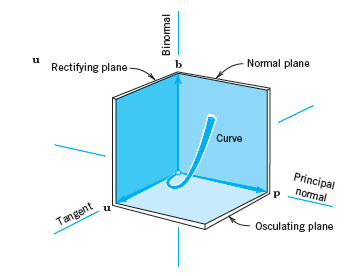
Given a curve C: r(t), find a tangent vector r'(t), a unit tangent vector u'(t), and the tangent of C at P. Sketch curve and tangent.r(t) = [t, 1/t, 0], P: (2, 1/2, 0)
Experiments show that in a temperature field, heat flows in the direction of maximum decrease of temperature T. Find this direction in general and at the given point P. Sketch that direction at P as an arrow.Graph some curves of constant temperature (“isotherms”) and indicate directions of heat
Find the work done by q = [5, 2, 0] in the displacement from (1, 1, 0) to (4, 3, 0).
Find the moment vector m and m of p = [2, 3, 0] about Q: (2, 1, 0) acting on a line through A: (0, 3, 0). Make a sketch.
Given a curve C: r(t), find a tangent vector r'(t), a unit tangent vector u'(t), and the tangent of C at P. Sketch curve and tangent.r(t) = [10 cos t, 1, 10 sin t], P: (6, 1, 8)
Summarize the essential ideas and facts and give examples of your own.
Experiments show that in a temperature field, heat flows in the direction of maximum decrease of temperature T. Find this direction in general and at the given point P. Sketch that direction at P as an arrow.T = z/(x2 + y2), P: (0, 1, 2)
Given the velocity potential of a flow, find the velocity v = ∇f of the field and its value v(P) at P. Sketch v(P) and the curve f = const passing through P.At what points is the flow in Prob. 21 horizontal?Data from Prob. 21Given the velocity potential of a flow, find the velocity v = ∇f of
Find the resultant in terms of components and its magnitude.u = [8, -1, 0], v = [1/2, 0, 4/3], w = [-17/2 , 1, 11/3]
Find the angle between a and c. Between b and d. Sketch a and c.
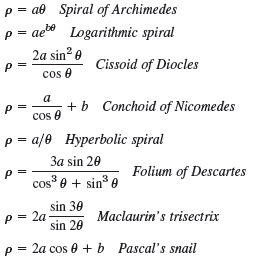
Use your CAS to graph the following curves given in polar form ρ = ρ(θ), ρ2 = x2 + y2, tan θ = y/x, and investigate their form depending on parameters α and b.
Prove (11)–(13). Give two typical examples for each formula.
Graph the following more complicated curves:(a) r(t) = [2 cos t + cos 2t, 2 sin t - sin 2t] (Steiner’s hypocycloid).(b) r (t) = [cos t + k cos 2t, sin t - k sin 2t] with k = 10, 2, 1, 1/2, 0, -1/2, -1.(c) r(t) = [cos t, sin 5t] (a Lissajous curve).(d) r(t) = [cos t, sin
Given the velocity potential of a flow, find the velocity v = ∇f of the field and its value v(P) at P. Sketch v(P) and the curve f = const passing through P.f = ex cos y, P: (1, 1/2π)
Explain why setting t = -t* reverses the orientation of [α cos t, α sin t, 0].
Find the resultant in terms of components and its magnitude.p = [2, 3, 0], q = [0, 6, 1], u = [2, 0, -4]
Find the work done by a force p acting on a body if the body is displaced along the straight segment A̅B̅ from A to B. Sketch A̅B̅ and p. Show the details.Is the work done by the resultant of two forces in a displacement the sum of the work done by each of the forces separately? Give proof or
Find u such that u and a, b, c, d above and u are in equilibrium.
Plot by arrows:(a) v = [x, x2] (b) v = [1/y, 1/x](c) v = [cos x, sin x] (d) v = e-(x2+y2) [x, -y]
Given the velocity potential of a flow, find the velocity v = ∇f of the field and its value v(P) at P. Sketch v(P) and the curve f = const passing through P.f = cos x cosh y, P: (1/2π, ln 2)
What laws do Probs. 12–16 illustrate?Data from Prob. 12(a + b) + c, a + (b + c)Data from Prob. 13b + c, c + bData from Prob. 143c - 6d, 3(c - 2d)Data from Prob. 157(c - b), 7c - 7bData from Prob. 169/2 a - 3c, 9 (1/2 a - 1/3 c)
Find a parametric representationHyperbola 4x2 - 3y2 = 4, z = -2.
Calculate ∇2f by Eq. (3). Check by direct differentiation. Indicate when (3) is simpler. Show the details of your work.f = 1/(x2 + y2 + z2)
Let a = [4, 7, 0], b = [3, -1, 5], c = [-6, 2, 0], and d = [1, -2, 8]. Calculate the following expressions. Try to make a sketch.a × b - b × a, (a × c) • c, |a × b|
With respect to right-handed Cartesian coordinates, let a = [2, 1, 0], b = [-3, 2, 0] c = [1, 4, -2], and d = [5, -1, 3]. Showing details, find:(i j k), (i k j)
With respect to right-handed coordinates, let u = [y, z, x], v = [yz, zx, xy], f = xyz, and g = x + y + z. Find the given expressions. Check your result by a formula in Proj. 14 if applicable.curl (gu + v), curl (gu)
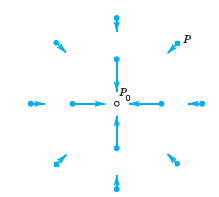
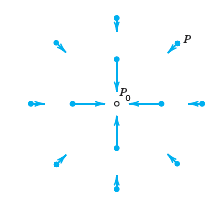
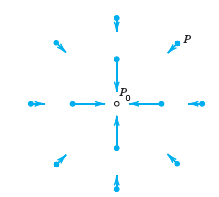
Sketch figures similar to Fig. 198. Try to interpret the field of v as a velocity field. v = xi - yj
Same question as in Prob. 16 when f = 25x2 + 4y2.Data from Prob. 16For what points P: (x, y, z) does ∇f with f = 25x2 + 9y2 + 16z2 have the direction from P to the origin?
Let a = [3, 2, 0] = 3i + 2j; b = [-4, 6, 0] = 4i + 6j, c = [5, -1, 8] = 5i - j + 8k, d = [0, 0, 4] = 4k.Find:(7 - 3) a, 7a - 3a
Find a parametric representationCircle 1/2x2 + y2 = 1, z = y.
Find the work done by a force p acting on a body if the body is displaced along the straight segment A̅B̅ from A to B. Sketch A̅B̅ and p. Show the details.p = [2, 5, 0], A: (1, 3, 3), B: (3, 5, 5)
Calculate ∇2f by Eq. (3). Check by direct differentiation. Indicate when (3) is simpler. Show the details of your work.f = ln (x2 + y2)
Let a = [4, 7, 0], b = [3, -1, 5], c = [-6, 2, 0], and d = [1, -2, 8]. Calculate the following expressions. Try to make a sketch.(a b d), (b a d), (b d a)
With respect to right-handed Cartesian coordinates, let a = [2, 1, 0], b = [-3, 2, 0] c = [1, 4, -2], and d = [5, -1, 3]. Showing details, find:(b × c) × d, b × (c × d)
With respect to right-handed coordinates, let u = [y, z, x], v = [yz, zx, xy], f = xyz, and g = x + y + z. Find the given expressions. Check your result by a formula in Proj. 14 if applicable.v • curl u, u • curl v, u • curl u
Sketch figures similar to Fig. 198. Try to interpret the field of v as a velocity field. v = xj
The force in an electrostatic field given by f(x, y, z) has the direction of the gradient. Find ∇f and its value at P.f = 4x2 + 9y2 + z2, P: (5, -1, -11)
Let a = [3, 2, 0] = 3i + 2j; b = [-4, 6, 0] = 4i + 6j, c = [5, -1, 8] = 5i - j + 8k, d = [0, 0, 4] = 4k.Find:7(c - b), 7c - 7b
Find a parametric representationStraight line y = 4x - 1, z = 5x.
Calculate ∇2f by Eq. (3). Check by direct differentiation. Indicate when (3) is simpler. Show the details of your work.f = cos2 x + sin2 y
Let a = [4, 7, 0], b = [3, -1, 5], c = [-6, 2, 0], and d = [1, -2, 8]. Calculate the following expressions. Try to make a sketch.6(a × b) × d, a × 6(b × d), 2a × 3b × d
Prove the parallelogram equality. Explain its name.
With respect to right-handed Cartesian coordinates, let a = [2, 1, 0], b = [-3, 2, 0] c = [1, 4, -2], and d = [5, -1, 3]. Showing details, find:(a + d) × (d + a)
With respect to right-handed coordinates, let u = [y, z, x], v = [yz, zx, xy], f = xyz, and g = x + y + z. Find the given expressions. Check your result by a formula in Proj. 14 if applicable.curl (u + v), curl v
Sketch figures similar to Fig. 198. Try to interpret the field of v as a velocity field. v = i + j
Verify the Cauchy–Schwarz and triangle inequalities for the above a and b.
The force in an electrostatic field given by f(x, y, z) has the direction of the gradient. Find ∇f and its value at P.f = ln (x2 + y2), P: (8, 6)
Let a = [3, 2, 0] = 3i + 2j; b = [-4, 6, 0] = 4i + 6j, c = [5, -1, 8] = 5i - j + 8k, d = [0, 0, 4] = 4k.Find:b + c, c + b
Find a parametric representationStraight line through (2, 1, 3) in the direction of i + 2j.
The velocity vector v(x, y, z) of an incompressible fluid rotating in a cylindrical vessel is of the form v = w × r, where w is the (constant) rotation vector. Show that div v = 0.
Showing 600 - 700
of 3937
1
2
3
4
5
6
7
8
9
10
11
12
13
14
15
Last
Step by Step Answers

 Get 50% OFF
Claim Now
Get 50% OFF
Claim Now