New Semester
Started
Get
50% OFF
Study Help!
--h --m --s
Claim Now
Question Answers
Textbooks
Find textbooks, questions and answers
Oops, something went wrong!
Change your search query and then try again
S
Books
FREE
Study Help
Expert Questions
Accounting
General Management
Mathematics
Finance
Organizational Behaviour
Law
Physics
Operating System
Management Leadership
Sociology
Programming
Marketing
Database
Computer Network
Economics
Textbooks Solutions
Accounting
Managerial Accounting
Management Leadership
Cost Accounting
Statistics
Business Law
Corporate Finance
Finance
Economics
Auditing
Tutors
Online Tutors
Find a Tutor
Hire a Tutor
Become a Tutor
AI Tutor
AI Study Planner
NEW
Sell Books
Search
Search
Sign In
Register
study help
mathematics
advanced engineering mathematics
Advanced Engineering Mathematics 10th edition Erwin Kreyszig - Solutions
Approximations of π = 3.14159265358979 · · · are 22/7 and 355/113. Determine the corresponding errors and relative errors to 3 significant digits.
Compare the methods in this section and problem set, discussing advantages and disadvantages in terms of examples of your own. No proofs, just motivations and ideas.
Compute π by Machin’s approximation 16 arctan (1/5) - 4 arctan (1/239) to 10S (which are correct). [In1986, D. H. Bailey (NASA Ames Research Center, Moffett Field, CA 94035) computed almost 30 million decimals of π on a CRAY-2 in less than 30 hrs. The race for more and more decimals is
Compute the integral of x3 from 0 to 1 by the trapezoidal rule with n = 5. What error bounds are obtained from (4) ? What is the actual error of the result?
Solve Prob. 32 by Gauss integration with n = 3 and n = 5.Data from Prob. 32Compute the integral of x3 from 0 to 1 by the trapezoidal rule with n = 5. What error bounds are obtained from (4) ? What is the actual error of the result?
Compute f"(0.2) for f(x) = x3(a) h = 0.2(b) h = 0.1.
Show the factorization and solve by Doolittle’s method. 4x1 + 5x2 = 1412x1 + 14x2 = 36
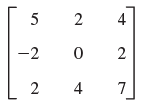
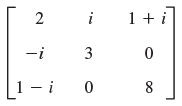
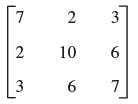
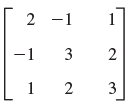
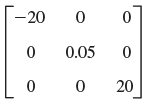
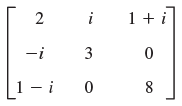
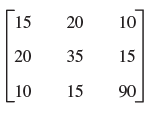
Find and sketch disks or intervals that contain the eigenvalues. If you have a CAS, find the spectrum and compare.
Compute the norms (5), (6), (7). Compute a corresponding unit vector (vector of norm 1) with respect to the l∞-norm.[1 -3 8 0 -6 0]
Apply the power method without scaling (3 steps), using x0 = [1, 1]T or [1 1 1]T. Give Rayleigh quotients and error bounds. Show the details of your work.
Fit a straight line to the given points (x, y) by least squares. Show the details. Check your result by sketching the points and the line. Judge the goodness of fit.(0, 2), (2, 0), (3, -2), (5, -3)
Solve graphically and explain geometrically. x1 - 4x2 = 20.13x1 + 5x2 = 5.9
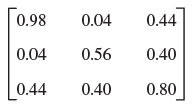
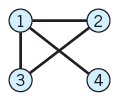
Tridiagonalize. Show the details.
Show the factorization and solve by Doolittle’s method.2x1 + 9x2 = 823x1 - 5x2 = -62
When would you apply Gauss elimination and when Gauss–Seidel iteration?
Show the factorization and solve by Doolittle’s method. 5x1 + 4x2 + x3 = 6.810x1 + 9x2 + 4x3 = 17.610x1 + 13x2 + 15x3 = 38.4
Find and sketch disks or intervals that contain the eigenvalues. If you have a CAS, find the spectrum and compare.
What is pivoting? Why and how is it done?
Compute the norms (5), (6), (7). Compute a corresponding unit vector (vector of norm 1) with respect to the l∞-norm.[0.2 0.6 -2.1 3.0]
Apply the power method without scaling (3 steps), using x0 = [1, 1]T or [1 1 1]T. Give Rayleigh quotients and error bounds. Show the details of your work.
Fit a straight line to the given points (x, y) by least squares. Show the details. Check your result by sketching the points and the line. Judge the goodness of fit.(0, 1.8), (1, 1.6), (2, 1.1), (3, 1.5), (4, 2.3)
Solve graphically and explain geometrically. 7.2x1 - 3.5x2 = 16.0-14.4x1 + 7.0x2 = 31.0
Show the factorization and solve by Doolittle’s method. 2x1 + x2 + 2x3 = 0-2x1 + 2x2 + x3 = 0 x1 + 2x2 - 2x3 = 18
What happens if you apply Gauss elimination to a system that has no solutions?
Compute the norms (5), (6), (7). Compute a corresponding unit vector (vector of norm 1) with respect to the l∞-norm.[k2, 4k, k3], k > 4
Show the factorization and solve by Doolittle’s method. 3x1 + 9x2 + 6x3 = 4.618x1 + 48x2 + 39x3 = 27.2 9x1 - 27x2 + 42x3 = 9.0
Find and sketch disks or intervals that contain the eigenvalues. If you have a CAS, find the spectrum and compare.
What is Cholesky’s method? When would you apply it?
Compute the norms (5), (6), (7). Compute a corresponding unit vector (vector of norm 1) with respect to the l∞-norm.[1 1 1 1 1]
Apply the power method (3 steps) with scaling, using x0 = [1 1 1]T or [1 1 1 1]T, as applicable. Give Rayleigh quotients and error bounds. Show the details of your work. The matrix in Prob. 3 Data from Prob. 3 Apply the power method without scaling (3 steps), using x0 =
Do 5 steps, starting from x0 = [1 1 1]T and using 6S in the computation. Make sure that you solve each equation for the variable that has the largest coefficient (why?). Show the details.10x1 + x2 + x3 = 6 x1 + 10x2 +
Fit a straight line to the given points (x, y) by least squares. Show the details. Check your result by sketching the points and the line. Judge the goodness of fit.Estimate the average speed vav of a car traveling according to s = v • t [km] (s = distance traveled, t [hr] = time) from (t,
Solve the following linear systems by Gauss elimination, with partial pivoting if necessary (but without scaling). Show the intermediate steps. Check the result by substitution. If no solution or more than one solution exists, give a reason.2x1 - 8x2 = -43x1 + x2 = 7
What do you know about the convergence of the Gauss–Seidel iteration?
Show the factorization and solve. 9x1 + 6x2 + 12x3 = 17.4 6x1 + 13x2 + 11x3 = 23.612x1 + 11x2 + 26x3 = 30.8
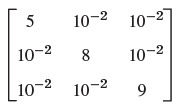
In Prob. 2, find T-T AT such that the radius of the Gerschgorin circle with center 5 is reduced by a factor 1/100. Data from Prob. 2 Find and sketch disks or intervals that contain the eigenvalues. If you have a CAS, find the spectrum and compare.
What is ill-conditioning? What is the condition number and its significance?
Apply the power method (3 steps) with scaling, using x0 = [1 1 1]T or [1 1 1 1]T, as applicable. Give Rayleigh quotients and error bounds. Show the details of your work.
Do 5 steps, starting from x0 = [1 1 1]T and using 6S in the computation. Make sure that you solve each equation for the variable that has the largest coefficient (why?). Show the details. 5x1 - 2x2 = 18-2x1
Solve the following linear systems by Gauss elimination, with partial pivoting if necessary (but without scaling). Show the intermediate steps. Check the result by substitution. If no solution or more than one solution exists, give a reason.-3x1 + 6x2 - 9x3 = -46.725 x1 - 4x2 +
Do three QR-steps to find approximations of the eigenvalues of: The matrix in the answer to Prob. 3 Data from Prob. 3 Tridiagonalize. Show the details.
Show the factorization and solve.4x1 + 6x2 + 8x3 = 06x1 + 34x2 + 52x3 = -1608x1 + 52x2 + 129x3 = -452
Explain the idea of least squares approximation.
Show the factorization and solve.0.01x1 + 0.03x3 = 0.14 0.16x2 + 0.08x3 = 0.160.03x1 + 0.08x2 + 0.14x3 = 0.54
If a symmetric n × n matrix A = [αjk] has been diagonalized except for small off-diagonal entries of size 10-5, what can you say about the eigenvalues?
What are eigenvalues of a matrix? Why are they important? Give typical examples.
Compute the matrix norm and the condition number corresponding to the l1-vector norm.
Prove that if x is an eigenvector, then δ = 0 in (2). Give two examples.
Do 5 steps, starting from x0 = [1 1 1]T and using 6S in the computation. Make sure that you solve each equation for the variable that has the largest coefficient (why?). Show the details.5x1 + x2 + 2x3 = 19 x1 + 4x2 - 2x3 = -22x1 + 3x2 + 8x3
Fit a parabola (7) to the points (x, y). Check by sketching.(2, -3), (3, 0), (5, 1), (6, 0) (7, -2)
Solve the following linear systems by Gauss elimination, with partial pivoting if necessary (but without scaling). Show the intermediate steps. Check the result by substitution. If no solution or more than one solution exists, give a reason. 6x2 + 13x3 =
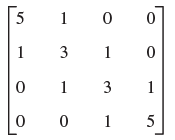
Do three QR-steps to find approximations of the eigenvalues of:
Show the factorization and solve.4x1 + 2x3 = 1.5 4x2 + x3 = 4.02x1 + x2 + 2x3 = 2.5
How did we use similarity transformations of matrices in designing numeric methods?
Try to find out experimentally on what properties of a matrix the speed of decrease of off-diagonal entries in the QR-method depends. For this purpose write a program that first tridiagonalizes and then does QR-steps. Try the program out on the matrices in Probs. 1, 3, and 4. Summarize your
Show the factorization and solve. x1 - x2 + 3x3 + 2x4 = 15-x1 + 5x2 - 5x3 - 2x4 = -353x1 - 5x2 + 19x3 + 3x4 = 942x1 - 2x2 + 3x3 + 21x4 = 1
What is the power method for eigenvalues? What are its advantages and disadvantages?
Compute the matrix norm and the condition number corresponding to the l1-vector norm.
In Prob. 3 set B = A - 3I (as perhaps suggested by the diagonal entries) and see whether you may get a sequence of q’s converging to an eigenvalue of A that is smallest (not largest) in absolute value. Use x0 = [1 1 1]T. Do 8 steps. Verify that A has the spectrum {0, 3, 5}. Data from
Apply the Gauss–Seidel iteration (3 steps) to the system in Prob. 5, starting from (a) 0, 0, 0(b) 10, 1,0 10.Compare and comment.Data from Prob. 5Do 5 steps, starting from x0 = [1 1 1]T and using 6S in the computation. Make sure that you solve each equation for the
Fit a parabola (7) to the points (x, y). Check by sketching.The data in Prob. 3. Plot the points, the line, and the parabola jointly. Compare and comment.Data from Prob. 3Fit a straight line to the given points (x, y) by least squares. Show the details. Check your result by sketching the points and
Solve the following linear systems by Gauss elimination, with partial pivoting if necessary (but without scaling). Show the intermediate steps. Check the result by substitution. If no solution or more than one solution exists, give a reason.3.4x1 - 6.12x2 - 2.72x3 = 0 -x1 +
Show the factorization and solve.4x1 + 2x2 + 4x3 = 202x1 + 2x2 + 3x3 + 2x4 = 364x1 + 3x2 + 6x3 + 3x4 = 602x2 + 3x3 + 9x4 = 122
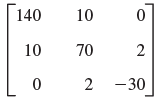
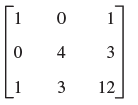
Use (4) to obtain an upper bound for the spectral radius: In Prob. 4 Data from Prob. 4 Find and sketch disks or intervals that contain the eigenvalues. If you have a CAS, find the spectrum and compare.
Derive the formula for the normal equations of a cubic least squares parabola.
Let A, B be n × n and positive definite. Are -A, AT, A + B, A - B positive definite?
What is tridiagonalization and QR? When would you apply it?
Use (4) to obtain an upper bound for the spectral radius: In Prob. 1 Data from Prob. 1 Find and sketch disks or intervals that contain the eigenvalues. If you have a CAS, find the spectrum and compare.
Compute the matrix norm and the condition number corresponding to the l1-vector norm.
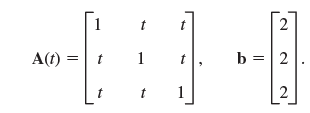
(a) Write a program for Gauss–Seidel iteration. (b) Apply the program A(t)x = b, to starting from [0 0 0]T, where For t = 0.2, 0.5, 0.8, 0.9 determine the number of steps to obtain the exact solution to 6S and the corresponding spectral radius of C. Graph the number of steps and the
Fit curves (2) and (7) and a cubic parabola by least squares to (x, y) = (-2, -30), (-1, -4), (0, 4), (1, 4), (2, 22), (3, 68). Graph these curves and the points on common axes. Comment on the goodness of fit.
Solve the following linear systems by Gauss elimination, with partial pivoting if necessary (but without scaling). Show the intermediate steps. Check the result by substitution. If no solution or more than one solution exists, give a reason. 3x2 + 5x3 =
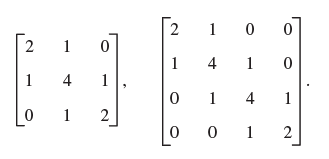
(a) Write a program for solving linear systems by Cholesky’s method and apply it to Example 2 in the text, to Probs. 7–9, and to systems of your choice. (b) Apply the factorization part of the program to the following matrices (as they occur in (9), (with cj = 1), in connection with
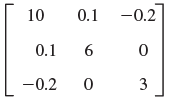
Use (4) to obtain an upper bound for the spectral radius:In Prob. 6Data from Prob. 6Find and sketch disks or intervals that contain the eigenvalues. If you have a CAS, find the spectrum and compare. 10 0.1 -0.2 0.1 6 0 -0.2 0 3
Find the inverse by the Gauss–Jordan method, showing the details.In Prob. 1Data from Prob. 1Show the factorization and solve by Doolittle’s method. 4x1 + 5x2 = 1412x1 + 14x2 = 36
Use (4) to obtain an upper bound for the spectral radius: In Prob. 3 Data from Prob. 3 Find and sketch disks or intervals that contain the eigenvalues. If you have a CAS, find the spectrum and compare.
Compute the matrix norm and the condition number corresponding to the l1-vector norm.
Do 5 steps, starting from x0 = [1 1 1]. Compare with the Gauss–Seidel iteration. Which of the two seems to converge faster? Show the details of your work.The system in Prob. 9Data from Prob. 9Do 5 steps, starting from x0 = [1 1 1]T and using 6S
Solve the following linear systems by Gauss elimination, with partial pivoting if necessary (but without scaling). Show the intermediate steps. Check the result by substitution. If no solution or more than one solution exists, give a reason. 2.2x2 +
For the given data and for data of your choice find the interpolation polynomial and the least squares approximations (linear, quadratic, etc.). Compare and comment.(a) (-2, 0), (-1, 0), (0, 1), (1, 0), (2, 0)(b) (-4, 0), (-3, 0), (-2, 0), (-1, 0), (0, 1), (1, 0), (2, 0), (3, 0), (4, 0)(c) Choose
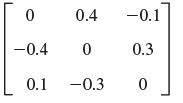
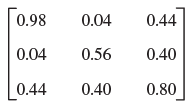
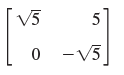
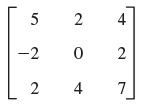
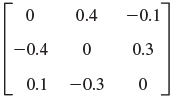
Verify that the matrix in Prob. 5 is normal. Data from Prob. 5 Find and sketch disks or intervals that contain the eigenvalues. If you have a CAS, find the spectrum and compare.
Verify (11) for x = [3 15 -4]T taken with the l∞-norm and the matrix in Prob. 13. Data from Prob. 13 Compute the matrix norm and the condition number corresponding to the l1-vector norm.
Write a program for the Gauss elimination with pivoting. Apply it to Probs. 13–16. Experiment with systems whose coefficient determinant is small in absolute value. Also investigate the performance of your program for larger systems of your choice, including sparse systems.Data from Prob. 13Solve
Do 5 steps, starting from x0 = [1 1 1]. Compare with the Gauss–Seidel iteration. Which of the two seems to converge faster? Show the details of your work.Show convergence in Prob. 16 by verifying that I - A,where A is the matrix in Prob. 16 with the rows divided by the
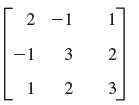
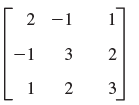
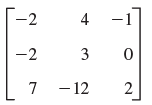
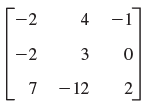
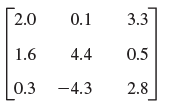
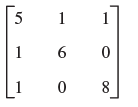
Compute the inverse of:
Find the inverse by the Gauss–Jordan method, showing the details.In Prob. 12Data from Prob. 12Show the factorization and solve.4x1 + 2x2 + 4x3 = 202x1 + 2x2 + 3x3 + 2x4 = 364x1 + 3x2 + 6x3 + 3x4 = 602x2
Compute the inverse of:
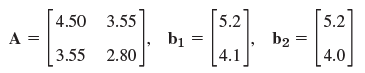
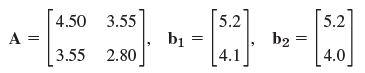
Solve Ax = b1, Ax = b2. Compare the solutions and comment. Compute the condition number of A.
Compute the norms (9), (10), (11) for the following (square) matrices. Comment on the reasons for greater or smaller differences among the three numbers.The matrix in Prob. 5Data from Prob. 5Do 5 steps, starting from x0 = [1 1 1]T and using 6S in the computation. Make sure
Compute the inverse of:
Do 3 steps without scaling, starting from [1 1 1]T.4x1 - x2 = 22.0 4x2 - x3 = 13.4-x1 + 4x3 = -2.4
For Ax = b1 in Prob. 19 guess what the residual of x∼ = [-10.0 14.1]T, very poorly approximating [-2 4]T, might be. Then calculate and comment. Data from Prob. 19 Solve Ax = b1, Ax = b2. Compare the solutions and comment. Compute the condition number of A.
Do 3 steps without scaling, starting from [1 1 1]T.10x1 + x2 - x3 = 17 2x1 + 20x2 + x3 = 28 3x1 - x2 + 25x3 = 105
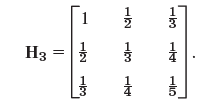
The 3 × 3 Hilbert matrix is The n × n Hilbert matrix is Hn = [hjk], where hjk = 1/(j + k - 1). (Similar matrices occur in curve fitting by least squares.) Compute the condition number κ(Hn) for the matrix norm corresponding to the l∞ - (or l1-) vector norm, for n = 2, 3, · · ·, 6 (or
Make a list of the most important of the many ideas covered in this section and write a two page report on them.
Compute the l1-, l2-, and l∞-norms of the vectors.[8 -21 13 0]T
Maximize or minimize the given objective function f subject to the given constraints.Maximize f = 30x1 + 10x2 in the region in Prob. 5.Data from Prob. 5Describe and graph the regions in the first quadrant of the x1x2-plane determined by the given inequalities. -x1 + x2 ≥
Explain how the following can be regarded as a graph or a digraph: a family tree, air connections between given cities, trade relations between countries, a tennis tournament, and memberships of some persons in some committees.
If you answer is yes, find S and T: (1) 3 (2) 4)
Guess how much less the probability in Prob. 10 would be if the sign consisted of 100 bulbs. Then calculate.Data from Prob. 10Let p = 2% be the probability that a certain type of light bulb will fail in a 24-hour test. Find the probability that a sign consisting of 15 such bulbs will burn 24 hours
Showing 1500 - 1600
of 3937
First
9
10
11
12
13
14
15
16
17
18
19
20
21
22
23
Last
Step by Step Answers

 Get 50% OFF
Claim Now
Get 50% OFF
Claim Now